
City Budgets and Revenues
In studying cities and their social processes an elemental question helps us to describe and understand how and why they look and act the way they do. Where do they get their money, and where do they spend it? The city's various social, spatial, and economic structures both create and facilitate nongovernmental economic activity, but its budget represents an actual cash outlay. Prior to the Depression, local property taxes were the most visible form of taxation. The relatively short psychological distance from its major source of revenue, individual property owners, made a city's budget
a sensitive sociopolitical barometer. Because budgeting decisions were, and to a lesser extent still are, an annual political event and tax collection is either annual or semiannual, the city's revenues and expenditures are almost always in the public eye.[1] The complex political process that determines the final budget may not be of any interest to taxpayers, but the outcome is. Political careers may rise and fall on the budget's revenues and expenditures, for it represents a fairly concrete and highly visible outcome of a governmental process.
In an important but skewed sense, the city budget may be taken as an operational definition of the city's priorities. Every year the city budget shows what resources most deserve funding. The skew in the definition of priorities by budget alone comes from noncash subsidies—those created by regulation of locational choices, by city-granted monopolies, and by the basic urban economies of scale and agglomeration. Most visible in the colonial cities, these indirect aspects of the city fisc resulted from economic opportunities granted by the city to private entrepreneurs or property owners. And in return for the granting of a franchise, some entrepreneurs might have taken over a specific city service—maintaining a street, for instance. Some economists would argue that in addition to these factors, governmental spending occurs in those sectors where the free rider problem inhibits capital investment. Schooling, public safety, and streets cannot easily be financed and operated by tolls on the users, for their real benefits extend to the whole society. For the actual users to support these services by fees would burden them unfairly, so governmental expenditures solve the free rider problem by distributing the costs over the whole population. Therefore, taking the budget as a reflection of priorities works only in a very narrow sense, for it actually represents priorities that are exercised either inefficiently or not at all by private initiative. The budget is, therefore, at the minimum, a definition of what may be considered the city's public goods, those activities that benefit all.[2]
Almost seventy years ago, Joseph Schumpeter argued that the budget and the process that created it would provide future scholars a central focus for social and political analysis. Perhaps because of the budget's complexity, perhaps because other topics in social science proved more tantalizing or perhaps because the budget is in fact such an imperfect and skewed point of entry, it is only recently
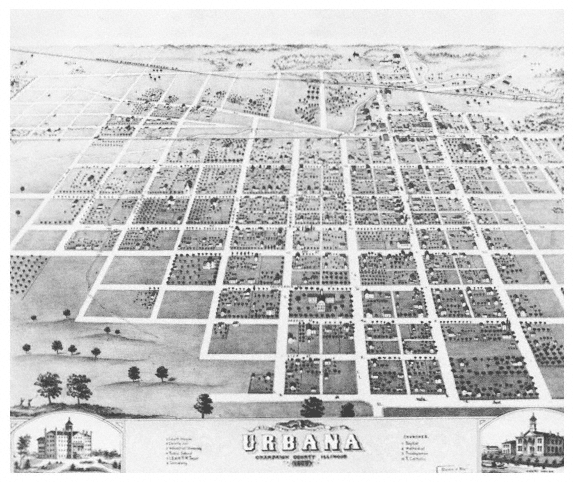
Urbana, Illinois, 1896.
A small Midwestern city: note the empty lots and platted streets determining
speculative value and shaping the city investment directions. Unlike Sumner,
Kansas, Urbana was not pure speculative smoke, and it prospered.
Source: Geography and Map Division, Library of Congress.
that historians and social scientists have begun to attend to Schumpeter's argument.[3]
American city revenues derive from a mix of taxes (usually on real property), license and user fees, fines, and occasionally sales of real property. Property taxes dominated this income mix until the early twentieth century, when nonlocal revenues, especially from the federal government, begin to form a portion of the city budget. Although the transition away from almost complete reliance on property taxes was gradual, it accelerated with the Depression in the 1930s. One particular aspect of the crisis, unemployment, helped trigger the conscious turn to the federal government for aid. Cities had traditionally cared for their poor, but never had the poor been so numerous. While debt load and the bank holiday may have been the underlying causes and precipitators of default, cities had borne the great brunt of welfare to the unemployed for the first three years of the Depression. By 1933 they had exhausted their resources: more important, they saw themselves as handling a national problem. Unlike debt that financed local capital expansion, welfare benefits went to all in need. In a classic problem that has plagued American cities since the colonial era, the responsibility for the welfare of urban residents fell upon city government, but by 1930, the separation of political boundary from economic region had become so obvious as to send mayors to the federal government. All other governmental entities were seen as too geographically limited to accept the responsibility for a much larger problem. The relationship to the federal government began to be perceived by urban politicians as the critical political and economic relationship.[4] Among a broad range of requests, the cities sought federal legislation to help them reorganize and refund debt to avoid default, but the modest legislation that did get enacted was overturned by the Supreme Court within three years.[5]
National figures for the proportion of all city taxes which came from property taxes do not exist, but for analysing the trend since the Depression, the combined state and local government figure stands as a reasonable substitute. Between 1932 and 1934, the property tax percentage of receipts for state and local governments fell dramatically, from 60 percent to 45 percent. Even the latter figure seemed high by the 1980s, when property tax contributed less than 20 percent of the total revenue.[6]
These figures would be considerably higher, perhaps as much as 50 percent, for municipalities alone, because the addition of state figures, which rely far less on property taxes, dilutes the real property tax base of cities. For instance, the average percentage of revenue coming from property tax for all municipalities in Illinois in 1962 was just under 45 percent, which contrasts with a nationwide state and local average of 32 percent. The range of contribution of real property tax in Illinois municipalities in 1962 was also quite broad, some cities taking as much as 62 percent of their revenue from property taxes, others as little as 28 percent. Chicago itself struck the mean at 43 percent. Thus, while the trend away from reliance upon property tax revenues is clear, its absolute level depends on the unit of government examined and varies from city to city.[7]
One might expect that increased revenues from the federal government have accounted for this relative decline in the importance of property tax, particularly after the New Deal's shift in power from the local to the federal level. Although this does not in itself account entirely for the move away from complete reliance on property tax, there has been a dramatic increase in federal and state aid to cities. Again, the most dramatic shift came in 1932–1934, when the federal contribution moved from 2 percent to almost 20 percent, a proportion that fell back to 10 percent by the start of World War II. But the federal contribution to local government revenue has not begun to assume as large a share as property taxes once did. The two did reach parity for state and local government combined in 1975, but again, because states rely less upon property tax revenues than cities, this parity has not yet arrived at the municipal level.
In Illinois, by 1962 the contribution of property tax to the total municipal revenue had fallen to about 43 percent, but all other governmental revenues contributed only slightly more than 12 percent of municipal budgets. And the decade of the 1980s began with property tax contributing 40 percent, state and federal aid 38 percent.[8] There is a clear correlation between the decline in property tax and the rise of intergovernmental revenue, that is city revenue from state or federal government. But intergovernmental revenue does not yet constitute a net replacement.
The degree to which there is a substitution does imply a slow loss of local attention to the city budget, simply because its tie to
local and direct revenue from property taxes has been considerably loosened. If the experience of California's widely discussed "tax revolt" and its constitutional limitation of property taxes is any portent, the irony of the revolt may be an acceleration of the decrease in importance of property taxes, with a concomitant increase in nonlocal revenues and decrease in local control of local government.[9] As it stands, the twentieth century draws to a close with property tax remaining an important part of the revenue structure of cities. But, unlike a century ago, it is now only one of several important revenue sources.
In the regulatory era of city government, from the seventeenth to the early nineteenth century, expenditures went for streets, maintenance of markets, docks, and warehouses, and aid to the poor. As the service city began to take shape, city expenditures became more varied and complex. By the mid-nineteenth century, modest amounts of support began to go to fire and police, schools, transportation, water and sewers, public health, the administrative mechanism of the government itself, various forms of welfare, libraries, and occasionally public utilities. As budgets increased in complexity, they also increased in amount. An exact per capita measure may be impossible to construct, but there is no question that since at least 1840, government expenditures on the local, state, and federal levels have increased.[10] Yet, for cities, there has always been an important lid on expenditures, for their charters stipulate that city expenditures must equal revenues, and since revenues are limited by tax rates set by state governments, revenues have de facto state-imposed ceilings.