
6
Paying for the Service City
In the late twentieth century, children learn about state level taxes when they buy toys and pay sales tax. Teenagers with their first jobs discover the federal government through Social Security taxes. Ironically, the government bureaucracies closest to our daily lives—schools, police, and fire—we discover last, if at all, when we buy property. In my own case, I didn't directly pay property taxes until I bought my second house, for the finance arrangement for my first house had included the payment of taxes through the bank that held the mortgage. Of course, my landlord and my parents knew the reality of property tax, but I was well into my adult life before I paid them directly. Probably most people are more acutely aware of sales and income tax in their own daily lives than of property tax, and thus are more concerned about what happens at state legislatures and in Washington, D.C., than they are about the nearby city hall. We are perceptually farthest from that government which is closest.
City Budgets and Revenues
In studying cities and their social processes an elemental question helps us to describe and understand how and why they look and act the way they do. Where do they get their money, and where do they spend it? The city's various social, spatial, and economic structures both create and facilitate nongovernmental economic activity, but its budget represents an actual cash outlay. Prior to the Depression, local property taxes were the most visible form of taxation. The relatively short psychological distance from its major source of revenue, individual property owners, made a city's budget
a sensitive sociopolitical barometer. Because budgeting decisions were, and to a lesser extent still are, an annual political event and tax collection is either annual or semiannual, the city's revenues and expenditures are almost always in the public eye.[1] The complex political process that determines the final budget may not be of any interest to taxpayers, but the outcome is. Political careers may rise and fall on the budget's revenues and expenditures, for it represents a fairly concrete and highly visible outcome of a governmental process.
In an important but skewed sense, the city budget may be taken as an operational definition of the city's priorities. Every year the city budget shows what resources most deserve funding. The skew in the definition of priorities by budget alone comes from noncash subsidies—those created by regulation of locational choices, by city-granted monopolies, and by the basic urban economies of scale and agglomeration. Most visible in the colonial cities, these indirect aspects of the city fisc resulted from economic opportunities granted by the city to private entrepreneurs or property owners. And in return for the granting of a franchise, some entrepreneurs might have taken over a specific city service—maintaining a street, for instance. Some economists would argue that in addition to these factors, governmental spending occurs in those sectors where the free rider problem inhibits capital investment. Schooling, public safety, and streets cannot easily be financed and operated by tolls on the users, for their real benefits extend to the whole society. For the actual users to support these services by fees would burden them unfairly, so governmental expenditures solve the free rider problem by distributing the costs over the whole population. Therefore, taking the budget as a reflection of priorities works only in a very narrow sense, for it actually represents priorities that are exercised either inefficiently or not at all by private initiative. The budget is, therefore, at the minimum, a definition of what may be considered the city's public goods, those activities that benefit all.[2]
Almost seventy years ago, Joseph Schumpeter argued that the budget and the process that created it would provide future scholars a central focus for social and political analysis. Perhaps because of the budget's complexity, perhaps because other topics in social science proved more tantalizing or perhaps because the budget is in fact such an imperfect and skewed point of entry, it is only recently
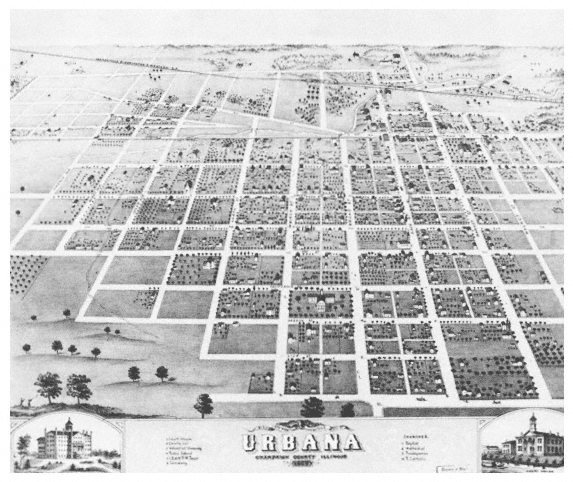
Urbana, Illinois, 1896.
A small Midwestern city: note the empty lots and platted streets determining
speculative value and shaping the city investment directions. Unlike Sumner,
Kansas, Urbana was not pure speculative smoke, and it prospered.
Source: Geography and Map Division, Library of Congress.
that historians and social scientists have begun to attend to Schumpeter's argument.[3]
American city revenues derive from a mix of taxes (usually on real property), license and user fees, fines, and occasionally sales of real property. Property taxes dominated this income mix until the early twentieth century, when nonlocal revenues, especially from the federal government, begin to form a portion of the city budget. Although the transition away from almost complete reliance on property taxes was gradual, it accelerated with the Depression in the 1930s. One particular aspect of the crisis, unemployment, helped trigger the conscious turn to the federal government for aid. Cities had traditionally cared for their poor, but never had the poor been so numerous. While debt load and the bank holiday may have been the underlying causes and precipitators of default, cities had borne the great brunt of welfare to the unemployed for the first three years of the Depression. By 1933 they had exhausted their resources: more important, they saw themselves as handling a national problem. Unlike debt that financed local capital expansion, welfare benefits went to all in need. In a classic problem that has plagued American cities since the colonial era, the responsibility for the welfare of urban residents fell upon city government, but by 1930, the separation of political boundary from economic region had become so obvious as to send mayors to the federal government. All other governmental entities were seen as too geographically limited to accept the responsibility for a much larger problem. The relationship to the federal government began to be perceived by urban politicians as the critical political and economic relationship.[4] Among a broad range of requests, the cities sought federal legislation to help them reorganize and refund debt to avoid default, but the modest legislation that did get enacted was overturned by the Supreme Court within three years.[5]
National figures for the proportion of all city taxes which came from property taxes do not exist, but for analysing the trend since the Depression, the combined state and local government figure stands as a reasonable substitute. Between 1932 and 1934, the property tax percentage of receipts for state and local governments fell dramatically, from 60 percent to 45 percent. Even the latter figure seemed high by the 1980s, when property tax contributed less than 20 percent of the total revenue.[6]
These figures would be considerably higher, perhaps as much as 50 percent, for municipalities alone, because the addition of state figures, which rely far less on property taxes, dilutes the real property tax base of cities. For instance, the average percentage of revenue coming from property tax for all municipalities in Illinois in 1962 was just under 45 percent, which contrasts with a nationwide state and local average of 32 percent. The range of contribution of real property tax in Illinois municipalities in 1962 was also quite broad, some cities taking as much as 62 percent of their revenue from property taxes, others as little as 28 percent. Chicago itself struck the mean at 43 percent. Thus, while the trend away from reliance upon property tax revenues is clear, its absolute level depends on the unit of government examined and varies from city to city.[7]
One might expect that increased revenues from the federal government have accounted for this relative decline in the importance of property tax, particularly after the New Deal's shift in power from the local to the federal level. Although this does not in itself account entirely for the move away from complete reliance on property tax, there has been a dramatic increase in federal and state aid to cities. Again, the most dramatic shift came in 1932–1934, when the federal contribution moved from 2 percent to almost 20 percent, a proportion that fell back to 10 percent by the start of World War II. But the federal contribution to local government revenue has not begun to assume as large a share as property taxes once did. The two did reach parity for state and local government combined in 1975, but again, because states rely less upon property tax revenues than cities, this parity has not yet arrived at the municipal level.
In Illinois, by 1962 the contribution of property tax to the total municipal revenue had fallen to about 43 percent, but all other governmental revenues contributed only slightly more than 12 percent of municipal budgets. And the decade of the 1980s began with property tax contributing 40 percent, state and federal aid 38 percent.[8] There is a clear correlation between the decline in property tax and the rise of intergovernmental revenue, that is city revenue from state or federal government. But intergovernmental revenue does not yet constitute a net replacement.
The degree to which there is a substitution does imply a slow loss of local attention to the city budget, simply because its tie to
local and direct revenue from property taxes has been considerably loosened. If the experience of California's widely discussed "tax revolt" and its constitutional limitation of property taxes is any portent, the irony of the revolt may be an acceleration of the decrease in importance of property taxes, with a concomitant increase in nonlocal revenues and decrease in local control of local government.[9] As it stands, the twentieth century draws to a close with property tax remaining an important part of the revenue structure of cities. But, unlike a century ago, it is now only one of several important revenue sources.
In the regulatory era of city government, from the seventeenth to the early nineteenth century, expenditures went for streets, maintenance of markets, docks, and warehouses, and aid to the poor. As the service city began to take shape, city expenditures became more varied and complex. By the mid-nineteenth century, modest amounts of support began to go to fire and police, schools, transportation, water and sewers, public health, the administrative mechanism of the government itself, various forms of welfare, libraries, and occasionally public utilities. As budgets increased in complexity, they also increased in amount. An exact per capita measure may be impossible to construct, but there is no question that since at least 1840, government expenditures on the local, state, and federal levels have increased.[10] Yet, for cities, there has always been an important lid on expenditures, for their charters stipulate that city expenditures must equal revenues, and since revenues are limited by tax rates set by state governments, revenues have de facto state-imposed ceilings.
The Civil War and Local Finance
Just as the fledgling service governments began to act, the Civil War intervened, raising taxes even higher. The war assured that nation's political unification, cementing the social and economic changes of the first half of the century. In the late 1830s, the Supreme Court case Bank of Augusta v. Earle ensured the foundations of interstate corporate mobility, and illustrated the intimate linkage between mobile capital and the developing urban network. The case decided the issue of whether or not a corporation chartered by one state's legislature (Georgia and also Louisiana) could borrow and lend in another (Alabama). The Georgia lender
was a bank; the Louisiana one a railroad.[11] The defaulter, Joseph Earle, in order to avoid paying his debt, made the plausible claim that legislation by one state, including acts of incorporation, could not carry into another state. His action set off other local defaults, including one on a debt made by the Bank of the United States in Philadelphia. But the whole legal and theoretical issue involving capital and its corporate form had its actual location in an urban network, tying banks, cities, and individual entrepreneurs together with the transportation medium of the railroad. The case literally swept across the three major port cities on the Gulf of Mexico, suggesting the fine webs of commerce tying these cities together. All the principals in the case were urban, either corporations or individuals, from Joseph Earle in Mobile, to the Bank of Augusta, Georgia, to the New Orleans and Carrollton Railroad Company. The Supreme Court found against Earle and in favor of chartered corporations acting across state boundaries. Of course, since colonial times, the new urban networks had largely disregarded state boundaries. Bank of Augusta v. Earle , however, ensured the dispersion of political-economic action across state lines.
Data collected in 1888 by Richard T. Ely indicate the impact of the Civil War on local taxes in Massachusetts and New York. Plotted in note 12, they suggest the following scenario: local antebellum tax revenues had been climbing very slowly for decades. The war virtually doubled them. Cities, towns, and counties paid for many war-related things, mainly those having to do with welfare of local people affected by the war, including relief and draft bounties. (By the end of the war, New York City paid bounties as high as $1,000, virtually three years' salary. Such a price for going off to war must have been very attractive. So too the incentive to desert and reenlist under another name.) And thereafter local taxes continued their climb, but from a new, higher plateau and at a steeper rate. Of course, cities and towns grew too, and their level of increase also steepened after the Civil War. However, the tax slope increased more sharply than the population growth slope. And obviously, the tax leap during the war had nothing to do with population growth. In the North, at least, the Civil War solidified a new type of local government, firmly anchoring the service city in place.[12]
The question of the war's fiscal impact on local government is yet to be resolved. Two different studies of three small Massa-
chusetts cities suggest that the high local cost of the war introduced new levels of spending, with the discovery that government could spend considerably more than it had. But it is equally possible that this new level of spending gave local taxpayers incentive to reduce spending once war debts had been paid off. Rather than demonstrating new possibilities, debt showed its vulnerability. An analysis of local debt, without considering revenue, suggests that just five years after the war's end, southern towns had comparatively greater debt loads than northern ones. But, as the case of Watertown, Wisconsin, discussed later in this chapter demonstrates, local debt has to be analyzed over time. We need to know the purposes to which debt was put. Did it promote growth or resolve crises? Did it pay for the war or build an infrastructure? And in building for the future, was it effectively spent or not?[13]
Local Debt and Borrowing
For cities with growth rates as steep as those in the nineteenth-century United States, taxes adequate to finance high-quality, service-intensive capital expansion could never have been raised on existing real property. The newer cities in the mid-nineteenth century literally built themselves from nothing. For the newest cities, the capital for construction of buildings, streets, water systems, and sewerage could hardly have been derived from taxes, as there was only the expectation and hope of growth. For all cities, population either lagged behind or just kept up with infrastructural growth, and a high tax on the existing inhabitants would have deterred new arrivals and investors. In new cities, subscription appeals for city construction, though numerous (particularly in the 1830s), had little success, given a general local capital shortage anywhere urban growth took place away from the eastern seaboard.[14] Cities therefore financed their growth by issuing debt, usually in the form of bonds marketed to investors in major eastern cities or in Europe.
Since ancient times, cities had used their corporate charter privileges to borrow money, but American cities have been unique in the degree to which they have depended on borrowing in the money market, and in their consequent competition with private debt instruments.[15] Very carefully drawn legal distinctions between public and private corporations appeared in the nineteenth century,
coinciding with the development of an active market in the bonds issued by public corporations. Ironically then, as judicial decisions insisted on the subservience of city corporations to states, municipal debt became an important part of the private money market.
In Britain, by contrast, nineteenth-century cities did occasionally borrow money, but about one-third of their borrowing was specifically directed by such national legislation as the Public Health and Artisans Dwellings Acts, which enabled them to borrow through the Board of Public Works Loan Commissioners of the Treasury, rather than in the private market. All local borrowing had to be authorized by special acts to go through the Treasury, or if in the private market, it had to be conducted for purposes similar to those authorized by the Board of Public Works Loan Commissioners. The Municipal Corporations Act of 1835 limited total local borrowing to no more than "two year's rateable value of the district," that is, no more than twice the annual total local property tax.
No American state constitutions set debt or tax ceilings until after 1870. As late as 1881, cities in twenty-three states had no constitutional debt limits, though some of them could no longer invest in private corporations, especially railroads. When states began to limit debts, they typically set them at a proportion of the assessed value of real property, usually 5 percent. For instance, Illinois, a leader in limitation, did not set local debt ceilings until 1870, when they were set at 5 percent of the real property value. In the 1920s, constitutional amendments raised Chicago's ceiling to 7 percent. Across the states, debt ceilings varied from 3 percent to 7 percent. Of the fifteen that were set by state constitutional restrictions or the three states where legislatures were authorized to set limits, all were based on a proportion of assessed property value. This, of course, made the actual amount of the debt highly flexible at the will of the city assessors. This means that in two ways, nominal limits and assessments, the U.S. debt limitation was substantially more generous than Britain's, perhaps by a factor of ten.[16]
The implied British principle was that specific prior authority had to be established before securing loans, whereas in the United States most state legislatures and constitutions gave carte blanche for borrowing purposes. State legislatures restricted borrowing only when excesses appeared to be causing default crises. Thus, in the
late 1870s, the recession seemed to have caused defaults on city bonds supporting railroads, and several states banned the lending of city debt to railroads.
A statistical analysis comparing the effect of debt limitation state by state shows that such limits were paper tigers, contrary to the impression given by some historians, who see them as putting "severe limitations" on a city, locking its "fiscal options into a rigid mold." The stepwise regression analysis reported in note 17 estimates the relationship of debt limitation, state age, the actual number of cities, and the number of cities per capita. Most relevant, the state-mandated limitations had no measurable impact. Nor did the number of cities in a state. Instead, the net city debt was mainly determined by the age of a state (older states had somewhat less debt than younger ones), the region (the North had greater per capita debt), and the number of cities per capita. What is most interesting from this point of view, is that the number of cities per capita rather than the number of city dwellers had such a powerful effect on debt. Given two states of equal urban population and age, the one with the greater number of smaller cities would have had the greater debt. By implication, the closer the local government to its voters, the more debt the government was willing to issue. It is possible that in smaller cities, where they were close to city government, property owners were more likely to see debt as an opportunity and a public good while their bigcity counterparts were less likely to be so supportive.[17]
The British policy on local debt significantly contrasted with the broad general rules governing city debt in the United States. In Britain the national government sanctioned borrowing for specified sets of projects, from harbors to jails. All other local borrowing needed a special parliamentary act. This contrast is important, for it foreshadowed liberal and conservative theories of corporate regulation in the nineteenth century. By the liberal theory, corporations had the right to act as they wished; they would be regulated by civil and criminal law, or by special legislation if need be. The conservative theory allowed corporations to do only that which they were specifically chartered to do; new or different activities required legislative charter amendments. The British operated under the conservative theory of corporations, while American cities (and business corporations) operated under the liberal theory.
In the 1880s British reformers expressed concern about the
amount and increase in local indebtedness, most of it urban, which had risen from 80 million to 137 million pounds between 1870 and 1880. This compares to a much higher per capita local debt in the United States, which increased only a few dollars in per capita figures but increased substantially in its total. At an exchange rate of about $4.90 per pound, the U.S. debt was $13 higher per capita in 1870, perhaps $14 higher in 1880.[18]
Most of the total government debt in the nineteenth century was issued by local, not state or federal, government. Illinois, for instance, in 1869, had a state debt of $6.3 million, a county debt of $8.5 million, and the enormous debt of cities and towns of $39.8 million. Across the Atlantic, municipal borrowing remained much more slight and uncoordinated; in Glasgow, for instance, each city department borrowed independently in 1886. More typical, when Leeds wished to build an elegant city hall at midcentury, city officials first tried to raise money by subscription. Failing this attempt, they built the hall with a loan from the national government, one eventually repaid from the property taxes and profits from the municipal water system. The caution of the council in borrowing was overcome only by its shame at the city's downtown appearance when compared to neighboring Bradford. As only about 5 percent of those eligible to vote for city council members were working class voters, there is no way of judging the popular appeal of debt financing for civic building. However, the effective exclusive of the British working class from home ownership suggests that it would not have been in its interest to support any expansion of local government.[19]
Entrepreneurial Competition, Local Debt, and Boosterism
Such schemes could only work in cities which already had enough property to tax. Rapidly growing American cities could not finance infrastructural development out of their current revenues because they were building for a short-term but quickly expanding population. A city of 10,000, making do with a city hall built for a village of 1,000, had to finance the building of a new hall for a city of 20,000. The fortunes of individuals, cities, and the new services cities provided often became inextricably tied, so that the speculative sale of land, business shares, and city bonds themselves could determine a new city's future. And although George Wash-
ington may not have been able to sell land in the District of Columbia, real estate developers, city officials, and speculators followed his precedent time and time again in subsequent land sales. From the very early decades of the nineteenth century on, a shameless hucksterism accompanied the explosion of new cities in the nineteenth century. It accelerated throughout the century, so that by the 1870s, empty stretches of land across the Midwest and West were touted as the new Rome, Athens, or Paris. In spite of uncountable false starts, heavy competition, and severe attrition, there are still eight Romes, fifteen Athenses, fourteen Parises, twenty-two Manchesters, twenty Oxfords, fourteen Cambridges, and seventeen Londons or New Londons in the United States![20]
This bubbly spirit of urban boosterism fronted a very serious enterprise. It also masked a unique moment in urban history, a moment when thousands of entrepreneurs seized opportunities to build a whole new system of cities on a basis never before tried. The new basis included unprecedented demographic growth and an expansion of a capitalist economic system underwritten and boosted rather than restricted by government.[21] State constitutions ensured that any group of people so petitioning could gain articles of incorporation as a village, town, or city. General incorporation legislation for businesses did not become widespread until the late nineteenth century, which meant that each new business seeking the privileges of incorporation had to have special legislation introduced in a state's legislature. Prior to the middle of the century, such incorporation was often difficult and expensive.[22] The privileges of incorporation are critical to capital enterprises, for they lower the costs of capital by protecting investors with limited liability. By granting virtually any settlement the privileges of a corporate charter, state legislatures created a spectacular opportunity for a new form of entrepreneurship, the city (or village or town) as economic actor. From the investor's perspective, particularly in the early nineteenth century, the money lent to growing cities was almost uniquely protected. Thus the carnival of land sales provided a facade for the business of capital expansion across the continent.
For instance, Morgan County, Illinois, made Jacksonville its county seat in return for a large land donation from investors in the as-yet-unbuilt city in 1825. During the nineteenth century the county constructed two courthouses. The first was raised in 1832, when the city had about 2,000 people and the county about 14,000.
The second courthouse came in 1869, when the city had grown to just over 9,000 and the surrounding county to about 27,500. To expect either a city or county to finance a structure for a population doubling or quadrupling every three decades was clearly unfeasible. Only debt, issued with the not unreasonable expectation that future growth would ease its repayment, made sense in an urban system increasingly wedded to a service government.
City building by entrepreneurship meant that services formerly provided by volunteers had to be regularized in advance, since there was no community on which to call. Hence, slowly, emerging urban services replaced the individual citizen volunteer. Thus, by the end of the nineteenth century, activities formerly accomplished as an obligation of all urban citizens had become a part of city government. And intercity communication about the techniques of accomplishing these tasks had resulted in the creation of national professional societies. Urban residents no longer actually performed these tasks; instead, they indirectly contracted for services through property taxes. Monetized and rationalized, traditional relationships of obligation and responsibility between city and citizen became contractual.[23]
With their powerful borrowing potential, these new cities burst upon the economic and demographic scene of the Western world, competing with other capital enterprises for loans and providing relatively secure investment opportunities. Even when the capital did not go directly to build streets and schools in brandnew towns and cities, it often went into the businesses that the new towns in turn aided and supported with large local subsidies, from manufacturing firms to the burgeoning railroads.
Cities then, faced a double fiscal burden, simultaneously financing a new infrastructure and the increasing expenditures associated with their transformation from regulators to public servants. These two local shifts took place within a context of increasing state and federal government expenditures.[24] The increases, occurring both in per capita terms and as a proportion of the gross national product, meant that cities competed with more powerful and unified governmental units as well as with one another for revenues.
And compete American cities did, issuing debt for a stunning multiplicity of projects, ranging from the mundane building of street and schools, to revenue-generating docks and bridges, to
straight cash aid to lure capitalists to invest in local projects. We know most about those projects that failed, for the failure to repay debt led to lawsuits and publicity. In 1870, the Census Bureau began to collect information on amounts of indebtedness, although it was not until 1902 that this became systematic. One can only crudely estimate local debt for 1870, 1880, and 1890, for not only was the reporting irregular but the census did not record the population of those places answering questionnaires concerning indebtedness. To add further complication, sometimes places reported subscribed but still-unissued debt, and at other times they subtracted the assets in sinking funds (that is, funds legally designated for the repayment of specified debts) from the indebtedness figures.
The figures, however, suggest a local debt that grew absolutely but declined in per capita terms from 1870. In 1870, counties had contracted debts for a total of $187.5 million, cities and towns for a total of $328.2 million. The per capita county debt was about $4.86, the local debt about $39.6. By 1880 the per capita county debt figures had fallen to $2.50, and they fell again to $2.30 by 1890. It is unclear whether this decline was actual or an artifact of different reporting methods. Nevertheless, the total county debt rose substantially between these decades, from $124.1 million to $145.0 million. Local debt rose to $701.9 million in 1880 and $761.2 million in 1890; this represented a slight per capita decline. As the twentieth century opened, the overall indebtedness and revenues of local governments (excluding state governments) were 50 percent greater than that of the federal government. By the watershed era of the Great Depression, this relationship had begun to reverse. World War II began the era we now consider typically twentieth-century, with the federal government's debt and revenue overwhelming state and local government debt by a ratio of five to one. This dramatic reversal of federal and local fiscal stances reflects the importance of local government at the beginning of the twentieth century, when, for instance, virtually all welfare and educational expenditures were local.[25]
What Got Taxed?
Taxes on real property were the easiest for governments to collect, for they were liens on immobile property rather than on
mobile individuals. Yet their simplicity from this point of view their complexity from any other perspective. The eighteenth-century corporate charter of New York City, for instance, made no allowance for any city tax levies. Those few taxes that were collected by the city had to have special enabling legislation from the colonial government. New York City depended on its property to earn its revenues. In addition, by carefully attaching requirements to its grants of valuable land, particularly waterfront lands, the city avoided capital expenditures. With the grants of waterfront lots extending 400 feet into the river, the city required that the owner build wharves and connecting waterfront streets.[26] In essence the city transformed its own property into private collateral in order to foster private capital investment in a public good.
By the mid-nineteenth century, New York City would use a different strategy. With its charter of 1830—like that of every other city, now guaranteeing a right to tax private property—the taxgenerating aspect of the private property within the city's boundaries became collateral on its debt. In this period, the budget expenditure record included debt principal and interest payments and served as an excellent indicator of the city's financial activities. For the eighteenth century, however, the city's revenues and expenditures simply do not reflect the city's effective fiscal power. By selling its waterfront land with undeveloped earning potential, it created an opportunity for private capital, the direct earnings of which it shared with the new owners. In addition, the city levied indirect taxes for the use of these waterlots by requiring the owners to build and maintain contiguous streets and various public slips. The city accounts, however, show only the direct revenues, not the private expenditures on wharf construction, slip dredging, or street construction and maintenance. Through regulation and careful control of its own property, the city could underwrite a vital aspect of its economic growth without any visible revenue or expenditure.[27]
In the nineteenth century, the terms municipal and city took on different technical meanings. They denoted virtually identical agencies in the popular mind, and so they do today to most people. In public law, however, the term municipal specifically denoted any governmental unit to which the state had delegated power. Therefore municipal governments could include cities as well as many other forms of state-created government. (This is why municipal
bonds in the late twentieth century fund a range of projects, only some of which are urban, including everything from straightforward city improvements to sprawling nuclear utility networks.) In the eighteenth century, a city like New York was not in fact a municipal corporation, for its charter gave it power independent of the colonial government.[28]
The introduction of separate school and irrigation districts in the late nineteenth century transformed the mid-nineteenth century legal definition of municipal government from a category containing one kind of instance—cities—to one with a bewildering variety of instances. The growth of special districts, ostensibly in order to overcome the inefficient boundary limitations posed by cities, was probably a way for county and state level politicians to circumscribe the power of ethnic political machines and at the same time escape the increasing limits that state legislatures had begun to place on cities in the aftermath of defaults during the depressions of the 1870s and 1890s.
As a result, an overlay of city government, and various functionally specialized districts—most notably school districts and water districts—comprise the typical twentieth-century city's governing body. These special districts each have a fund whose revenues come from property and other taxes, fees, and intergovernmental transfers. Consequently, to find a city that has a government contiguous with other special districts may no longer be possible in the United States. Figure 6 demonstrates, in a simplified form, the reason for this historical complexity. Note that here the word historical has a double meaning, suggesting as it does that the complexity itself has risen for historical reasons, as new accretions of special political districts overlaid older ones, and also that the complexity frustrates historical generalization on a scale large enough to have meaning.[29]
Each unit in this complex of modern municipal government may issue debt to finance its capital construction, whether for schools, water and sewerage systems, or roads. For the first seventy years or so of the nineteenth century, unitary governmental units issued debt, collected taxes, and spent money. But as the service government expanded, so did its organizational specialization.
A study of mid-twentieth-century Illinois, for instance, illustrates that only in the case of two types of special district, roads and schools, did the number shrink between 1940 and 1962. The
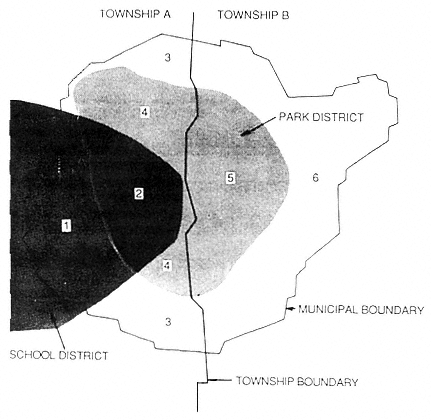
Figure 6.
Overlapping Municipal Boundaries
This diagram shows six different government units—excluding state,
federal, and other units such as flood control districts—which overlap in
what might seem like a homogeneous area.
Source: Glen W. Fisher and Robert P. Fairbanks, Illinois Municipal Finance: A
Financial and Economic Analysis (Urbana: University of Illinois Press, (1968), 82.
number of school districts across the United States diminished through consolidation during this period, the consequence of a centralization and reform movement which had begun much earlier, in the Progressive era. The number of school districts in the nation fell from over 127,000 in the early 1930s to 115,000 in 1942 to 35,000 in 1962 and under 15,000 in 1982.[30] In Illinois, though, all other special districts proliferated, including actual municipalities,
fire, park, and sanitary districts, so that by 1962, the state had 1,251 city governments and 5,221 other governmental units. The mean number of governmental overlays—that is, governments having jurisdiction over any one location—increased from 6.9 in 1940 to 9.0 by 1962.[31]
The Politics of Local Finance: The Watertown Railway Bond Issue
The Watertown, Wisconsin, ordeal over debt and debt payment illustrates in a microcosm several aspects of nineteenth-century urban finance. A small city struggling to capture the potential economic benefits of its proximity to Madison, Watertown epitomized mid-nineteenth-century tensions and hopes. Although it was an extreme case, lasting nearly four decades and unresolved even by a Supreme Court decision, the dynamics of the local struggle illustrate features of town finance, debt, and default that figured in small and large cities across the United States. Its heavy debt load, its persistent creditors, and its complex social, economic, and political structure evoked a complete range of local responses to an urban fiscal crisis. Moreover, the town's default on debt repayment highlighted the sense in which default was and still is a political action.
In 1856 the Wisconsin legislature authorized the issuance of $400,000 of railroad aid bonds by the city of Watertown.[32] These bonds were divided between two fledgling railroad companies; apparently the railroads were to pay both principal and interest payments. Such an arrangement was in effect a collateralization, the city's credit underwriting the railroads' capitalization. The panic of 1857 caused one of the railroads to virtually collapse, and the lessees of the company sold the city's bonds in Boston for 32.5 percent of their face value. The other railroad traded its stock to the city for the bonds. But the $200,000 owed to the Milwaukee & St. Paul Railroad brought the city neither railroad nor capital improvements, and one historian of this debt claims "its crushing weight stayed its growth, paralyzed its industries."[33] By 1870 the city debt plus interest equated one-half of the city's assessed property value.
Although one might doubt that Watertown's destined greatness had been foiled by this debt, the debt became a major public
and political issue. In 1867 townspeople met and discussed various schemes to deal with it, from buying up the discounted debt to "foolish speeches" in favor of repudiation.[34] By 1868 the city had discovered a clever solution to its problem. It began over two decades of governing without government, without those persons in its government upon whom a lawsuit could be served. The city business was always accomplished prior to the first council meeting, which formally consisted of a handing in of all signed business and resignations to the city clerk. A Board of Street Commissioners made all council-like decisions. For instance, in 1874, the Board's regular order of business included such jobs as paying various city employees and spending money from the fifth ward "poor fund" for medical assistance to a poor woman. Two years later, at its regular meeting the Board planned the upcoming Fourth of July celebration, arranging prizes, processions, and stipulating that school children would sing national songs.[35]
Thus, as courts awarded first one judgment and then another against the city, creditors found no one upon whom to serve papers. In 1872 the state legislature passed a bill making it impossible to seize private property to satisfy municipal creditors, effectively protecting the city's property owners from the seizure and sale of their property. The Watertown Republican (March 6, 1872) alleged that the city's debt had been issued irresponsibly by the propertyless, "by a rabble of railroad laborers thrown out of employment on a road that had stopped." These unpropertied workers encumbered the honest property owners, including, of course, "every widow and orphan" who would gladly pay a real debt, but would refuse "to satisfy the avarice of the men . . . who have combined to use the wealth they wrung from the sweat and blood of the farmers of Wisconsin [referring to the great mortgage scandals of the 1850s], to buy these Railroad bonds against cities, towns, counties, and villages, at a small fraction of their par value, in order to build their fortunes upon the ruin of so many." Having blamed the debt on irresponsible and transient workers, the essay shifted to threaten a revolution of decent townspeople if the greedy speculators persisted in attempting to collect the debt.
Five of the town's "prominent and influential citizens" (including two former mayors) awoke one summer morning in 1872 to find miniature wooden coffins on their doorsteps, in an incident reminiscent of the Captain Swing riots forty years earlier in En-
gland. A letter within each coffin urged: "In this bury all your Railway Bonds and your villainy with it." One month later the prorepudiation forces formed an organization of working-class homeowners, the Union League, which was to play an influential role in city politics for the next two decades.[36]
In July 1872, this "class of discontented, ignorant people," led by Patrick Devy, formed a bilingual, German-Irish and Democratic organization which continued to be active in the city until 1897. The league's secret Committee of Safety agitated against all bond payments, and threatened to burn the city down if creditors tried to collect the debt or seize private property to pay it. The Union League saw the debt as a plot of the wealthy against the workers. As G. Baumann told the league on September 14, in an address in both German and English, "a certain clique of cunning men . . . men who from the first setting of this place had subsisted on the sweat of the laboring class of Watertown" had foisted the debt on the town. Their plot was foiled and resisted by the "workingmen only who fight for Right and Home." The antirepudiation Democrat called their meetings a "hodge-podge mess of drivelling, drooling gibberish and contemptible bosh."[37]
The league's vigorously militant stance culminated by September in a unanimous resolution that gave a sense of the depth and passion of its members. "Resolved that the Union League of the City of Watertown will use all justifiable means to protect their property from legal robbers as they would from thieves and highway robbers."[38] The only opposition to the league, an ineffective Citizen's Association, worked to compromise the debt in some way. The league's power grew, as first Devy and then Hezekiah Flinn, both Leaguers, gained seats in the state legislature in the late 1870s, where they worked to keep the debt unpaid.
The Supreme Court, in Almy v. City of Watertown (130 U.S. 301, 1889), decided that the debt claims must be served on the mayor and that the state legislation prescribing this mode of service was proper. That the city had no mayor could not be brought into the argument, and the case effectively sealed Watertown's victory over the bondholders. The Milwaukee attorney who had represented the bondholders for twenty-five years, and perhaps held most of the bonds himself, later settled with the city, exchanging over $600,000 in bonds for a $15,000 settlement. In 1894 the city
government began normal operations again, thus ending thirty-five years of turmoil.
There were five positions on the debt taken by different groups of townspeople. The handful of well-off local capitalists who also held city bonds wanted complete payment of the debt. The out-of-work railroad laborers first supported payment of the original debt, but whether they later joined the repudiation groups is not clear. The Union League—German, Irish, and Democratic, though not in tune with the town's democratic newspaper—advocated strict repudiation but also seemed to represent numerous small property holders as well as the propertyless. The Citizen's Association, apparently Republican, wanted to compromise the debt, a position comfortable to the smaller entrepreneurs and probably to all three town newspapers. And finally nonleague Democrats maintained an uneasy fifth position that skirted around favoring complete repudiation.
That property owners could have supported so militantly the antiestablishment Union League is no surprise, for as in most newly founded western cities, the acquisition of small real property holdings was possible for all but the totally destitute.[39] Economic class differences grew at the margins between three groups: these very small property owners, who could literally tear down their houses and move them to another town; the local entrepreneurs, who possessed a bit of capital and the spirit typified by the Duluthian who happily worked hard but "worked the other fellow at the same time"; and the handful of local capitalists, who invested heavily in city bonds and local economic activities in addition to their regional activities.[40] Ethnic splits, articulated through political parties, fractured these three economic classes, leaving a world of local politics which hotly contested the economic issues. These issues, which can often be subsumed under the concept of boosterism, directly but differently affected the fortunes and jobs of town dwellers.
Class differences usually accounted for various positions on debt. Small property holders willingly issued debt and willingly repudiated it, standing to gain from city debt that boosted economic and population growth but having little to lose. The petty capitalist also favored the issuance of debt that promised to make the city grow, having tied his or her economic future to the city.
For this reason, then, the petty capitalist stood for good credit, for debt payment when feasible and for readjustment when not. For them, local government's fiscal catastrophe spelled personal economic doom. The few wealthy resident bond holders and backers of larger local corporate enterprises favored debt for economic growth and payment at all costs. These basic positions became complex when overlaid by party and ethnic positions. The Democrats and the Irish tended to favor repudiation as in the post-Reconstruction South. And Republicans, "Americans of the New England Puritan type, men of refinement and culture,"[41] and the native-born and Germans, would in general work for the soundness of city credit and "reputation."
Fiscal Crises
Watertown used its debt-issuing abilities to foster economic growth. When the expectations of growth were not met, conflict occurred along class and political lines, and this conflict determined the outcome of the city's position regarding debt obligations. The city's internal conflict over finances directly tied local taxpayers of all classes to local politics and to the larger economy. Debt, the corporate privilege of the city, represented an opportunity and a risk, and the city's fate demonstrates its continuing boldness. Had the rail ventures originally underwritten by city debt succeeded, one imagines the city might have experienced somewhat more economic growth, growth that in retrospect would have been deemed natural.
Idiosyncratic or nonexistent data collection methods preclude any systematic time series analysis of total urban revenues and expenditures for the United States prior to the revision of census priorities in 1902.[42] However, an interrupted time series analysis of the annual number of defaults on municipal bonds from 1850 to the late 1940s confirms two aspects of debt financing. First, the number of defaults per year slowly drifted upward from 1850 on, although an adjustment for the number of urban dwellers suggests that the per capita number was more or less stable. Second, a statistical analysis of the depressions of 1873, 1893, and the 1930s confirms that only one, the Great Depression, had any unexpected impact. With the exception, therefore, of the Depression of the 1930s, we may conclude that defaults on municipal bonds stayed
surprisingly stable.[43] Whatever other transitions came about in the urban budget, failures to honor debt have been relatively few. We should use them for the rare look they provide at the politics of the city budget, rather than as signs of imminent urban catastrophe.
Data reflecting the urban balance sheet from 1929 to 1982 cannot directly be compared with the default data even though the two overlap, but several implications can be drawn from them.[44] Most important is the long upward drift after the Depression, reflecting cautious but increasing use of state and local debt. Since 1968, this drift has approached debt payment proportions reminiscent of the early Depression. As case studies emphasize, and the experience of Watertown exemplifies, these fiscal positions constitute necessary but not sufficient conditions for default crises. The key to turning high debt payment ratios into default is most often found in popular politics, most likely local taxpayer action. And this in turn depends on local political allegiances and cleavages. Because of the overlay of special districts, increasing dependence of cities on intergovernmental transfers, and the rise of sophisticated urban services, the municipal budget has drifted far from the comprehension of most taxpayers. Operating costs and urban services are the only budgetary issues to have become the center of political attention in the twentieth century. Debt as an issue only comes to the fore in potential default crises, as that of New York City in the mid-1970s and Cleveland in the late 1970s. Only when the broad political issues centering on using the city as an economic machine can be articulated should we expect purposeful defaults by city governments.
The Watertown story illustrates the great difference between private corporate enterprise and the city. Although cities are public corporations whose legal status resembles private corporations, their essence does not derive solely from the charter.[45] Cities, in fact, are historical, social, geographic, economic, and cultural entities that exist prior to and independent of the enabling legislation that makes it possible for them to borrow and act in some ways like legal persons. if the legislation giving them corporation privileges were to be eliminated, cities would be seriously altered, many new cities of the nineteenth century might never have been built, and the remarkable growth of the American urban network would have been retarded. But cities would not disappear as a social
form. This often overlooked, simple fact explains some of the anger and apparent irresponsibility of city officials and inhabitants of bankrupt cities, both in the nineteenth century and today. They perceive the city as a whole, and in a fiscal crisis value their indebtedness bonds, relative to the rest of the budget, much less than do the financiers, who would seem at these moments of crisis to control the city's fate.
When New York City's fiscal crisis became apparent in 1973, one commentator asserted that it was simply inconceivable that the city could fail. And in a sense this was a realistic observation, for cities are far more than legal fictions enabled by legislative fiat to act like persons. City officials differ from corporate officials, whose responsibility to the shareholders is to multiply capital. This is not to say that city officials have always done well in exercising their obligations. In fact, what becomes apparent in examining individual city stories is that there has been a deep and perhaps irremediable disjuncture between electoral and fiscal responsibility. Smart politicians spend the money of their constituents' grandchildren. Yet this disjuncture is older than the American urban network: in a mass demonstration in fourteenth-century Florence, some 5,000 residents demanded a ten-year moratorium on debt repayment.[46]
This gap between political responsibility and politically created public debt accounts for other invisible costs displaced by the urban present to the urban future. For instance, the economic advantages of central place locations appear to be persisting into the electronic age, in spite of dismal predictions to the contrary. These advantages accrue to the whole society. But the long-run costs of building and maintaining central places are high, and it is probable that these costs are not fairly allocated, over either space or time. Though this is a much-contested terrain in urban economics, the argument that the central cities do not bear excessive costs relative to prosperous suburbs and exurban areas has yet to be conclusively demonstrated.
Debt is the way in which capital costs are paid over time, while taxation allocates these costs over space. Yet the use of debt has been enlisted in support of economic growth as well as for urban services. While voters can approve or reject bond issues, it is not clear how wisely, creatively, or humanely debt has been used. In a sense, the proper use of debt has been conceived as a
parallel to the debt usage of other corporate enterprises, even though few could argue that such principles would apply to the purpose and function of a city. When in the nineteenth century debt became an issue of public debate and discussion, as in Watertown, its complexities, if not possibilities, came to the fore. One cannot help but be impressed by the vigor and richness, as well as the irresponsibility, of the public argument surrounding debt.
Since the 1930s the issues surrounding local debt have become more complex, the arguments more abstract, and the conflict buried. And, for better or worse, it is almost impossible to imagine popular local action of the kind seen in the defaulting cities of the nineteenth century. A look at some aggregated data on municipal debt suggests that we are once again approaching a situation ripe for crisis, although the lack of political understanding of debt adds an unpredictable element to any potential crisis.
The Depression and Federal Finance of Local Government
Consistent annual data on local revenues prior to 1929 are not obtainable, but nearly comparable information can be found for 1902, 1913, 1922, and 1927. These data indicate that federal aid to state and local government varied between 0.6 percent and 2.2 percent prior to the Depression. From 1902 property tax had declined slightly in its contribution to local revenue, but remained within the 60 percent range. Given that these estimates may be slightly high owing to inconsistent data, we can nevertheless conclude with some confidence that the local finance mix from the beginning of the century until 1930 had exhibited stability, especially when compared with the dramatic effects of the Depression and World War II.[47]
For 1929 to the present, aggregated state and local government expenditure and receipt data for the United States are available annually. These data mark the shifting role of the federal government in state and local government. To an unknown extent they also hide the changing fiscal posture of the city by lumping urban affairs with state-level activities. Nevertheless, the patterns are instructive and set the context for understanding post-Depression urban finance. Nineteen-thirty marked the high point in local government property tax revenue, about 4.5 billion dollars, until well into World War II, 1944. The absolute bottom in receipts came in
1934 at under 4 billion dollars, but recovery did not really begin until the end of World War II, eleven years later. The proportion of total receipts accounted for by property tax, which began a decline in 1933 that has not yet ceased, does not clearly reflect the fifteen-year-long collapse in the urban economy from 1930 to 1945. In the early 1930s property tax accounted for 60 percent of all state and local revenues; by the 1970s this proportion had fallen to 20 percent. As discussed earlier, this reflects the dilution of the urban situation by the increase in state income tax revenues, but the trend if not the level is correct.
Both in absolute and proportional values, federal aid to local governments has increased since 1929, fluctuating widely during the 1930s, then beginning its long upward trend. From accounting for less than 2 percent of local governments, receipts in the late 1920s and early 1930s, the federal contribution increased to over 20 percent for the recent period 1972–1981.
The ratio of expenditures to receipts gives a simple index to the overall balance sheet of state and local governments, indicating if governments spent more than they took in. The last depression year with a positive balance was 1933, and the condition was not to be corrected until 1949. Then followed twenty years of alternating deficits and excesses, until 1968, when a long deficit pattern comparable only to the late Depression began. As of 1982, only seventeen of the fifty-five years since 1929 had positive balances.
Yet the specter of government budgets becoming more and more dedicated to debt service has not followed precisely the same pattern as have most indicators of state and local government finance. The percent of total expenditures dedicated to interest payments hit a peak in 1933 of 8 percent. The narrow range of this index, from a high of 8 percent to a low of 2.8 percent in 1950, suggests that as an aggregate it minimizes much more severe local imbalances, for instance Detroit's budget, with over half committed to fixed-debt service obligations. However, the interest peak accurately identifies 1933 as the most severe point in the Depression crisis. Moreover, it shows a steady climb back toward high interest to expenditure proportions after 1968. By 1982, interest payments consumed almost 7 percent of state and local government budgets, a very high figure matched only by the first three years of the Depression.[48]
The history of earlier defaults suggests that although the eco-
nomic basis for a default crisis may be present, Only local political action will cause default. If anything, the default history of Watertown, though exaggerated, accurately shows how default was a conscious political action. Of all depressions since 1850, only that of the 1930s can be shown to have had a meaningful impact on urban defaults. And though it is apparent that this depression did drive cities to default, many defaults during the 1930s were more specifically caused by the bank holiday, which deprived cities of local sources of cash, on which they were highly dependent.[49]
The Depression probably hit Detroit, fourth largest city during the period, most directly because of its large proportion of automobile workers. It is somewhat surprising, then, that Detroit struggled along, even managing to make local welfare contributions with no support from the federal government. The city did not default until the bank holiday of February 1933 simply and abruptly dried up its cash resources. Thus the local banking situation rather than the larger pressures of the Depression toppled the city into default. Had it not been for the closing of the banks, the city might have continued to get along, on a much reduced budget but without defaulting.[50] Cities may not be capable of controlling the larger economy, but Detroit's experience demonstrates that default crises are neither inevitable nor irreversible. Urban finance can be a field for creativity and a central arena for the democratic use of city government.
The expansion of the city budget over the nineteenth and twentieth centuries should be regarded neither as an intrusion of government into formerly communal affairs nor as an expansion of the role of government. Rather, it should be seen as an outcome of the transformed role of local government, a transformation from the regulation of the local economy to the promotion of the local economy. This promotion occurred both directly—as in granting of land and direct capital investment financed through the issuance of municipal debt—and indirectly—through the creation and implementation of the service city. City government had not merely grown, it had changed, and as it changed, it shaped the trajectory and consequences of growth. Its budget marked the front lines of that change.