
The Temptation of Jugendstil
Whereas the Tragicomedies cycle remains for the most part stylistically ambivalent, a large number of postcards, addressed to Joseph Ruederer and now preserved in the manuscript collection of the Municipal Library in Munich, illustrate the extent to which Corinth allowed himself to be seduced by the radically simplified pictorial language of Eckmann and Strathmann. Datable to the years 1896 to 1898, some of these postcards also bear greetings from Strathmann and may well have been illustrated in collaboration with him (Figs. 52, 53). A strong element of design is common to most of the imagery, as well as a naive, at times even coarse, humor that suggests caricature played an important part in Corinth's exploration of the formal idiom of Jugendstil . In a whimsical sketch of about 1896 (Fig. 54), which shows the full-length figure of Benno Becker, a self-portrait in the upper right, and the heads of two other painter friends, Friedrich Wahle (1863–1927) in the upper left and Hermann Eichfeld (b. 1845) in the lower right, Becker's countenance has been transformed into a bizarre configuration of curvilinear patterns and capricious arabesques. Though far removed from the trenchant characterizations of Thomas Theodor Heine and Olaf Gulbransson, whose irreverent parodies appeared regularly in Jugend and Simplizissimus , the caricature nonetheless approximates their sophisticated use of line.[66]
Ordinarily Corinth's modified naturalism took a less extreme form. In Faun and Nymphs (Fig. 55), one of several illustrations he published in the early is-
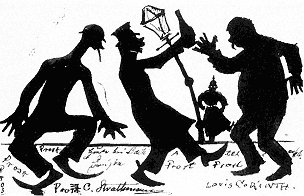
Figure 52
Lovis Corinth (and Carl Strathmann?), Postcard to
Joseph Ruederer, 1897. Pen and ink, 8.9 × 14.0 cm.
Stadtbibliothek, Handschriften- und
Monacensia-Abteilung, Munich.
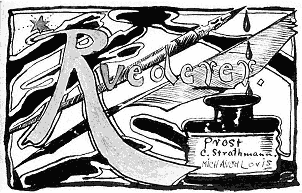
Figure 53
Lovis Corinth, Postcard to Joseph Ruederer, 1897.
Pen, brush, and ink, 8.9 × 14.0 cm. Stadtbibliothek,
Handschriften- und Monacensia-Abteilung, Munich.
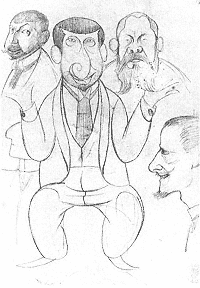
Figure 54
Lovis Corinth, Caricatures , c. 1896.
Pencil, 32.6 × 23.7 cm. Formerly
Collection Johannes Guthmann,
Ebenhausen; present whereabouts
unknown.
Photo courtesy Hans-Jürgen Imiela.
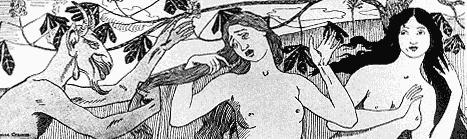
Figure 55
Lovis Corinth, Faun and Nymphs , 1896. Pen and ink.
From Jugend , November 28, 1896, p. 456.
Photo: Horst Uhr.
sues of Jugend , the landscape has been reduced to a flat background, but the figures, even though there is little modeling, retain mass and weight. They are bound by emphatic contours and linked by a measured flow of gestures, resulting in a eurythmic movement that is predominantly decorative in effect.[67] Closely related to the drawings for Jugend are Corinth's illustrations for a collection of short stories by Joseph Ruederer, entitled Tragikomödien , published in 1897. In the vignettes simplified figural motifs based on silhouetted forms are framed by floral borders. The full-page illustrations to the individual stories are less stylized but always accentuate the two-dimensional character of the pictorial field.[68]
In Resurrection (Fig. 56), one of two closely related drawings of this subject from 1896, Corinth applied the same decorative convention to the biblical motif. The horizontal tomb, placed before a simplified landscape, is guarded by three sleeping soldiers. Supported by two flanking angels, Christ stands in the center, erect and with arms outstretched, his attenuated body compartmentalized as in stained glass or cloisonné enamel. All the figures float weightlessly in a shallow, frieze-like space.
Although Corinth's use of Jugendstil formal elements is most evident in his graphic works, his paintings were not entirely immune to the prevailing taste for simplified pictorial structures. But in them the tendency to abstract the forms of nature is always held in check by Corinth's observation of the model, resulting in the stylistic ambiguity already noted in the discussion of Tragicomedies . In the small canvas Adam and Eve (B.-C. 101), for example, painted in 1893, Corinth subtly stylized the two nude figures without departing from anatomical plausibility. The postures and gestures, however, were contrived so as to form a harmonious pattern against the flat backdrop of the meadow. Two pictures of 1895, Autumn Flowers (B.-C. 123) and Dance of Spring (B.-C.
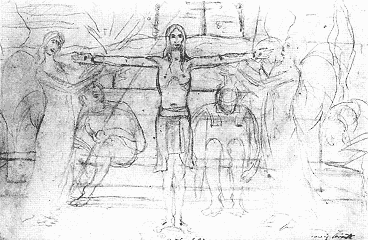
Figure 56
Lovis Corinth, Resurrection , 1896. Pencil, 30.6 × 46.5 cm.
Staatliche Museen, Berlin (DDR) (21/6292).
124), employ the same vertical, flower-strewn space, as does Nude Girl by the Water (B.-C. 142) of 1897, a painted version of the illustration Corinth had published in Jugend the previous year. Trifolium (1897; B.-C. 151) and Joy of Life (1898; B.-C. 153) are compositions based on a similarly flowing rhythm of the figures' gestural lines.
The portrait Corinth painted in 1897 of his friend Otto Eckmann (Fig. 57) is of special interest in this context, for here the stylistic features are also the specific attributes of the sitter. The uncial lettering of the inscription along the lower edge of the narrow canvas alludes to the studies Eckmann had begun in an effort to develop a typographic design in harmony with his Jugendstil borders and illustrations. Standing before a shallow ground, Eckmann holds a flower signifying his role as the creator and chief exponent of floral Jugendstil . The face is meticulously modeled, but the rest of the figure is simplified.
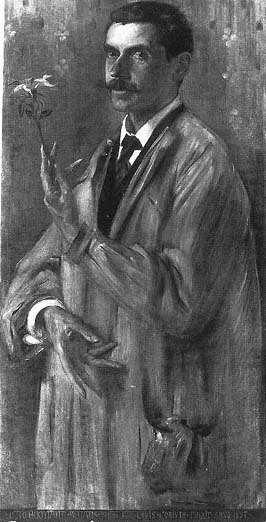
Figure 57
Lovis Corinth, Portrait of Otto Eckmann , 1897.
Oil on canvas, 110 × 55 cm, B.-C. 141.
Hamburger Kunsthalle, Hamburg.
Photo: Ralph Kleinhempel.
The ritualistic gesture of the attenuated hands adds a ceremonial touch to Eckmann's demeanor, an impression reinforced by the voluminous folds of the smock, so that the painter has the air of a celebrant of some new aesthetic creed.
The stylistic ambivalence of this and other paintings from the 1890s suggests that in pursuing the pictorial conventions of Jugendstil , Corinth simply undertook an exercise in a spirit of camaraderie—allowing himself to be "carried along in this stream," as he put it.[69] Apparently recognizing that he could not reconcile his own strong inclination toward naturalism with the
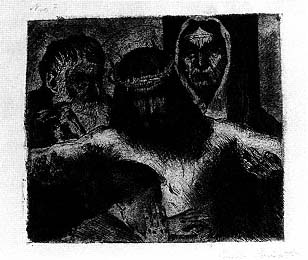
Figure 58
Lovis Corinth, Deposition , 1894. Etching,
13.0 × 14.5 cm, Schw. 9. Städtische Galerie
im Lenbachhaus, Munich (G4.515).
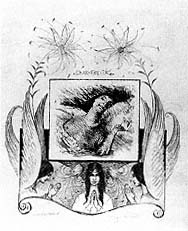
Figure 59
Lovis Corinth, Good Friday , 1894.
Lithograph, c. 32 × 28 cm, Schw. L8.
Orlando Cedrino, Munich.
decorative idiom of Eckmann and Strathmann, he abandoned his original intention to print the Deposition (Fig. 58) in a specially designed rectangular lithographic frame (Fig. 59). Instead, he printed the etching separately and subsequently used the lithographic frame for the image of a nude girl in bed, a substitution that implies a notable indifference on his part toward the religious motif. The ecstatic posture and expression of the model, copied from the painting of a full-length reclining nude of 1893 (B.-C. 109), strike a particularly odd note in conjunction with the inscription "Good Friday" just above the frame.