
May Day in 1981-91
Since 1980 the Islamic Republic has done its best to tame May Day by monopolizing, containing, sanitizing, and minimizing it. May Days are still being observed in the early 1990s, but their form and content have dramatically changed.
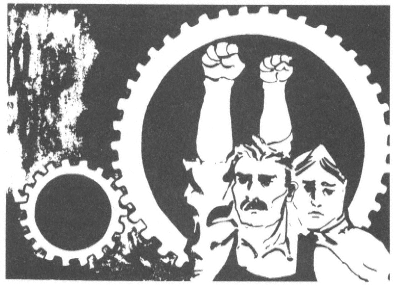
Figure 9.
May Day picture issued by the Tudeh party in 1979.
The Islamic Republic has monopolized the holiday by systematically eliminating all political opponents. In 1980 it banned Paykar, and in 1981 it outlawed the Mojahedin, the National Front, and many Marxist groups, including the Minority Fedayin (this faction, unlike the Majority Fedayin, had openly criticized the regime). In 1982 the authorities carried out mass arrests of both the Tudeh and the Majority Fedayin — two organizations that hoped to function as the regime's loyal oppositions. In fact, their May Day rallies of that year, although larger than their previous ones, had scrupulously avoided any direct criticism of the regime.[65] It is no accident that the authorities chose May 1, 1983, on which to broadcast the Tudeh leader's previously made videotape in which he "confessed" to "spying for the Soviet Union," "conspiring against Imam Khomeini," and being "insincere in his support for the Islamic Republic."[66] Finally, in 1987, when the IRP dissolved itself (mainly because of differences between conservatives and radical populists), Workers' House and its Islamic
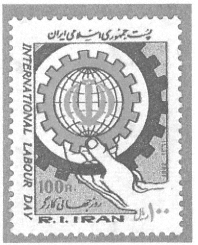
Figure 10.
May Day stamp (1982).
councils took over the task of holding annual May Day meetings. In some years, they have been helped by armed volunteers — especially by the Revolutionary Guards.
The regime has contained May Day by moving the event from the streets into confined spaces — first into public squares and university campuses; then into sports stadiums, as in the days of the shah; and finally, after Khomeini's death, into his large, covered mausoleum. The earlier events were processions and happy celebrations in which workers actively participated in flexing their political muscle. The later ones were solemn and tightly controlled shows in which the workers were bused in by the Revolutionary Guards to passively listen to government officials. The former reflected the influence of society over the state; the latter reflected the power of the state over society.
The regime has sanitized May Day in a number of ways. It has increasingly labeled it Workers' and Teachers' Day, giving added prominence to Motahhari's martyrdom. It has eliminated the more radical demands: the right to strike, equal pay for equal work, and the nationalization of foreign trade and large enterprises. By the late 1980s the predominant theme was the need to mobilize the population against "American imperialism and Iraqi
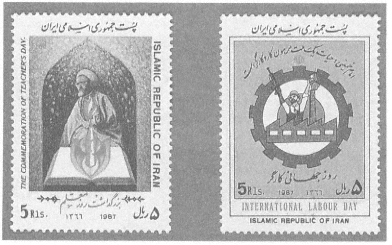
Figure 11.
Stamps for Workers-Teachers' Day (1987). The teachers' stamp
depicts Ayatollah Motahhari.
fascism," although the importance of raising literacy and "spirituality" among the working class was also acknowledged. The only radical demand left was the need for a new labor law. In addition, some government spokesmen have claimed that the Marxists have intentionally ignored the importance of religion to nineteenth-century American labor organizers.[67] Government newspapers have given a religious coloring to the early May Days in America by translating the Knights of Labor as the Pasdaran-e Kar (Guardians of Labor).[68]
The regime has also done its best to minimize the importance of May Day. The official calendar ignores the day even though it enumerates over thirty public holidays, including Ramazan, Moharram, the Iranian New Year, the birthdays of the Prophet Mohammad and Imam Sadeq, and the anniversaries of the Islamic Republic, the Islamic Revolution, and the 1963 June Uprising. Some prominent clerics have suggested that Workers' Day should be moved to coincide with the birthday of the Hidden Imam (Mahdi).[69] By the late 1980s May Day meetings were being held in the late afternoon so that factories would not lose
working hours. Government papers have drastically cut their coverage. In the early 1980s they had allocated most of their front pages for the occasion and issued special supplements. By the late 1980s they were printing no more than brief inside stories and, in some years, allocating more space to Motahhari than to Workers' Day.[70] Also, the regime has tended to organize May Days only in the capital.
The decline in the importance of May Day can be clearly traced in official pronouncements. Khomeini made his last May Day speech in 1982. In it, he hailed workers and peasants as the "country's two strong arms"; described the Prophet Mohammad and Imams Ali, Sadeq, and Baqer as hardworking "manual laborers"; and noted that the Prophet had respected physical work so much that he had kissed the calloused hands of poor toilers.[71] He repeated an old hadith in which the Prophet had declared, "The sweat of a laborer is as valuable [in the eyes of God] as the blood of the martyr." He also drew sharp distinctions between manual laborers, who enjoyed "physical" and "spiritual" happiness because of their hard work and frugality, and "capitalists," who lived in moral and corporal "sin" because of sloth, boredom, gluttony, and oversleeping. "One day in the life of a worker is more valuable than the whole life of a capitalist." This was probably the most populist of all his speeches. By the mid-1980s, however, Khomeini was leaving May Day speeches to his president and prime minister, and by the late 1980s the president and prime minister were delegating them to the labor minister and the chairman of Workers' House.
The metamorphoses of the event can be seen best in 1990. The May Day meeting was held inside Khomeini's mausoleum in the afternoon. The participants, mostly male workers, were bused in from their factories. The audience did not participate but sat listening to a series of official speeches. They cheered at the appropriate places, especially when one of the speakers declared, "God is a worker." The speakers sprinkled their talks with the fatalistic term inshallah (God willing). At the end of the meeting, the audience endorsed by public acclamation resolutions that reaffirmed support for the Islamic Republic, promised an increase in produc-
tivity, and asserted the need for work projects, unemployment benefits, literacy programs, and, most significant of all, the passage of the long-awaited labor law. The fact that the Islamic Republic, even after eleven years, still had no labor law indicated the nature of the regime's populism: a great deal of radical rhetoric but little concrete action in terms of improving workers' living conditions. Even radical symbols had been drained of their potency: instead of the simple but vibrant red carnation, the official newspapers carried pictures of vased and elaborate bouquets — the type found in funeral parlors and bourgeois homes. That evening a Workers' Theater Group performed a play entitled Every Day Is Like Every Other Day. May Day had been tamed. But the fact that it has survived, even in this tamed form, reflects the symbolic strength of the leftist tradition in modern Iran.