
Chapter 4
The "Entirely Spanish Art" Returns to Its Homeland
1795–1805
Something similar to what occurs in our foreign trade has happened to us Spaniards, when giving the abundant and essential raw materials of our soil, we later receive them manufactured by the greater industry and application of those who purchased them
.—José Miguel Alea
By the late 1700s, the country that had once set the pace in deaf education had considerable catching up to do. 'The end of the eighteenth century and the beginning of the nineteenth saw a renewed interest in what Andrés Morell had termed the "entirely Spanish art." A state-sponsored class for deaf children was soon succeeded by a more ambitious establishment, the Royal School for Deaf-Mutes, which was destined to become the nation's premier institution of its kind. The opening of public schools for deaf students was in keeping with the nation's widespread belief in the redemptive value of education, and the growing realization that deaf people could be educated.
During the latter decades of the 1700s, history recorded occasional instances of deaf Spaniards who were educated privately—indeed, two such individuals would arrive at the Spanish capital in the mid 1790s[1] — but it was not until the final years of the 1700s that the first school for deaf students was created. The directive came from Charles IV himself, although the secretary of state and royal favorite Manuel Godoy, called the "Prince of Peace," would later claim that the idea had originated with him, and that it was he who had first broached the subject to the
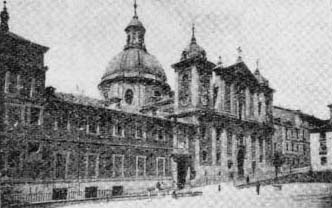
Figure 9.
Piarist School of San Fernando on the Calle del Mesón
de Paredes. From Miguel Granell y Forcadell, Historia de la enseñanza
del Colegio Nacional de Sordomudos desde el año 1794 al
1932 (Madrid: Colegio Nacional de Sordomudos, 1932). Biblioteca
Nacional, Madrid.
monarch.[2] But be that as it may, in the fall of 1793 the king, upon learning that the Piarist father José Fernández Navarrete de Santa Bárbara was in the Spanish court, determined that the priest should dedicate himself to deaf education. The following spring Charles IV, "with an eye to facilitating and extending such an important teaching to this unfortunate portion of humanity," decreed the establishment of a class for deaf children, to be housed in a school run by the Piarist fathers, and taught by Fernández Navarrete.[3] And in 1795, the same year in which Hervás y Panduro's Escuela española de sordomudos was published in Madrid, Navarrete began his teaching at the Piarist school of San Fernando, located on Mesón de Paredes, in the Lavapiés district.[4] Father Navarrete, like Hervás, could ultimately trace his training back to Charles-Michel de l'Epée, for Navarrete too had spent some years in Rome, where he had studied under de l'Epée's Italian disciple, the abbé Silvestri.[5] (Indeed, Navarrete and Hervás may well have crossed paths there.)
Shortly after Navarrete welcomed his first pupils, another Spaniard also revealed an interest in the teaching. This was José Miguel Alea Abadía, an abate (unbeneficed clergyman of minor orders) and a man of letters who was destined to become a champion of Spanish deaf people.[6] In a 1795 letter to the newspaper Diario de Madrid, Alea attempted to rally public support for deaf education in general and for Navarrete's
school in particular. Instruction there was open to the public, for Charles IV had decreed that "all mutes who wish to learn" could go to the priest's class,[7] but at least initially, very few took the king up on his offer. Some months after Navarrete had begun the lessons, Alea wrote that "the deaf-mutes of this court do not attend the ... school." So far, he related, the priest had had but two disciples, both of whom had left after one or two months, "although with a fair amount of progress for such a short time," he hastened to add. The explanation, Alea hypothesized, was to be found in "the poverty of their parents," for most deaf children came from poor families that could ill afford offspring who did not contribute their share of domestic labor. Thus, one of Navarrete's students, the son of an esparto grass weaver residing in Madrid, had been obliged to return to his father's workshop in order to earn a living.[8] Alea also pointed to another possible reason for the dearth of students, namely, public concern about the "safety and certainty of the principles of the art."[9] Apparently by this time the teaching had fallen into such disuse that Spaniards now viewed with suspicion and mistrust the very training that had first brought fame to their nation some two and a half centuries earlier. Thus it seems that economic necessity, coupled with apprehension about this instruction, kept most potential scholars away from class.
In addition to his account of Navarrete's school, Alea also included in his letter a brief history of deaf education—proclaiming it to be of Spanish origin, of course—and he related the story of Gregorio de Santa Fe, an educated deaf youth of his acquaintance who was twenty-two years old. Young Santa Fe told Alea that he had been born in Huesca, in the present-day province of Aragon, in northeastern Spain, and that his father, Pedro Santa Fe, had been secretary to the Inquisition of Saragossa. Gregorio was deaf from birth. He had been taught, he said, by one Diego Vidal, who had been residing at the convent of the Piarist school of Santo Tomás, in Saragossa. Vidal, according to Gregorio, had been a Jesuit and he had previously lived in Bologna. He had been raised in the same household with the deaf boy's father, and because of the close ties between the two men, Vidal had agreed to teach his friend's son. From the time Gregorio was five until he was ten and a half, the tutor had instructed him clandestinely at his pupil's home, never revealing to anyone at the school of Santo Tomás that he possessed this ability. The secretive ex-Jesuit had died an anonymous death in Andalusia, around 1791.
Gregorio Santa Fe further explained that both his parents were deceased. Poverty, he said, had forced him to abandon Saragossa, and
two months before Alea published his story in the press, he had made his way in desperation to the Spanish court. There he hoped to present himself to the king, win the royal compassion, and thus secure a pension that would allow him to study drawing and painting, for which he had a natural talent. When he arrived in Madrid, he knew Christian doctrine perfectly, he could write fairly well but was none too good at spelling—after all, more than a decade had elapsed since he had last been under Vidal's tutelage—and according to Alea, he had "a gigantic talent for anything and everything one might wish to teach him, and I don't doubt that he would be a good painter, if his situation were less uncomfortable, so he could give himself freely to the exercise of this liberal art."[10]
Alea and young Gregorio first met, oddly enough, at the theater, one of the few amusements available in an otherwise uninteresting capital—it was reputed to be Europe's dullest—where the court resided but a few weeks out of the year.[11] ("Social life here does not offer those interesting resources which we find in France, England, and Germany," lamented one foreign visitor, who encountered in Madrid "nothing but plays, bull-fights, promenades, and tertulias .")[12] As Alea explained, "Since the diversion which in the court first attracts any visitor's attention is the theater, Gregorio Santa Fe turned up there, and naturally the spectators began to notice, because of the movements and gestures he made, that he understood everything that was said in the play." One might well ask how a deaf person could possibly comprehend what was uttered on the stage—indeed, one might wonder whether such a person was really deaf at all—and this was precisely Alea's reaction: "I myself have twice witnessed the sensation he experiences, particularly when the actor Querol pronounced some joke or buffoonery corresponding to his role," he wrote, "so that by the gestures of his hands and head, by the signs of approval or disapproval made at the right time, by his laughter or frown, depending of what the passage required, I came to believe that he was not deaf but only mute, due to a defect of the tongue."[13]
The young man, as it turned out, actually did suffer from a malformation of the tongue, which rendered him unable to speak: "Gregorio is mute," Alea wrote, "because the tip of his tongue is attached to the lower part of his mouth, so that he cannot raise it above his lower teeth." This condition had been with him from birth and was, according to Alea, so "inherent to his organization" that any attempt to sever the lower ligaments could prove fatal, as surgeons consulted during the boy's childhood had informed his father.[14] In addition to his muteness, however, Santa Fc was also completely deaf, as Alea soon discovered
himself: "I did not take long to be undeceived," he recounted, "when having found him a few days later in a home, I was convinced by the testimony of others and by my own experiments that he was as deaf as a mud wall."[15]
The private home in which Alca encountered young Grcgorio was no doubt the scene of a tertulia, or social gathering. Here conversation enlivened the boring social scene of what residents called the villa, or market town, of Madrid. Around this time two rival tertulias convened regularly in the Spanish capital. One was headed by the poet and dramatist Manuel José Quintana, the most enlightened humanist of his day.[16] Quintana's study was, in the words of one participant, the spirited political orator and author Antonio Alcalá Galiano, "the principal meeting place for those Spaniards most noted for their talent and knowledge."[17] The congregants included the poet, journalist, and future religious polemicist José María Blanco White, and the celebrated dramatist, poet, and editor Nicasio Alvarez de Cienfuegos, the poet Juan Nicasio Gallego, the notorious author, critic, and political figure abate Marchena, the writer Eugenio de Tapia, the historian and literary critic Antonio de Capmany, the poet and naval officer Juan Bautista Arriaza, the writer José Somoza, the Andalusian clergyman Manuel María de Arjona y de Cubas, and José Miguel Alea, our public-spirited abate .[18] At Quintana's house Alea was in fast company—indeed, more than one of his companions would eventually run afoul of the Inquisition. According to tertuliano Alcalá Galiano, these men subscribed to "an excess of political and religious liberty"; their ideas, he wrote, were "those of the eighteenth-century French philosophers and of our neighbor nation's revolution, regarding both religion and politics," although he was quick to point out that "not everyone carried things to that extreme."[19] Their conduct, this writer maintained, was "Cultured and decorous, well suited to the master of the house, a dignified and stern man," but another participant, Antonio de Capmany, left a rather different impression, referring to "scandalous and contemptible" poems read there—although he too left Quintana's reputation unscathed.[20]
The rival tertulia was headed by the celebrated poet and playwright Leandro Fernández Moratín, who was a close friend of the Piarist father and deaf educator José Fernández Navarrete.[21] At Moratn's tertulia could be found the writer and critic Pedro Estala, the editor abate Juan Antonio Melón, and the poets and literary critics Juan Tineo and José Gómez Hermosilla.[22] The liberal, reformist politics espoused here did not differ significantly from those of the opposing band—in fact, in the
years to come, many participants would side with the French invaders during their nation's war of independence, among them Estala, Melón, Hermosilla, and Moratín himself. But while Moratín and his devotees curried favor with Charles IV's secretary of state Manuel Godoy, dedicating many of their works to him—indeed, it was widely believed that only Godoy's patronage had prevented the Inquisition from adding Moratín's play La Mojigata to its list of forbidden books[23] —Quintana shunned the royal favorite's patronage and never dedicated a line to him, whence the rivalry between the two groups. Quintana's tacit reproach, according to tertuliano Blanco White, was enough to kindle "a spirit of enmity among the Court literati, which ... breaks out in satire and invective on the appearance of any composition from the pen of Quintana."[24] Although hostility between the two tertulias was fairly open, there were nevertheless at least some men of letters who did not adhere strictly to one group or the other, and had friends—or enemies—in both camps.[25]
The tertulianos ' discussions most often centered on literature, philosophy, politics, and sometimes current events as well, but on the occasion in question it was Gregorio Santa Fe who captured their attention. His deafness notwithstanding, he had appeared to understand the dialogue at the theater, and this fact aroused the abate 's interest, along with that of others present at the tertulia . "This novelty," he wrote, "excited my curiosity, since I could not understand how one deaf from birth could understand what the actors were saying, according to the unequivocal signs he gave during the play. With this doubt, and being unable to explain the cause of this phenomenon by the commonly held belief that those deaf from birth can only understand others by signs, I made up my mind to examine him; but a coincidence saved me the trouble, and [saved] Gregorio Santa Fe the work he would have had in suffering my questions, [which were] too dull-witted and tiresome for his extraordinary comprehension. As it turned out," Alea continued, "one of those in attendance began to ask him questions in a normal conversational tone of voice, and I noted with great wonder that the mute, taking up a pen, answered, as I could do with my five senses. Not only this, but when the same individual wanted to show everyone that Santa Fe was absolutely deaf, he again asked him different questions by only moving his lips, and without any of us hearing what he was saying; Gregorio Santa Fe answered just as appropriately as before" (354).
The experiment did not end here, however, for Alea soon recounted the events of the tertulia to a friend, who naturally wanted to see for
himself, and so the two again sought out Gregorio. The unidentified companion performed several tests before proceeding to administer the last and most difficult one, which was to dictate a letter to the youth, in the presence of Alca and several others. To their great amazement, Gregorio wrote down the words of the dictation, passing the examination with flying colors.
Their taste for experiments still not satisfied, the following day the two friends took Santa Fe to Father Fernández Navarrete, the teacher of the fledgling class for deaf children. After examining the lad, Navarrete was, as Alca put it, "as astonished as we were, and he confessed with the candor typical of his profession and of all men of talent ... that he himself would very gladly become Grcgorio Santa Fe's disciple, if he wanted to teach him the principles of the labial alphabet he used to understand others" (355).
Alea made one more visit with Grcgorio, this time to the home of a man he identified only as the "individual the abbé de l'Epée refers to in his manual as one of the most advanced in the understanding of his methodical signs; although he is neither deaf nor mute, and [he studies] only out of mere interest and curiosity" (360). This unnamed Spaniard must have been Francisco Angulo, from whom Alea confessed he hoped to learn about the French method first hand. (During his stay in Paris, Angulo had enjoyed a close relationship with de l'Epée, so much so that the abbé had allowed him to be present during his audience with Joseph II, the Holy Roman Emperor, who had traveled incognito to visit the Paris school; the Spaniard also sat in on his mentor's meeting with the celebrated philosopher Condillac, who had wished to learn about the abbés teaching.) Together Alea and Angulo put young Gregorio through his paces, and like the others before him, this trusted follower of the French educator was astounded at the youth's lipreading abilities. "After testing him repeatedly," Alea wrote, "he confessed to me at last that neither among the disciples of de l'Epée nor in any other country had he found a deaf person so skilled in the art of understanding by the movement of the lips as our Gregorio Santa Fe," and bearing in mind that Father Vidal had employed only five and a half years in teaching him to read, write, and lip-read, Angulo pronounced the young man's abilities to be "prodigious and unheard of" (360, 361).
Alea realized, of course, that Grcgorio was not the only deaf person capable of lipreading, for he was aware that de l'Epée had on occasion given his students oral dictation unaided by the use of signs, and Alea
himself knew of "many [untaught] deaf-mutes" who could by studying the movement of the lips make out the gist of a conversation (357, 358). But "the ability of Gregorio Santa Fe's teacher is infinitely superior," the abate insisted—mistakenly attributing the achievement not to Gregorio's own talent but to instruction—because the deaf lad could understand anyone who addressed him, even if he had never met him before, or if the speaker made no special effort to articulate clearly, or talked rapidly or indistinctly. Moreover, Gregorio could make out a conversation from a considerable distance and write it all down word for word, "land in this," Alea maintained, "he exceeds those who are endowed with all five senses." Indeed, the youth's ability was truly amazing, for he could lip-read a person who, at a distance and with his back to him, spoke facing a mirror, he could write down from the movement of the lips words dictated in English or Greek, and on and on. Dazzled by Gregorio's proficiency at lipreading, Alea concluded that this skill was "much more useful than all that has been invented up until now" (356).
The author of these lines may have been unaware of the limitations of lipreading, for instance, the impossibility of following a conversation in poor lighting conditions, or if the interlocutor turns his head away, or speaks from a distance, or if two or more people talk at once. And even under the best conditions many aspects of articulation are simply not visible—English pan, bad, and mat, for example, may all look alike on the lips, as may Spanish paja (straw), vaca (cow), and maga (female magician). Much of lipreading is a matter of intelligent guesswork, which in turn must be grounded in a thorough knowledge of the grammar of the language—its phonology, morphology, syntax, and semantics—for unfamiliar words and constructions cannot be meaningfully interpreted, and persons deafened later in life and those with greater degrees of residual hearing are obviously at an advantage over persons deaf from birth or with little residual hearing.
What strategy underlay Gregorio's extraordinary competence? Alea described it as follows: "When I speak to him he makes the same lip movements I do and furthermore he repeats them to himself before replying in writing; and when I told him one day not to move his lips when I spoke to him, he replied that without performing this activity he would understand nothing." The abate, of course, could not resist putting Gregorio to the test: "On another occasion when I was moving my lips as if I were saying something, but in reality without pronouncing any letter or syllable, he recognized the deceit at once and he let me
know, with a kind of resentment because of the trickery, that I should say something if I wanted him to answer me" (357).
When asked how he had been instructed, Gregorio explained that in the beginning, Vidal had taught him using the Englishman Wallis's methods—once again, the influence from abroad—and had also used certain principles that the pupil would not disclose. Alea conjectured that Vidal had "perfected the labial alphabet, which must be a fixed and invariable alphabet as is the manual one for the deaf or the written one ... for us [hearing people]."[26] Asked if he himself would teach other deaf students with Vidal's approach, Gregorio said he would, provided they did as he said and applied themselves. But when pressed for details of the method, the youth made clear that he would divulge them to no one, adding cryptically, "Father Vidal taught me with a subtle idea, which is easy" (357).
History does not reveal what became of Gregorio Santa Fe after publication of Alea's account. The abate donated the profits from his letter, which because of its length was published as a special supplement to the Diario de Madrid, to assist the deaf youth, and at the time the letter went to press, Gregorio had been taken in by the curious friend who together with Alea had subjected him to so many experiments, and this unnamed benefactor was making every effort to find employment for his protégé. But in the years to come apparently no one, neither José Miguel Alea nor anyone else, would write another word about Gregorio Santa Fe or his mysterious teacher—perhaps because the deaf orphan's tale was, simply, a tale.
For one thing, Gregorio claimed that Diego Vidal had been a Jesuit, and that he had been living in the Piarist convent of Santo Tomás in Saragossa. But there is no record of any Diego Vidal having entered the Society of Jesus, or of his having resided at the convent of Santo Tomás.[27] Perhaps most important, if he had actually been a Jesuit, he could not have been in Spain at all. The society had been expelled in 1767 and disbanded in 1773, and although its members were able to return—albeit briefly—in 1798, none of the Jesuits who went to Italy following the expulsion were permitted in Spain during the years when Vidal supposedly taught Gregorio, not even those who left the order with the hope of being allowed back. It follows, then, that if Vidal was in Saragossa teaching Gregorio Santa Fe during the late 1770s and the early 1780s, or if he died in Andalusia around 1791, as his disciple claimed, he could not have been a Jesuit.[28]
Young Gregorio also stated that his father, Pedro Santa Fe, had been a secretary to the Inquisition in Saragossa; if so, he would hardly have dared entrust the education of his son to an ex-Jesuit at a time when former affiliates of the disbanded order were banned from Spain. Moreover, the name of Pedro Santa Fe is nowhere to be found among the lists of appointments to the Holy Office of Aragon.[29] And small wonder, for it is virtually impossible that anyone by the name of Santa Fc would have been employed by the Inquisition, and especially in Saragossa.[30] In 1483, some three hundred years before Gregorio's instruction, King Ferdinand had extended the control of the Castilian Inquisition in Saragossa, despite the opposition of the many wealthy and influential Jewish conversos, or New Christians, living there.[31] Prominent conversos of that city, whether secret Judaizers or not, justifiably feared the threat the Inquisition posed to their well-being and to their very existence. Unlike Jews and Muslims, they were subject to the Inquisition and were frequently prosecuted for apostasy; if convicted, their property was routinely confiscated. Thus, they hatched a plot to assassinate Pedro Arbués de Epila, canon of the cathedral of Saragossa, and the head—and heart—of the tribunal in Saragossa.[32] y The conspirators included many of Aragon's most important and influential citizens, among them a certain Francisco Santa Fe, counselor to the governor of Aragon and son of the famed converso and anti-Jewish demagogue Jerónimo de Santa Fe.[33]
On the night of September 15, 1485, Pedro Arbués knelt in prayer before the main altar of Saragossa's La Sco cathedral. Eight paid assassins stole up behind him, hesitating momentarily until one of them, Abadia, shouted, "Get him, traitor, that's him!" The inquisitor had been warned of a possible converso plot against his life—whence the steel cap and coat of mail he wore beneath his robe for protection, and the knife he kept nearby—but these measures proved futile against his attackers. One of the assailants, Vidal Durango, struck him a blow to the back of the neck, cleaving it from nape to chin, and Arbués died two days later.[34] In retaliation the Inquisition unleashed a wave of repression against converso families involved in the treachery. The actual assassins were put to death, their accomplices were subject to a succession of autos-da-fé, and for years to come the tribunal did virtually as it pleased with large numbers of New Christians, crushing some of the most powerful families of Aragon.[35] As for Francisco Santa Fe, he gained even further notoriety when he hurled himself from a tower of the Aljafería, the ancient
Moorish palace where he was imprisoned, dying in the act, and thus cheating the Inquisition.[36]
Although these events had occurred some three centuries earlier, in the Saragossa of Gregorio's day anyone by the name of Santa Fe would still be recognized as of converso descent and could not be in the employ of the Inquisition, for that body demanded of its members limpieza de sangre (purity of the bloodline), and New Christians, whether of Jewish or Moorish descent, were forever stained.[37] Knowledge that Santa Fe was a converso last name had been kept alive and passed from generation to generation, thanks in no small part to the Libro verde de Aragón, Aragon's "green book," a genealogy compiled in the early sixteenth century by an assessor to the Inquisition of Saragossa.[38] The manuscript named the Jewish ancestors of many of Aragon's leading families, documenting their converso "taint" to perpetuate the memory of their Jewish heritage, and to "inform those who do not wish to mingle their purity with them."[39] The author recorded, for instance, how a Jew by the name of "Ravi Vsualurguin" (that is, Rabbi Joshua haLorqui) had changed his name to Jerónimo de Santa Fe—Jews who converted to Catholicism often changed their names at baptism, frequently taking for their surname the name of a Christian saint—and how his son Francisco had been condemned by the Inquisition and had committed suicide.[40] But even without a libro verde such things were not easily forgotten, as Blanco White, who rubbed shoulders with Alea at Quintana's tertulla, explained: "Knowledge of such a fact [does not] die away in the course of years, or become unnoticed from the obscurity and humbleness of the parties," he wrote, citing by way of illustration a family of Jewish descent in Seville that had long before run afoul of the Holy Office. "Not a child in this populous city is ignorant that a family, who, beyond the memory of man, have kept a confectioner's shop in the central part of the town, had one of their ancestors punished by the Inquisition for a relapse into Judaism," he wrote.[41]
Thus, Santa Fe was a known converso last name and a notorious one at that, for the Libro verde, aided by a relentless oral tradition, kept alive the memory of Jewish ancestry, and along with it, Francisco Santa Fe's complicity in the Arbués assassination, and his subsequent condemnation and suicide. It follows, then, that Pedro Santa Fe could not have been a secretary to the Inquisition, and it is therefore not surprising that we find no record of his having been employed by the Holy Office. So why would Gregorio have fabricated the story that his father was a sec-
retary to the Inquisition? Quite possibly, to assuage the fears of a superstitious populace; if so, this demonstrates once again the suspicion with which the Spanish public had come to regard educated deaf-mutes and any method capable of achieving their instruction.[42] These same attitudes may also serve to explain the extreme secrecy surrounding Gregorio's tutor—recall that the deaf youth stated that not even Vidal's companions at the convent of Santo Tomás knew that he possessed the art, and that he was teaching a deaf child.
There is another reason why Diego Vidal might have been looked upon with suspicion in Saragossa, and thus felt the need to labor clandestinely. The last name Vidal, a calque of the Hebrew word chaim, meaning "life," is probably indicative of Jewish origin. And the assailant who had severed Pedro Arbués's neck three centuries earlier was named Vidal Durango, so in Saragossa the surname Vidal, like Santa Fe, was most likely still linked in the public mind to the inquisitor's assassination, even in Gregorio's day. Moreover, the Libro verde dutifully recorded that the name Vidal was of Jewish origin, and that more than one Vidal had been condemned by the Inquisition. Pedro Santa Fe, Gregorio's father, and Diego Vidal, his tutor, had more in common than merely having grown up together, then, for both men were of converso descent, and both bore notorious surnames. Thus in the second half of the eighteenth century two members of society's outcast groups, the New Christian Diego Vidal and the Jew Jacobo Pereira, both sought to teach those of another marginal group, deaf people.[43]
So the story Gregorio related to José Miguel Alea was, in all probability, not entirely true. The importance of their fortuitous encounter should not be underestimated, however, for it seems to have sparked Alea's interest in the topic of deaf education. This instruction, he now proclaimed, was a topic "worthy of occupying the pen of an honest man." Throughout his writings Alea would express his concern for the cause of education, for the betterment of the less privileged classes, and for the common good, concerns he shared with other members of Spain's enlightened elite, and thus he admonished readers of his letter to the Diario, "If you, or any other man of letters, finds stronger arguments than mine to persuade the Spanish Public of the importance of this invention, do so without delay, for I shall be the first to celebrate it. The object of an honorable man's ambition must always be the common good, and if it is not, ambition ceases to be noble and degenerates into egoism."[44] In the years to come the altruistic abate would play a key role in the education of deaf Spaniards.
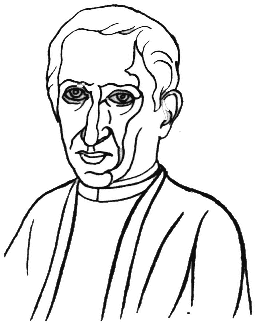
Figure 10.
José Fernández Navarrete. From
Miguel Granell y Forcadell, Historia de la enseñanza
del Colegio Nacional de Sordomudos desde el
año 1794 al 1932 (Madrid: Colegio Nacional de
Sordomudos, 1932). Biblioteca Nacional,
Madrid.
In June 1802 a royal decree sent Father Fernández Navarrete to Almendralejo, in what is now the province of Extremadura, to teach Lorenzo Golfín, the deaf son of the marquis of Encomienda.[45] Spain's first state-sponsored public class for deaf students now closed its doors, and in Barcelona, too, the municipal school had folded earlier that same year when the teacher, Juan Albert y Martí, had returned to France.[46] The number of trained educators of deaf children in Spain at this time could apparently be counted on the fingers of one hand, and when one departed it was no easy matter to replace him. This paucity of knowledgeable instructors combined with a general lack of funding to guarantee that the existence of these first establishments would be always precarious. With the schools in Madrid and Barcelona shut down, deaf education was once again confined to wealthy families with private tutors.
But not for long. In the fall of 1801, a certain Antoine-Joseph Rouyer had approached Madrid's Royal Economic Society of Friends of the Country with a plan to establish a school for deaf children.[47] His proposal would soon return their teaching to the public domain. Rouyer, who years later would characterize himself as a "tolerant Christian, a moderate citizen, and a liberal Frenchman,"[48] had been born in Paris, but he had lived most his life in Spain, where his father held the post of royal dentist.[49] A graduate of the University of Paris, he had studied with de l'Epée's successor, the abbé Roch-Ambroise Sicard—when it came to deaf education in Spain at this time, all roads led back to the Paris school, so it seemed—and he was, like the French abbés, a grammarian, and he was also interested in the invention of a universal writing system.[50] Early in the 1790s he had gone to Spain with the intention of founding a school for deaf students there, supporting himself in the meantime by teaching French and working as a dentist. When his efforts to open a school proved unsuccessful, he sought the support of the Friends of the Country.[51]
The society received the Frenchman's proposal with interest. This organization, which enjoyed the patronage of the crown, sought to promote the nation's economic and cultural prosperity through the development of science, agriculture, and industry, and in so doing it afforded local notables the opportunity to "contribute to the happiness of the kingdom."[52] Members constituted an enlightened, reform-minded elite who busied themselves setting up model farms, introducing new crops, supporting local industries, and above all, promoting education. The society's motto was Socorre enseñando, "Help by teaching." There existed in Spain during this era an abiding faith in education as a panacea for all the nation's ills, although of course instructional goals were conceived differently by different segments of the population. True to their motto, the Friends of the Country had already founded various "patriotic schools," whose purpose was to teach students reading, writing, and arithmetic, along with a trade, for instance, spinning and weaving, stenography, or embroidery.[53] Targeted for this occupational training were society's most marginal groups—vagrant children, beggars, delinquents, and the like—who the Friends of the Country aspired to transform into useful citizens. It was only natural, then, that they should look with sympathy upon another outcast group, deaf people, believing that they too could be redeemed through education. While in France and various other European nations teachers of this period were often affiliated with the Church and interested primarily in
saving deaf souls, the principal concern of the Friends of the Country was the formation of productive subjects who would contribute to the economic and social well-being of the realm. Establishment of an institution for deaf children, soon to be known as the Royal School for Deaf—Mutes, was in perfect keeping with the society's other educational activities, then, and indeed with the mood of the entire kingdom.[54] The teaching that had begun in monasteries some two and a half centuries earlier and was subsequently entrusted to private tutors was about to come under the direction of a public-spirited society, and to be bankrolled by the Spanish state.
Foundation of schools such as the one the Economic Society now agreed to sponsor was important because it underscored a shift in consciousness regarding deaf people: the acknowledgment that such individuals could indeed benefit from instruction. Deaf people had long been considered ineducable, irrational, little more than animals, and they were frequently regarded with fear and suspicion and passed over for even the most menial types of labor.[55] "In their actions they look like men, but in their ideas they differ little from the beasts," the Diario de Madrid had editorialized in 1795, adding that they were "useless and injurious to Society, which cannot employ them in any capacity that requires ideas." But the Diario, in step with the times, left no doubt as to where the solution lay: "Mutes leave this miserable state by way of instruction," the newspaper assured its readers.[56]
The opening of schools for deaf people was important for another reason as well. With the creation of such establishments, Spain broke with its long tradition of catering exclusively to the needs of deaf sons (and an occasional daughter) of privilege—whether in monasteries or in aristocratic households—and focused instead on deaf children from the lower class.[57] Poor deaf people in particular had been subject to the negative stereotyping exemplified by the Diario 's remarks—deaf aristocrats, although surely not viewed as equals by hearing people, were no doubt less stigmatized—for people from the humbler classes were seen as the perpetual inferiors of the wealthy, and this was no less true of lower-class deaf-mutes. Yet now, for the first time, they too would have the chance to obtain an education.
Before the opening of their schools, deaf individuals—even those affluent few whose families could afford a tutor—had often been condemned to lives of isolation. But now the Royal School would gather together deaf subjects from all over the kingdom, creating the necessary conditions for them to coalesce into a social group and to form an
authentic community in which deaf youths would be educated and trained to become contributing members of society, and their language and culture would develop, evolve, and flourish.[58] Deaf children, some of whom had never seen another deaf person in their lives, would be brought together there, and when the deaf sons and daughters of hearing parents—some 90 percent of the deaf population—arrived at school, the rude pantomime that had served as a stopgap to communicate with parents, siblings, and neighbors would blossom into a real language, which newcomers would learn from children of deaf families and from older classmates. The fact that deaf offspring of hearing parents often acquire their language and culture primarily from other deaf children sets them apart from their hearing counterparts, in whose families language and traditions are generally passed from parent to child, and it is at their schools that this transmission of their linguistic and cultural heritage can take place. Hence, the centrality of these establishments to the deaf community.
A nineteenth-century American traveler to Madrid left us the following vignette of a deaf Spanish beggar: "The road from the Gate of the Sun to the library was the habitual stand of a young man, a deaf mute who sat cross-legged in a gray capote with his hat before him and a bell in his hand.... He took no notice of those who gave to him, but sat ringing his bell and uttering sounds which, as he knew not how to modulate them so as to strike a tone of supplication, came harshly upon the ear, like nothing so much as the moans sent forth by the wounded victims of the arena." The traveler wrote that the young man's character seemed "tinged ... with a degree of brutal ferocity," and this he attributed to "the sense of his misfortune, of his complete separation from the rest of the human family."[59] Now, with the foundation of Madrid's Royal School for Deaf-Mutes, deaf people's "separation from the rest of the human family" would come to an end, and they would be ushered into the human circle.
But several years would pass before the circle accommodated them. The Friends of the Country, upon receiving Antoine Rouyer's proposal, first interviewed the Frenchman and corresponded with his mentor, the abbé Sicard, then broached the subject to Charles IV to obtain the royal assent. Rouyer was named head teacher of the future school, and in the spring of 1802 he was sent back to Paris to perfect his skills under Sicard's tutelage. Father Fernández Navarrete, who was at this time still teaching at the Piarists' school, wanted to accompany Rouyer, but his petition was denied because of the "irreconcilable enmity" the Friends
of the Country had observed between the two men; for whatever reason, they were "implacable enemies" who "hated each other with all their hearts."[60] Rouyer wrote from the French capital in the summer of 1802 that he was attending classes daily, as well as going to public demonstrations. Sicard had further refined de l'Epée's system of methodical signs, and his lessons, Rouyer opined, were "lucid and brilliant." The enthusiastic disciple gave thanks to God that he would be able to establish such a school "in a country I love as much as my own"; his dream, however, was not to be realized.[61]
The Spanish crown had agreed to fund the Royal School with monies from the bishoprics of Cadiz and Sigüenza—an arrangement that would prove problematic—but the original allocation was soon reduced by half, so the Friends of the Country were forced to scale down their earlier plans.[62] Determined that the school should open despite financial difficulties, members of the commission charged with its establishment hit upon a way to make do with but 50 percent of the previously anticipated sum: they reduced the number of students proportionately, along with the number of employees and their respective salaries. They reasoned that with half as many pupils, the head teacher and his assistant would have but half the work, so they could be paid accordingly—that is, half the amount originally agreed upon.[63] The Friends of the Country were eager to open the new school—by this time more than two years had passed since Rouyer's initial contact—and they now summoned to Madrid their designated head teacher, who returned from Paris over Sicard's objections.[64] But when presented with the revised conditions of employment, Rouyer, not surprisingly, rejected them. He interpreted the new terms as an "indirect insinuation that he should resign his position," and in January 1804 he did just that.[65]
A salary dispute had culminated in Rouyer's departure, but the Friends of the Country would not be long without a teacher, for one Juan de Dios Loftus y Bazán was already waiting in the wings. In the winter of 1803 Loftus, an infantry captain brevetted to lieutenant colonel, had written to the Economic Society from his post in Ceuta, where for the previous six months he had been teaching a deaf child, nine-year-old Juan Machado. In his letter Loftus stated that his pupil, who he would later refer to as a "living document" of his teacher's competence, already knew the meaning of 1,083 nouns, which he could write upon seeing the appropriate sign or the referent itself, and he could count to 100.[66] At that point the society already had a teacher, Antoine Rouyer (then still with Sicard in Paris), but the members thanked Lof-
tus and asked him to keep them apprised of his student's progress. When the lieutenant colonel wrote again in the summer of 1803, it was to request that he be named head teacher. He was told that the position was not vacant, but when Rouyer resigned some months later, the Friends of the Country proposed to Charles IV that Loftus be appointed in his stead. Their petition was denied, in a royal order that alluded to "just causes."[67] At that point Loftus revealed what he supposed to be the reason for the royal refusal, namely, an embezzlement of which he had been accused in his former regiment. While acknowledging the truth of the charge, the would-be teacher was repentant and averred that he had mended his ways.[68] With the society's continuing support, Loftus's appointment finally won the king's approval in the fall of 1804.[69]
When we consider the nationalistic mood of the times, we begin to understand why the Friends of the Country were eager to hire a confessed embezzler. The art of teaching deaf people to talk had originated in Spain in the mid-1500s, yet two and a half centuries later the Friends of the Country had been obliged to import the teaching expertise from abroad—although in 1802 Rouyer had offered his assurances that he would never allow foreign teachers at the Royal School.[70] Members were on record as being loath to "find themselves in the hard necessity of begging among foreigners, when it came time to look for a teacher," and even while Rouyer was still officially in their employ, they had made discreet inquiries as to whether Spain had among its subjects accomplished educators of deaf people.[71] So when presented with the opportunity to replace a French disciple of Sicard with a native son, this enlightened body threw caution to the winds and entrusted instruction at the Royal School to Lieutenant Colonel Loftus y Bazán. As if to underscore their questionable judgment, they then promptly hired Angel Machado, the father of Loftus's prize student, as teaching assistant.[72] The senior Machado was also a military man, a second lieutenant, and like Loftus, he too had been embroiled in the embezzlement of his regiment, but this fact did not deter the Friends of the Country.[73] After all, these two were not just any embezzlers, they were Spanish embezzlers.
On January 9, 1805, Madrid's Royal School for Deaf-Mutes opened at number two on the Calle de las Rejas, under the direction of the Friends of the Country.[74] (Around this same time the public instruction of deaf people was resurrected in Barcelona as well.)[75] The inauguration was
conducted with fitting pomp and celebration, and among the invitees to the opening ceremonies were Secretary of State Manuel Godoy, who was then director of the Economic Society, the archbishop of Toledo, and the count of Montarco. The duke of Osuna read the inaugural address, after which five of the school's six students were introduced—all boys, for it would be decades before girls would be admitted, although the desire to educate both sexes was present from the beginning.[76] Then Lieutenant Colonel Loftus proceeded to examine his star pupil, Juan Machado, before the assembled public. By this time young Machado had progressed considerably. He could write some thousand nouns and five hundred adjectives and form their plurals, he could conjugate some four hundred verbs, he knew the parts of speech, the days of the week, and the months of the year, he had mastered the units of time from a second to a century, he knew Arabic and Roman numerals and some arithmetic.[77] Loftus had taught the boy some speech as well, and he could now pronounce the five vowels of the Spanish language plus the consonants p, b, t, and d, and read a list of thirty words.
By the time the school opened, the commission responsible for its establishment had been replaced by a governing board, composed of the director of the Economic Society and eight others. This body, which convened on Sunday mornings, would maintain considerable control over the school and play an active role in day-to-day affairs—an arrangement that would soon lead to friction between its members and head teacher Loftus. Within the board's purview was the hiring and firing of employees and the admission and expulsion of students, as well as oversight of instruction and supervision of all who worked at the school—including the head teacher. Each week a different member was designated as the socio semanero, or "member of the week," responsible for seeing that all was in order at the school and that employees fulfilled their obligations "at all hours."[78] It fell to the head teacher to implement the instruction and to discipline unruly scholars as he saw fit, but if the measures he took to curb misconduct proved insufficient, the next step was up to the governing board, for teacher and students alike were expected to submit to its higher authority.[79]
From its inception, the school provided for various kinds of students. The Reglamento (governing rule) of 1804 stipulated that six disciples between the ages of six and twelve would be maintained at the society's expense, but paying students were also welcome. In its desire to reach as many as possible, the school also accepted day students, who might attend for free or for a fee, as their circumstances warranted. Tuition for
paying residential students was fifteen reales per day—more than at Madrid's prestigious Seminario de Nobles—and for day students whose families could afford it, tuition was 100 reales per month.[80] As was customary for the era, well-to-do and poor pupils were treated differently, in accord with the respective positions they were expected to assume in society. Paying and nonpaying boarders were housed in separate quarters, as it was commonly held that upper-class children should not mingle with those of the lower classes, lest they acquire bad habits. Meals for paying students were as in well-to-do families—hot chocolate for breakfast, soup, boiled meat with vegetables, and an entrée at midday, fruit in the afternoon, and stew, salad, and dessert for supper—while nonpaying students' fare was described simply as "more frugal, since it is free."[81] Uniforms for the two classes were different, too. Paying students donned three-piece black woolen dress suits, complete with top hats and dark brown overcoats, for streetwear, and three-piece suits of pale gray wool for use within the school, whereas nonpaying students were attired more humbly in three-piece suits and topcoats of coarse wool, which during summer months they exchanged for suits of dark-colored cotton. The curriculum originally prescribed by the Reglamento made no distinction between paying and nonpaying scholars, but at the suggestion of the king himself, here too different treatment of the two classes became the rule. It was anticipated that wealthy students would eventually ascend to a position in keeping with their families' socioeconomic status, but poor students would have to support themselves, hence, it was decided that this latter group should be trained for a suitable trade, such as printer, lathe operator, shoemaker, or tailor.[82] If the Friends of the Country were to promote the nation's economic well-being, it was logical that they should start with their own deaf charges, by preparing them to be self-sufficient.
Classes convened for three hours in the morning (two of lessons and one of review), and two additional hours in the afternoon (one of lessons and one of review). The curriculum—reading, writing, arithmetic, and Spanish language—was comparable to that of hearing schools.[83] Geometry, geography, and history were also taught to students who were advanced enough to receive such instruction and whose social position required it. When it came to religious education, the Reglamento, as if to emphasize that the authors' foremost concern was the formation of productive citizens, stated only that once a spiritual advisor had been appointed, the specifics of this instruction would be determined in consultation with him.[84]
In choosing its methodology, the Royal School turned its back on the Spanish tradition and adopted the French approach unapologetically. And although the oralistic pedagogy set forth in Bonet's Arte would be reinstituted a decade after the school's inauguration, the first Reglamento contained no reference to the teaching of articulation, and it stated explicitly that the head teacher should employ the methods of the abbés de l'Epée and Sicard, which he might modify according to the dictates of his own experience and observation.[85] Indeed, the Friends of the Country held Sicard in such high esteem that they had made him a socio de mérito (outstanding member) in 1802.[86]
The French approach found one of its strongest proponents in the abate José Miguel Alea, who had championed the deaf youth Gregorio Santa Fe. By the time the Madrid school opened, Alea had added his name to the list of Friends of the Country and had gained a seat on the governing board. (Members who evaluated his application noted that his character was "gentle and beneficent" and that he was widely reputed to possess the "most excellent moral qualities and the greatest intelligence concerning literature.")[87] Appointed socio protector (protective member) of the board of directors and put in charge of theoretical aspects of the teaching, Alea steered the school toward the French methodology, providing copies of de l'Epée and Sicard's instructional manuals and even offering to translate them into Spanish.[88] The society also acquired Sicard's Manuel de l'enfance at Alea's request, another member, Josef Martínez Hervás, donated his Elements de grammaire générale .[89]
Thus when the Madrid institute opened, in keeping with the French method whose use it explicitly required, the school must have employed some sort of methodical signs, that is, some kind of manual translation of Spanish. Whether the actual signs from the Paris school were used in Madrid is an open question, however.[90] Francisco Angulo, to whose home Alea took the deaf youth Santa Fe, had studied under the abbé de l'Epée, but he seems not to have been in contact with the Economic Society when the Royal School was founded; Antoine Rouyer was a disciple of the abbé Sicard but, as we have seen, he never put his knowledge to use at the Madrid school. Lieutenant Colonel Loftus, the first practicing head teacher, most certainly employed signs in the classroom, but it is not clear whose. Two years after the school had opened, however, Loftus's favorite pupil, Juan Machado, explained that his teacher was by then instructing him "according to Sicard's method, different from the one he followed at the beginning."[91] (As for what approach he had used originally, we know only that he claimed to teach
"without methods given by [any] other.")[92] At any rate, whatever French signs might have been introduced in the Madrid establishment would no doubt have mixed rapidly with the children's own native signs.[93]
The teaching of deaf children with methodical signs was consistent with the state's educational policy, dating from the late 1760s, that instruction throughout the realm should be imparted in Castilian Spanish. Methodical Spanish, the system of communication used at the Royal School, was not a minority language on the par with, say, Galician, Basque, or Catalan, but rather, a manual version of the officially mandated tongue. This practice would persist until the 1830s, when the Madrid school would begin educating deaf people in Spanish Sign Language, a natural language with a grammar of its own—once again, in emulation of policies adopted in deaf schools in France.
Why did the Friends of the Country, on founding a state-sponsored school, spurn the oralism of their forefathers in favor of French manualism? Spain had pioneered the oral instruction of deaf people, yet as we have seen, the school's first Reglamento mandated the pedagogy of the Paris institute and made no mention of the teaching of articulation; moreover, the Friends of the Country initially hired a teacher who had been formed by Sicard, then sent him back to his French mentor to perfect his knowledge. Some writers have speculated that the Spanish tradition, and Bonet's Arte along with it, must have been lost in that era, and at least one went so far as to posit that Hervás's book too must have been either forgotten or unknown, but clearly this was not the case.[94] Memory of the Spanish past was alive and well, for Feijóo's writings, with their vindication of Pedro Ponce, were still widely read.[95] And in the years immediately before Rouyer contacted the Friends of the Country, Spain had seen publication of Juan Andrés's Lettera (1794), Hervás's Escuela española de sordomudos (179 5), and Alea's letter to the Diario de Madrid (179 5), all of which touted the Spanish origins of the teaching and celebrated the Spanish masters. As for Bonet's book, although it was rare in the day, clearly it was not unknown; Alea had referred to it in his letter. Nor was Bonet's work unobtainable: the director of the Economic Society, Manuel Godoy, had a copy in his personal library, and several years before the school opened he had loaned it to Alea, who tried his hand at teaching with it.[96] And Hervás's book? If we are to believe Godoy, it was known to "everyone in Spain."[97] It can hardly be maintained, then, that the Friends of the Country's preference for the French manual method stemmed from ignorance of their nation's oralist heritage.
The truth is that the French abbés were widely held to have improved upon the techniques of their Spanish predecessors—it was frequently said that they had "perfected" the teaching—and the French approach was considered, in a word, superior.[98] It was one thing to maintain that Spain had been the birthplace of the teaching, but quite another to espouse the methods of the early Spanish teachers, and on this occasion enlightened Spaniards laid nationalism aside in favor of what they took to be the best pedagogy available.
The decision to employ the French methodology must also be viewed within the larger context of the political and economic situation, which had changed greatly since the time of Ponce, Bonet, and Ramírez de Carrión. Politically and militarily, Spain had been the most powerful nation on earth, but this was no longer true. In the cultural and intellectual spheres as well, Spain was now widely perceived as being "behind" the rest of Europe, and at least some Spaniards—depending on their political persuasion and religious convictions—had grown accustomed to looking to their more "advanced" neighbor across the Pyrenees for inspiration in a variety of fields. As Manuel José Quintana, host to Madrid's most famous literary tertulia, put it, "We eat, we dress, we dance, and we think a la francesa [in the French way]."[99] Indeed, the practice of following the French intellectual lead was by now well entrenched, for France had been the center of the European Enlightenment during the last half century. Spanish educational reformers, too, turned to France in their pursuit of pedagogical renewal, and when it came to deaf education, French prestige was second to none. Numerous schools modeled after the Paris institute had been founded throughout Europe, the names of de l'Epée and Sicard were on every tongue, and even as the Friends of the Country labored to create the Royal School, theatergoers in Madrid attended a play that paid tribute not to the early Spanish masters but to the abbé de l'Epée.[100] For all these reasons, then, oral instruction of deaf children, the approach pioneered by Ponce, practiced by Ramírez dc Carrión, and publicized by Bonet, simply had no proponents among the Friends of the Country at this time.[101] Curiously enough, these men seem not to have considered Hervás y Panduro's method, either, although in its rejection of methodical signs and its reliance on the deaf people's own sign language as a vehicle to teach the written form of the national tongue, Hervás's system was arguably superior to de l'Epée and Sicard's. Most Spaniards received at least the rudiments of an education during these years.[102] But literacy
was still far from universal, and for this reason a method that depended so heavily on writing may have been deemed less suitable for the lower class.[103] Even more important, however, Hervás's fame as an educator of the deaf simply could not compare with that of the French abbés, and it may be primarily for this reason that his work was overlooked.[104]
Recognition of this state of affairs may also suggest the answer to another oft-raised question, namely, why didn't the Friends of the Country send a disciple to Germany, where oralism was flourishing, rather than to the manualist Paris institute? The answer seems to be that they felt no desire to do so, for they judged the French pedagogy to be superior. (There is no telling what course they would have followed had they been approached by a German rather than a Frenchman.)
In the final years of the eighteenth century the Spanish state had at long-last turned its attention to its deaf citizens, promoting their instruction, albeit on a limited scale. With the opening of public schools, deaf people were in effect recognized as a social group—although not as a linguistic minority. Nevertheless, when the founders of the Royal School opted to educate their charges with the French manual approach, their decision was in keeping with the kingdom's educational policy regarding minority language speakers: all subjects, regardless of their mother tongue, were to be taught in Castilian Spanish, and the Methodical Spanish used at the Royal School was but a manually encoded version of the official language. Thus deaf people, like speakers of Spain's minority languages, came to be instructed in an alien tongue.[105]