
Chapter Five
The Jewel of the Desert
As the first few months passed, life at Topaz settled into a routine. Warren Watanabe described it in the first annual report for JERS: "People settled in; it was a quiet center with no serious outbreaks of trouble, no apparent resentment at the regimented life. Bitterness and anger were natural but lay dormant."[1] The apparent tranquillity was due in part to the establishment of the institutions of community life—schools, self-government, a newspaper, public health services, churches, and an opportunity for work, self-improvement, and recreation. In part it stemmed from the nature of the residents and their backgrounds. But before long the Caucasian administration precipitated events that came close to tearing the camp apart: the killing of James Hatsuaki Wakasa and the registration and segregation controversies. One must first consider the positive to appreciate properly the effects of the negative.
Creating schools for the children of Topaz was even more important than it had been at Tanforan. Schools would keep the nearly two thousand children occupied and provide instruction in at least the basic skills.[2] Historian of education Thomas James wrote that the schools could also be "used to explore the nature of democracy and to prepare students as citizens. For educators, the connection between democracy and education was an article of faith." But the question arises of how well camp educators could keep that faith,
given the conditions of internment.[3] The director of the WRA's western regional office called a conference in July to discuss guidelines for the curriculum, and everyone there agreed that the interned students had to learn how to be participating citizens in a democracy.[4] The assumption seemed to be either that nothing in their prior educational experience had taught them this, or that if it had, life behind barbed wire would quickly eradicate the effects.
Instruction based on planning by the education school at Stanford University had already begun at Tanforan, and the WRA intended to open schools as quickly as possible at Topaz—at least by October 19, in order to meet Utah's requirement of a nine-month school year.[5] But these good intentions were delayed by unfinished construction and the lack of supplies.
Yoshiko Uchida recalled with some bitterness the beginnings of school at Topaz. Superintendent of Schools John C. Carlisle and the assistant director of the WRA's education division attended the first meeting of the teaching staff. Uchida was pleased that they seemed sensitive to the situation and were willing to use a curriculum that was not only flexible but omitted such ironies as saluting the flag. But the facilities appalled her. When she looked into the barracks in Block 8, where one of the two elementary schools was to be located, she saw a barren room devoid of stove, light bulbs, and equipment. That was actually the better of the two barracks, since Caucasian teachers were to be assigned there. The schoolroom in Block 41, for the Nisei teachers, had "large holes in the roof where the stove pipes were to fit in, inner sheetrock walls had not been installed, floors were covered with dust and dirt, and again there were no supplies or equipment for teaching." Nevertheless, the "insensitive and ineffectual white man" in charge ordered registration to begin. Classes started on October 20, but because it was too cold for the children to remain in the unheated barracks, they moved outside. A monstrous dust storm brought matters to a head. Uchida and some of her pupils tried to carry on, then gave up. When the principal of the elementary schools chastised the teachers for threatening to resign rather than teach in such appalling conditions, Carlisle stepped in. Uchida recalled, "Because he was wise enough to respect our dignity and accord us
some genuine understanding, the mass resignation of the resident teaching staff was averted." Classes finally resumed later, after a new supervisor had been appointed.[6]
By December 1942 classes were underway again. The same residents who had spearheaded the educational effort at Tanforan took the lead at Topaz. Yoshiko Uchida earned $19 a month as an elementary school teacher, and so did her sister Keiko and her classmate, Mills College graduate Grace Fujii, who set up a nursery school as they had at Tanforan. Three preschools were functioning, with 182 students, fewer than half the eligible children. Caucasian supporters supplied them with materials from schools in the Bay Area. Nursery school was not only a babysitting function: it helped the young students learn or practice English and to adjust to the strange and often disturbing environment in which they now lived.
The elementary schools enrolled 675 by the year's end, and the high school had 1,037 students. The Stanford-based curriculum was progressive, in line with current thinking; in addition to vocational education, it followed a "core" program combining English and social studies. The high school offered a limited college preparatory program, including mathematics, journalism, music, Latin, modern languages, physics, and speech, in addition to the "core." Laboratory facilities were virtually nonexistent, and the quality of instruction at the outset was an unknown and variable commodity.[7]
Certified Caucasian teachers were scarce but the deficiency was made up by resident Japanese Americans. They lacked training in pedagogy (since few Nikkei had been allowed to teach in prewar America) but they generally had college educations. The white administrative staff was quickly assembled; salaries were generally higher than in their previous positions, especially for administrators in Utah. Carlisle came to Topaz from Logan, where he had been a dean at Utah State University (then Utah Agricultural and Mechanical College). LeGrand Noble, a former superintendent of schools from Uintah County, was the first high school principal and succeeded Carlisle as superintendent in February 1943 when the latter returned to Utah A & M. Laverne C. Bane of the University of Utah and Reese Maughan, an educator from northern
Utah, accompanied Carlisle to Topaz. Wanda Robertson, who had supervised teacher training at the University of Utah, later became principal of the elementary schools.[8] By December 1942, the preschools had two supervisors and twenty-six assistants, all camp residents. The elementary schools had thirty-five teachers—seven Caucasians and twenty-eight Nisei—and there were two Caucasian librarians. Topaz had the "finest public library of all the centers, drawing an average weekly patronage of 2,500."[9] The high school staff included four counselors and directors and one librarian, all Caucasian, and forty-five teachers—twenty-five Japanese Americans and twenty whites. The schools still lacked an additional nine or ten Caucasian elementary teachers and four or five secondary teachers.[10] By November 1943 there were forty high school teachers, thirty-six elementary teachers, and twenty-one preschool teachers.[11]
Many problems remained. A heavy snow shut down the schools completely in November. The facilities reopened in mid-December after they had been completely winterized.[12] At best the schools were crowded, with student-teacher ratios of 48:1 in the elementary schools and 35:1 in the secondary, compared to an average of 28:1 outside.[13] The classrooms were bleak, with insufficient equipment and makeshift supplies, but energetic teachers and willing students tried to overcome the drabness with their artistic endeavors. The totally Japanese faces presented a vista that was unlike both the teachers' and the students' prewar experience. Many of the Caucasian teachers were returning older women, young college graduates, missionaries, or conscientious objectors, and their qualifications varied greatly.[14] They tended to stay only a short time, because there were teacher shortages everywhere and for some the camp environment was just too harsh. Topaz administrator James F. Hughes commented that "our judgement in the selection of personnel was tempered all too freely by the urgency of obtaining the needed employees,"[15] and this judgment certainly applied to the teaching staff.
Nonetheless, the schools did their best with what they had. The high school students published the Rambler , which was printed in the Millard County Chronicle pressroom in Delta. They studied art,
performed plays, formed a choir, organized chapters of the American Association for the Advancement of Science, the American Red Cross, and the Future Farmers of America, and set up a language club. On-site teacher training was undertaken to improve the resident staff, and a scholarship fund was created to help the abler students to go on to college. In March 1943 a chapter of the Parent-Teacher Association was established. The tendency for gang behavior that developed at Tanforan seemed to have disappeared, at least for the moment.[16]
Eleanor Gerard Sekerak had vivid memories of her experiences teaching at Topaz. She had just graduated from the University of California and her first job choice, a prestigious California school district, hired a man in preference to her. She was then recruited for Topaz by Lorne Bell, who met her at the train when she arrived in Delta. Students welcomed the young teacher, for a few had known her in Oakland during her student teaching days. Their "Miss Gerard" was determined to fit in with her charges and began to attend the internees' Protestant church (a combined effort of some fourteen denominations). The resourceful teacher acquired surplus textbooks from her old high school in Berkeley and devised lessons that would emphasize democracy and local government, using Topaz as a model. Her students also participated in the economic life of the community by growing their own vegetables, and later they studied towns in which they wished to resettle. These students, she wrote later, "arrived at class on time, with homework completed, worked diligently, took their exams, and otherwise observed normal classroom standards." They participated in "all the normal life of a typical high school," including a "student chorus, student newspaper, yearbook, student government, drama, athletics, dances, and the usual senior week activities." She even borrowed caps and gowns from the University of Utah for the high school graduation. She accompanied her teenaged girls on a seasonal job near Ogden and brought them home again when she discovered they had been assigned to unsanitary lodgings. When she was moved to larger quarters, she made her room a center for visitors and student meetings and parties. Topaz was an injustice for the Japanese Americans, as Eleanor Gerard well knew, but she
tried her best to make its high school a worthwhile learning experience for her students.[17] The favorable impression she made on her students is still apparent five decades later.
Paul Bell and his siblings were some of the few Caucasian students in the Topaz schools. The four children of Roscoe and Gladys Bell attended schools briefly in Delta, but then moved with their parents when housing became available. Since the Bells were from the Bay Area, they knew that Japanese American students were very hardworking, and they wanted that kind of educational stimulation for their children. Paul spent his junior and senior years as a student in the Class of 1945, and those were years he never forgot. The Class of 1945 had a special identity, since it was the only class to spend all its years in camp at Topaz High, and Paul spoke at a class reunion in 1980 about his experiences as a resident of Block z and a classmate of the Nisei. Initially he had been intimidated by them, he confessed, for in the Berkeley schools he remembered that they were—as he put it—"brains." Even though he was much taller than his classmates, he learned judo and participated in sports with the other students; he also joined student clubs, worked on the newspaper and yearbook, served on student committees, became involved in fundraising and service projects, and went to dances. And as a teenager he enjoyed the surreptitious drinks of homemade sake or bootlegged booze his classmates acquired. The administration segregated the races in peculiar ways, he found. He could not invite his Nisei friends to his Caucasian block recreation room, but if he were ill, he would share the same hospital. Forty years later he recalled Topaz as a "rich, rich and special experience for me during which time a very high respect grew within me for Japanese culture and tradition." But he confessed that he did not realize the pain the experience had caused his classmates. [18] He was, as he later termed himself, an "inside-outsider."
What was Topaz High like for Paul Bell, Maya Nagata, Ryozo "Rosie" Kumekawa, Fumi Manabe, and the other students in the Class of 1945? What sort of nursery school did Keiko Uchida
establish? What kind of elementary school did Dave Tatsuno's son attend? Interviews with Nisei who attended camp schools and Caucasians who were involved with them produced a very mixed picture, for what to some was an intolerable situation was quite acceptable to others. Some students learned despite inadequacies in equipment and poorly trained teachers and went on to successful college careers or jobs. Some had teachers who cared for them and provided a good learning environment despite the obstacles. Others felt cheated out of the education they might have if they had remained in San Francisco. Many eventually attended college, but only after they returned to their former homes or resettled elsewhere, since without a scholarship it was "close to impossible to go to school" directly from Topaz High, as Fumi Manabe Hayashi recalled.[19] To some who were not interested in higher education, camp schools were fun precisely because they were not as rigorous as elsewhere, and parents could not enforce good study habits in the cramped living quarters. Others found the highly competitive Japanese Americans around them more challenging than the Caucasian students in the schools they had attended back home. An analysis of the educational system thus presents a varied picture, one in which the elements do not all mesh.
The first impression of the Topaz school system was of its makeshift character. Although the administrators set aside buildings within the blocks to be used for education, nothing was ready in October 1942. Harry Kitano of the Class of 1944 wrote that at Topaz High state standards of education were established, but "some courses were taught by local evacuees who were not yet college graduates, and others were taught by Caucasian Ph.D.'s" (among them conscientious objectors.) His education was very uneven in quality.[20] The teacher shortage intensified as time passed. Caucasian teachers earned far more than the Nisei, $150-$200 a month with room and board, compared to $19 a month for residents, as stipulated by the WRA, and of course the Caucasians lived better. They also occupied all positions of authority, reflecting the general administrative policy of the camp. Topaz had more than eight hundred residents with college degrees, but because few had been trained as teachers, they learned on the job, sometimes from
less well educated Caucasian colleagues. The experience of Henry Tani, the high school principal, who had established the educational system at Tanforan, counted for naught. The Nisei were under no illusions that teaching experience at Topaz would accredit them in the outside world after camp. Many of the first resident teachers resettled as soon as they could because they could earn more outside, and they were replaced by younger, less experienced evacuees. Those who remained often took easier jobs, since the compensation was the same and teaching, with its endless round of papers to grade and students to inspire, was hard work.[21]
Each crisis in camp life affected the children. According to James, whenever the community was racked by a disturbing event the younger children became disoriented, the adolescents tense and unable to concentrate. High school students felt the trauma of events that could significantly alter their own lives—the draft or segregation to Tule Lake or the possibility of accompanying their parents to Japan. Because they followed a progressive curriculum, they were encouraged to write about their feelings in class. A common subject was the ambivalent meaning of democracy, with its record of intolerance toward minorities, and the students had much to say.
Japanese Americans had traditionally been very well behaved students, since they came from homes that stressed obedience and hard work. As Frank Miyamoto observed about Seattle, because many Issei had received little education in Japan, they were all the more determined that their children would be well educated; they insisted that they "strive to their utmost in their school work, and thus pay their filial obligations."[22] At first the children responded similarly to the camp educators, but as time passed their behavior changed. Youth gangs appeared; they were called "juvenile delinquents" by shocked staff members and parents alike, and they behaved in ways all but unknown to the Issei before the war—talking back, cheating, abusing the furniture, committing vandalism, bullying younger children, and gate crashing at parties.[23] Grace Fujimoto said they were just "being American," and she recalled that before the war there had been groups the other teenagers called yogure , or dirty, who emulated the "zoot-suit" culture
of delinquents elsewhere.[24] The administrators decided that the problem stemmed from the adult orientation of the Topaz community, which at first offered little for children to do. They worried that gangster movies and comic books might contribute to delinquency, but the WRA concluded that children's behavior was still the parents' problem.[25]
Part of the "delinquency" was a result of the breakdown of family life in camp. Parents whose roles were undercut by the internment were unable to control their children, who left the small rooms early in the morning and returned only to sleep. Almost everyone ate at long tables in the mess halls, and teenagers often sat with their friends; even the semblance of normal family life disappeared. The lack of privacy also made disciplining difficult.[26] As school-aged children grew older, the peer group became increasingly important in determining their behavior. Particularly devastating was the loss of self-esteem and prestige in the family group suffered by the father as a result of internment.
The Parent-Teacher Association was a traditional adjunct to school life, but its agenda was different from the normal one in the American school system. In 1943 more than seven hundred parents attended a mass meeting to call for a more conservative approach to education. They disliked the experimental "core" curriculum. So did many of the students, who wanted more emphasis on basics and feared the inclusion of vocational education would route them away from college, which they saw as the best way to success in postwar America. Their concerns were mirrored in the fate of the students who graduated from high school in June 1943. They seemed to have lost their ambition: of 219 seniors, only 20 went to college in the fall. Fumi Hayashi and Grace Oshita both recall that the first class had an especially difficult time obtaining scholarships, which were essential because of the drop in family income.[27] Many students believed that the high school curriculum and inadequate teachers had ill-prepared them for higher education. George Sugihara, who worked in the Topaz reports office, conducted a survey of the Class of 1942 that purported to show that two-thirds of the girls and three-fourths of the boys felt they could not meet the challenge of college.[28] Some of the students never intended to go
on to college; Grace Fujimoto (who married Ben Oshita in Salt Lake City after the war) had trained in high school in San Francisco for a secretarial career, and after graduating in 1943 she became the secretary to elementary school principal Wanda Robertson, a position she was very pleased to obtain. Others just feared leaving their parents and the security of camp life.
The graduating class of 1943 expressed many of the sentiments of Nisei in Topaz in general. One student wrote that the future still lay within themselves, and that if their minds ceased to be free, so would their world. Many decried the paralysis of spirit caused by the internment—the creation of an "evacuation mind." Some also feared that along with mental laziness would come a dependency mentality, a willingness to be content as wards of the government. Above all, these students knew they had to work for tolerance.[29] But they were much less assured that higher education held the answers for their own lives.
Adult education presented fewer problems. Laverne Bane directed this program, which included basic English, divided into four levels of difficulty, a creative writing class, personal and commercial sewing, music, art, math, nurses' aid, first aid, flower making, and phonetics, as well as geography, Americanization, and carpentry. Most adults were eager for activities to occupy their time, especially women whose traditional homemaking tasks had been preempted by camp institutions and who had previously enjoyed little access to instruction in English. Ultimately, adult education offered 150 classes to more than three thousand residents. It also sponsored frequent lectures and hobby and art shows. The shows were particularly important events in a camp with a number of distinguished artists. Chiura Obata had taught at the University of California before the war, Miné Okubo had traveled in Europe on an art scholarship, Hisako and George Matsusaburo Hibi had exhibited widely in California in the 1930s, and Byron Takashi Tsuzuki had already established himself as an artist. They founded an art school in Tanforan for the residents, and instruction continued at Topaz.
The camp had the largest number of professional artists, including Suiko Mikomi, Masao Mori, and Yonekichi Hosoi. There was also a music school.[30] Many of the residents learned to paint, play the piano, grow bonsai trees, or create beautiful and delicate jewelry from the shells of the old Sevier lake bed. Even the Boy Scouts were organized under the adult education division.[31]
The young people's reaction to their education experience varied and changed over time, for the schools, like every other camp institution, were not static but suffered with the loss of trained personnel in the last year. For many the time passed quickly. In later years, people who were children or adolescents at Topaz remembered only scattered events. Abu Keikoan, for example, looked back on junior high school as a featureless blur, of which she remembered little. Athletics, the endless opportunity to play—these memories she recalled fondly—and of course lunch; "I really don't remember much about the school. Maybe that says something."[32] Maya Nagata Aikawa was bitter: "We knew we really didn't have to study, because it was a camp school. I don't remember anything I learned in camp." She had to spend an extra year in Los Angeles after the war completing her high school education.[33] Michiko Okamoto said that Topaz High School did not provide her with the kind of education she wanted. No physics was taught, nor was there advanced French. Instead of college prep courses, she took drama from teacher Eugene Lewis, who encouraged her to explore the field that later became her career. Although after further study in New York she did become an actress, she always regretted the college education she believed the camp high school had denied her.[34]
Shigeki Sugiyama also studied drama at Topaz High School, but his experiences at the school and the camp were much briefer than Michiko's, and internment marked him in quite different ways. Sugiyama was originally from Alameda, where Nikkei were uprooted with little notice in late February 1942; the county was deemed a restricted area because it had two airports, a harbor, and a naval shipyard. The family, which at that time consisted of the parents and seven children, settled in French Camp, where Shig's father worked as a farmer. Shig, then fourteen, did not return to
school but worked to supplement the family income, which was shattered by the suddenness of the upheaval. In May they were moved a second time when French Camp became part of the general evacuation of Military Districts One and Two. Their new home was Manzanar, both an assembly center and a camp, and from the outset a turbulent community where hostilities between the accommodationist JACL members and their opponents led to violence. After a riot in which two people were killed and twelve injured, Shig—although just a bystander—was deemed "pro-American," and he became persona non grata to people who opposed the administration. He tried to stay away from trouble, even eating at a different barracks from his neutral parents, and he began working at the hospital after school to keep out of sight. Despite his youth, he did the tasks of an orderly and even a nurse's aide as more experienced personnel relocated. The Sugiyamas decided to move out of Manzanar to the more tranquil Topaz in November 1943.[35]
Sugiyama found many aspects of Topaz tolerable. He affiliated with the Buddhist church, as he had at Manzanar, and taught Sunday school. He worked at the hospital as soon as a position became available. While an eleventh grader, he did advanced tasks such as surgical preparations when the professional staff relocated. School was a pleasure for him. Quite accidentally he was recruited into dramatics, and he enjoyed not only the plays but also his teachers, as well as the opportunity that performing provided for him to travel outside camp. He found several teachers especially inspiring, and he still corresponded with one, Jack Gooding, in 1988. As first he was conscientious about his studies, for his work in the camp hospitals had stimulated an interest in attending medical school, but then he, like many others, got lazy. He recalled slacking off in history class by moving from the front of the room (where he usually sat so he could see the board) to the back, nearer the stove. He found he could look up the answers to the teacher's questions before she called on him, and this amused him until she surprised him by making him take three examinations (made up for three different classes) one after another. His "A" grades showed that he had learned despite himself.
In his senior year, after eight months at Topaz, Sugiyama and a friend applied to relocate to Ann Arbor, Michigan, to work cleaning dormitories at the University of Michigan. Although his father was at first angered by Shig's temerity, he soon agreed that it was a good idea for his eldest son to leave camp. The boys had not completed high school. When they reached Ann Arbor, they found that one school, University High school, was affiliated with the university, which Shig aspired to enter because of its famous medical school. He won a scholarship and was one of four Nisei in a class of fifty. He entered the university, but a year later his medical dreams were deferred by the draft. He made the military his career and later joked that it took him "twenty years to get a B.A." He returned to school at the University of California in 1966 and earned a master's degree in Public Administration. He retired in 1988 in the office of the special counsel of the Civil Service Commission.[36]
Shig Sugiyama's experience with camp education was exceptional. Like many gifted students, he learned in spite of himself, and his parents' emphasis on the importance of education led him to strike out on his own. Robert Utsumi's reaction was probably more typical. He did not respond well to Topaz High school. Like Maya Aikawa and Michiko Okamoto, he rated the teachers in his junior and senior year of high school as terrible, especially after all the college graduates among the resident teachers had resettled. He responded with disruptive behavior, as did many of his friends. He recalled one occasion where his chemistry teacher, whom he described as "dangerous" because of his lack of knowledge, was attempting to show what happened when sodium reacted with water. Egged on by Utsumi and his classmates, the teacher added more and more sodium. Finally the tub blew up, sending water all over the ceiling and the first few rows of the classroom. "This is why I say it was dangerous, but it was so hilarious at the time," Utsumi laughed. He mentioned several more times when the students got out of control. These occasions were very funny to the participants, but the result was not humorous: "I really don't think I learned anything. If I did it wasn't very much, and I just felt that I didn't get a high school education." Utsumi certainly did not acquire the study habits necessary for success in college, and he soon dropped
out of the University of California to join the armed forces, which he made his career.[37]
Lee Suyemoto also recalled disrupting the educational process. He led his classmates out of the classroom in rebellion when a Caucasian teacher made a racist remark. The boycott was a tactic in which Topaz students specialized. Suyemoto's class remained out for two or three days, demonstrating the students' power in that classroom. The same pattern appeared in family life: parental control weakened as peer pressure grew. Lee related only to the members of his block gang and spent as little time at home as possible. He learned to smoke when he was thirteen, to his parents' great dismay. Despite his youthful rebellion, Lee continued his education after the family relocated, and he earned a Ph.D. in mathematics at the University of Cincinnati. As he demonstrated, for many teenagers rebellion was a temporary reaction to the extraordinary situation of internment. Harry Kitano, himself a rebellious Topaz youth, has shown that juvenile delinquency was not intrinsic to Japanese American culture.[38]
The school system operated with several liabilities: a nationwide teacher shortage; differential treatment of Caucasian and Nisei teachers, which made the students contemptuous of their own people; a high student-teacher ratio; poor facilities; and an inadequate number of books and other supplies. Probably the most devastating feature was the harm incarceration brought to family life. A culture that esteemed education was enough support for some students; they made the most of their schooling and continued on to college outside, especially with the help of the National Japanese Student Relocation Council. Some did poorly in camp schools but, like Kitano and Suyemoto, compensated in universities after the war for the inadequate secondary education they had received. Others, like Fumi Hayashi and Grace Oshita, felt that the schools were adequate for their needs. Still others found that their schooling stifled all interest in higher education and handicapped them for the rest of their lives.
The first year of the Topaz school system was its best. Many of the problems it faced then could be overcome by the sheer determination of those involved, by acquiring materials and adjusting to
the internment situation. Other problems reached a crisis point later, triggered by the collapse in morale that beset Topaz in its final months.
Harry Kitano analyzed the camp experience as a sociologist more than a decade after his student days at Topaz High. He emphasized the positive aspects of community life of Topaz as well as the negative. He noted that it was, for many people, their first exposure to "an American model of a small community. Block votes, community services, community decisions, and the like, provided a taste of 'ideal' American community democracy, the likes of which few Americans have actually ever seen."[39] In its first few months this community began to develop the features that distinguished it from a prison camp. Not only was education inaugurated; self-government became a permanent feature. This development was, as Roger Daniels wrote, a "matter of convenience for each side" and not exactly participatory democracy. Having "some evacuees govern, regulate, and manipulate their fellow Japanese Americans... was simpler and certainly cheaper than having large staffs." He compared the Nikkei participants to "trustees in a prison system, monitors in a crowded school."[40]
In many camps such involvement led to charges of collaboration, especially since some who took part were members of the already-suspect Japanese American Citizens League. The JACL was a source of contention at Topaz, too, but opposition to it did not break out into the open, as it did at Manzanar. Topaz had its share of acrimony, which sometimes led to fights between cliques as well as individuals, but neither self-government nor the JACL was usually the cause. The problem there was how to sustain any kind of continuing leadership that could present Nikkei demands and concerns to the administration, when the most active and responsible residents left camp quickly, abandoning government and block management to the more intractable Issei.[41]
The WRA realized the advantages of having the Nikkei govern themselves, "not only as a matter of human decency but as the most
practical way of insuring cooperation and mutual understanding between administrators and administered."[42] But implementation was left vague. Since prewar Japanese American communities had been led by Issei who were imprisoned by the FBI after Pearl Harbor, creating new leadership was a real challenge. The WRA hesitated between forcing a plan on the residents and waiting until they devised something themselves. The administration finally sent out a memo on June 5, 1942, announcing that all center residents eligible for membership in the work corps—that is, over sixteen years of age—were eligible to vote but restricting officeholding to citizens over the age of twenty-one. The WRA called for the election of a temporary community council made up of one representative from every block, plus an executive committee to advise the project director and a judicial committee to aid in maintaining law and order. At a WRA conference held in San Francisco on August 24, the voting age was set at eighteen. Again the Issei were excluded from holding elective office but were eligible for appointive positions. This exclusion was rescinded on April 19, 1943, when it became clear that most of the people remaining in the camps who were capable of governing were Issei. As Leonard Arrington noted, the new regulation helped to lessen the gap between the Issei and the Nisei.[43]
From the WRA's perspective, self-government at Topaz was not a great success. Since the Issei were generally unsympathetic to the WRA's overall goal of resettlement, their officeholding made the councils into obstructionist forces. Issei leadership also negated the councils' roles as liaisons between the evacuees and the administration, for many of the members became adversaries rather than collaborators. Continuity in office perpetuated the disagreements; members served six-month terms but were frequently reelected. Unable to manipulate the councils, the WRA then curtailed their authority to enforce ordinances, so that the residents saw them as powerless. The WRA's attitude was obviously highly paternalistic. Washington believed that it was magnaminous to allow as much self-government as it did, but the evacuees considered the limitations evidence that they were not trusted. By early 1944 the two sides had reached a standoff.[44] The councils had become
increasingly dominated by intransigent Issei, sometimes rubber stamps for the camp director, but at other times sources of opposition and acrimony as well. They ensured that rules and regulations were obeyed but had no real governing function. By the end of the year, councils in many camps had ceased to operate. The dilemma only underlined the paradox that lay at the heart of internment: how could people held without cause by a supposedly democratic system possibly govern themselves in any meaningful way when internment itself denied them their freedom?
In addition to the community council, each block had a block manager, appointed by the administration and paid at the rate of $16 a month. This official looked after the needs of the block community of 250 to 300 people, providing brooms, soap, light bulbs, and the like, and made sure that the area was well maintained. The block managers were initially the men (and occasionally women) who had held this position at Tanforan, but as the Nisei relocated Issei and Kibei took their places. The managers helped alleviate food shortages and problems in coal distribution, and they oversaw the winterizing of the barracks and the dining halls. As liaisons between the population and the administration, they also informed residents of official announcements and regulations. The block managers' group was not intended as a governing body, although the administration frequently used it as a sounding board.[45] Michi Weglyn has written that the Issei consolidated their power behind the block managers, who played key roles in attending to the needs and wishes of the people and hence wielded considerable influence. By 1944 they overshadowed the community councils in importance.[46]
Roger Daniels has been harshly critical of camp self-government, seeing it not in terms of community but rather of collaboration. He compared the councils and block managers to the Judenräte in Nazi concentration camps; the latter went far beyond the camp block managers and actually selected their fellow inmates for death.[47] Perhaps the two groups were comparable in that both contributed to oppression simply by helping the camp to function, but otherwise the comparison seems disproportionate. At Topaz the first few councils seemed genuinely interested in
improving life for the incarcerated residents and thus helped to build a sense of real community; the last three were ineffectual, motivated by self-interest and personal agendas. The block managers did work to help people in their daily lives, and this service became increasingly important for the people who were determined to remain in Topaz for the duration of the war.
Topaz's self-government was inaugurated by a provisional council chosen in October 1942, which served three months; it helped ameliorate the housing shortage and drafted a constitution for the camp as well.[48] The first regular council, elected by all residents over the age of eighteen, was headed by Tsune Baba. This council received a baptism of fire in the period after James Wakasa was killed; it mediated the crisis and helped to prevent further violence. In the second council, elected six months later, Issei were allowed to hold office, although those who had opted for repatriation to Japan or answered "no-no" on the loyalty questionnaire (see below) were ineligible. Before the election several prominent residents were assaulted for being too "pro-administration," an indication of growing tensions between the Caucasians and the Nikkei and among the camp residents themselves. The victims included a Christian minister and art professor Chiura Obata. Director Ernst announced that the administration would maintain "law and order" and protect the officeholders.[49]
The first council had to contend with the most difficult events in the camp's history, the segregation controversy and the killing of James Hatsuaki Wakasa. Both took place in the first half of 1943; although the segregation issue surfaced first, it continued long after the crisis surrounding the Wakasa's death had subsided.
James Wakasa was a sixty-three-year-old Issei bachelor who had graduated from Keio College in Tokyo in 1900. He immigrated to the United States soon afterward. He studied at Hyde Park High
School in Chicago for three years and completed a two-year postgraduate course at the University of Wisconsin in 1916. Wakasa worked in San Francisco as a chef and served in the U.S. Army as a civilian cooking instructor during World War I, for which he had received American citizenship (which was rescinded in the Ozawa decision). When he was killed, he had been in the United States for forty years.[50] Because of the Exclusion Act, he was never able to marry. He worked primarily as a cook and was in California almost by chance in 1941.
Wakasa's death was outrageous and unexpected, and the circumstances surrounding it were the subject of considerable investigation. No one actually saw the incident, but these facts are generally agreed on: Wakasa was shot by a military police sentry just before sunset, at about 7:30 P.M . on Sunday, April 11, 1943, near the west fence but inside the camp, about three hundred yards north of Sentry Tower No. 8 in the southwest corner. Immediately after the shooting his body was taken by Director of Internal Security Ted Lewis to the hospital and then removed by the military police to their compound.[51] At 8:16 P.M . Lieutenant Henry H. Miller, commander of the military police, notified a member of the WRA staff that a Japanese resident had been shot forty-five minutes earlier and that his body was now in the military area. The MP said that Wakasa had approached the west fence; despite four warnings he had continued walking as if to escape, and finally the sentry in the No. 8 post had shot him. Although the MP originally said Wakasa was attempting to crawl through the fence, that story was quickly amended and the military admitted that he was from forty to sixty-five inches inside the fence when he was shot. Wakasa, who was facing his killer, was hit in the chest at the third rib; his spine was shattered, and he died instantly. The report by the WRA stated that the body had been removed and measurements made from the bloodstains.[52]
The camp administration contacted the sheriff and the attorney of Millard County, who quickly arrived, but military staff members would not talk to them. The deputy coroner was only allowed to examine the body and report the cause of death. There was some delay since the internal security officials in camp did not know that
the acting director, James Hughes, was in Salt Lake City and Charles Ernst was in Washington. Finally Lorne Bell, chief of community services and acting director in the absence of Hughes, was located, and he took charge. About 10:00 P.M . the administrators contacted the chair of the community council, Tsune Baba, who brought several other councilmen into a discussion of the incident. It was not until 2:30 A.M . that they learned the identity of the deceased; he was identified by his glasses, since the military police would not let anyone see the body, which had no identification on it. Then the councilmen were allowed to confirm the identification by viewing Wakasa's remains. Unsure how the Topaz residents would react to Wakasa's death, Lieutenant Henry H. Miller called a general alert, complete with machine guns, gas masks, and tear gas, which further terrified the distressed population. The alert was canceled two days later.[53]
The camp's residents were shocked and outraged when they learned what had happened; they feared that this act of violence was a precursor to others. They immediately demanded an open investigation of the killing. Chairman Baba first attempted to determine the facts and then called a meeting of the council, to be held Monday night.[54]
A special edition of the Topaz Times carried the story in both English and Japanese on Monday, April 12, and the news was then released to the local media.[55] The story was carefully worded, intended to inform but also to calm the residents, but it only raised more questions: why had the residents of Block 36, where Wakasa lived, not been notified immediately; and why had all the councilmen not been invited to the first council meeting? Baba and Lorne Bell thought that the announcement in the Times would control the public reaction, but they quickly recognized their error. The council then decided to select a campwide Committee of Ten to investigate the death. In addition, a special committee of the council (the Committee of Five) was appointed to work with the first committee. The council committee agreed to cooperate with the administration, although the members were rightly concerned about being labeled "stooges." Most council members believed that the WRA administration, like the members themselves, wanted only to find
out what had happened and to prevent a recurrence.[56] After all, the military, not the WRA, had done the killing.
The funeral preparations raised other issues. The council decided on Monday that Block 36 should make the arrangements, since Wakasa had no family. But Hughes informed the council on the next day that the funeral had already been set for the following Monday and that workers and students would be excused from their normal tasks to attend. There was disagreement as to where the funeral should be held: the residents wanted it to take place on the spot where Wakasa had died, claiming this was Japanese custom. The administration feared that a ceremony there would cause a riot but conceded the point rather than have the dispute itself bring on demonstrations. Preparations for the funeral proceeded amid growing tension between the two groups, which nonetheless did not cease their dialogue.[57]
The press coverage of the story indicates the unimportance it had for white America. The Millard County Chronicle noted the story briefly, and the Millard County Progress , printed in Fillmore, Utah, picked it up. Its brief article in the weekly issue of April 16 told of the death, stressing that Wakasa had been warned four times before he was shot and that the WRA felt a careful investigation would be necessary. The paper printed the statement issued by Bell, which read in part: "The administration joins with the community in the feeling of genuine sadness as the result of this tragic incident." While making clear his hope that such an event would not be repeated, Bell urged "every resident to familiarize himself with the rules and regulations." Clearly Wakasa had erred in choosing to walk so near—if not under—the fence. The Salt Lake City newspapers carried equally brief stories on the day after Wakasa's death and nothing of the aftermath. The only paper to give daily space to the story was the Topaz Times , which ran brief articles from April 12 to April 20, the day of the funeral. Its stories, clearly censored, stated that Wakasa had been shot "while attempting to crawl through the west fence." The sentry fired after warning him four times.[58] That initial error was never corrected. Readers then learned that the anonymous sentry would be court-martialed at Fort Douglas, near Salt Lake City. Representatives of
the Spanish embassy and the Spanish consulate in San Francisco would investigate, because Wakasa was a Japanese citizen and Spain had undertaken to act in Japan's behalf in the United States. Someone from the State Department would also participate. The residents protested the killing, but only nonviolently, through their representatives on the council. Succeeding stories in the Times dealt with the way the military police was to be restrained in the future and gave an account of the elaborate two-and-a-half-hour funeral.[59] The Times never printed any opinions about the event, its causes, or its resolution.
The community council met daily to review the case. A few days after the killing, the Spanish consul and the State Department representative arrived; Mr. Young, from the State Department, came solely to learn what the Issei were telling the consul, who would, presumably, inform the government of Japan. Chairman Baba again raised the question of the location of the funeral with Acting Director Hughes, who had returned to Topaz. Baba and the other councilmen reiterated that it should be held where Wakasa had died and cited Japanese precedents. Hughes was equally insistent that such a location would only stir up the populace and might give the military police further occasion for violence. A compromise was reached, perhaps through the intercession of the Spanish consul: the funeral was held later than originally scheduled, on April 20, near where Wakasa died but away from the fence.[60]
The Caucasians did not present a united front. A military sentry had shot Wakasa, and the military closed the WRA staff out of the investigation as quickly as it had the Delta officials and the community council. Expecting trouble, the military grew defensive. MPs harassed a group of evacuees who came to the site later to investigate, warning them that if they did not stay away, they would "get what the other guy had gotten." Army officers from Fort Douglas arrived with the consul and the State Department representative.[61] The military was alert and hostile toward the Japanese Americans but it was also uncooperative with the camp administration. Lieutenant Miller refused to hold an inquest, although he did open a board of inquiry.
When James Hughes returned from Salt Lake City, he took charge of the investigation inside the camp. He learned that the soldier who fired the shot, one Gerald B. Philpott (whose name was never released to the camp residents or the press), was to be arrested, taken to Fort Douglas, and tried at a general court martial.[62] (He was exonerated.) This was scarcely the open trial the Topaz residents wanted, but when Charles Ernst returned to camp he obtained only a few further concessions. In a letter Miller promised that henceforth his men would be less heavily armed. (The Topaz Times noted that sentries were ordered not to carry extra weapons such as tommy guns and tear gas bombs, but that sidearms were an indispensable part of their regular uniforms.) The soldiers would not enter the camp without clearance from the WRA, and they would not harm or carry out "unusual" surveillance of the residents of Topaz. On April 20 Ernst announced that day guards inside the camp would be eliminated, and only one soldier would be present at the main gate to check entering people and baggage.[63]
Wakasa's death alarmed Topaz residents in part because it came from an initial shot, with no warning round, fired by a sentry at someone he presumably thought intended to crawl under the fence. Whether this was the first such incident is a matter of dispute. According to one source soldiers had fired warning shots at Topaz residents some eight times in the months previous to Wakasa's death.[64] The matter of the fence had been, from Topaz's beginning, very ambiguous; it was not completed when the first residents arrived, and on occasion people had been able to obtain passes to walk or hike in the areas around the camp. One man even got lost on such a hike and was missing for several days. However, when the military took control of security, it assigned combat veterans and less capable men who were clearly trigger-happy to the Topaz duty. The Wakasa case made the guards more careful, but not necessarily less determined to prevent "escapes" of the people they identified as the enemy. On May 22 a sentry in the southeast watch tower fired a warning shot into the ground to prevent a couple from strolling too near the fence. The sentry subsequently reported the incident to headquarters, and there was
an investigation. Rumors of another Wakasa case flew around camp, but no one had been injured. Once again the administration warned people to stay away from the fence, particularly in the early evening and at night.[65]
The Topaz Nikkei conducted two nonviolent responses to the shooting. They planned and held a large funeral, which was preceded by spontaneous work stoppages around camp. After Wakasa's death absenteeism increased among residents seeking a safe way to demonstrate their outrage. The administration was remarkably unsympathetic to this tactic. Russell Bankston, the WRA reports officer, recorded that it gradually became clear that no one would return to work until after the funeral—even after the Japanese Americans were informed they would not be paid for work missed. He was surprised that they would accept punishment for these actions and even continue them. Soon virtually none of the Nikkei were working. The council won its battle with the administration over the funeral's location. All work stopped while the religious leaders of the camp held a moving open air funeral. The women had made huge wreaths of paper flowers, Miné Okubo recalled, and the administration estimated that between 1,500 and 1,700 people attended. The Topaz Times raised the number to 2,000. The Protestant service included hymns, special music, prayers, and a sermon, with words of condolence offered by the Reverend Z. Okayama of the Interfaith Group, Council Chair Baba, and Assistant Director Hughes. The Reverend Barnabas Hisayoshi Terasawa pronounced the benediction.[66] The funeral seemed to defuse tensions in the camp and everyone returned to work.
After the ceremony the administration, the council, and the military put together a compromise to prevent another such shooting. The special council committee achieved little in its meeting with the Spanish consul and the administration, but the problem was really with the military, not the WRA. In fact, the army was ready to back off a bit; in addition to restricting the use of arms and the presence of MPs in camp, the officer in command announced that soldiers who had seen war service in the Pacific would be withdrawn and no more would be assigned to Topaz.[67] Not everyone
was pacified, as Okubo noted; "the anti-administration leaders ... started to howl."[68] Some of the innocence and presumed good will that had existed between the interned and the incarcerators died with Wakasa and was not reborn. Philpott, the sentry whose name the military so carefully guarded, was found not guilty of violating military law and reassigned. The residents were never told of the disposition of the case. In June a member of the landscape crew erected an illegal monument to Wakasa, but it quickly disappeared.[69]
Two Issei remember the Wakasa incident very well, but from different perspectives. Karl Akiya was a Kibei friend of Wakasa's who had dinner with him on the fateful day. Akiya was born in the United States and educated in Japan, but his opposition to Japanese militarism led him to return to America in 1932. The evening of Wakasa's death Akiya talked with him, as he had many times; they liked to speak Japanese together and reminisce about Japan. Wakasa was from the East Coast, said Akiya, and had been interned only because the war had caught him on the West Coast, where he had come on business. Akiya and Wakasa usually left the dining hall together, but that night his friend left early to take a walk after dinner. Most accounts say that Wakasa went to walk his dog; the WRA report on the incident stated that he was "known to walk his dog in the area." Camp residents were allowed to keep dogs or cats; however, Akiya did not think Wakasa owned a dog, but rather that he was playing with a stray.[70] A half hour after they parted, Akiya recalled, he learned that his friend had been shot by a sentry. After the shooting he went to the scene of his death and found an unusual flower just outside the fence. Akiya believed Wakasa might have been reaching for the flower when he was shot. He said there were scuff marks on the ground indicating the body might have been pulled outside the fence after the shooting. He also emphasized that the sentry had just returned from the war in the Pacific and thus had an exceptionally strong hatred of "Japs." Akiya insisted that Wakasa would not have tried
to escape; after all, where would he have gone?[71] Ted Lewis, who worked for internal security, knew Wakasa and remembered that he complained a good deal about the internment of U.S. citizens, but he agreed with Akiya that Wakasa had no reason or incentive to escape.[72]
George Gentoku Shimamoto related a different story. An Issei from San Francisco, Shimamoto had supervised Nikkei construction workers in camp and was prominent in camp politics. He was selected to serve on the general residents' committee investigating Wakasa's death. In contrast to most other residents, he concluded that Wakasa had probably been trying to escape and was crawling under the barbed wire fence when he was shot. Shimamoto was not as concerned about Wakasa's being punished for disobeying the rules as he was bothered by the excessive use of military force and the lack of a warning. He too reflected that there was no place for Wakasa to run.[73]
Shimamoto was not the only one concerned about the use of lethal force. Many residents were terrified that they would become targets for the armed, "Jap-hating" sentries. Richard Drinnon noted sarcastically that any movement "endangered their lives, from beginning to end. Technically, the inmates were free to walk to the barbed wire and be killed, as happened to James Hatsuaki Wakasa."[74] Michi Weglyn commented that death, rather than thirty days' imprisonment as the regulations stated, seemed to be the penalty for attempted escape from the camps.[75] It certainly was in Wakasa's case. Since there was no recurrence, however, one might conclude—without in any way excusing this reprehensible action—that it was an exception. Nevertheless, after this event, no one tried to escape, either inadvertently or on purpose. The point had been made: Topaz was an armed concentration camp.
Former internees also stressed the shock of the incident in their published memoirs. Yoshiko Uchida thought, like Karl Akiya, that Wakasa had been looking for something and was distracted. She recalled that people often walked with their heads down, looking for the occasional trilobite or arrowhead. Everyone was outraged that the guard had not at least fired a warning shot before killing the man; after all, how far could Wakasa have gone even if he had
crawled under the fence? If this happened once, it could happen again, and parents worried especially for the safety of their children.[76] Uchida and Miné Okubo both were troubled because "particulars and facts of the matter were never satisfactorily disclosed to the residents."[77] And indeed, the WRA did disclose its bias against the Japanese American internees by depriving them of significant information that affected their lives. Once again it demonstrated the powerlessness of the Nikkei.
Former administrator Roscoe Bell and his wife Gladys remembered the event clearly, forty years later. They recalled that Wakasa was hard of hearing, and Gladys Bell noted that the wind was blowing especially hard that day, so that he might not have heard the sentry. Roscoe Bell knew that many of the sentries were "misfits, wounded, or disabled and were not fit for other active duty." He thought that Philpott was a disabled veteran of the Aleutian campaign, which had probably made him a "Jap-hater." He reflected that everyone was uneasy about the guards; he himself was because they were so arbitrary in their actions. Sometimes they would stop farm trucks he was sending to the fields, while on other occasions they would wave everyone through. Sometimes they carried handguns, and at other times rifles. Many former camp residents agreed that the guards were misfits. Roscoe Bell feared that Japan would retaliate and use the incident to mistreat American prisoners of war, but it did not.[78] Probably the event was never known in Tokyo, since the Spanish consulate took its duties in such matters very lightly.
Whatever the truth of the Wakasa killing, it was a profoundly disturbing event, especially to camp residents who knew or lived near the man. Michiko Okamoto was traumatized by the event, and it was one of her most prominent memories of camp life forty-five years later: "We were totally vulnerable. We were helpless. There was no way of defending ourselves from anybody who just got trigger-happy and wanted to shoot us."[79] It suggested the ultimate nightmare, that concentration camps could turn into death camps for everyone as they had for one unfortunate man. Although Hughes, Ernst, and Roscoe Bell took pains to make sure that there would be no repetition at Topaz, the very presence of
armed guards made violence against the residents a permanent possibility.
Although the initial outrage at Topaz over Wakasa's killing was considerable, it was relatively mild; at Manzanar or Tule Lake the residents would have rioted. Both the military personnel and the camp administration at Topaz expected that the Nikkei would riot there, too. Maintaining order and conducting business as usual were of greater concern than expressing solicitude over the residents' fears. The MPs planned riot control measures, and the administration tried to keep the residents at work. The reasons for the relative calm of the Nikkei can be traced to the lack of aggressive leadership and the desire of their elected representatives to avoid confrontation. The council cooperated with the administration to defuse the crisis and deflected the residents' anger. It might be said that it was acting as a "tool" of the WRA, but it was also realistic and fearful. The administration, although not openly sympathetic to the residents' fears, gave in on the location of the funeral and separated itself from the military. It obtained restrictions on military activities within camp, which significantly reassured the inhabitants. The historian Richard Drinnon charged that some members of the WRA really had little sympathy for the victim, and he cited a letter from Luther T. Hoffman (who succeeded Charles Ernst as Topaz's director) to WRA Director Dillon Myer written in July 1944. In the letter Hoffman, who was not at Topaz at the time of the Wakasa killing, wrote that the camp newspaper had frequently warned people not to go near the fences, and "the WRA could hardly have been in a position to specify the action the military would take in case persons approached the fence or attempted to go through or over it."[80] It is doubtful that many Caucasian staff members were as cold-blooded about the killing as Luther Hoffman seems to have been. Eleanor Sekerak's depiction of him as the consummate bureaucrat helps make his comment understandable, if still reprehensible. According to Jane Beckwith, the Delta residents who recalled the Wakasa incident years later
considered it murder, since they knew by this time that the internees posed no threat to them. They explained Wakasa's behavior as an inability to hear or understand the sentry's orders because of the wind or his poor English.[81] The Topaz Times had warned people to stay away from the fence, but no one had told them what the consequences might be.[82]
The whole subject of self-government in the camps is highly controversial. One analyst, Norman R. Jackman, called the relocation centers "at best, a benevolent authoritarianism." Drinnon put it more harshly: "From WRA social scientists the word community had much the Orwellian ring of the word truth from the lips of a minister of misinformation."[83] In such circumstances self-government was an oxymoron. Community councils did not function completely effectively at any center. The members were either regarded as pawns of the administration and were therefore disdained, ignored, or physically attacked by the other residents, or they sided with the activist elements in camp and were disregarded by the administration. The councils in Topaz went through both phases.
The registration-segregation crisis, which overwhelmed the second community council, demonstrates the two aspects of camp self-government. George A. Ochikubo, a Nisei dentist from Berkeley, was elected the chair, with George Gentoku Shimamoto as assistant. Shimamoto favored adjusting to the circumstances of camp life as tranquilly as possible, in order to co-exist peacefully with the Caucasians. The council was one-third Nisei, two-thirds Issei, demonstrating the changed balance of power in camp as Nisei began to resettle. But even though Ochikubo was a Nisei, he was much more obstructionist than the Issei toward both the administration and his fellow council members. Frequently threatening to resign if he did not get his way, he was difficult to work with, yet his continuing popularity with the residents suggests that his belligerency was quite acceptable to them.
In the winter of 1942-43, before Wakasa's death, the administration announced a new policy that affected the residents even
more directly than the killing. The crisis began innocuously. Eager to determine once and for all the "loyalty" of male citizens of military age in order to draft those who were eligible, the army decided to circulate a questionnaire. The WRA thought such a device might be useful for clearing "loyal" residents for resettlement. The Justice Department had similar sentiments: Edward Ennis of Justice reflected much later that he thought the questionnaire would be a simple device that would separate the "very small" number of disloyal from the loyal, enabling the administration to remove the former and process the latter to leave.[84] The army saw its needs as paramount, and it believed that loyal camp inhabitants could better serve their country by fighting for it than by picking sugar beets. Its goal was the formation of a special all-Nisei combat team. The WRA told the evacuees that they would regain "status" by signing up with the army. The plan began to take shape in January 1943 and was modified as its purpose expanded. First intended just for male Nisei, the questionnaire was ultimately expanded to apply to all Nikkei seventeen or older, so the older people could be identified for resettlement. The questionnaire, ambiguously entitled "Application for Leave Clearance," was announced on February 10, 1943.
A special edition of the Topaz Times informed the residents of the new procedure and a series of mass meetings, chaired by Council Chairman Tsune Baba, explained the purpose of the questionnaires. Problems cropped up immediately. To begin with, the form was poorly titled, since most Issei had no desire to leave camp and were too old for the army.[85] With superb bureaucratic obfuscation, the WRA allowed no questions at the mass meetings, which quickly turned into gripe sessions, the "scratching of old wounds," as Bankston characterized them in his report. To many Nikkei the purpose was more devious than the government admitted; they believed they would continue to be segregated and then formed into a suicide battalion. The poorly worded questionnaire quickly became controversial, as the sharp-eyed residents read into it more than the bureaucrats intended. The discussion centered on two key questions: Number 27, which asked draft-age males if they were willing to serve on combat duty in the armed forces of the United
States, and Number 28, which requested the Nikkei to swear allegiance to the United States and forswear allegiance or obedience to the Japanese emperor. For the noncitizen Issei the latter was unacceptable, since their action would turn them into stateless persons. After considerable agitation Ernst called Washington and Number 28 was reworded, but the damage had already been done.[86] Some Issei, however, made the opposite response: they signed a petition renouncing their Japanese citizenship and asking to volunteer for the army. They were not accepted, since there was no procedure for them to enlist, but they filled out the forms anyway. Many Nisei considered the question a trap: by giving up allegiance to Japan they would be admitting that they had in fact held it. As Michi Weglyn pointed out, "to the once starry-eyed Nisei, highly sensitive to their citizenship obligations, registration was the ultimate insult."[87] Question 27 provoked almost as strong a response. Many felt it was not only an insult but unanswerable. Given that they were in concentration camps with their civil rights suspended, how could they be asked to take up arms and defend the country that had incarcerated them? They felt only a conditional answer of "yes... if" was possible.[88]
The response of Topaz residents to Question 27 was similar to that of people in the other camps: over all, some 4,600—22 percent of the 21,000 Nisei males eligible to register for the draft—answered "no," gave a qualified answer, or made no response, but many were protesting internment rather than expressing disloyalty by their answers.[89] The response at Topaz was not violent, as it was at Manzanar, nor did it take the form found at Heart Mountain, where draft resistance led many to civil disobedience and jail. Like the residents of the other camps, the people of Topaz accepted the question but showed by their responses how disturbing they felt the issue was. The controversy aroused strong emotions on both sides, forcing men who had never thought of questioning their American citizenship suddenly to do so, and putting those who supported volunteering in a precarious and sometimes dangerous position. A committee called the Resident Council for Japanese American Civil Rights was formed, which encouraged registration but only if Nisei civil rights were restored.[90] In many of the meetings the Nisei
remained silent, fearing violent attacks by strongly opposed Kibei if they spoke in favor of volunteering. One block manager proposed a resolution calling for the free movement of volunteers back to the West Coast as well as the elimination of segregation in the armed forces, but its passage assured nothing, since the WRA was in no position to grant either. Most Nisei eventually registered, although there was much "confusion," as the WRA put it: some thought registering and volunteering were interchangeable, while others felt that registering would mean one would have to be resettled. There were originally 5,364 yeses and 790 noes to Question 28, but subsequently 30 percent of the noes changed to yes and seven yeses changed to no. Ultimately, 113 men volunteered, of whom 59 were accepted into the military. At the same time, the controversy sparked a large number of requests for repatriation and expatriation: 447, with 201 coming from draft-age citizen males (159 Kibei and 42 Nisei). By September these requests had almost doubled. Only 36 people, however, actually left Topaz to sail for Japan.[91]
The repatriation requests came as a shock to Washington, for the originators of the questionnaire had not anticipated that kind of response. Oscar Hoffman attempted to explain to Director Myer why such requests had occurred. He concluded that the Issei—especially those whose English was poor or nonexistent— felt America promised no future for them. The children of the renunciants were simply demonstrating traditional patterns of obedience by following their parents' lead. Some were embittered by the evacuation, while others had money and property in Japan that they did not wish to lose. Some wanted to move to Tule Lake, believing that changing camps would help them to avoid the draft.[92] Ernst, too, was disturbed by the many requests for repatriation and expatriation, which he could not reconcile with his image of the "loyal" Japanese Americans in Topaz. But even Hoffman, whose job it was to "understand" the Nikkei, did not realize that the renunciants who answered "no-no" might have reasons unconnected to loyalty. Japanese Americans' anger, frustration, and fears were deeper than many sympathetic whites could comprehend.
One of the Kibei who signed "no-no" was Morgan Yamanaka. Reflecting on the episode forty-five years later, he recalled his confusion. He and his brother were well aware that the questionnaire was connected to the recruiting efforts of the U.S. Army, but they felt their civil rights should be restored before they were asked to serve. These teenagers had no comprehension of the consequences if they did not give affirmative answers to the pertinent questions: "There was no discussion of the consequences. It came only after." Were they disloyal? Certainly not. Even though Morgan Yamanaka was technically a Kibei, he had been a young child when he was living in Japan and had not acquired any militaristic sentiments. It was simply his family home, where he had many relatives and his family had property. Regarding the fateful questions, Yamanaka said, "I don't think we were particularly bitter. I don't think we were particularly angry, but we were 'pissed off,' in the jargon of the 1980s." It was insulting to be asked such questions at such a time in such a place. Why should he have to demonstrate his loyalty or serve in a segregated army while the rest of his family remained behind barbed wire? The registration crisis caused Morgan Yamanaka to renounce his American citizenship and request expatriation to Japan. (He quickly withdrew the request later.) His actions, supported by his family, resulted in their being transported to Tule Lake, where Morgan ended up in the infamous stockade.[93]
The registration controversy certainly intensified opposition to the army's volunteer Japanese American combat team. Even people who were interested disliked the idea of a segregated force made up of men whose civil liberties had been terminated, and they worried about the care of their families in their absence. Those who did volunteer found themselves and their families threatened by Nikkei who had become violently anti-American as a result of the controversy. Volunteering went slowly; finally, one group was recruited, from Block 5. At first only 58 volunteered, but when the camp administration took over the effort from the military, letting the Nisei themselves encourage others to join, the number gradually increased to 113. The induction of several hundred young women into the Women's Auxiliary Army Corps
(which later became the WAC) stimulated the men to volunteer, since they did not want to appear less patriotic.[94] The young women also held parties for the male volunteers, and suddenly enlisting became exciting and fun.
One of the volunteers was Bill Kochiyama, a Nisei from New York City, who was raised in an orphanage after his mother died. Kochiyama was an accidental Californian; he had come to Berkeley to try to attend the University of California, but his hopes were dashed when he learned he would have to pay out-of-state tuition. Unable to afford that, he was just knocking about San Francisco trying to find a job when the war stranded him. Kochiyama felt very alien in the San Francisco-Japanese American culture; he did not speak Japanese and his English had a strong New York accent. He also had a sense of outrage and a willingness to express it that contrasted strongly with his peers in California. He went into camp protesting every inch of the way, determined to get out as soon as he could. Movie actor Lee Tracy came to Topaz to promote volunteering, and Kochiyama listened to him speak. He told Tracy that if he could be taken out of camp the very next day, he would enlist. Tracy assured him this could be done, and Kochiyama signed up. He was indeed on his way to war the next day.[95]
The registration controversy culminated in the segregation of the "disloyal," as the army had intended. The WRA concluded that all who had signed "no-no," along with their families, should be separated from the loyal and placed in one particular camp. In fact, registration was not a War Department order and failure to register was not a violation of Selective Service regulations, but few found out that it was not before they reached Tule Lake, the camp designated for recalcitrants.[96] The Topaz administration, fearing a repeat of the turmoil that had greeted the questionnaire, prepared for the departure of the "no-nos" (as they came to be called) long in advance. The council set up community cooperation committees, and the administration created an information consultant's committee. A transfer office was established to handle logistics, and a board of review was created for those who might change their minds—but only before July 15, when decisions became irrevocable. (In fact, the movement was in the other direction; more and
more decided to leave.) A manual was even prepared to guide staff members working with the departing ones. Evelyn Hodges, a social worker from Logan who later married Ted Lewis of internal security, was hired to interview people who were considering going to Tule Lake. She found that there were many issues on their minds. One man wanted to know if there was any sand there: Topaz's infamous dust aggravated his asthma. A young woman wanted to stay with her boyfriend at Topaz but her family wanted to go to Tule; the couple finally resolved their problems by marrying, since the girl's parents would not let her remain in Topaz without their supervision. The counselors were not supposed to tell people what to do, just help them come to some conclusion.[97] The administrators made special provisions so people could move their pets (there were five departing dogs and three birds).
Ultimately 1,447 decided to depart, 1,062 Nisei and 385 Issei. The camp prepared a festive sendoff. At the same time, 1,489 Tuleans arrived, "loyal" Tule Lake residents who were being moved away from the "disloyal." Some of the latter were actually "old Tuleans" who just did not want to move again. Because of a mixup the Nikkei from Tule Lake arrived a day early, so there was one night of real overcrowding, but they all managed and the departure went smoothly. The aim of segregation was to create more homogeneous camp populations, but this was not entirely achieved. Some "yes-yeses" remained at Tule Lake, and as people at Topaz became more disillusioned, an increasing portion of the population there was considering moving to Japan at the end of the war but could not be accommodated in the overcrowded Tule Lake camp.[98]
The mood at the time of the departure for Tule Lake was, despite all precautions, "abnormally tense," as Oscar Hoffman reported. Clashes broke out between employers and employees, and even an abortive general strike. Hoffman noted that a few evenings before the transfer many residents "sought relief in drink," something that was ordinarily illegal at Topaz.[99] Apparently, many of the tipplers were Hawaiians, whose transfer was augmenting their resentment for the way they had been treated at Sand Island in Hawaii. Since most of them were bachelors, their rowdiness was somewhat ex-
pected. Decked out in leis, they shouted "three banzais" as their bus pulled away. The others left solemnly, and some of the women and girls cried. The camp was in the habit of making a festival out of every possible event, as a morale-building device, and this was no exception. The arriving Tuleans were greeted warmly, and pretty girls were met with whistles. The newcomers submitted without protest to the inevitable baggage search. With many friends and relatives among them, Hoffman thought their assimilation would be rapid, especially since the facilities at Topaz were better than those at Tule Lake. The only sour note was the lack of jobs at Topaz, since the WRA had recently been ordered to cut back. The Tuleans immediately complained.[100]
Roscoe Bell was assigned to accompany the departing Topaz residents to Tule Lake. As their train approached the segregation camp, everyone became tense, he recalled. Someone played a recording of "You're in the Army Now" over the public address system—black humor, for the travelers were entering a facility under military control, not the relatively benevolent jurisdiction of the WRA. The return trip had a much different atmosphere, for compared to Tule Lake, Topaz was almost free, and the Tule "yes-yeses" were happy to be leaving one camp for another, even if it was still internment.[101]
Abu Keikoan remembered that move from Tule Lake to Topaz. A native of Sacramento, she and her family had been interned in the nearby Walerga Assembly Center and then sent to the northern California camp. She found Tule Lake "like a horse barn," and she was very impressed with the "nice white bathrooms" at Topaz. A junior high school student, Abu hated to leave her cousins, who remained at Tule Lake when their father opted with the other "old Tuleans" and refused to move again. Since the Keikoans were "yes-yeses," they moved to Topaz. Abu's older sister soon resettled in New York and her brother joined the armed forces.[102]
With the end of the segregation conflict, Topaz completed the first phase of its brief life as a community. The camp's population was
complete, although it was slowly being drained by resettlement, transfers, and the occasional in-migration of family members from other camps or prisons. Self-government in the form of community councils had been established, complete with a constitution and elections, and other major institutions were also in place. It had all the external trappings of democracy—except freedom.
One important institution in camp was the newspaper, the Topaz Times , which printed all the news the administration wanted printed. (The WRA had mandated a newspaper for each camp to keep the residents advised of its policies and to maintain morale in the centers.) The paper was published in English and Japanese three times a week at the Millard County Chronicle offices in Delta. It cheerfully recorded vital statistics including the latest number of new arrivals, either by train or by birth, along with the scores of recent baseball games, news for women in a special column, and accounts of other camp activities. Although the administration almost never resorted to overt censorship (except in the Wakasa case), Russell Bankston, who supervised the Times , indirectly controlled what the paper printed by the type of people he appointed as journalists. On one occasion, the administration "learned the Japanese language section of the Topaz Times was being subverted; that the translators were calling on citizens to resist registration." The offenders were asked to resign, Bankston noted, adding that they were both "no-nos."[103] He found someone more reliable to make sure the Japanese version of the text corresponded to the English version.[104]
Topaz also was the home of Trek , a literary magazine that featured creative writing and the marvelous illustrations of Mina Okubo. It only lasted for three issues, because its staff opted for resettlement.
Religion was another important aspect of camp life. Approximately 40 percent of the residents were Protestant and 40 percent Buddhist. The other 20 percent were Catholic, and there were twenty-six Seventh-Day Adventist families, plus a small number with no religion. There were also members of several smaller faiths. Several hundred people belonged to "Seicho no Iye," described by the community analyst as resembling Christian Science. (In fact,
this was one of the "new religions" of Japan, a syncretistic belief that had cooperated with the militarists in prewar Japan.) Some were affiliated with the Kagawa Christians in Japan, nondenominational believers who followed the leadership of Kagawa Toyohiko. Some also observed the "Nishi System of Health Engineering," which Fumi Hayashi described as a practice involving a half hour of exercises in the morning to help the practitioners, of whom her father was one, deal with pain.[105] There were several other faith-healing groups, which Hoffman described as "cults."[106]
Among the Protestants were a number of ministers from the Bay Area. All denominations met as one group. They chose a common creed, and various ministers in camp shared the leadership. Before the evacuation the Reverend Taro Goto served as pastor of the Pine Methodist Church in San Francisco and the Reverend Lester Suzuki presided over the Berkeley Methodist United Church; they were leaders in the Protestant community in camp. Suzuki described Yoshio Isokawa as the "most active lay person in the center." Dave Tatsuno and Tad Fujita were also very involved in church activities. Devout Caucasians, such as Roscoe Bell and his family and Eleanor Gerard and Emil Sekerak, joined them. An Interfaith Church Council was created under the direction of Lorne Bell; it elected the Reverend Goto as its chair and the Reverend Kenryu Kumata as secretary, who was later succeeded by the Reverend Howard Toriumi. The Reverend Carl Nugent, the former pastor of the Japanese Evangelical Reformed Church in San Francisco, joined the ministerial staff in spring 1943; he and his family resided in Delta. His primary function was to assist with resettlement, but his concern for the Christian flock was remembered warmly years later. Publication of the activities of the various religious groups was assigned to several of the faithful: Tad Hirota for the Buddhists, the Reverend M. Nishimura for the Protestants, and H. Honnami for the Catholics. The two largest groups, the Protestants and the Buddhists, met in an old CCC camp building moved from Callao, Utah, and the Catholics and Seventh-Day Adventists shared another building. Services were held in both English and Japanese. The Protestant ministers rotated their preaching, and they were aided by Caucasians from outside: Nugent, the Reverend Frank
Herron Smith, and others, including the well-known missionary to Japan, the Reverend E. Stanley Jones. The Protestants were concentrated in Block 28.[107]
The first Christmas in camp was inevitably a sad and trying time, as Mina Okubo's drawings depicted.[108] The Christians helped to organize an all-camp program, and Quakers and a few other generous people around the nation cooperated by sending small gifts for the children. Among those who were touched by this generosity was Tad Fujita, whose son David received a little pocketknife. When Fujita found the name of the donor—Barbara Crocker of Fitchburg, Massachusetts—inside the package, he immediately wrote her a letter of thanks. This began a friendship that lasted until her death more than thirty years later.[109] This episode was the more touching because it was so rare; most Americans were unaware of the camps.
The Buddhists also organized, a task made difficult since so many priests were imprisoned after Pearl Harbor because of their supposed loyalties to Japan. The headquarters of the Buddhist Church in America were transferred from San Francisco to Topaz. There were ultimately five priests at Topaz serving some 40 percent of the camp's population. Buddhists were most numerous in blocks 36 and 37. The priests served congregations of 400-500, meeting on Sunday with an overflow service on Wednesday.[110] Like the Christian services, the Buddhist services were in English and Japanese. Buddhists and Christians cooperated at Topaz, forming an inter-faith group; this was apparently unusual among the relocation camps. In 1944 Easter and Buddha's birthday fell on the same day, so both congregations held Easter services in the morning and Buddhist services in the afternoon.[111]
The residents devised a number of activities to keep themselves busy. Many worked in the camp. By June 1943 some 75 percent of the able-bodied residents were employed, working for the administration, in the dining halls, on farms, the cooperative, or the hospital. Most earned $16 a month for a forty-four-hour week, at a time when other Americans made $150-$200 a month. This discrepancy
brought much resentment and encouraged resettlement, as it was in part designed to do. Unemployment compensation was also paid: $3.25 to an adult male, who also received $2.75 for his wife and $1.50 for each of his children—per month. This practice was helpful when the WRA decided in late 1943, in the interests of governmental economy, to reduce the number of employees allowed at each camp. The cuts hurt people whose financial resources were already meager, and it also created serious morale problems. Since many workers could not afford to resettle away from the camp, it seems to have been a bit of additional stupidity on Washington's part. Unskilled workers were paid $12 a month. Soldiers, with whom the evacuees were compared, made $21 a month and also got board and "room," of a sort, but their pay was later raised to $50 a month while relocation camp wages remained unchanged.[112]
In order to help purchase needed clothing and other items, the residents organized a consumers' cooperative; they charged a membership fee and borrowed from their numbers to capitalize the enterprise. They selected a general manager and division heads and also established a credit union. The WRA co-op supervisor, Walter Honderick, soon earned the respect and friendship of Dave Tatsuno, manager of the dry goods section. Tatsuno and his assistant, Tad Fujita, were able to leave the camp on buying trips, traveling as far away as Saint Louis. They kept the residents supplied with goods and necessities.[113] The managerial positions gave them both experience that they used later in the outside world. In addition, the trips made it possible for Tatsuno to smuggle film into camp for his movie camera. He had loaned the camera to a friend, but Honderick voluntarily requested it to be sent to Topaz. Tatsuno was thus the only Nikkei in camp to document its story on film. The film was processed outside and mailed to Tatsuno's brother at the University of Utah; it ultimately came back to Tatsuno at Topaz. Many years later it returned to the University of Utah to be used in a documentary about camp life made by the resident public television station, KUED. (The original film was donated to the Japanese American National Museum in Los Angeles in early 1992.)[114]
Relations between the Nikkei workers and their Caucasian superiors could be very cordial. Chiyoko Yoshii Yano was asked to
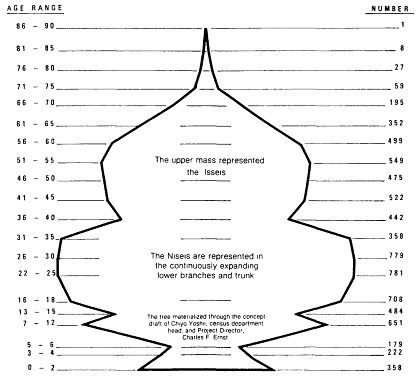
The Tree of Topaz
Reprinted by permission of Chiyoko Yoshii Yano.
set up the central statistics department, which reported to Charles Ernst, the project director. She and her staff collected vital statistics, and she produced the demographic "tree of Topaz" that became the camp's symbol. Forty-five years later she was still very proud of her work. Kazu Iijima, one of the few Nisei who held civil service jobs in prewar Oakland, worked in the social welfare department with George LaFabreque, whom she described as a "wonderful man... a warm person with a marvelous sense of humor." What was even better, LaFabreque "really liked us a lot." Iijima recalled that Charles Ernst and his staff members would meet over coffee and they would tell him their grievances; he was even sympathetic at 2:00 A.M . After her fiancé, Tad Iijima, volun-
teered for the military, they married in Salt Lake City, where he was sent for a physical exam. Kazu stayed at Topaz only until she was able to join him in Mississippi.[115] LaFabreque also left camp for the army in April 1943.[116] Some of the Caucasians made many lasting friendships at camp; several teachers kept in touch with their students, and the annual Christmas card exchange was mentioned by many. Gladys Bell did volunteer work among the residents, teaching English and music, and she helped organize a USO group for servicemen and women and their families. The Bells, like the Sekeraks and the Pratts, had close friends among the internees.
Recreational activities were another positive experience for the residents. They ranged from adult education to physical activities. There were picnics in good weather, dances every week, and entertainment and parties for everything from departing draftees and WACs to arriving Hawaiians and Tuleans. The singer Goro Suzuki, who later had a television career as Jack Soo, was a favorite. In summer 1943 a recreational camp was established on the site of an old CCC camp at Antelope Springs, at the foot of nearby Swasey Peak. Grace Fujimoto Oshita remembered going on a picnic to nearby Oak Creek canyon, where local residents provided fried chicken dinners for a dollar apiece.[117] Since it was some distance from Topaz, trucks transported campers there to swim and hike. Adults were allowed outside the residential compound to hike that fall, to roam the entire 19,000 acres of the project. Occasionally someone got lost, but no one tried to run away. The Nikkei also had a community New Year's Eve party with the Caucasians in camp, and there were several occasions when they invited people from Delta. They were entertained in turn by the Delta High School Concert Band. In November 1942 they even had turkey for Thanksgiving dinner. (The following year they would not be so fortunate; there was a turkey shortage in the WRA, so only administrators got to eat the bird, even in Topaz where they raised turkeys.)[118]
But even apart from actions precipitated by Caucasian violence, Topaz was far from a harmonious community. A number of prob-
lems came from its Kibei population, some of whom were not comfortable with Nisei customs and values. The WRA files mention episodes when "troublemakers," often Kibei, were arrested for beating up residents whom they considered too pro-administration. Tom Kawaguchi recalled with some bitterness how his parents and those of other volunteers were harassed by Kibei "no-no" youths.[119] Kazu Iijima stated that her husband went with a group to Salt Lake City for their preinduction physicals to avoid attacks in camp. On one occasion Kibei were sent to an old Indian school in Leupp, Arizona, that had been made into a prison for citizen "agitators": The "Topaz Eleven" were arrested in July 1943; although not charged with anything, they transferred to Leupp after FBI agents interviewed them. Even the prison's director was later convinced that they were guilty of nothing and had been bullied by the FBI agents.[120] WRA reports filed at the time indicate that the young men, apparently Nisei, sent to Leupp had announced they were disloyal and would commit sabotage if they could.[121] The Kibei, although a diverse group, were often pro-Japanese, and their "Japanesy" ways isolated them from the Americanized Nisei. There was also a language barrier, since they more often spoke Japanese than English. They were hard for the Caucasian administrators to understand as well, and their "foreignness" made it easy to identify them with the hated enemy.
Topaz experienced disturbances over registration and the Wakasa killing, but increasingly it suffered from what Hoffman termed "bad morale." He pointed out that "the aggressions of the very polite, threatened Japanese-American group [were] increasingly turned inward." He saw a number of social problems as evidence of "this hypochondriasis," or suppressed hostility, and suggested that it also led people to blow personality conflicts out of proportion.[122] There were also instances of severe stress, as conversations with retired social workers Faith Terasawa and Kazu Iijima revealed. Sometimes these resulted in hospitalization, but ordinarily the families took care of such problems at home.[123] At the time these problems were seen as morale issues, but clearly they were situational responses to incarceration. Internment just made people sick.
A problem arose at the hospital that demonstrated this stress and "hypochondriasis." As early as November 1942 the staff members presented a grievance petition stating that they had been promised a 175-bed facility but when they arrived it was just "a pile of lumber." A month later they still had only half the promised beds and lacked basic drugs and equipment. There were no facilities for infant dietary needs. An emergency appendectomy required permission from the chief medical officer to remove the patient to Delta, and a staff member had to go to his home three times to obtain it because the doctor was drunk. The petition found its way to a hospital committee chaired by Kenji Fujii, but a satisfactory response was slow in coming, probably because hospital needs were great everywhere in wartime.[124] When the shortages were filled, the staff members then began to quarrel over personnel. When Dr. James Goto arrived with his physician wife from Manzanar, the staff signed a petition refusing to work with him because of his abrasive personality. After much dissension, the administration agreed to transfer him, but Washington refused to concur. Goto worked for a while in public health, and after his wife gave birth the family moved to another camp. Meanwhile, the rest of the staff began to squabble over other issues. Some of the Caucasian personnel resigned and the Nikkei relocated, but the contentious situation continued to the end of Topaz's days.[125] The complaints of the hospital staff probably stemmed from differences in status between Caucasian and Nikkei personnel in the concentration camp setting. No physician was accustomed to being told what to do, and having to work for a pittance while their white counterparts made outside wages was an intolerable affront to many interned physicians. The staff's strong reaction to the turmoil in the hospital seems to reflect the general social malaise of Topaz.
There were, in addition, occasional episodes of social deviance. The reports contain vague references to illicit sexual relations and prostitution, but these are hard to document. An anonymous Nisei bragged to JERS interviewer Charles Kikuchi in Chicago after the war that he "had enjoyed sex with dozens of girls in the Topaz camp, and forced himself on several more when they were let out together to work in the fruit harvest."[126] This statement may just
have been an example of male braggadocio. Paul Spickard concluded that since the Nisei had little to do in camp but socialize, a great many either became engaged or married before leaving. Given the lack of privacy and the generally high moral values of the Nikkei, illicit sexual liaisons were uncommon in the camp itself, but references to women operating out of the beds of trucks or in unoccupied barracks appear in the files and were mentioned by some of the people interviewed for this study. (These were reported as rumors, ordinarily not as something the respondent had direct knowledge of, and as Shibutani documented, rumors were the leaven of camp life.) Liquor was smuggled in or made from grain alcohol obtained from the hospital, and some residents even made sake, although surplus rice was hard to obtain. Gambling, the bane of Tanforan, appeared again; the third community council banned the playing of bingo on the grounds it had become a "racket," but the chairman admitted that the ordinance would be hard to enforce.[127]
Many expressed their disgust with camp life by resettling, joining the army, or requesting repatriation, which was a statement of disillusionment with America itself. Others remained and became morose, withdrawn, or bitter. Young people vented their frustrations in disobedience to parents and teachers, and some became vandals or thieves. There were cases of assault and the harassing of inu , or dogs, the term for people perceived as stooges of the administration. Nonetheless, Topaz was a remarkably peaceful and law-abiding community, which did not even have a detention center or jail. (The few lawbreakers were incarcerated in the town of Fillmore.)
Labor troubles were another area of conflict. Like the problems at the hospital, they reflected underlying tensions in the camp, conflicts between Caucasians and Japanese Americans, and specific precipitants such as segregation. There was a work stoppage in the garage repair shop on September 3, 1943. The director decided to put a guard at the truck gate when the military sentries were not on duty because he suspected liquor smuggling. By mistake, a military guard rather than a civilian watchman was placed there, and the Nisei truck drivers refused to pass. When the garage su-
perintendent, Carl Rogers, ordered the crew back to work in a way they interpreted as an insult, they refused. Included in the group were some Kibei who were scheduled to leave soon for Tule Lake, and they turned on Rogers, insisting he be discharged for discriminatory behavior. The motor pool shut down. Agricultural crews joined the dispute, and farming stopped. Even the livestock were not fed (although Roscoe Bell recalled that his loyal workers came to him in great distress over the plight of the animals, and he sent his sons to do the job). The community council delegated the problem to its labor committee, which held discussions with workers and the administration. Rogers himself was investigated by the WRA on grounds he was anti-Japanese, and for a while it seemed all Topaz would join the strike. A compromise was worked out, in a settlement that was an important victory for the council: Rogers "took a vacation," and the workers returned to the fields and trucks. The charges against Rogers were dropped and the whole matter blew over when he received a draft notice and departed for the army. Everyone felt satisfied with the outcome.[128] Although the Nikkei residents of Topaz felt that conditions were barely tolerable, many Utahns believed otherwise. Governor Herbert B. Maw and some members of the state legislature were convinced that the evacuees were being "pampered" (a feeling still held by some in Delta in 1988). Maw and the senators came for a visit in March, were shown around the camp, and finally pronounced themselves satisfied with what they saw. The episode demonstrated the persistence of racism; it is hard to imagine that Caucasians could believe that a camp for interned Japanese Americans in the middle of the desert was somehow like a summer resort. Members of the Dies Committee of the U.S. Congress arrived in the fall to look for un-American activity on the part of inmates and administrators, but they too were disappointed.[129] Topaz was what it professed to be: a concentration camp in the desert holding people whose only crime was the fact that they had the faces—not the minds—of the enemy.
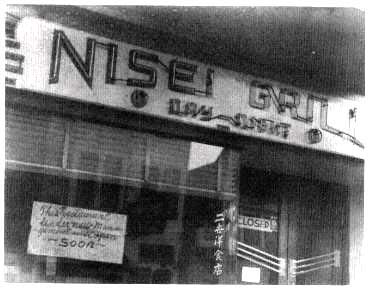
1.
The Nisei Grill in San Francisco was closed when the Japanese American
community prepared for evacuation to the assembly center at Tanforan in March 1942.
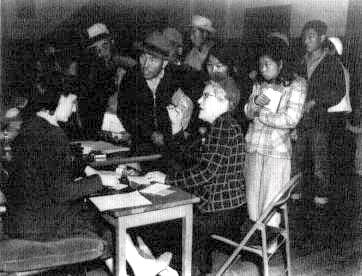
2.
Registration, San Francisco. All Japanese Americans
were required to register prior to their evacuation.
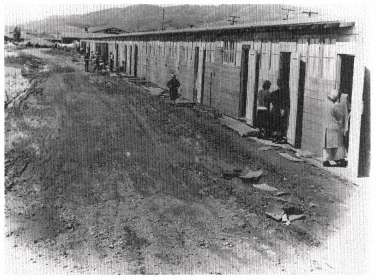
3.
The Tanforan Assembly Center in San Bruno. Muddy streets and plank
entryways added to the general unpleasantness of these former horse stalls.
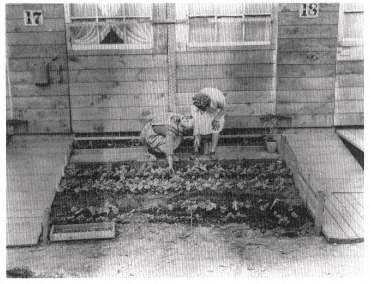
4.
In the summer of 1942, Tanforan residents attempted to s
upplement their army rations by growing fresh vegetables.
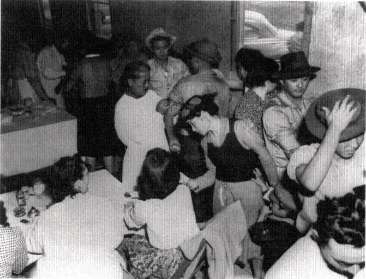
5.
Evacuees arriving at the Tanforan Assembly Center were checked for
infectious diseases and given vaccinations against smallpox and tuberculosis.
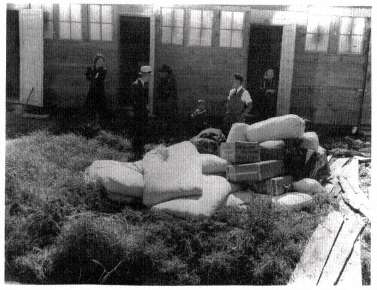
6.
New arrivals at Tanforan were given cotton ticks to stuff with straw for mattresses, and
these, along with their meager belongings, were dumped in front of the assigned stalls.
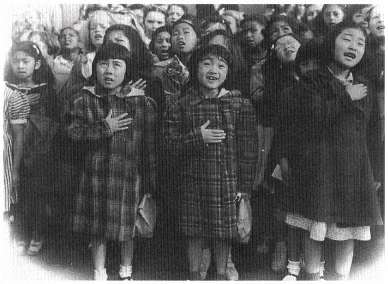
7.
Children pledging their allegiance to the United States despite
their internment. The child in the center, Mary Ann Yahiro, lost
not only her home but also her mother, who was removed to another
camp and died before being reunited with her family. Mary Ann Yahiro
was living in Chicago in 1922 and still had bitter memories of
camp (San Francisco Chronicle, February 1992).

8.
The nursery or "play center" at Tanforan established
by Keiko Uchida in a small four-room cottage.
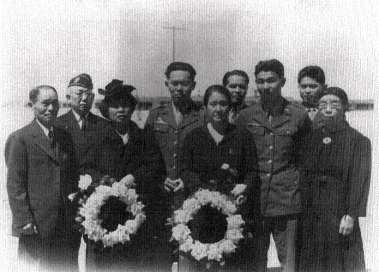
9.
Memorial ceremony honoring the
Nisei killed in the war, December 1944.
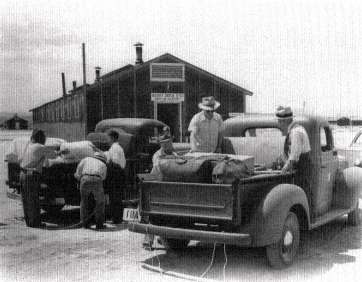
10.
Buddhist church headquarters staff packing
supplies for the return to San Francisco.
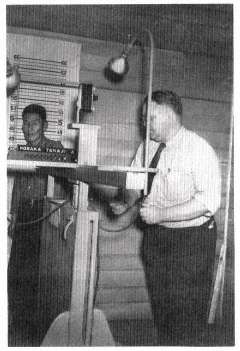
11.
Kosaka Takaji's "mug shot" being taken when
he was transferred from Topaz to Tule Lake Segregation
Center for answering "no-no" on the loyalty questionnaire.
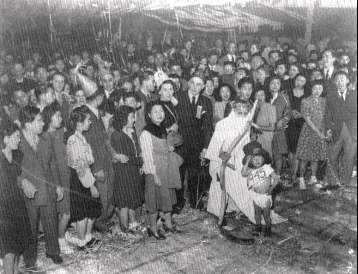
12.
New Year's Eve, 1944, Topaz.
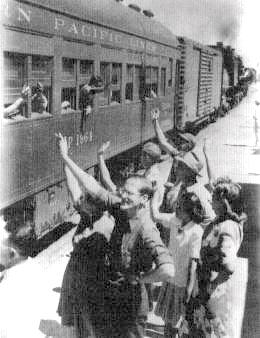
13.
One of the last trains to leave Delta in the fall of 1945 brought
fond farewells from the remaining administrative staff.
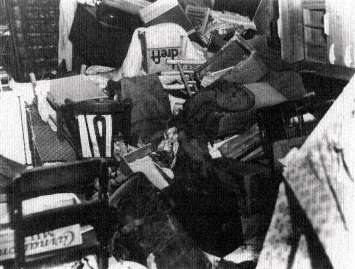
14.
Nikkei property stored by the federal government for those who
could not make other arrangements was not protected;
vandalism was not uncommon.