
The Revision of Proposition 9—
An Alternate Solution
In this direct problem, the orbit is an equal angle spiral and the center of force is located at the pole of the spiral. The statement of the problem and the solution employing the linear dynamics ratio remain as they were in the 1687 edition. That initial solution is brief compared to the solutions of the other problems that followed it. (See chapter 8 for a full discussion of the initial solution.) The alternate solution employing the circular dynamics ratio, however, is even more brief, requiring only the following few lines.
Proposition 9. The perpendicular SY dropped to the tangent, and the chord PV of the circle cutting the spiral concentrically are to the distance SP in given ratios; and thus SP3 is as SY2 × PV, that is (by Proposition 6, Corollaries 3 and 5 ), reciprocally as the centripetal force .
Figures 9.12A and 9.12B compare Newton's diagrams for Proposition 9 in the 1687 edition and the revised editions. The normal to the tangent
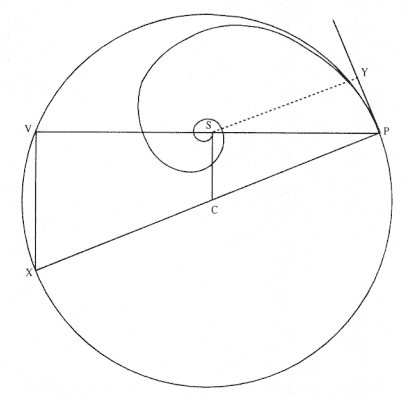
Figure 9.13
The diagram for Proposition 9 with the spiral extended from the point P into
its pole S and the circle of curvature PVX displayed.
through the center of force SY has been added. Moreover, the line of force PS has been extended to a point V , where the distance PV is the chord of the circle of curvature at point P . This relationship is made explicit in the extended version of the diagram shown in figure 9.13, where PVX is the circle of curvature at the point P of the spiral whose pole is at the center of force S . Note that the chord of curvature PV through the pole S is bisected by the pole.
Step 1 . Find "SY." Note from the figure that the angle SPY is the given constant angle of the spiral. Thus, SY = PS cos (SPY ) and therefore SY and SP are "in a given ratio."
Step 2 . Find "PV." As has been argued in the discussion of the initial solution in chapter 8, Newton uses without demonstration the relationship that the chord PV of the circle of curvature drawn through the pole of the spiral is equal to twice the pole distance SP . Thus, PV = 2 SP and therefore PV and SP are "in a given ratio."
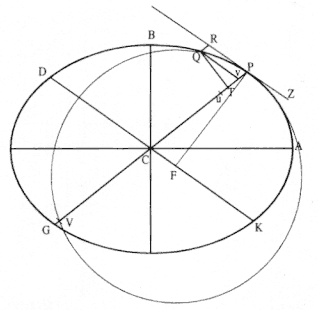
Figure 9.14
A revision of Newton's diagram for Proposition 10 in the
1713 Principia with the circle of curvature PV added.
Step 3. Find the circular dynamics ratio . Substituting SY and PV from Steps 1 and 2 directly into the circular dynamics ratio 1 / SY 2 × PV , the force is found to be proportional to 1 / SP3 .