
Shlonsky's “You Are Hereby”
Hebrew literary historiography commonly describes the intrasystemic struggle between modernism and premodernism in Hebrew poetry as an intertextual wrestling match between two dominant modernist and premodernist paragons: Shlonsky and Bialik. Avraham Ha-Gorni-Green in a study aptly titled Shlonsky ba'avotot Bialik (Shlonsky in the Bonds of Bialik) (1985) calls this view into question. Other scholars have also observed that the stylistic relationship of Shlonsky's moderna to its intrasystemic predecessors, the poetry of the ha-tchiya generation, is marked by a powerful ambivalence. (Compare Tzur, 1985, and Shavit, 1981, 1988.) The resistance to the strong pull which the traditional literary norm had on the pre-Statehood Poets needed to be motivated by an equally powerful intersystemic modernist affiliation. Russian futurism offered a cluster of salient prototypes such as revolutionary ideology and an attack on the literary institutions of the past. These prototypes provided Shlonsky with the required antitraditional “destructive” motivation; at the same time, the urgent needs of Hebrew as a defective polysystem in a state of crisis offered a compelling mission and a “constructive” motivation for many of the same futurist, antiromantic poetic practices. For the purposes of my argument, this conjuncture of intersystemic and intrasystemic motivations becomes particularly exemplary in Shlonsky's use of allusion and neologisms.
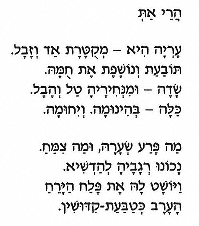
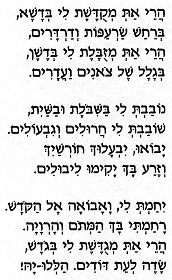
You Are Hereby
She is naked—steaming from mist and dung,
Demanding and puffing in her heat—
A field—and from the nostrils: dew and vapor—
A bride—in a veil. An aroused woman.
How wild-looking is her hair, and how long-grown.
Her dirt-clods are ready for the grass.
And he hands her a slice of the moon
This evening as a wedding ring.
You are hereby sanctified unto me by grass,
By a whisper of thoughts and thistles.
You are hereby manured unto me by fertilizer,
With the dung of flocks and herds.
You produced for me the sheaf of wheat and the thorn-bush,
You renewed for me brambles and stalks.
They will come, your plowers will husband you
And they will establish in you a seed for crops.
You were hot for me, and so I came to the holy-place.
I felt compassion for your wholeness and your plenty.
You are hereby overflowing unto me with abundance,
A field at the season of lovers. Hallelujah!
—Shlonsky (1947:8; translated by Eric Zakim)
In “Harey at,” the intertextual links to traditional sources are much more explicit than in Fogel's poem. In fact, they are flaunted in the poem's very title. And, in the end, they leave their mark on the diction and syntax of every line. The most salient feature of the allusive pattern in the poem is the marker harey at (“you are hereby”), which constitutes the title and reappears at the beginnings of three lines highlighted in the center and at the end of the poem. This marker evokes the traditional speech act performed by the bridegroom during the Jewish marriage ceremony, harey at mekudeshet li … ke-dat moshe ve-israel (literally: “you're hereby sanctified unto me … by the religion of Moses and Israel”). However, the juxtaposition of the title and the first line indicates, semantically as well as prosodically, that the traditional allusion is pointedly used for antitraditional purposes:[37]
HAREY At (you are hereby)
ERYA Hi (she is nude/genitalia)
Harey and erya bring together, in a rearrangement of almost identical sounds, the boldly contrasting realms of the sacred and the profane, the spiritual and the physical, contrasts which are highly prototypical of Shlonsky's poetics of allusion. The poem contains a bold allusive juxtaposition not just between the title and the first line but also within the first line itself. This contrast recurs in all other stanzas of the poem: between the naked agricultural body of a (personified) fertilized field, “steaming (perfumed) with mist and dung” (mekuteret ed va-zevel ), and the norms of traditional Hebrew love poetry represented by the covert allusion to the beloved in the Song of Songs (3:6), rising out of the desert, “perfumed with myrrh and frankincense” (mekuteret mor u-levona ). In addition, within the diachronic context of Hebrew love poetry, Shlonsky's reinterpretation of harey at, especially given his metaphorical rendering of the beloved as a field (identified explicitly in line 3), clashes with the forceful norm of the earlier hatchiya generation poetry.
It is impossible to conceive of Shlonsky's “Harey at” without in some way involving Shaul Tchernichovski's pantheistic epithalamium, “Harey at mekusemet li” (“You Are Hereby Bewitched unto Me”) (1929; in Tschernichovski 1950:492). Shlonsky, then, is struggling to extricate himself from both the religious norm (ke-dat moshe ve-israel, “according to the law/religion of Moses and Israel”) and its
humanist/pantheist critique by Tchernichovski (ke-dat oto parpar … be-sod kol shirat ha-adam, “according to the law/religion of that butterfly … with the secret of all human poetry”). The poem combines the ideological motivation provided by the anticlericalism of socialist Zionism, a salient aspect of which is the rejection of traditional Jewish attitudes toward sacred rituals such as the marriage ceremony, with its concomitant modernist rejection of traditional and romantic notions of beauty and propriety. In this way the poem celebrates an iconoclastic secularization of traditional Mosaic values at the same time that it rejects a neoromantic religion of nature.[38] The alternative that Shlonsky offers is itself ideologically motivated: it reifies the religious and sexual metaphors which are an integral part of the left-wing Zionist idealization of agricultural labor. As in the beginning of the poem, the ideological conversion of the sacred first into the natural realm and ultimately into the realm of labor is aesthetically motivated through the spectacular prosodic conversions of a focalizing sound pattern and untraditional rhyme scheme which are placed in the center of the poem (lines 9 and 11):
mEku DESHE t (sanctified)—Mosaic religion
BE DESHE (with grass)—Tchernichovski's pantheism
BE DESHE n (with fertilizer)—socialist “religion of labor”
These prosodic patterns are, of course, typical of the modernist functional activation of rhyme and rhythm as opposed to a convention-dictated employment of a metrical scheme. The focalizing sound pattern and the asymmetrical rhyme are the means for establishing semantic relations among mekudeshet, be-deshe, and be-deshen.[39] By elevating deshen (“agricultural fertilizer”) to an alternative for both traditional Judaism and pantheism, the poem bestows religious significance on the new pioneer values of labor and return to the land. This radical valuation actually has quite a specific parallel in the revolutionary and iconoclastic poetics of Russian futurism: from V. Khlebnikov's image of the modernist poet shooting arrows at the gods to his glorification of the garbage and maidenry of the “steaming fields” (1976:55, 99). The coincidence of futurist ideology and the values of the “labor religion” (dat ha-avoda )[40] in Shlonsky's poetry is far from accidental since the same Russian revolutionary socialism fed the roots of both.
Shlonsky's well-known tendency toward neologism also reveals a complex system of congruities between internal and external needs.
Statements made by Shlonsky in a series of manifestoes of the moderna supply the explicit poetics for his neologistic bent. They present the futurist view of language from a decidedly Hebraic perspective, fraught with ironic allusions to traditional Jewish texts and traditional Jewish practices. Although these pronouncements were made about twenty-five years before the publication of “Harey at,” they nevertheless directly prefigure the poem's umbrella metaphor of an antitraditional woman. This woman, however, started out as the “word,” and only later became the “field.” “The word (under the rule of the melitsah of the language) just as a woman (under the patriarchal rule of society) is not free: she is dependent on her husband for her livelihood; … we have rebelled: ‘free love! civil marriage!’ Our melitsah —a kosher humble daughter of Israel—has accepted the tradition: matches are made in heaven. ‘By the law of Moses and Israel’” (1923:189-90; in Harshav [Hrushovski], 1973:154-55). Instead of this religious linguistic bondage, Shlonsky advocates “civil ceremony, free love between words without arranged marriages of ancestral-proud style, without a dowry of associations, and mainly: without a religious chupa (too much family purity in our language!!). Each coupling of words—a promiscuous surrender, a one-night stand” (1923: 190; in Harshav [Hrushovski], 1973:154).
The same new value system of free love and antitraditionalism which characterized early labor ideology in Palestine generates the materials of the umbrella metaphor for a rebellious, modernist style. In the poem “Harey at,” both anticonventional and “permissive” conceptions of love similarly serve as the source of materials for a metaphor, except that here the tenor is the pioneer/laborer's relationship to his land. The pioneer sexually possesses (bo'el ), plows, and plants in the nakedness of the feminized field who demands her satisfaction from him, “puffing in her heat” (line 2).
As in Fogel, and as we shall see later on, in Amichai as well, the same “free love between words,” which rebels against the norms of love poetry, simultaneously and perhaps paradoxically also preserves the traditional model. The poem “Harey at,” in fact, resurrects the agricultural/natural component within the imagery of the Song of Songs itself and modifies it to fit modernist ideological needs. Whereas in the biblical poem the worlds of agriculture and sheepherding serve as vehicles for the tenor of the lovers' relationships, here the terms of the metaphor are reversed: free, unruly love serves as a vehicle for the tenor of a new commitment to the field and the land. However different, the
context of the evoked biblical text is mobilized in support of even the most antitraditional of Shlonsky's modernist stances.
The neologisms themselves are new words coined from existing roots or portmanteaux, blends of two separate roots. Many of them are presented in morphological patterns with the stress on the penultimate syllable—a typical compensation device in moderna poetics for the paucity of such Russian sounding, “soft” (mil'eyl ) forms in Hebrew: péra —a portmanteau of pere (“wild”) and paru'a (“disheveled”); gélel —“dung”—rather than the common milra equivalent, the plural form glalím; rachámti —a portmanteau of rechem (“womb”) and rachamim (“pity,” “compassion”); megudéshet —a portmanteau of gdusha (“heaping full”) and mekudeshet (“sanctified” or “sacred”). These neologisms and others like them appear on the surface to be lexical innovations. As such they are consistent with those modernist prototypes which view the language of poetry as a productive process of signification rather than with the opposite modernist prototype which denies the very possibility of signification. However, on close examination, it turns out that all the neologisms in the poem are actually resuscitated forms which are found at least once in traditional sources.[41] For example, a form such as novavt in line 13, which at first strikes the modern Hebrew speaker as odd if not incomprehensible, appears in the Bible, within a context strikingly similar to that of the poem: ve-tirosh yenovev betulot (“[Corn shall make the young men cheerful]/And new wine the maids”) (Zechariah 9:17). Similarly, the uninflected noun yichuma in line 4 (note that it isn't the feminine possessive of yichum! ) appears in the liturgical poetry of Ha-Kalir[42] in the sense of “woman,” investing Shlonsky's text with the stock identification of femininity with unbridled eroticism (from yichum, “sexual arousal,” “heat”).
With all their stress on lexical innovation, the Russian futurists themselves also viewed neologisms as a process of “delving into the root.”[43] Mayakovsky's description of Khlebnikov's poetic practice might easily apply to Shlonsky: “He created an entire ‘periodic table of the word.’ Taking the word in its undeveloped unfamiliar forms, comparing these with the developed word, he demonstrates the necessity and the inevitability of the emergence of new words…. Khlebnikov is simply reversing the process of word formation” (in Brown, 1976:15).
Clearly, Shlonsky is less radical in his practice of lexical innovation and experimentation than Khlebnikov and the other futurists, in part because he must limit his selections to those neologistic devices which
best serve the intrasystemic goals of revitalizing the Hebrew language. Paradoxically, this very tension between innovation and tradition points to the major congruity between the needs of European modernism and the demands of the internal system within Shlonsky's poetry. According to Shlonsky's own account, neologisms are viewed by the Russian futurist poets as a way out of the impasse for a literature which is trapped between “the domestic grayness of the realists” and the “symbolists' flight to the heavenly clouds” (cited by Yaffe, 1966:159). Shlonsky continues: “Now a change has taken place in the concepts, perceptions, and interests of the generation, and of necessity this requires a change in the verbal stock. Therefore we must renovate the language, produce new words, coin expressions which have never occurred before” (cited by Yaffe, 1966:159–160).
This acute need to renovate the language becomes for Shlonsky not just a matter of modernist disappointment in realism and symbolism. It is necessary in order to help Hebrew extricate itself from the status of a defective polysystem, to fill in the gaps in the lexicon and the stylistic registers, and to work toward the establishment of a highly differentiated, stratified system which all types of discourse can then draw on. These goals, unmentioned in Shlonsky's modernist manifesto, nevertheless form an integral part of his generation's implicit poetics. Ironically, the rebellious, modernist desire to shatter the archives of petrified traditional language serves a constructive collective goal of reviving and preserving the old-new Hebrew tongue.