
Chapter VIII—
Villaverde
Twelve kilometers due east of La Mata, about eighteen kilometers northeast of Salamanca, is the lugar of Villaverde. It lies just off the main highway from Salamanca to Valladolid, at 831 meters altitude, near the source of the small Rio Guareña. Here the land is flatter than at La Mata, and the town nucleus can be seen from all directions, dominated by its square church tower rising like the prow of a ship at its western end.
Although not large, the town had features in the eighteenth century that gave it a modest urban flavor. At its center was an irregular unpaved plaza, on which faced a public building that served both as council house and prison. The town council also owned a tavern, a blacksmith shop, and a butcher shop, which it rented to the vecinos who operated them. In addition, 116 houses faced on the streets that led off in various directions from the plaza. Of these 2 were in ruin and 10 others were empty—the town had had more inhabitants in the sixteenth century. Three granaries (paneras), one belonging to the town council and two to the receiver of the tithes, eleven barns (pajares), four corrals (two of them belonging to the town council), and some baking ovens completed its structures.[1]
Villaverde is on the eastern edge of the rich Armuña district, where the land gets poorer. In the eighteenth century it was surrounded by two despoblados and two alquerías. Only to the west did it border on a popu-
[1] AHPS, Catastro, Villaverde, libro 2813, resp. gen. QQ 22, 23, 24, 29, and information in maest. segl., and maest. ecles. The total number of houses comes from the libros maestros, more accurate than the respuestas generales.
lated town, Pedrosillo el Ralo, slightly larger than Villaverde.[2] Yet Villaverde itself was in a fertile spot; the catastro returns indicate that on the average its soil produced thirty-eight reales per fanega per year, close to La Mata's forty and well above the regional average of twenty-seven. The total area was 1,650 fanegas, or huebras as they were called locally[3] (740 hectares), and there were 97 lay vecinos and 1 ecclesiastic, for a total population of 357.[4] Both in area and in population Villaverde was half again as large as La Mata.
Its employment structure was also more complex, as Table 8.1 and Figure 8.1 show. The proportion of men engaged in agriculture was higher, and next after them came the craftsmen, whereas in La Mata there were only two craftsmen. The muleteers of Villaverde, on the other hand, were only a ninth of the vecinos.
The farmers of Villaverde devoted themselves primarily to the raising of wheat, as could be expected in the Armuña district. According to the catastro, the town had 1,354 plots devoted to wheat, 88 meadows, and 13 enclosed plots (cortinas ) for growing fodder (herren ).[5] Despite this description, however, wheat was not the only crop sown in the open fields; the tithe records show that there was a sizable harvest of algarrobas, used for fodder, and lesser ones of barley, rye, and garbanzos.
A first approximation of the annual harvest comes from the recorded area and quality of the arable plots, and the average yield and seed requirements stated in the catastro (Table 8.2). The seed requirement, 858 fanegas of wheat, is 19 percent of the gross harvest. The predicted yield: seed ratios for the three classes of land are 5.3 : 1, 6 : 1, and 3.6 : 1, with the overall average 5.2 : 1. It is hardly possible for middle-quality land to have a higher ratio than first quality, but there is no way of checking the data provided by the catastro. In any case, the land was substantially less productive than in La Mata, where the overall ratio was 7.2.
The figures for the gross harvest can be checked by the tithes (Table 8.3). Not all the partible tithes in Table 8.3 represent harvests grown within the limits of the town, for its tithe collector also kept half of the tithes paid by the vecinos on the crops they harvested outside the town, sending the other half to the parish where the harvest was grown.[6]
[2] Villaverde, resp. gen. Q 3.
[3] Villaverde, maest. segl., introduction.
[4] Villaverde, personal de legos. The listing of family members is careful and appears complete.
[5] Totals of maest. segl. and maest. ecles.
[6] Villaverde, resp. gen. Q 15; the partible is "los diezmos del término y la mitad de los que arrastran de otros." The catastro of the neighboring despoblado of La Cañada, repeats this information (AHPS, Catastro, La Cañada, resp. gen. Q 16).
| ||||||||||||||||||||||||||||||||||||||||||||||||||||||||||||||||||||||||||||||||||||||||||||||||||||||||||||
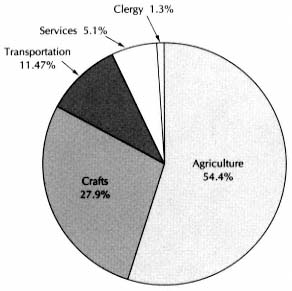
Figure 8.1.
Villaverde, Employment Structure, 1752
| |||||||||||||||||||||||||||||||||||||||||||||||||||||||||||||||||||||||||||||
| ||||||||||||||||||||||||||||||||||||||||||||||||||||||||||||||||||||||||||||||||||||||||||||||||||||||||||||||||||||||||||||||||||||||||||||||||||||||||
| ||||||||||||||||||||||||||||||
Similarly, other parishes sent to the cilla of Villaverde half the tithes on the crops their farmers harvested within its limits. The catastro does not say how much these portions amounted to, but one can obtain a reliable approximation from the tithe book for the years 1773–1811, now in the provincial archive of Salamanca.[7] It breaks down the payments between towns for the years 1776–80 and 1805–7. Table 8.4 shows the different shares for the first period. It separates the payments to the two adjoining despoblados of La Cañada and La Cañadilla, both anexos of the parish of Villaverde, from those to other towns; the former were increasing during the period covered by the tithe book, an indication that the vecinos of Villaverde were extending the land that they farmed in the despoblados. By projecting back from 1776–80, one can estimate the payments to these two places at midcentury. There is no sign of change in payments to or from other towns, and I shall use the same proportions for midcentury as in the table.
We are now in a position to calculate the total harvest from the tithes reported in the catastro. To do so I shall apply the percentages of 1776–
[7] AHPS, Hacienda, libro 167.
| ||||||||||||||||||||||
1800 to the total tithes of 1747–51, with the difference indicated for the two despoblados, and include an estimated payment of the first tither at the earlier period, which no longer went into the partible after 1761.[8] Table 8.5 provides the data and indicates that the total crop, which was ten times the tithes, was 4,688 EFW. This figure is 5.6 percent higher than the 4,441 EFW predicted from the extent and different qualities of land (see Table 8.2), evidence of remarkable accuracy in the catastro's survey. Since the tithe returns are a more exact measure of the harvests, I shall use them and increase the estimate of the net harvest by the same proportion to 3,783 EFW.
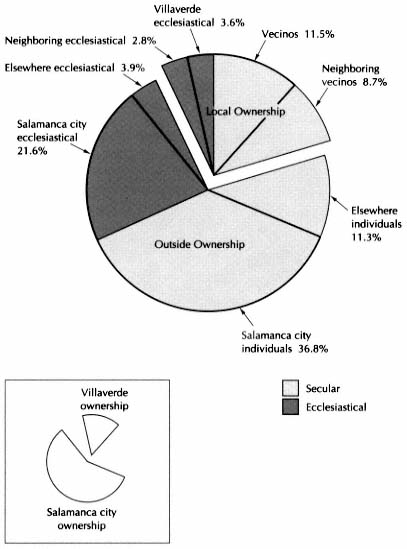
How much of the net harvest remained within the town economy depended in large measure on the ownership of the land, shown in Table 8.6 and Figure 8.2. At first sight the distribution recalls that of La Mata, for most of the land belonged to nonresidents and outside institutions, but closer observation reveals significant differences. Outside owners held almost as much as in La Mata, 69.3 percent of the land, compared to 71.4 percent, and similarly, of this share the larger part belonged to owners located in Salamanca city. On the other hand, although ecclesiastical ownership was high in Villaverde, 47.5 percent, it was far less than the 77.5 percent of La Mata. Moreover, vecinos were
[8] See Appendix G.
| ||||||||||||||||||||||||||||||||||||||||||||||||||||||||||||||||||||||||||||||||||||||||||||||||
in a better position, with 19.6 percent compared to 9.8 in La Mata. The vecinos also owned most of the houses, 79 of 116, with another 20 belonging to the parish church and nearby vecinos.[9]
Following instructions, the makers of the catastro reported the rate of rent collected by ecclesiastical owners, which Table 8.7 lists.[10] With a different rate for each quality of land, it is a subtler calculation than the
[9] Villaverde, maest. segl. and maest. ecles.
[10] Villaverde, maest. ecles., f. 325.
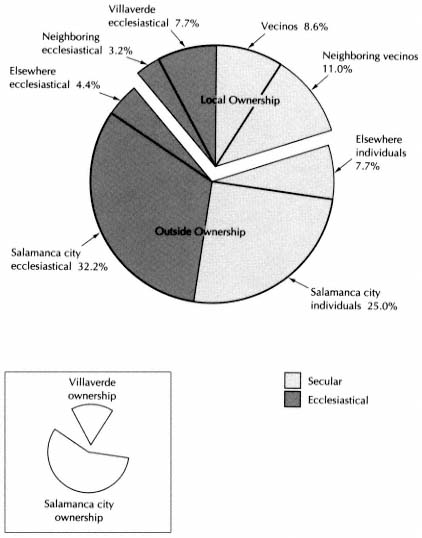
Figure 8.2.
Villaverde, Ownership of Land, 1752
rule of thumb in La Mata of 1 fanega of wheat for each fanega of land, regardless of quality. Unfortunately, I have little data to check its accuracy. Although the records of several monasteries that rented fields in Villaverde are preserved, their leases usually lumped plots outside Villaverde with those in its limits. Only two of those available cover property entirely within the town. The convent of Corpus Christi of Franciscan
| ||||||||||||||||||||||||
nuns owned in Villaverde 1.5 fanegas of first-quality land, 9.5 of second, and 3 of third.[11] The catastro's rule would indicate a rent of 10.125 fanegas of wheat. The convent's accounts for the years 1800–1805 show that the rent was 12.5 fanegas. The tenant fell behind in the bad year, 1803, but made up his arrears with the harvest of 1805.[12] Evidently the convent was not charging too much, although 20 percent more than the reported rule calls for. It also got the horros on its land. The second case involves seven plots bought in 1794 by the nuns of the monastery of Nuestra Señora del Jesús of the Order of Saint Bernard. They had the plots surveyed accurately; there were 3.92 fanegas of first-class land, 3.08 of second, and 0.45 of third. The rule indicates a rent of 8.30 fanegas of wheat; the actual rent from 1795 to 1798 was 10 fanegas, and in 1799 the nuns raised it to 11.5 fanegas. In addition they received the horros.[13] Here the rent was 20 to 40 percent above the rule. Had the rents been raised since the catastro? We do not know, but the next case suggests that this is not the explanation for the disparity.
The nuns of Jesús also owned a group of fields in Villaverde and Pajares, the next town to the north. The holdings in Villaverde consisted of thirty-three arable plots, a meadow, a cortina, and a house. The predicted rent for the plots in Villaverde is 21.125 fanegas of wheat.[14] The predicted rent for its holdings in Pajares is 13.05 fanegas of wheat, for a total in both towns of about 34 fanegas.[15] In 1758 these lands were
[11] Ibid., ff. 201–5.
[12] AHN, Clero, libro 10880, f. 24; libro 10869, f. 47.
[13] AHN, Clero, libro 10668, f. 217r–v.
[14] Villaverde, maest. ecles., ff. 268–81: 5.5 fanegas of first-class land; 9.5 second; 23, third.
[15] AHPS, Catastro, Pajares, maest. ecles., ff. 69r–74r, 199.
| ||||||||||||||||||||||||||||||||||||||||||||||||||||||||||||||||||||||||||||||
rented to a vecino of Villaverde for 46 fanegas of wheat plus the horros. In 1775 the nuns raised the rent to 50 fanegas but dropped it in 1788 to 26, presumably because the lease no longer included all the above property.[16] In 1758 the rent was about 35 percent above that predicted from the information in the catastro.
This limited evidence indicates that the tenants paid more rent than the rule stated in the catastro. In La Mata the rule proved too high; the more complex calculation reported for Villaverde gives results that are probably too low. Under the circumstances, I shall use an estimate for rent 20 percent above that predicted by the rule in the catastro. Table 8.8 lists the property of outside owners and the estimate of the rent they would have collected, 1,050 fanegas of wheat. The total harvest on this property, using the yields shown in Table 8.2, would be 3,225 EFW. Increasing this amount by 5.6 percent, according to the correction derived from the tithe returns, one can predict a total harvest of 3,406 EFW. The rent would then be about 31 percent of the total harvest.
This rate is a surprising amount higher than the 23 percent calculated for La Mata.[17] In both towns the estimated rent is based on evidence from actual rental agreements. If the rule given in the catastro for Villaverde is applied, the rent would be 26 percent of the harvest, and in La Mata it would be 27 percent, almost the same, although the rules were
[16] AHN, Clero, libro 10668, f. 173.
[17] Above, Chapter 7, section 2.

Map 8.1.
Villaverde and Its Environs
NOTE : In the nineteenth century despoblados were incorporated in adjoining
towns. La Cañada and La Cañadilla went to Villaverde. I am indebted to
Angel Cabo Alonso of the University of Salamanca for identification of
the eighteenth-century roads that served Villaverde.
different. Is this pure coincidence, or is it possible that the accepted rates were established some time in the past to produce similar rents but had since been altered by economic forces to the benefit of the farmers of La Mata and the disadvantage of those of Villaverde? Let us keep in mind the possibility of such a development.
At 31 percent of the predicted harvest, the rent paid by the vecinos for the grain fields of the town church and endowments it controlled would be 113 EFW, and for fields belonging to nearby churches, 48 EFW.
An important share of the town land belonged to vecinos of nearby towns, more in fact than to vecinos of Villaverde itself (Table 8.6). As Map 8.1 shows, most of the nearby owners lived in the larger town of Pedrosillo el Ralo, four kilometers to the west. The question arises whether Villaverde was exploited by nearby vecinos or there was a pattern in this area of ownership across town boundaries. Without a full study of the catastros of towns within walking distance, no firm answer
is possible, but a review of the catastros of the three nearest towns reveals that in them the vecinos of Villaverde owned less than half the property that their vecinos owned in Villaverde.[18] I shall therefore estimate that Villaverde's vecinos owned about half as much outside its término as nearby vecinos did in it.
In assigning the income from these lands, one must know who farmed them as well as who owned them. Even though vecinos of Villaverde owned less land outside the town than nearby vecinos did in it, the tithe records indicate that they harvested about four times as much outside as others did in their town (Table 8.5). Obviously even locally owned fields were not always farmed by their owners, and the vecinos of Villaverde had to pay rent to nearby owners as well as to more distant landlords. The lands of nearby vecinos would produce an estimated harvest of 396 EFW, with a potential rent of 123 EFW, at 31 percent of the harvest. From the tithes we know that nearby vecinos harvested about 140 EFW in Villaverde (twenty times the tithes they paid to the parish of Villaverde, Table 8.5), which is 35 percent of the total crop in the fields belonging to them. Villaverde vecinos must have farmed the rest, paying some 80 EFW in rent.
If vecinos of Villaverde owned half as much land outside the town as nearby vecinos in their término, the harvests on these lands would have been about 198 EFW. But the tithe records indicate that Villaverde vecinos actually brought in 556 EFW from outside (twenty times what they paid the parish of Villaverde on outside harvests, Table 8.5). They therefore rented lands outside the término that produced 358 EFW. At the ratio for seed and rent found in Villaverde, their net harvest from outside, after deduction for seed, would be 450 EFW and the rent for these lands would be 111 EFW.
From the tithe records, we have also estimated that the farmers of Villaverde harvested 630 EFW in the despoblados of La Cañada and La Cañadilla. Their net crop after seed would have been about 510 EFW, and their rent, 195. One must remember that on all harvests grown outside the término, half the tithes remained in the town where they were grown.
Besides the tithes, the farmers paid also the first fruits and Voto de
[18] Vecinos of Pedrosillo el Ralo owned land in Villaverde evaluated at 2,098 reales per year; those of Villaverde owned land in Pedrosillo el Ralo evaluated at 607 reales. The corresponding figures for Gomecello are 71 and 40, for Pajares 50 and 356. Totals: outsiders held 2,219 reales' worth in Villaverde, vecinos of Villaverde 1,003 in the other towns. These are the three towns that bordered on Villaverde. AHPS, Catastro, Pedrosillo, maest. segl.; Gomecello, maest. segl.; Pajares, maest. segl.
Santiago, following the same rules as in La Mata. The first fruits averaged over the previous five years at 66 EFW and the Voto at 23 EFW.[19]
Raising animals was an integral part of local agriculture. The catastro lists oxen and cows, horses and pigs. Among the tithes paid were thirty chickens per year, which meant that at least three hundred were born.[20] The catastro does not mention sheep, but there was a shepherd, seventy years old, helped by his sixteen-year-old son.[21] The tithe book occasionally lists the receipt of wool, 90 pounds in 1777, 51 pounds in 1779, 81 in 1781. This represents a shearing of about 750 pounds per year, so that there would have been some 500 sheep, and they were probably there already in 1752.[22]
Following the method described in Appendix K, one can draw up Table 8.9 for the income from raising livestock in Villaverde. It shows a gross income from livestock of 758 EFW. From this one must deduct the cost of pastures. Most of the animals were pastured in the despoblados of La Cañada and La Cañadilla,[23] where there were 186 fanegas of pasture valued by the catastro at 920 reales per year. If this was indeed the amount of the rent, the vecinos paid 66 EFW to feed their animals outside the town.[24]
Breeding livestock was such a central activity of the town that twenty vecinos reported income as dealers in livestock (tratantes y cambistas de ganado ) ranging from 150 to 1,200 reales per year.[25] They included fifteen labradores (who earned 8,800 reales), four craftsmen (2,550 reales), and one man classed only as a tratante (but who declared only 150 reales income from this occupation). The total income from these activities was 11,500 reales per year, 820 EFW. Seven dealt only in mules and four in cattle and mules, while three dealt in pigs, cattle, and mules. Since the town did not produce many mules, the tratantes were dealing to considerable extent in animals raised elsewhere. And since the town was self-sufficient in animals, the dealers sold as well as bought outside. The total local production of oxen, horses (including mules), and pigs was
[19] Villaverde, resp. gen. Q 16, and maest. ecles., f. 323.
[20] Villaverde, resp. gen. QQ 15, 16.
[21] Villaverde, personal de legos.
[22] Sheep in this region produced about 1.4 pounds (libras) of wool each; see Tables 9.3 and 9.6 (748 sheep produced 1,028 lbs. of wool in Pedrollén). In the sierra town of El Mirón, 2,100 sheep produced 3,550 lbs. of wool, 1.7 lbs. per sheep.
[23] Villaverde, resp. gen. Q 20.
[24] I have not used the catastro volumes of La Cañada and La Cañadilla. The provincial summary indicates that these were the pastures in these two towns (AHN, Hac., Catastro, libros 7476, 7477, 7478), and the tithe register lists them as rented to Villaverde farmers.
[25] Villaverde, resp. gen. Q 31; AHN, Hac., libro 7476, letra F, f. 108.
| ||||||||||||||||||||||||||||||||||||||||||||||||||||||||||||||||||||||||
worth 420 EFW. Half of this may have been sold outside by the tratantes (and the rest consumed or used locally) and should not be counted again as town income, so that dealing in livestock brought in a net return to the town of some 610 EFW.
We now have the information needed to calculate the net income from agriculture of the vecinos of Villaverde (Table 8.10). It produces a total of 3,077 EFW.
2
To see how this income was divided among the inhabitants, the best source is the book of tithe rolls, which begins in 1773, twenty-one years after the catastro was completed. The book identifies the tithers as either labradores or senareros, those for whom farming was the main occupation and those who used it to supplement other income. Thirty-two labradores were listed in each of the first two years (thirty-one of them the same individuals), and fifteen senareros (but only eight individuals
| ||||||||||||||||||||||||||||||||||||||||||||||||||||||||||||||||||||||||||
| ||||||||||||||||||||||||||||||
appeared both years). (We recall that because of the two-year farming cycle, one must average each farmer's share of the harvest over a two year period to determine his economic position.) As before, the harvests of the casa excusada and cuarto dezmero are not listed.[26] The fourth tither's harvest can be interpolated between those of the third and fifth, and I project that of the first above that of the second with a difference slightly larger than between those of the second and third tithers. These are only rough approximations, for the evidence from La Mata indicates that once named to one of these positions, a person was usually kept there, although his harvests might no longer entitle him to it.[27]
On this basis Table 8.11 calculates the distribution of harvests of the first two years of the tithe rolls. To project this pattern back to the time of the catastro, one must adjust for the fewer number of men in agriculture at that time. The catastro lists twenty-eight labradores, four less than in 1773–74. It does not say how many senareros there were, but eighteen is a good guess, four fewer than in 1773–74. Table 8.12 readjusts the individual shares of the harvest in Table 8.11 to these lower
[26] The two individuals are identified by name in 1773, 1774, 1775, and 1804.
[27] See Appendix I.
| |||||||||||||||||||||||||||||||||||||||||||||||||||||||||||||||||||||||||||||||||||||||||||||||||||||||||||||||||||||||||||||||||||||||||||||||||||
numbers and then applies the information on income from agriculture to estimate the individual incomes in 1752.
As was done for La Mata (see Table 7.10), one can check the distribution of the individual harvests in Table 8.12 by a distribution based on the number of oxen owned by each labrador, as recorded in the catastro (Table 8.13). The check proves to be rough because the range in number of oxen is not great, but there is consistency between the two calculations. The labradores owned seventy-seven oxen and one draft horse (which may have been hitched with a mule). According to the rule
| ||||||||||||||||||||||||||||||||||||||||||||||||||||||||||||||||||||||||
that one yoke of oxen could plow 22.5 fanegas per year, forty yokes sufficed for 1,800 fanegas of land in a two-year cycle. Villaverde's catastro recorded 1,650 fanegas of arable, but the oxen were also used outside the town.
One can also check the table by the tithes of the fourth tither. These indicate a gross harvest of 252 EFW, which means a net income from harvest of 105 EFW (see Table 8.10). This is below the 130 EFW predicted in Table 8.12 and, if correct, would mean larger harvests for the first three tithers than predicted in the table. We recall that the tithes of the fourth tither of La Mata were also less than predicted (Appendix I). Perhaps fourth tithers fudged on their tithes because the cathedral of Salamanca, to which these tithes went, could not keep a strict control throughout the many towns of the partido or perhaps, as suggested, the "fourth tither" had fallen from fourth place but had not been replaced. In any case, his tithes do not seem adequate evidence to discredit Table 8.12.
In addition, most of the income from raising livestock went to the labradores, who owned the largest number of each kind of animal ex-
cept donkeys; and fifteen of the labradores also dealt in livestock as tratantes. Table 8.12 indicates the estimated income from these activities for the individual labradores.
Out of their gross income, the wealthier labradores had to pay the cost of hired labor. Thirteen labradores had more than one yoke of oxen, ranging from one and a half to three. There were ten jornaleros in the town, to each of whom the catastro assigned wages of two reales per day for 180 days per year, or 26 EFW.[28] One can divide the total wages of the ten jornaleros among the top labradores according to the number of extra yokes of oxen they owned. The approximate results are given in Table 8.12, together with the net income of the labradores from all sources after deducting the cost of labor, and the net income of the senareros from agriculture.
The range of the net income of the labradores is great. The casa excusada, with 315 EFW per year, received ten times the amount of the most modest labradores. How well-off they were depended on the size of their households. The fifteen labradores who were also tratantes had larger households than the others; they averaged 5.2 people as opposed to 3.4. Ten of the fifteen labradores-tratantes had a male servant in the household eighteen years or more of age, and four of them had servant girls. The other labradores had only two male servants and one female servant among them. Neither group had many children, and the two largest households had only 7 members including servants. If, as established earlier, an adequate household income consisted of 12 EFW per person, the average requirements of the labradores-tratantes was 62 EFW and of the others 41. All the labradores-tratantes had more than required, and the first six, with net incomes of 165 EFW or more, could be considered wealthy. At the other extreme, however, at least five of the bottom six families, who had incomes estimated at 31 EFW and 3 or more members (one family consisted of a childless couple), were below the line of comfort.
A comparison with the income of the labradores of La Mata is revealing (see Table 7.11). All these had an income of at least 75 EFW, whereas 40 percent of those of Villaverde were below this level. At the other extreme, 40 percent of the labradores of La Mata can be considered wealthy (over 100 EFW annual surplus above the 12 EFW per person require-
[28] Villaverde, resp. gen. Q 34. The catastro of La Mata says its jornaleros worked 120 days a year. The disparity is too great to be credible, but I follow the information of the catastro. The effect on family income is not great (Table 8.18).
ment), but only 20 percent of the labradores of Villaverde. While the wealthiest labradores in Villaverde were as well-off as their counterparts in La Mata, as a group the labradores of Villaverde did not have the economic strength of those in the nearby town. The most obvious reasons for the difference that have come to light are that the land in Villaverde was less fertile and the proportion of the harvest taken as rent was higher. Although there may have been errors in drawing up the catastros of the two towns, it is hardly likely that all the differences are merely the fault of bad data. In both cases, the rate of rent is based on actual contracts. One can assert with confidence that the labradores of Villaverde were poorer than those of La Mata.
The other people in agriculture skirted the threshold of poverty. These were mostly older villagers, some possibly retired from more active occupations, with smaller families and fewer needs. The shepherd was seventy and had a daughter and a sixteen-year-old son. The four guardas de campo averaged forty-seven years of age, the ten jornaleros forty-two. The youngest were three jornaleros of thirty-two. Most of the jornaleros probably leased a few plots and were senareros as well and had incomes of 6 to 11 EFW from this activity plus their animals (Table 8.12). Almost all these people had families of three; even so, as Table 8.14 shows, they barely eked out an adequate income, and the elderly widowed shepherd did not.
3
La Mata owed much of its well-being to its flourishing sector of muleteers (arrieros). In Villaverde the sector devoted to haulage was much less important. Nine vecinos were arrieros, and so were two adult sons of widows. The individual income of these men depended on the number of animals each had. As in La Mata, the catastro calculated income at two reales per day for each mule and one for each donkey, but whereas the arrieros of La Mata were reported to work 200 days per year, those of Villaverde were credited with only 150 working days.[29] Evidence of lack of reliability in the rough estimates of income in the catastro? Perhaps, but more likely a reflection of a real difference in the two towns. The arrieros of each town, we are told, usually went out as a group and had their established routes. Those of La Mata went to Burgos and Bilbao, carrying the wheat of La Armuña and bringing back fish
[29] Villaverde, resp. gen. Q 32.
| ||||||||||||||||||||||||||||||||||||||||||||||||||||||||||||||||||||||||
| ||||||||||||||||||||||||||||||||
and other products.[30] Those of Villaverde went to Salamanca and Zamora,[31] or south across the sierra to Plasencia and from there east to Madrid and other points in Castile.[32] They had virtually no return freight.[33] The makers of the catastro evidently knew what they were doing in showing less income for arrieros in Villaverde.
In La Mata, we estimated an annual net income from mules of 25 EFW and from donkeys of 12.5, after taking account of the cost of feeding and income from breeding. In Villaverde, if gross income per animal was 75 percent of that in La Mata, the proportion of net income was lower, because the cost of feeding an animal would be more than 75 percent of that for La Mata. The relevant calculations indicate 18.6 and 9.3 EFW as reasonable estimates of annual income from each mule and donkey. These produce Table 8.15, giving the net income of the arrieros from haulage. It is unlikely that many arrieros were also senareros. Juan Mellado, a senarero in 1773, the first year of the tithe rolls, was probably the same person as the richest arriero in 1752, for this was the only person with this surname in the catastro. My estimate of eighteen senareros allows for ten jornaleros and eight artisans, but no arrieros, however, so I shall attribute them no income from this source.
In any case, the available evidence indicates that arrieros' income was marginal. The average family size was 4.5 for complete households, 2.5
[30] Above, Chapter 7, section 5.
[31] Villaverde, resp. gen. Q 32.
[32] Cabo Alonso, "La Armuña," 127–28.
[33] Ringrose, Transportation, 23. His Map 13 identifies only six transport routes in the whole country with two-way loads, and two of these are between La Armuña and Bilbao.
for those of widows. Unless they had substantial income that I have not been able to trace, all but the top four arrieros were below the 12 EFW line. There were none who could live comfortably and have money to save, as the top third of La Mata's arrieros did. Their total gross income from haulage was about 720 EFW;[34] and if, as in La Mata, 75 percent of this represented income from outside the town (a generous assumption since there was a larger harvest in Villaverde and fewer arrieros to take it to market), their contribution to the net income of the community was 540 EFW, about 50 per capita, compared with 75 per capita by the arrieros of La Mata.
Artisans were a more important group in Villaverde, over a quarter of the vecinos. Their income, however, was not impressive. The catastro lists their earnings from their crafts and from other sources: dealing in livestock (as tratantes) or acting as town drummers (tamborileros ) to provide music for local festivals. Four of their names appear as senareros in the tithe rolls of 1773–74. They were probably the same persons, for in 1752 their ages were between twenty-six and forty-two. No doubt these four and other craftsmen farmed on the side in 1752. All these sources of income are included in Table 8.16.
The incomes of the artisans were low, about the same level as those of the arrieros and the bottom half of the labradores. It is true that the catastro's figures are only rough estimates, reported as a daily income and a specified number of days worked per year, but they were an attempt to represent reality and so are very unlikely to have indicated poverty where there was comfort. The blacksmith was "igualado" (that is, he was paid a fixed salary, or iguala, by the town) and had the largest income in the town from dealing in livestock, placing him economically with the first quarter of the labradores. Otherwise, the artisans lived a marginal existence.
The artisans could compensate for their income by having small households, and this they did. The blacksmith, who could afford it, had the only large family, with 2 sons and 5 daughters. Without him, the craftsmen averaged 3.7 persons per household. None but the blacksmith earned enough to think of saving, and the known income of several placed them below the 12 EFW line. Yet they were a large group, obviously producing for a market outside the town itself, although not for an urban market. (The tailors "make clothes for the use of the labrador.")[35] If two-thirds of their income as craftsmen came from outside
[34] From four mules and fifty-nine donkeys.
[35] Villaverde, resp. gen. Q 33.
| ||||||||||||||||||||||||||||||||||||||||||||||||||||||||||||||||||||||||||||||||||||||||||||||||||||||||||||||||||||||||||||||||||||||||||||||||||||||||||||||||||||||||||||||||||||||||||||||||||||||||
| ||||||||||||||||||||||
the town for goods sold or labor done elsewhere, they brought in about 720 EFW to the economy of the community.
Finally, Villaverde had a small service sector. The net income of the butcher (oficial de carnes mayores ), after paying the town 18 reales rent per year for his shop, was a bare 25 EFW, but he must have eaten meat and offal without cost. He lived alone with a daughter. The farrier made "between one activity and another" about 43 EFW. He was thirty-eight, and his wife was the only other member of his household. In contrast, the surgeon-barber received an annual income (iguala) from the vecinos of eighty fanegas of wheat. Only twenty-four, he supported a wife and a brother-in-law. Someone in the town earned additional income as sacristan, 331 reales from first fruits and 150 reales for ringing the church bell. He thus added 34 EFW to his income, but we do not know who he was.[36] The service sector did not bring in income from outside the town.
In economic terms, the priest also belonged to this sector, but don Francisco Repila's income set him apart from the others. It came entirely from his benefice, for his only possession was a donkey (Table 8.17). Don Francisco's household consisted of his mother, a sister, and a maid. His income of 210 EFW was below that of the top labradores. Nevertheless, the considerable material rewards of his office, of which the catastro does not tell the full story for it includes nothing for services
[36] Villaverde, resp. gen. QQ 32, 33, and maest. segl.
| |||||||||||||||||||||||||||||||||||||||||||||||||||||||||||||||||||||||||||||||||||||||||||||||||||||||||||||||||||||||||||||||||||||||||||||||||||||||||||||||||||||
| |||||||||||||||||||||||||||||||||||||||||||||||||||||||||||||||||||||||||||||||||||||||||||||||||||||||||||||||||||||||||||
conducted for private individuals, combined with his sacramental role to endow him with unique local prestige, similar to that of his colleague, don Juan Matute, in La Mata.
To conclude our survey of the income of the different households of Villaverde, Table 8.18 and Figure 8.3 plot their relative position in a socioeconomic pyramid. In studying it, one must always keep in mind that it is created out of the income distribution that can be identified in the catastro and tithe records and that in any small rural community, much real income would have changed hands without being covered by any formal acknowledgment or occupational label that an official survey could categorize.
4
Because of all these hidden internal transfers of income, a final assessment of the well-being of Villaverde needs, besides the income of the
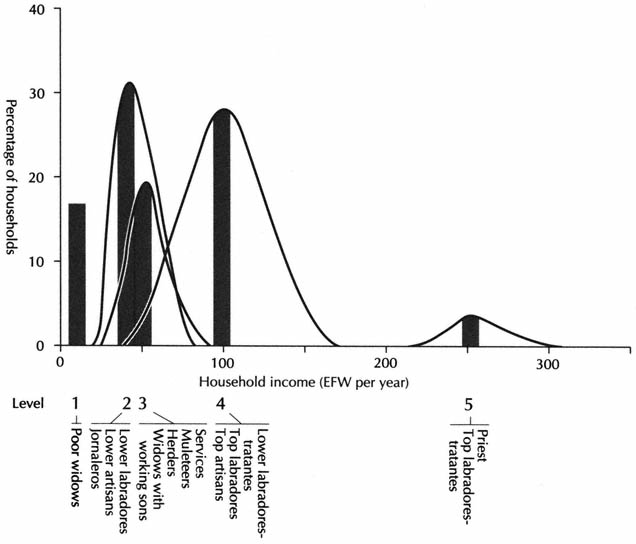
Figure 8.3.
Villaverde, Socioeconomic Pyramid, 1752
NOTE : This is a bar graph based on Table 8.18, with an indication
of dispersion. It is not a set of frequency distributions.
various sectors and individuals, an estimate of the condition of the economy as a whole. The sources of income have been seen, but of the payments made to the outside world only the rents have been established. Most of the others were religious in nature, and of these the most substantial came out of the tithes (Table 8.3). Two-ninths of the partible tithes, the tercias reales, went to the University of Salamanca. Three-ninths went to the owner of the prestamo of the town, the Colegio de San Gregorio of Valladolid, but the colegio was required to give one-twentieth of this payment to the cathedral of Salamanca. These two shares of the partible were 104 and 156 EFW. (Of the remaining four-ninths, three went to the parish benefice and one to the fabric.) The tithes of the fourth tither (cuarto dezmero) went to the cathedral of Salamanca, and the outside owners of lands free from tithes took the horros on the lands. The minor tithes (diezmos menudos ) on animals and wool were divided in the same way as the partible; of a total of 8 EFW, 4 left the town. The first fruits, 66 EFW, were all taken away, two-thirds to the holder of the "beneficio simple servidero," the second priest of the parish, who had chosen not to reside in the town, and one-third to the aforementioned Colegio de San Gregorio. The Voto de Santiago, 23 EFW, went to the cathedral of Santiago de Compostela.[37] Finally, as in the case of La Mata, one can estimate that about one-quarter of the income of the parish church was spent outside the town. Taking into account its share of the tithes, the horros, and the rent on the plots that belonged to the church and the endowments attached to it, the amount leaving would be 26 EFW.
The final deductions are obligations that the town council met for the vecinos as a whole. It paid a hospital in Salamanca 2.5 fanegas of wheat and 1 fanega of garbanzos (5 EFW), presumably for the right to send its sick to the hospital, and 206 reales (15 EFW) variously to a preacher for Lent, the insane asylum of Valladolid, and the bula de la cruzada. The administrators (sexmeros) of the partido of Salamanca received 380 reales (27 EFW).[38] (La Mata must also have paid them its dues, but its catastro overlooks the item.) The town council also paid royal taxes, established as an annual fixed sum through encabezamiento (Table 8.19). These taxes were almost nine times as high as those reported by La Mata, which in fact did not mention alcabalas y cientos (a sales tax originating in the Middle Ages). As with its high rents, Villaverde appears to have been burdened with charges that dated from an earlier, more prosperous time.
[37] All from Villaverde, resp. gen. Q 16 and maest. ecles., ff. 314–23.
[38] Villaverde, resp. gen. Q 23.
| ||||||||||||||||
The information is now at hand to establish the best estimate of the net annual income of the town, and it is 4,919 EFW (Table 8.20).
The family lists of the catastro, which appear reasonably complete for Villaverde, give a total population of 357[39] and a per capita income of 13.8 EFW. Although this is above the 12 EFW line, it is only about 70 percent of La Mata's per capita income. Most families lived frugally, while the poorer labradores, the jornaleros, and most artisans (Level 2 in the socioeconomic pyramid) were on the borderline of an adequate income. Only three labradores-tratantes and the priest (Level 5) were wealthy, while the remaining twelve labradores-tratantes and the blacksmith (Levels 4A, 4B) were well-off. A poorer economy than La Mata's, Villaverde's was also less egalitarian, for the wealthy labradores stood out above the body of the community. These men almost had to save or use their surplus to perform pious works. As husbandmen, they would be eager to buy land if it came on the market.
5
Such an economy did not offer encouragement for demographic expansion. The majority of the families were small; only the upper labradores, the muleteers, and the linen weavers averaged more than four in a household. Yet the population was not particularly old, as the age structure in 1752 reveals when compared to that of La Mata (Table 8.21 and Figure 8.4). Nevertheless, even though the population of La Mata was expanding rapidly, the available census information indicates that that
[39] Villaverde, personal de legos and personal de eclesiásticos.
| ||||||||||||||||||||||||||||||||||||||||||||||||||||||||||||||||||||||||
| |||||||||||||||||||||||||||||||||||||||||||||||||||||||||||||||||||||||||||||||||||||||||||


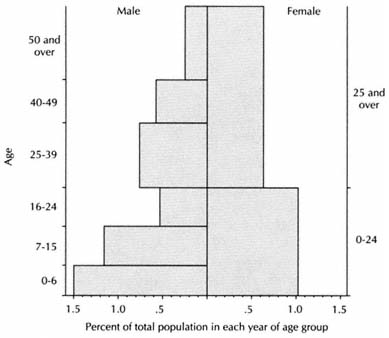
Figure 8.4.
Villaverde, Population Structure, 1752
NOTE : Since there is no limit to the top age groups, a span of
seventeen years for males is used for convenience only.
| |||||||||||||||||||||||||||||||||||||||||||||||||||||||||||||||||||||||||||||||||||||||||||||||||||||||||||||||||||||||||||||||||||||||||||||||||||||||||
of Villaverde was almost stagnant (Table 8.22). These counts indicate that Villaverde was slightly more populated in the sixteenth century (its impressive church looks as though it were built about 1600), declined slightly in the seventeenth century (the vecinos of 1712 are probably underreported), and recovered little in the eighteenth century. The catastro and census of 1786 are the most reliable counts and give full population. Over this thirty-four-year period, while La Mata grew 39 percent, Villaverde declined 3 percent. But demographic stability was not new to Villaverde in the second half of the eighteenth century.
One of the methods employed to keep the population down was late age at marriage. In La Mata 46 percent of the women and 44 percent of the men aged sixteen to twenty-four were married in 1786, in Villaverde only 10 and 12.5 percent respectively (Figure 8.5).[40] Six laymen over twenty-five were bachelors, 7 percent; in La Mata 3 percent. While Villaverde's population was slightly younger in 1786 than in 1752, it was
[40] For data on the 1786 census of Villaverde, see Appendix N, Table N.6.
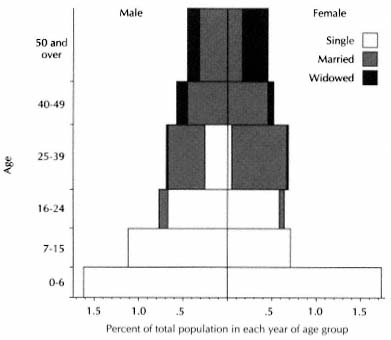
Figure 8.5.
Villaverde, Population Structure, 1786
NOTE : Since there is no limit to the top age group, a span
of seventeen years is used for convenience only.
now old by comparison with La Mata's (see Table 7.17). Twenty-seven percent were forty and over, in La Mata 18 percent. New people arrived in Villaverde as in La Mata, but not so many. Of forty-one regular tithers in 1798, ten had last names not present in 1752; in La Mata one-third were new. These features reveal why Villaverde was demographically stationary while its prosperous neighbor multiplied.
Villaverde also followed the practice of sending young girls away to serve—there were only twenty-two girls present in 1786 in the 7–15 age group compared to thirty-five boys. In La Mata they returned at about the age of sixteen and married soon, but in Villaverde they came back older—there were twenty females and twenty-four males in the 16–24 age group. There is a strong indication, moreover, that young men were also absent in the 16–24 age group both in 1752 and 1786 (see the age pyramids, Figures 8.4 and 8.5). It will become evident later that many unmarried young men served in the despoblados and alquerías of Salamanca, and very likely this is where some of those of Villaverde went to
| ||||||||||||||||||||||||||||||||||||||||||||
work.[41] The small size of households was the result not only of births averted but of an absence of part of the families.
The vecinos were also seeking other ways to improve their lot. One way was to move into more rewarding forms of work. The list of occupations in the census of 1786, although not so detailed as the catastro, gives evidence of this change (Table 8.23). Along with the jornaleros, the artisans had made up the poorest sector in 1752, and the next generation responded by leaving the trades. In La Mata artisans were also poor, and they disappeared by 1786. The depressed state of the crafts was apparently a general phenomenon in central Spain in the eighteenth century. Pierre Vilar has concluded from a study of the provincial returns of the catastro that throughout the Castilian meseta the crafts were in the last stages of a long decline.[42] The very increase in transportation that benefited the muleteers of La Armuña destroyed the monopoly of its artisans over local markets and hastened their disappearance.
Muleteering had absorbed much of the decline in craftsmen in Villaverde. There were five more arrieros in 1786 than in 1752. Their mean income had been slightly higher than that of artisans in midcentury, and it was a calling whose income did not decline in the next decades. Farming too was drawing more people. The census lists five more labradores, and the tithe records give independent confirmation that their number
[41] See below, Chapter 18, section 3, and esp. Figure 18.1.
[42] Vilar, "Structures de la société espagnole," 435–39.
| ||||||||||||||||||||||||||||||||||||||||||||||||||||||||||||||||||||||||||||||||||||||||||||||||||||||
was increasing. By the mid-1790s there were sixteen more labradores than at the time of the catastro, an increase of 32 percent.[43] By giving up crafts in favor of muleteering and husbandry, the community was specializing in areas of local comparative advantage.
In La Mata the increase in the number of farmers led to the sowing of more labor-intensive crops of the pulse family. In Villaverde, too, the vecinos experimented with various crops (Table 8.24). Between the catastro and the five-year period 1778–82, they reduced the amount of algarrobas, a fodder, and planted more wheat, with a resulting 17-
[43] In the early 1770s the tithe register lists about thirty-two labradores, in the mid-1780s about thirty-five, in the mid-1790s thirty-seven, and the number peaked at forty-four in 1800 (52 percent above 1752) After the epidemic of 1803–4, it declined to thirty-six in 1806 and rose to thirty-eight in 1808.
percent growth in the value of the harvest (at 1752 prices). In the next five years they tried a much larger garbanzo crop (in 1785 it was 28 percent of the harvest), the same years when La Mata increased its output of garbanzos. The total yield within the término was disappointing, only 11 percent above 1752 figures, and they abandoned the experiment. Between 1788 and 1797, they emphasized wheat again and planted pulses in more modest quantities. This proved to be the most profitable mixture, for the value of harvests was higher than ever.
Nevertheless the value of harvests grown within the town limits increased less rapidly than the number of labradores, but the tithe records indicate that the vecinos had another card up their sleeves. At the time of the catastro, the estimate of the vecinos' crops from neighboring towns was 556 EFW and from the despoblados of La Cañada and La Cañadilla 630 EFW, for a total of 1,186 EFW (Table 8.10). The tithe returns show that the outside harvests increased as follows (in EFW value and indexed against 1747–51):
|
By the end of the century, Villaverde farmers were harvesting over three times as much in neighboring towns and despoblados as at midcentury.
Most of the increase came from La Cañada and La Cañadilla. In two separate periods, 1776–80 and 1805–7, the cillero of Villaverde kept a detailed record of the tithes paid to outside towns for crops harvested in them instead of giving only a total figure for these payments. In the three intervening decades, the crops harvested by Villaverde farmers in nearby towns rose from about 625 EFW to about 900 EFW, but at the same time the harvests in La Cañada and La Cañadilla went from about 865 to about 3,900 EFW (Table 8.25). The Marquesa de Castelar, who lived in Madrid, owned 80 percent of the 974 fanegas of La Cañada, while the Encomienda of San Juan de Barbalos of Salamanca owned about 75 percent of the 367 fanegas of La Cañadilla.[44] Absentees, they would be glad to have the land of the despoblados broken to bring in more rent.
[44] For the area, AHN, Hac., Catastro, libro 7476, letra D; for the owners: AGS, Dirección General de Rentas, Unica Contribución, Mayor Hacendado, libro 536.
| ||||||||||||||||||||||||||||||||||||
If one considers the net income from harvests rather than the gross harvests, the growth in the two despoblados is even more impressive. The tithe book occasionally mentions the rent paid by the vecinos. In 1789 the rent for La Cañada was 520 fanegas of wheat and 180 of barley (total 610 EFW). In 1803 it was raised to 640 fanegas of wheat but was lowered to 600 after the bad harvests of 1803–4. For La Cañadilla the rent was 180 fanegas of wheat in 1801.[45] Subtracting rent, tithes, and seed (19 percent of gross harvest), the net return from harvests of the Villaverde farmers in the two despoblados was 1,990 EFW in 1805–7. The estimate for 1752 was 252 EFW;[46] it was now eight times as much.
The harvests of 1805–7 were unusually good and do not provide a representative picture of the situation at the turn of the century, for in good years the tenants profited more. Nevertheless, the farmers of Villaverde obtained a major increase in their harvests by exploiting the two despoblados. They were breaking ground where previously there had been pastures. The development was similar to that of La Mata and its anexo Narros, but with an important difference. The labradores of La
[45] From the entries for La Cañada and La Cañadilla for these years. I base the decline after 1804 on the decline in horros for these despoblados, which were 42 2/3 fanegas of wheat in 1803 and 40 in 1807. The records indicate that the horros were 1/15 of the rent.
[46] Table 8.10. Net harvest 510 EFW, less rent 195, and tithes 63.
Mata extended their farming into the despoblado of Narros until, in 1789, twelve vecinos moved to Narros and formed the core of a new town. Thereafter La Mata lost this resource. The farmers of Villaverde also turned to despoblados anexos for new land, but they did not move out of their town, so that the new fields added to the local income. These are two specific examples of how new land was assarted in Spain in the second half of the eighteenth century and how the economic condition of the local population changed as a result.
The evolution of the farmers' income can be followed by considering their total harvests inside and outside the town limits (Table 8.26). The harvests grown within the término by nearby vecinos almost disap-
| ||||||||||||||||||||||||||||||||||||||||||||||||||||||||||||||||||||||||||||||||||||||||||||||||
peared by the 1790s. The residents of neighboring towns who owned plots in Villaverde must have given up farming most of them and rented them to vecinos of Villaverde. With this additional harvest and those they brought in from outside, the farmers of Villaverde had between 50- and 60-percent larger harvests than at the time of the catastro. Meanwhile the number of labradores increased by a third, from twenty-eight in 1752 to thirty-seven in the mid-1790s.[47] Since the relation between the gross income and the net income from harvest probably changed little, the labradores had managed to raise their per capita income, not because of their experiments with different rotations but because of the new leases they had obtained within the término and outside it.
At the same time, the tithe rolls show that the disparity in income among labradores had declined since midcentury. In 1773–74 the first three of thirty labradores gathered 23.9 percent of the harvest. In 1798–99, the first four of forty-two gathered only 17.6 percent of the harvest.[48] A comparison of the net income from harvest of the top half of the labradores in 1752 (estimated from the harvest distribution of 1773–74) and 1795 gives the results in Table 8.27. The income curve had flattened out. The top labradores had noticeably less income than in 1752, but the income of those in the middle had risen. There are no figures for the end of the century on income from livestock, dealing in cattle, or cost of labor. In 1752 the total income of the first tither was 25 percent above his net income from harvest. This proportion increased as one went down the rank order until in the middle range it was 50 percent, because the share of work done by hired labor was progressively less. (Below these ranks, the labradores did not deal in livestock, and the proportion fell again, Table 8.12.) If this pattern still held true at the end of the century, then the income curve for the top half of the labradores was even flatter than Table 8.27 indicates.
The overall effect of the changes in occupational structure and farming activity can be observed by summing up the individual changes in the town income (Table 8.28). The net town income had risen about 30 percent. In 1786 the population was 346; in 1826 it would be reported as 394 (Table 8.22). One can interpolate for 1795 a population of 357, the same as in 1752, so that per capita income also rose 30 percent, from 13.8 to 17.9 EFW. These figures are only approximations, of course, for there are many unknowns. Income from livestock breeding and trading and the rate of rents inside Villaverde have been held con-
[47] Table 8.1 and n. 43 above.
[48] The crop of the casa excusada is estimated.
| ||||||||||||||||||||||||||||||||||||||||||||||||||
stant for lack of information. Additional information would undoubtedly change the estimate of per capita income at the end of the century, but not necessarily down, and if down, not enough to wipe out known gains.
Although part of La Armuña, Villaverde had had a relatively depressed economy at midcentury. Now it was flourishing. The vecinos had used with success the various means at their disposal to improve their economic position: sending their sons and daughters away to work, marrying late, moving into more profitable occupations, experimenting with different mixtures of crops, taking over leases of arable plots from outsiders, and above all breaking new ground in the neighboring despoblados. It was their good fortune to live next to vacant places with fertile land that needed only cultivation to make it produce, and to obtain their use for a modest rent. Those who benefited were the middle and lower-level farmers, for the most prosperous labradores lost some in the changes. About twenty labradores, perhaps an artisan and an arriero or two, and the priest would find it natural to put some of their income into savings, but there would be few strong fortunes when disentail began.
| ||||||||||||||||||||||||||||||||||||||||||||||||||||||||||||||||||||||||||||
6
The first sales in Villaverde were concluded in September 1799,[49] and the last of which I have a record took place in May 1806.[50] Within this period 221 of the 1,354 arable plots were sold and 9 out of 101 meadows: 19 percent of the land according to its value. Two houses were also sold.[51] Between the making of the catastro and the disentail the proper-
[49] AHPS, Contaduría, libro 850, f. 404r.
[50] Ibid., libro 856, f. 152r.
[51] Most of the properties can be identified in the catastro, but because this document does not give accurate names of all the religious institutions that owned land in Villaverde, some can only be identified on the basis of size, quality, and number of plots involved andby a process of elimination. Three plots sold do not appear to have been recorded in the catastro at all, but their value can be calculated from their size and quality. The Villaverde sales are in the following sources: ibid., libro 850, ff. 400v, 404r; libro 851, ff. 154r, 162v, 165r, 181v–191r; libro 852, ff. 123r–125r, 131r–137r; libro 853, ff. 112v–117r; libro 854, ff. 57v–58v; libro 856, f. 152r–v. Sales recorded in Madrid not entered in Contaduría are C1291, C12681, C15981. C19980, C31845, C31872. Vecinos of Villaverde bought some lands outside the town: AHPS, Contaduría, libro 851, ff. 94r–95v, 223r, 253r, 285v; libro 853, f. 102v; libro 855, f. 32r; libro 856, ff. 94r, 97r.
ties of four laymen (31 plots, 1 meadow, and 1 house) had been transferred to religious endowments and were among those disentailed.[52] In two cases these properties were purchased by vecinos of the same town as the 1752 owner, so that there was no net change of type of owner.
The situation after the disentail in 1808 is compared to that of 1752 in Table 8.29 and Figures 8.2 and 8.6. The change in ownership of land was not so extensive as in La Mata, where 42 percent of all land changed hands. The main cause of the difference was that ecclesiastical endowments owned less land in Villaverde, for they also lost massively here, 38 percent of their land being sold. The parish church and its funds were most affected, losing 53 percent of their property. In absolute terms, however, the religious institutions of Salamanca suffered most: their share of the town property fell from 33 to 22 percent.
A more significant difference between the two towns was in the buyers. La Mata's vecinos bought 55 percent of the property sold, Villaverde's only 16 percent. Vecinos of towns near La Mata bought 8.5 percent, vecinos of towns near Villaverde only 2.3. Nearby vecinos had made two bequests of land in Villaverde to religious foundations since 1752, and this land was now bought by residents of Salamanca, with the result that the share belonging to nearby vecinos declined by a fifth. Disentail did help the vecinos of Villaverde redress their position vis-à-vis their neighbors, extending to ownership a process that had been going on in rentals for several decades. In the sales Villaverde farmers acquired twenty-two plots and a meadow outside the término, while nearby vecinos bought only seven plots in Villaverde. The gain was modest, and on the whole the disentail hurt the town economy slightly. By contrast in La Mata the value of land in local hands almost doubled.
The massive buyers in Villaverde were residents of Salamanca, who
[52] Twenty-two plots owned in 1752 by the priest of Gomecello, Villaverde, maest. ecles., ff. 213–20; sold, AHPS, Contaduría, libro 851, ff. 154r–158r; two plots owned in 1752 by a vecino of Salamanca, Villaverde, maest. segl., ff. 217–31; sold, Contaduría, libro 851, f. 186v; four plots, one meadow, one house owned 1752 by a sister and brother in Pedrosillo el Ralo, Villaverde, maest. segl., ff. 275–79, 283–87; sold, Contaduría, libro 850, f. 404r; and three plots probably owned in 1752 by a vecino of Espino de la Orbada, Villaverde, maest. segl., f. 323, sold, Contaduría, libro 853, f. 115v.
| ||||||||||||||||||||||||||||||||||||||||||||||||||||||||||||||||||||||||||||||||||||||||||||||||||||||||||||||||||||||||||||||||||||||||||||||||||||||||||
bought 64 percent of the property sold and raised their share of the village's land from 25 to 37 percent. Residents of other distant places also increased their share. Among these individuals was don Francisco Alonso y Moral of Salamanca, one of the largest buyers in the province. He made five purchases totaling sixty-three plots and four meadows, 4.7 percent of the property in the town, as well as a house. Don Lorenzo Piñuela, a priest and prebendary of the Salamanca cathedral, in two purchases acquired forty-two plots, while don Cosme de Trespalacios, an advocate of Madrid, bought thirty-six plots and a meadow. Together these three gentlemen acquired two-thirds of the land sold in the town. We shall meet them again in Chapter 20, when we consider the persons who obtained most from the disentail.
Thirty-two people bought land in Villaverde. Table 8.30 gives their identity and the percent of the land in the town that each bought. The list shows a clear pattern. Residents of Salamanca and Madrid dominate the top quarter; they are seven of the top eight buyers. Vecinos of Villaverde make up most of the next quarter. Those in the bottom half of the
| ||||||||||||||||||||||||||||||||||||||||||||||||||||||||||||||||||||||||
| ||||||||||||||||||||||||||||||||||||||||||||||||||||||||||||||||||||||||||||||||
list, people who mostly bought only one or two plots, had scattered residences, two certainly and two probably in Salamanca, one in Valladolid, and eight in nearby towns.
Chance did not dictate this pattern. On the whole, lands were purchased by residents of the place in which the religious institution that owned them was located. Twenty-seven of the 28 plots and all 3 meadows that the vecinos of Villaverde bought belonged to the funds of their church. Residents of Salamanca bought most of the holdings of Salamanca institutions, all but 34 of their 148 plots (29 of the other 34 went to Trespalacios, a vecino of Madrid who soon was to move to Salamanca). Vecinos of Villaverde would have found it difficult to bid for most of these properties, for they formed parts of endowments that consisted of plots scattered over various towns and, sold in blocks, were beyond the means of any local farmer. One may recall, however, that two buyers of La Mata were able in at least one case to bid on and buy those plots that lay within their town and neighboring Narros of a large endowment that spanned other towns. Vecinos of Villaverde did not achieve any such success. And when the large property of a confraternity of Villaverde, 25 plots and 2 meadows, went on sale, Alonso y Moral stepped in to acquire it.[53] He had to pay more than the assessed value in hard currency to get it, seventeen thousand reales, which he would not have done unless forced to by competing bidders. One suspects that the vecinos made a concerted effort to get these lands but failed before his wealth. In comparable circumstances, the vecinos of La Mata obtained the vast property in their término of the General Hospital of Salamanca.
Nine vecinos bought land in the town, two of them and five others bought land outside. Among these fourteen were four women. What can we tell about them? Our main source of information is the tithe book; except for two of the women, all their names appear in it at sometime or other. They were seven labradores, two labradoras, two senareros, and a priest. That is, nine of the fourteen were already full-time farmers.
The largest purchaser was the priest, don Alonso González. The parish supported two clergymen, the curate and the beneficio simple servidero, holder of a capellanía without specific duties. The census of 1786 identifies don Alonso as the latter person. In 1752 the holder of this capellanía had not been resident, but don Alonso's name appears on the tithe register as a senarero from 1774 to 1797. He bought one plot in
[53] AHPS, Contaduría, libro 853, ff. 112v–114r.
1800 for 7,700 reales, which had belonged to the benefice he held;[54] the same year he headed a group of six buyers who purchased two plots in Villaverde and ten plots, one meadow, and two vineyards in nearby towns.[55] These properties had formed the endowment of another capellanía of Villaverde, which don Alonso may also have held. The purchase seems to have been a family affair: besides don Alonso there were three other Gonzálezes, Antonio and Manuel, labradores of Villaverde, and Josepha. The two other buyers were María and Isabel Albarez, sisters perhaps, the last a vecina of Negrilla. They paid 30,620 reales, a respectable sum. We do not know the source of this capital or how much each person's share was. Don Alonso had the income of his benefice; Antonio and Manuel were small labradores. Antonio disappeared after 1802, and Manuel died after the harvest of 1804. The priest was evidently the driving force of the group. He was no longer farming, probably because of his age, and so he rented his newly purchased fields.
Several of the other labradores who bought lands were among the upper third of the farmers, and it is easy to explain their resources. Manuel Romo Borrego, who spent about 3,900 reales for three plots and a meadow as his share of a purchase made in 1801 by three vecinos (one of whom, Manuel González, has already been mentioned), was an elderly and distinguished member of the community.[56] We first find his name simply as Manuel Romo in 1766, when he shared a lease for the lands of the monastery of Discalced Franciscan Nuns of Salamanca in Villaverde and six surrounding towns.[57] His name is regularly in the tithe book from its inception in 1773, and in 1786 he signed the census return as one of the two alcaldes of the town. He was second tither in 1798–99, with an annual net income from harvest in excess of 150 EFW. At 1800 prices (43 reales for a fanega of wheat in Salamanca) he could have had much more money put away than he spent on his purchase. Manuel Romo Martín, a tither since 1786 (his appearance was the cause of the other Manuel Romo adding his matronymic surname Borrego), was the third of the men making the joint purchase in 1801. He bought four plots for about 2,800 reales. In addition he and Gerónimo Romo together purchased two plots in Pajares, the next town to the north, paying 5,170 reales.[58] Manuel Romo's net income from harvest of 135 EFW would have permitted him to save the total of these
[54] Ibid., libro 851, f. 162v.
[55] Ibid., ff. 94r, 182v, 223r, 253r, 385v.
[56] Ibid., libro 852., ff. 133r–134v.
[57] AHN, Clero, libro 10854, ff. 111–21.
[58] AHPS, Contaduría, libro 856, f. 97r.
purchases by himself in five years. Since Gerónimo Romo appears to have been the heir of Manuel Romo Borrego (on the latter's death, he took over his lease to the lands of the Franciscan nuns), he could easily have paid whatever his share was. The labradora Juana Encinas was the widow of Juan Rodrigo, who died in 1798.[59] Rodrigo had been on the tithe register since its inception, and in 1786 he signed the census as the second alcalde. Before his death he had risen to be third tither, just below the other alcalde. When his widow first appeared on the tithe lists in 1798–99, she was sixth, having given up some of his leases. Her net income from harvest averaged about 135 EFW. In 1803 she bought four plots for 5,409 reales;[60] she would not have had trouble financing the purchase.
Where the others got their money is less clear. Josef Carvayo, fourth largest buyer among those of Villaverde, was thirteenth in the ranking of harvests for the years 1798–99 with an annual net income from harvest of about 120 EFW. In 1801 he bought six plots in Villaverde for 12,100 reales.[61] Perhaps he saved forty fanegas of wheat a year, at current prices over an eighth of his purchase, but since prices had risen recently, his purchase represented a minimum of nine or ten years' savings, or less if he paid in vales reales (the contaduría records do not specify the form of currency). He had been on the tithe rolls since 1791, but one suspects that he had an inheritance or other income. Mariana Martín, the other labradora, bought five plots in Pajares in 1806, paying 5,000 reales.[62] She first appeared in the tithe rolls in 1804; in 1807–8 she was sixteenth tither, putting her at the top of the group that netted about 100 EFW in 1795. It would have been hard for her to save the price of her fields; she was probably a widow with inherited wealth. The origin of the capital of Francisco Laso, the last of the labradores who bought land, is the most difficult to understand if it came only from farming. He appeared on the tithe rolls in 1798 almost at the bottom of the labradores. In 1803 he bought six fields lying outside the town, four of them in La Cañada and La Cañadilla, paying the relatively modest sum of 2,620 reales.[63] Farming could hardly have provided his savings; did he engage in other activities? We do not know.
I have classed the other two local purchasers as senareros, although
[59] She took over his lease to the lands of the monastery Nuestra Señora del Jesús in 1799 (AHN, Clero, libro 10668, f. 217r–v).
[60] AHPM, C31872.
[61] AHPS, Contaduría, libro 852, f. 132v.
[62] Ibid., libro 856, f. 94r.
[63] Ibid., libro 855, ff. 32r, 32v.
the identity of one is in doubt. This is Manuel Martín, who paid 6,250 reales in hard currency for a large plot in 1803.[64] His name appears only once in the tithe book. in 1801 as a senarero. Was this unlikely person the buyer, or did the notary in Madrid corrupt the name of Manuel Romo Martín the labrador, who could easily have added this to his other acquisitions? There is no doubt about the identity of the second senarero, Cayetano Prieto. He first paid tithes in 1800. In 1802 he bought five plots and two meadows in two separate purchases, paying altogether 3,500 reales. Furthermore he paid this in hard currency at more than the minimum price; he had beaten out other bidders.[65] His case is particularly interesting. Listed as a senarero until 1806, he appeared as a labrador in 1807 and 1808. In 1798–99 his harvest was about 38 EFW; in 1807 it was 145 and in 1808, 117. Yet the plots he bought produced only 10.5 fanegas per year in 1752, so that most of his harvests in 1807–8 came from rented lands. Whatever his profession before the disentail, he seized the opportunity to buy land and went on to become a labrador.
Prieto's case reveals the economic mobility induced by the sales, not as striking in Villaverde as in La Mata but clear in some cases. Manuel Romo Martín had the ninth harvest in 1798–99; by 1807–8 he was sixth. Josef Carvayo was even more successful: number thirteen in 1798–99, he rose to number two in 1801–2 and was still there in 1807–8. One recalls that his resources are not clear; it is clear that he had great individual drive. At a lower level, Francisco Laso, among the poorest labradores in 1798–99, after his purchase in 1803 rose to be tenth by 1807–8. Two purchasers did not advance, but in both cases their age can account for their declining harvests. The widow Juana Encinas, number six in 1798–99, fell to number twelve in 1807–8. Since her late husband was already farming in 1773, she was probably getting too old to administer all her leases and passed on some to others. The alcalde Manuel Romo Borrego was number two in 1798–99, dropped to number seven in 1801–2, and died after the harvest of 1803. He had been farming since at least 1766; age and infirmity may have forced him to restrict his activities.
In none of these cases do the lands purchased alone account for the change in status. Josef Carvayo's six plots produced 13.5 fanegas of wheat in 1752, his gross harvests went from about 245 EFW in 1798 to almost 700 in 1807–8. His is only the most striking case. As in La Mata, the purchase of lands evidently made a farmer a more attractive
[64] AHPM, C31845.
[65] Ibid., C19978, C19979; AHPS, Contaduría, libro 853, ff. 114v–115r.
tenant, and he could extend his leases at the expense of his more passive neighbors. Here, as in La Mata, disentail reversed the trend toward flattening out the income curve of labradores. In 1798–99 the top tither on the rolls (second after the casa excusada) paid 4.3 percent of the tithes collected; in 1807–8, 6.0 percent. The top five tithers listed in 1798–99 paid 20 percent of the tithes; in 1807–8, 26 percent.
Most of the purchasers were in the top half of the labradores, those with excess income, but they were scattered through this group. Only three of the top ten in 1798–99 bought land. They included number two and the widow of number three but not the head of the casa excusada nor the cuarto dezmero.[66] The well-to-do of the town benefited as a group but not all the richest individuals, only those who leavened their resources with personal ambition.
Religious institutions and endowments had owned 48 percent of the land; their share was reduced to 32 percent. In La Mata the transformation favored the town. In Villaverde this was not the case; after disentail the land controlled by the town, its church and residents, including land outside the término, had declined slightly. The formula established earlier indicates that the rent paid by the vecinos to nonresident owners increased about twenty fanegas of wheat per year as a result of the sales. The amount is small, hardly affecting the town economy, but it is symptomatic of the fact that desamortización did not help Villaverde. The wealthy citizens of Salamanca, by acquiring more than the churches of the city lost, raised the city's share of Villaverde slightly. Villaverde remained as much an economic dependency of Salamanca as before, despite the gains it had made in the second half of the eighteenth century.
At first sight, the failure of Villaverde to do better comes as a surprise when one considers the success of La Mata. At this time their populations were about the same, but the vecinos of Villaverde spent only about 74,000 reales on disentailed land, those of La Mata 251,000. La Mata's major success, the purchase by sixteen vecinos of the properties of the General Hospital of Salamanca, for which they paid 174,000 reales, was led by a man addressed as don who was a newcomer to the town. This man may have brought a major share of this capital with him. Nevertheless, one would have to credit the other vecinos with providing at least 150,000 of the 251,000 spent, twice the amount of those of Villaverde.
The vecinos of Villaverde could not compete with the buyers of Sala-
[66] The casa excusada and cuarto dezmero are identified in the tithe roll of 1804; they were Manuel Escudero and Antonio García. Neither was a buyer.
manca for large blocks of properties scattered across a number of towns, but they let escape lands in their own town that were easily within their reach: eleven plots and four meadows bought in 1800 by a resident of Salamanca for only 9,285 reales, two small plots of first quality land that went to another buyer in Salamanca in 1801 for 800 reales, and the only properties of the General Hospital in Villaverde, seven plots, bought by a vecino of Salamanca in 1806 for only 8,150 reales.[67]
Since the middle of the century, the vecinos had improved their economy substantially. When disentail began, their estimated per capita income of 17.5 EFW was not far below that of La Mata, 20 EFW. Yet they did not take advantage of the royal decree as the vecinos of La Mata did. A number of reasons have come to light for their differing responses. Villaverde had only recently recovered from what appears to have been a long, drawn-out depressed economy. According to the data, at midcentury it had a lower yield-seed ratio, higher rents, and heavier royal taxes than La Mata; a large sector of its population engaged in declining crafts; and its arrieros followed less remunerative routes. Its physical aspect as well, with abandoned houses and an elegant old church, indicates a more prosperous past when artisans were thriving, more productive land justified higher rents, and the crown compounded its taxes at a corresponding level. Times had gotten worse, but the burdens of rents and taxes were fixed by tradition. La Mata had a more modest past, witness its taxes and its church, not completed until 1791. Since before the catastro it had experienced a heady growth, which led to its seizure of the opportunity of disentail.
The story of the two towns since the catastro was almost reversed, with Villaverde improving its economy and La Mata struggling to stay where it was, and this may be the major factor in the difference in their responses. With rapid population growth induced by the town's prosperity, La Mata's farmers had declined relative to the population of the town as a whole. For a while in the 1780s the despoblado of Narros offered them a way to keep their marginal productivity from falling, but when it became a separate town in 1789, they lost this resource. The town was still prosperous; the families had savings accumulated over recent generations; and the labradores with large harvests had immediate means to pay for purchases, as did the arrieros, whose position had not declined. Disentail offered them a possible way out of their straits, and one that looked especially attractive at a time of high grain prices. The pressure of circumstances encouraged them to unite against the
[67] AHPS, Contaduría, libro 851, f. 181v; libro 852, f. 123r; libro 856, f. 152r–v.
world represented by their landlords in Salamanca, as they did in buying the lands of the General Hospital.
It would be hard to argue that the labradores of Villaverde were less enterprising than those of La Mata, for the remarkable expansion of their harvests, in part at the expense of neighboring towns, shows that as a group they had plenty of drive. Rather, one can say that for Villaverde the disentail came at a less opportune moment. Prosperity had come more recently, and the cause of it, the expansion of farming into the two despoblados anexos of the town, was still working. Families probably had fewer savings, and labradores could see less advantage in buying land when they could rent virgin soil relatively cheaply next door. In economic terms, the opportunity costs of investing in disentailed land were higher for the farmers of Villaverde, and so they let slip out of their grasp some easy acquisitions.