
Royal Reform and Revolutionary Mobilization
The royal Administration of the Book Trade in France had collapsed by January 1791, and it was not to be resuscitated for almost twenty years. But the most powerful cultural institution of the Old Regime, the Paris Book Guild, did not fall with the Bastille. In fact, its members were quietly holding a meeting to admit a new printer into their ranks on the very day that the Parisian masses toppled what had become the preeminent symbol of royal tyranny.[1] To historians of the French Revolution, the last register of the meetings of the Paris Book Guild, which recorded the group's formal activities from 1787 to 1791, has appeared to be a profoundly disappointing source.[2] In it we read endlessly of the reception of apprentices, booksellers, and printers; their examinations; the attestations to their religious faith and moral standing; their participation in the processions of the rector at the university and in the parish; and the annual roll call for the royal "capitation" tax. Indeed, the entries for the eighty-eight meetings of the guild over this period depict a world more reflective of urban corporate life during the late reign of Louis XIV than of Paris in the throes of revolution (plate 2).
Upon closer reading, of course, the great events of these years are visible, refracted dimly and elliptically through the lens of corporate
[1] BN, mss. fr. 21861, "Registre de la communauté des libraires et imprimeurs de Paris," entry for July 14, 1789.
[2] Ibid., December 7, 1787–March 18, 1791. For mentions of the source, see, for example, Chauvet, Ouvriers du livre 2:28; and Estivals, Dépôt légal, 100.
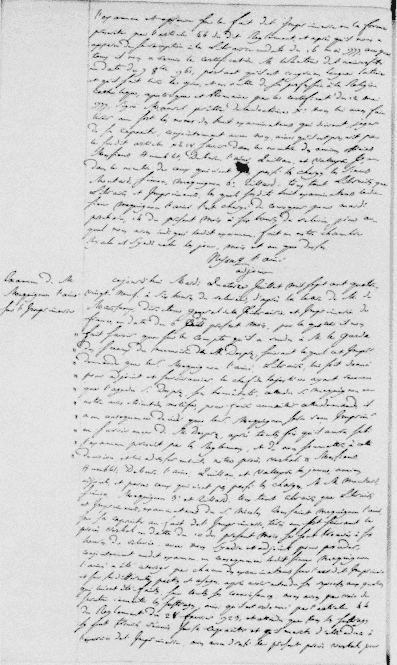
Plate 2.
Register of the Paris Book Guild: Entry for the meeting of July 14, 1789.
The Paris Book Guild was quietly admitting a new printer into its ranks as the
masses toppled the Bastille. Bibliothèque Nationale, Cabinet des Manuscrits.
ritual. The exile of the Parlement of Paris, for example, is quietly acknowledged by a notation of the absence of parliamentary representatives at the rector's procession on August 7, 1788.[3] And later, on April 24, 1789, the register records that the guild's officers had "assembled the entire community through written notice . . . to nominate commissioners and examiners to draft the 'cahiers de doléances' of the publishers and printers of Paris."[4] Still, with the exception of a few similarly unrevealing disclosures, the register of the Paris Book Guild rolls over 1788, 1789, 1790, and 1791 without ever noting even the formal suppression of the guild's existence.
Yet it is the very historical dissonance of the register of the Paris Book Guild as a document of the Revolution and its anachronistic character that present the historical problem: What was the position of the Paris Book Guild on the eve of the Revolution? What role did it play in the Revolution itself? Did the Guild form part of a corporatist-aristocratic reaction, as some historians have suggested?[5] Did its members passively or stoically submit to their fate, as others have supposed?[6] The answers lie beneath and beyond the circumspect inscriptions of the guild's cautious official guardians.
The Paris Book Guild was quick to mobilize its presses and its members to insure that it would be represented at the Estates General as a corporation. On December 6, 1788, Siméon-Prosper Hardy, a bookseller on the rue St-Jacques and member of the guild, recorded in his journal the receipt from guild officers of a copy of a memorandum submitted to the king: the judges and counsellors of the city of Paris requested a special separate delegation of representatives from the Corporations of the Arts and Trades of Paris to the Estates General to assist the Crown in reestablishing the "credit and confidence" of the realm.[7] The printer
[3] BN, mss. fr. 21861, entry for August 7, 1788.
[4] Ibid., entry for April 24, 1788.
[5] Louis Radiguer, Maîtres imprimeurs et ouvriers typographes (Paris: Société Nouvelle de Librairie et d'Edition, 1903), 141–146.
[6] William Sewell, Jr., Work and Revolution in France (London: Cambridge University Press, 1980), 87.
[7] Siméon-Prosper Hardy, "Mes loisirs," BN, mss. fr. 6687, 8:164 (entry for December 6, 1788). See also Etienne Martin St. Léon, Histoire des corporations de métiers (Paris: Alcan, 1909), 601.
of this memorandum was the highest officer of the Paris Book Guild, the syndic André-François Knapen (see table 2). The pamphlet went straight from his presses to its constituency, the guilds that elected the judges and counsellors of the city of Paris.
By December 16, 1788, Hardy records having acquired a copy of a petition of the Six Corporations of Paris calling for a more proportional representation of the Third Estate—that is, one cleric to two nobles to three members of the Third Estate, giving the Third Estate an assured representation of 50 percent.[8] Hardy judged this to be a "configuration that today appears to conform most closely to equity . . . and to the spirit of the institution." And he was not the only member of the Paris Book Guild who held this opinion. On December 22, 1788, the guild register recorded that "several members of the guild requested a general assembly of the guild in order to propose that the guild adhere to the petition of the Six Corporations."[9] The following day Hardy received a sealed copy of the petition from the guild officers and a notice for a general assembly of the guild.[10]
The guild officers dared to mention the purpose of this meeting only in a marginal note in the official register.[11] And they recorded no account of the deliberations or their outcome. Fortunately, Hardy was more forthcoming in his private journal:
Sieur Cellot, publisher and former printer . . . held forth very directly and with great vehemence in favor of the petition; he urged that everyone support it, and that we do so hastily by giving it our unanimous signature. But he was wisely and forcefully countered by sieur Charles-Guillaume LeClerc, publisher, former syndic, and former judge-counsellor of the city . . ., who argued vigorously that we should not give formal written support to the petition so quickly. . . . His proposal passed by a vote of nineteen to fourteen. . . . But as all of those who wanted to support the petition announced their discontent and left having refused to sign anything, this tumultuous assembly decided to defer the final deliberation.[12]
We have no trace of the final outcome of the debate over the adherence of the Paris Book Guild to the petition for proportional representation. However, the Parlement did allow the Six Corporations to submit their
[8] Hardy, "Mes loisirs," BN, mss. fr. 6687, 8:172 (entry for December 16, 1788).
[9] BN, mss. fr. 21861, "Registre de la communauté," entry for December 22, 1788.
[10] Hardy, "Mes loisirs," BN, mss. fr. 6687, 8:185 (entry for December 23, 1788).
[11] BN, mss. fr. 21861, "Registre de la communauté," entry for December 24, 1788.
[12] Hardy, "Mes loisirs," BN, mss. fr. 6687, 8:186 (entry for December 24, 1788).
petition to the king.[13] And only a week later, on December 27, 1788, Minister of Finance Necker persuaded the king to decree the doubling of the number of representatives of the Third Estate.
The debate in the Paris Book Guild over the petition made clear that their disagreement was over strategy rather than substance. The division—and it was close—was between the strident and the cautious. At bottom guild members had firmly allied their interests with the Third Estate and were agitating, even if not officially, for enlarging that group's representation. At a purely legalistic level, this is not at all surprising. Nor was it particularly revolutionary by the end of December 1788. After all, the publishers, printers, and booksellers of Paris were formally members of the Third Estate. Furthermore, others were beginning to point out that real political change lay not merely in increasing the number of representatives of the Third Estate, but rather in putting an end to a political order based on the division of society into separate privileged estates.
The cultural politics behind the guild's support for the movement to double Third Estate representation were soon elucidated in a pair of anonymous pamphlets, Remerciment des libraires de la rue S. Jacques à M. Necker and Réponse des libraires du Palais Royal, au remerciment de leurs confrères de la rue Saint Jacques, à M. Necker , which appeared in early January "chez Desenne, Gattey, and Petit, libraires, au Palais Royal."[14] The Remerciment was a grub-street satire of the corporate cultural vision of the Paris Book Guild, in which the booksellers of St-Jacques offer profuse thanks to the minister of finance for the decree doubling the number of representatives of the Third Estate. Why? Because, the pamphlet explained, the decree would restore political order and in so doing put an end to public interest in the political ephemera sold in "that magical palace [the Palais Royal], which, like a sun sucking up water and leaving the plains desiccated, has consumed all the business in the capital."[15] Necker had thankfully put an end to the political crisis and hence to the craze for political pamphlets sold beyond the jurisdiction of the king and his book guild by booksellers in the Palais Royal. Readers
[13] Martin St. Léon, Histoire des corporations, 601–602.
[14] Remerciment des libraires de la rue S. Jacques à M. Necker, suivi de quelques autres pièces relatives aux circonstances (Paris: Desenne, Gattey, Petit, 1789); and Réponse des libraires du Palais Royal au remerciment de leurs confrères de la rue Saint Jacques, à M. Necker (Paris: Desenne, Gattey, Petit, 1789).
[15] Remerciment, 6.
would now mercifully return to the literary fare offered by the privileged publishers on the rue St-Jacques.
The pamphlet thus transformed the cultural geography of Paris into an allegory of the political debate between reformers, who wanted to modify the system of representation by orders, and revolutionaries, who wanted to abolish distinctions by order altogether. From the perspective of the Palais Royal, the doubling of the Third Estate was far from revolutionary. On the contrary, it only served the interests of those bent on maintaining corporate privileges and distinctions—like those of the Paris Book Guild, whose members worked and lived on the rue St-Jacques. The privileged publishers, the booksellers of the Palais Royal taunted, could not survive in a competitive cultural world based on consumer demand rather than state monopolies.
The Réponse des libraires du Palais Royal, au remerciment de leurs confrères de la rue Saint Jacques , in contrast, sounded a conciliatory note—one stressing the potential symbiosis rather than the conflict—between the publishers of St-Jacques and the Palais Royal:
You feign jealousy of our place in the magic palace, but in reality it is you who control big publishing and bring so many volumes to the light of day. And you have an interest in our being there, to expose your books to the gaze of the curious . . . We are there, from the first sound of the trumpet in the journals, to distribute [your works]. You know, dear colleagues, everything depends on timing, and no one knows better than us how to make the most of it.[16]
The real division within the publishing world, the Réponse suggested, lay not between the privileged and the unprivileged, nor between book and pamphlet publishing, but between publishing books and retailing them. The publishers of the rue St-Jacques, they urged, should abandon their defense of privileged orders and cultural monopolies and instead work together with the booksellers of the Palais Royal to take advantage of the opportunities that a publishing world based on free-market principles could offer in compensation.
Some members of the Paris Book Guild were soon won over by arguments calling for an end to the division of public life into privileged orders. Hardy himself, one of the hesitators in the guild debate over the petition, soon enthusiastically noted the publication of Emmanuel Sieyès's
[16] Réponse , 11–12.
Qu'est-ce que le état? in his journal and its author's call for an end to the division of the nation into privileged estates.[17] But others within the guild remained firm in defense of their privileges and the old corporate publishing world. Nor was it merely the reestablishment of "credit and confidence" that the guild hoped to achieve from the opportunity for reform presented by the convocation of the Estates General.
On January 5, 1789, a week after the debate on the doubling of the Third Estate in the Paris Book Guild, Poitevin de Maissemy, director of the royal Administration of the Book Trade, received a memorandum from "the Printers and Publishers of Paris."[18] Dieudonné Thiebault, chief officer of the administration's Paris bureau, informed his newly appointed superior that the memorandum was "well known"; indeed, it had already been presented to the former director in the same terms.[19] Another copy of the same memorandum dated 1787 confirms Thiebault's report.[20] This mémoire had served as a position piece for the Paris Book Guild and was presented to each new head of the royal Administration of the Book Trade with the hope of gaining a ministerial ear for guild interests. It allows us to locate the posture of the guild in relation to the royal administration on the eve of the Revolution. The mémoire opened in the following terms:
Your elevation to Minister of Laws has given hope to the Book Trade. Ruined, devastated by the six arrêts of the Royal Council of August 30, 1777, we dare to beg you to restore the regulations of 1723. . . . Ten years have sufficed to reveal the vices of the new regime. . . . Of these arrêts , those concerning pirate editions and the duration of privileges are the ones that have dealt the worst blows to the Book Trade.[21]
On the eve of the Revolution, the Paris Book Guild was already at war with the Crown and its administration, and had been for over ten years. As far as the guild was concerned, the "old regime" had come under
[17] Hardy, "Mes loisirs," BN, mss. fr. 6687, 8:223 (entry for February 3, 1789). Emmanuel-Joseph Sieyès, Qu'est-ce que le état? [Paris, 1789].
[18] AN, ser. V1, carton 550, Report by Thiebault, February 5, 1789.
[19] Ibid.
[20] BN, mss. fr. 21822, "Archives de la chambre syndicale des libraires et imprimeurs de Paris," fols. 2–10.
[21] AN, ser. V1, carton 550, "Mémoire," February 5, 1789, fol. 1r.
assault in 1777. For the officers of the Paris Book Guild, the convocation of the Estates General represented an opportunity to restore rather than to dismantle the corporate publishing monopolies of the Old Regime.
The dispute between the Paris Book Guild and the Crown was no small squabble. The decrees of 1777 had represented the culmination of a fifty-year debate between the Crown and the Paris Corporation of Printers and Publishers concerning the nature and duration of royal literary privileges. The royal Code de la librairie , established to regulate the Parisian publishing world in 1723, and extended to the entire nation in 1744, had defined a literary "privilege" as at once an official approbation of the work, a permission to publish, and a kind of copyright, in that a privilege assured its holder a legal exclusivity on the commercial publication of the work.[22] While in principle the Crown could revoke or extend privileges at will, by the end of the seventeenth century the centralizing and corporatistic royal administration had in practice encouraged the consolidation of a monopoly by the Paris Book Guild on the lion's share of the literary inheritance of France.[23] It did this by conferring extensive privileges for publication of both individual texts and whole areas of knowledge to particular Paris publishers and then renewing these privileges automatically over generations.[24]
To protect their monopoly against the protests of excluded provincial publishers, the Paris publishers began in the late seventeenth century to evolve their own interpretation of the meaning of the literary privilege. In 1726, the Paris Book Guild commissioned the jurist Louis d'Héricourt to write a legal brief arguing that a privilege was not a royal "grace" to be conferred or revoked at the king's pleasure, but rather a royal confirmation of an anterior property right. Invoking John Locke's notion of the origins of property in appropriation, d'Héricourt argued that the property in ideas is derived from labor: "It is the fruit of one's own labor, which one should have the freedom to dispose of at one's will."[25] According to the Paris Book Guild, privileges were nothing more than the legal confirmation of a preexisting property right founded in the
[22] For the text of the Code of 1723, see Jourdan, Decrusy, and Isambert, eds., Recueil général des anciennes lois françaises , (Paris: Belin-Leprieur, 1826), 21:216–252.
[23] H.-J. Martin, Livre, pouvoirs et société ; H.-J. Martin, "Prééminence de la librairie parisienne"; and Birn, "Profits in Ideas."
[24] See Birn, "Profits in Ideas," esp. 139.
[25] Cited in ibid., 144.
author's labor and transmitted to the publisher through a contract. Ironically, the argument that ideas were the property of the individual author was first advanced in defense of the monopoly of the Paris Book Guild on texts whose authors were long since dead.[26]
By the middle of the eighteenth century the issue of literary privileges became caught up in a more general movement by enlightened royal officials to deregulate commercial life, including commerce in ideas, by dismantling the corporate monopolies created by Colbert. Although the royal reformer A.R.J. Turgot had exempted the book guild from his famous decrees of 1776 suppressing commercial monopolies, the Crown heeded the advice and counsel of successive officers of the royal Administration of the Book Trade and through six arrêts on August 30, 1777, announced an important shift in its policies concerning the book trade.[27] The king's Council of State issued a series of decrees intended definitively to refute the guild's interpretation of literary privileges as confirmations of property claims and to decentralize the publishing world by breaking up the Parisian monopoly on the nation's cultural inheritance.
In the 1777 decrees the king's council made its interpretation of "privilege" explicitly clear: "A privilege for a text is a grace founded in Justice. . . . The perfection of the work requires that the publisher be allowed to enjoy this exclusive claim during the lifetime of the author . . . but to grant a longer term than this would be to convert the enjoyment
[26] Mark Rose makes a similar observation about the source of property arguments in the English context; see "The Author as Proprietor: Donaldson v. Beckett and the Genealogy of Modern Authorship," Representations 23 (1988): 56.
[27] Chrétien-Guillaume de Lamoignon de Malesherbes, the director of the royal Administration of the Book Trade between 1750 and 1763, argued for revising the code on the book trade to allow authors to publish and sell their own works, rather than requiring them to use licensed publishers and booksellers, in his "Memorandum on the Necessary Regulations to Prevent the Printing, Selling, and Importing of Bad Books," written sometime during his tenure and first published in his Mémoires sur la librairie et sur la liberté de la presse (Edited by E. Rodmell [Chapel Hill: University of North Carolina Press, 1979; orig. ed. Paris: Agasse, 1809], 175–178). Notes for a second memorandum, advancing similar arguments, were written by François Marin, general secretary of the Administration of the Book Trade, at the request of Joseph d'Hemery, inspector of the book trade in Paris, and submitted to the new director of the royal administration, Antoine-Raymond-Jean-Gaulbert de Sartine, in 1764. See BN, mss. fr. 22183, "Représentations et observations en forme de mémoire sur l'état ancien et actuel de la librairie et particulièrement sur la propriété des privilèges, etc., présentées à M. Sartine par les syndic et adjoints, et en marge les observations que M. Marin a faites sur chaque article, d'après les notes instructives que je [d'Hemery] lui ai remises par ordre du magistrat" (March 1764); cited by Birn, "Profits in Ideas," 153–154.
of a grace into a property right."[28] The Crown thus reaffirmed the absolutist interpretation of royal privileges as an emanation of the king's grace alone and not the recognition of a property right.
The decrees created two categories of literary privilege. Privilèges d'auteur , which legally recognized the author for the first time, were to be granted to authors in recompense for their labor and held by them and their heirs in perpetuity , unless sold to a third party. Authors were thus for the first time in fifty years permitted, indeed encouraged, to hold on to their manuscripts and to engage in publication rather than sell their manuscripts to publishers. Publishers' privileges, or privilèges en librairie , by contrast, were to be limited to the lifetime of the author and nonrenewable. After the author's death, these texts returned to the "royal domain" to be enjoyed by any royally licensed publisher, with the king's permission. The Crown hoped that by making these lucrative legal books available to provincial publishers they could be wooed away from the booming traffic in pirated and illicit works. In an effort to institute these reforms on a new footing, the Crown, by another arrêt of the same date, legitimized all pirate editions anterior to the arrêt .[29] Thus in 1777, with a stroke of the royal pen, the cultural capital of the Paris Book Guild, as embodied in inheritable literary privileges, had been threatened with extinction.
Not surprisingly, the Paris Book Guild did not receive any of these arrêts passively, and it outlined its position succinctly in its mémoire to Maissemy of January 1789:
The arrêt concerning the duration of privileges . . . renders the property rights of authors illusory. . . . The dispositions of this arrêt are founded upon the principle that a publisher's "privilege" is no more than a "grace founded in justice." . . . But . . . a "privilege" is nothing more than the guarantee of the author's property in his work. . . . If property is incontestable there can be no distinction between an author's "privilege" and that of a publisher. . . . Why this violence against the sacred principle of property?[30]
In its most strident moment, the guild denounced the arbitrary manner in which the royal council determined the matter: "No authority can take our property from us and give it to someone else."[31]
The positions of the Crown and the Paris Book Guild in this debate
[28] Jourdan, Decrusy, and Isambert (eds.), Recueil général des anciennes lois françaises 25:108–123.
[29] Ibid., 121, 123.
[30] AN, ser. V1, carton 550, "Mémoire," February 5, 1789, fols. 1v, 2.
[31] Ibid., fol. 2v.
ring with dissonance and irony to the modern ear. On the one hand, the Crown, in defining the legal claims on a text as a royal "grace," revocable and mutable at the king's will, had sought to liberate the literary inheritance of France from the monopoly of a privileged corporate elite, to acknowledge the author as the creator of his or her works, and to create a competitive commercial market in ideas. On the other hand, the Paris Book Guild sought to defend its corporate monopoly on the entire literary inheritance of France by defining literary privileges as royal confirmations of sacred and inalienable property rights, inhering originally in a contract between author and publisher. Inviolable by any human authority, property in texts was, according to the guild, a natural right merely ratified by royal privilege.
The dispute between the Crown and the Paris Book Guild in 1789 over the meaning of privilege and who had power to determine this question was not, however, purely theoretical. A good deal of evidence suggests that the guild had, in effect, gone on strike against the efforts of the royal Administration of the Book Trade to implement the six arrêts of 1777 and was still in full resistance to the Crown on the eve of the Revolution.
Following the proclamation of the arrêts of 1777, the Administration of the Book Trade began to implement the reforms pertaining to the new limits on the literary privileges held by members of the Paris Book Guild. The exclusive claims of guild members over thousands of titles were systematically limited or revoked.[32] The Crown then began to give permission to provincial publishers to produce and market works that had previously been the exclusive privilege of members of the Paris Book Guild.[33] The Paris guild, however, refused to register the six arrêts ,
[32] BN, mss. fr. 22004, "Archives de la chambre syndicale de la librairie et imprimerie de Paris, bureau de la librairie: état des privilèges; état des titres de propriété fournis par les libraires de Paris" [1777]; 22005, "Archives de la chambre syndicale . . ., feuilles des jugements des privilèges derniers et définitifs conformant à l'article XIe de l'arrêt de conseil du 30 août 1777 sur la durée des privilèges"; and 21832, "Archives de la chambre syndicale," feuilles 26–40, "No. 2, Tableau des ouvrages jugés communs ou qui le deviendront à l'expiration des privilèges dont ils sont revêtus, par l'arrêt de conseil du 30 août 1777, portant règlement sur la durée des privilèges en librairie." Another arrêt of July 30, 1778, further increased the discretionary power of the administration by allowing the keeper of the seals to extend the duration of privileges beyond ten years at his own will; see Augustin-Charles Renouard, Traité des droits d'auteur dans la littérature, les sciences et les beaux arts (Paris: Renouard, 1838), 180.
[33] See BN, mss. fr. 1682, Collection Joly de Fleury, "Librairie, imprimerie et censure des livres: règlements sur la matière, 1607–1789," feuilles 168–235 (1779–1780) and 250–268 (1780).
to enforce them, or to recognize the legality of the claims of those who did. Instead, its members mounted a public campaign against the arrêts in a series of pamphlets.[34] And they took their case to the Parlement of Paris, which remonstrated in favor of the guild position.[35] The guild succeeded in keeping its cause alive in the courts well into the 1780s, thus lending legal credence to their obstruction of the royal administration.[36]
Sometime after January 1782, at the behest of the Parlement of Paris, the guild prepared a Compte rendu par les syndics et adjoints de la librairie des faits relatifs à l'exécution des arrêts du Conseil du 30 août 1777 concernant la librairie .[37] According to this report, the arrêt pertaining to pirate editions had been settled amicably with the royal administration: the keeper of the seals had agreed to let the Paris guild prohibit the sale of the newly legitimated provincial pirate editions in Paris.[38] With the most controversial arrêts , however, those pertaining to privileges, the situation was different, in part because the guild was not fully able to prevent the implementation of the arrêts , nor at every point was it in its interest to do so. Thus, the guild recognized and registered authors' privileges because these conformed to its view that exclusive commercial claims should be perpetual.[39] But when it came to publishers' privileges the situation was more complex. The guild refused to implement any policy that either explicitly or tacitly recognized the new royal "permissions" to publish formerly privileged works.[40] In fact, the guild was seizing any shipment of books from the provinces for which a privilege had once been held by a member.[41] The Paris Book Guild was thus engaged in a full-scale war
[34] For examples of Paris Book Guild propaganda against the arrêts, see [Charles-Guillaume LeClerc], Lettre à M [sur la propriété littéraire] [Paris, December 19, 1778], BN, imprimés; and the Lettre d'un libraire de Lyon à un libraire de Paris [Paris, 1779], Musée de l'Imprimerie & de la Banque, Lyon.
[35] AN, ser. V1, carton 550, "Mémoire," February 5, 1789, fol. 7v.
[36] The legal history of the Paris Book Guild's case in the Parlement is documented in BN, mss. fr. 1682, Collection Joly de Fleury, "Librairie, imprimerie et censure," feuilles 168–235, 250–268. See also Renouard, Traité des droits d'auteur, 166–193. The guild ultimately lost.
[37] BN, mss. fr. 1682, Collection Joly de Fleury, "Librairie, imprimerie et censure," feuilles 168–173.
[38] Ibid., feuille 170.
[39] Ibid., feuille 169.
[40] Ibid.
[41] The Compte rendu presented to the Parlement by the Paris Book Guild in 1782 gives examples of this practice: "Un S. Baume, libraire à Nîmes, conçut, il y a quelques années, le dessin de faire une édition de l'Histoire ecclésiastique de M. de Fleury. Il en existait une somme considérable de in-12 et de in-4 dans les magasins des Libraires de Paris qui en avaient le privilège. . . . Depuis les arrêts de 1777 . . ., il [le S. Baume] a voulu faire venir [l'édition] à l'adresse du S. Baume: Nous l'avons suspendue"; ibid., feuilles 171–172.
with the royal council and the Administration of the Book Trade when the Estates General was convoked in May 1789. The guild placed its hopes first on the Parlement and then on the Third Estate to defend its corporation and its perpetual monopoly on literary privileges, as they had been interpreted under the Code of 1723.