
PART I—
THE HISTORICAL CONTEXT OF ORESME'S TRANSLATIONS
1—
Royal Patronage of Vernacular Translations
Patronage and Audiences
The rapid increase in translations from Latin into the vernacular is a hallmark of fourteenth-century cultural history.[1] The process had begun by the beginning of the thirteenth century, when social, political, and economic conditions in western Europe created a climate favorable to the spread of literacy among the lay population. Among the new audiences who read for pleasure, business, or both, were members of the royal bureaucracies, the feudal nobility, merchants, and growing numbers of the middle class living in towns or cities.[2] Earlier waves of translations addressed to a learned and largely clerical audience had made accessible many works of the Greek and Roman scientific and philosophical corpus previously unknown to medieval culture. These Latin translations are closely tied to the rise of universities in the twelfth and thirteenth centuries.[3] The appropriation and assimilation of classical and Arabic texts into medieval Christian culture through the mediation of the university curriculum marks a significant turning point in Western thought.
Less well known, however, is the process by which authoritative texts in Latin were translated into the vernacular. Such translations involve another stage in the appropriation of classical culture by secular patrons and audiences, who chose the language, texts, and channels for the dissemination of knowledge.[4] Accurate versions of serious and scholarly works on philosophy, theology, and natural science became available in modern languages.[5] Although a rich body of literary texts in vernacular tongues had long existed, the fourteenth century witnessed the development of modern languages as instruments of abstract and scientific thought.
Modern scholarship has linked a preference for the vernacular by lay audiences to the growth of personal libraries and to new methods of reading.[6] Certain types of vernacular literature composed for aristocratic circles, such as chansons de geste, romances, and poetry, were intended for oral performance. Also read aloud was the popular thirteenth-century compilation in verse known as the Histoire ancienne jusqu'à César . Around 1200 French prose became the favored vehicle of vernacular historiography. During the course of the thirteenth century, members of the nobility commissioned for a French-speaking laity historical texts chronicling royal deeds written in the vernacular.[7] Of great importance is the translation from Latin into French of the official national history in 1274 by Primat, a monk of Saint-Denis, the royal abbey entrusted with this responsibility. The moral value of his-
tory as a guide to contemporary rule, the creation of a mythic French past, and the appeal to a lay audience provided important models for the political context of vernacular translations.[8]
The practice of composing original works in or translating them into French vernacular prose did not, however, suddenly eliminate the oral recitation of written texts. But Paul Saenger dates to the middle of the fourteenth century a shift among the aristocracy from oral performance or reading in small groups to silent, visual reading. As Saenger explains, the practice of individual reading and advances in the compilation of texts had begun during the thirteenth century in academic circles to enable students to master texts of the university curriculum. Such improvements encouraged the demand for and production of new vernacular texts.[9]
During the second half of the thirteenth century, royal patrons and members of the nobility closely tied to court circles commissioned various translations of serious or scholarly works in French prose.[10] As a young man, King Philip IV ordered translations of Giles of Rome's influential Mirror of Princes text, intended for the political and moral counsel of rulers, the De regimine principum , and later of the perennial medieval favorite, Boethius's De consolatione philosophiae .[11] The pace of translations accelerated during the first half of the fourteenth century, when French queens and princesses, unschooled in Latin, encouraged the commission of vernacular works.[12] Among the texts chosen for translation into French by royal patrons were works of history, classical mythology, liturgical and biblical texts, and treatises of moral instruction and personal devotion.[13]
The father of Charles V, King John the Good, who reigned from 1350 to 1364, continued the royal tradition of patronage of vernacular texts and of sumptuously illustrated manuscripts. As the founder of the royal library housed in the Louvre and as the first French king to envisage a program of artistic patronage for political ends, John the Good set an important precedent for his son. While still duke of Normandy, John commissioned the translation of James of Cessola's De ludo scaccorum from John of Vignai. After his accession to the throne, King John ordered from Master Jean de Sy a vernacular version of the Bible.[14] After the battle of Poitiers in 1356, the imprisonment of the French monarch interrupted this ambitious project. Even in captivity, King John ordered both religious and secular books written in French.[15]
The most important secular translation commissioned by King John was Pierre Bersuire's French version of Livy's History of Rome . Bersuire, a Benedictine, was a longtime resident of Avignon, which, as the temporary seat of the papacy, was an important cultural crossroads. Bersuire's translation profited both from the manuscripts in the papal library and from his contacts with Petrarch. The famous humanist may have furnished the translator with missing portions of Livy's text.[16] After Bersuire's return to Paris from Avignon in 1350, he seems to have enjoyed the protection of King John. Bersuire and Petrarch, whose friendship continued by correspondence, met again in Paris, when in 1361 the latter served as an ambassador to the French court of Galeazzo Visconti, ruler of Milan. In an address congratulating King John on his return from his English imprisonment, Petrarch deeply impressed his audience, including the future Charles V.[17]
Completed by 1356, Bersuire's translation of the first, third, and fourth Decades of Livy's History of Rome is the first word-for-word translation of a classical work executed on French soil.[18] In his prologue addressed to the king, Bersuire emphasizes that Livy's narrative contains valuable information for contemporary princes. The war between France and England may have increased the practical appeal of Livy's text in its account of Rome's policy on defense of native territory, conquest of foreign lands, and aid to allies.[19] On another level, Bersuire's emphasis on the Roman rise to world dominance from humble beginnings had particular relevance because of the mythical descent of French rulers from the Trojans, legendary founders of Rome. The appropriation of Livy's work by French royalty sounds the theme of the translatio studii , the transfer of linguistic, military, and cultural dominance.[20]
From a practical standpoint, Bersuire's compilation of the text shows his understanding of the need to re-present the work for his lay audience. To make Livy's text easier to follow, the translator breaks up the three main sections (Decades) into short chapters introduced by titles. Intermingled with the texts are sets of notes or comments, entitled Incidens , that furnish the reader with information about unfamiliar Roman place names, terms, people, events, and institutions.[21] To aid the reader in comprehending the many new terms he introduces into French, Bersuire provides a glossary of some eighty terms arranged at the beginning of the text in rough alphabetical order.[22] Also influential on later translations is Bersuire's method of transforming Latin words into French ones by changing the endings or spelling.[23] By this method of calques , Bersuire added forty-three neologisms to French.
King John's commission provided an important precedent for Charles's translation project, particularly for Oresme's French version of Aristotle's works. The French translation of such an authoritative classical text as a guide to political rule is noteworthy. Also significant are the linguistic methods and compilation features configured to re-present the work to a new lay readership.
Political and Cultural Implications
The increasing linguistic preference for the vernacular had political and cultural implications. By the last third of the fourteenth century, French had gradually replaced Latin as the language used for many types of administrative records and documents. During the reign of Charles V, members of the chancellery prepared drafts for the king's approval written in cursive script.[24] Charles V wrote and signed letters in French and annotated and corrected documents in the vernacular.[25] This increased use of French in royal administration gave the language greater prestige and helped to break down the traditional distinction between literate Latin-reading clerics and laymen, who were considered illiterate because they had at most limited knowledge of Latin. This statement does not imply that knights, lawyers, and social groups involved in public administration knew no Latin at all. Recent studies indicate that groups used Latin for business or professional purposes
and for religious observance.[26] The existing evidence indicates, however, that the Latin proficiency of Charles V, his court, and high officers was insufficient to understand classical or medieval authors whose works interested them.[27] Indeed, in their justifications of producing vernacular versions of antique texts, the translators' complaints about the difficulties of classical Latin style, syntax, and terminology go beyond topoi of their inadequacy.[28]
The increased use of the vernacular in public life also shows a nationalistic aspect.[29] Pride in the beauty of the French language is a theme of Oresme's prologues in translations commissioned by Charles V.[30] The first phase of the Hundred Years' War undoubtedly heightened consciousness of the French language as a distinctive national characteristic. Many prologues written by Charles V's translators refer to current political issues, especially to the natural superiority of the French nation to their English enemies.[31] A related motif in Oresme's prologues is his compliment to the lay audiences he addresses. He identifies them in two ways. First, he names the officers of government, including the king and princes. His second category is a vague, broader grouping of Frenchmen of high intellect.[32] Oresme's positive attitude toward the French language also appears in the prologue of his translation of the Politics when he observes: "As Cicero puts it in his Academica , authoritative works on weighty matters are delightful and most agreeable to people when written in the language of their country."[33]
Oresme's claim of the broad appeal of French translations to a lay public receives confirmation in Monfrin's study of the numbers of manuscripts of vernacular translations and their owners from the thirteenth century to early printed editions of these texts.[34] While some of these readers came from royal and aristocratic circles, also represented are lawyers and other professionals, government officials, members of the Parlement of Paris and the haute bourgeoisie who had personal libraries.[35] Finally, as Charles V's program indicates, French translations also had a political function.
The Scope of Charles V's Program of Translations
Charles V commissioned more than thirty translations of authoritative classical and medieval works as part of a conscious policy to legitimate the new Valois dynasty. He placed his encyclopedic library, housed in a tower of the Louvre, at the disposal of the intellectuals in his employ. His carefully organized collection included Mirror of Princes texts on the moral and political education of rulers as well as political treatises and historical writings.[36] Among the histories was the king's copy of the Grandes chroniques de France , written at court and updated through Charles V's own reign with an emphasis on political issues.[37]
A social and moral justification of Charles V's program of translations occurs in Nicole Oresme's prologue to his French version of Ptolemy's Quadripartitum . As models, Oresme alludes to two principal translations commissioned by John the Good: the French version of the Bible by Jean de Sy and Bersuire's vernacular rendition of Livy.[38] In her biography of Charles V and other writings, Christine
de Pizan also stresses the moral and educational functions of the translations, citing the king's concern for future generations. Executed by the most qualified masters, these translations provide moral instruction in all the arts and sciences.[39] In her poem entitled the Chemin de long estude , Christine specifies even more clearly the ethical intent of the king's program of translations:
Et moult fu noble oeuvre et perfaitte,
Faire en françois du latin traire,
Pour les cuers des François attraire
A nobles meurs par bon exemple.
(And it was a noble and perfect action to have [them]
translated from Latin into French to attract the
hearts of the French people to high morals by good
example.)[40]
Various prologues to the translations commissioned by Charles V make similar points about the social and political value of the enterprise. In the preface to his translation of St. Augustine's City of God , Raoul de Presles states: "vous avez voulu estre translaté de latin en francois pour le profit et utilité de votre royaume, de votre peuple et de toute crestienté" (you have desired [it] to be translated from Latin into French for the benefit and advantage of your kingdom, and all Christendom).[41] As Delisle points out, the phrase "l'utilité du royaume et de toute la crestienté" also appears in the official document which states that Charles V paid the translator for his work.[42] Repeated in other acts of Charles's reign, such language places the translations in the context of an articulated public policy.[43]
Yet it would be a mistake to ignore Christine's many references to Charles V's translation program to substantiate his intellectual character and his taste for books and learning. Charles's earliest commissions reveal his personal interests and approach to ruling. Sponsored by Charles before his accession to the throne, these earliest translations are astrological treatises. The texts date from about 1360, when as regent he faced serious challenges to the survival of the monarchy. Consistent with the practice of medieval rulers, Charles sought knowledge of the immediate and long-range outcome of events through astrological prediction. For example, a section of Robert de Godefroy's French version of the Liber novem judicum (Le livre des neuf anciens juges d'astrologie ) contains a timely discussion of the disposition of the territory that once belonged to a king who has now lost his lands.[44]
Several translations dating from the years after Charles's accession to the throne in 1364 show a broadened subject matter. Among this group are French translations of two religious works, the Homilies of Saint Gregory and the Treatise on the Soul (Traité de l'âme ) by Hugh of St. Victor;[45] the French versions by Pierre Hangest date from 1368. The manuscript appears in all the inventories of Charles V's library and was written by Raoulet d'Orléans, the scribe of the king's second set of the Ethics and Politics translations.[46] Historical works were translated at the end
of the 1360s by the Carmelite Jean Golein. Golein, along with Nicole Oresme and Raoul de Presles, is one of the three translators most favored by Charles V. In 1369 Golein completed a French version of the shorter works of the influential Dominican Bernard Gui. (A year earlier an unknown translator produced Gui's Les fleurs des chroniques .) Before 1373 Golein also translated a massive universal history, Les chroniques d'Espagne ou de Burgos , written by Gonzalo of Hinojosa, bishop of Burgos.
Christine de Pizan's discussion of Charles V's translation project concentrates on works dating from the 1370s, when the program took on an overt political and moral tone. In their prologues, which show their exchanges of texts and ideas, the translators are aware that their work corresponds to the ancient and medieval classics chosen by the king for translation: Christine's "les plus notable livres" (the most noteworthy books). Among them are three works by Aristotle rendered in the vernacular by Nicole Oresme: the Ethics , the Politics , and On the Heavens . The first dates from 1370 to 1372; the second, after 1372; and the third, from 1377. Christine does not mention the pseudo-Aristotelian Economics , which Oresme also translated. Since this short work was frequently included with the Politics , she may have thought it unnecessary to name it separately.[47] As famous as the Aristotelian works are two texts of St. Augustine. The City of God (Cité de Dieu ) was translated by Raoul de Presles between 1371 and 1375, and the Soliloquies (Soliloques ), by an unknown translator. Of great importance to a medieval ruler is a classic of political thought, the Policraticus (Policratique ) of John of Salisbury, translated around 1372 by the Franciscan Denis Foulechat. Also a great medieval favorite is the scientific encyclopedia, Bartholomaeus Anglicus's On the Property of Things (Propriétés des choses ), translated in 1372 by Jean Corbechon. By 1375 the first four books of the well-known text by the Roman historian Valerius Maximus, Factorum et dictorum memorabilium libri novem (Faits et dits dignes de mémoire ) were translated by the Hospitaller Simon de Hesdin. Christine pays particular attention to a translation of the Bible entrusted to Raoul de Presles around 1375.
Christine's list highlights only the most important translations commissioned by Charles V. She lumps together what she calls a "tres grant foison d'aultres" (a great abundance of others). A varied group of texts dates from the 1370s, including Jacques Bauchant's vernacular version of Les voies de Dieu (1372), a devotional work by St. Elizabeth of Hungary. Also omitted are the French translations of Seneca's De remediis fortuitorum (Des rémèdes ou confors de maulx fortunes ), as well as of Petrarch's De remediis utriusque fortunae (Les rémèdes de l'une et de l'autre fortune ), completed in 1377 by Jean Daudin. Daudin also rendered into French Vincent of Beauvais's De eruditione filiorum nobilium (L'enseignement des enfants nobles ). Jean Golein's translations of the 1370s do not figure in Christine's list either. In 1370 Golein completed his French version of Cassian's Collations and, four years later, the Rational des divins offices (Durandus's Rationale divinorum officiorum ), including the important Traité du sacre . Golein claims that this short but vital text on the procedures and symbolism of coronation ceremonies is a translation.[48] Golein's last certain translation for Charles V, in 1379, is a Mirror of Princes text, L'information des princes .
Also not included in Christine's list is the anonymous version dating from 1372 of Thomas of Cantimpré's Bonum universale de apibus (Livre du bien universel des mouches à miel ). Nor does she cite Jean Daudin's 1374 vernacular rendition of another work by Vincent of Beauvais, the Epître consolatoire . Absent also is one of the most influential political tracts of the period, Le songe du vergier , translated by an unknown person with interpolations from the contemporary—but not identical—treatise entitled the Somnium viridarii . Finally, two other translations of the 1370s need mention. From 1373 there dates a translation (Rustican ) of the Ruralium commodorum libri XII by Peter of Crescenzi. Only fifteenth-century copies survive of this encyclopedic treatise on agriculture. Totally lost is the French version of the astronomical tables of Alphonso, king of Castille (Les tables astronomiques d'Alphonse, roi de Castille ).
Although only a partial guide to Charles V's translation project, Christine's list of over thirty translations is enlightening. It shows Charles's broad vision and boldness in bringing into the orbit of secular French culture the most authoritative Latin works of pagan and Christian origin, encompassing secular moral and religious texts, classics and recent writings on political thought, and works on education, astrology, history, and natural science. Christine rightly emphasizes the royal initiative that promoted and directed the program and outlines its moral and political dimensions. She also provides the clues to determining its broader cultural aims.
The Translatio Studii
It is significant that Christine de Pizan follows her discussion of the translations sponsored by Charles V with a chapter on his close relationship to the University of Paris. As the seat of the university, a primary center of learning in the Christian West, the city of Paris merits the title of the "new Athens."[49] By presenting one version of the translatio studii , the topos of the transfer of antique culture and military power from Greece to Rome, she takes up the tradition dating from the twelfth century that France had taken possession of the Roman heritage.[50] To emphasize the foundations of French national superiority, the translatio studii theme was absorbed into royal historiography and merged with an allegorical interpretation of a primary monarchical symbol, the fleur-de-lis.[51]
The idea of the translatio studii takes on a new resonance in Oresme's prologue and particularly in the apologia for his translation of the Ethics and the Politics .[52] As noted above, Oresme quotes Cicero in affirming the pleasure of writing in one's native language. Oresme also takes a historical and cultural view of language and notes that, just as Greek letters and power gave way to Latin and the Roman empire, Latin is being replaced by French as the language of learning. Oresme emphasizes the value of French as a "langage noble et commun a genz de grant engin et de bonne prudence" (a noble language shared by people of great discernment) and as the obligation to translate "telz livres en françois et baillier en françois les arts et les sciences" (such books into French and [to] make available the arts and sciences in French) as a legal transmission of culture.[53]
In Christine's version of the translatio studii theme, the prominence of Paris encompasses both the university and Charles V's patronage of art and letters. A personal and dynastic model for the studious and enlightened monarch was the emperor Charlemagne. Several similarly worded prologues of translations commissioned by Charles draw parallels between Charlemagne's love of learning and that of his Valois namesake.[54] For example, Jean Golein's preface to the Rationale of Divine Offices refers to Charlemagne as the "droit patron" (true patron) of the kings of France, especially of Charles V. The translator connects Charles V's Christian faith, shown by the use on his coins of the legend Christus vincat, Christus regnat, Christus imperat (Christ conquers, Christ reigns, Christ rules), with his "estude et sapience" (study and wisdom) and victories against the English.[55] Thus, the traditional themes of faith, wisdom, and chivalry embodied in the fleur-de-lis are attributed to the kingdom of France and its ruler, Charles V.
In addition to the favorable cultural analogies that Golein makes between Charlemagne and Charles V are the specific political benefits attributed to Charles by association with the Carolingian ruler. Golein asserted that Charles V descended directly through the male line from Charlemagne.[56] Charles V himself encouraged the linking of his rule with that of Charlemagne by various strategies.[57] The so-called scepter of Charlemagne was apparently commissioned for, and used in, Charles V's own coronation. Now in the Louvre, the scepter features a representation of the emperor seated in majesty. Several miniatures from the Coronation Book of Charles V , ordered by the king as a souvenir of, and guide to, the actual ceremony held in 1364, show him holding a scepter that closely resembles the Louvre object.[58] Thus, the effigy of Charlemagne so prominently displayed on the very symbol of monarchic sovereignty represents a bold visual coupling of Charles V's rule with that of the Carolingian emperor. Moreover, Charles collected relics and celebrated the feast day of St. Charlemagne in his chapel.[59]
In a more concrete political context, Charles V cultivated another fiction connected with Charlemagne. Embodied in the formula rex imperator in suo regno (the king is emperor in his kingdom), this argument made by royal apologists contends that the kings of France were not subject to imperial or papal sovereignty. The premise is that Charlemagne did not intend his own patrimony, the kingdom of France, to be subject to himself or to anyone else who held the title of Holy Roman Emperor.[60] Among the many references in the translations sponsored by Charles V to the rex imperator in suo regno formula, three stand out. In the preface to his French version of Cassian's Collations , Golein mentions his patron as he who holds and governs the kingdom and empire of France. Golein's treatise on the coronation ceremony included in the translation of the Rationale of Divine Offices not only speaks of "l'empereur de France" but also asserts that Charlemagne left the sacred banner known as the oriflamme in France "en signe d'empire perpetuel" (as a sign of eternal empire).[61] In outspoken fashion, Le songe du vergier , which in 1378 adapted a Latin text composed three years earlier, adds to the original work an assertion that the king of France is emperor in his own kingdom. Invocation of this formula counters English claims to disputed territory, such as Guyenne,
and more generally, accounts for the legal inability of the king of France to alienate or surrender any part of the realm. These bold interpolations probably reflect Charles V's direct intervention in the writing of the translation.[62]
At about the same time, a visual application of the rex imperator in suo regno formula can be found in an illustration accompanying an account of the visit in 1377 and 1378 of Charles V's uncle, the Holy Roman Emperor Charles IV. Among the novel scenes that explain these events in the king's copy of the Grandes chroniques de France is a representation of the entry into Paris of Charles IV, his son Wenceslas, and Charles V. Leading his imperial visitors, the French king rides on a white horse that symbolizes his sovereignty.[63]
Thus, the translations commissioned by the king emphasize the cultural and political superiority of the French nation under the leadership of Charles V. The translators' prologues contend that this ruler carries on the heritage of piety, learning, and military victories of his namesake and purported ancestor, the emperor and saint Charlemagne. In such a context, Charles V's translation program ushers in a new phase of the translatio studii , in which, under monarchic patronage, a transfer of learning and power is expressed in works written in the French language.
Humanistic Currents
While the retrospective, political aspects of Charles V's program of translations are important, his policy of encouraging works in the vernacular also reflects a personal interest in and contemporary taste for the classical past and early Italian humanism. An important precedent is John the Good's sponsorship of Bersuire's translation of Livy. Although King John's copy does not survive, in an inventory of 1373 the custodian of Charles V's library describes in unflattering terms the writing, illumination, and illustration of this manuscript.[64] Indeed, the oldest extant illustrated copy of Bersuire's translation is one from Charles V's collection. The colophon in the king's hand states that he was responsible for having the book written, illuminated, and brought to completion. The elaborate cycle of illustrations attests to the king's taste, an analogue of his preference for the vernacular.[65]
Ties with Petrarch and Avignon may also have influenced Charles's interests. Perhaps the king recalled his encounter with Petrarch in Paris. In 1361 during a diplomatic mission, the Italian humanist failed to deliver to the French court a scheduled discourse on Fortune. To compensate, Charles V may have commissioned in 1376 the first translation of Petrarch's work: the French version by Jean Daudin of the De remediis utriusque fortunae .[66] In another direction, Petrarch's devotion to St. Augustine's City of God may have spurred Charles V to order Raoul de Presles's translation of this text.[67] This hypothesis seems plausible in view of Presles's reliance on the Latin commentaries on the City of God by two English friars, Nicholas Trevet and Thomas Waleys. Both men were longtime residents of Avignon with strong humanist interests.[68] Presles focused on the wealth of infor-
mation about ancient Greek and Roman culture provided by the first half of the City of God and the later Latin commentaries. Indeed, Presles writes that because theology was not his specialty, he does not comment on the second half of the text, and Laborde states Presles's translation was popular precisely because of its wealth of anecdotes about classical heroes and other subjects from ancient history rather than its religious content.[69] In addition, the elaborate cycles of illustrations that often accompany the popular translation by Presles made the texts more accessible and appealing to lay audiences.[70]
In the French version of the first four books of Valerius Maximus's medieval favorite, the Faits et dits dignes de mémoire , the translator, Simon de Hesdin, depends heavily on the earlier commentary of 1342 written in Naples by Fra Dionigi da Borgo San Sepolcro. Fra Dionigi's patron was King Robert the Wise of Anjou, whose court was an early center of Italian humanism.[71] The illustrations of the French translation, executed between 1375 and 1379, clearly indicate this interest in classical culture. A French version of Seneca's letter to Lucilius commissioned by a high official of the Angevin court also found a place in Charles V's library.[72] King Robert also commissioned a copy of the missing fourth Decade of Livy's History of Rome .[73] Two of three manuscripts associated with the Angevin court in Naples that later belonged to Charles V and his brother the duke of Berry also deal with Roman history.[74] Thus, the relationship between the French court in Paris and that of Naples suggests another channel to early humanistic currents in Italy.
The sponsorship by Charles V of illustrated manuscripts of Bersuire's translation of Livy, as well as those of Simon de Hesdin's vernacular version of Valerius Maximus and of Presles's influential rendition of St. Augustine, contributed to their popularity and dissemination among lay audiences. Although it is difficult to separate the humanistic elements of these translations inspired by contacts with Petrarch, Avignon, and Naples from traditional French medieval classicism, both strands may have motivated the original and subsequent demands for these texts. And while the translations of classical works from just one part of Charles V's program, they constitute a distinctive aspect of his personal taste and that of his generation. With their extensive, if not always correct, explanations of classical allusions, Nicole Oresme's translations of Aristotle's Ethics and Politics exhibit a similar fascination with the culture of the ancient world.
2—
Intellectual and Political Ties between Nicole Oresme and Charles V
The Historical and Biographical Context
The relationship between Oresme and his patron provides another context for the Aristotle translations.[1] Although scholars now agree that Oresme was not Charles's childhood preceptor,[2] it seems likely that he served as an informal intellectual adviser. Oresme's early writings in French provide evidence that by the late 1350s he had attracted the prince's attention. Miniatures in manuscripts commissioned by Charles clarify not only his relationship to Oresme but also some of the future king's interests.
Details of Oresme's early life are sparse. He was probably born near Caen sometime in the early 1320s. His name first appears in a document of the University of Paris dated 1348 among the masters of the Norman nation and as a scholarship holder of the College of Navarre. After teaching arts and then theology, he became a master of theology in 1356. Oresme probably studied with Jean Buridan, head of the College of Navarre, which was founded in 1304 by Queen Joan of Navarre, wife of King Philip IV. Buridan, an interpreter of Aristotle, was also an important nominalist and natural philosopher and may have influenced Oresme's thinking.[3] Since Oresme was at the leading center of Aristotelian studies in Europe, he would have been infused with a thorough knowledge of the Philosopher's thought. The first group of Oresme's writings date from the late 1340s to the early 1350s, when Oresme was teaching in the arts faculty. Among these unpublished works are collections of individual questions on selected topics, a method of scholastic argument, six of which concern works of Aristotle. A second group of Oresme's writings in Latin on mathematics and physics addressed to scholarly audiences probably dates from the late 1340s to the early 1360s.
In 1356 Oresme was named Grand Master of the College of Navarre, a royal foundation, around the same time that scholars believe he came to the attention of the royal family. That year marked a low point in the fortunes of the new Valois dynasty that had succeeded the last Capetian king, Charles IV, in 1328. The accession to the French throne of King Philip VI, the first of the Valois line and father of John the Good, had precipitated the Hundred Years' War. At the decisive battle of Poitiers that ended the first phase of the Hundred Years' War, in 1356, King John the Good and the flower of French chivalry were defeated and captured by the English. Leadership of France fell to the Dauphin Charles, eldest son
of John. Only eighteen years old, Charles faced the threat of civil war. Certain aristocratic factions sided with the English claimant to the French throne, King Edward III. Opposition to the Valois dynasty also arose from Charles the Bad of Navarre. His mother, Queen Joan II of Navarre, was the daughter of Louis X, one of the last Capetian kings. But the exclusion of women from inheriting the French throne either directly or passing it to a male heir negated the claims of both Edward III and Charles the Bad.[4]
Other threats to the Valois monarchy came in the late 1350s from a revolt in Paris led by Etienne Marcel, provost of the wool merchants, who allied himself with Charles the Bad. In 1358 the peasant revolt called the Jacquerie broke out. Furthermore, a financial crisis, partly caused by the need to raise the ransom for the captured king, brought cries for monetary reform. The various meetings of the Estates General between 1355 and 1358, summoned to raise money first by John the Good and then by Charles, brought pressure for political and monetary reform of the monarchy. A particular sore point was the king's continued debasement of the coinage. Disaffection with royal power was widespread and extended to members of the faculty of the University of Paris, among them Nicole Oresme. As master of the College of Navarre, he may have been an adherent of the faction supporting Charles the Bad.[5]
Economic Counsel
Under these circumstances of extreme civil unrest, about 1356 or 1357 Oresme wrote the first version of his influential treatise De moneta (On the Debasement of the Coinage),[6] the first medieval treatise on economics. Heated in tone and outspokenly critical, De moneta states that the coinage is not the property of the sovereign but belongs to the entire community.[7] Regulation of it, therefore, is not the prerogative of the monarch alone but of a gathering of the kingdom's inhabitants. Furthermore, the coinage cannot be altered without the consent of the people's representatives. In this treatise, Oresme borrows essential arguments from both the Nicomachean Ethics and the Politics . From the Politics come the distinction between tyranny and monarchy and the warning that power should not be unduly concentrated in any one segment of the community. Oresme's argument that the king's economic powers are subject to regulation by law and custom also derives from the Politics .[8]
Drawing on the authority of these citations from Aristotle, Oresme wrote a second Latin version of De moneta , seemingly in response to the mood of crisis caused by the defeat at Poitiers and John the Good's captivity. Although the tone of the tract is unfriendly to monarchy, the advice offered may have attracted the attention of the Dauphin. In any case, the wording of the reference to a reader in the conclusion of a French translation of De moneta —called the Traictié des monnoies —attributed to Oresme suggests that the vernacular version was addressed to Charles.[9] Although the date of this translation presents problems, the final section suggests that between 1357 and 1360 personal ties existed between Oresme and
the Dauphin.[10] This does not mean that the Traictié des monnoies was necessarily Oresme's first writing in French. Oresme himself named the Livre de divinacions as his earliest work in the vernacular. If, as some scholars propose, this treatise dates from between 1356 and 1357, the Traictié des monnoies could follow it in the last few years of this decade.[11]
In any case, historians generally accept that Oresme's suggestions in the De moneta for reforming the currency were followed in December 1360 by John the Good.[12] Emile Bridrey points out that the language in preambles to a series of royal ordinances dealing with financial policy derives from key terms used by Oresme in De moneta and its French translation.[13]
Another type of evidence confirms Oresme's political and intellectual influence with Charles while he was acting as regent. In 1359 Oresme was secretary of the king and had direct access to members of the royal family, including the sovereign—or in this case, the regent Charles. If commanded to do so by the king, a secretary was entitled to sign acts, and Oresme did so in 1359 (document now lost).[14] Although at this time the rank of secretary was less powerful than in later periods, the holder of this position was nonetheless an intimate officer of the king.[15] Further corroboration of the Dauphin's faith in Nicole Oresme's acumen can be found in a document of 1360. According to Bridrey, in that year Oresme was given the delicate mission of obtaining a substantial loan from the city of Rouen.[16] Oresme's advice to Charles in a period of great crisis forms a practical basis for his relationship with the future king. In this connection, the relevance of Aristotelian ideas advocated by Oresme as a basis for reform constitutes a precedent for his translations of the Ethics and the Politics .
The Question of Astrology
Although little information survives about Charles's formal education, inventories and extant manuscripts from his library indicate that he began collecting books well before his accession to the throne. Lys Ann Shore has found that Charles's library contained more than thirty manuscripts of astronomical and astrological texts in French.[17] In the Middle Ages astrology connoted the study of the celestial bodies both for a rational understanding of the physical nature of the universe and as a pseudo-scientific system to predict the outcome of an individual or collective event. Scholars disagree on which aspect of the subject attracted Charles's attention. In his recent study on Oresme's De causis mirabilium , Bert Hansen takes the position that Charles was predisposed to the irrational side of astrology seen in the king's "official and public commitments to the reality of magic and marvels." As evidence he cites "Charles's patronage of astrologers, his support for the translating, writing, and copying of astrology books, his collection of talismans, and his founding of the College of Master Gervais at the University of Paris for the study of astrology and astrological medicine."[18] By contrast, Charity Cannon Willard believes that Charles's interest in astrology centers on its "investigation of the physical world as part of a single philosophical activity concerned with the search for reality and truth."[19] Willard bases her judgment on the kinds of books Charles
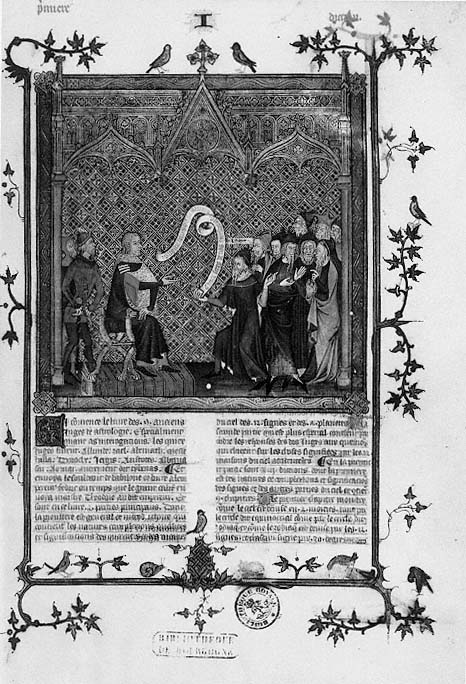
Figure 1
The Future Charles V Disputes with the Nine Judges of Astrology. Le Livre des neuf
anciens juges d'astrologie.
collected, as well as on the description of the king's knowledge of the subject by his biographer, Christine de Pizan.[20]
Christine herself was the daughter of Charles's astrologer, Tommaso de Pizanno, summoned from Bologna in 1365 to serve at the king's court. Before and after he ascended the throne, Charles employed a series of astrologers. Of course, catastrophic events such as the Hundred Years' War and the Black Death obviously encouraged the taste for and belief in astrology. The English called an astrologer, said to have predicted the French defeat at Poitiers, to enliven the captivity of John the Good, while another escorted the king back to France.[21]
Charles commissioned several books on astrology written in French before his accession to the throne, which may shed light on his attitude toward the subject. The earliest of them is Le livre des neuf anciens juges d'astrologie , a translation by Robert Godefroy of the Liber novem judicum . The text is dated to Christmas Eve 1361 by Godefroy, identified in another of the works as the Dauphin's "astronomien."[22] Of particular interest is the unusual frontispiece of the 1361 text (Fig. 1). In Godefroy's absence, the Dauphin addresses Aristotle, the foremost and only identified member of the "neuf anciens juges." The philosopher holds an inscribed banderole that indicates his willingness to answer the questions posed by the prince.[23] The miniature is exceptional not only for its likeness of Charles but also for its depiction of him as the enthusiastic agent of intellectual inquiry. The astrological text contains practical advice on war, pestilence, and dreams drawn from the writings of ancient and Arabic sages.[24] Aristotle's leading role in the frontispiece corresponds to his position in the text, where his authority on celestial matters remains preeminent.
The Dauphin also commissioned two treatises on astrology from another of his household astrologers, Pélerin de Prusse. The first, on the twelve houses of the planets, is dated 11 July 1361; the second, on the astrolobe, 9 May 1362.[25] In the prologue to the first treatise the author refers not only to Charles's insistence on clear writing in French but also to his avid search for instruction on astrological lore that affects rulers. A miniature in a manuscript in St. John's College, Oxford, shows Charles receiving the work from the author while engaged in active dialogue with him (Fig. 2). Although Charles's likeness is conventional, the miniature features a well-organized room furnished for scholarly purposes that corresponds to Christine de Pizan's glowing description of the king's private study.[26] The elaborate horoscopes of the royal family added to the treatise in 1377 attest to the king's lasting interest in the texts of this manuscript.[27] Thus, the first two works commissioned by Charles in the early 1360s show that he viewed astrology as a way to control political events rather than as a disinterested investigation of natural philosophy. Yet the Dauphin's active intellectual engagement with the subject shows him to be capable of developing more theoretical areas of learning.
Charles's enthusiasm for astrology may well have aroused the anxiety of his mentor. Oresme was a fierce opponent of using astrology to predict the future.[28] In general, Oresme disliked the irrational approach of astrology, as he preferred to account for terrestrial phenomena by natural causes rather than by occult celestial
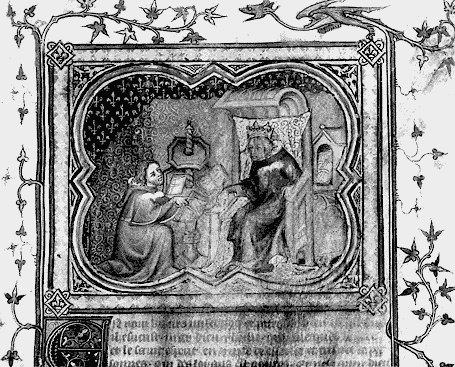
Figure 2
Charles V Receives the Book from Pélerin de Prusse. Nicole Oresme, Traitié de l'espere,
and Pélerin de Prusse, Astrological Treatises.
influence. His theory that celestial motions were incommensurable meant that their configurations would not be repeated. This notion nullifies a basic premise of astrological prediction.[29]
Oresme's French writings on astrology offer concrete examples of the dangers faced by rulers who depended on this form of knowledge. In his Livre de divinacions he addresses "princes and lords to whom appertains the government of the commonwealth." Although not directed to Charles specifically, Oresme gives historical examples of rulers whose reigns ended disastrously because of their attempts to predict the future.[30] He does not totally deny the value of astrology to the ruler but separates its scientific aspects from reliance on divinations and occult practices.[31] Oresme stresses that the most basic form of knowledge for a ruler is the science of politics. Oresme's description of politics as "architectonic" and as the "princess and mistress of all human science"[32] in the prologue of his translation of Aristotle's Politics reveals his pedagogical motivation in translating the Ethics and the Politics conceived in the spirit of Mirror of Princes literature. This educative tone substantiates the tradition that Oresme served as mentor to the Dauphin.
The first translation commissioned from Oresme by Charles also reinforces their close personal and intellectual ties. Not surprisingly, the text is an astrological
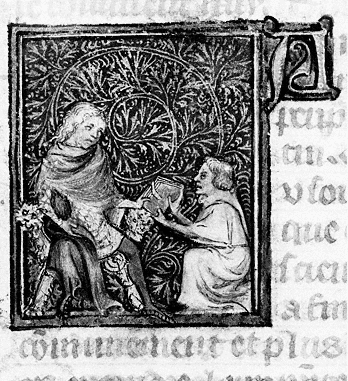
Figure 3
The Future Charles V Receives the Book from Nicole Oresme.
Ptolemy, Le Quadripartit.
treatise based on Plato of Tivoli's Latin version of the Quadripartitum of Ptolemy with commentary by Ali ibn Ridwan.[33] Both the attribution and date of the manuscript are controversial. Delachenal's arguments that Nicole Oresme (not his brother the less-known Guillaume Oresme) was the translator are persuasive, as is Clagett's dating of it between 1357 and 1360.[34] Delachenal refers to the ideas and language that later reappear in Oresme's prologues to his translations of the Ethics and the Politics . Among them are the translator's praise of the beauty of the French language and of the royal house for commissioning works in this tongue.[35] Furthermore, in several glosses of the Ethiques and the Politiques Oresme mentions in familiar terms the French version of the text.[36] Reference to "Charles, hoir de France, à present gouverneur du royalme" (Charles, heir to the crown of France, at present regent of the kingdom), seems to limit the date to the return in 1360 of John the Good from captivity in England. Another kind of evidence for attributing the treatise to Nicole Oresme is the tiny illustration at the head of the first column of the prologue (Fig. 3). The style of the miniature confirms an early dating of the text, while its iconography makes it the earliest known example of an informal dedication portrait from Charles's iconography.[37] The appearance of the iconographic type of the intimate presentation portrait testifies to a one-to-
one relationship between prince and author. Charles's mantle, shoulder-length hair, and beard are features repeated incisively in Figure 1. By contrast, the figure of Oresme, who looks squarely at the Dauphin, is far more substantial than that of the wispy prince. The short, chubby portrait type of Oresme is consistent with similar images in the later dedication scenes of his translations of the Ethics and the Politics .
Oresme's favorable comparison of the valiant kings of France to the Roman emperors who had sponsored translations of Greek classics into Latin hints at the theme of the translatio studii . More specifically, Oresme is thinking of John the Good's patronage of Jean de Sy's translation of the Bible and Pierre Bersuire's French version of Livy.[38] The prologue states that, with these precedents in mind, Charles commissioned the present translation of a work that contains the most noble science: astrology that is free of superstition and composed by excellent and accepted philosophers.[39] In other words, Oresme says, this text of the Quadripartitum is an example of the kind of knowledge about the physical world that does honor to the prince and benefits the public good.[40]
Oresme's work of mathematical astronomy, his Traitié de l'espere (On the Sphere), is not specifically addressed to Charles.[41] The concluding chapter, however, mentions that the treatise is intended to be useful knowledge for every man, especially for a prince of noble mind.[42] Oresme is writing for a lay audience, similar to the one mentioned in his version of the Quadripartitum . The copy of the text in the king's library strengthens the hypothesis that Oresme had Charles in mind as a primary reader. In fact, the Traitié de l'espere precedes the treatises by Pélerin de Prusse discussed above. In a miniature from this manuscript, Charles is reading and studying by himself (Fig. 4). Seated in a high-backed chair, he holds one book open on his lap, while he consults another lying on his revolving bookstand. The fleur-de-lis pattern on the walls and floor allude to his rank. Although the portrait is conventional, the image establishes Charles as an active seeker after knowledge. Indeed, the presence of the armillary sphere suggests that Charles is pondering the subjects treated in Oresme's work. Despite certain problems with the date of this manuscript, the text and image of the Traitié de l'espere testify not only to Charles's intellectual character but also to a type of knowledge about the celestial world Oresme considered appropriate for both a layman and a prince.
Certain features of the book emphasize its pedagogical character. Among them is the large historiated initial on folio 2 depicting a scholar (possibly a conventional portrait of the author) pointing at an armillary sphere. Dominating the text is a series of rather crude, but clearly labeled, diagrams explaining basic concepts in the text. The glossary of sixty-eight scientific and technical terms supplied by Oresme also addresses the general, educated reader.[43] The inclusion of Oresme's treatise on acceptable "astronomical" knowledge in the same manuscript as Pélerin de Prusse's astrological works is ironic. The compilation indicates the difficulty of Oresme's task in defining the boundaries of knowledge that he considers beneficial to Charles.

Figure 4
Charles V Studies Astrology. Nicole Oresme, Traitié de l'espere, and Pélerin de Prusse ,
Astrological Treatises.
While the dating of Oresme's early writings is controversial, the motivation for his shift from Latin to the vernacular seems clear. As soon as he developed political ties with Charles and his circle, he found it necessary to express his ideas in French. In order to exert his influence, he had to recast not only his language but also the formulation and compilation of his treatises. These early writings in French provided the model for Oresme's more elaborate and sophisticated translations of the 1370s.
Oresme's Later Career
After Charles's accession to the throne in 1364, Oresme continued to enjoy the confidence of the new sovereign. Two years earlier, Oresme had been appointed canon of the cathedral of Rouen, where he was named dean shortly before Charles's coronation. In 1363 he was made a canon at the Sainte-Chapelle, Paris. Upon completion of the Aristotle translations, with royal support he became bishop of Lisieux in his native Normandy. He held the post from 1377 until his
death five years later. Oresme also undertook official missions for the king, such as a journey in 1363 to Avignon to persuade Pope Urban VI to remain in that city under Charles V's protection. In an official document of 1377 Oresme is called counsellor of the king, although his appointment to that position may have come earlier. In his prologue to the Politiques , Oresme refers to himself as Charles's chaplain. Oresme played a conspicuous part in two important ceremonial occasions of the reign. During the visit in 1378 of the king's uncle, Emperor Charles IV, Oresme was a member of the delegation that escorted him to Vincennes. Later, the chronicles mention him among those taking part in the funeral ceremony of Queen Jeanne de Bourbon.[44] Oresme's long service to the crown included diplomatic and political acts, as well as less measurable intellectual contributions. Among them, his translations of Aristotle's works are highly significant, culminating his long personal and political ties with Charles. In these works, Oresme remained consistent with his earliest French writings, in which Aristotle's thinking served as a model for the prince's right conduct and rule.
3—
Nicole Oresme as Master of the Texts
Changing Structures of the Medieval Book
As master of the texts, Oresme inherited a long classical and medieval tradition regarding the theory and practice of translation. His approach would have been especially mindful of Roman rhetorical theory and its application to moral philosophy and political science, particularly to issues of practical wisdom. Interpretive and exegetical techniques drawn from ancient and medieval rhetorical treatises affected the style and content of the "replacement" texts composed for and directed to new audiences.[1] Like rhetoric, the translations themselves are part of a system of communication captured within the physically delimited space and structure of the codex. As the recent study by Mary Carruthers demonstrates, the medieval book is designed as a complex cognitive structure that helped the reader to understand the text.[2] Through layout, writing, methods of compilation, and organization, medieval texts were fashioned to advance certain psychological processes, of which memory and recollection are the chief tools of cognition.[3] Carruthers's study emphasizes the role of internal and external imaging in Aristotelian and medieval memory theory.[4] In both the design and compilation of his texts, as well as in the programs of illustrations, Oresme's strategies as a translator appear to reflect his awareness of, and response to, these rhetorical and cognitive traditions.
Nicole Oresme's arrangement and compilation of his translations for a lay readership include features unusual in vernacular texts of this period. Aids for the reader, such as an alphabetical, cross-referenced index of noteworthy subjects in the Politiques are, however, not Oresme's invention. During the thirteenth century, the need to retrieve certain types of information for specific audiences and newly created institutions governed developments in the layout, arrangement, and apparatus of original, as well as of authoritative, works composed in Latin. One source of this change was the founding of the mendicant orders, whose mission was to deliver sermons to the laity and to write works combating heresy. Consequently, preachers required access to authoritative texts that were organized in such a way as to permit retrieval of specific topics that formed the basis of sermon materials. Collections of exempla, biblical concordances, and distinctiones are among the reference books specifically developed for sermon writers.[5]
In addition, the growth of universities during the thirteenth century brought better organization to manuscript production and the book trade under university
control.[6] Teaching and scholarship required, instead of collections of excerpts, study of original texts essential to the training of orthodox preachers and theologians. Both students and professors had to locate quickly precise references on specific subjects. To facilitate research, books were broken down into chapters or even smaller units. Tables of contents, indexes, and chapter summaries aided readers in consulting texts.[7] As Malcolm Parkes has indicated, the arrangement and accompanying apparatus for university texts brought significant changes in the mise-en-page of the manuscript book.[8] Among the devices that made scholastic texts easier to read was rubrication, which marked sections of the text and indicated the source of glosses. In analytical tables of contents, alternating red and blue initials divided chapters one from another, while red ink was used for headings and black for subheadings. Running titles and other locators became standardized features that helped readers find their way through materials required for professional purposes. Such devices were associated with psychological theories and practices to promote cognitive mastery of texts.
Although these developments first occurred in religious texts, law and medical schools adapted these methods of organization and compilation to works in their own fields.[9] Also a beneficiary of these new procedures was the corpus of Aristotelian works that became available in Latin translations during the thirteenth century. Indeed, the process of assimilating the structure of Aristotle's works to Christian thought promoted the development of various research tools, including those mentioned above. From about 1250 Aristotle's works on logic, natural science, and the Ethics were accompanied by alphabetical indexes.[10] In fact, alphabetical order as a system of organizing references was a conspicuous feature of guides to Aristotle's works.[11] For example, the reference system for a topic includes the title of the work, the volume and chapter numbers, and a letter of the alphabet indicating placement within a chapter.[12] Robert Grosseteste, bishop of Lincoln, who in 1246 to 1247 made the very influential translation from Greek into Latin of all ten books of the Nicomachean Ethics , not only added notes to the Greek commentaries but also compiled a summary of the important points in each chapter. The aim of this summa, called Tituli , was to help the reader understand and remember the text.[13] In a magisterial work, Martin Grabmann discusses the vast array of commentaries, summaries, excerpts, and tables of contents that accompanies the Latin translations of the Aristotelian corpus and facilitates its appropriation by and assimilation to medieval intellectual life.[14]
For the most part, such developments in the organization and arrangement of the book were directed to a clerical audience. But during the fourteenth century, historical works commissioned by courts or royal patrons were equipped with alphabetical indexes and other finding aids. Thus, a manuscript of the Faits des Romains , written between 1324 and 1331 at the Angevin court at Naples, contains a large Latin table of contents.[15] In 1330 a second edition of a universal history written for King Philip VI is equipped with an alphabetical table of contents, a device hitherto unfamiliar to lay readers.[16] During the fourteenth century, writings in the vernacular gradually acquired the apparatus, methods of compilation, and the mise-en-page previously limited to Latin works.[17]
Oresme's Translation Strategies
Oresme's translations of the Nicomachean Ethics and the Politics are the first extant, complete translations of Aristotelian texts in a modern language. According to Albert D. Menut, who made the critical editions of these works, the translation of the Ethics was done first and must have been begun at least a year earlier than 1370, the date given in the translator's prologue.[18] In turn, Oresme probably based his French version of the Ethics , here referred to as the Ethiques , on a manuscript of a revised edition of the Grosseteste translation made in Paris about 1270. For his own commentary, Oresme drew extensively on Albert the Great and on Thomas Aquinas's Commentary on the Nicomachean Ethics , as well as on later commentaries by Walter Burley and Jean Buridan.[19] Oresme made only one redaction of the text, of which the oldest known copy is MS A , dated after 1372.[20]
Oresme's French version of the Politics , referred to here as the Politiques , is based on the translation from Greek into Latin by William of Moerbeke dating from about 1270.[21] Léopold Delisle identified Oresme's own copy of his French version that serves as the basis of the critical edition by Albert D. Menut.[22] Delisle discovered that Oresme made three separate redactions of his translation of the Politics . Usually included with the Politics is a short treatise, the Economics . No longer considered an Aristotelian work, the Economics has a complex history. In his critical edition and translation of Oresme's French version, referred to here as the Yconomique , Menut traces its varied sources, including William of Moerbeke's Latin translation from Greek originals.[23]
Oresme was thus working with authoritative translations that bore equally authoritative and worthy commentaries. The medieval Latin of these translations had evolved as the international language of communication of a clerically dominant elite. The thirteenth-century translations of the Aristotelian corpus greatly enriched medieval Latin as an instrument of both abstract thought and social control.[24] These works relied on principles of interpretation and commentary inherited from ancient Rome, modified by the Christian exegetical tradition, and composed in an academic format appropriate for its clerical audiences.
Oresme continued the academic format of the Latin Aristotle translations and in doing so appropriated for the vernacular their authoritative status.[25] He was aware of the tension between the richness of the Latin sources and the limitations of the vernacular. In re-presenting Aristotle to a new and well-defined lay audience, he had a definite didactic goal.[26] Among his problems was making the works intelligible in a language that lacked conceptual, syntactic, and lexical subtlety. In the "Excusacion et commendacion de ceste oeuvre" (Apologia for and justification of this work) Oresme states: "Et comme il soit ainsi que latin est a present plus parfait et plus habondant langage que françois, par plus forte raison l'en ne pourroit translater proprement tout latin en françois" (And if it is the case that Latin is at present a more perfect and richer language than French, it is all the
more obvious that one could not translate all of Latin into French).[27] Furthermore, the Aristotelian works require understanding of a technical philosophical and political terminology. The translator acknowledges the difficulty in another passage of the "Excusacion":
D'autre partie, une science qui est forte quant est de soy ne puet pas estre bailliee en termes legiers a entendre. Mais y convient souvent user de termes ou de moz propres en la science qui ne sont pas communelment entendus ou cogneüs de chascun. Mesmement quant elle n'a autre fois esté traictiee et excercee en tel langage. Et telle est ceste science ou regart de françois.
(On the other hand, a science that is difficult in itself cannot be rendered in terms easy to understand. But it is often appropriate to use terms or words proper to the discipline which are not commonly understood or known to everyone, especially when it has not already been treated and handled in such a language. And such is this discipline in regard to French.)[28]
Oresme was faced with a not unusual conflict between adhering to the literal meaning of the Latin translations, which were often obscure in themselves, and presenting a clear, if more general, sense of the texts. He puts the problem this way:
Par quoy je doy estre excusé en partie se je ne parle en ceste matiere si proprement, si clerement et si ordeneement comme il fust mestier; car, avec ce, je ne ose pas esloingnier mon parler du texte de Aristote, qui est en pluseurs lieux obscur, afin queje ne passe hors son intencion et que je ne faille.
(For which reason I am to be excused in part if I do not express myself as appropriately, as clearly, and as methodically as is required; for in matters like these I do not dare to depart from Aristotle's text, which is often obscure, lest I go beyond his meaning or fall short of it.)[29]
Oresme took up this challenge in several ways. To enrich the vernacular vocabulary, he introduced over 450 neologisms.[30] Many were calques , Latin adaptations of Greek words provided with French endings.[31] Oresme also used double translations, a method of explanation that provided synonyms connected by a conjunction. He occasionally added an exposition of short phrases or clauses, as well as a gloss that further defines a word, its etymology, or both.[32] In some instances he omits passages from the text and makes changes to simplify and clarify the Latin translation. Oresme followed the pattern of the medieval translator who, in offering a replacement text, was "master of the author."[33] His glosses and commentaries were primary vehicles of his authorial identity.
Glossaries and Indexes
Oresme's translations of Aristotle are early examples of transferring to a modern language sophisticated methods of arranging and compiling learned texts. As noted above, Oresme may have followed the example of Pierre Bersuire's glossary of unfamiliar words placed at the beginning of his translation of Livy's History of Rome . An even earlier example of such a glossary is, however, found in a moral treatise produced in Flanders at the end of the thirteenth century, Li ars d'amour, de vertu, et de boneurté .[34]
Oresme's Traitié de l'espere is the first of his French works equipped with an alphabetical list of some sixty-seven words following the last chapter. A two-line initial introduces each new letter of the alphabet. A word is placed in the first of three columns. In the second, Roman numerals mark its location within the chapter. And in the third, a letter denotes the place within the chapter where the word is first defined. The letters appear in the designated places in the margins of Charles V's copy of the text (Oxford, St. John's College, MS 164). Oresme includes an explanation of how the glossary works.[35]
This system is less useful to the reader than a glossary that collects at the end of the volume all the definitions of new words. This was the procedure Oresme followed in Charles V's first copy of his translation of the Ethics . The glossary of fifty-five words is entitled "La table des moz divers et estranges" (The table of explanations of difficult words). An introductory paragraph describes the purpose of the glossary and how to use it.[36] The fact that Oresme explains the meaning of alphabetical order shows that this system of organizing references was not familiar to his readers.[37] He includes twelve words transliterated from Greek, as well as philosophic, linguistic, ethical, or political terms. The definitions are full and clear, with references to glosses, book and chapter locations in the text, and synonyms.[38]
As a reflection of the greater interest of the Politics to both patron and translator, the glossary is longer and more developed than in the Ethiques . The table of explanations of difficult words comprises some 132 words, some of which repeat terms explained in the Ethiques . Although the Politiques word list does not refer to specific locations in the text, it includes cross-references to the Ethiques and cites various sources in the Bible or classical authors as examples of the meaning of a word. Oresme also gives contemporary exemplars of Greek words. For instance, he cites as an example of the term demagogue Jacques d'Artevelde, a Flemish leader of a mid-fourteenth-century insurrection against the French. Following the short prologue, the Politiques also includes an instruction to the reader that singles out a series of words essential to an understanding of the text. The translator refers to the chapter titles and the glossary as finding aids, since Oresme is aware of the many neologisms introduced in his translations. Among the essential and unfamiliar terms mentioned are four of Aristotle's six forms of government.[39]
A special feature of the Politiques is the index of noteworthy subjects, the "Table des notables." Here are found examples of essential terms defined in the glossary,
such as citoien , with references to books and chapters. Seven different citations of citoien , ranging from one sentence to several lines, are offered to clarify the content and context of a term possibly unfamiliar to the contemporary reader.[40] Multiple entries are arranged according to order of appearance in the text: citation of a term in Book II will precede one that appears in Book III. Oresme also includes cross-references to related terms. Since the index of noteworthy subjects follows an alphabetical organization according to key terms, Oresme provides a list of them as a preface to the "Table des notables." He calls this feature "Les mos par quoi l'en trouve les notables" (the words by which one finds the notable topics) and includes a paragraph describing its purpose and use.[41] The words total 112 and range from discussions of morality and immorality and the upbringing and education of children to political terms and institutions. The extensive entries for cité (nineteen), fourteen for gent sacerdotal (priestly class), twenty-three for lays (laws), and twenty-five for policie (regime) not only summarize the most important topics in the text but present Oresme's opinions about them.
The amount of space devoted to the glossary and index indicates the significance attached to them: twenty folios in B and fifteen in D . Furthermore, in B the calligraphic presentation of the key words preceding the index and of the "Table des notables" itself is lavish. Painted initials with pen flourishes and line endings, as well as rubrics and alternating red and blue capital letters, facilitate the sequential and separate reading of these verbal aids so densely packed with information.[42]
Prefatory and Explanatory Materials
While the index and glossary that accompany Oresme's translation of the Ethics and the Politics are relatively novel features in contemporary book compilation, other elements designed to direct the reader through the books were standard for the time. Chapter headings for each book precede the text, while numbers at the top of the folio called running titles indicate the number of the book. Written in the margins, chapter numbers direct the reader to specific subdivisions within the text. Summary paragraphs in rubrics usher in new books, while text endings clearly demarcate one unit from another. Among the most important features to direct the reader through a text are the division into chapters and the summary list of chapter headings at the beginning of each book or text division. Oresme apparently increased the number of chapters, shortening and rearranging the Latin translations, since smaller units of difficult subject matter are easier to grasp, especially when they are accompanied by summaries of their contents.[43] Oresme also summarized the content of each entire book in a short introductory paragraph.
Oresme offered guidance to the reader, unusual for the time, in his lengthy "Proheme" to the Ethiques and in the accompanying "Excusacion et Commendacion de ceste Oeuvre."[44] While the prologue to the Politiques is much shorter than that of the Ethiques , Oresme gives more specific instructions to the reader for the use of the book. As previously noted, this short text explains the system of compi-
lation Oresme used. Furthermore, MS B , Charles V's first copy of the Politiques , contains an apparently unique second instruction to the reader.[45] In it, Oresme explains the meaning of the bifolio frontispiece. All the prefatory materials indicate Oresme's awareness of linguistic problems in translating the complex Latin texts into a less-developed language and the necessity of directing the reader to the glossaries and indexes that will clear a path through these difficult works.
Glosses and Commentaries
In his glosses and commentaries to the Ethics and Politics Oresme follows an ancient tradition of scholarship. Through the centuries the works of Aristotle had accumulated an impressive wealth of commentaries, including those of Byzantine and Arabic writers that were incorporated in the twelfth- and thirteenth-century translations from Greek and Arabic into Latin. The process of assimilating the Aristotelian corpus to the structures and beliefs of Christian theology produced extremely important commentaries by Thomas Aquinas and Albert the Great during the thirteenth century, and in the fourteenth, by Walter Burley, Jean Buridan, and others, mentioned above. Yet it does not follow that Oresme had to follow this path in vernacular translations addressed to a nonacademic audience. Indeed, although other translations commissioned by Charles V, such as that of the City of God , contain explanatory materials within the text, they do not include the scholarly apparatus of the clearly separated gloss or commentary.[46] As Menut suggests, Oresme may have wished to keep intact the authoritative and scholarly character of the Aristotelian works without neglecting the moral and intellectual guidance of the reader.[47] As noted above, by preserving the academic form of the Latin translations, he was appropriating or transferring their authority to the vernacular. The translator may also have relished the opportunity not only to demonstrate his knowledge of the texts and scholarly tradition but also to place on the same level as the great commentators his opinions and resolution of knotty problems.
The proportion of glosses (defined as short, explanatory notes) to commentaries (extended interpretations or discussions) in Oresme's translations of Aristotle vary considerably. For example, the Ethiques contains only three commentaries and the Yconomique , six. By contrast, the Politiques contains many commentaries, as does the translation of a fourth Aristotelian work, On the Heavens . Especially in the Politiques Oresme addresses leading issues of the day and tries to reconcile Aristotle's views with those of the contemporary world.[48]
Susan Babbitt has analyzed the types of glosses in the Politiques , which in many cases apply also to the Ethiques and Yconomique .[49] The first group explains a particular aspect of the text. For example, a gloss can explicate the purpose or location of a segment of the text in the sequence of Aristotle's argument, or it can provide a cross-reference to another part of the work in which a topic is discussed. Oresme also uses a gloss to summarize certain points or to finish a sentence. In another category, Oresme is concerned with definitions of words, their etymologies, or identification of persons or places. Yet another type provides concordances from
biblical, patristic, or antique sources that buttress a particular Aristotelian argument or statement. If Oresme does not find a statement acceptable, in some instances he will contradict "the Philosopher." Such glosses may relate to Oresme's explanation of obscure or ambiguous passages in Aristotle's text. On such occasions, he may call on earlier commentators for help in working out the sense of the text portion. Sometimes in glosses Oresme raises his personal objections to ideas in the texts or views held by earlier commentators. Even more interesting is Babbitt's identification of the commentaries in the Politiques that cover one or more folios. Among the topics covered are church-state relationships, problems within the church, types and values of kingship, and various ethical, political, and philosophical discussions.[50] Indeed, recent scholarship considers that Oresme's commentaries on the Politics are important contributions to the understanding and interpretation of Aristotle's text.[51] Unlike previous commentators, Oresme set out to interpret Aristotle in the light of contemporary institutions. In turn, his commentaries on issues of the day, such as the need for reform of the church, became the basis of further interpretation during the later fourteenth and fifteenth centuries.[52]
Between the two sets of Charles V's manuscripts of the Ethiques and Politiques the format of the separation of text from gloss differs considerably. By far the more elegant arrangement is found in A (Fig. 11) and B (Fig. 55). In them the text is written in two narrow columns of thirty-five lines in script larger than the glosses in the four surrounding margins. Renvois , or linking symbols, appear next to a word, phrase, or passage as a sign that it is the subject of a gloss. This symbol is repeated in front of the gloss. Rubrics repeating the key words of the gloss help to link the two parts separated from each other on the page. This layout has the advantage of maintaining the continuity of the text in a way a gloss inserted directly in the text column does not.[53] As Menut observes, if the gloss expands to the length of a commentary, its added length would extend over several folios and disturb the clarity and neatness of the format. Such a layout, borrowed from civil-law manuscripts, is appropriate for volumes of large size. Production is more expensive, since a relatively smaller amount of text can fill a folio and a less uniform layout is required. It is, therefore, not surprising that the smaller, portable set of the Ethiques and Politiques (C and D ) produced for Charles V abandoned this elaborate format. On the first folio of the Politiques the worthy scribe Raoulet d'Orléans explains the system: "Je, Raoulet d'Orliens, qui l'escri, ay mis le texte premier, ainsi signé T ; est après la glose s'ensuit, ainsi signée O , qui fait Oresme (I, Raoulet, who transcribed it, have placed the text first, designated thus [as] T ; then the gloss follows, designated thus [as] O , which was done by Oresme).[54] With the extensive commentaries in the Politiques , this layout, in which gloss immediately follows the text passage, is more practical, as well as less expensive.
Tradition and Innovation in the Illustrations
Illustrations of the Latin versions of the Ethics and the Politics are limited to historiated initials, most frequently representations of Aristotle teaching. Therefore the
development of programs of illustrations for the French translations of these texts is a significant occurrence. The taste for illustrations in vernacular texts gradually developed during the thirteenth and fourteenth centuries as a reflection of the preferences of their patrons.[55] As was discussed in Chapter 1, the Capetian and early Valois monarchs built up a tradition of commissioning French translations of Latin texts that had not been previously illustrated. As Ruth Morse points out, the commission of vernacular translations, presented in expensive illustrated copies, conferred prestige and power on the patrons.[56]
Charles V shared this predilection and took an active part in the production of manuscripts that were particularly important to him.[57] In her biography of Charles V, Christine de Pizan describes the king's "active supervisory role in the making of the volumes that entered his collection."[58] Several documents that specify payments for parchment indicate the king's personal involvement in book production.[59] Recent studies emphasize Charles V's role in the editing and rewriting of texts that had important political implications.[60] Two colophons in his Coronation Book and his copy of Bersuire's translation of Livy specify that the king had the books illustrated.[61] François Avril believes that Charles V may have requested, and had a hand in composing, an explication of an unusual frontispiece of a Bible historiale commissioned by him.[62] Charles V's taste for heavily illustrated manuscripts of French translations of Latin texts is analogous to his preference for the vernacular. Illustrations concretize and update concepts of the source language. Indeed, as detailed analysis of the Ethiques and Politiques cycles will reveal, the function of many images is that of a visual glossary or definition of neologisms or unfamiliar terms introduced into French by Oresme. Another dimension of this analogy is the appearance in the art of this time of a more naturalistic style manifest in portraiture and the representation of landscape.
In two respects the programs of the Ethiques and the Politiques differ from those of other vernacular translations commissioned by Charles V. First, these are the only illustrations that consistently employ inscriptions embedded in or surrounding the text. This inscribing of the verbal within the visual is essential to the didactic and mnemonic functions of the illustrations.[63] Second, except for frontispieces to various types of texts and the cycle of the Cité de Dieu illustrations, the Ethiques and the Politiques programs offer more than usually complex visual structures, characterized by departure from a column format and division of the picture field into two or three registers. These features show special care in linking image and text to order and direct the reader's understanding of the works.
Oresme's Role in Designing the Programs of Illustration
Oresme's multifaceted career does not include any obvious connection with the visual arts. Yet his training in Aristotelian and scholastic logic may have spurred him to emphasize definition and demonstration as essential tools of both verbal and visual arguments. Likewise, his absorption of Aristotelian, Roman, and medieval rhetorical works may have guided his organization of the visual structures of
the programs. His choice of contrasting representational modes of personification, metaphor, and allegory for the Ethiques and paradigm for the Politiques and Yconomique may reflect the application of general rhetorical strategies.
In a different vein, Oresme's many writings on natural science involve theories of vision and perception, light, and color.[64] Furthermore, Oresme was familiar with the importance Aristotle himself assigned to images. For example, in Oresme's De causis mirabilium and his Questiones super libros Aristotelis de anima , he devotes many passages to discussing theories of cognition and memory based on the Philosopher's classic works.[65] In the De memoria et reminiscentia and the De anima , Aristotle assigns a crucial role to images in the processes of human thought and memory. As Janet Coleman states: "What we perceive and thereafter conceive must be imageable by the mind. Not only is memory pictorial but Aristotle assumes the world can be known empirically: signs, words, images do correspond for the most part to objective reality in a satisfactory way."[66] Frances Yates and Mary Carruthers also have shown that scholastic memory treatises and other medieval texts emphasize the role of visual images in locating and assimilating ethical concepts.[67] By inscribing verbal concepts within the illustrations' pictorial field, Oresme could enrich the scope of his arguments and, by association, imprint words and images within the memory of the reader.
Oresme's writings on physical and natural science may connect with an interest in aesthetics taken up in various and sometimes unexpected contexts. One such instance is the concept of proportion. An early Latin writing, De proportionibus proportionum , discusses the topic in mathematical terms.[68] The concept of proportion in relationship to the body politic is a feature of Oresme's influential treatise De moneta. Proporcion and proporcionalité are neologisms Oresme introduced into French while translating the section on Distributive Justice in Book V of the Ethiques .[69]
Oresme's theoretical interests and training may well have affected his planning of the program of illustrations. But his role of designer took place within a well-defined system of book production.[70] Patrick de Winter points out that along with the libraires , official booksellers, and stationnaires , "the equivalent of modern publishers," écrivains , or scribes, had considerable responsibility for the execution of a manuscript. Ecrivains not only carried out the system of rubrication and laid out the book but also hired the illuminators, miniaturists, and perhaps the binders for luxury books.[71] Among the official écrivains of Charles V was Raoulet d'Orléans, who worked on two manuscripts of the king's copies of the Ethiques and the Politiques, C and D .[72] Raoulet d'Orléans was one of the most honored copyists of his time. Twelve manuscripts dating from 1362 to 1396 carry his signature,[73] and his composition of several long verse colophons to manuscripts that he copied reveal his self-confidence and pride. In one of them, a Bible historiale presented to Charles V, he mentions the lavish nature of the book's decoration and praises the efforts of the person who brought it together. The implication is that he acted as the coordinator of the book's production.[74]
Oresme worked closely with Raoulet in re-editing the layout and text revisions of the second set of Charles V's copies of the Ethiques and the Politiques .[75] As
master of the text, the translator would also have designed the revised program of illustrations, as he would have done for the first two copies of his translation of the Ethics and the Politics . Independently, or with Raoulet's help, Oresme would have forwarded instructions to the miniaturist responsible for the execution of the illustrations. Since new illustrations were required, scholars assume that the translator who had knowledge of a given work would have been the person to furnish such instructions. The outstanding example of such an explicit, verbal set of instructions occurs in Jean Lebègue's edition of Sallust dating from 1418 to 1420. The illustrations in a surviving manuscript correspond exactly to these instructions.[76] Contemporary with the Ethics and the Politics translations, a manuscript of a moral treatise, Le miroir du monde , includes instructions to the illuminator for a series of fifteen images of virtues and vices.[77] A related, if rare, tradition in fourteenth- and fifteenth-century French manuscripts provides a written explication to the reader of an unusual or complicated program of illustration. The earliest surviving example is contained in the Belleville Breviary of about 1330.[78] François Avril discovered an anonymous guide to the meaning of an unusual frontispiece to the second volume of a Bible historiale commissioned by Charles V.[79] As noted elsewhere, Oresme furnished such an explanation at the beginning of the king's first copy of the Politiques . Another contemporary example of a program of illustration based on written instructions to the illuminator is the presentation copy of Raoul de Presles's translation of Augustine's City of God .[80] Here, Sharon Smith found that the iconography of various illustrations depends on certain obscure passages of glosses furnished by the translator, who alone would have been familiar with their content. The same observation holds true for key illustrations in Charles V's copies of the Ethiques and the Politiques .[81] In other words, the illustrations constitute another level of translation of concepts and other interpretive materials familiar only to Oresme.
Unfortunately, no written program for the illustrations of the Ethiques and the Politiques survives. Nor are there traces in the margins of Charles V's copies of these texts of abbreviated verbal instructions to the illuminator, rough sketches, or notes for background color or patterns, notes so meticulously recorded in Charles V's copy of the Grandes chroniques de France .[82] Yet, as the discussion in Parts II and III will disclose, Oresme's role as designer of the programs of illustrations of his translations of the Ethics and the Politics emerges from the close relationship between the illuminations and his texts, glosses, glossaries of difficult words, and index of noteworthy subjects.