
1
HISTORY:
THE NEW AND OLD WORLDS
One
Protestant Meditations on History and "Popery"
Spokesmen for Anglo-America in the New World, nineteenth-century American historians constructed a national history that traced America's development from colonial settlements of religious refugees and adventurers to an industrializing society whose progress was the joint result of Protestant and republican reformist energies. In the words of one Philadelphia journal, antebellum Americans would succeed in their pursuit of exemplary nation building if they could simply "bear in mind that they are the patriarchs of modern emancipation."[1] Such progress, however, depended on a sustained rearguard action against a European past conceived of as contaminated by monarchism, aristocracy, and Roman Catholicism. If the revolutionary struggle had successfully deposed royal power, the struggle against Roman Catholicism continued. An enemy conventionally figured over the course of four centuries as popery, Romanism, or, more graphically, the Whore of Babylon, the Catholic church infiltrated the American Protestant historical imagination as a principal impediment to progress and at times as a principal attraction. If, as Cotton Mather proclaimed in his Magnalia Christi Americana , the workings of Providence demanded the defeat of the remaining "Baits of Popery " yet left in the church, those vestiges of Romanism proved curiously resistant, even against the postmillennial optimism of later revivalists like Jonathan Edwards, for whom America, after enduring an anticipated "very dark time," was to conquer the Antichrist and enjoy the coming of the millennium.[2] In part because he thought the "power and influence of the Pope is much diminished,"
Edwards fought infidelity more than popery; but in claiming the dynamism of evangelical Protestantism as America's identifying possession, Edwards implicitly lodged Catholicism in the darkness of contemporary spiritual indifference.[3]
Events in the decades following Jonathan Edwards's death in 1758 threatened such confidence in an American providential design. Especially in the aftermath of the American Revolution, Protestantism contended with disestablishment and the consequent rise of voluntarism, sectarianism, and secularization.[4] Initially fought during the Reformation, the Protestant battle against Rome, in its variant denominational aspects, was reenacted and precariously legitimated by the spread of English Protestant culture in the New World. Catholicism continued to be silenced by a providential history that in the sixteenth century had performed two momentous and interrelated feats: the Reformation and the Puritan settlement of America. Antebellum America understood its privileged status as emerging from the doctrinal revolutions of the Reformation and from the ethnic superiority of those early "Teutonic" rebels against "Latin" tyranny. "The genius of Northern, Scandinavian life thenceforth asserted its supremacy," explained one essayist of America's emancipatory origins, "and reformations, discoveries of new worlds in the physical and mental sphere, free institutions, and popular governments were necessary, unavoidable facts."[5]
The British Puritan imagination, analogizing from its understanding of the New Testament's typological fulfillment of the Old, conceived of the New World as both separating from and seeking to purify Europe. The Puritan reforming spirit, stemming directly from God and later strengthened by the alleged racial superiority of the Teutonic genius, continued to enact the divine will in nineteenth-century America's "manifest destiny" to extend its territorial boundaries.[6] The major antebellum historians of America's southern and northern frontiers, William H. Prescott and Francis Parkman, stressed the "Anglo-Saxon" cultures' destined conquest of the land, its native American inhabitants, and European Catholic power. Intent on claiming the Puritan Christian teleology for the New World, early American Protestants like Mather and Edwards as well as later historians like Prescott and Parkman insisted that the Reformation had rescued the progressive workings of the spirit from the stasis or even regression of papal captivity.[7]
This resuscitated evangelical force, heroically transported to the New World in the Puritan migration, reemerged in the nineteenth century as the Protestant Way, a cultural route invoked to unify an increasingly
fragmented Protestantism and to fight the threats posed by Irish and German Catholic immigration. Since the Reformation had freed believers from a church deemed tyrannical in part because of its philosophical resistance to the notion of change, "history" and America's Protestant sects were firmly identified, an alliance that occasionally extended to all of time itself: time was endowed with the same invincible commitment to reform. Thus the European Reformation, argued one New Englander, was a natural outgrowth of a universal phenomenon: "The reforming process, of which Luther's resistance was one of the stages, began before he existed, it survived when his wars were over, and will keep on long after our generation is in the dust." That Catholics should still exist after having been directed offstage nearly four centuries earlier greatly disturbed both conservative and liberal American Protestants, who alike concluded that their very position in the vanguard of history called for constant vigilance against the immigrant Catholic to maintain, even perfect, the virile autonomy of the "native" Protestant American self. As Emerson argued in his 1849 essay "Power," the "necessity of balancing and keeping at bay the snarling majorities of German, Irish, and of native millions, will bestow promptness, address, and reason, at last, on our buffalo-hunter, and authority and majesty of manners." But if the emancipatory narrative unfolded initially in Puritan historiography pervaded antebellum periodical literature, sermons, and speeches, its consensus about the Protestant victory over a Catholic past was rendered internally fragile by the disputing Arminian and Orthodox persuasions—an internal schism that required a concerted resistance to the menacing Catholic immigrant and to the ahistorical, largely invisible, and profoundly magnetic power of popery.[8]
Antebellum New England efforts forged a national identity that was not only oppositional but even "negative" in its essence, for it was profoundly shaped by a continued rejection of and rivalry with Roman Catholicism. Seeking to confirm a still provisional, self-consciously Protestant nationhood by contrasting it with what was familiarly called the "foreign faith," the romantic historians drew on colonial and eighteenth-century attitudes toward the repudiated church for their new progressive historiography. If the papacy had receded in political influence with Anglo-America's triumphs against both New Spain and New France, as an ideological figure known as popery or "Romanism" it received an alarmed scrutiny during the antebellum decades from ministers, novelists, statesmen, and historians, who often invoked the unlikely threat of papal overthrow to divert attention from intractable
national problems that finally had little to do with religion. Divisive sectionalism, urbanization, immigration, industrialization, race slavery, and finally the stresses in the formation of the middle-class family all challenged the notion of a national identity made coherent by its allegiance to Protestantism. To assert a national selfhood that was essentially religious enabled American Protestants of varying and often antagonistic denominations (and social classes) to minimize, if not resolve, racial, sexual, and economic divisions in the American nation.[9]
If nineteenth-century American Catholics defensively divided the world between the one, holy, and apostolic church and the unchurched cosmos, American Protestants had their own troubling divisions to deal with. In several respects, conservative Catholic invective against the evils of Protestantism touched on painful truths of the national culture. The practiced controversialist Archbishop Martin Jay Spalding of Baltimore described the Reformation in extravagantly reactionary terms that pointed, however, to interpretive quandaries liberal Protestants were indeed struggling with, although of course they would have disagreed with Spalding's Catholic diagnosis:
It was not a merely local or transient rebellion against Church authority which was at hand, but a mighty revolution, which was to shake Christendom to its very centre; and to endure, with its long and pestilent train of evils, with its Babel-like sound and confusion of tongues, with its first incipient and then developed infidelity, probably to the end of the world![10]
American historians like Prescott and Parkman, the novelists of the American Renaissance, and writers of popular and domestic fiction were indeed troubled by a confusion of tongues, perplexed in part by a bisection of cultural time into an iconic Catholic "past," sealed off from the present and available for aesthetic and psychological rumination, and an emphatically text-oriented Protestant "history," extending from the Reformation into the antebellum present. The ideology of American Reformed Christianity constructed this vanquished, static, regressive Catholic "past": it appeared most commonly as a conglomeration of ruins and foreign cultures, Italian Renaissance and Baroque art (made available through new processes of reproduction), and a foreign "Latinate" or "Celtic" selfhood, seen by American tourists abroad and, with the onset of Irish immigration in the 1840s, confronted at home as well. Against this ideological construction of an imagistic, "idolatrous," and politically regressive Catholic past (itself a regressive construction that became very much "present" in antebellum America), Old and New
World Protestant "history" upheld the power of the "Word" against that of the "Image" and, by extension, the power of biblically allusive historical and fictional narratives against the suspiciously flesh-bound powers of Rome.[11] Both Protestant religious polemics and American travel accounts opposed ahistorical Catholic "ruins" to Protestant "history" and the perilously attractive ahistorical corruptions of the Catholic body to the progressive and cleansing powers of the Protestant voice. Between Catholic matter and Protestant spirit snaked the dividing line of the Reformation, which had initiated a new religious narrative against the allegedly calculated falsehood of the pope's story and which reiterated crucial oppositions between autonomy, purity, and self-regulation, on the one hand, and the dangers of submission and "excess"—whether liturgical, aesthetic, or political—on the other.
The conflict between Protestant enlightenment and popish duplicity was early fashioned into epochal drama by John Foxe in his famous (and to Catholics, notorious) history, Actes and Monuments (1563). When, as Foxe recounts, "coloured hypocrisy, false doctrine, and painted holiness, began to be espied more and more by the reading of God's word," the revolutionary dynamic revealing the Word's power over the image was set in motion.[12] Such an asserted triumph of textuality over European humanity's imagistic, duplicitous past could only be sustained by endowing the Word (in the confines of what early Dissenting preachers denoted the plain style) with the charismatic power, if not the palpable contours, of the abandoned image.
Modeling his history on the French Calvinist Jean Crespin's Book of Martyrs , Foxe in his martyrology displays a series of significations that interlock the sacred, the political, the aesthetic, and the technological. Thus he proclaims the invention of printing as a divine intervention in earthly affairs that makes possible the production of authentic history; the Word, made newly available to humanity by the printing press and soon thereafter by Foxe's heroic historiography, rivals and finally transforms the flesh of Foxe's martyrs into pointedly articulate and distributable text. In the transformative medium of fire that consumes a series of Marian martyrs Foxe's words themselves assume the rhetorical authentication of the passional suffering they record. Conversely each victim, in the agony of incineration, achieves the evangelical potency and historical permanence of Gospel text. Thus Foxe punctuates his historical account with execution tableaux in which text and flesh dramatically coalesce; martyrs read aloud from the Bible as they burn, words and flesh consumed in a synchrony that argues in turn for their mutual incorruptibility. Heretical and heroic like each martyr, the
Word in turn enforces the identity between martyr and reader of martyrdom:
There was a company of books cast into the fire; and by chance a communion-book fell between his hands, who receiving it joyfully opened it, and read so long as the force of the flame and smoke caused him that he could see no more. Then he fell again to prayer, holding his hands up to heaven, and the book between his arms next to his heart, thanking God for sending him it. (392)
Such tableaux, then, fuse the Book and the Body, reading and corporeal suffering, into a spectacular and revelatory historical action whose permanence derives not from the tangibility of the Catholic icon but from the gruesomeness of the icon's extinction. One particular polemical benefit of Foxe's martyrology, then, is its incorporation of the body's iconic and commemorative power into the new Protestantism. Foxe's history establishes distinctions between text and flesh specifically to deny them; the Word, as made present through Foxe's words, engineers the paradox by which the martyrs become new relics for their iconoclast audiences, translated from venerated body to venerated text. The Gospel sufficiently anesthetizes the flesh so that Foxe's Marian martyrs comment theatrically on their grisly transfiguration by clapping their burning hands to signal the absence of pain. That same Word interprets such theater for the populace. In a transformation extremely important for later Protestant historiography, the Word becomes the words of the historian, authenticated by their revelation of "popish" evil and consequent conversionary impact on the reader. Exposé and conversion are rhetorically and theologically linked, for conversion to Protestantism critically depends on the exposure of Catholic duplicity and wickedness. Thus in Foxe's accounts each burning is preceded by a ritual dialogue (of forgiveness, temptation to recant, etc.) between the martyrs and their Catholic persecutors, followed by the victims' invocations to the audience before the lighting of the fires. These spontaneous sermons by the bound victims provide cameo lessons in history, explaining how the imminent holocaust will contribute to the great battle against Antichrist predicted in the Book of Revelation.
Because Foxe's record of these sacred sacrifices assumes a power kindred to that of the Gospel, advertising to the world the horrors of Bloody Mary just as the Gospels published the persecuted glory of Jesus Christ, the Foxean imitation insists that exposure of Catholic iniquity serves as humanity's new access to revelation. Like Christ, Foxe must not
only expose and exorcise but also convert; in his professedly impartial documentary record of the burnings, the Protestant historian-martyrologist draws his readers into the conversionary state of the spectator by enforcing a parallel between witnessing the martyrs' deaths and reading of that witness: "And the fire flaming about them they yielded their souls, bodies and lives into the hands of the omnipotent Lord, to whose protection I commend thee, gentle reader" (418). While Foxe's history was influential enough to be chained to lecterns in English churches, its charismatic blend of hagiography and invective sounded increasingly anachronistic to nineteenth-century readers. The martyrologist Cotton Mather, a self-styled American Foxe, offering "unto the Churches of the Reformation, abroad in the World, some small Memorials, that may be serviceable unto the Designs of Reformation," was particularly distrusted by liberal antebellum Protestants, not only for his role in the Salem witchcraft executions but also for more generally symbolizing the persecutorial energies latent in American Calvinism.[13]
For nineteenth-century Americans, religious liberation had lost its gritty detail of slow-burning wood and agonized flesh and had assumed the vague contours of humanistic freedom. Although a Catholic priest could still cause a national uproar by burning Protestant Bibles, the Word in its temporal expression as history was losing its numinous force.[14] History had forsaken none of its progressive dynamic, but its goal had become increasingly abstract, even hypocritical, disguising beneath its optimistic terminology of emancipation and improvement the unsavory realities of imperialist expansion and race slavery. If nineteenth-century American schoolbooks pictured Western history as a "Hegelian process for the realization of the idea of freedom," neither the process nor the freedom was especially apparent.[15] Depleted of its previous urgency and salvific aura, and challenged by denominational disputes in Protestantism itself, Reformed Christianity—particularly liberal New England Congregationalism and Unitarianism—could no longer easily dismiss the countertext of Catholic iconography and ceremony. Although declared discontinuous with the present, that iconic past, palpable in image and statue, cathedral and catacomb, lithograph and engraving, now intruded on the purified and printbound present.[16] Thus as the Reformation receded, so too did the insurrectionary and purifying powers of the Word. New England Puritans had created and sustained their subversively conservative identity through a still rare written word that recounted the human conquest of an inarticulate past bent on silencing the Gospel. But by the mid-nineteenth century, Scripture was everywhere competing with the encroachments of a developing mass-printing market.[17]
Although anachronistic, Foxe's drama of the cleansed "text" of Reformed Christianity overcoming the diseased embodiments of Roman Catholicism by the incendiary enumeration and publication of its fleshly corruptions still informed American sensibilities in the 1840s. A contemporary essayist, for example, distinguished Luther from Loyola precisely in terms of Lutheranism's textual supremacism: "But while Luther swore allegiance to the Holy Scriptures, the Jesuit gave himself to dreams and rhapsodies and to a chivalrous devotion to our Blessed Lady."[18] Many accounts of Protestantism's historical development stressed the crucial cultural contributions of printing and of reading, particularly lay reading of the Bible, to the individual exercise of "private judgment."[19] In describing his English ancestry, early America's most famous citizen, Benjamin Franklin, proudly noted how his Dissenter forebears ingeniously thwarted Anglican regulations against Bible reading.
They had got an English Bible, and to conceal and secure it, it was fastened open with Tapes under and within the Frame of a Joint Stool. When my Great Great Grandfather read in it to his Family, he turn'd up the Joint Stool upon his Knees, turning over the Leaves then under the Tapes. One of the Children stood at the Door to give Notice if he saw the Apparitor coming. . . . In that Case the Stool was turn'd down again upon its feet, when the Bible remain'd conceal'd under it as before.[20]
Early republican novelists like Susanna Rowson (Charlotte Temple , 1794) and Hannah Foster (The Coquette , 1797) appropriated Protestantism's legacy of individual judgment to justify the writing and reading of female didactic fiction about the sexual temptation and destruction of women in the New World. At the same time, however, these novelists, uncomfortably aware that Protestantism could lead the independent soul astray, warned against the potentially anarchic effects of solitary reading, especially when the prerogatives of "private judgment" were extended to a young girl's reading of seductive letters: Mademoiselle LaRue's invidious injunction to her student Charlotte Temple to "open the [seducer's] letter, read it, and judge for yourself," abruptly perverts Charlotte's readerly devotion to Scripture; henceforth, she reads only the language of seduction and descends into sexual error, pregnancy, and death.[21] When the Vatican in the nineteenth century tried to curb Catholic reading of the King James Bible and when American Catholics demanded that the Protestant Bible be excluded from public schools if Catholic Bibles were to be prohibited, American Protestants had further evidence of the tyrannical opposition of popery to the democratizing
effects of private (unguided) reading of Scripture. Indeed, when a Roman Catholic priest publicly burned Protestant Bibles in 1842, an event known as the Champlain Bible Burning, it recalled Foxean images of Protestant martyrs reading in the flames and was even proclaimed a revival of the Spanish auto-da-fé in the United States.[22]
Combined with Scripture into a single progressive sacred text, history as a conventional term of antebellum Protestant periodical prose enjoyed the redemptive power of a language close to "nature" and hence divorced from the contaminations of culture. Americans who understood their country as "Nature's nation" relegated Catholicism to the realm of culture—an ideological region of artifice, complexity, and immorality.[23] New World Christians, empowered by the lands apparently made theirs by divine fiat, strove to free themselves from the restraining grip of European culture as well as the insidious effects of urbanization and the inevitable artifices of a developing cultural life.
If fire was Foxe's primary image of release and self-purification from institutional corruption, water was central to the American Protestant symbolic imagination. For the early immigrant generations of religious exiles, the Atlantic ocean crossing powerfully suggested a renewed baptism into the life of the spirit and the land of promise.[24] But water imagery also continued to convey antebellum America's cleansing from Catholic pollution. The German church historian August Neander (1789-1850) imagined history, in the approving words of one American critic, as a liquid flowing from the Old to the New World:
He [Neander] thus was pre-eminently qualified to trace the flow of Christian doctrine and influence from its sacred fountains down through its discolouring channels of transmission, through ages of darkness and eras of renewed light, through corruptions, heresies, and partial reformations, to these latter days, in which its still divided current rolls on to become one again in that happier future foreshadowed in the Saviour's prayer at the Last Supper.[25]
By the antebellum decades, such transatlantic crossings had lost their typological force, in part because Catholic immigrants were now making that voyage. Purification was no longer accomplished by crossing the Atlantic, but, more metaphorically, by journeying from Europe to the American frontier. History flowed from the Old into the New World and then, quickly enough, from the eastern seaboard to the "Adamic" western frontier, in harmony with the imperialist notion of empire's westward course, first popularized by Bishop Berkeley. Like English Protestants,
historiography was itself freed of discolorations in this westward course. Since the "pure light of the Gospel, in penetrating the thick mist which enveloped the heathen world, became itself discolored at once,"[26] it took the discovery of the New World to restore that light to purity, to liberate the divine schedule of events from the discolored, clogged impediments of the Old World. This formative symbolic opposition between European contamination and American purity played itself out not only in the triumph of the Protestant word over the Catholic image but also in the triumph of heuristic clarity over "Jesuitical" obfuscation. American Protestants were accordingly obliged to pursue their clarified vision with moral strenuousness. "Under the patronage of our free institutions," explained the anti-Catholic agitator W. C. Brownlee, "the religion of Christ enjoys an opportunity of working itself clear from the sediment of misrepresentation which has been cast into its pure fountain."[27]
The Protestant historical vision, then, claimed a virtually redemptive function precisely by defining history as Protestant, as a dynamic that cleansed the spiritual of its material dross by separating out the entangled strands of sanctity and corruption. For liberal New Englanders, in particular, Christian worship had grown steadily less Catholic by continuing to separate itself from the earthy, the inarticulate, and the literal. Unitarian Christians (who were greatly interested in Roman Catholicism during the 1830s and 1840s) placed themselves in this vanguard movement toward a fully literate, increasingly bodiless, "spiritual" religion; indeed, liberal Unitarians demonstrated their allegiance to the Word rather than worldly ecclesiastical power and theological incarnationalism by an increasingly symbolic reading of Scripture, a willingness to interpret the Word as a congeries of images, metaphors, and symbols.[28] Religion's progress from the material to the spiritual, the ceremonial to the verbal was finally successful, then, because of the way providential history worked. As one Unitarian contended, sacrifice, as religious ritual, had already progressed from corrupt material offerings to pure spiritual ones because the "mode of historical development is that of a separation of things mixed, allowing individual representations to both of the contending principles." It was not just that, for example, communion tables were no longer to look like altars in Virginia's churches after disestablishment but also that American history was thereafter dedicated to the segregation of altars from tables, a continued disentangling of "things mixed."[29]
Liberal Protestant voices performed this anti-incarnational function of extracting spirit from flesh, text from image to gain a righteously empowered purity. But in separating the elements of sacrifice one from
another, these voices also spoke a new language of radical simplification. By the mid-nineteenth century, the false could more readily be distinguished from the true thanks to history's personified capacity for organizing life into a drama of Catholic regressive "matter" conspiring against Protestant progressive "spirit" but ultimately vanquished by it. What individuals encountered when they personally inquired into the past was another matter. But for influential contemporary periodicals like the North American Review , the Christian Examiner , and Harper's Magazine , history's main role was as organizer and judge of a past whose ideological message was purposefully simplistic. It was in this judgmental, clarifying sense that Protestant history laid claim to a God-like function. While liberal Protestant clergy and novelists struggled to overthrow the aggressive exclusionism of orthodox Calvinism, which dismissed most souls to eternal perdition, they still clung to Calvinism's predilection for separation and purification in their meditations on national identity; if Protestant souls increasingly enjoyed the benefits of a liberalized theology that democratized the availability of the spirit, Protestant citizens were building a national identity ever more exclusionary.[30] And if "foreigners" were no longer overtly "damned," they were frankly, and at times violently, excluded from the privileges of republican union.
The Roman church, naturally catalogued as ahistorical by the liberal antebellum religious press, its own histories invalidated as fiction or reactionary polemic, nonetheless guarded itself zealously from innovation, in part to protect itself from Protestant attack but also to maintain its divinely commissioned mandate to preserve its truths from the vagaries of historical change. Protestant critics, flatly refusing this redemptive view of changelessness, insisted that Catholic ahistoricity had little to do with the Eternal and much to do with the disguised tyranny of reactionaries. Many Americans were uncertain, however, whether Catholics opposed the purifications of history intentionally and conspiratorially, were victims of the divine plan, or, worse yet, were psychological and political dupes of "priestcraft." Was it even possible to distinguish among Catholics, or was papal authority so monolithic that it crushed any distinctions of gender, class, national origin, and temperament? From one perspective, the Roman church menacingly "set itself in systematic opposition to the Christian ideas of freedom and development announced by Jesus and his Apostles,"[31] thus requiring Protestants of whatever denomination to militantly oppose any Catholic presence on American shores and to ferret out alleged papal conspiracies against American republican ways. From another perspective, because Cathol-
icism was seen as a human fabrication excluded from the divine-natural world of providential history, it was impotently mired in its own duplicities and suffered the consequent frailties of the human. It was not a global power but an uncanny survival of a European, even feminine, consciousness. From this patronizing (but potentially more sympathetic) perspective, the Roman church was to be pitied, even studied, and perhaps celebrated, but finally dismissed. Associated with the fabulous, with the world of fiction instead of fact, with stasis instead of progress, Catholicism represented the false narrative of Western culture to which one could respond with outraged, even paranoid, indignation or with tentative explorations of the motivations behind this Romish falsity.
Having been excluded from the nation's forward movement and the history that had articulated and continued to promote it, Roman Catholicism ironically attained a crucial place in defining New World Protestantism and maintaining that self-definition through the antebellum decades. It played the fiction to Protestantism's truth, the failure to its progress, the weaker femininity to its superior masculinity. Observers called the Roman church a yarn spinner, turning out ever taller tales to meet the "pressing and practical" demand for miracles in Rome. A typically condescending description of the process of beatification assures readers that "no story or miracle can be invented, so preposterous that it may not be overmatched by what is received, sanctioned and magnified in the Sacred City to-day."[32] The spectacle of such a globally institutionalized power intricately allied with fantasy nonetheless intrigued suspicious empiricists. Understood as fictional rather than authentic, the Roman church could then exert the proverbial seductions of fiction. Emerson, writing in 1847, faulted Protestantism for its sectarianism while praising the collectivist aesthetic of Catholicism as most natural and hence amenable to the transcendentalist imagination:
The Catholic religion respects masses of men and ages. . . . The Protestant, on the contrary, with its hateful "private judgment," brings parishes, families, and at last individual doctrinaires and schismatics . . . into play and notice, which to the gentle, musing poet is to the last degree disagreeable. . . . The Catholic Church is. . . . in harmony with Nature, which loves the race and ruins the individual.[33]
Indeed its delusions were understood as hoodwinking its most intelligent defenders; even the famous Catholic convert and controversialist Orestes Brownson was disoriented by its illusions. So Brownson's efforts to
explain (and defend) Catholicism—efforts that by 1870 had amounted to some twenty volumes of essays and fiction—were compared to Captain Perry's efforts to reach the North Pole by unwittingly hiking north on an iceberg moving south. Against the "current" of the age, Brownson was laboring vainly to "reach the north pole of a frozen and arctic religion."[34]
If Orestes Brownson, ex-Transcendentalist and very much ex-Protestant, uncomfortably personalized the threat of Catholicism's attractions, New England observers often disguised their discomfort by incorporating the Roman church into the very drama of Protestant reform. Thus one essayist declared that "somewhere the antagonist should stand forth to give battle, and occupy the strength of heart, head, and arm of the youthful era of a better social organization; and the Catholic Church is that embodiment and that antagonist."[35] Those who prided themselves on being above the bigotry of anti-Catholic nativists (who campaigned for punitive restrictions on Catholic immigration and voting rights) consigned Catholics instead to a parental role in the family romance of Protestant self-development. In this drama, popery played a ritual parental figure—a menacing but eventually impotent opponent, one whose defeat had already been decided and whose threat was finally an intriguing one.
By contrast, religious alarmists like Samuel F. B. Morse, painter, inventor of the telegraph, and anti-Catholic agitator, saw the Roman church actively contending against the nation's republican principles. Ironically, Morse's paranoid nationalism endowed the immigrant church with a genuine, if menacing, vitality. Shocked by public indifference to alleged papal conspiracies, Morse reminded his readers that the blood shed by Catholicism was "still wet upon the dungeon floors of Italy" while the "spirit of '76" lay sleeping.[36] But for those relatively uninfected with nativist emotion, Catholicism was simply not strong enough to pose a serious threat. Its role in history was effectively finished. "In the providence of God it had a purpose to fulfill, and it has fulfilled it," declared one journal with quiet confidence.[37] It was a sentiment echoed by many other genteel voices of the day as they took turns at politely interring Catholicism. Somewhat less graciously, the Reverend Nicholas Murray (a Catholic turned polemical Presbyterian minister) exulted that "popery" was "like unto a bladder once blown to its full extension, but now dry, beyond the power of holy oil or water to soften, and rent beyond the power of priests to patch up, and utterly incapable of a new inflation."[38]
Two
"The Moral Map of the World"
American Tourists and Underground Rome
From the 1830s on, American Protestants were challenged not just by internal dissension and Catholic immigration, but by the surprising aesthetic attractions of Catholic Europe, made possible by steamship travel. "Americans," declared the North American Review , "have a special call to travel. It is the peculiar privilege of their birth in the New World, that the Old World is left them to visit."[1] Travel itself was both a cultural activity necessary to the continued formulation of national identity and a spiritual enterprise. But increasing contact with Catholic Europe on the part of monied New Englanders complicated the construction of a coherent historical account of national development and of the character of "Antichrist." These ideological constructs of clerical and nativist rhetoric had abruptly to include a constellation of stunning visual elements: European cathedrals, museums, and public architecture frequently overwhelmed admiring American tourists with their astonishing display of human genius and the expansive potential of the senses. Those who at home expressed confidence in the genteel or apocalyptic defeat of Antichrist were often those who, once abroad, found themselves embarked on a disturbing exploration of the repudiated Catholic world, an experience frequently described as an uncanny, potentially guilty return to the cast-off, specifically maternal, parent culture.
Americans who returned thus as travelers to Europe were often aware of reversing New England's legendary separation from Old World corruptions. With mounting and increasingly reverential exposure to the Catholic artworks and architecture of Italy, in particular, the American Protestant victory over popery no longer seemed as complete as previously claimed. If Puritan America was to accomplish the destruction of Antichrist, by the mid-nineteenth century many Protestant Americans
found themselves visiting the home of Antichrist, studying it with fascination, and purchasing reproductions of Italian or Spanish art and souvenirs to decorate their parlors back home. The "Grand Staircase of Burgos Cathedral" (Fig. 1), engraved for American readers of the Illustrated Magazine of Art , offers for scrutiny one such intriguingly elaborate religious space, in which the "dim light impart[s] an air of mystery to the intricate workmanship of the decorations."[2]
In contrast to the destinarian promises of Protestant or, more narrowly, "Teutonic" victory (arguments that would become increasingly racialist and often frankly racist by the 1850s), personal encounters with Catholic culture, specifically with architecture and liturgical rites, created a nexus of troubled sensations that argued against Protestant doctrinal supremacy while confirming Americans of northern European descent in their ethnic superiority. The complexities of a Catholic "past," both suddenly available and carefully arranged by the new tourism, competed against the triumphant abstraction of "history" in contemporary magazine writing. Travel narratives of the period contradictorily advertised the triumph of Protestant history over the visible evidence of contemporary Italy's pagan ruins and allegedly Vatican-induced poverty while acknowledging the overwhelming force of the visual encounter with classical and papal Rome. If Rome, as Leslie Fiedler long ago observed, provided the site for Americans to encounter themselves, to discuss troublesome questions of self and national identity in a safely foreign and leisured environment, the visual experience of Catholic Rome insinuated itself into these ideological ruminations and often disturbed their conclusions. While the staircase of Burgos cathedral astonished by its scale, Catholicism also offered mysteries of a powerfully compressed, populated, and hidden interiority. Inside a "huge black den hung with broken stalactites," the young tourist Francis Parkman was led by a priest toward the shrine of Santa Rosalia. What the future historian finally discerned in the darkened light impressed him deeply.
The priest kneeled before a grating beneath the altar, and motioned me to look in between the bars. Two or three lamps were burning there, but for some time, I could discern nothing else. At length, I could distinguish a beautiful female figure, sculptured in marble, and clothed in a robe of gold, lying with a crucifix in her hand and a scull [sic ] beside her. The white transparency of the marble showed beautifully in the light of the lamps.[3]
Parkman's gradual discovery of the "beautiful" female form hidden within an interior that strangely combines golden riches and bones in the
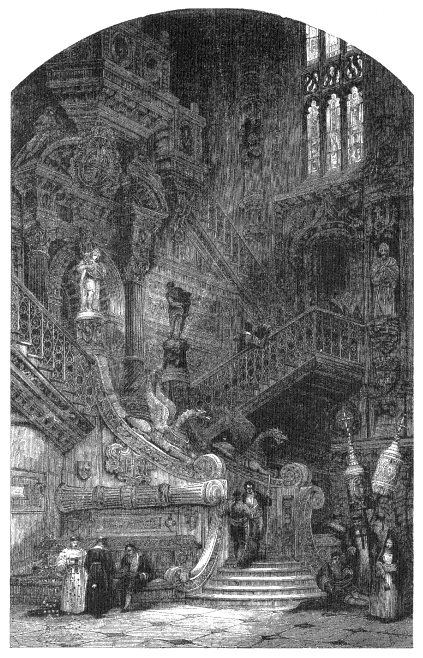
Fig. 1.
"Grand Staircase of Burgos Cathedral."
Illustrated Magazine of Art, 1853
lambent features of marble disrupts customary viewing relations, inviting him into a privatized and novel aesthetic in which artificiality testifies to authenticity, morbidity to feminine beauty. Whether encoded in famous travel novels like Nathaniel Hawthorne's Marble Faun (1860), George Hillard's best-selling My Six Months in Italy (1850), or the brief sketches that appeared frequently in the major magazines, travel to Rome challenged Americans to absorb the defamiliarizing power of such images. While many, like Parkman, recorded astonishment at the Italian religious aesthetic, some found their faith disabled or reconfirmed by these often spectacular images.
While repudiating the Roman church's self-proclaimed vision of a single global Christian church, Protestant tourists abroad could not help reading their European Catholic past ambivalently, witnessing Italian culture through the revisionist lens of Protestant history. That perspective divided historical time into the apostolic, the papal, and the reformed eras and further organized the nineteenth century into a lingering Catholic past existing behind or beneath a vital Protestant present that yet remained ambiguously attached to it. As American tourist rhetoric continually implied, such Protestant attachment was preoccupied with issues of psychological and cultural loss, the loss of a mighty, avowedly maternal, Rome whose comforts of the spirit included those of semantic certitude—one born, however, of the image rather than the text.
Antebellum Americans who possessed a spiritual past in Scripture but felt the lack of a sufficient national heritage selectively, if awkwardly, appropriated a cultural ancestry from their tourist experiences in Catholic Europe.[4] This tourist "discovery" was kept in guarded relation to the present back home, available for middle-class tourists and readers but strenuously dissociated from contemporary theological and political domestic issues. In several respects tourist literature resolved the dilemma of a nation hungering for a past yet fearful of the burdens such a past might entail. The American republic could neither originate from a European past, frequently figured as a tainted maternal origin, nor derive from the New World, whose native cultures also threatened to contaminate a fledgling democratic selfhood.[5] Struggling to create an undefiled, self-originating identity, antebellum Protestants maintained at home a tense proximity to both sites of suspect origin. The advocates of democracy—in sermon, history, travel sketch, or novel—poised the country, like Hawthorne's Donatello, midway between "savagery" and
"civilization," somehow meant to grow without growing older, to develop without risk of decay.
But as Hawthorne suggested in The Marble Faun , many affluent American tourists experienced an ardent, even dependent, attraction to this decayed Catholic Europe—a Europe whose offerings to the American ambiguously shifted between the spiritual and the aesthetic and in so doing called into question the reality of any strict division between the two regions and, more disturbingly, between the two religions. While American travels to Europe in the nineteenth century were shaped by the eighteenth-century tradition of the Grand Tour, American travelers themselves showed an additional and marked religious preoccupation that lent a sectarian edge to conventional pursuits of the picturesque and the sublime. In numerous travel sketches, the tourist experience of moving through and looking on Catholic Europe emerges as a valuable aesthetic acquisition that can offset the losses resulting variously from the disruptive forces of disestablishment, immigration, and urbanization back home. "I would be free even to declare, that, in the light which played between those lips and lids," an American clergyman wrote of the Dresden Madonna, "was Christianity itself,—Christianity in miniature for the smallness of the space I might incline to express it, but that I should query in what larger presentment I had ever beheld Christianity so great."[6] It was a delicate task, however, to remain distant from Romanism and close to Rome's splendors—a balance necessary to the spiritual and aesthetic enterprise of national identity formation. Beneath the triumph proclaimed by Protestant ideology lay an uneasiness that threatened not the defeat but the embrace of the enemy—an embrace that led not so much to religious conversion as to an aesthetic and emotional appropriation of the enemy's powers. If Harriet Beecher Stowe's Puritan heroine, Mary, of The Minister's Wooing (1859) is too modestly circumstanced to tour abroad, the ocean waves themselves bring her a da Vinci "Madonna" to hang on her bedroom wall, "a picture which to Mary had a mysterious interest, from the fact of its having been cast on shore after a furious storm, and found like a waif lying in the seaweed."[7] Mary's discovery on the Newport beach is meant to be extraordinary, the logic of realism discreetly ruffled by the contravening interests of evangelical sentiment to demonstrate the heroine's transcendent status. Mary's serendipitous art acquisition keeps her safe from the contamination of travel, the dross of contemporary Italy through which American tourists looked to the ideal region behind. Although one's first impressions of Italy would undoubtedly be mundane and ugly, let the traveler "bide his time," counseled the most popular travel writer of the
1850s. "The Rome of the mind is not built in a day . . . the unsightly and commonplace appendages will disappear, and only the beautiful and the tragic will remain."[8]
Italian travels inevitably reminded American Protestants of their Reformation roots, the poverty of the Italian populace and the opulence of the Vatican returning them imaginatively to the heroic age of Lutheran and Calvinist reform. If class divisions back home were becoming uncomfortably apparent with industrialization and immigration, that domestic menace receded before Italy's extremes of deprivation and wealth. "They draw life," wrote Parkman of priests he observed in Messina, "and sustenance from these dregs of humanity—just as tall pig-weed flourishes on a dunghill."[9] Italian travel presented New England tourists, in particular, with a heroic Catholic past that not only diminished the disturbing impressions of the Catholic present but also embellished the dreary realities of the Protestant present. If Americans generally expressed confidence in their national future, they had no such simple emotions toward their present or past. Like English and European neomedievalists who invented a past of benevolent authoritarianism and organic communitarian values to compensate for the gross disruptions of the Industrial Revolution, some Americans found in Europe the pleasures of a recovered Catholic medievalism, especially as imaginatively projected by Walter Scott, Thomas Carlyle, and William Cobbett. But a culturally pervasive romancing of the Middle Ages did not characterize American culture until after the Civil War, at which point medievalism served as one rallying cry against the manifold psychic deprivations of modernization.[10] For the vast majority of antebellum tourists to Italy theology and aesthetics were crucial, not, as in neomedievalism, psychology and aesthetics.
Tourism to famed sites of European Catholic art relinked what ideology and geographical distance had severed; having returned from Italy and the Holy Land, Melville, in the formulaic tones of the lyceum, expressed what was quickly becoming a conventionalized sense of re-connection to the Old World: "On entering Rome itself, the visitor is greeted by thousands of statues, who, as representatives of the mighty past, hold out their hands to the present, and make the connecting link of centuries."[11] The Protestant Word and the words of accusation and self-defense it generated were surprisingly vulnerable to this "connection" experienced by American tourists in Rome. Archbishop Spalding in his History of the Protestant Reformation (1860) somewhat uncharitably decided that his Protestant historian colleagues were necessarily baffled by history because they had abjured Christ's promise to protect
his Church, a promise that was the "thread of Ariadne, which would have conducted them with security from the tortuous windings of the labyrinth of history, in which they appear to have been lost."[12] Protestant historians largely denied such confusion, but Protestant tourists frankly expressed their amazement and religious disequilibrium in the labyrinthine Italian streets and catacombs. Reconnection with a repudiated past and the disorientation of foreign travel coalesced to produce a sense of uncanniness for American visitors to Rome. The first recorded use of the term sight-seeing , in 1847, indicated the spread of a new, touristic, form of seeing but one that was still not carefully distinguished from sacramental vision, the looking on the raised Host. Antebellum sightseers in Rome struggled constantly to convert sacred sights (and sites) into touristic ones while yet pondering with genuine theological intensity not only what they saw but also whether (and how) they believed in what they saw.[13]
While journals back home declared their confidence in the Protestant principle of "private judgment," American tourists and artists abroad wandered psychologically between the conflicting worlds of two faiths. The North American Review assured its readers that "it is wonderful to see how one of those principles of the gospel, when received in the living letter, illuminates every region of the soul, and casts light so broad and far on the way of life, that no one can wander, if the heart is only true." But it was no easy task to maintain a true heart once outside a society rife with evangelical certainty about the "living letter." The reassuring "spirit of preciseness" that even Unitarians claimed for the Bible, in contrast to the antiscriptural mysteries of the Catholic church, began to blur before Rome's imprecise but powerful collections of images.[14] As a context that undermined Protestant Scripture, the Eternal City burdened visitors with its novel, elusive, or simply excessive meanings. So condensed were Rome's significations that they reminded Hawthorne of the epistolary cross-writing popular in the pre-Civil War era in which letter writers—to save paper, to preserve privacy, to create a disguised intimacy of two—superimposed vertical onto horizontal script. Displayed before Hawthorne's weary and intimidated gaze, Rome appeared like the "broadest page of history, crowded so full with memorable events that one obliterates another; as if Time had crossed and re-crossed his own records till they grew illegible."[15]
Confusion before this Roman world was aggravated by two rival Protestant versions of the past: those encountered in written histories and religious polemics and those personally encountered in travel. This division of American time into a moribund Catholic past (encountered in
travel) and a dynamic history (connoting beneficent change and denying the sad workings of time and human evil) was reinforced by the habitual splitting of the Western world into Old and New.[16] According to Nicholas Murray, all one had to do was look at the "moral map of the world" to see the division.[17] What many anti-Catholic Americans saw was a globe divided between New World industry and Old World indolence, the "one portion of the earth's surface reminding us of the powerful, ever-advancing Gulf-Stream,—the other of the weedy, motionless Sargasso Sea."[18] Such a moralized geography dictated that history—as the study of change—was a Protestant possession; the stagnant terrain of the past belonged to Catholics. The New Testament, Protestant history, and America's Manifest Destiny moved jointly forward; Catholicism, divorced from time and Scripture, stood still.[19]
Supposedly left to eternal stagnation, Roman Catholicism emerged as vitally, even shockingly, alive to antebellum tourists. Cast as ritual antagonist rather than historical force, the Roman church had long enjoyed a certain borrowed power from the sheer force of Protestant invective. And having declared that Romanism was dead, Protestant tourists in particular found themselves not so much rid of popery as faced with palpable images of an elaborate morbidity, an excess largely constituted by their own religious preoccupation with self-regulation and the cultivation of the perfectionist powers of voice and text over the recalcitrance of the body. Disease, death, and decomposition were frequently identified with a faith continually pathologized as dead. "The taste of Roman Catholics for the morbidly horrible in death's doings is strangely general," declared Harper's New Monthly Magazine in 1854.[20] As increasing numbers of Americans descended on Italy, this same opinion became strangely general among them. The Catholic past and present, graphically displayed in bone reliquaries and sarcophagi, loomed as an uncanny challenge to Protestantism's anticorporeal aspirations and increasing efforts to sentimentalize death as an antiseptic transition into resurrection.
In one of her typically exasperated dialogues with the Presbyterian Oswald, the Catholic heroine of Mme de Staël's best-selling novel Corinne; or, Italy (1804) insists that Rome is "not simply an assemblage of dwellings, it is the history of the world."[21] While tourists throughout the nineteenth century responded to this melancholy universality of Roman ruin, American visitors were notably occupied with the physically morbid aspects of the Eternal City. At home Walt Whitman saluted the past as a "corpse . . . slowly borne from the eating and sleeping rooms of the house," a corpse that seemed to end up in Rome where Americans
visited it with troubled curiosity.[22] Travelers repeatedly singled out from the plethora of visual novelties the presence of the Italian dead, buried in catacombs, lying on biers, their bones seemingly displayed everywhere for veneration or, worse yet, decoration. At its most literal and grotesque, this "past" exposed itself with an indecent, even erotic, energy before American viewers. The dreamy nostalgia perfected by Washington Irving as he wandered discreetly through Westminster Abbey's "wilderness of tombs" was frankly inadequate in Rome, where graveyard romanticism often gave way to hysteria at this bone-filled world.[23]
Catholic churches appeared stuffed with death, "full of bones and skulls, and coffins," repositories of biological decay that seemingly ignored any hygienic or moral etiquette.[24] Or rather, that etiquette was a foreign and vulgar one that violated American Protestant notions of propriety and aesthetic organization. Young Parkman, himself in revolt against conservative Unitarian proprieties, uncomfortably noted in his Italian journal that the dead virgins of the Capuchin convent catacombs "all wear crowns of silver paper, from beneath which they grin and gape in a most alluring fashion."[25] Traveling to recover the health he had professedly lost through excessive physical exercise, Parkman confronted the crowned female skeletons with a sexual unease apparent in many tourist accounts. That these females were virgins only exacerbated the anxiety; their vows of celibacy, their rejection of sexual experience, irritated Parkman's developing preoccupation with virility even as their display of asceticism intrigued him. Parkman was hardly eccentric in his dismissive but carefully detailed reports of "alluring" Catholic skeletons. Having proclaimed their freedom from Old World bonds, tourists often felt compelled to reenter a specialized experience of deathly enclosure once overseas—a surrender not only of the eye but of the body as it roamed through a variety of novel, and at times conspicuously morbid, architectural interiors. Accounts of being captivated by the Italian experience include familiar emotions proper to the sublime and the picturesque; but conventional enchantment could easily resolve into disgust or even panic before relics or skeletons. Such temporary experiences of aesthetic discomfort were in turn conventionalized as a false "literary" captivity that frankly imitated the titillating details of the Gothic. And like Gothic narratives, American tourist accounts wavered between simulated and authentic terror.
In particular, the descent into Rome's catacombs elicited fears of incarceration, even live entombment. Descending from the New World to Rome's literal underworld, American explorers of Roman catacombs experienced a psychological captivity that strikingly contrasted with the
vastness and perceived emptiness of their still largely rural landscapes back home[26] If the symbolic terrain of American Protestantism figured itself as clean, empty, and magically capable of change without decay, that of Catholicism was clogged with the filth of bodies. Emptied of Catholic artifacts, New England and Virginia churches presented studiously cleansed interiors to subordinate the distractable eye to the aural experience of the Word. Such interior emptiness, architecturally speaking, facilitated the Protestant's unmediated relation to the Holy Spirit; but the ideological affection for emptiness also influenced the perception of the American landscape as empty of inhabitants and hence available for settlement. John O'Sullivan's seminal 1845 essay in the Democratic Review explained that America's "Manifest Destiny" was to construct a national interior from an "empty" wilderness. When American Whigs and Democrats stood in the catacombs and dusted the powder of bones from their hands, they hesitantly acknowledged an altogether different destiny that tied them to earth and bones, holding them captive to neither Jehovah nor American Indians but to biology. In the Roman catacombs such tourists experienced a confused merging of the literal and the metaphoric, of corpses and the past. That combination produced a pleasing metaphysical shiver, a carefully measured dose of romantic melancholy that, once conveyed in nationally printed travel essays back home, offered a safe alternative to the fiction of elite writers like Hawthorne and Melville, whose visions of America's past and future recorded the more subversive anxiety that led Melville to declare of the Galapagos Islands that it "is but fit that like those old monastic institutions of Europe, whose inmates go not out of their own walls to be inurned, but are entombed there where they die; the Encantadas too should bury their own dead, even as the great general monastery of earth does hers."[27]
Roman monastic practices of burying the dead beneath the living horrified yet pleased American visitors. If back home they prided themselves on orderly cemeteries discreetly positioned in churchyards or, increasingly, in separate areas on town perimeters, they consciously sought out the horror of European burial pits; visiting the famous Naples cemetery, the "traveller invariably gave the guard a small tip to lift one of the stone slabs so that he could look within, and he invariably reported the most horrible sight of decaying forms that he had ever seen."[28] Such burial pits luridly challenged the theological optimism of liberal American Protestantism, which increasingly figured heaven as an extension of the middle-class home and promised to close the distance between God and person originally insisted on by Calvin, who argued that in heaven "our glory will not be as perfect as to allow our vision to comprehend
the Lord completely . . . there will be a wide distance between Him and ourselves." Properly organized cemeteries in the antebellum decades now ideally functioned as "nurseries of piety for an everlasting home"; one sat or walked through a collection of the dead, each safely, separately, encased and textualized beneath commemorative stones. The developing suburban American cemetery extended the design principles of sentimental, genteel domesticity that stressed purification, ventilation, and the studied arrangement of household furnishings to inspire pious character development.[29] Increasingly distanced from the dead at home by these habits of sentimental commemoration (memorably satirized by Mark Twain in his portrait of Emmeline Grangerford in Adventures of Huckleberry Finn ), the American tourist's proximity to corpses in Rome enabled the recovery of an illicit but finally safe authenticity. The dead, after all, were not their own and were not from their class, religion, or ethnic group. Italian burial pits presented grisly subterranean interiors that starkly contrasted to cemetery parks; the pits substituted the pleasures of visceral astonishment for those of contemplation, the threat of engulfment for the "upward" pull of sorrow. Liberal, genteel Protestants who meditated in graveyards back home found that in Italy funerary text was boldly displaced by shocking image, the meditative tempo of reading by the instantaneousness of bodily spectacle.[30]
Rome's distinctive geography, then, confirmed Protestant convictions of Catholic morbidity, whose crowdedness pressed upon the tourist with an eerie but consoling pressure. The American George Greene, who begged permission to accompany a Jesuit archaeologist on his inspection of the catacombs, afterward wrote that he "never walked the streets of Rome again without feeling that with every footfall I was awakening an echo in the caverns of death."[31] Rome's deathly underground competed against its romantic ruins for tourist attention; the ruins above ground provided access to the favored experience of European romanticism, involving a textually scripted imitation of an anterior European self, either fictional (Corinne) or historical (the historian Gibbon sitting in the Coliseum). Such identification with English or European characters' experience of the Italian sublime was undermined by the vernacular Roman sights of catacomb and burial pit that pulled the tourist down from the sublime to the "lower" sensual Gothic world, where terror was born of titillation and disgust. Rome's juxtaposition of sublime art (and ruins) to contagious "malarial" soil legitimated the vulgar desire to detect the rottenness at the heart of the sublime or, in the inflammatory misogynist rhetoric of anti-Catholicism, to expose the Whore of Babylon at the heart of Mother Church.
This change in "genre" registered by tourists' descent from the sublime into Rome's contagious soil also figured as a partial loss of control, specifically the control enjoyed by the traveler gazing discreetly on the foreign. The fascination with walking atop the pagan and Catholic dead derived in part from being able to establish both contact with them and dominion over them. Indeed tourist accounts of descending into the catacombs nervously monitor the level of aesthetic and psychological intimacy by trivializing or frankly mocking the terrors of the site. A catacomb anecdote related by Greene points to this careful positioning of the American Protestant tourist before the Catholic dead. An interpolated vignette recounts how an eighteenth-century artist lost his way in the catacombs, having let go of his guiding thread. Minutes of panicked searching for the lost thread produced only a sickening realization of loss and impending death in the clammy, dark labyrinth. But just as he began to faint in panic, his hand fell on the thread and, grabbing hold, the artist made his way back to daylight, experiencing a hysterical glee. This artist of a century back offers a fantasy of resurrection for the antebellum narrator and his readers, the tourist who shares this tale providing the Gothic pleasure of both incarceration and euphoric exit. As these doubled eighteenth- and nineteenth-century narratives of escape suggest, fleeing the catacombs and the surrounding morbidities of papal Italy was fraught with difficulties that pointed less to Roman wickedness than to the imperatives of their Protestant manufacture.
Like the anecdote of the lost thread, other magazine accounts of escape from Italian interiors sound a similarly contrived, hastily evasive note: if the psychic challenges of international encounter imbued with ethnic and religious prejudice were confronted by tourists in Rome's underground, they were scarcely resolved. Rediscovery of the lost thread abruptly, if unconvincingly, enables an otherwise unseemly flight. In a long essay entitled "A Reminiscence of Rome," an American tourist recounts his descent, with a companion, into monastic burial vaults. Initially the two men seek to disguise the discomfort born of intense religious ambivalence by cataloguing the anatomical features of their macabre surroundings. Minimizing the mystery of the monastery vault interior by satire, the narrator crumples the supernatural significance of the skeletal displays beneath the biological, reducing Catholicism to the gruesome absurdity of the dismembered human body—a strategy that assuages doctrinal hostility by heightening a generalized religious anxiety. "The acanthus-shaped sacrum and os coccygis formed a rich cornice for the walls and arches, while ribs, fingers, toes and disconnected vertebrae served for the mouldings of the curiously wrought panel-work of
the ceilings."[32] The foreign religion and the intimacy of the body's promise to decompose are jointly repulsive. Like Ishmael's ponderings on the enormousness of the whale skeleton in Melville's Moby-Dick , the bony interior of this narrative prompts uneasy, finally frenzied reflections on the relation of the bony bodily "inside" to the invisible cultural "outside"—a relation imagined as a Catholic interior detected and pathologized by Protestant observers. Amid the skeletal decor, the visitors regress, not to originary, childlike selves, but rather toward a desiccated masculinity as they try to sketch and eventually dance with one of the skeletons, their monastic skeletal partner pointing to their own future decomposition and the exposure of their bony interiors. Released from the individual bodily boundaries they enjoyed in life, the various skeleton parts of deceased monks display a queasy democracy where hierarchy is replaced by what the two tourists report to be a promiscuous mingling of the "bodies," which submit to such jumblings to meet the vulgar demands of a grisly Catholic aesthetic. When the tourist pair seek to master this interior decor by asking permission to sketch it, they unwittingly forfeit their fragile superiority, for the attempt to draw the lurid enclosure precipitates nervous collapse. Left alone in his "voluntary entombment" while his companion goes to retrieve his sketching equipment, the solitary amateur artist, "locked in with silence and death," becomes hysterical. While he sings and dances with the skeletons, his horrified companion listens outside, certain the hellish fiends are carrying off his friend. But once back inside the walls, he finds to his bewilderment that his hysterical friend has been, in his word, the "aggressor" (745).
That these masculine visitors should not only disturb but frankly assault the dead imitates the syncopated tempo of aggression and haphazard self-control that typifies female Gothic narrative. As Harriet Beecher Stowe revises Gothic conventions of female vulnerability in Uncle Tom's Cabin , positioning the fugitive slave Cassy as a living ghost who haunts Legree, so "A Reminiscence of Rome" recounts a hostile American haunting of the tyrannous Italian dead. In so doing, this particular essay offers a rare glimpse into the violence of the American tourist-interloper, whose dance with the skeletons desecrates the foreign interior. The tourist's frenzy emanates not just from hostility to death but, more particularly, from the materiality and plurality of these monastic bodies whose various parts he forcibly removes from their sacred design to the secular (but hardly less troubling) intimacies of the dance. The American tourist's "minuet" with the Italian skeleton is a memorable instance of a foreign bodily contact that forbids genuine communication. Appearing in the genteel pages of Harper's New Monthly
Magazine , "A Reminiscence of Rome" even finally evades the very audience courted by its Gothic excitement; frankly refusing further dialogue with his readers, the narrator concludes that the events gave him "an insight into the mysteries of psychology; but upon this subject I do not wish to be confidential with everyone" (745). Thus does the narrative encase its own hostility to the materiality of the Catholic body—both its fragility and the obtrusiveness of its lingering presence. In a replication of this cultural distancing, the narrator thwarts his readers, refusing confessional disclosure to preserve the enclosure, the psychological privacies, of his Protestant subjectivity.
The narrative's retreat into secrecy is a coy maneuver that reduces the possibility of any ecumenical or interethnic communication to the insignificance of flirtation. Neither the Roman dead nor the author's "mysteries" overcome these tourists (or implicitly their readers); indeed, enough of their sketches survive to illustrate the essay quite elaborately and, in so doing, guide its reception (Fig. 2). Surrounded by engravings of skeletons, the magazine text replicates the vault experience of bony encirclement, its prose closed in upon by the grinning monks. Such typographic claustrophobia further invites the reader into the American touristic experience while simultaneously reducing it to the manageable level of the decorative. In this latter sense, the article's illustrations perform an evasion similar to that of the narrative voice that refuses further disclosures under the presumed necessity for privacy. The article's graphic presentation thus registers the successful assertion of American identity against the foreign, for, having regained control of themselves in the burial vault to the extent that they can sketch what has made them hysterical, the tourists further advertise their management of the Catholic menace by the commercial display of their encounter.
Both celebratory accounts of the catacombs and the accounts of other American tourists who attempted to claim rather than repudiate this Catholicized terrain of the dead contrast to such derisive portraits of unseemly Catholic intimacy. Instead of relegating the foreign religion to a prehistory of bone-ridden archives, some visitors tried to insert parts of Catholicism into Protestant time—tried, in other words, to convert elements of Italy's troubling, morbid "past" into America's mainstream "history." A principal site for this reappropriation was the catacombs. Turning from the artificial ruins fashionable in the late eighteenth century, nineteenth-century American visitors exploited Rome's ruins for
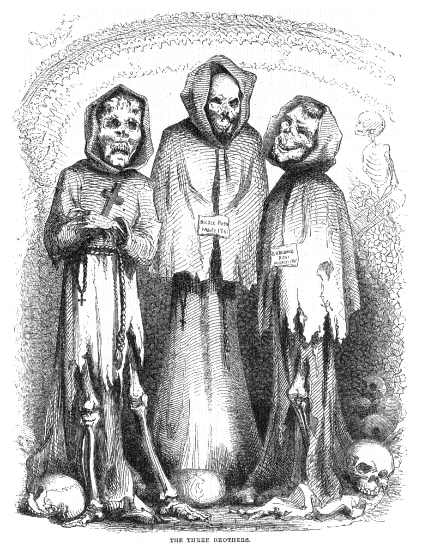
Fig. 2.
"The hideous mummies leered at me from beneath their moth-eaten
cowls; their eyeless sockets seemed to gleam with fiendish intelligence,
and their idiotic grinning put on a devilish motive and character." "The
Three Brothers," from "A Reminiscence of Rome,"
Harper's New Monthly Magazine, 1857.
ammunition in their contemporary religious disputes.[33] According to this revisionism, the skeletal remains and decorated sarcophagi of the catacombs were not instances of a vulgar Catholic morbidity but rather a "rebuke to the Papal Rome above"—the indisputable evidence of a primitive Christianity ennobled by persecution and free from contaminating relations to the state.[34] The very earthiness of such newly opened archaeological sites reassured the more skeptically inclined, who, having denied the papacy's supernatural sanctions, were casting about for alternative authorities and empirical guidelines to support their "private judgment." Americans easily extended the Reformation rhetoric of "restorationism" (the attribution of Protestantism to the early days of the Church) to include the silent catacombs recently discovered beneath Rome. Viewed from this perspective, the dead harbored in the catacombs were seen as free from the objectionable exhibitionism of monastery burial vaults; they became virtual Protestants for some American tourists and thus their spiritual parents, ancestors who exerted a magnetic authority over a modern progeny who were confessedly suffering the discomforts of theological uncertainty and a consequent fascination with violent (and violated) religious conviction. Such an "American" Roman past supported domestic Protestant polemics against American Catholic claims of the church's unbroken allegiance to the apostolic era. The catacombs that provided this much-needed Protestant antiquity with a vision of an extensive and pure history that could compete with the vast but contaminated past of Rome did so, importantly, without threatening to mingle with the American present; as "ruins" they were not only overseas but also underground. Doubly distant, they enjoyed tremendous appeal.
Such appreciation for early Christian martyrs, then, effectively converted a portion of the Catholic "past" into mainstream American Protestant "history," enabling American tourists to subversively imagine their national origin in the Roman catacombs. Rome's past became America's future in the dual sense that catacomb martyrs pointed to the English Puritan exodus to America while themselves epitomizing an ideal Protestantism for antebellum American emulation. In preserving America's ancestors, the catacombs pointed to a redeemed future for an ailing Protestantism; containing the "exhibition and the promise of a purer Christianity," they served as both origin and destination for the providential vision of New World onlookers.[35] From the liberal New England perspective, the catacombs, as underground church, belied the contemporary pagan Christianity above. Indeed, the persecuted catacomb dead collapsed classical and papal Rome aboveground into a single text of
dangerous, if dazzling, corruption. Discussing Charles Maitland's Church in the Catacombs (London, 1846) and the anonymous Rome, Pagan and Papal by an English Resident (London, 1846), one Unitarian underscored the religious obligation of American tourists to detect this underground truth. While "old Pagan Rome seems to have risen from her ashes and still to live in the prevailing rites and usages of the 'eternal city,' " a Protestant past lies encapsuled beneath, waiting to be deciphered by tourists of sufficient spiritual insight.[36] To look on the skeletons of these early Christians offered a vicarious experience of grace; N. P. Willis, writing of the "humble traces of the personal followers of Christ" in the catacombs of St. Sebastian, suggested the excitement of this return to apostolic times. "We saw the skeleton as it had fallen from the flesh in decay, untouched, perhaps, since the time of Christ."[37]
New World tourists in Rome positioned this recovered Old World ancestry in the horizontal (if intermittent) sequence of earthly history, rather than in a vertical, thoroughly mediated, Catholic continuum from earth to heaven. The catacombs were proof positive, serving as archives from which tourist-explorers, as New World Protestants, reconfirmed their temporal history of persecution, martyrdom, flight, and perseverance. The historical continuity produced by these tourist experiences of Protestant ancestral bonding was distinct from the traditional Roman Catholic vision of a cosmos in which the sainted dead lived on in anxious heavenly supervision of the earth's struggling souls. For American Catholics, the dead lived eternally, not historically. Affirming the link between the earthly and heavenly cities (and implicitly disputing the Protestant focus on Rome's supposed morbidity), the American Catholic journal the Metropolitan declared: "Nowhere in this world, we believe, is there a more living, real, exultant life than in old Rome; and who are more living than those whom we call the dead?"[38] Challenging the American tourist's preoccupation with Catholic Rome's political and erotic deathliness, with an antiquated institutional papacy atop and mingled monastic bodies beneath, American Catholics appealed to New Testament promises of life-in-death to defend Rome, whose ruins and skeletons were precisely the evidence for eternal vitality.
Like C. Auguste Dupin of Edgar Allan Poe's detective narratives, Protestant tourists searched the catacombs for clues to their religious identity by constructing narratives of ecclesiastical crime from a disorderly collection of mute details. The accounts they fashioned conscientiously opposed the distrusted conventions and imagery of Italian Catholic art. Trying to imagine the early saints afresh, one such amateur historian-detective revealingly wrote that it is "from the catacombs that
we must seek all that is left to enable us to construct the image that we desire."[39] As the Vatican had allegedly conspired to suppress the Bible, so these detective-tourists unburied it, citing their discoveries as further contributions to American biblicism. Although they assured readers of their "faithful and honest exploration" (33), what they discovered rather naturally confirmed their reading of church history. Denizens of the catacombs turned out to be model believers whose faith had little need of institutional support.
In those first days there was little thought of relics to be carried away,—little thought of material suggestions to the dull imagination, and pricks to the failing memory. The eternal truths of their religion were too real to them; their faith was too sincere; their belief in the actual union of heaven and earth, and of the presence of God with them in the world, too absolute to allow them to feel the need of that lower order of incitements which are the resort of superstition, ignorance and conventionalism in religion. (519)
The early Christians emerge in this idealized portrait as ancestors to their modern day Protestant celebrants; together they disdain Rome's "superstition, ignorance and conventionalism." But they also emerge as rivals to their visiting modern Protestant progeny, for it was not only Catholics who needed the material dimension but also Protestants, who were carrying away relics and for whom the "eternal truths" were decreasingly persuasive.
Shaped by such a nostalgic and self-deprecating revision, the dark, twisting catacombs ironically emerged as symbol for devotional clarity and straightforwardness. Their labyrinthine interiors opposed the obfuscations of the papacy, the quandaries of liberal Protestantism hoping to illuminate what church tyranny had disguised and what modern subjectivity could not find. Representing an era when the "mystery of the mass and the puzzles of transubstantiation had not yet been introduced among the believers" (521), the early martyrs sanctioned a bumptious "scientific" hubris on the part of these Americans; archaeological efforts to bring corpses to light and to reconstruct the history they mutely evoked imitated God in his acts of revelation. Thus the "Cuvier-like" archaeologist De Rossi was credited for discovering the remains of St. Cecilia by an "inductive process of archaeological reasoning" (683)just as the "Lord discovereth deep things out of darkness, and bringeth out to light the shadow of death" (685). In a final irony, such an appropriation of divine power for the developing science of archaeology sig-
naled the secularization of the catacombs, a process that rapidly converted them from sacred mausoleum to museum and tourist attraction. As underground Rome was recovered and organized, its mortality, initially so overwhelming to American visitors, was gradually transformed by the light of science into purified historical evidence against papal fictions. What remained above ground represented for many of these tourists the true city of the dead, a degenerate conglomeration of pagans and popes whose tombs possessed little of the redemptive, revelatory power of the catacomb dwellers.
Thus, in Protestantizing Christian antiquity, American tourists obtained partial control over a Catholic past whose dead (along with the funerary art and architecture devoted to their memory) initially overwhelmed them. Disputing the Catholic dogma of Apostolic Succession, one antebellum nativist insisted that the Holy Spirit had escaped the corruptions of a priest-ridden civilization in full accord with the Book of Revelation. "They say it is the first form of Christianity. That is a mistake. It is the second . The first appeared for a while, then 'fled into the wilderness, where she had a place prepared of God,' and re-appeared at the Reformation."[40] For many antebellum tourists, the catacombs had become that wilderness refuge.
Three
The American Terrain of W. H. Prescott and Francis Parkman
For mid-century Americans, this moribund Catholic world of catacombs and ruins did not reside in Italy alone. For those who wrote and many of those who read the popular romantic histories of William Hickling Prescott, author of the best-selling History of the Conquest of Mexico (1843), and Francis Parkman, author of the seven-volume France and England in North America (1865-92), tourist images of Catholic Europe influenced their historical "tour" of America's past. Visiting the Catholic Old World served in effect as the experiential counterpart to reading the consciously literary histories of America's national formation unfolded by Prescott and Parkman. Like many other New England authors of their day, both historians had visited Italy as young men and later incorporated their vision of Catholicism into their mature histories. What they encountered early abroad and wrote later at home constituted a sequential narrative that legitimated (if regretfully) Anglo-America's victory over ecclesiastical corruption and political authoritarianism.
Although both historians emerged from Unitarian Boston, their stories of America's historical development returned obsessively to the question of Catholicism. As the two principal historians of America's struggle against Catholic imperial powers, they argued for the overriding historical agency of a virtually hypostatized Protestant selfhood made narratively coherent by its opposition to a contradictory and irrational Romanism. In their historiography the European Catholic world, as aestheticized ideological construct intricately composed of antebellum tourist images and post-Reformation Protestant polemics, shapes the New World terrains of their histories. Indeed European Catholicism, according to their historical narratives, had deviously situated itself at
the very origin of the English and Spanish New Worlds. In an 1853 oration on the discovery of America Edward Everett, the famously eloquent clergyman, Harvard College president, and Massachusetts senator, claimed that Columbus's fateful landing had in fact enslaved the New World to the Spanish: "When on the following morning the keel of his vessel grated upon the much longed for strand, it completed with more than electric speed, that terrible circuit which connected the islands and the continent to the footstool of the Spanish throne."[1] But the deeper meditations of the New England historical mind uncovered a pre-Columbian Catholicism already entrenched in the Western hemisphere. It was carried in the minds and cultures of North American and Mesoamerican Indians, whose faintly understood cultures seemed to resemble Romanism in sufficiently astonishing ways that at points they simply merged as twinned images of popery. Modern Americans who read Prescott and Parkman could thus "tour" an elaborate and morbid aesthetic of Catholicized savagery just as they physically explored the gloom of cathedral and catacomb overseas. Revealing the continued difficulty of New England Protestantism's separation from Rome, these histories positioned Catholicism at the root not only of America's repudiated European origins but of its New World past. In their exodus to the New World, "Anglo-Saxons" encountered the very enemies of sensualism, ritualism, and mystery from which they had fled.
Prescott's and Parkman's post-Puritan romantic accounts of the necessary demise of Amerindian ritualism betray a volatile touristic combination of fascination with the foreign and disdain for it. Native American representatives of indolence, superstition, and decadent materialism must eventually surrender to Anglo-Saxon energy, ideality, and modern efficiency. But the Indian (whether Aztec or Huron) entices the melancholic New England historical gaze that searches for a redemptive primitive; once engaged, that gaze on the vanishing aboriginal American reveals the shadow image of a New England "native" self, vanishing beneath its own repressions. This latter self demands its own form of therapeutic control, one accomplished through the historiographical construction and eventual elimination of an aboriginal Catholicism. It is the disappearance of this secondary "native" Protestant self that energizes the elegiac attention of these histories. Their providential plots master Aztec, Iroquois, Spanish, and French Catholic cultures but resist surrendering the imagery and implications of New World Catholic heroism, ritualism, and tragic asceticism, a subordinate but persistent text whose essence contains an autobiographical narrative of the "native" masculine self in combat with its New England "Brahmin" cultivation.
If these antebellum histories of national formation resolve the problem of Anglo-America's eradication of allegedly unassimilable native cultures by continued appeal to an unassimilable Catholicism, that Catholicism in turn discloses a drama of Protestant selfhood resisting its own proprieties.
Like their various heroes in pursuit of New World territory and souls, both narrative historians made great efforts to capture a past prior to Anglo-America, to track it down and encircle it with language vivid enough to resurrect the triumph and the cost of this mastery. Although contemporary reviews frequently praised Prescott and Parkman for their impartial realism, the past they presented curried to the political and psychological needs of their educated readership while disavowing the ideological (and compositional) labor of their works. Especially anxious to distance himself from the excesses of the religious minded (of whatever creed), the agnostic Parkman repeatedly advertised the documentary empiricism of his history's second volume, The Jesuits in North America (1867). "I have studied and compared these authorities," he declared of his missionary and other sources, "as well as a great mass of collateral evidence, with more than usual care, striving to secure the greatest possible accuracy of statement, and to reproduce an image of the past with photographic clearness and truth."[2] Such assertive realism arguably rendered his romantic historiography more vulnerable than it might otherwise have been to contemporary novelistic conventions, for speaking as documentary investigators, Parkman and Prescott also distributed a carefully elaborated religious allegory through their scenic narratives. What later readers detect as a religious and ethnic Brahmin myth of Amerindian tyranny and sloth possessed the charismatic transparency of truth to these historians and their readers—a truthfulness born of their self-distancing from the religious bigotry of their Puritan ancestors and the anti-Catholic nativism of their conservative Protestant contemporaries.[3] Prescott and Parkman simply refuse to engage in any overt doctrinal debate with Rome. In its place they offer the superior authenticity of romantic narrative, whose truth claims depend on its proffer of a "psychological" Catholicism, a constellation of (still disabling) personality traits that explain the collapse of native cultures. Symptomology and diagnosis replace religious polemic.
As conservative Whigs and religious liberals, Prescott and Parkman pride themselves on the psychological realism of their characterological histories and frequently contrast their cautious empiricism to the allegedly irrational and exaggerated Catholic chronicles on which their narratives uncomfortably depend. The subject matter and the majority of
historical sources for both historians dwell in a prehistoric morbid atmosphere of superstition and religious enthusiasm. An unscientific, antiprogressive, stagnant world, it calls for the greatest investigative skill combined with the conquering dynamism of picturesque romantic historiography. Armed with ironic wit, both historians forge their route through a tangle of untrustworthy sources, searching for the scenic distillation of reality their romantic methodologies are designed to disclose. In so doing, they present their readers with painterly images of an exotic, violent past crucially severed from contemporary America. Just as the Old World divided irrevocably into pre- and post-Reformation time, so they split their New World into superstitious and enlightened eras. History, conceived of as those events leading to the establishment of Anglo-American culture in North America, effectively begins only with the arrival of (English) Protestantism. What exists before that event is a "past" as morbidly compelling as that found in any Roman catacomb.
Prescott and New Spain
In 1843 William Hickling Prescott published The History of the Conquest of Mexico , which became a best-seller for that year and has since remained a classic achievement of nineteenth-century romantic historiography.[4]Mexico begins with a lengthy essay on Aztec civilization, then narrates Cortés's expedition and later career, and concludes with an appendix consisting of an essay, "Origin of the Mexican Civilization—Analogies with the Old World," and three translations of "original documents": the Spanish historian Bernardino de Sahagún's account, "Advice of an Aztec Mother to Her Daughter"; an Aztec "Poem on the Mutability of Life"; and Ixtlilxochitl's "Of the Extraordinary Severity with Which the King Nezahualpilli Punished the Mexican Queen for Her Adultery and Treason." This overall structure—the lavish introductory resurrection of a native culture, the account of its conquest, and the concluding fragmented meditations on Aztec culture's seeming resemblance but actual profound difference from European civilization—recapitulates the very dynamics of conquest as they proceed from initial invasion to ambivalent commemoration.
Published three years before the United States' 1846 war with Mexico (a war that concluded with Mexico's sale of California, New Mexico, Nevada, and parts of Colorado, Arizona, and Utah to the federal government in exchange for fifteen million dollars and with the establishment of the boundary between the two nations at the Rio Grande),
Prescott's Mexico provided a narrative rehearsal for that event. Adolph De Circourt, one of Prescott's fervent European admirers, wrote in June 1847: "You seem to have, while describing so eloquently the past Conquest of Mexico, foretold the future one."[5]
If to write history was to reenact it, so too the reading of Mexico 's romantic duplication of the first conquest prepared the way for the second. Prescott himself characteristically conceived of his compositional procedures as a military calculation, struggle, and triumph that competed against, even while emulating, those of his "genius" Cortés; similarly, readers of Mexico absorbed its ideological and even literal directives for the 1846 war. General Winfield Scott virtually followed Cortés's route in 1519 from Vera Cruz to Mexico City, and it is likely that not only Scott but also a fair number of American soldiers were reading Prescott as they advanced on Mexico City. On a trip in 1846 to Washington, where he socialized with Webster, Polk, and Calhoun, the already famous Prescott wrote home that his Mexico had become a campaign manual of sorts. "Mr. Mason, former Secretary of the Navy told me that the sailors on board the Delaware had sent in a petition that the 'Conquest of Mexico' should be entered among the books of the ship, and that it was now ordered to form part of the library of every man-of-war in the navy. He said he considered this as the greatest compliment I had received. [6] As it turned out, the second conquest was easier than the first. In April 1848 Prescott commended the Yankee general Caleb Cushing for his expedient military conquest, which triumphantly duplicated the sixteenth-century invasion while forming a corrective sequel to his own 1843 history.
You have closed a campaign as brilliant as that of the great conquistador himself, though the Spaniards have hardly maintained the reputation of their hardy ancestors. The second conquest would seem, a priori to be a matter of as much difficulty as the first, considering the higher civilization & military science of the races who now occupy the country. But it has not proved so—and my readers, I am afraid, will think I have been bragging too much of the valor of the old Spaniard. [7]
Prescott's Mexico , together with its companion volume, The Conquest of Peru (1847), represents antebellum America's principal account of the rise and decline of the Spanish empire in the New World; both volumes provide a crucial rationale for North American imperialism and the superiority of "Anglo-Saxon," in particular New England, culture over the racially mixed cultures of the south. Prescott's account of the
Spanish discovery, invasion, and conquest of the Aztecs (and then the Incas) participates in the 1840s Anglo-American campaign to convert a specifically Catholic foreignness into the "native" through the extension of a strenuous, if self-doubting, Protestant imperialism.
Mexico subtly modulates into a critique of the vitiated Hispanic civilization that results from the conquest, thus providing an ancestor narrative justifying Mexican subordination to an expansionist Protestant United States. Prescott's Cortés, the "young adventurer, whose magic lance was to dissolve the spell which had so long hung over these mysterious regions" (Mexico , 130), functions as a charismatic agent in this cultural mystification, enabling white North Americans to identify with "Spain, romantic Spain" (537) while divorcing themselves from contemporary Mexico, indicted by one contemporary newspaper for its "idol worship, heathen superstition, and degraded mongrel races." [8]
The assimilation of a foreign territory and culture into a "native" Anglo-Saxon America was a pressing issue on the domestic as well as the international front. While Prescott was composing his history, "native-born" Americans in his hometown of Boston were struggling against Irish Catholic immigrants; Prescott's Mexico records Anglo-America's confrontation not only with Mexicans in the Southwest, then, but with Catholic foreigners on the northeastern "frontier" as well. As an affluent Bostonian of the 1840s, Prescott faced not only the specter of racial mixture in the Southwest, a contamination of the industrious, liberty-loving Anglo-Saxon "gene" with that of the Mexican (who was already a disturbing compound of Indian, African, and Spanish ancestries) but also the threat of ethnic mixture in his hometown. Of the Irish immigrant, Prescott mused: "What can he know of these [the "sympathies," "feelings," and "ways of thinking which form the idiosyncrasy of the nation"], who has never been warmed by the same sun, lingered among the same scenes, listened to the same tales in childhood, been pledged to the same interests in manhood by which these fancies are nourished; the loves, the hates, the hopes, the fears that go to form national character?"[9] If the body politic precariously depended, as Prescott's rhetorical question suggests, on a uniformity of domestic experience (listening to the "same tales in childhood"), Prescott enabled this provincial American self to surmount the challenge of ethnic and religious difference by producing for its consumption a native-born Bostonian history about America that records the subordination of difference into national uniformity. The demise of Prescott's "gloomy" Aztec afforded a therapeutic consolation for native-born Americans faced in the East with large numbers of Irish Catholic immigrants and in the West with Catholic
Mexico, which (according to the logic of Manifest Destiny), occupied lands destined to be enclosed in the providentially disposed borders of the continental United States.
Finally, if Prescott's Mexico points to these frontier struggles with both Mexico and Irish Catholic immigrants, such violent boundary disputes presaged escalating sectional differences within—specifically, between southern and northern whites. Prescott's imaginative reconstruction of an antidemocratic and indolent southern kingdom, doomed to submit to the morally purified violence of Cortés, transplants to the American hemisphere European distinctions between the Teutonic and Mediterranean, the northern and the southern; those distinctions then figure not only in the rhetoric of North America's invasion of Mexican territory but as the rhetoric for civil war hardly more than a decade later. Indeed, Prescott's conservative Whig vocabulary plays off one version of the South against the other: Polk's campaign against Mexico represents a suspiciously land-hungry American South in debatable action against a southern enemy. Northern suspicions of southern slaveholders' ambitions combined with distaste at the notion of any racial mixture to create a composite image of the South as a region of unregulated appetite and violated purity. Acknowledging that "we are going on triumphing to the Halls of Montezuma," Prescott wrote to his sister during the war that "the Spanish blood will not mix well with the Yankee, and the Southern scale of our republic is already getting a good deal too heavy." [10] Although a social conservative, Prescott was not unsympathetic to contemporary radical Whig opposition to the Mexican War that saw in the conflict the inner workings of slavery, metaphorized by one radical abolitionist as a maternal pathology: "The egg was laid surreptitiously in the nest of the American Eagle, who now loves its ghastly and hideous disclosure better than all her legitimate brood, whose food that young cormorant devours apace, defiling what is not destroyed." [11]
Notwithstanding his conservative Whig suspicions of a conspiratorial slave power, Prescott saturated his narrative with the sacrificial, even providential, violence that characterized Democratic annexation rhetoric. Anticipating the decline of the Aztecs after the establishment of New Spain's first colony at Vera Cruz, he predicts in his history's opening pages that Spanish culture will have a purgative effect on that of Mesoamerica, destroying it with the "light of a consuming fire" (191). Confiding to his memorandum book that the story of Cortés and Montezuma was remarkable chiefly for its "resistless march of destiny ,"[12] Prescott finally submerged his New England mercantile distaste for an agrarian southern imperialism beneath a destinarian discourse of romantic his-
toriography; in so doing, he effectively translated questions of national guilt (and sectional dispute) into his signature literary effects of irony and nostalgia. Mexico , which sold an estimated ninety-one thousand copies by 1860, was so popular in part precisely because of this ambivalent authorial agreement with imperial expansion; Prescott's narrative stance both entertained proponents of the war and spoke to the war's large opposition, which consisted of an unstable coalition of abolitionists, conservative Whigs, and a significant number of southerners reluctant to assimilate the racially suspect populations of Mexico. [13] Prescott's cautious opposition to expansionism and slavery and his support for the racial and religious superiority of North American (and especially New England) whites supply the history's generative tension and its distinctive melancholic voice as it negotiates its burdened route between contradictory allegiances. The history resituates the nation's divided conscience over slavery and annexation in the literary tropes of chivalric exploit and religious doom, nostalgically resurrecting the losses attendant on the ascendency of a capitalist, avowedly Protestant culture over inferior native civilizations. "Brave Moctezuma [sic ]," who appears in the history's appendix as hero of the Indian "Poem on the Mutability of Life," serves as prime elegiac instance of the universal instability of empire and thus offers "native" sanction for the antebellum destruction of Mexican culture. Figure of mourning and of the violence that produces it, Montezuma provides as well an indigenous aristocratic genealogy for a New England Brahmin class anxiously detecting its own decline in status.
As a sixteenth-century enactment of vehement antebellum debates over the legitimate boundaries of the nation, Cortés is himself a violent, wily creator of boundary, who, as instrument for the extension of Spain's boundaries, enjoys the vaunted boundlessness of the immigrant European male. As the history tracks Cortés from the ocean toward the center of the Aztec empire, the reader "experiences" the expansion of Spanish Catholic territory. But the text just as rapidly converts this Spanish conquest into an Anglo-American religious one as Cortés sheds his Catholicism for Protestant self-reliance, demonstrating that he is "as usual, true to himself" (429). Cortés's diminishing Catholicism and increasing Protestantism refer the history in turn to its contemporary imperialist context, the impending conversion of Mexican Catholic territory into North American Protestant possession. Cortés's coherent identity, in which his interior symmetrically issues into a representative exterior (a
coherence reflected by the conquest's easy resolution into narrative sequence), is opposed by Montezuma's disintegrating and opaque selfhood: degenerating under the burden of his "priest-ridden" and materialist culture, Montezuma forsakes any autonomous identity, vacillating between fierce monarch and cowed "savage" until lapsing into "effeminate" despair. This decomposition of Montezuma's personality into conventional configurations of the effeminized native is both a key instance of the European's providential achievement and a reason for it.
In its rhetorically charged portraits of an indolent Cortés transformed into an energetic Protestant hero who delivers just retribution on the Aztecs' sacerdotal culture for its idolatry and ritualism, the history reveals the extent to which anti-Catholicism structured New England historical constructions of American origin. Termed by Prescott the "Dominicans of the New World" (50), Aztec priests, for example, are at once Catholic and barbarian, living in monastic seclusion and practicing flagellation, baptism, confession, and absolution. If to one reviewer such resemblances demonstrated how "thin is the partition that sometimes divides the heathen from the Christian world, [14] to Prescott the gulf between Aztec and Roman Catholic monkishness and Protestant Christianity is unbridgeable.
Such a powerful coincidence between sixteenth- and nineteenth-century America is achieved through a Unitarian indictment of Catholicism, whose allegedly illicit comminglings of spirit and matter, transcendence and institutional power, link Aztec, Spaniard, and Mexican. Situated at the root of both America's problematic European origin and its "savage" New World past, Catholicism, as historical and transcendental category of difference, is the enabling device by which native Mesoamerican culture is rendered dismissible in familiar terms for New England readers. Prescott, disengaging Catholicism from its institutional and geographical framework and transplanting its uprooted traits to Aztec culture, extends Walter Scott's technique of extrapolating attributes from European (principally Italian and Spanish) Catholicism to create a Catholic "character," one defined principally by its incongruous extremes. Such a character then dramatizes cultural otherness whose destruction needs justification or whose meaning remains problematic. Once Aztecs become sufficiently Catholicized (Catholicization being a process finally of southern Europeanization), their annihilation becomes prerecorded, as it were, in the Reformation's triumph over the papacy. As Italy, lingering on for aesthetic perusal, provided American tourists with a symbolic terrain from which to produce for sale ruminations on their own white American identity, so Mexico, as Prescott offered it up, was
a New World Italy—a "wilderness of sweets [in which] lurks the fatal malaria ," a "land of enchantment" (10)—a land, in short, of past grandeur and present mongrelization, of seductive exterior and corrupt interior. Even the region's volcano speaks to the fearful tourist eye: its "long, dark wreaths of vapor, rolling up from the hoary head of Popocatepetl, told that the destroying element was, indeed, at work in the bosom of the beautiful Valley" (335).
Such an anti-Catholic discourse ironically places Europe at the very center of the Americas; scrutinizing the Aztecs, Prescott, like nineteenth-century Americans in Italy, repeatedly focuses on the problem of Catholicism's adulterous mixtures. The ancient Mexicans, like their Italian Catholic colleagues four centuries later, betray an intractable confusion of matter and spirit. The resemblance of such Aztec religious mixtures of "pure philanthropy . . . and of merciless extermination" (44) to Catholicism's own mixtures is surprisingly close, claims Prescott. Aztec inconsistencies "will not appear incredible to those who are familiar with the history of the Roman Catholic Church, in the early ages of the Inquisition" (44-45).
The degenerative character of the Aztec is due finally, then, to the indigenous Catholicism that constitutes the interior of that character. Positing a superstitious interior to be investigated by an enlightened Protestant outsider, the Catholic-Protestant opposition shaped not only Prescott's vision of both America's western and southern frontiers but also more general views of perception and interpretation. Nourished by "nature," the enlightened mind is spontaneously able to perceive intended meanings. The superstitious mind, by contrast, is imprisoned within a Poesque interior, baffled by its own distorted perceptions and unable to exert sufficient interpretive control. The Poesque interior is one of excess mediation where superstition verges on lunacy—a transgression that, in the words of one popular medical critic of the "superstitious" mind, marks a discursive shift from religious deviance to psychological pathology:
The straggling sunbeam from without streams through the stained window, and as it enters assumes the colors of the painted glass;—whilst the half-extinguished fire within, now smouldering in its ashes, and now shooting forth a quivering flame, casts fantastic shadows through the chambers of the soul. Within the spirit sits, lost in its own abstractions. The voice of nature from without is hardly audible. [15]
The superstitious mind in this and other accounts assumes the qualities of a Catholic cathedral; falsely mediating between self and reality,
it imprisons the human creature in his or her own delusions. Rather than functioning correctly as a transparent medium between self and "nature," the superstitious mind is a cluttered, muffled piece of Old World architecture whose windows discolor perceptions precisely as the Catholic church, both theologically and architecturally, impedes the Gospel's pure light. In effect, the superstitious mind is that church in miniature, for it intercedes duplicitously between consciousness and world as the papacy does between believer and God. The spectacle of this primitivized mind, unable to extricate itself from its own gloomy fantasies and finally collapsing into its own interiority, like Brockden Brown's Wieland or like Prescott's Montezuma, who was "deeply tinctured . . . with that spirit of bigotry" (437), provided a fascinating psychological investigation for "enlightened" Americans.
As the story of the antebellum moment, Prescott's history of the collapse of dual Spanish and Aztec origins into a single European (finally English) origin—of native America supplanted by North America—is a story of uncanny religious resemblances converted into racial difference, of an insider's ecclesiastical narrative translated into an outsider's racial one. As the racial other, Montezuma, whose "hard fate," Prescott admits, is to be "wholly indebted for his portraiture to the pencil of his enemies" (280), is nostalgically expelled from the cultural body of America, and a new genealogy is established from the white Cortés. Ideological contradictions at work in this transaction fuel rather than impede the narrative, for they provide the crucial narrative trope of "sacrifice" of the Catholic other that functions as Prescott's central, ostensibly apolitical, rationale for this new genealogy. Focusing his scenic narrative talents on Aztec rituals of human sacrifice and cannibalism, Prescott argues from them to the necessary "sacrifice" of Mesoamerican culture.
How can a nation, where human sacrifices prevail, and especially when combined with cannibalism, further the march of civilization? . . . The heart was hardened, the manners were made ferocious, the feeble light of civilization, transmitted from a milder race, was growing fainter and fainter, as thousands and thousands of miserable victims, throughout the empire, were yearly fattened in its cages, sacrificed on its altars, dressed and served at its banquets! The whole land was converted into a vast human shambles! The empire of the Aztecs did not fall before its time. (612-13)
Seen as a primitive, sanguinary ritual in need of clarifying extermination, Aztec religion nonetheless provides the primary site for the
history's confusion, for the perceived uncanny resemblance of Aztec religious practices to European Christianity, and Spanish Catholicism in particular, forms the interpretive crisis at its core. Prescott's subtle anti-Catholicism functions as the principal medium through which this crisis is enacted, for the resemblance between Aztec and Roman Catholic practices of confession, baptism, priestly hierarchy, and punitive ritual provides the history's compelling ideological argument and confusion, identifying the New and Old Worlds while enforcing a new distinction between the papal-Indian amalgam and Protestant North America. "The existence of similar religious ideas in remote regions, inhabited by different races, is an interesting subject of study; furnishing, as it does, one of the most important links in the great chain of communication which binds together the distant families of nations" (38 n.5).
In recording this providential triumph, Mexico and its Aztecs, who were "another, yet the same," open a consolatory, therapeutic space for readers to ponder the irrevocability of difference—a reading space that paradoxically emerges from (and just barely contains) a subversive text of religious resemblance and hence potential identification. Reviewing George Bancroft's historiography of the Old and New Worlds, Prescott observed:
The analogy is much more striking of certain usages and institutions, particularly of a religious character, and, above all, the mythological traditions which those who have had occasion to look into the Aztec antiquities cannot fail to be struck with. This resemblance is oftentimes in matters so purely arbitrary, that it can hardly be regarded as founded in the constitution of man; so very exact that it can scarcely be considered as accidental. [16]
But if religion, specifically in its bloodthirsty outbreaks, revealed to Prescott the universality of human nature, it also demonstrated the perplexing phenomenon of incongruity. "The forms in which it [religion] is expressed are infinitely various," Prescott continued in his essay on Bancroft, "but they flow from the same source, are directed to the same end, and all claim from the historian the benefit of toleration." [17]
Remarking that his concluding essay, "Origin of Mexican Civilization" (which finds that the evidence argues against the New World's derivation from the Old, notwithstanding the numerous resemblances), was first written as part of his introduction, Prescott suggests a certain circularity to his historiographical enterprise. The appendix, adjudicating issues of origin, derivation, resemblance, and difference, was "orig-
inally designed to close the Introductory Book" (Mexico, 688) and was written as part of the introduction. It is in this appended essay that Prescott isolates the vexed issue of religious resemblance and difference. Religion functions as the crucial evidence in support of the initial obligation of his romantic narrative history to convert cultural and historical difference into resemblance, to transform distant Aztecs into psychological verisimilitudes of human nature (universalized beings on whom the reader's involvement with the text depends). But unlike New Spain's "monkish chroniclers," who superstitiously perceived resemblances between Indian and Catholic rituals, Prescott promises to offer his readers "only real points of resemblance, as they are supported by evidence, and stripped, as far as possible, of the illusions with which they have been invested by the pious credulity of one party, and the visionary system-building of another" (692).
Yet if Prescott gently mocks his Catholic sources for perceiving theological affiliations between Spaniard and Aztec, he readily analogizes the inconsistencies of Catholicism to those of Montezuma. In the process, that is, of asserting his differences against the imagined religious resemblances chronicled by Catholic missionaries, he acknowledges cultural analogies that emerge from "nature, common to all" (699). The various subversive potentialities of resemblance (Is the New World the same as the Old? Are the Aztecs one of the Lost Tribes of Israel? Is the Aztec like the North American Indian? Is the Catholic Cortés like the Emersonian hero? Are the Mexicans like New Englanders?) are regulated by acknowledging the innocuous resemblance of all to "human nature." As the concluding essay demonstrates, the key analytic terms in Prescott's narrative of the conversion of foreign Americas into the familiar "New World" of North American Protestants are finally those of religious resemblance and difference, the difficult object of the history being to extract the racial difference from a constructed religious resemblance, to break any continuity between native and European to justify the latter's imperialist mission. Thus what is original to this peculiar, indeed "original," Aztec character of Montezuma is precisely the contradiction of Prescott's vision of unique human natures residing within the universal. The incongruous Aztec character achieves its morphological expression by its volatile intermediate position in the world's civilizations. "The Aztec had plainly reached that middle station, as far above the rude races of the New World as it was below the cultivated communities of the Old" (330). At the same time, the "Egyptians were at the top of the scale, the Aztecs at the bottom" (56). But like the developing middle classes of capitalist America, the Aztecs'
middle station harbors the uneasy prospect of decline. Prescott's Aztecs are on their way down, not up.
Preoccupied by the threat of both miscegenation and ethnic assimilation, Prescott's history broods over what it declares to be the mixtures of Aztec culture, implicitly arguing that Aztec heterogeneity is the polluted origin of the contaminated difference of the nineteenth-century Mexican, theorized by one editorial as a "sickening mixture, consisting of such a conglomeration of Negroes and Rancheros, Mestizoes and Indians, with but a few Castilians." [18] Such mixtures confirmed not only the racial but also the religious purity of the Anglo-American reader.
Saturated with the historian's self-conscious investigative voice, supplemented by lengthy footnotes, and surrounded by an extensive, extratextual correspondence with Spanish and English historians, however, Prescott's history reveals him to be no simple polemicist against popery but rather a skilled mythologizer of archival materials whose self-consciously antique "chivalric" narrative speaks to the nativist political moment. As an aristocratic historian speaking for and to America's "democracy," Prescott advertises the accuracy and coherence of his account by contrasting his cautious empiricism to the superstition of his Catholic sources. He is Cortés on the narrative plain, constructing a new account of white America from prior Aztec and Hispanic texts that are flawed by primitive faith. Throughout, the Unitarian historian sounds a wry, nostalgic, skeptical note before a spirit-ridden pagan world of Aztec and Spanish Catholic beliefs. "It is impossible to get a firm footing in the quicksands of tradition. The further we are removed from the Conquest, the more difficult it becomes to decide what belongs to the primitive Aztec, and what to the Christian convert" (694 n.18). His is an agile act of interpretation, like the Unitarian reading of Scripture; Prescott both believes and discredits his sources, invalidating them as history while paradoxically relying on them as eyewitness accounts of a lost era. Famous for introducing critical bibliographical footnotes to the writing of history, Prescott creates from this religious drama a two-tier text whose typographical organization—romantic narrative on top, scholarly footnotes beneath—plays out the dominion of liberal Protestant historiography over Catholic chronicles that themselves blend disturbingly with their indigenous Aztec double. This troubled confrontation between Catholic source and Protestant revision is reduced to a mock combat that finds symbolic typographical expression: the encounter invariably occurs in footnotes accompanying but never usurping the mainstream narrative. Such encounters are frequently reenacted within
individual notes. Pondering the pagan-papal flaws of one Tezcucan source, Prescott writes in a footnote:
All these advantages are too often counterbalanced by a singular incapacity for discriminating—I will not say, between historic truth and falsehood (for what is truth?)—but between the probable, or rather the possible, and the impossible. One of the generation of primitive converts to the Romish faith, he lived in a state of twilight civilization, when, if miracles were not easily wrought, it was at least easy to believe them. (561 n.10)
Prescott's papal and Reformed Christianities, one associated with bias, the other with truth, enact a historiographical conflict beneath his avowed impartiality. American historians attain their greatest control over Catholicism by practicing a courtly tolerance, even ambivalence, toward a faith notorious for the intolerance of its Inquisition. The voice of Prescott's inherited Unitarianism is objective, self-consciously masculine, and committed to disclosure; that of Catholicism, as implied by his portraits of Aztec and Spanish Catholic character, subjective, effeminate, and bent on deception. Drawing on while simultaneously questioning his missionary Catholic chroniclers, Prescott, maintaining a studiously modest dominion over his sources (one of whom, he notes approvingly, was "purified in a great measure from the mists of superstition" [35 n.41]), subtly replays the great defeat of the papacy represented by the establishment and growth of Protestant America. At the very base of the history, then, an intricately politicized relation to prior Catholic texts is at work, an ideologically loaded interchange that determines the structure and intention of the history, enabling it to be not only a disclosure but an exposure of past and present Catholic contaminations. Embedded at the core of the history, this gentrified confrontation between falsehood and truth, Catholic eyewitness and Protestant judge provides a view of cultural dissent otherwise obscured by the seductions of scenic narrative.
Mexico provided an enormously influential legitimation of European ascendance in the Americas not only because of its ambivalent endorsement of the Mexican War but also because of its careful commercialism. Emerging from Boston's Brahmin culture, Prescott's "amateur" history frankly aspired to a popular status at odds with its author's Anglophile pretensions. Writing to Fanny Calderón de la Barca (the wife of the Spanish ambassador to Mexico and the author of a Mexican travel
narrative closely consulted by Prescott for his history), Prescott happily described his history as a popular, even Gothic, tale: "The 'Conquest of Mexico' goes off bravely. More than three thousand copies have been disposed of in little more than two months. I am quite popular among children, and for aught I know the tiers état . It is a child's story as much as any of Monk Lewis's tales of wonder." [ 19] If this commercialism broached class lines, it didn't breech them. For a man who claimed never to have "worked for the dirty lucre," [20] the pursuit of a mass readership offered a reasonably decontaminated access to public power—a literary mastery free of the vulgarity of politics that Prescott at times associated with feminine corruption. The gendered tension between the purified province of historiography and the suspiciously female, potentially class-less precinct of politics emerges in his criticism of his fellow historian (and lifelong friend) George Bancroft's unseemly involvement with the Democratic party: "How a man can woo the fair Muse of history and the ugly strumpet of faction with the same breath, does indeed astonish me." [21] For Prescott, the reading public, unlike the political public, was not an obstreperous or seductive woman but a site where class, gender, and generational differences might be molded into consensus through the powers of romantic narrative. [22] But if he was writing for fame rather than for "dirty lucre," for consensus rather than the "strumpet of faction," the issue of profit was not inoperative but rather was resituated onto the literary. Prescott's conservative Whig indictment of the vulgar femininity of Bancroft's Democratic partisanship had no vulgar masculine correlative. If the public was associated with a disreputable femininity, America's masculine crudities displayed the promise of progressive development into a malehood free of class mingling. Prescott declared that even Polk's misadministration would not harm America's virility, which proceeds "like a great lusty brat that will work his way into the full size of a man, from the strength of his constitution, whatever quacks and old women may do to break it." [ 23]
Prescott's flight from the political into the historiographical produced a powerful ideological prose that consistently advertised its emptiness, transparency, and lucidity. If Prescott's prose style was compared by one enthusiastic reviewer to the "manners of a well-bred gentleman, which have nothing so peculiar as to awaken attention," [24] the history was meant not only to entertain without provoking "attention" but also to maintain class structure. The history's apparent lack of partisanship led its most vehement critic, Theodore Parker, to attack it for "lack[ing] philosophy to a degree exceeding belief" and hence for having been composed with and for an "average sense" of mankind. [25] That quality
of emptiness was far more typically read, however, as indicating the work's truthfulness. Mexico was elsewhere admired for being preserved in the "embalming" effects of pure "truth" rather than being encased in the "varnish" of bias that would speed any work's "dissolution." [26] Such language mimics the colonizing procedures of Prescott's historiography that sentimentally embalm Aztec culture while recounting its destruction. Indeed, Prescott's own sense of the complex distancings and artifice of romantic historiography suggests how crucial was this achievement of transparency. His was to be not only a theatrical text but a simulacrum of theater. As one reviewer explained, "One of the 'primal duties' of a historian is . . . to produce an effect resembling as nearly as possible the illusion created by seeing the events he narrates represented by well-trained actors, with appropriate costume, scenery, and decorations. Here, too, Mr. Prescott has been signally successful." [27]
These literary theatrics, then, not only shroud the political but, more fundamentally, stand in for it; explaining why he chose not to write a history of the Mexican War, which began three years after his history's publication, Prescott confessed that he "had rather not meddle with heroes who have not been underground two centuries at least." [28] But as a reviewer of Mexico suggested, Prescott's historiography was, in its very evasion of contemporary politics, redolent of a political and religious dominion over foreign material. "The most superficial reader perceives, that he has made himself a perfect master of the subject, and that he writes down upon it from a superior position." [29]
Among the many accolades for his work, Prescott received no higher compliment than that from his close friend Charles Sumner, famed opponent of the extension of slavery in Texas and equally famed victim of a vicious caning on the Senate floor in retaliation for his inflammatory speech, "The Crime against Kansas." "Since I first devoured the Waverley novels, I have read nothing by which I have been so entirely entraîné," Sumner wrote to Prescott. [30] Sumner's selection of the French term entraîné to convey his absorption indicates a careful appropriation of the French language to register social standing—both the one the two men shared and that of Prescott's text. Such aristocratic status was confirmed through the self-silencing of one's ethnic and religious prejudices before the hypnotic force of romantic historiography. This effort to be free of "national or party feeling," as Prescott phrased it in the preface to his earlier history of Ferdinand and Isabella, emerges as well from the strategy of liberal Unitarianism in the face of denominational dissension: an assertion of tolerant, relativistic selfhood via the unifying power of the symbolic imagination. [31] Situated in the destabilized interpretive field of
liberal Protestantism, Prescott's romantic history borrows from fiction to gain the allegedly bipartisan authenticities of the literary and whatever convictions of sentiment might be gleaned from a skillfully aestheticized past. [32]
Prescott's text was not to be a sensationalist exposé of Spanish perfidy, for vehement anti-Catholic bias belonged neither to genteel Unitarian society nor to its histories. In the case of Cortés and Montezuma, whose story appeared in schoolbooks throughout the nineteenth century, Prescott's own schoolbook history distinguished itself from sectarian treatments that reveled in details of Spanish cruelty and, in so doing, won Archbishop Hughes's gratitude for a fair treatment of Catholics. Contemporary reviews sometimes chided Prescott for not judging the Spanish more harshly, but he consciously avoided descending into the middle-and lower-class discourse of anti-Catholicism in favor of a genial relativism that sophisticated rather than dismissed his discomfort with Rome. [33] Prescott displaces Catholicism onto the Aztec, replacing the "Black Legend" of Spanish conquistadorial cruelty with tales of chivalric heroism, and thus merges an aristocratic Spanish Catholicism into American Protestantism. Mexico presents the conquest as a single text blending nature and literature that brings Cortés within the precincts of an antifeudal providentialism. "Nature," Prescott mused in his diary, "does not often work out epics like the Mexican conquest." [34]
The assertion of cultural and racial superiority by a sentimental identification with subordinated Indian cultures operates finally at the foundation of the history's composition where Prescott grafts one European genre onto another, as preliminary to the later engrafting of Europe onto the Americas. Prescott compared his narrative at its earliest stages of composition to Italian epic poetry; it is "as romantic and as chivalrous as any which Boiardo or Ariosto ever fabled," he noted in his memorandum book. [35] Having turned toward the study of Spanish history after reluctantly abandoning the field of Italian literature to his close friend George Ticknor, a Harvard professor of romance languages, Prescott inscribed "Italy" onto "Spain." But he transcribed not only chivalrous Italy but also contemporary Roman Catholic Italy, its Romanism alluring, commingled, and ultimately doomed—a construct not simply disguised by the historian's liberalism but a constituent feature of it. Writing to Lucas Alamán in 1846, Prescott listed the various sectarian readings to which he had been subjected:
It is true you think I savour something of the old Puritan acid in my anti-Catholic strictures. A Roman Catholic Dublin review
speaks of it as doubtful from my writings whether I am a Catholic or Protestant. A Baltimore Catholic journal condemns me as a deist. The Madrid translator of Ferdinand and Isabella (Rector of the University of Madrid) condemns me for my hostility to the Inquisition. So I think between them all I may pass for a very liberal Christian. [ 36]
As another reviewer suggested, the ambiguities in Prescott's estimation of the Aztec empire set a crucial boundary for readers in a secularizing age. Approving of Prescott's acknowledged uncertainty about the origins of pre-Columbian Mexican civilization, one reviewer converted his ambivalence into a salutary metaphysical mystery: "It is one of those mysterious questions, which, from the insuperable difficulties they present, administer a tacit rebuke to the pride of human intellect, by the bounds which they set to its progress, presenting depths which it cannot fathom and heights which it cannot scale." [37]
If Prescott's struggles with the literary origins of his text yield to the history's preoccupation with the impure genealogy of the Aztecs, that impurity in turn recoils upon the conflicted nature of their religious culture. Prescott's representation of the racial, religious, and national otherness of the Aztec, which substantiates contemporary efforts to subordinate and even demonize the Mexican people, unfolds from the history's key trope of incongruity: "In contemplating the religious system of the Aztecs," Prescott writes in the introduction, "one is struck with its apparent incongruity, as if some portion of it had emanated from a comparatively refined people, open to gentle influences, while the rest breathes a spirit of unmitigated ferocity" (37). Such a hybrid national type supported the era's sustained invective against miscegenation, and in particular the hybridized character of Mexico, vilified by Polk's secretary of the treasury as a country of "mixed races, speaking more than twenty different languages, composed of every poisonous compound of blood and color." The vitiated character of both Aztec and contemporary Mexican further served as sacrificial double for the "miscegenated" selves produced under American slavery. Speaking in 1853 against any further acquisition of Mexican territory, Senator John Clayton voiced a typical fear of being overrun by mulattoes: "Yes! Aztecs, Creoles, Half-breeds, Quadroons, Samboes, and I know not what else—'ring-streaked and speckled'—all will come in, and instead of our governing them, they, by their votes, will govern us ." [38]
Such incendiary rhetoric over the annexation of Mexican lands reveals a preoccupation with "character" similar to that in Prescott's history. The insistent focus of Prescott's historiography upon the powerful individual engineer of historical events thus represents a literary confirmation of the contemporary racial preoccupation with character. As fictional construct and political device, "character" works in the service of a cultural defense against foreign contaminants, a pure substance that forestalls the dangers of mingled social existence. In his attack on the moral and religious disintegration of frontier settlements, the easterner Horace Bushnell argued for the insidious connection between aboriginal cultures and Roman Catholicism and their combined threat to Protestant character. "Let us empty ourselves of our character, let us fall into superstition, through the ignorance, wildness and social confusion incident to a migratory habit and a rapid succession of new settlements, and Romanism will find us just where character leaves us." Bushnell's specter of a Catholicized American West incorporates the southern frontier as well; Mexico and South America "have been descending steadily towards barbarism, in the loss of the old Castilian dignity."[39] Since character, literarily speaking, must be reasonably consistent to attain representational verisimilitude, contradictions must be carefully regulated: A character who advertises irresolvable contradiction meets fictional eradication. The contaminations of feudalism and Catholicism become the property of the doomed, effeminized Aztec—a character at once profoundly literary and inimitable because of its peculiar inconsistencies, which arise not only from the extreme climate and the Aztecs' positioning in the "middle station" between aborigines and Spaniards but also from Catholicism itself.
The contradiction between feudalism and modernism at the base of Cortés's character shifts, therefore, as the history proceeds, onto Montezuma. "The Aztec character was perfectly original and unique. It was made up of incongruities apparently irreconcilable . . . the extremes of barbarism and refinement" (91). It is these very imperfections of Aztec character that make it amenable to picturesque representation, fueling the literary production that is dedicated to their enfeeblement.[40] Precisely because of the impurity born of such contradictions, the incongruous Aztec culture lays claim to the history's therapy. Prescott's history, as we have seen, monitors a crucial shift in the elaboration of cultural difference from religion to race; if its first trajectory serves the mandates of racial purity, dedicated to the aligning of whites (Catholic or Protestant) against native cultures, the second, conflicting, trajectory
serves the dictates of class anxiety, the stratification of New England culture into various Protestant masters and Irish Catholic subordinates. Initially eager to differentiate between his Catholic Indians and his Catholic conquerors, Prescott eventually collapses this crucial distinction. His overriding concern with the delusions of Catholic piety and ritual finally consumes the very oppositions initially constructed by it. Both Aztec and Spaniard exhibit a disjunction between (and mingling of) spirit and letter—difficulties Unitarianism had allegedly solved. Catholic and Indian cultures, as unfolding paradigms of the feminine, indulge in beautiful forms that disguise corrupt contents. Protestant fears of an aestheticized Roman conspiracy—of being duped and captured by a malignant ecclesiastical beauty—underscore Prescott's fascinated depiction of Aztec culture, whose prayers are "often clothed in dignified and beautiful language, showing, that sublime speculative tenets are quite compatible with the most degrading practices of superstition" (53 n.36).
Posited against this deviant, heterogeneous Aztec character is Prescott's own, one universally hailed for its geniality, its capacity to transmute difference into consensus. One panegyric review presents the historian as ideal simulacrum for expansionism itself. "His knowledge, patiently acquired and long reflected upon, has become assimilated and blended with the substance of his mind, and is not the crude and half-digested result of a hurried process of cramming."[41] Celebrated alike for the transparency of his prose and his personality, Prescott, who declared that his history was "nothing but a plain tale," presented a racial and narrative homogeneity set in (genial) opposition to a heterogeneous America .[42]
Indeed, Prescott's ambivalence toward the violent "character" of Cortés permits the diffusion of ambivalence to political events. Prescott pondered becoming a biographer in 1825 because of the "deeper interest which always attaches to minute differences of character, and a continuous, closely connected narrative."[43] In biography, character and hence cultural differences can be converted into the unities of romantic narrative. The finely calibrated character analyses of Prescott's history not only prefigure and commercialize images of the ideal racial and religious character central to annexation debates but also speak to Pres-
cott's preoccupation with the regimentation of his own character. According to his first biographer and close friend George Ticknor:
He made a record of everything that was amiss, and examined and considered and studied that record constantly and conscientiously. It was written on separate slips of paper,—done always with his own hand,—seen only by his own eye. These slips he preserved in a large envelope, and kept them in the most reserved and private manner. From time to time . . . he took them out and looked them over, one by one. If any habitual fault were, as he thought, eradicated, he destroyed the record of it; if a new one had appeared, he entered it on its separate slip, and placed it with the rest for future warning and reproof.[44]
That the agnostic Prescott should so closely follow Franklinian textual practices of character reformation testifies to his powerful attraction to asceticism, an attraction embedded in and disguised by his persevering efforts to create a leisured rhetoric.
Just as his history, in its conclusion, backs onto its introduction and thus suggests a continued preoccupation with origin, so his conception of the Spanish and Aztec confrontation reverts to Europe's classical origins. Of an early battle between the Spaniards and Tascalans, Prescott surmises: "It was, in short, the combat of the ancient Greeks and Persians over again" (238). As Prescott's identification with Cortés's militarism makes clear, such a Europeanization of New World history struggles to subordinate conquistadorial violence to a superior Protestant moralism. Cortés's violent and labored campaign into the Mexican interior is reproduced by the historian's Protestant moralism, itself a campaign directed not only at the world but also at himself, specifically his indolent self. "My pen is my good lance," wrote Prescott in his journal, "with which I may fight the battles of humanity—for the diffusion of truth, and virtue, and civilization. And shall I let it rust from slothfulness?"[45] Of his lengthy introductory essay on the Aztecs, Prescott recorded in his diary that he had "given the reader, or, at least, myself—a sweat in the Introduction. The rest must be play for both of us."[46] As the terms of both entries suggest, Prescott understood the narration of the conquest as a recreation that disguised the labor involved in both the construction and the consumption of the historian's panoramic display of Indian culture and landscape. This opposition between work and play figured at the heart of expansionist rhetoric prior to and during the Mexican War since it was precisely Mexican indolence and inability to improve the land that often justified invasion by the industrious Anglo-Saxon.
The socialite son of a successful Boston lawyer and politician, Prescott lived with his wife and children and parents in the parental home for twenty-four years, establishing his own home only after his father died. While diary entries and correspondence indicate satisfaction with this protracted filial status, they also monitor a continuing struggle against the psychological burdens of leisure, the "effeminate native of Hispaniola" within. Struggling to oppose the temptations of socializing with his Franklinian regime of self-imposed labor, Prescott vowed: "To the end of my life, I trust I shall be more avaricious of time and never put up with a smaller average than 7 hours intellectual occupation per diem ."[47] The irony was that this self-regimentation was dedicated to the creation of leisure reading, to providing a "narrative for intelligent loungers."[48] Blinded in one eye during a food fight while an undergraduate at Harvard, Prescott also suffered partial blindness in his remaining eye and composed most of his histories on a noctograph (an instrument to guide the handwriting of the blind), having absorbed his data from dictation and composed his text in his head. Figure 4 shows him sitting erect at this instrument, composing his portrait of Montezuma for "loungers," the body of the historian in disciplined contrast to the ornate and melancholic figure of Montezuma that appeared as frontispiece for Mexico (Fig. 3). As the recipient of some eight thousand pages of unpublished source materials for his Mexico , the invalid historian understood his historiography as in part the display of his heroic will over the indolence and disability born of encountering the "Rome" within:
Many, very many, all too many ways lead to Rome. Idleness leads there; for Rome saves the trouble of independent thought. Dissoluteness leads there, for it impairs moral vigor. Conservatism, foolish conservatism, leads there, in the hope that the conservatism of the oldest abuse will be a shield for all abuses. Sensualism leads there, for it delights in parade and magnificent forms. Materialism leads there, for the superstitious can adore an image and think to become purified by bodily torments, hair shirts, and fastings, turning all religion into acts of the physical organs .[49]
Opening with a voluptuous travelscape, Prescott's introductory depiction of Aztec culture, most fully epitomized in Montezuma's character, is the labor-intensive artifact he built to protect himself against these internal Roman encounters—a creation the ensuing recreational narrative violently dismantles. The history's narrative structure, then, enacts Prescott's potency over the foreign religious object as the partially blind
Fig. 3.
"Montezuma, II. Emperor of Mexico." From William Hickling Prescott,
The History of the Conquest of Mexico (1843).
Courtesy, TheBancroft Library, University of California, Berkeley.
Fig. 4.
W. H. Prescott at his "noctograph," a writing instrument designed
for use by the visually impaired. Courtesy,
The Bancroft Library, University of California, Berkeley.
historian writes the text of his own character regulation onto that of Montezuma's dissolution.
Travel excursions, the writing of history, the extension of imperial power, and the construction of a national self from the disciplining of the invalid body function as reciprocal activities in Prescott's Mexico . Reviewing Mme de Calderón de la Barca's Life in Mexico (which he consulted for his taxonomy of Aztec character and landscape), Prescott fashions key connections between the sacred, the chivalric, and the touristic.
The taste for pilgrimage, however, it must be owned, does not stop with the countries where it can be carried on with such increased facility. It has begotten a nobler spirit of adventure, something akin to what existed in the fifteenth century, when the world was new, or newly discovering, and a navigator who did not take in sail, like the cautious seamen of Knickerbocker, might run down some strange continent in the dark; for, in these times of dandy tourists and travel-mongers, the boldest achievements, that have hitherto defied the most adventurous spirits, have been performed: the Himmaleh Mountains have been scaled . . . and the mysterious monuments of the semi-civilized races of Central America have been thrown open to the public gaze.[50]
In this key passage for understanding the Anglo-American representation of the Americas as theater presenting an aestheticized southern drama for northern beholders (a bifurcation that typified Mexican War propaganda in its focus on the erotic Mexican woman), Prescott's language locates the origins of tourism in a religious spirit that subsequently issues into the ahistorical but solidly gendered field of adventurism. Chivalric exploits rescue those "dandy tourists and travel-mongers" from the twin threat of unstable gender and class constructs, from effeminacy and vulgarity. For Prescott, who himself never traveled west of Niagara, "travel" jointly defines fifteenth-century European voyages of discovery and conquest and the nineteenth-century opening of foreign cultures "to the public gaze."
What Prescott articulates here is not only a conventional pictorializing of the foreign (and its disguise of imperial appetite) but the domestication of the alien by a touristic vision that converts an external foreignness into a psychological possession internal to the Anglo-American subject. The democratic implications of Prescott's rhetoric of mysteries now opened
to the public gaze are in turn recontained by the sentimental privacies of the history's printed pages. If travel registers the freedom of the mobile New World eye penetrating the contradictory ("mysterious") body of the foreign—a freedom largely unavailable to the nearly blind historian—Prescott further insists that such democratic motions will issue, not into communication with the tourist's constructed other, but rather into a meditation with one's self while in its presence. This dynamic is not unlike the experience of reading his romantic history. For Prescott, history enacts on the narrative plane the disciplining of both the personal body and the democratic fantasia of travel. His history is travel corrected of the latter's potential transgression of ethnic and religious difference. Travel's disruption of boundary threatens national identity and, in so doing, the aesthetic particularity, the discernible foreignness of the other. "Nations are so mixed up by this process, that they are in danger of losing their idiosyncracy; and the Egyptian and the Turk, though they still cling to their religion, are becoming European in their notions and habits more and more every day."[51] In short, Prescott valued the cultural separateness made available through imagining but carefully avoiding travel, for such separateness supplied the material for the production of romantic historiography.
In a New World empty of architectural enclosures to investigate, the mind of the "superstitious" savage served as the Catholicized interior for anti-Catholic readers to tour without risk of contamination. Empowered by the interpretive guidelines of reformed Christianity, American tourist-readers of Prescott's Mexico could peer into the mind of Montezuma, whose effeminate "Catholic" distresses reduced the threatening complexities of New World racial difference to the familiarities of Old World religious difference.
Because the representation of the Aztec forms the charismatic center of his historical narrative and makes manifest the virtuosity of his ambivalent, melancholic prose, Prescott's Aztec culture carries within its self-destructive contours the possessiveness and excited mastery of the invalid historian's power. Elegy, which disguises the necessary work of imperialism, also serves as expression for the author's labored and masterful self-effacement. Indeed, the very structure of the history suggests that while it consistently argues for the inevitable sacrifice progress entails, its interior drama is preoccupied with vulnerability and the protection of an inner aboriginal self. As Prescott's journal entries on the experience of composing his history imply, the text's therapeutic workings enable readers to reconstruct their own lost alterity as text, itself explored, conquered, yet always possessed on the bookshelf in its pre-
invasion defenselessness. Aztec society, sumptuously evoked, then, affords the opportunity both to locate supposedly internal Catholic pathologies that will lead to its collapse and to experience that foreign body's wholeness in religiously familiar terms. This Mexican "past" as romantic-historical construct becomes, finally, the touristic other with whom the middle-class reader (adult and child) can mingle without danger of religious or racial corruption. Further, the reader is given access to the interior not only of Montezuma, "prey to the most dismal apprehensions" (289), but also of Cortés, whose initially coherent European identity is eventually disclosed as also harboring the opposing "extremes of barbarism and refinement" (91) and whose character is finally, like the Catholic faith, "marked with the most opposite traits, embracing qualities apparently the most incompatible" (681). If the hero sweeps away the Aztecs, he is "civilized" only by contrast to his "barbarian" victims; having performed the work of Protestant culture by killing the Indian, Cortés resumes an incongruous character that will invite the same fate. Like Montezuma, he is removed from providential time and locked in the stasis of his equilibrated oppositions. Internal heterogeneity comes to mark the Spaniard as well as the Aztec as unnatural, deviant, and appropriate for sacrifice. Cultural heterogeneity or, put more locally, the conversion of 1840s Boston from Protestant preserve to immigrant plurality is deposited (and provisionally contained) in the interior of both their Catholic characters. At the end of Prescott's history, Mexico is powerfully excluded from the destined precincts of North America to remain foreign until its Protestant domestication three years later, in 1846. The self that Prescott's history constructs, the self that his judicious but intimate Unitarian voice claims as its own definitive and sacrificial "character," is constituted precisely at this narrative boundary between American Protestantism as heroic suppression of bodily deficiency and Aztec Catholicism as melancholic collapse into the flesh.
Francis Parkman and New France
I was led into a convent by the same motives that two years later led me to become domesticated in the lodges of the Sioux Indians at the Rocky Mountains, with the difference that I much preferred the company of the savages to that of the monks .
Francis Parkman, "A Convent at Rome," 1890
In 1855 Thomas D'Arcy McGee published the first Catholic history of America, attempting on a popular level what John Gilmary Shea's mas-
sive History of the Catholic Church in the United States attempted on the scholarly: the revision of American history to acknowledge the role of Catholics in the founding, settlement, and growth of the nation. Addressing his immigrant readers, McGee's Catholic History of North America sought to raise Irish self-esteem through the familiar, if troublesome, tactic of illustrating the minority's membership in and affection for mainstream culture.[52] As he struggled against nativist prejudice by Americanizing Catholics, he also worked to Catholicize America, a country that from McGee's perspective had been discovered by the great Catholic explorer Columbus under the especial patronage of the Virgin Mary. Irish immigrant laborers, as the instruments of the nation's industrial development, were the true pioneers, not Emerson's "buffalo-hunter." Resisting the Anglo-Saxon prejudice of contemporary histories and novels, McGee pushed aside the Natty Bumppos and Davy Crocketts of frontier mythology: "I claim that the first highways which crossed the Blue Ridge and the Alleghenies were the work of the Irish Hercules—the true pine-bender and path-preparer of the new world" (131 ).
To McGee, the central fact of American culture was not Anglo-America's defeat of Catholic power but the church's triumphant expansion, a growth that had paralleled (and was largely responsible for) the progress of the Republic. Beneath this patriotic picture of Catholicism's productive liaison with democracy is an insecure assertion of its secret victory over Protestantism. With Hawthornesque sensitivity to the interplay between the two Bostons, McGee offers his ironic account of American development: "The Puritan was to become rich; and the Catholic in his poverty was to come after him, to win wages from him by industry, and to erect in the land of the Puritan, with the money of the Puritan himself, the cross the Puritan had so long rejected" (105).
McGee's narrative of the church's disguised entry into Puritan culture and sly mastery of it alternates with his other, more public, version of history: that America was initially and powerfully Catholic. According to this latter interpretation, Catholicism originally possessed what it later would have to recapture in the nineteenth century. But in either of McGee's perspectives, the Roman church controlled access to the New World and its development, in large part because of the Jesuits, whom McGee depicts as sentry figures in American history, demanding deference from antebellum inquirers into the American past: "I might almost assert that every Catholic order is represented in the history of this continent. Why be at war with history? The Jesuits are there, in the outer gate of all our chronicles. Speak them civilly as you pass on" (66).
In the context of contemporary anxieties about Jesuit conspiracies and a pervasively "Jesuitical" reasoning that could bewilder and even enchant the susceptible Protestant, McGee's claim was intentionally provocative. The revival of the Jesuit order in 1814 unleashed suspicions that had hardly been laid to rest, and the Jesuit resumed his powerful status in the American Protestant imagination—an invisible, impenetrable figure of celibate masculine power. The American Protestant Vindicator , a major nativist publication, inflamed such fears by claiming as an "ascertained fact that Jesuits are prowling about all parts of the United States in every possible disguise, expressly to ascertain the advantageous situations and modes to disseminate Popery."[53] While Jesuits loomed large to the nativist, they seemed pitiable to the refined Unitarian: "Poor owls," wrote one Jesuit-watcher in the Christian Examiner ; "surprised by the broad sun in their nocturnal rambles, the Jesuits are groping about from court to court for a shelter, proferring the cooperation of their foiled policy and exploded hypocrisy, acting the part of satellites of those monarchs of the earth, of whom they were formerly the terror."[54] Such condescension disguised a vestigial unease. Inappropriate, even grotesque, the Jesuit "owls" continued to haunt nineteenth-century Americans, especially the theological liberals of New England.
Parkman's Jesuits in North America (1867) is deeply informed by this conflicted cultural context of renewed paranoia and studied condescension toward Jesuits. Throughout this work, the second of his seven-volume history, the historian both disputes that the Jesuits were in any way central to the nation's development and demonstrates that they were indeed of great importance to antebellum American attitudes about the national past. As Parkman explained in the midst of his historical narrative, "The Jesuit was, and is, everywhere."[55] Parkman's extended and complex inquiry into this ubiquitous figure narrows into a profound study of the Jesuit missionary "mind," which he reveals as pervaded not by conspiratorial intentions but by a religious enthusiasm so ardent as to elevate the missionaries into a heroic, if not saintly, asceticism. Like Prescott in his History of the Conquest of Mexico , Parkman celebrates the violent encounter between Old and New World cultures through his agnostic, often lavishly scenic, display of Catholic features. Catholicism symbolically inhabits the allegedly indolent and superstitious Canadian Indian cultures, an aboriginal "wilderness" that must be vanquished before Protestant America can properly begin. But while Prescott genially delivered his Catholic-Aztec world to sentimental extinction, Parkman's profound attraction for that exterminated world more seriously complicated his historical enterprise. No matter how he worked to infuse
"local color" and the correct degree of impartiality into his romantic historical narrative, Parkman produced a heavily literary history. Although famous for his traveling of the forests that figure in his histories, he maintained a simultaneously deferential and dismissive relationship to previous written accounts, creatively arranging them to conform to his narrative point of view. Following the example of Prescott (who was the first to append lengthy critical notes to his text), Parkman produced a history similarly characterized by a curious flirtation between New England historian and Catholic sources—a relationship that lends a distinctive tone of bemused skepticism and suppressed admiration to Prescott's genial and Parkman's baroque histories.[56]
Professedly empirical, Parkman organized his historical data according to the novelistic techniques of Sir Walter Scott and James Fenimore Cooper, whose visual tableaux, heroic characterizations, and suspenseful plots were deemed more faithful to wilderness history than those contained in the Canadian government's 1858 republication of The Jesuit Relations (referred to hereafter as the Relations )—the principal source material for Parkman's Jesuits . The eyewitness accounts of the Relations recorded events from a supernatural perspective that always seemed unrealistic, if not duplicitous, to the Unitarian-bred historian. Although he declared the Jesuit Relations "trustworthy," Parkman associated them with the theater and his own historical consciousness with the technical superiorities of the new photography: "Nearly every prominent actor in the scenes to be described has left his own record. . .. I have studied and compared these authorities, as well as a great mass of collateral evidence, with more than usual care, striving to secure the greatest possible accuracy of statement, and to reproduce an image of the past with photographic clearness and truth" (Jesuits , vii). Jesuit accounts provided data, not structure; material, not meaning. Thus Parkman's professional estimation of the Relations rested upon an appreciation of their scenic value rather than their substantive content and purpose. "In respect to the value of their contents, they are exceedingly unequal. Modest records of marvellous adventures and sacrifices, and vivid pictures of forest life, alternate with prolix and monotonous details of the conversion of individual savages, and the praiseworthy deportment of some exemplary neophyte" (Jesuits , vi). It is important to set against this view, however, the praise Parkman garnered for the range and depth of his research; the work led the Abbé Casgrain in 1872 to see in Jesuits "a reparation and a work of justice which our enemies have too long refused us" and to claim that the "facts" uncovered by Parkman's assiduous scholarship outweigh any "erroneous interpretations."[57]
Combining Scott's narrative techniques with his own ethnic and aesthetic prejudices against Irish and Italian Catholicism, Parkman abstracted various attributes from popery to create a Catholic "character" who functions as the principal agent of historical change and historical explanation in his volume on the Jesuits. Such a character not only dramatizes the colonial moment and justifies the destruction of one culture by another but also, as the Protestant's principal symbol of "mystery," importantly provides the terms through which Parkman conceives historically problematic issues. For example, once the Huron culture becomes sufficiently Catholicized (a process, finally, of mystification), their annihilation becomes permissible, if not desirable. Through this religious dynamic, Parkman not only organizes his colonial historiography but also voices the ambiguities of his Protestant consciousness, which practices a strenuous reserve toward both the heroic asceticism of the Jesuit martyrs and the mysterious assaults of his own estranged body, crippled by lifelong and ultimately mysterious illnesses.
In his history of the seventeenth-century Indian civil wars and failed Jesuit missions, Parkman's post-Unitarian and frequently dark agnosticism converts supernature into innermost human nature, a secularizing process that finally ties the foreign church to the Boston psyche. Translating the foreign sacred into the psychological, Parkman depicts the holy and the satanic as emerging jointly from a pathologically energized bodily interior. Thus Parkman's rhetorically charged inquiry into the Jesuit "mind" extends the conspiratorial mode conventional to Protestant views of the Jesuit into an even more radical claim for his ubiquity. He is not only "everywhere" out in society but "everywhere" inside the Parkmanian historical imagination.
The complexity of Parkman's portrait of the Jesuit derived partially from the guilty nostalgia toward American nature that characterized mid-nineteenth-century thinking. As the supremely civilized being who threw himself into the worst of wildernesses, the Jesuit missionary was inevitably implicated in widespread antebellum debates over the relative merits of nature and civilization; conflictedly engaged with the romanticism of the Jesuit in the wild and the romanticism of the advance of Anglo-Saxon civilization, Parkman's writing celebrates the violence of the latter while indulging in a deeply imagined identification with the Promethean excesses of Jesuit asceticism. In their willed pursuit and endurance of torture and death at the hands of the Iroquois, these seventeenth-century missionaries hardly resemble the indolent Catholic sensualism of Prescott's Montezuma. Rather, they emerge as virtual
icons of masculine self-control, confronting through their missionary activity horrendous temptations to self-surrender—temptations they heroically refuse. If for New England romantics, in particular, Protestantism claimed for itself a spiritualized nature that struggled against corrupt and materialist Catholic civilizations, this drama depended upon a deeper and more troubling correspondence between Catholicism and biological matter. The uncultivated nature of the New World that existed prior to the advent of a spiritualizing Protestantism belonged, according to this symbolic logic, to Catholicism; and it was this New World nature—flesh-bound, violent, superstitious—that called for annihilation. Catholicism, then, represented the extremes of barbaric nature and overrefined civilization, while Protestantism existed in between, quarantined from the twinned corruptions of the wild and the artificial.
The Christian Examiner , reviewing the Catholic apologist Reverend J. Balmes's Protestantism and Catholicity Compared in Their Effects on the Civilization of Europe (1851), revealed the violence implicit in this liberal Protestant dichotomy between nature and civilization. Pondering the complexity and alleged barbarity of Catholic Europe, the article condones the often brutal and reductive procedures of Protestant civilization. "Man has been placed by his Creator upon this earth, as upon a great theatre of action. Vast stores and wonders it contains, adapted to his convenience and comfort. But these do not lie upon the surface. They require to be sought and searched for,—the earth requires to be scrutinized and 'subdued,' before they can be reached."[58]
In such a view of colonization as a struggle against the secrecies of the earth, there is no mention of native inhabitants but rather the suggestion that the New World, like a text, invites a scrutiny that will eventually yield the gift of meaning. To rest content with what the earth offers upon its "surface" is to risk divine displeasure, for such a refusal to extract the earth's true essence would constitute a refusal to be a spectator at the Creator's theatrical performance. Like many of their New England contemporaries, Prescott and Parkman located Catholicism upon the deceptive surface that must be carefully studied and finally "subdued" by the Protestant historian. Moreover, in the symbolic terrain of Parkman's celebrated forest histories the "surface" of indolent Indians, fanatic priests, and interminable wilderness must be brilliantly reconstituted—for this historiographical effort marks the scrutiny necessary to the acquisition of the secrets beneath that surface.
Thus Parkman's New World does not become truly new until Britain gains control; before that providential event America remains an aged
world that breeds danger and chaos. Elaborating on Buffon's Eurocentric vision of a sodden, imperfect New World, Parkman introduces his Jesuits with a portrait of a decrepit, diseased land, its politics and nature anarchic. "America, when it became known to Europeans, was, as it had long been, a scene of wide-spread revolution," declares the historian in the opening sentence of his volume. His landscape's revolutions are natural in an aboriginal, not Protestant, sense; cyclical and chaotic, they bear little resemblance to the orderly, divinely sanctioned (and divinely contained) American Revolution. Within this anarchic zone, the organizing imprint of history is little evident, and without it the romantic historian has difficulty embarking upon his interpretive enterprise. No plot can be fashioned from the welter of repetitive biological processes that constitute the Amerindian cosmos; nor can any moral vision be summoned up. As Parkman explains: "These Canadian tribes were undergoing that process of extermination, absorption, or expatriation which, as there is reason to believe, had for many generations formed the gloomy and meaningless history of the greater part of this continent" (341).
What distinguishes this volume of Parkman's history not only from Prescott's work but from later volumes in Parkman's own series is that in recounting the white man's arrival, he does not inevitably shift into the progressive thematics of romantic history. The appearance of the Jesuits, among the most able representatives of European civilization, introduces into this "meaningless" history, not meaning, but rather a new element of chaos. Entering an ongoing struggle between Huron and Iroquois, the Jesuits eventually become, like the Indians, victims of New World processes of extermination. An already unstable mixture of the savage and the civilized, Parkman's missionary French Catholicism finally fractures and collapses in the wilderness world, which itself already possesses so many popish qualities. As a latter day and discreetly ironical martyrology, the Jesuits depicts an abortive New World where savagery and superstition fight their final battle—a battle in which the white missionary meets his doom as surely as the native. The Jesuits and the Canadian Indians, representing the extremes of civilization and nature, confront each other like Poesque doubles, mocking and soon outwitting each other, their resemblances increasing as their mutual destruction approaches.[59]
As devious materialists, Jesuits and Indians skulk along the underbelly of Parkman's historiography, embodying a rejected, compellingly conflicted cosmos of contaminated matter and heroic asceticism. That cosmos first made its literary appearance in Parkman's travel journal of
1843. Suffering the first of a series of physical and psychological disorders that he would later organize under the rubric "the enemy," Parkman set off for Europe, recording in his journal the discordant responses that Italy, in particular, provoked in him. The European travel was intended as therapy for the nervous prostration he acknowledged was induced by his own obsessive physical exercise (and unacknowledged psychological regimentation) while at college; the trip initially afforded him reassuring confirmation of his own self-management techniques. Sailing to Malta (on a British troopship), Parkman, the son of a prominent Unitarian minister, approvingly noted Europe's radical cultural difference from Unitarian Boston:
A becoming horror of dissenters, especially Unitarians, prevails everywhere. No one cants here of the temperance reform, or of systems of diet—eat, drink, and be merry is the motto everywhere, and a stronger and hardier race of men than those round me now never laughed at the doctors. Above all there is no canting of peace. A wholesome system of coercion is manifest in all directions.[60]
The attractions of such coercion were manifold, for they promised a utopian dynamic of simultaneous restraint and release of bodily appetite, the silencing of its complaints and vulnerabilities to enable a virile expression at once conformist and physically autonomous. Parkman's early tourist experiences with European Catholicism are crucial for understanding his historical exploration of Jesuit missionaries composed more than twenty years later, for it was as a tourist that he first encountered actual Jesuits, whose eloquence surprised him. Their powers threatened to encircle his reserved and frustratingly invalid New England self.
It is as startling to a "son of Harvard" to see the astounding learning of these Jesuit fathers, and the appalling readiness and rapidity with [which] they pour forth their interminable streams of argument, as it would be to a Yankee parson to witness his whole congregation, with church, pulpit, and all, shut up within one of the great columns which support the dome of St. Peter's —a thing which might assuredly be done.[61]
In his later history of the Jesuits, the specter of Protestant encasement within a column of St. Peter's is thoroughly banished by the historian's own masterful and lavish rhetorical performance, which unfolds an ironically doubled battle between Indian and Jesuit in which the only victor is the wry, heroically invalid historian who recounts their sacrificial confrontation. Not only do the Huron and Iroquois fight civil wars that
fatally weaken them and thus deprive the Jesuits of any chance for missionary success, but the Jesuits themselves also indulge in a lust for self-extinction. Combined with what Parkman sees as the almost ludicrous otherworldliness of Jesuit piety, Indian and Jesuit unwittingly forfeit the victory to the British, who make their appearance in later volumes.
The forces of Anglo-Saxon liberty remain outside the purview of the Jesuits , the second volume in Parkman's series. What absorbs this narrative instead is the deathly and ironic struggle between missionary and savage, a fight between slaves before the master arrives. If what interested the invalid Parkman was "struggle in general as the condition of life,"[62] that struggle appears in its most compellingly futile form in the encounter between Indian and missionary. Without the Indian, there would be no Jesuit, no martyrdom, no ascetic, but emotionally ardent greatness. In 1852 Parkman wrote his cousin-in-law, Mary Dwight Parkman, of his personal struggles with an intermittently recalcitrant body, one that voiced itself by coercing him into stasis, a painfully lesser version of the glorified afflictions later suffered by his Jesuit martyrs in his 1867 history. To his cousin, he recounts his suffering in characteristically action-filled prose:
At present I am fast bound—hand and foot—and there is little possibility of my ever regaining even a moderate share of liberty. Yet, if by God's mercy, a single finger is unloosed, its feeble strength will not lie idle. In achievement I expect to fail, but I shall never recoil from endeavour, and I shall go through life, hoping little from this world, yet despairing of nothing.[63]
Not surprisingly, Parkman was enamored of both the fierce endurance displayed by Indian and Jesuit and its futility—a theatrical display of masculine transcendence of bodily pain that was purged of the contemptible Gothic inauthenticities so apparent in his early tourist sight of a "granite column, to which he [a Franciscan monk] said that the monks were bound when condemned to the penance of flagellation—it would have made a very fair scene for Monk Lewis."[64] While a spokesman for Protestantism's superiority, then, Parkman reveals himself in this volume as the supreme analyst not of Gothic captivity but of tragic bondage. Anticipating the breakdown of romantic optimistic history in the work of Henry Adams and the "scientific" historians, Parkman's ironic, pain-filled vision haunts his faith in the progressive powers of Anglo-Saxon culture to rid the New World of its "gloomy" and chaotic materialism.
By definition the Protestant world, where order and freedom prevail in a "meaningful" pattern perceptible to the historical imagination, could not be tragic. Nor was it intriguing enough to engage Parkman's polarized consciousness. In his Harvard College oration, he dismissed the American Revolution as a fit subject because it had "no display of chivalry or of headlong passion, but [showed] a deliberate effort in favor of an abstract principle." By contrast, the Lake George terrain was an ideal site for a narrative history because "blood has been poured out like water over that soil!"[65] That collegiate view remained relatively unchanged in the mature historian, for whom the creation of the New (English) World, while associated with the desirable anticorporeal spirituality of Protestantism, was powerful only literarily in its struggle with a prior materiality, one both "savage" and "Catholic." Without this struggle, the spirituality of the Anglo-Saxon rapidly converted into what Parkman saw as the despicable effeminacies of liberal Protestant culture, which he fled by writing his histories of the forces that created them. This theological conflict worked to make Protestantism psychologically inaccessible to many Protestants, who professed an increasing inability to feel its substance as their own. Only by setting this "bloodless" Protestantism against the feminine, embodied, violently ascetic materiality of Catholicism, could Protestant piety claim a renewed virility. One contemporary essayist thus compared the difference between Luther and Loyola: "When we consider, that Luther's struggles with himself arose from the action of conscience and intellect, were waged by means of his intellect, and terminated in a doctrine,—while Loyola's came from conscience and a past life of wrong-doing, went on by the instrumentality of imagination and feeling, and resulted in a new life, we see no ground for any comparison between the two."[66]
The implied feminization of Catholicism in this character sketch of Loyola underlies Parkman's ambivalent attitude toward Jesuit piety as both excessively female in its religious enthusiasm and paradoxically male in its endurance of bodily deprivation and torture. The blood-drenched soil of New France superficially advertises the virtues of masculine force, but at base it is a feminine terrain, self-sacrificing and indulgently visionary. Thus feminized, the historiographical terrain quickly assumes threatening qualities of unreason and sensuality as the confusions of religious difference turn to the polarizations of gender for relief. Parkman's pursuit of this Catholic world and its thematized sexual excesses (an inquiry that, narratively speaking, enjoys its own running border dispute with hagiography), is the secret drama that transpires beneath the created surface of his historiography.
A Huron in the crowd, who had been a convert of the mission, but was now an Iroquois by adoption, called out, with the malice of a renegade, to pour hot water on their heads, since they had poured so much cold water on those of others. The kettle was accordingly slung, and the water boiled and poured slowly on the heads of the two missionaries. "We baptize you," they cried, "that you may be happy in heaven; for nobody can be saved without a good baptism. "
Francis Parkman , The Jesuits in North America
The boiling baptism of two Jesuit missionaries, Jean de Brébeuf and Jérÿme Lalamant, is only one of several tortures described in the culminating chapters of Parkman's history. But it is perhaps the most symbolic, for its diabolic version of a central Christian rite underscores the complex theatrical kinship between savage and priest that generates and organizes the imaginative intensity of this history. It is a kinship of reciprocal violence, of failed purpose, and finally of mutual extinction. Unlike Prescott's accounts of the subterfuge between Cortés and Montezuma, Parkman's passage leads us to feel that, oddly enough, Jesuit and Indian fundamentally understand one another; like the antebellum Catholic apologist Orestes A. Brownson's claim that Protestants have "stolen the livery" of Catholicism, the Indians reject Christianity by skillfully maiming its rituals. Paradoxically, ceremony comes to dominate Parkman's allegedly chaotic wilderness world, and in their rituals of intimidation and imitation the two doomed cultures mime their murderous sympathy for one another.
Thus while Parkman structures the events of his history around tribal warfare and the fight to impose salvation, he organizes his historical meanings around the ironic resemblance between adversaries and the pathos of their combat. Beneath the initial, sharply sketched, opposition between pagan and Catholic cultures lies this troubled kinship that voices within itself Parkman's militarized affiliation with his own "fast bound" but skeptical body. Catholicism is the "only form of Christianity likely to take root in their crude and barbarous nature" (418) because it represents the European double to Indian religion. The resemblance soon erupts into a rivalry between the two cultures as each struggles to dominate the other by adopting foreign practices to their own indigenous and conflicting purposes. Baptism, the bestowal of the opportunity for eternal life, becomes the chosen ritual that each culture enacts in the effort to eradicate the other. What the Jesuits perform symbolically, the Indians practice literally; the Indians "baptize" Jesuits by torturing them
into submission to their religion, the priests having plied them with Catholic trinkets, rosary beads, and crucifixes, haranguing them all the while as black-robed medicine men. These distinctions only partially describe the intentional rhetorical and ideological confusions of this baptismal scene, where Indians "baptize" Jesuits by deviously metaphorizing their creed and where Jesuits refute this corruption by their studied refusal to verbally counter the heretical claim. Christian dogma adopts Indian ceremonial form quickly but finally less effectively than Indian culture mimics Christian ritual. Conversion plays a poor, if dramatic, second to torture.
In Parkman's historical reconstruction of this and other scenes vividly reported in Jesuits , he underscores the ironic affinities between Indian and priest to heighten the psychological intrigue of their cultural combat. While the missionary and the savage intuitively (or as the baptism scene demonstrates, theologically) understand one another, the two remain confessedly impenetrable to the author. Parkman writes that the Nation of the White Fish "proved tractable beyond all others, threw away their 'medicines,' or fetiches [sic ], burned their magic drums, renounced their medicine-songs, and accepted instead rosaries, crucifixes, and versions of Catholic hymns" (416). American readers had already been introduced to such ironic appraisals of missionary settlements over eighty years before, when Jedidiah Morse made much the same observation on Jesuit colonies in Paraguay in his Geography Made Easy (1784): "Most of the country is still inhabited by native Americans who are gross idolaters, worshipping the sun, moon, stars, thunder and lightning; but the Jesuits boast that they have now made a great number of them Roman Catholics, an exchange not much for the better."[67]
To heighten the ideological power of these culminating resemblances between Indian and missionary, Parkman devotes the introductory section of his history to detailing the differences between them. Following Prescott's example in Mexico , he opens his history with a lengthy exposition on Huron society that provides his readers a leisurely, imagistic survey of the doomed cultural victim. A puerile and degenerate group, enfeebled by gambling, sorcery, and torture, Parkman's Hurons are a stagnant culture living in "perpetual fear" (81) of their spirit-ridden environment.[68] Their numerous deficiencies justify their extinction; using the same ominously innocent verb as Prescott, Parkman claims the Indians have "melted" away, not because civilization destroyed them but because their own "ferocity and intractable indolence made it impossible that they should exist in its presence" (418). If the white man is not responsible for the destruction of the Indians, neither are the Iroquois
especially accountable for their rabid destruction of Huron and Jesuit, for these "human tigers" (346) are more animal than human, creatures whose "organization and . . . intelligence were merely the instruments of a blind frenzy" (538).
Parkman opposes his fatalistic portrait of the Indians almost point for point in his following chapter on the Jesuits. While uncontrolled violence, sensualism, formless democracy, and superstition dissipate Huron and Iroquois, the Jesuits function as an army of disciplined idealists, empowered by their hierarchical, finally totalitarian, organization to accomplish heroic feats. Parkman's Jesuits emerge, somewhat paradoxically, as representatives of the modern state out to cultivate and systematize the savage remnants of the globe.
But this dramatically imaged antithesis between chaotic paganism and rationalized piety soon shifts into a confused identity between the two cultures. Although the Jesuit mentality is motivated and disciplined by a professedly spiritual organization, it turns out to be as polluted by the material realm as that of the savage. Indeed, Catholic piety is so immersed in the corporeal dimension that its practitioners, like the Iroquois tigers, cannot be justly condemned. The various contaminants of their superstitious faith, for example, corner the Montreal settlers like animals, as the minds of these New World settlers struggle, like those of Prescott's Aztecs, against the confinements of Catholicism. "Surrounded as they were with illusions, false lights, and false shadows; breathing an atmosphere of miracle; compassed about with angels and devils; urged with stimulants most powerful, though unreal; their minds drugged, as it were, to preternatural excitement,—it is very difficult to judge of them" (300-301). Parkman's judgmental-nonjudgmental portrait of this imprisoned Catholic mind implicitly depends upon a system of counter-values that remains significantly unarticulated in his history—a Protestant worldview that projects its mastery by the quietness of its survey. Nature not supernature, mind not imagination, God not angels are what the authorial consciousness tacitly opposes to the lurid enthusiasms of his various historical actors.
While Indians grow mysterious when exiled to the mute and irrational animal world, Jesuits grow strange in their association with the borders of human nature; so bizarre is their piety that it finally provokes an imaginative and comic association with crime. In one telling metaphor, Parkman compares the missionaries' speed at baptizing savages to the "nimble-fingered adroitness" (207) of pickpockets.
Positioned midway between diatribe and hagiography, Parkman's "realistic" history, then, prides itself on discerning the indiscernibility of
Catholicism. On the surface it presents the keen-eyed, Protestant persona, investigating and appraising the Jesuits, whose virtues "shine amidst the rubbish of error, like diamonds and gold in the gravel of the torrent" (553). But even those virtues are depicted as problematic. Echoing Hawthorne's and Brownson's sense that negation formed the basis of Protestantism, Parkman favorably opposes the ardent missionary Brébeuf to a nihilistic Protestantism; Brébeuf's Counter-Reformation piety, however, borders on an abnormal fertility: "Not the grim enthusiasm of negation tearing up the weeds of rooted falsehood, or with bold hand felling to the earth the baneful growth of overshadowing abuses: his was the ancient faith uncurtailed, redeemed from the decay of centuries, kindled with a new life, and stimulated to a preternatural growth and fruitfulness" (143).
Because Parkman was a practiced horticulturalist himself, his imagery for this reinvigorated piety is suspect; while this Catholic fecundity is superior to a Protestant revolutionary enthusiasm that, like the American pioneer, rips the wilderness apart, it dangerously approaches the terrain of organic decay. The Catholic enthusiast feeds off his church. Thus Parkman describes the "fanatical Chaumonot, whose character savored of his peasant birth,—for the grossest fungus of superstition that ever grew under the shadow of Rome was not too much for his omnivorous credulity, and miracles and mysteries were his daily food" (471-72). This parasitism, gluttony, and rank organic growth result from the church's mixture of spirit and matter, an adulterous activity that produces such omnivorous contaminated progeny as Chaumonot. The original "sordid wedlock" (172) of Holy Mother Church to secular governments abnormally involved the spiritual life with the body and the exhilarations of power. Such adulterated piety manifests itself in the excesses of asceticism or worldliness—alternatives whose very extremity of rejection or embrace betray their engagement with the body. The pollution is so powerful that it spreads outside its institutional boundaries into the psyches of individual priests who suffer the same "mixture" that defines the structure of the church. With Chillingworth-like accuracy, Parkman detects the unconscious corruption in the priestly heart as it compels obedience from its flock:
His conscience, then, acts in perfect accord with the love of power innate in the human heart. These allied forces mingle with a perplexing subtlety; pride, disguised even from itself, walks in the likeness of love and duty; and a thousand times on the pages of history we find Hell beguiling the virtues of Heaven to do its work. . . . The unchecked sway of priests has
always been the most mischievous of tyrannies; and even were they all well-meaning and sincere, it would be so still. (251-52)
Catholic missionary power stems, then, from its deceptive combinations of pride and love, dominance and desire. But priests, who practice this seductive duplicity, are finally deceived by themselves. Fooled in the innermost recesses of their own psyches, they can entrap others with magnificent cunning, their power limitless because unconscious.
Often vociferously opposed to monastic asceticism (its rejection of society, matrimony, and worldly work for the suspect virtues of seclusion, celibacy, and contemplation), antebellum Americans like Parkman anxiously struggled with bodily appetites and ailments without the guidance or cultural sanction of traditional forms of asceticism. Newly secularized efforts to link psychological ailments to physiological imbalances, to pinpoint the physical rather than the metaphysical as determinant cause for the still intractable emotional regions of the self, particularly focused on the melodrama of the female constitution. As one psychology journal put it, "When the young female suffers from irregular action of the ovaria on the system, the natural astuteness and quickness of perception degenerates into mere artfulness or monomaniacal cunning."[69] Such portraits of women became increasingly prevalent in the "therapeutic" culture of postbellum America; in the antebellum decades, such physiological formulations inevitably called up theological discourses, specifically the doctrinal debate over the proper mixture of spirit and matter. Woman, with her modest exterior and potentially cunning interior, was capable of Jesuitical intrigue, her volatile uterine constitution commingling ovaries and rage into "artful" behavior. If the female constitution was, to a troublesome extent, inherently Jesuitical, the male was endowed with the superior capacity to transcend such fleshly modes. Efforts to control the body's influence extended into the ultimately physical event of martyrdom; even at that moment the ideal Protestant victim was to maintain his independence of the physical, as manifested in visions and heavenly visitors. As to how Protestants were meant to endure agony without the "bodily" consolations afforded Catholic martyrs, W. Newnham explained in his Essay on Superstition (1830):
The Christian has nothing to fear from this view of the subject; the promised strength from on high, strength equal to his day, is vouchsafed, but it is afforded by the ordinary assistance of the Holy Spirit: it is conveyed through the medium of second causes, and not by the intervention of a supernatural creation;
by leading the mind into all truth, and not by the perversion of its imagination; by the sure word of God, and not by the presence of an angel. The latter fancied appearance is a brainular illusion, from which the disciple of Christ should pray to be delivered.[70]
There is no such deliverance for Parkman's Jesuits and Indians; they remain interred in their separate but nearly identical mental confinements until the end, twin victims of "brainular illusion" who pursue but never gain the other. Their sufferings, therefore, remain somehow suspect—implicated in the falsity of matter, whether because of their dependence on ritual, on crucifixes in the flames, or on hallucination in the forests. Heroic, they are never finally granted sanctity. As the judicious historian who nonetheless chafed under his own studied agnosticism and Unitarian proprieties, Parkman hovered about the edges of this priest-savage relationship, fascinated by religious enthusiasm, as he admitted in his 1890 article entitled "A Convent at Rome," which recalls his stay in a Passionist monastery when a young tourist in Italy.[71] What so compelled Parkman was less the God-man relationship and the divinity that inspires such enthusiasm, than the mind-body relationship such enthusiasm can create. In short, he invests Jesuit spirituality with such imaginative intensity because he perceives that it splits the self in two and thus divorces it from the anxieties of the flesh. Jesuit endurance and stamina assume not a numinous but a dissociative grandeur to the invalid historian, the intimate pains of existence finding their most violent expression and denial in the ritual torture-deaths of the Jesuits.
Parkman's youthful experiments in asceticism, in part a revolt against a Unitarian minister father who, according to one Parkman scholar, "made a fetish out of clerical proprieties and formalities," were self-confessed failures, for his efforts to perfect himself brought on crippling headaches, arthritis, impaired vision, and chronic insomnia.[72] Abandoning his strenuous exercise program to redirect his physical and psychic drives, Parkman spent the rest of his life admiring external and internal restraint, celebrating in his volume on the Jesuits the joint pursuit and transcendence of physical affliction. But finally his various illnesses constrained him far more effectively than any purposeful discipline; by forbidding the more active life he coveted, however, they also enabled the achievement of his art. In a rare confiding letter to his close friend George Ellis, Parkman described in 1864 the "mania" of his young manhood that his ensuing invalidism unconsciously, if painfully, remedied: "The condition was that of a rider whose horse runs headlong, the bit between his teeth, or of a locomotive, built of indifferent material,
under a head of steam too great for its strength, hissing at a score of crevices, yet rushing on with accelerating speed to the inevitable smash."[73] Parkman's only novel, Vassall Morton (1856), exhibits (with mawkish sentimentality) the romantic desire that remains unmentioned in the letter to George Ellis. Morton's emotions threaten to overcome him as the machinations of his romantic rival unjustly confine him to an Austrian prison; there the hero practices a virile repression of his "girl-hearted" temptation to despair and finally wins his girl.[74]
Thus in their relentlessly intimate relationship to their bodies—in the grotesque bodily recesses of the Indians and the baroque extremism of the martyrs—Parkman found the missionaries and the Indians jointly compelling. In their frankly exhibited closeness to the body, the domain the invalid Parkman took great pains, literally, to subdue, lay their peculiar triumphs over the flesh, their capacity for silence in the face of pain. The Jesuits, paradoxically, match their corrupting proximity to a materialist theology with a disdain for bodily comfort that unleashes an ascetic fortitude that often, in turn, provokes additional Indian violence. If, as Brownson claimed, "of the motives which governed the missionaries, of their faith and charity, as well as of their whole interior spiritual life" Parkman understood "less than did the 'untutored Indian,'"[75] it was this very lack of understanding that enabled him to render Jesuit martyrdom with such dramatic intensity. As an outsider to both Iroquois and Euro-Catholic viewpoints, he scrutinized their mysterious interiority unrelentingly in an effort to focus, recurrently displaying in his footnotes the accuracy of his scenic accounts while implicitly confessing the strange nonsense of his story. Having virtually secularized the Jesuits with his dark Unitarian perspective, the historian is then left with the phenomenon of their inexplicable power, an unrivaled spectacle of masculine, not divine, energy, a reincarnation of his own practice in his college days, when he made long, even heroic, treks into the forest, preparing to accomplish his already formed "plan" to write the history of the French defeat in Canada. He recollected his younger self in the third person:
As fond of hardships as he was vain of enduring them, cherishing a sovereign scorn for every physical weakness or defect, deceived, moreover, by a rapid development of frame and sinews which flattered him with the belief that discipline sufficiently unsparing would harden him into an athlete, he slighted the precautions of a more reasonable woodcraft . . . stopped neither for heat nor rain, and slept on the earth without a blanket.[76]
In the Jesuits , the Indians display a similar awesome asceticism, impassive in the face of torture and the grinding deprivations of the wilderness. But theirs is an animal rather than a masculine power. Parkman is content to let them go.
While Parkman's fervid admiration of Jesuit stoicism betrays the idiosyncratic depths of his personal illness, it also accords with contemporary Protestant visions of Ignatius Loyola and the organization produced from his militaristic piety. Amid their widespread accusations of priestly depravity and debauchery, antebellum periodicals consistently praised Jesuit missionary strength. Although Ignatius, as we have seen, was implicated in the feminine precincts of an emotionally ardent visionary nature while Luther claimed the masculine world of the text, the Jesuit founder also displayed the organizational genius that flowered from ascetic self-discipline, thus yoking obedient community and autonomous individuality in a way that inspired Protestant admiration. Anticipating the "cult of the strenuous" that would attract privileged Americans in the postbellum decades as an antidote to hypercivilization and neurasthenia, one writer approvingly noted of Loyola: "We may call him fanatical, mad, hypocritical, perhaps; but call him what we will, he was training his nature to endurance and labor such as few men have ever encountered."[77]
The Ignatian spiritual exercises called for long periods of concentrated mental attention upon internally formed images of Christ—attention guided by the use of the body (especially the hands) as mnemonic aids. The contrast between Ignatian spiritual directives and Parkman's lifelong focus on his illness forms an intriguing opposition, for what Parkman, who produced some twenty-six volumes of prose, found so difficult to do was to concentrate. His difficulties were threefold as he described them: "an extreme weakness of sight, disabling him even from writing his name except with eyes closed; a condition of the brain prohibiting fixed attention except at occasional and brief intervals; and an exhaustion and total derangement of the nervous system, producing of necessity a mood of mind most unfavorable to effort. To be made with impunity, the attempt must be made with the most watchful caution."[78] Because Parkman so closely identified with Jesuit powers of concentration—powers he claimed not to possess yet manifested on a heroic scale in his writings—the Jesuit missionaries of his history are subjected to the same mystification with which he viewed his illness. Beneath their cultural ambiguity as wielders of powers both archaic and visionary, modern and systematic, Parkman's Jesuits wield the creative power of the invalid historian, whose "vehemence" for his historical vocation broke the
bounds of bodily propriety, with the crucial difference that while the missionaries aggressively released their enthusiasm onto Indian cultures, Parkman made sure to keep his "from being a nuisance to those around."[79] In Parkman's history, Loyola is described as a man of tremendous inward emotionality who manages the critical feat of externalizing his powers before they disable him. "In the forge of his great intellect, heated, but not disturbed by the intense fires of his zeal, was wrought the prodigious enginery whose power has been felt to the uttermost confines of the world" (95). As Promethean figure, Loyola attracted other romantic spokesmen for subversive pastoral retreat, like Emerson and Thoreau. But for Parkman, the Jesuit venture into the wilderness, while indeed Promethean in its flouting of fate, exhibited a masculine power tragically aware of interior ailment. In his balancing of "worldly wisdom" with the "highest flights of his enthusiasm" (466 n.2), the individual Jesuit missionary is accessible to the rationalist historian. But Parkman is finally interested in this Jesuit balance not for the political power it can produce (which figures centrally in conspiratorial attitudes toward Jesuits) but for its ascetic genius, specifically its capacity to master zeal without risking its slightest diminishment.
Reluctant to admit that papist "superstition" could produce such masculine heroism, more conventional admirers of Loyola instead preferred to see two contradictory sides of the saint's personality. As holiness became an increasingly feminine and therefore suspect quality, the male saint, looked at spiritually rather than politically, tended toward freakishness. Protestant gentility dictated that men practice a subdued piety, avoiding the seeming abasement and self-exposure of holiness. Emersonian and, even more, Melvillean heroism was achieved through harboring and controlling, rather than surrendering, the self; in the terms of this masculine logic, true sacrifice consisted of abnegation, not communion; of restraint, not expressive release.[80] The Jesuits (and the Huron and Iroquois on a secondary, "animalistic," level) achieve the supreme Parkmanian feat of expressively refusing to disclose themselves. Celebrating Jesuit and Indian as emblems of virtually numinous restraint, Parkman displaces their ardent rituals and religious rhapsodies to the psychic sidelines where his own illness dwells, a "bodily terrain" with which the historian cannot directly communicate. It is this marginalization that irritated Orestes Brownson, but it is precisely this authorial denial of the Jesuits' Christian love, of their dialogue with God, that renders them baroque figures, strangely lit and excessive. In constructing this luridly pictorial narrative, Parkman inverts anti-Catholic ideology: if the Catholic minds of his ritualistic missionaries and savages are
polluted by the corporeal, their bodies are redemptively implicated in the spiritual. Cleansed of all dross, the tortured body becomes the true, if unconfessed, zone of the sacred in this history.
Ironically, the tortured body is the safe one, for it is freed of the tormenting routines of the historian's irritable constitution that finally escape the considerable powers of Parkman's language, his headaches, "endurable in comparison with other forms of attack which cannot be intelligibly described from the want of analogous sensations by which to convey the requisite impressions."[81] Like Parkman's linguistically evasive illnesses, the Jesuit missionaries, to the extent that they can be represented, emerge in terms of contradiction and paradox that yet fail to describe their most identifying feature, their love of Christ. This assertion of authorial incomprehension becomes Parkman's signature analytic mode, an ironical claim "not to see" that historiographically reproduces his own physical inability to endure light, which forced him, like Prescott, to use a noctograph.
Obsessively pictorializing a Catholicism that he professedly cannot see, Parkman can only "sketch" the infinitude of Jesuit features:
Of this vast mechanism for guiding and governing the minds of men, this mighty enginery for subduing the earth to the dominion of an idea, this harmony of contradictions, this moral Proteus, the faintest sketch must now suffice. A disquisition on the Society of Jesus would be without end. No religious Order has ever united in itself so much to be admired and so much to be detested. (99-100)
Parkman's rhetorical impotence in the face of Jesuit complexity disguises an effective ideological attack on Rome, for had he claimed to understand Catholicism, the skeptical historian would have partially reduced its alien status and to some extent legitimated it. Like more militantly Protestant writing, his history depends on maintaining, indeed nourishing, Catholicism as an alien structure in its midst. Thus while Parkman's history accedes to the generic constraints of romantic historiography, in which heroic character motivates events and providentially patterned scenic narrative dominates analysis, his work carefully avoids judging one side against the other. Although Parkman claimed to be a realist, working, not "to eulogize" the missionaries, "but to portray them as they were" (100), he was, more profoundly, a brilliant allegorist of Protestant selfhood in quest of its American origins.
In his bodily identification with the missionary priests, Parkman achieves his final unsettling insight, that Catholicism, like the Jesuit, is
everywhere. It has broken out of the confines of history and lives in the present, its spectacular visibilities potently allied with the invisible suffering interiors of both priest and historian. Less a subject to be investigated than a bodily truth to be endured, Parkman's Catholicism is human nature, its powers those of humanity: "Clearly, she is of earth, not of heaven; and her transcendently dramatic life is a type of the good and ill, the baseness and nobleness, the foulness and purity, the love and hate, the pride, passion, truth, falsehood, fierceness, and tenderness, that battle in the restless heart of man" (173).
With this declared psychological affinity, Parkman's romantic historiography overcomes the ideological schism that forms the larger subject of his historical inquiry into New World imperial conflict. If Parkman's narrative of Jesuit folly, duplicity, and grandeur achieves the brilliance of a therapeutic empathy, the bonds formed are those of the body, not the spirit. Priest and Protestant historian alike are invalids of the "restless heart."
Coda to Part 1
Catholicism, conceived of not as a historical institution but as a series of proliferating traits, assumed increasing powers of personification for antebellum Americans. Its morbid interiors, which alarmed and beckoned American tourists and historians, were similarly personalized by contemporary periodical prose, and in a further, implausible, development of this abstracting process, some writers catalogued the human mind itself as either Protestant or Catholic in its proclivities and capabilities. In a New World relatively empty of built religious enclosures, the minds of the Jesuit missionary and the superstitious Aztec became Catholic interiors that Protestant readers might explore without risk of entrapment.
Whether those interiors were finally evaluated as pathetic or heroic, they remained psychologically exotic and intimately Romanish. Because Prescott's Unitarian perspective and Parkman's darker agnosticism converted supernature into innermost human nature, the foreign church was particularly tied in their works to the compelling needs of their leisured but strenuous lives. Both historians depict the holy and the satanic as emerging jointly from a pathologically energized interior that reflects their own embattled encounters with illness and the related temptations of indolence.
The spectacle of the superstitious Roman mind collapsing, like Brockden Brown's Wieland, into an eroticized and violent interiority, incapable of extricating itself from its own gloomy fantasies, fascinated "enlightened" Americans, whether they were touring Italy, described by one critic as "the best show the nineteenth-century had to offer,"[1] or reading about Aztec captives or Jesuit missionaries. Empowered by the interpretive clarities of Reformed Christianity, American tourists and readers peered into the Catholic mind and its elaborate architectural or historiographical structures. But as we have seen, antebellum tourists and historians were both troubled and excited by this inquiry into the aboriginal "Catholic" interior. Wasn't that interior a Christian one after all? Were Prescott's readers meant to indulge in a traditional hostility to Cortés or an equally traditional hostility to New World "savages"?
One solution was to shroud both sides of the issue in the mystifications of a conspicuously deferential liberalism. Thus one reviewer, critical of Prescott's cautious judgment of Catholic Spain, turned the vexations of cultural imperialism and individual culpability back to the God from whom Prescott (and Parkman) had so ambivalently wrested their narratives: "We shall but tell the impartial story. God, the searcher of all
hearts, can alone unravel the mazes of conscientiousness and depravity, and award the just meed of approval and condemnation."[2] Such a return to a sovereign God, who alone can survey the "mazes" of the human heart, was for many antebellum Protestants an unsatisfying solution to the perplexities facing their "native" faith. Better to focus on a foreign Catholicism whose labyrinthine interiors, at once fearful and familiar, beckoned Protestant investigation and promised to disclose not deity but the truths of domestic identity.