
One—
Church Architecture:
The Structure of A la recherche du Temps Perdu
When, in 1919, Marcel Proust wrote to the Comte Jean de Gaigneron, he commended, with almost excessive ingenuousness, the Comte's insight into his novel A la recherche du temps perdu . Proust also confided to the Comte what now seems but a gratuitous revelation, that the structure of A la recherche is like a cathedral.
When you speak to me of cathedrals, I cannot but feel touched at the evidence of an intuition which has led you to guess [deviner ] what I had never mentioned to anyone, and here set down in writing for the first time—that I once planned to give to each part of my book a succession of titles, such as Porch, Windows in the Apse , etc. . . . so as to defend myself in advance against the sort of stupid criticism which has been made to the effect that my books lack construction, whereas I hope to prove to you that their sole merit lies in the solidity of their tiniest parts. I gave up the idea of using these architectural titles because I found them too pretentious, but I am touched at finding that you have dug them up by a sort of intelligent divination.[1]
The Comte de Gaigneron had divined what became public and explicit only subsequently, in the posthumous publication of the last volumes of A la recherche . There, in now celebrated passages, Proust's narrator declares his structural purpose, taking care to avoid the pretension Proust expressly eschewed in selecting his
titles. Architect and dressmaker, Marcel balances the enormity of his "architectural labours"—to "build" a book "like a church"—with the humility of a seamstress's craft. He plans to work in the manner of his nurse, Françoise:
As all the unpretentious persons who live close beside us acquire a certain intuitive comprehension of our work . . . I would work near her [Françoise] and almost in her manner—at least as she used to, for she was now so old she could scarcely see any more—for, pinning on an extra sheet here and there, I would construct my book, I dare not say ambitiously "like a cathedral," but simply like a dress.
(II, 1113)
But once he has thus qualified his ambitiousness, Marcel abandons the simile of artist-dressmaker, elaborating instead his task as church architect. Whatever discomfort he continues to feel (the result of choosing one simile in favor of another) is dealt with by uncertainty and hope, feelings which newly administer the salve of professional modesty. The image of his book as "church" is nonetheless striking; and we might do well to recall Hopkins's poetic churches and witness them transformed here into a monument of fiction no less awesome or grand:
And yet, while all my useless duties to which I was ready to sacrifice the real one went out of my head in a few minutes, the idea of the thing I was to construct did not leave me for an instant. I knew not whether it would be a church in which the true believers would be able little by little to learn some truths and discover some harmonies, the great, comprehensive plan, or would stand, forever unvisited, on the summit of an island, like a druid monument. But I had decided to devote to it all my strength, which was leaving me slowly, as though reluctant and wishing to allow me time, having completed the outer
structure, to close the funereal door. Soon I was able to shew a few sketches. No one understood a word. Even those who were favourable to my conception of the truths which I intended later to carve within the temple congratulated me on having discovered them with a microscope when I had, on the contrary, used a telescope to perceive things which, it is true, were very small but situated afar off and each of them a world in itself.
(II, 1118)
This chapter will concern itself with these images, Proust's and his narrator's, of fiction as architecture, as cathedral, temple, even rooms. What relationship does architecture, as art analogue of fictional literature, have to Proust's conceptions and methods of literary structure, subject, and style? And what, then, does architecture so conjoined with literary art have to do with Proust's evaluation and use of memory in A la recherche du temps perdu ?
Perhaps the passage above constitutes the defense proper, the "proof" which Comte de Gaigneron perceptively did not need, that A la recherche does not "lack construction." If the defense is tardy, occurring after some two thousand pages of text, it is deliberately so: chronologically, it masks as a kind of retrospective insight into the structural order of A la recherche , thereby gaining force and value, like those after-pages in which a writer, reflecting upon his work, confers upon it what Proust praises as "retrospective illumination," an "ulterior" beauty surpassing the work itself (II, 491). But the defense does double duty, for it evidences and substantiates the writer's controlled "foresight of the end in the beginning," what Pater had specified as a prerequisite of great literary architecture: and in fact these last pages were written before the text itself.[2]
Marcel's architectural simile clearly achieves more than strategical defense: not only does the image endow the book with "teachfulness" ("true believers" might "learn" there) and symbolic monumentality, legendary and mysterious (a "druid monument"); it also enables the narrator to describe "making" (is this like Hopkins's "process"?) and so release discussions of literary structure from the confines of descriptive formalism into vistas of interpretative possibility. The formal distinction between outer structure and inner detail, between exterior and interior, might, for instance, suggest those perceptual and conceptual antinomies between a generalized harmony (inaccuracy?) and a particularized truthfulness (accuracy?), between distance and size (the confusions of relative measurement, telescope versus microscope), between continuous and contiguous worlds ("each of them a world in itself"). Likewise, the evocation of literary artist as Gothic craftsman who carves images (or "truths"!) suggests something about the materials and functions of language, its permanence, solidity, and spatial potential.
These matters Marcel, for the moment, only suggests. Regarding the other riches bestowed by the architectural image, Proust's narrator is explicit. By evoking comparison with a Gothic cathedral, Marcel reserves for the literary artist the right to an incomplete work:
And in those great books there are certain portions which there has been time only to sketch in and which no doubt will never be completed because of the very magnitude of the architect's plan. How many great cathedrals remain unfinished!
(II, 1112)
But perhaps most important to the narrator, the image of the cathedral secures the book as an edifice constructed in
"Time." Marcel, fearing his own waning strength, comments:
In any event, if I still had the strength to accomplish my work, I realized that the nature of the circumstances which today . . . had given me at one and the same time the idea of my work and the fear of not being able to carry it out would assuredly before all else imprint upon it the form I had once dimly sensed in the church at Combray, during certain days which had deeply influenced me, a form which usually remains invisible to us, the form of Time. This dimension of Time which I had once vaguely felt in the church at Combray I would try to make continually perceptible in a transcription of human life necessarily very different from that conveyed to us by our deceptive senses.
(II, 1121)
While the young Marcel might have only "dimly sensed" the significance of the church at Combray, the mature narrator had, even in the early pages of the book, enlarged the naive view to something more. Although nature herself was indifferent to the singularity of the church (Madame Loiseau's fuchsias leave her flower-pots to cool "their purple cheeks against the dark front of the church") (I, 47), the narrator's mind defied this visual evidence and exploded between church and town an abyss. Saint-Hilaire stood apart precisely because it occupied "four dimensions of space—the name of the fourth being Time" (I, 46). The special "geometry" of the church is likewise the geometry—and the innovativeness—of the novel: the varieties of temporal extension, with the capacity for contradictory, because instantaneous, contraction, are not only essential and necessary to both architecture and literature; they also reveal and constitute both the material and the "dematerialized" essence of both art forms and of literary architecture.
Contemporary criticism, with its hawk-eyed attention to literary structure, has observed Marcel's remarks and from them construed the serviceability of his architectural references. One of the most outstanding Proust critics, Gilles Deleuze, in an otherwise revolutionary reading of Proust's art, alludes to the cathedral only as an image sanctioning "incompleteness."[3] Richard Macksey, in a more modest essay, finds in the steeple of Saint-Hilaire what Georges Poulet calls "temporal perspective," the unity of A la recherche and the signature of Proust's genius. In this symbol, fragments of time and space, character and narrative incident, are reconciled and united by a "vital simultaneity," a unifying point of view which newly combines what had been discrete and mutually exclusive, especially the Méséglise and Guermantes ways.[4] I should like to suggest that while the text corroborates Deleuze's observation, Deleuze nonetheless slights the church analogue, perhaps of necessity, in concession to the demands of his persuasive polemical stance. And although Poulet and Macksey concede architecture's temporal significance, their notion of a simultaneity and a whole (of recombined fragments and reconciled opposites) seriously undermines, if it does not violate, Proust's painstaking definition of a whole which preserves rather than annihilates difference, distance, extension, fragmentation, as narrative necessities and epistemological truths. Proust is careful to suggest that Time, hence the novel, "traverses" fragments which do not themselves constitute a whole or confirm a unity. And—almost ironically for Poulet and Macksey—it is the church of Combray which displays these "crossroad" links. The church
occupied, so to speak, four dimensions of space—the name of
the fourth being Time—which had sailed the centuries with that old nave, where bay after bay, chapel after chapel, seemed to stretch across and hold down and conquer not merely a few yards of soil, but each successive epoch from which the whole building had emerged triumphant.
(I, 46) [Plate 25]
Proust's whole breaks with the Coleridgean model in which parts relinquish their identity by relation to other parts and to the whole.[5] Rather, the formal structure of the novel, its ability to "sail," to "stretch," to "span" and "cross," fashions, not a unity of identity or recombination of parts, but a unity which establishes exchange and communication between discrete and separate fragments ("each [truth] a world in itself") without destroying that dimension which causes and characterizes such fragmentation. In the closing passage of a book composed of multiple events, perspectives, attitudes, Marcel puts forward the image of a simultaneity which demands and maintains the discontinuous and disjunctive nature of Time.
I would not fail to stamp it [my work] with the seal of Time . . . and I would therein describe men—even should that give them the semblance of monstrous creatures—as occupying in Time a place far more considerable than the so restricted one allotted them in space, a place, on the contrary, extending boundlessly since, giant-like, reaching far back into the years, they touch simultaneously epochs of their lives—with countless intervening days between—so widely separated from one another in Time.
(II, 1123–1124)
With a kind of imitative pun, Marcel expresses the idea of disjunction by a syntactical displacement, an interruption; the parenthetical phrase about distance in fact distances: Marcel's giants "touch simultaneously
epochs of their lives—with countless intervening days between—so widely separated from one another in Time." Even in the syntax, that which distances need not fragment; it can also "span" and "connect" sentence elements which nonetheless remain distinct and separate. Proust's words and syntax can span because he conceives of and uses them dimensionally, for their depth. Simultaneity is the name for such touching or connectedness in time; transparency or superimposition is its spatial name.
It is notable that Proust's literary concept of a unity of the discontinuous, structuring and allowing an inclusiveness and variety, finds its counterpart in the architectural theory Proust ardently explored in the works of Viollet-le-Duc and Emile Mâle. But still more striking, the notion of disconnectedness in the service of another unity, stands at the heart of the architectural essay Proust chose to study and translate, John Ruskin's Bible of Amiens . The cathedral, writes Proust, "is a book to be read and understood"; it is built of many rough stones which the architect must not "mutilate," for "there is history in them."[6] Proust quotes Ruskin:
And in all their [the stone's] veins and bones and flame-like stainings, and broken and disconnected lines, they write various legends, never untrue, of the former political state of the mountain kingdom to which they belonged, of its infirmities and fortitudes, convulsions and consolidations, from the beginning of Time.[7]
[Plates 27 and 25]
From Ruskin Proust learns that the greatness of Gothic architecture is due, in large part, to its freedom from rules of order, symmetry, unity, rules which represent the enslavement of laboring and creating minds. Ruskin is explicit:
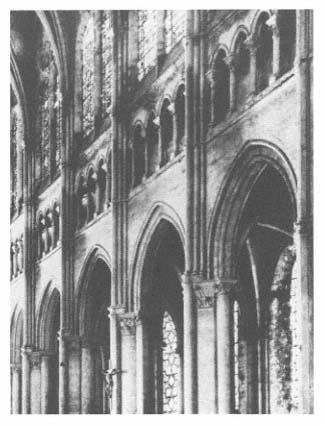
25
"Bay after bay, chapel after chapel, seemed to stretch across
and hold down and conquer not merely a few yards of soil,
but each successive epoch from which the whole building
had emerged triumphant." (Chartres Cathedral)
And it is, perhaps, the principal admirableness of the Gothic schools of architecture, that . . . out of fragments full of imperfection, and betraying that imperfection in every touch [the architects] indulgently raise up a stately and unaccusable whole.[8]
[Plates 6 and 7]
These "fragments"—like "surprises," "accidents," sudden "changes" and incomplete images, reminiscent of Pater's literary architecture as well as of Hopkins's Denbigh Hill—do not violate "unity," but rather assume an importance of their own such that Ruskin singles out for
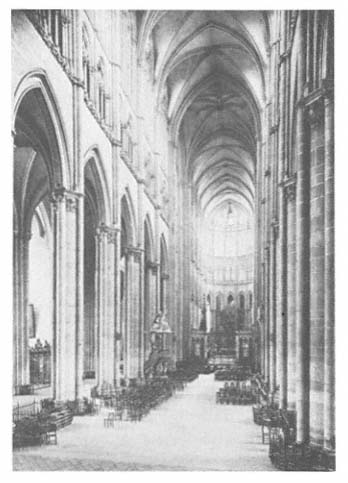
26
Here we see space-time, that is, time as and inseparable from space.
Distance measures, therefore, both time and space intervals at once;
it clearly requires two (di ) positions in space-time—where we stand
as viewers and where we look to ( di indicating subject and object
distinction). If we look down the center, we are actually looking
through—per-ceiving —space-time which we can only see in the
context of the surrounding or enclosing structure. Space-time throws
into relief the human scale: notice the chairs. (Notre-Dame d'Amiens)
description and analysis partial views and "pieces" of buildings. [Plate 3] In this, Ruskin, like Proust after him, breaks from traditional architectural concerns with the orders and unities, shifting his attention to qualities of craftsmanship and problems of truthfulness, of novelty, of accumulation of details. It seems a misreading of Proust to search for and describe a unity which reconciles opposites and neutralizes tension between discrete parts; for Proust's literary debt, in this instance, is to a man who does not value conventional wholes. Ruskin describes the changeful variety of Gothic architecture:
Undefined in its slope of roof, height of shaft, breadth of arch, or disposition of ground plan, it can shrink into a turret, expand into a hall, coil into a staircase, or spring into a spire, with undegraded grace and unexhausted energy; and whenever it finds occasion for change in its form or purpose, it submits to it without the slightest sense of loss either to its unity or majesty,—subtle and flexible like a fiery serpent, but ever attentive to the voice of the charmer.[9]
[Plate 27]
Daring interruptions of the formal plan would rather give additional interest to symmetry than injure it. Proust's cathedral Saint-Hilaire, partly in homage to Ruskin, likewise preserves what is broken and discontinuous. The "communication" which takes place between the separate naves and bays of Saint-Hilaire, like that communication between narrative incidents and characters in A la recherche , depends upon discontinuity, the gap or space between, which may receive or transport a charge, what Puskin calls tension: that communication is again at the basis of Ruskin's concept of the Gothic.
In Gothic vaults and traceries there is a stiffness analogous to that of the bones of a limb, or fibres of a tree; an elastic
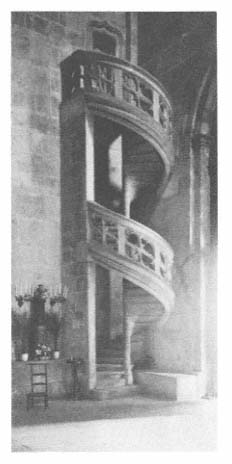
27
The splendor of Gothic architecture: the
elasticity of architectural form and structure
discovers an equivalence in style and structure
of literary architecture. (Church at Autun)
tension and communication of force from part to part, and also a studious expression of this throughout every visible line of the building.[10]
[See Plates 22 and 28]
Proust's critics Poulet and Macksey seem to ignore the important shifts in late nineteenth-century architectural tastes and the possible relationship between these shifts and Proust's self-conscious architectural analogue for literature. Poulet and Macksey argue that the steeple of Saint-Hilaire symbolizes the unity and connectedness of A la recherche because the steeple offers a view which connects fragments of countryside. Macksey writes:
This new law of temporal perspective was beautifully perceived by Georges Poulet in the emblem which crowns Combray, the spire of Saint-Hilaire. From the vantage of this point surmounting the work of centuries, the opposition of the mutually exclusive ways of Méséglise and Guermantes was resolved, the arch was closed.[11]
Poulet and Macksey furthermore overlook the explicit inadequacy of this view from the tower. While, it is true, the tower enables such an overview, it does so at the expense of a ground view—its enlargement or grounded extension—which is also necessary. The Curé of Saint-Hilaire points this out: from the steeple
you can see at the same time places which you are in the habit of seeing one without the other . . . from the top of Saint-Hilaire . . . the whole countryside is spread out before you like a map. Only, you cannot make out the water; you would say that there were great rifts in the town, slicing it up so neatly that it looks like a loaf of bread which still holds together after it has been cut up. To get it all quite perfect you would have to be in both places at once; up here on the top of Saint-Hilaire and down there at Jouy-le-Vicomte.
(I, 81)
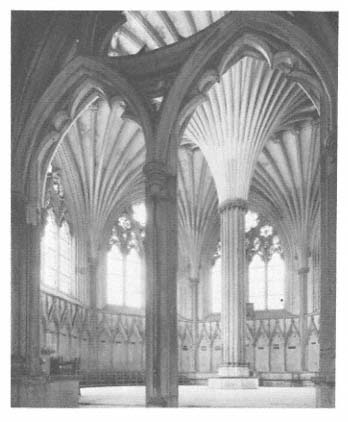
28
Gothic architecture organic: "bones of a limb, fibres of a tree."
(Wells Cathedral)
Poulet's and Macksey's concept of unity, in other words, violates the di-stance , that is, the space, hence time, of the novel. More crucial yet, it is the distance and the discontinuity of a ground view—the Martinville towers—which stimulated Marcel's first attempt at art, at discovering truths behind the appearances of things. Marcel's Saint-Hilaire, as "Time incarnate," spans epochs and ways, traverses them, crosses space, much as the narrative I spans and links the episodes of A la recherche , connecting characters in space-time while surprising the reader with accidents and changes. Marcel's A la recherche , his book as cathedral, carefully presents his "conception of truths" carved within the temple, truths which, "it is true, were very small but situated after off and each of them a world in itself" (II, 1118).