
Chapter One
Subvert the Dominant Paradigm
War has become a constant presence in our everyday lives, whether through telecasting of ethnic cleansings in Cambodia or Bosnia or Rwanda, or through experience of militarization. We may seem further away from nuclear night than we were as recently as 1989, but smaller-scale widespread explosions of violence force us to ask just why it is that communities that were living together in "peace" suddenly turn to killing each other. The causes of war must be explored; surely war is not inevitable; it is only made to seem that way.
Two Paradigms
A bumper sticker on the car in front of me reads Subvert the Dominant Paradigm. My mind wanders from the "Morning Edition" broadcast story about Serbian aggressions in Gorazde to the two dominant paradigms I study: war and gender.
War is conventionally defined as organized armed conflict among states, that is, among political entities having or aspiring to have a monopoly on armed force within their territory. The goal of war is definitive resolution—victory. Even when such a resolution is not reached, and it rarely is, it is often said to be reached. Victory is declared; fighting ceases. The war is over. Therefore, the new state must be one of peace. During peace, society no longer needs to be divided between spaces where certain tasks are performed by men
and other tasks are performed by women. Previously, this sex segregation was so accepted that few questioned what the philosopher J. Glenn Gray calls the "artificial separation of the sexes or, at best, a maldistribution" (Gray 1970, 62).
Unlike convents and monasteries, as well as boys' and girls' schools, the front and home front have not usually been analyzed as gendered spaces. Until recently these emergency, gender-specific spaces have not been so different from peacetime, patriarchal arrangements. Women occupied spaces that had little if any direct access to the spaces of power that the men in general occupied. In the Arab world this absence was marked by such words as "veil" and "harem." In the West the absence had to be uncovered. As David Harvey writes, space allocation constructs power and privilege, because "the assignment of place within a sociospatial structure indicates distinctive roles, capacities for action, and access to power within the social order."[1] The inequities built into military space are grounded in the fact that where women are not, is the space of privilege.
Like war and peace, gender is thought of in binary terms that are said to be natural. But gender, far from being natural, is a cultural code that describes, prescribes, and thus shapes social expectations for sexed bodies: men and women grow up differently and most act in ways consonant with their culture's prevalent images and values. The literary critic Eve Sedgwick defines gender as the "dichotomized social production and reproduction of male and female identities and behaviors . . . in a culture for which 'male/female' functions as a primary and perhaps model binarism affecting the structure and meaning of many, many other binarisms . . . the meaning of gender is seen as culturally mutable and variable, highly relational . . . and inextricable from a history of power differentials between genders" (Sedgwick 1990, 27–28). Gender is constructed in a discourse that the psychologist Carol Cohn describes as being "not only about words or language but about a system of meanings, of ways of thinking, images and words that first shape how we experience, understand, and represent ourselves as men and women, but that also do more than that; they shape many other aspects of our lives and culture. In this symbolic system, human
characteristics are dichotomized" (Cohn 1993, 228–29). Thus, our images come to polarize both war and gender. If war and gender so powerfully organize the world dyadically, their reconception and rearticulation may become the instrument for recreating that world.
I am interested in the blurring of binaries in contemporary wars. I am also concerned with the ways in which people who have lived through wars tell their stories, because stories influence how the next wars will be fought—and then told. Until quite recently, most wars were recounted within a narrative frame that the British military historian John Keegan argues has remained essentially unchanged since Thucydides. This frame I call the War Story with thanks to Tim O'Brien for drawing our attention to the problem of war story telling, and for his passionate plea to believe the "crazy stuff" and to resign ourselves to the fact that "in a true war story nothing is ever absolutely true" (O'Brien 1990, 79, 88).
The War Story gives order to wars that are generally experienced as confusion. It justifies not changing the rules, laws, and strategies of engagement, despite the fact that as a German commander once declared: "Every scheme, every pattern is wrong. No two situations are identical. That is why the study of military history can be extremely dangerous" (Dyson 1985, 153). Put otherwise, that is why writing the War Story can be extremely dangerous. Nevertheless, military historians force a grid on the anarchy; they arrange experience and actors into neat pairs: beginning and ending; foe and friend; aggression and defense; war and peace; front and home; combatant and civilian. Emphasizing that such splits occur, they explain women's need for protection as the reason men must fight. The War Story reinforces mythic wartime roles. It revives outworn essentialist clichés of men's aggressivity and women's pacifism. It divides the world between the politikon , where men play "political" roles, including the warrior as homo furens , whom Glenn Gray describes as being a subspecies of H. sapiens (Gray 1970, 27), and the oikon , where women are lovers or mothers, the latter category including the Mater Dolorosa (the weeping madonna), the Patriotic Mother (the ever-ready womb for war), the Spartan Mother (the jingoistic mother who prefers her sons dead to defeated). The War
Story proclaims that this sex segregation is justified for biological reasons: the men are strong, therefore they must protect the women who are weak.[2] It is written in their genes that men shall be active and women passive.
How to Tell the War Story
War is messy but until recently it was not told that way. Men have generally turned their messy war experiences into coherent stories, poems, memoirs, films, and photograph albums and even into official records. The dichotomies of the War Story organize the confusion so that aggression should not be confused with defense, victory with defeat, civilian with combatant, home with front, women's work with men's work.
Lebanon's ordeal between 1975 and 1992 offers a telling example of this ordering and dichotomization. I went to Lebanon in 1980 to interview women who were writing fiction on the civil war that had raged in the eastern Mediterranean for five years. I was surprised to find that literary activity was intense, that the war had inspired many to write and paint. Women and men were churning out novels, short stories, and poetry. The women's descriptions of the war seemed to preclude the possibility of arranging the chaos into a coherent narrative, whereas most men's war stories lined up oppositions. It was my comparative analysis of women's and men's differing senses of responsibility during the war that gave me a clue as to how the War Story grid remains even in the most intractable chaos.
By acknowledging chaos, the women presented the situation as out of control and urged each individual to assume responsibility for ending the war. Responsibility in the women's writings entailed duties toward others, duties that had to be fulfilled so that the war might stop. In the men's writings, responsibility adhered to a notion of rights: protagonists protected what was theirs against others. After disavowing chaos, the men transformed it into the clarity of friend and foe (Cooke 1988).
It was only years after the writing of War's Other Voices , my analysis of the war writings, that I was to realize that the most
enlightening example of how to tell the Lebanese War Story might be through photographs. In 1980 and then again in 1982, I had noticed war albums with their full-page pictures of blood and guts in Beirut living rooms. I assumed that this phenomenon was peculiar to Lebanon, and beyond a cursory glance at the mostly gruesome contents I paid them little attention.
When I traveled to Croatia in the late summer of 1993 I began to suspect that this expensive packaging and marketing of war images might be more pervasive than I had thought. While in Zagreb, I bought Zoran Jovicic's War Crimes Committed by the Yugoslav Army 1991–1992 . This oversized photo-illustrated book with its text in Croatian, English, and German was published in 1992 by the Croatian Information Centre. Although more sober than its Lebanese counterparts, this book too was a handsome production with many stunning photographs. Further, Jovicic or his publishers added a titillating detail: the last four pages were sealed with a piece of red tape. Like Madonna's presentation of her autobiography, this book was not accessible to the casual browser but had to be bought to be seen in whole.[3] I went straight to this section whose cover page carried the following message in three languages: "WARNING. The sealed pages contain some of many available photos depicting brutal murders and massacres committed by the YU-Army and Serbian irregular units against the civilian population in Croatia during the years of 1991 and 1992." To my relief, but also I must confess somewhat to my disappointment, the pictures were not as grim as I expected; I had seen worse in the uncensored Lebanese versions (among them, color photos).[4] Why did the publisher use the red tape trick here? Clearly, it made people buy the book and not just skim the pages in the store. Beyond the mercenary motive was a stated moral purpose: "This book has been outlined to identify the crimes committed by the YU-Army" (Jovicic 1992, 95). Jovicic and his team of twenty-two photographers assumed the role of detectives and lawyers for the prosecution. Jovicic sent me back to the Lebanese war albums. Maybe they, too, were not just examples of macabre commercialism.
The most popular of the Lebanese albums was Harb Lubnan (Lebanon's war), which came out in 1977 and was reprinted in
1980. Other than a two-page introduction and a war chronology, it had no written text—160 pages of photographs with as many as four per page. For the first time, I read the introduction. It was signed "The Publisher," but I could not tell whether this person was Layla Badi' 'Itani, who prepared the volume, or the photographer, 'Abd al-Razzaq al-Sayyid, or the editor, Sami Dhabyan, or someone else in the Dar al-Masira publishing house. Unlike the Croatian volume, Harb Lubnan did not set itself the task of identifying the enemy, although the format and nature of the subjects photographed suggested sympathies. Its avowed intent was to chronicle the war truthfully: "This is exactly what happened. Here it is between the two covers of a book. . . . Photo after photo out of which pour blood, stream rockets, burst shrapnel. A torn out eye, a cut off hand, a burned cadaver, a skinned body may slap you in the face. . . . Here is the nation, Lebanon, which they [this "they," I emphasize, indicating the enemy, whoever that might be] crucified for two years. We present it in pictures, events and documents. . . . We wanted to touch its wounds and then to bring them together in ink on paper because we do not want the tragedy to happen again. . . . We are less interested in whether this war was a victory or a defeat than we are in bringing it into your house, your office, into every corner of your house. . . . May it be a war on war itself and on you if you were one of its instigators, one of those who lit its fire or poured oil on it or failed to put it out. . . . This war might have been noble had the many revolutionaries and fighters not been joined by thieves and criminals, killers, drunks and ignoramuses. . . . [a paragraph later:] The war has ended." The writer urges the reader to look to the present and the future which must guarantee four aims: that Lebanon remain independent and united; that it be part of a pan-Arab ethos; that it no longer remain indifferent to Israel but confront its territorial ambitions in Lebanon; that it function in terms of its newly awakened consciousness.
What are we to make of such an introduction? It establishes the project as moral: this photojournal is supposed to make us experience the war and its horrors so as to assume responsibility for ending the war. But then, oddly, it announces that the war is over. Now it is time to build the future and this book plays a role in
constructing this future. The very last sentence declares: "Our ambition is that you should read with us the brilliant future in the pictures, documents, and events" (my emphasis). Everything about the book says that it is time to rebuild, although from the perspective of 1994 we know that the seventeen-year war was in its second year only.[5] But what this album does is not re -build, but simply build. The author has used fragments of the Lebanese civil war to build the Lebanese War Story. The volume is a concrete example of how the confusion of war can be streamlined into the black and white certainties of a binary narrative.
Let us look at the way in which Harb Lubnan uses photographs and their captions to set up a binary structure. The pairs at issue are war and peace, and men's and women's spaces. The gendering of space points to another dichotomy, that of combatant versus civilian. We begin with war and peace. How does this volume frame the action? The covers are a good place to start. The front image represents the war front in medias res: burned-out buildings and bullet-pocked walls, sandbags, young men in khaki—two in helmets—alert with their Kalashnikov rifles at the ready, no women, in fact no sign of civilian life (Fig. 1; see the section of illustrations that follows p. 43). The back photograph is quite different (Fig. 2). It suggests that the war is over. We surmise this because the young men are sprawled over a tank, they are smiling and chatting, some have even returned to civvies. These masculine soldiers will protect us; they are in charge. We know this because although they are at ease, their tank's phallic gun thrusts out aggressively from the epicenter of the image; it fills the vision; it is pointed at us, between the eyes, so much so that it blocks out part of the image, including the head of one of the "soldiers." He sits on the shaft of the gun; opposite and facing him is a very relaxed man. The homoerotics of the scene are unmistakable. In this space of men and victory, men can with impunity love each other both emotionally and physically. On the right edge of the frame we see the peaceful background, absent from the rest of the volume, and we note unharmed residential buildings with hints of the cheerful orange awnings and a cedarlike tree. This tree serves two functions: it represents the return of life, but above all, the cedar is the tree of Lebanon. Its
presence in this photograph suggests that the good guys have won. These cover images are the most important in the entire book because they are there on the coffee table, next to the afternoon teacup and the preprandial snacks. Family members and their guests can linger over two moments: the middle and the end of the war.
But what about the photographs inside? The images with their captions inside fill out the message of the covers: they move from being at war to beginning peace. They trace the progression of the war from its onset on 13 April 1975 when members of a fascist militia, called the Phalangists, shot up a bus of Palestinians in 'Ayn al-Rummana, a neighborhood in Beirut (Fig. 3), to its "end" on 1 May 1977. This ending is anticipated by some boiler-plate images and captions. First, "The al-Hoss government has dealt [note the past tense] with many problems that were a legacy of the war" (141)—so, the war is dead and the inheritance is being disposed of. Next, we see a bulldozer mopping up (Fig. 4). It is the beginning of a new day: "They [this 'they' is never specified, but at this late stage of the volume 'they' are always confident, relaxed young men in some military context] came with the dawn to make fast the peace of Rada' [prevention forces]—peace by force" (141; Fig. 5). "They" enter the city—I say "enter" because, presumably, we are in the city and they are approaching us; they are friendly and relaxed. Next, we recognize another take of the scene on the back cover. This image, however, is much less aggressive: the gun is smaller in the picture and off to the right, it is still pointed toward us but not at our eyes, there are more civilians hanging around—a man with a camera and some Roman ruins to balance the residence on the right—and in this case there is a caption: "They arrived—and the cannons were silent. A smile . . . a cannon" (141; Figs. 6 and 7). In other words, we are friendly, but don't mess with us! Clean-up operations in the devastated city are underway.
The absolute end is conclusively established with four photographs on unnumbered pages, as though they were outside the war that the book has been presenting. The first shows a leader—Kamal Jumblat—lying in state; the caption does not say who he is or that he was assassinated, only that "he lies on the bed of death between
his two companions in life and death" (Fig. 8). The next shows the fortieth-day remembrance of Jumblat's death being observed, we are told, by 150,000 citizens and, as we can see, by "soldiers" lined up in organized rows; this picture seems to hark back to much earlier pictures of marching and victorious soldiers (15, 105), but these men look more disciplined (Fig. 9). The third photo assures us that things are moving in the right direction: a meeting of politicians in earnest and friendly conversation—the caption announces: "Before beginning to govern, President Elias Sarkis conducted consultations and initiated contacts," followed by names that include the Palestine Liberation Organization leader Yasser Arafat and the commander of the Syrian Air Force (Fig. 10). Thus, we get the impression that all the warring parties are represented here and that they are in agreement. Fourth, a group of civilians—marked by the fact that there are young women among them—meet at the Mathaf (museum) traffic circle (Fig. 11). After the Lebanese capital was divided in the mid-1970s, this Mathaf was one of the most dangerous crossing points from East to West Beirut. This last picture is the most reassuring: if it is safe enough for women to be at the Mathaf then the city will not continue to be divided for long. More than any other image, this one convinces us that peace is at hand.
The photographs create a sense that this was a war like many before it. It could even turn out to have been a good war. As we were told in the introduction, "This war might have been noble had the many revolutionaries and fighters not been joined by thieves and criminals, killers, drunks, and ignoramuses." We leaf through images of war made familiar by the plethora of World War II representations: crowds running, demonstrating, buying bread, setting up temporary shops in the streets, dragging the wounded out of sniper shot; refugees leaving town; bad guys gleefully celebrating with champagne (Fig. 12). We see gutted buildings, exploded cars, streets littered with military debris ("The Game of Death," 35) and the charred (120, a color photo), bloated, or crushed remains of "collateral damage" that are sometimes so mangled that a superposed arrow must point them out (48–49; Fig. 13). We see armored cars carrying "troops" (19) who are never referred to as
the militiamen or thugs they actually were; we watch children playing on piles of sandbags. Interspersed among these images of violence are the calm takes of politicians huddled around conference tables. The captions are laconic, for example, "A meeting to find a solution" followed by the list of those in attendance (65). Clearly, these men are the ones who are waging war and deploying troops. They know what is going on. Others know that they know and that is why they still trust them [whoever they might be], even if "they" are not always willing to help. In a series of four photographs (Figs. 14–17), a father of five is pictured on his way to parliament to register a complaint about his children's hunger, but "the policeman's and the deputies' hearts are hard" (74–75). Had they not been hard, the images and the captions seem to say, they could have done something.
The images tell the story of a war that separated the men from the women and by extension the combatants from the civilians. Although early on we are allowed to see women soldiers (15), soon women disappear from photographs depicting anything that might be construed to be the front. A bizarre exception is the image of an image of a woman: after a shoot-out in the Basta market all we can see are scattered fruits and above them a billboard depicting a woman in a slip; the banner running behind her says: "When love collapses and marriage fails, what is the fate of the divorced, wronged woman?" (88; Fig. 18). This poster reminds the men that this is a time to reassess past behavior and to make sure that women are not wronged but defended. Early in the book, and therefore in the war as presented in this album, a woman has lost her husband and her desperate search announces that "the war entered every house" (24; Fig. 19). At rare intervals we see women weeping, in this case within the cramped space of a simple home (39; Fig. 20). Children—quintessential noncombatants—are pictured lost in the ruined streets-become-war front (Fig. 21). Their jarring presence reminds us of the inevitable transgression of segregation that they thereby serve to reinforce. The ironic caption reads: "Childhood survives to carry the future" (38). There are occasional images of women defending and preserving, an apparent role reversal that endangers the home/front binary. In two juxtaposed images (Figs.
22–23) a very young father and a mother are holding an infant. The first image suggests domesticity: the father stands quietly by a wall, looking toward what we assume to be his home. He seems contented as he holds the baby, its bottle, and its pillow; the caption reads: "War births: they are trying to escape to peace. He carried him in the first stage." When a father can hold his baby at home, all must be well abroad. The second image suggests present danger: the mother is rushing along a street, the baby tightly clasped to her bosom: "And his mother carried him in the difficult stage" (81). The caption announces that she is the one who really protects the weak. But another interpretation of this second image is that when there was danger in the streets, the men were out there protecting the women who were protecting the children. That is, the subtext reinforces the reassuring binaries of the War Story. In this self-contained narrative of a war that is told as finished, possibly won, Beirut appears to be clearly divided between home and front, between combatants and civilians, between men's action and women's reaction.
The cause of the war becomes clear: identity. With a cause to defend, combatants line up on opposing sides. Several images of corpses carry captions that explain the cause of death as being related to their identity but without elaboration: "Streets of corpses. Massacring identity" (31) and "Tragedy. They kidnapped them and killed them. Because of their identity" (93). The captions, and not the photographs alone, confirm that the war was about the politics of identity. Further, the pictures of desecrated sanctuaries (28; Fig. 24) and religious leaders remind the reader that yes, the identity in question is religious and the enemy is the religious other who kills our god in the name of his.
The book aims to persuade us that this chronicle of the war is true, total, and unbiased. Again, the introduction claims: "This is exactly what happened. Here it is between the two covers of a book" (4). Above all, we—unlike those who merely lived through the war but were not privileged to share this ubiquitous vision—are allowed the photographer's special access: we are made privy to the most inaccessible meetings; we get the impression that we have seen all parties to the conflict. We have even been up on the roof and in
hideaways with the snipers (18, 77, 97; Fig. 25). Crucially, we have also seen one of them shot down, stripped of his threat, of his clothes, and of his gender, for had the caption not said that this was "The Holiday Inn sniper [masculine] who fell naked from the twenty-second floor" (107; Fig. 26), we would not know if this were a man or a woman. Indeed, the latter seems more likely because with the underwear yanked down and the beaten up body this image suggests a victim of rape.[6] Feminizing the sniper is consonant with the book's principal aim, which is to turn the chaos of the civil war into the militarized order of the War Story. For whereas the militiamen could be and indeed were represented as soldiers, the Lebanese sniper cannot be glorified. His job is to be alone, not to cohere with the group. The sniper is the quintessential symbol of anarchy, for his assignment is not to kill the enemy but rather to sow terror by hitting precisely those whom the military men are supposed to be protecting. The military men have to get rid of this loose cannon who detracts from the justness of the fight. Best of all, he should be shown to be different from them, should be humiliated, and what could be more humiliating than to look like a woman? (Jeffords 1989, 171–75). The photographer was there when this particular monster was killed, he witnessed the feminization, took the picture from close up, he was standing right above the body. He was participating in eliminating such undesirable elements. He is masculinized in this act of witnessing and feminizing, and so are we. It is this masculinization that is the sine qua non of victory, as we saw on the back cover.
We are given further assurance that we have been where few others dared to tread because we see those who are supposed to be managing the violence—journalists, through camera control, and politicians, who have otherwise been shown in consultation that promises resolution—out of control, running, ducking and "jumping" in fear for their lives (138, 139). The photographer, 'Abd al-Razzaq al-Sayyid, is in greater control of the violence than are the politicians; he was able to get a steady shot of the jumping deputies (Fig. 27)! He is braver than the other photographers who are cowering, feminized by their fear. The caption reads: "The photographers and journalists were there. . . . But!" The heavy
sarcasm seems unwarranted when we think a bit about the angle of his camera; is he not lower than the woman whose frightened face he shoots? So maybe he was a little scared, but that is less important than the fact that our photographer is always there at the right moment (Fig. 28): a man is kidnapped on his return from shopping, and al-Sayyid catches the moment of shock that we later revisit (65). Two photos of planes: in one, it has just landed with its cargo of flour; in the next, the charred remains are recorded still smoking (119).
We are not restricted to painful emotions, we can also appreciate the moments of irony that wars produce. Sometimes we shake our heads in disbelief, as when a bulldozer is pictured trying to conquer a mountain of rubble (69; Fig. 29). At other times we are moved, as by the photograph of a corpse lying behind the wheels of an abandoned United Nations car (Fig. 30); the caption reads: "A witness to the massacre in Burj Square" (88). And then we smile in relief with the militiaman who is amusing himself by putting together the scattered limbs of a mannequin (Fig. 31): "In Bab Idris, streets of elegance and beauty. Will she walk through death?"
The sense of having had the experience that we are viewing in stills is enhanced by the inclusion of an unmarked section of fifteen full-page color glossies without captions. This section, entitled "The Crime: In Color," is introduced by a few lines explaining why color. It is "not a luxury, but rather another way of describing. Colors say what black and white cannot . . . they have ceased to serve as decoration and have become a witness for the prosecution of a crime and of those who committed the crime thinking that they were living a film on a wide screen . . . and in color" (my emphasis). This language is much closer to that used in the Croatian volume that emphasized the ethical aspect of the project. But there is a prurient quality to these brilliant images that, as Sontag writes in her comparison of color with black and white photographs, are more voyeuristic, sentimental even because they are so crudely lifelike (Sontag 1977, 114).
We are so much there with al-Sayyid that we witness a man's shooting and the ensuing suffering (Fig. 32): "One of the Irtibat armed elements in Shiyah was hit by a sniper's bullet. 3 June 1975."
This series compels us to share al-Sayyid's choices: to intervene or to record? To save a life or capture a death? Here the choice is dragged out over several images—three shots of a man asking for help (30). If al-Sayyid found three photos good enough for inclusion in this book, how many were there on the contact sheet from which he chose? Did it ever occur to al-Sayyid that he might choose between intervening and recording? Was he, and are we with him, inured to the victim's pain and terrible need so that we can overlook, literally, the fact that in the last two images this man is looking straight at him/us, screaming at him/us to do something for God's sake? Neither we nor al-Sayyid are going to do anything, unless it be to get closer for the perfect shot. As Susan Sontag notes, "Photographing is essentially an act of non-intervention. . . . To take a picture is to . . . be in complicity with whatever makes a subject interesting, worth photographing—including, when that is the interest, another person's pain or misfortune" (Sontag 1977, 10, 11). The fact that the man was directly engaging the photographer and begging for his help meant that he was peculiarly photogenic.
For al-Sayyid what mattered was documentation. Here was just another event he was representing. But what of the other event, the one that involved him, the wounded man addressing him and us? More than most of the images in this book, this series alerts us to the role of the photographer in war. He is not a disinterested agent mediating reality, he is using fragments of his individual experience to construct another reality that he projects as objective.[7] These three frozen moments tell us that this book is the sum of an individual's choices. His camera has indeed proven to be what Sontag calls "a sublimation of the gun." He has gained double control over this man's life: the mere act of taking the image is "a sublimated murder—a soft murder" (Sontag 1977, 13); additionally, he has chosen to let him suffer, die if necessary. He has made other choices: of subject matter, of angle, of juxtaposition, and of captioning. Above all, he has chosen to assemble these images in a book that must be read in the order that he adopted. As Walter Benjamin states, such organization of photographs is comparable to what happens in film "where the meaning of each single picture appears to be prescribed by the sequence of all the preceding ones" (Ben-
jamin 1969 [1936], 226). Once the sequence is broken, the meaning assigned by the context is lost or at least deferred until the advent of another organizer, and so on. That is the power and weakness of this democratic technology that allows anyone to subvert a dominant paradigm and then to pastiche together a convincing reality, at least until someone else comes along with a new idea or ideology. Each montage or collage authenticates itself by reference to these transparencies on to reality that in fact relays a fragment of someone else's experience. To paraphrase Sontag, 'Abd al-Razzaq al-Sayyid has explored the war, duplicated aspects of it, fragmented its continuities, and fed "the pieces into an interminable dossier, thereby providing possibilities of control that could not even be dreamed of under the earlier system of recording information: writing" (Sontag 1977, 95, 138). This control has created a visual version of the Lebanese War Story more powerful even than the novels and short stories that some men produced during the early years of the civil war.
Why question the photographer's story? Without the war photographer we would lose compelling evidence to prosecute criminals and also to remind ourselves and the world of what the war had been like. In 1964 Robert Capa reminded us of World War II: a few poignant, clear images, each with its own page of text. Although his project also tidies up the war into the War Story, it does so with less voyeuristic profusion. It does not allow the viewer the filmic sense of having been there. It is the profusion and its arrangement that allow al-Sayyid's fabrication to work so well that we accept that this is the way things happened in Lebanon even though this is not the story that many individuals, and particularly women, told while the war was raging. Photographs are particularly suitable building blocks in the construction of the War Story. Photography and later film allowed noncombatants to observe and witness war in a way that had never before been possible. The evidence provided by still and moving images of death and destruction from what was said to be the front gave the impression of being there. This "witness," you, may not have actually been there, but you feel that you know what it must have been like because you know what it looked like . For those of you who feel
guilty about surviving unharmed physically and also psychologically you can feel partially vindicated. You can appropriate this war as your own, talk about it with the authority of experience, even though what you experienced was a perception of a fragment of what the photographer framed. "War and photography now seem inseparable," writes Sontag. "The feeling of being exempt from calamity stimulates interest in looking at painful pictures, and looking at them suggests and strengthens the feeling that one is exempt. . . . In the real world, something is happening and no one knows what is going to happen. In the image world, it has happened, and it will forever happen in that way. . . . The powers of photography have in effect de-Platonized our understanding of reality, making it less and less plausible to reflect upon our experience according to the distinction between images and things, between copies and originals" (Sontag 1977, 147–48, 158). We have the illusion of having been present at the crucial moments and in the turning-point places.[8] Since we were there, we have a stake in confirming that this war was not fought for nothing. The war may not have deprived us of a loved one, but it did rob us of our innocence. We have interest in its being told as a good war.
Photography throws into relief what happens when war experiences are codified into the War Story. The connection between what actually happened and its documenting is never transparent. Keegan graphically illustrates this point when he writes that the General Staff historian's "mind is made up for him by prevailing staff doctrine about the proper conduct of war and he will accordingly select whatever facts endorse that view, while manhandling those which offer resistance. . . . The rhetoric of [battle history] is so strong, so inflexible and above all so time-hallowed that it exerts virtual powers of dictatorship over the historian's mind" (Keegan 1978, 34–35). In other words, the accounts of war that have come down to us are the products of careful screening by politicians, military historians, creative writers even, all of whom have at least some sense of what it is that they are doing. Although he understands how and why the War Story has remained unchanged for millennia, Keegan is not so much critical as he is impressed by the inspirational value of such stories (Keegan 1978, 20). The War
Story shapes reality as we would like it to be or as the government says it was. That is why the War Story has usually been written very soon after war at a time when, as Elaine Showalter writes, "canon formation has been particularly aggressive . . . when nationalist feeling runs high there is a strong wish to define a tradition" (Showalter 1985b, 11).
The resort to a familiar war narrative and attitude is not restricted to governments and militaries who demand that the war they have just fought be told in a particular way; it is almost a reflex. During the Spanish civil war there was much side-swapping, much confusion, and yet it is now narrated as the romance of right against wrong. As Frederick R. Benson writes, many idealized the war and explained their participation as "a humanitarian desire for a world in which poverty, injustice, and misery might be eliminated." Benson quotes Malraux as believing that the war could restore to the intellectual "his fertility, his fundamental sense of belonging to a definite time, a definite place, and a specific milieu, without which a meaningful life and true understanding of the self, cannot be achieved" (Benson 1967, 7). In Homage to Catalonia George Orwell writes that he was less frightened by the violence of the Spanish civil war than he was by the "immediate reappearance in left-wing circles of the mental atmosphere of the Great War" (Dyson 1985, 129). It made little difference that these two wars were utterly different, the one total and the other civil. To be at war entailed a remembering of what other wars had been so as to understand what was and would be happening and so as to know how to proceed.
Nuclear age wars, however, lend themselves ill to the streamlining of the War Story. The film director Francis Coppola is only one example, if one of the best, of the implementation of a new narrative frame. As he struggled to make sense of the experience of Vietnam, he lit upon the Polish-English Joseph Conrad and followed him—with his camera crew and a reluctant Marlon Brando—into the heart of darkness. It was there that he shot Apocalypse Now . Coppola did not know how otherwise to express the unspeakable that war always is. Wars today increasingly involve combatants and targets rarely officially acknowledged. The stories that today's warriors—many of them women—tell of the
wars they have known stray further and further from the binarized structure of the War Story. Since women are no longer everywhere systematically excluded from the military and war, the War Story will eventually have to take account of them.
Derailing the Paradigms: Women in the Military
In the wake of the Cold War and the triumph in the Persian Gulf, an anti-militarist became president of the United States and commander-in-chief of the armed forces of a country whose military includes some 11 percent women, namely among the highest percentage of women personnel of all NATO countries (Stanley and Segal 1988, 559–85). The U.S. congress voted to eliminate the clause excluding women from combat on ships. Dearly held beliefs about the appropriateness and feasibility of women fighting to defend the country, which they have often mythically represented, began to crumble. Proponents of equal access to all areas of national service, including military, began to argue that it constituted a central tenet of citizenship in a democracy.
What do American advocates for equal opportunity in the military, many of whom are women and feminists, really want? Few are uncompromising pacifists, most are concerned with justice. The historian Joyce Berkman argues that feminists' assessment of the "'justness' of their nation's military action would pretty much shape the position they would take on the war . . . short of countenancing a global war, most European and American women, with countless feminists among them, support a strong national military establishment" (Berkman 1990, 150, 157). A less jingoistic perspective is articulated by the political scientist Kathleen Jones. She encourages women to "demand access to the military only as a means to acquire the power base from which to redefine the range of responsibilities included in the concept of citizenship . . . and to enrich the meaning of citizenship" (Jones 1990, 133). Sheila Tobias is the most instrumental in her argument that women should be allowed to enlist without restriction. War experience, she writes, has been "a convenient stepping stone for politics" (Elshtain and Tobias 1990, 183). Judith Stiehm criticizes anti-militarists in North
America whose "interest too often stops when they are no longer threatened, and U.S. women feel threatened only by nuclear war. A serious and consistent critic [of the military] should analyze the wars fought by surrogates, the consequences of profiting from arms sales, the effects of 'winning' miniature wars" (Stiehm 1988, 105).
Some fear that increasing the number of women in the armed forces may strengthen the military and therefore—perhaps—make the country readier to go to war. They recall military historians like Carl von Clausewitz, Hans Delbrueck, and John Keegan who argue that this readiness for war constitutes a defining characteristic of the state and that citizenship is tied to the obligation to defend one's country. This argument would seem to doom us to wage war ad infinitum and to embrace it if we want to be citizens. What is to be done? Feminists are divided. Some advocate boycotting military service, arguing that war might become less likely if fewer people predicated their lives on its possibility, and if citizenship was not linked to war service. Others believe, however, that unilateral demilitarization is not an answer at a time when increasing numbers of new nations are expanding their militaries with easily procured arsenals of lethal arms. Also, feminist advocates of equal opportunity in the military want citizenship for all in a strong country whose military is rational and democratic, and has a humanitarian commitment to the promotion of freedom and the maintenance of a just peace.[9]
Objection in the United States as elsewhere to women combat soldiers has been vehement.[10] Opponents claim that opening up combat positions for women jeopardizes military effectiveness largely by disrupting men's cohesiveness. Yet combat duty is clearly not for everyone. Some, including men, are just not qualified, and many more may not want to participate. Further, a few women have long been "frontline combatants" without being publicly acknowledged as such. Women have stoked cannons and then stepped aside to make room for the men to fire (Enloe 1983, 123). In short, the War Story has long not been true, its dichotomies never absolute.
Wars today challenge more than ever the conventional binaries and their consequent exclusions that have organized war stories
throughout history. In our Geneva Convention era, international military lawyers are entrusted with the task of establishing a war taxonomy, of determining who is a civilian, where a particular event happened, under what circumstances, and so on, in order to be able to judge the legality of behavior in a war situation. Yet some are beginning to acknowledge that they are not quite sure how to differentiate the space, activities, and actors of war. More and more lawyers are deployed with troops to the war theater. During the Gulf War the U.S. Army brought two hundred of them, and one of the lawyers' tasks was to establish clear categories according to the law of war and to draw up "a target list for the following day and pass it on to the commander." It was they who then had to work out the legalities of hitting a civilian shelter that had been disguised as a bunker.[11] We have at our disposal sophisticated surveillance technology, yet not even those who have been trained to observe and judge the conduct of wars can in the final analysis separate the combatant from the noncombatant, the warring from the peaceful village, and the one who pulls the trigger from the one who stokes the gun or receives the shock of the explosion. In spite of all this, the War Story continues to survive.
Cross-culturally and historically, combat has been reserved for male defenders as that arena in which they could test, prove, and be rewarded for their virility (Stiehm 1983). John Keegan writes of men who regret, even repudiate, machismo yet when the fight is on think it to be necessary. The inclusion in combat of women and also of men who are ambivalent about their sexuality may complicate a mobilization and a cohesion made attractive because of its promise to turn boys into men. How important is male bonding? Can the military's rhetoric about "cohesion, sense of mission, mood of self-sacrifice, local as well as national patriotism . . . self-confiedence and credulity" (Keegan 1978, 277)—along with the hope for immortality that subsumes an individual's death to the group's survival (Gray 1970, 40–47)—motivate large numbers of women and gay men to kill or be killed?
Women's presence in the quintessentially male domain makes several important differences. Stiehm writes that "it alters the military if service is no longer a way to demonstrate manhood. It alters
the assumptions of military incentive systems to have mother-soldiers." It challenges basic beliefs or myths that are "fundamental to the military enterprise: 1) War is manly; 2) Warriors protect; 3) Soldiers are substitutable." She suggests that women who do not understand their own role as protectee will not realize that they are "essential to legitimate violence. The protectee is its justification" (Stiehm 1989, 7, 224, 230). Moreover women's physical presence undermines the unmarked aspects of soldiers' lives. These soldiers are no longer "our boys" whom we are reluctantly but proudly prepared to sacrifice. Rather, they are women and men who are above all parents and spouses who saw in the military a chance for employment and even for social mobility. Several myths and realities of the military are having to give, although, as Stiehm writes, they give less easily in connection with women than they do with men: "accommodations are regularly made for fathers that are not compatible with the myth that every service person is always available for worldwide assignment" (Stiehm 1989, 119). Our "neomercenary military" has brought a new focus to the costs of patriotism. As coverage of the Gulf War demonstrated, the new questions raised by the new face of the military may be responsible for the brevity of the war. Just how long would we be willing to expose mother soldiers to danger when their babies were waiting at home with their perplexed fathers? And as we focus on mother soldiers, father soldiers also demand attention to their needs. At the "Just War—Gulf War" conference at Vanderbilt in January 1992, an officer in the audience challenged a panelist who had argued for the elimination of women from combat positions. After praising women's achievements in the Gulf War and describing his own and fellow father soldiers' pain at parting from their families, he urged us all to remember that the American military is no longer an institution attracting single young men only, it is now made up of families. Thus, these are simultaneously the families that the military is supposed to protect and the families who are supposed to do the protecting. The military is no longer so different from civilian society.
When the military analysts Mady Segal and David Segal were writing in 1983, they noted that public opinion tolerated women
in military roles that had civilian counterparts but that it had "not gone the next step and defined as acceptable women serving in the traditionally male ground combat specialties that do not have counterparts in the civilian labor force. . . . [Yet i]f the military continues to expand women's participation, or even maintains it at present levels, it will in the process be serving as a critical agent for future social change" (Segal and Segal 1983, 255–256). In other words, the military might pioneer social reform, even if such reform originates in what Stiehm calls "coerced behavior changes" (Stiehm 1989, 107). D'Ann Campbell counters that the armed forces since World War II have been more progressive than civilian society. Women officers "were trained for leadership positions and were paid more than an average college-educated woman could earn in the private sector." These women who had done so well in the military were less successful outside: "Putting women in uniform was simply too radical a step for most Americans. A handful of years could not erase deeply ingrained norms and stereotypes" (Elshtain and Tobias 1990, 117, 118). They shared the experience of women fighters in revolutionary situations, like Algeria and Eritrea. For example, Amair Adhana, a former guerrilla fighter in the successful thirty-year struggle of the Eritrean People's Liberation Front against the Soviet-backed dictatorship, told an Economist reporter: "In the field, the men respected us—our brains, our strength. . . . They now respect make-up, nice hair, being a proper housewife." Whereas before 1991 the women fighters were "treated with awe," their attire and demeanor emulated, in 1994 many of the demobbed women were back in their kitchens.[12] and yet enlisted women are different both from the conscripted women and those in revolutions because they are not doing men's work in an emergency. They have chosen and have been chosen to do as a career what has been considered to be a man's job.
The thesis thus far rests on a paradox: feminists advocate the opening up of opportunities for killing to women in the hope that they will choose to exercise their right only when they see no other solution. Such a discourse elides the apparent chasm that divides those who speak about national security from those who speak about citizenship rights. It invests hope in the nightmare of the
military effectiveness mavens: if a government must send women and families to war, it will be more reluctant to fight. It elaborates a link between military and civilian societies so that when the military eliminates discrimination, civilian society will follow suit, that when civilian society criminalizes the killing of civilians, the military will do the same. Having established the link, this discourse then seeks to destroy the link.
Feminist pacifists, like Mary Wollstonecroft, Sara Ruddick, and Klaus Theweleit, might well be skeptical about such a paradoxical discourse, questioning the acceptability of any collaboration with a militarized system. Although they would doubtless affirm the political importance of sexual equality, they would oppose swelling the military ranks with "natural" advocates of nonviolent resolutions to conflict.[13] If aggressivity is learned and women are as prone to violence as men, the ungendering of the makeup of the military may mean that aggressive behavior will spread throughout society. Such fears seem to be justified by blockbuster movies like Aliens whose androgynous female grunts are braver, brawnier, and more brutal than male peers in countering xenomorphs. In his Vietnam novel-memoir The Things They Carried , Tim O'Brien describes how the jungle transformed the proper, middle-class Mary Anne into "part of the land. She was wearing her culottes, her pink sweater, and a necklace of human tongues. She was dangerous. She was ready for the kill" (O'Brien 1990, 125). This might be a description of women in Peru's Shining Path (Sendero luminoso), or, to a lesser extent, of women settlers in the Israeli Occupied Territories. Throughout the period of the rule of the Imam Khomeini, Americans were regaled with media images of chador-swathed women toting Kalashnikovs. The war in Bosnia has provided images of Serb women blocking humanitarian aid to Muslims and Croats, of Croat women who make up 5 percent of their national army and who, like Sanja Arbanas, "feel best when I sleep with a hand grenade," and of Muslim women in the Bosnian army with "head scarves and Kalashnikovs."[14] These women, whom Jean Bethke Elshtain describes as the "Ferocious Few" (Elshtain 1987, 163–80), do not accord well with their traditional images as representatives of a culture and a land to be
protected. Their transformation dramatizes their group's determination to destroy whatever stands in its way. Stiehm believes that the "pictures of women with guns appear when a country is under siege. Their purpose is to mobilize civilians. Their purpose is to demonstrate unified commitment. It is to tell an enemy that it will have to occupy the country and pacify every citizen before it can claim victory. But, perhaps most importantly, it is a way of mobilizing young men . . . few men are able to resist the call to service when women are serving" (Stiehm 1988, 96). These women's pictures are flat embodiments of the desire of their nation. And feminist pacifists do not take such images lightly; they do not dismiss their threat as part of rhetorical hype. They fear that women in combat do not portend a kinder, gentler military but rather that they prefigure the worst that is yet to come.
In response to such a list of fearsome Amazons I would propose another: mother warriors who risk all for their children, real or adopted.[15] Such women fighters have become popular idols of the American screen. This is true of Terminator2 and the Star Wars trilogy, and even of Aliens where the reluctant Sigourney Weaver has to play the part of the ultimate marine, fearlessly diving down deep into the bowels of the space colony to save the little girl she had "adopted" from the monsters. The madres and abuelas for years successfully opposed the military regimes of Chile and Argentina with nothing more than patience and placards. In 1984 the "Mothers of Algiers [women divorced from Algerian men and seeking access to or custody of their children, denied them for many years] marched from Paris to Geneva to present their case to the Commission of Human Rights of the United Nations" (Hélie-Lucas 1993, 56). The Palestinian mothers on the West Bank and in Gaza, Zapatista mothers in Mexico, and the mothers of Soweto have evolved with their children a form of resistance with sticks, stones, and machetes that renders life for the resident oppressor as arduous as possible. In the summer of 1994 Chechnya mothers were televised keeping the Russian army at bay. They scored few victories, but they were a presence.
These activist mothers are committed to a cause but above all they have adopted responsibility for another on behalf of whom they
improvise new forms of resistance and opposition that pay attention to the survival and preservation of the largest number of people possible. Writing of Edna St. Vincent Millay, Susan Schweik says that the "maternal metaphor allowed her to represent women in active political engagement, and to represent active political engagement as womanly—to claim women's right, power, and responsibility to speak of and to act knowingly and protectively in the war effort" (Schweik 1991, 78). These mother warriors have forced themselves on public awareness. They draw attention to themselves and to the roles that they have played in war and in the playing have transformed. Their activism in the "battlefield" contrasts with expectations that they should be passive, or, best of all, absent. They and their counterparts in the military as well as the growing battalions of women reporters in war zones sensitize the world to what happens to women in war. They do so especially in situations when governments sanction rape as a weapon. News from Bosnia of the Serb rape camps raised a furor. Demonstrations worldwide reminded a forgetful world that this is not the first time that women's bodies have been officially and systematically targeted. Even only in the past sixty years the list of mass rapes includes those during the 1930s by Japanese against Chinese women; during World War II by Nazis against Russian and Jewish women, by Soviets against German women, and by Japanese against Korean women (Brown-miller 1975); during the 1960s and 1970s by Americans against Vietnamese women; during the early 1970s by Pakistanis against Bengali women; during the late 1980s by Iraqis against Kurdish women and then Kuwaiti and Palestinian women during the Gulf War.[16] In 1992 alone, rapes by personnel in military organizations were reported from several widely separated locales, all happening simultaneously with the Serb military attacks on Muslim women in Bosnia. Human Rights Watch reported rapes by Peruvian soldiers against more than forty women, by Indian security and militant groups against women in Jammu and Kashmir, by Burmese government troops against Rohingya Muslim women. In each case, the rapes were officially sanctioned as part of a considered attempt to demoralize the people and even to drive them from their homes.[17] These are only the better known cases.
The ungendering of combat further undermines the "normality" of rape in war. Women in combat positions will not rape and they may report those who do. If the International Tribunal at the Hague indicts, tries, and condemns the Serb rapists and their leaders, officially organized and sanctioned rape will be punished as a crime against humanity on a par with Nazi genocide and Japanese war crimes. Will women civilians thus targeted be accorded the rights of combatants?
Many Little War Stories
Never before has the fictionality of the War Story been so obvious. In nuclear age wars the women and the children—whom the War Story had described as at home and safe because defended by their men at the front—are increasingly acknowledged to be attractive military targets. They are not being protected. Their men cannot protect them. This fact has never before been so openly and widely acknowledged as it is now, because war is no longer the province of military historians and national security analysts and advisers, all of them men, but has now become a magnet for humanists, many of them women and feminists.
Less rigidly bound by conventions that confine the understanding of war to extended battle, these cultural analysts of war are revealing connections that may allow for new ways of thinking. For example, the threat of war is in itself a kind of war. It is with hindsight that we can now look back on the Soviet-U.S. standoff and say, yes—I survived the forty-year Cold War! Soon, geologically speaking, the numbers of those who have had that experience, and who know that this war was lived as an uneasy peace, will dwindle. When added to the list of the world's long wars, our forty-year standoff may be remembered as devastating. I am not trying to minimize the very real fear that we all felt as we imagined and campaigned against the nuclear holocaust for which Hiroshima and Nagasaki seemed to be curtain-raisers, but I do want to record a fact that is as true for the Cold War as it is for the hot little wars exploding all over the globe: war behind the front lines, when such lines can be defined, often becomes another normality, a kind of
charged "peace." Except in an idealized Kantian formulation of Perpetual Peace, peace is not the opposite of war but is rather a provisional tolerance of differences, of the conflicts they engender, and of the knowledge that absolute resolution may not be possible.[18] Peace thus construed is linked with war on a continuum of conflict negotiation spanning absolute nonviolence through mayhem. War is not always unspeakable horror. It can be, but it entails more commonly an intensity, a heightened awareness, a massive human displacement, and a preparedness to move from being at peace to being at war.
Can affairs of state function within such ambiguity? When split-second decisions have to be made can notions of continuity, uncertainty, and instability be tolerated? In general, governance and control have required clear-cut categories. Dyson writes that the "public voice of the military establishment cannot be critical of its own purposes. The military machine is designed to carry out the missions which it has established for itself, irrespective of the thoughts and feelings of individual commanders" (Dyson 1985, 8). Clarity is also essential for the public image of the military. Voters demand attention to their welfare and safety. The wise ruler must create the illusion of peace so that war shall always be utterly different.
Women's prominence as guerrilla fighters, as military targets of bombs and rapes, and as subjects of debate about the gendering of the military and of combat has complicated the telling of the War Story. These women are telling their own counternarratives, revealing that what we had thought to be self-evidently true is true only for some, for those for whom this particular truth is useful. This truth is of course the War Story, which is not just a story but a paradigm that lies at the heart of our inability to understand war and to construct a culture of peace, to paraphrase Alexandre Bloch, the director of International P.E.N.[19] Their stories help us see the ways in which war compels men and women to take over unfamiliar roles. For the duration, men and women fill in for one another—military men as medics and secretaries, women in munitions factories. A few male writers like Glenn Gray and Erich Maria Remarque even described men who nurtured and loved each other,
whereas women like Helen Zenna Smith (Not So Quiet . . . 1989 [1930]) showed that the women who volunteered, like the ambulance drivers, became hard and fearless. Performance of new tasks and roles allowed for temporary transgressions of gender-prescribed behavior—women could act like men without losing their femininity, men could act like women without risking the knee-jerk label of "wimp."
Yet in the aftermath of war—and particularly its paradigmatic version, the War Story—this wavering, this gender instability and ambiguity, had to be sanitized. How can we retrieve the detritus? This is the task of the responsible intellectual: to make sure that the binary frame narrative does not predetermine the articulation of the experience. Instead of endlessly repeating tales of roles and experiences in which each war mirrors the experience of its predecessors, war stories should allow for the narration of war's dynamism and incomprehensibility, but also of other aspects usually excluded from the War Story. A vivid example can be found in O'Brien's Vietnam stories where he describes boredom. This less than heroic condition is portrayed as "dripping inside you like a leaky faucet, except it wasn't water, it was a sort of acid, and with each little droplet you'd feel the stuff eating away at important organs." For this man to write the story of his experience in Southeast Asia was not to replicate some outworn formula but rather to interrogate memory, to question what had seemed to be so self-evidently true: "Stories are for joining the past to the future. Stories are for those late hours in the night when you can't remember how you got from where you were to where you are. Stories are for eternity, when memory is erased, when there is nothing to remember except the story. . . . If a story seems moral, do not believe it. If at the end of a war story you feel uplifted, or if you feel that some small bit of rectitude has been salvaged from the larger waste, then you have been made the victim of a very old and terrible lie. . . . By telling stories, you objectify your own experience. You separate it from yourself. You pin down certain truths. You make up others" (O'Brien 1990, 37, 40, 76, 179). These stories are not for others only but mostly for an individual author, and yet in the process they create open areas of access for those
others who have not had the experience that entitles them to tell the War Story. These stories do not silence, because as Tim O'Brien suggests provocatively, "a true war story is never about war" (O'Brien 1990, 91).
Such are the stories that Lebanese, Bosnian, Iraqi, Algerian, and Palestinian women are telling today. These stories offer some understanding and an alternative. They describe an experience of war that all can understand because it does not take place in a special privileged elsewhere but is rather the heightened awareness and management of lethal conflict that is different from ordinary life only in terms of its intensity. What women experience in war repeats in stereo the daily experience of violence that has become ordinary. This telling of the ordinariness of war bypasses the age-old prohibition on women writing about war. In these accounts women are not trespassing on men's space, threatening to deprive them of the glory of having been there where only heroes and martyrs tread. In these stories women assign their own meanings to what they have felt and done. What used to be labeled civilian experience—being bombed, raped, expropriated, and salvaging shreds of living in a refugee camp—some name combat experience. Everyone can have this experience and it is this acknowledgment of universality that is critical in re-imagining a world where conflict is a constant fact of life and survival depends on the ability to confront conflict without the automatic use of violence. We begin to understand women writers who have represented women in Lebanon, Bosnia, and Eritrea not as passive victims but as active survivors and even resisters. We can recognize the parallels between military women in combat and literary women authorizing themselves to name and inscribe women's experiences in war as "war experiences." If women with their different experiences of war write at the time that war is happening, and if they recognize that the collapsing of feeling and language undergirds the silencing and excluding discourse that finds its authentication in the "authority of experience," they may be able to intervene in how the War Story is finally told, and how future wars will be fought and then told. Their iconoclastic stories may make it hard indeed to continue to believe that dulce et decorum est pro patria mori .
Women's counternarratives of war and changes in the gender arrangements of the military allow us to frame new questions that reject either-or explanations. When does a war begin? Does the first shot to be fired launch a war, or do we have to take into account the buildup? When does it end? What are we to make of the negotiations of outcome? If war is not declared, if it is in fact Pure War, how can we "stop something that wasn't a war" (Virilio 1983, 26)? When does a civilian become a warrior? Does being targeted, as in total war, entail such a transformation? Or is there less at stake in defining who is a civilian when men and women can both be combatants?
I am increasingly persuaded that a binary epistemology facilitates the declaration of war and the consequent semiotic transformations; it sanctions what are otherwise considered crimes. To be militarily effective, people must be convinced that what they do in war bears no relation to actions and their meanings elsewhere. They can only be good soldiers if they believe and do not question the fact that war transforms the meaning of actions. For the duration, violence is normalized, even glorified as the experience of the sublime. The Martiniquais revolutionary psychiatrist Frantz Fanon refers to the violence that the Algerians employed in their struggle against the French colonizers as "sacred," and Gray writes of the horro of murder but of the pleasure and glory in heroic killing. Gray concedes that there is a growing problem, because "the warrior who slays an impersonal enemy has traditionally not been regarded as a criminal, a murderer. Yet in the era of total war the distinction becomes ever more blurred. And the dissociation in our lives between soldiering and civilian pursuits grows at the very period when distinguishing between combatants and noncombatants threatens to disappear altogether." Later he writes that this differentiation is essential lest killing be confused with murder. Murderers are criminals, but "killers [i.e., soldiers] come to feel like high priests" (Gray 1970, 33–36, xvi, 131–32, 154). Even a pacifist can say that killing may acquire the aura of sanctity if it happens in the right place. In 1984, the State Department announced that "it will no longer use the word 'killing,' much less 'murder,' in official reports on the status of human rights in allied countries. The
new term is 'unlawful or arbitrary deprivation of life'" (Cohn 1990, 51). Language matters. In women's writings, there is no right place for killing or theft or rape. These women refuse the polarization of space that conceals the fact that the violence of war is not so different from the violence of peace. They reject black and white certainties and thus cast doubt on the validity of semiotic transformations occasioned because of the space and action with which they are attached.
Once we judge what happens in war by the same standards that we invoke to assess equivalent actions and events outside war, we may begin to understand the ways in which violence is so often not only justified but actively pursued. We can begin to think in these new ways because all around us the old structures are cracking. Women are in contemporary wars—whether by fiat of a governing body or because they find themselves in a place that has burst into violence. Women who have experienced this explosion of the normal and who have decided to talk and write about it draw attention to the reality of what women and those like them actually do and endure during war. It is by putting women into the war stories that we can begin to recognize the strangeness of the unchanging metanarrative that the War Story has always been. If we render transparent the process whereby the War Story not only legitimizes but also necessitates what in peacetime is considered criminal behavior, we may make it a little harder for governments and gangs to sally off to war.
Feminist praxis gives individuals the courage to be active witnesses whose words may serve to subvert dominant paradigms. These witnesses are elaborating survival strategies that include the forging of alternative visions and stories. They are voicing dissension from the status quo, they are making visible the linguistic strategies of patriotism and patriarchy, they are examining the role of consciousness and constructing a memory that is responsible to the future.
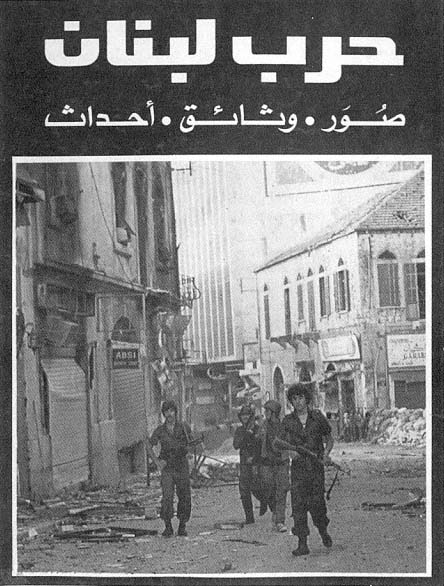
Figure 1.
Front cover of the book Harb Lubnan —Lebanon's War—with title and subtitle.
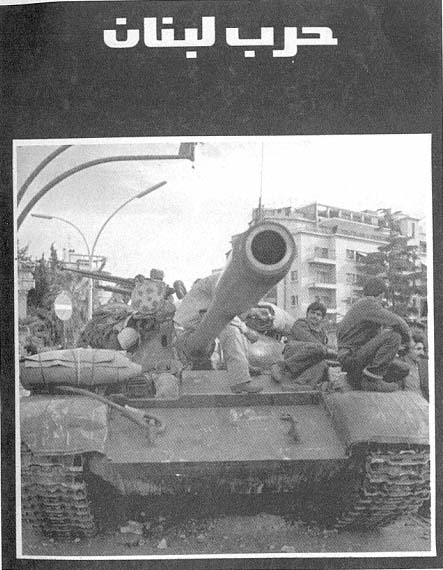
Figure 2.
Back cover of Harb Lubnan , also bearing the title.
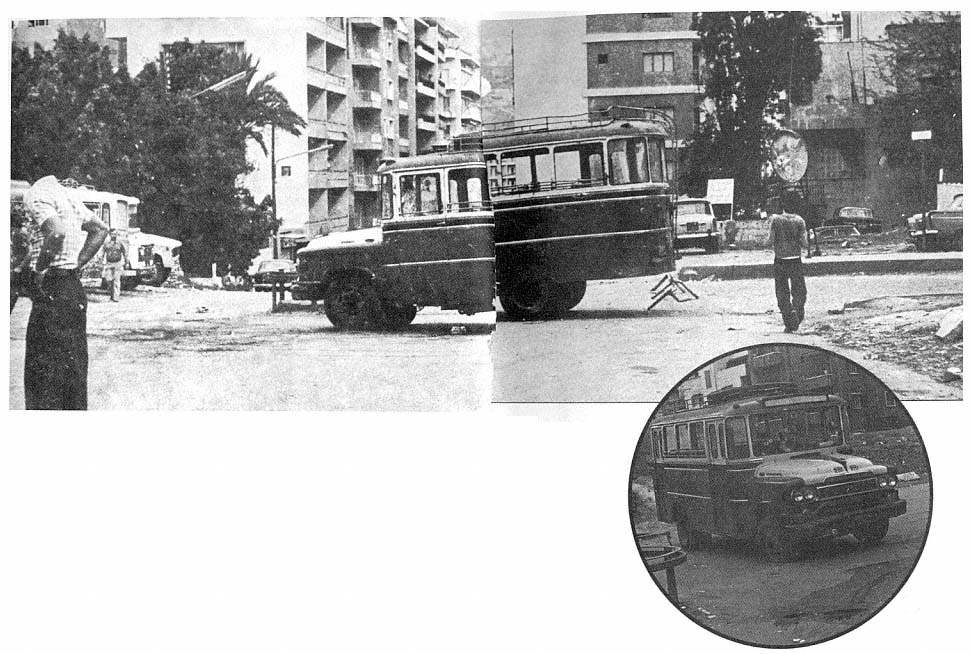
Figure 3. On Sunday afternoon 13 April 1975, the famous 'Ayn al-Rummana bus incident occurred. The beginning of the burning of Lebanon.
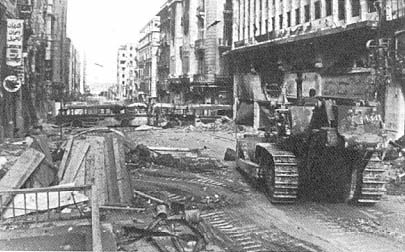
Figure 4.
A workshop: a bulldozer removes the barricade of buses!
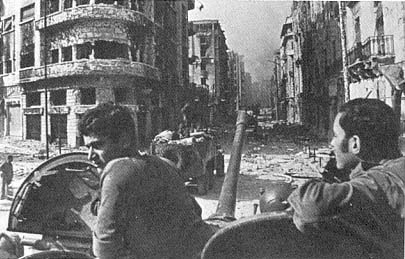
Figure 5.
Al-Rada'—peace by force.
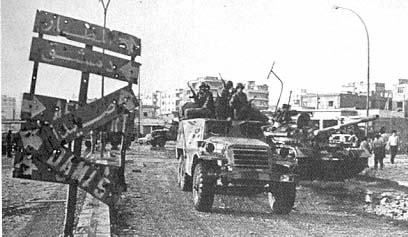
Figure 6.
They arrived, and the cannons were silent.
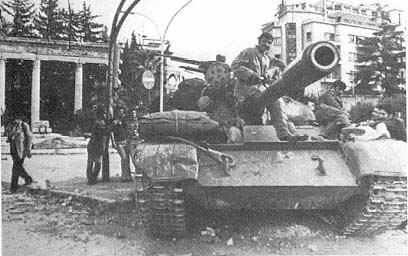
Figure 7.
A smile . . . a cannon.
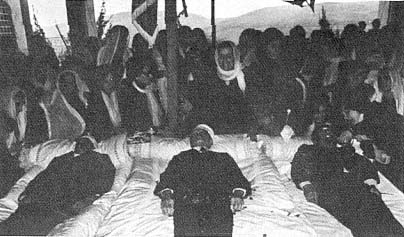
Figure 8.
He lies on the bed of death between his two companions in life and death.
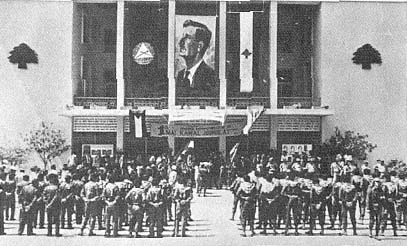
Figure 9.
The parade at UNESCO on 1 May 1977. The forty-day memorial
for the martyr Kamal Jumblat, attended by more than 150,000 citizens.
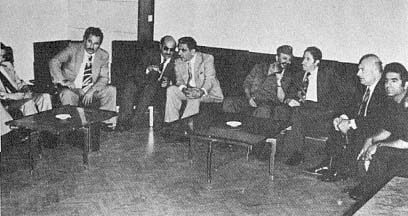
Figure 10.
Before beginning to govern, President Elias Sarkis conducted
consultations and initiated contacts. . . . Here with Lieutenant Colonel
Ahmad al-Hajj, commander of the Internal Security Forces; Colonel
Muhammad al-Khuli; the assistant secretary-general to the Arab League,
Hasan Sabri al-Khuli; Yasser Arafat, president of the Palestinian Liberation
Organization; General Naji Jumayyil, commander of the Syrian Air Force;
Henri Lahhud, governor of the Biqa'.
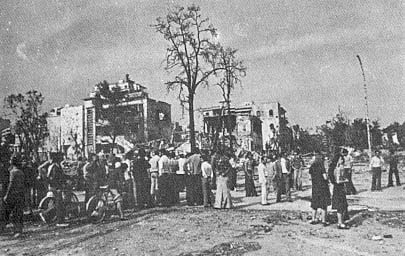
Figure 11.
A meeting at the Mathaf traffic circle.
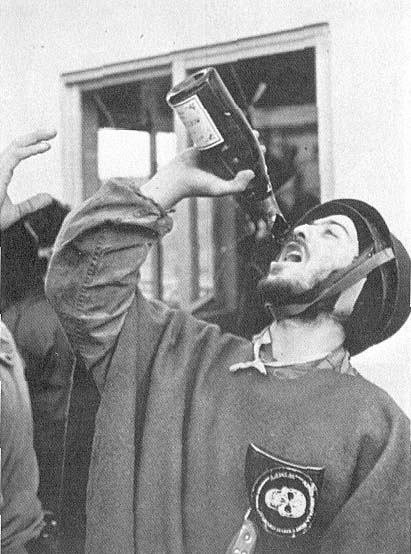
Figure 12.
Uncaptioned photograph—one of sixteen full-page colored
photographs grouped at the end of the book and introduced with a short paragraph
entitled "The Crime: In Color."
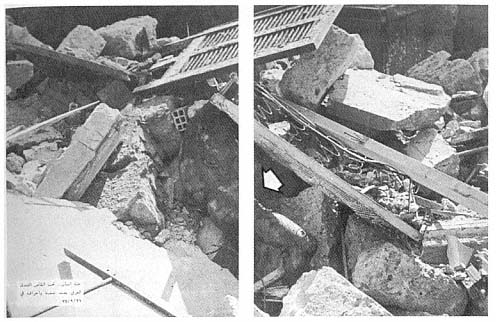
Figure 13.
A human corpse—under the rubble of the Arabi Hotel after it was destroyed and
burned on 21 September 1975.
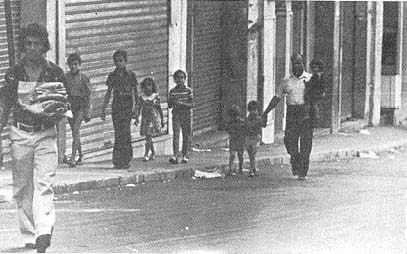
Figure 14.
The children's hunger is stronger than the war.
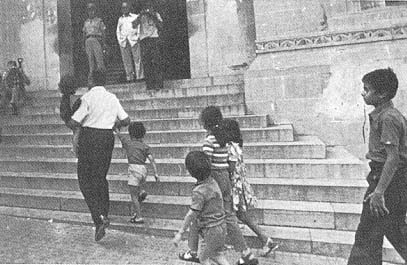
Figure 15.
The father could not feed his family because of the war . . .
so he led them to the parliament (26 October 1975). Full of hope he climbed
the stairs with them.
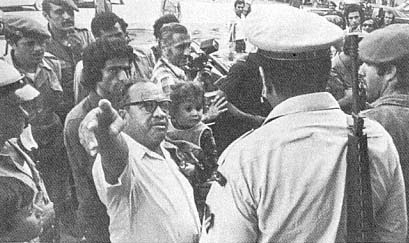
Figure 16.
And the police stopped him—and he tried to convince them of the
children's hunger.
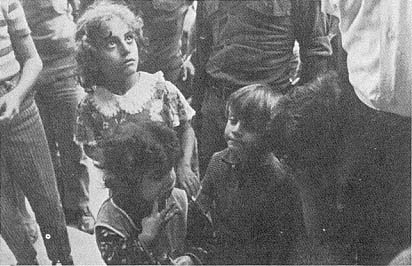
Figure 17.
But the policeman's and the deputies' hearts are hard. They were not
touched by the children and they did not relieve their hunger or stop their tears.
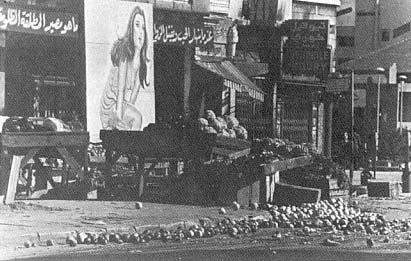
Figure 18
They left everything behind them. . . . Basta [a market
in Beirut], above and below. . . . Apples, beware of the bullets.
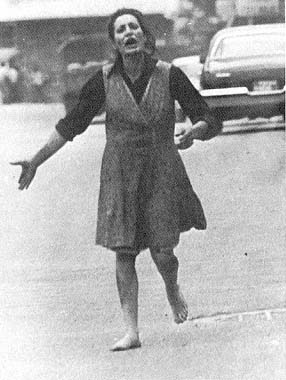
Figure 19.
"He's lost. . . where's my husband?" That is
how the war entered every house!
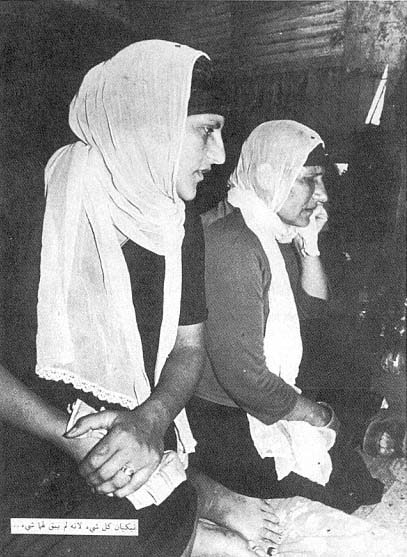
Figure 20.
They weep for everything because they have nothing left.
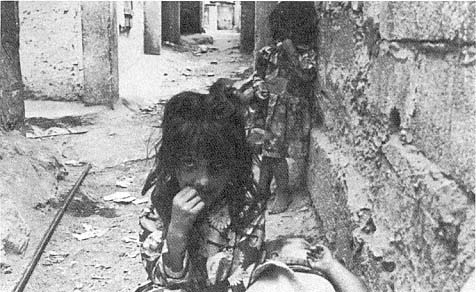
Figure 21.
Childhood survives to carry the future.
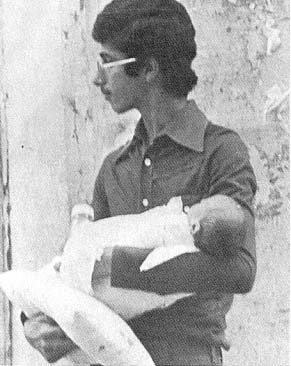
Figure 22.
War births: they are trying to escape to peace.
He carried him in the first stage.
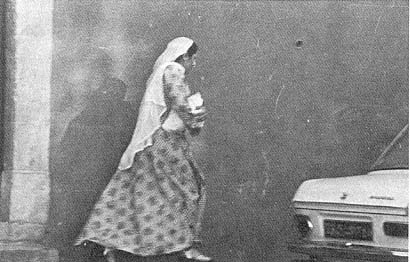
Figure 23.
And his mother carried him in the difficult stage.
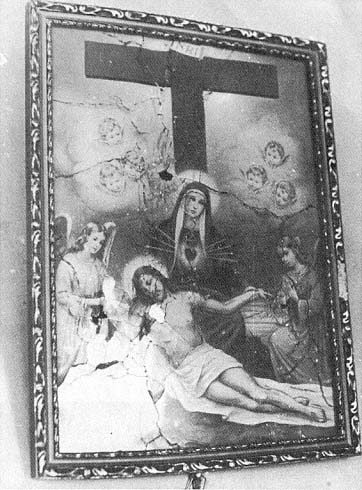
Figure 24.
Uncaptioned full-page image.
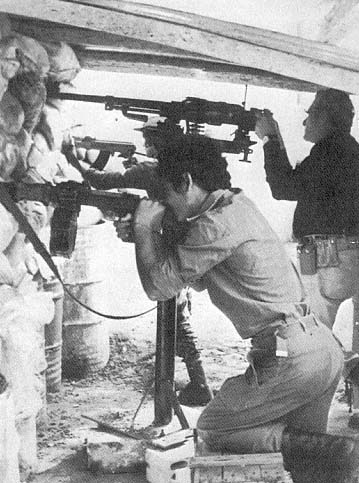
Figure 25.
Uncaptioned full-page image.
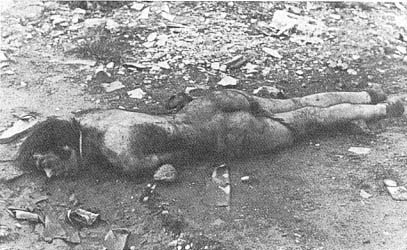
Figure 26.
The Holiday Inn sniper who fell naked from the twenty-second floor.
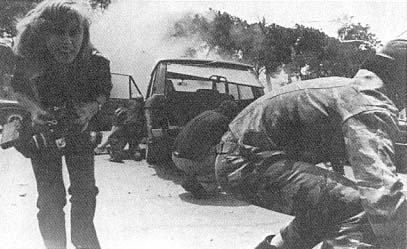
Figure 27.
The photographers and journalists were there. . . . But!
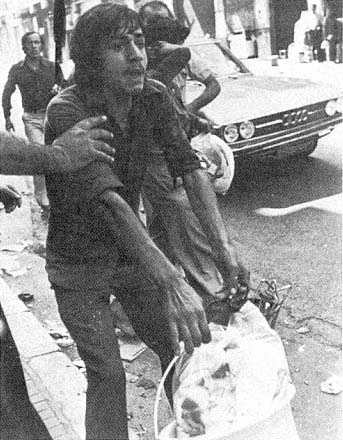
Figure 28.
They grabbed hold of his arms . . . then to the car . . .
perhaps to the earth. The war continues in Beirut.
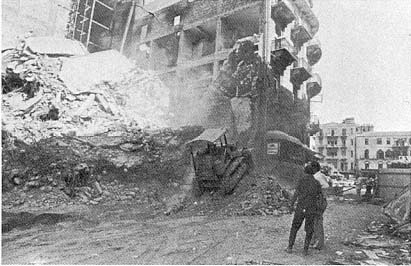
Figure 29.
The bulldozers moved on 15 October 1975 to remove the
rubble of the Arabi Hotel in Martyrs' Square in Beirut, and the dialogue
committee bulldozer removes the barricades in Shiyah.
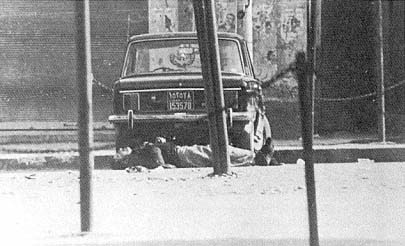
Figure 30.
A witness to the massacre in Burj Square.
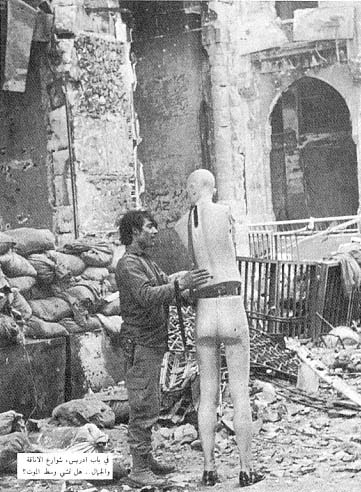
Figure 31.
In Bab Idris, streets of elegance and beauty.
Will she walk through death?
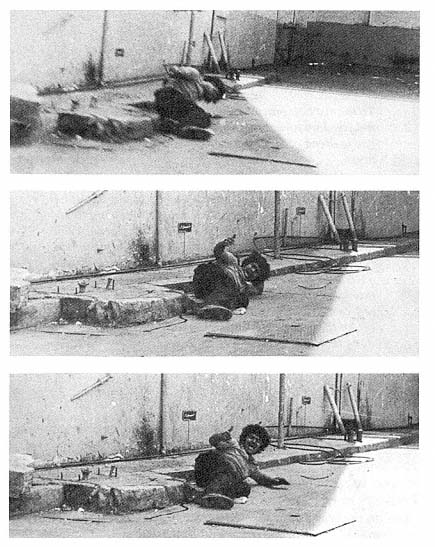
Figure 32.
One of the Irtibat armed elements in Shiyah was hit by a sniper's
bullet. 3 June 1975.