
III—
"THE STORED CONSCIOUSNESS":
MARCEL PROUST
But a cathedral is not only a thing of beauty to be felt. It may, for you, no longer be a source of teaching to be followed, but at least it is a book to be read and understood.
Marcel Proust
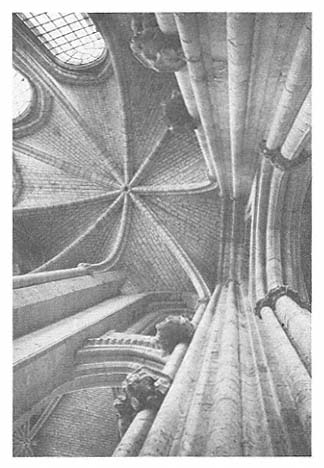
24
The aspiration. (Saint-Mathurin, Larchant)
One—
Church Architecture:
The Structure of A la recherche du Temps Perdu
When, in 1919, Marcel Proust wrote to the Comte Jean de Gaigneron, he commended, with almost excessive ingenuousness, the Comte's insight into his novel A la recherche du temps perdu . Proust also confided to the Comte what now seems but a gratuitous revelation, that the structure of A la recherche is like a cathedral.
When you speak to me of cathedrals, I cannot but feel touched at the evidence of an intuition which has led you to guess [deviner ] what I had never mentioned to anyone, and here set down in writing for the first time—that I once planned to give to each part of my book a succession of titles, such as Porch, Windows in the Apse , etc. . . . so as to defend myself in advance against the sort of stupid criticism which has been made to the effect that my books lack construction, whereas I hope to prove to you that their sole merit lies in the solidity of their tiniest parts. I gave up the idea of using these architectural titles because I found them too pretentious, but I am touched at finding that you have dug them up by a sort of intelligent divination.[1]
The Comte de Gaigneron had divined what became public and explicit only subsequently, in the posthumous publication of the last volumes of A la recherche . There, in now celebrated passages, Proust's narrator declares his structural purpose, taking care to avoid the pretension Proust expressly eschewed in selecting his
titles. Architect and dressmaker, Marcel balances the enormity of his "architectural labours"—to "build" a book "like a church"—with the humility of a seamstress's craft. He plans to work in the manner of his nurse, Françoise:
As all the unpretentious persons who live close beside us acquire a certain intuitive comprehension of our work . . . I would work near her [Françoise] and almost in her manner—at least as she used to, for she was now so old she could scarcely see any more—for, pinning on an extra sheet here and there, I would construct my book, I dare not say ambitiously "like a cathedral," but simply like a dress.
(II, 1113)
But once he has thus qualified his ambitiousness, Marcel abandons the simile of artist-dressmaker, elaborating instead his task as church architect. Whatever discomfort he continues to feel (the result of choosing one simile in favor of another) is dealt with by uncertainty and hope, feelings which newly administer the salve of professional modesty. The image of his book as "church" is nonetheless striking; and we might do well to recall Hopkins's poetic churches and witness them transformed here into a monument of fiction no less awesome or grand:
And yet, while all my useless duties to which I was ready to sacrifice the real one went out of my head in a few minutes, the idea of the thing I was to construct did not leave me for an instant. I knew not whether it would be a church in which the true believers would be able little by little to learn some truths and discover some harmonies, the great, comprehensive plan, or would stand, forever unvisited, on the summit of an island, like a druid monument. But I had decided to devote to it all my strength, which was leaving me slowly, as though reluctant and wishing to allow me time, having completed the outer
structure, to close the funereal door. Soon I was able to shew a few sketches. No one understood a word. Even those who were favourable to my conception of the truths which I intended later to carve within the temple congratulated me on having discovered them with a microscope when I had, on the contrary, used a telescope to perceive things which, it is true, were very small but situated afar off and each of them a world in itself.
(II, 1118)
This chapter will concern itself with these images, Proust's and his narrator's, of fiction as architecture, as cathedral, temple, even rooms. What relationship does architecture, as art analogue of fictional literature, have to Proust's conceptions and methods of literary structure, subject, and style? And what, then, does architecture so conjoined with literary art have to do with Proust's evaluation and use of memory in A la recherche du temps perdu ?
Perhaps the passage above constitutes the defense proper, the "proof" which Comte de Gaigneron perceptively did not need, that A la recherche does not "lack construction." If the defense is tardy, occurring after some two thousand pages of text, it is deliberately so: chronologically, it masks as a kind of retrospective insight into the structural order of A la recherche , thereby gaining force and value, like those after-pages in which a writer, reflecting upon his work, confers upon it what Proust praises as "retrospective illumination," an "ulterior" beauty surpassing the work itself (II, 491). But the defense does double duty, for it evidences and substantiates the writer's controlled "foresight of the end in the beginning," what Pater had specified as a prerequisite of great literary architecture: and in fact these last pages were written before the text itself.[2]
Marcel's architectural simile clearly achieves more than strategical defense: not only does the image endow the book with "teachfulness" ("true believers" might "learn" there) and symbolic monumentality, legendary and mysterious (a "druid monument"); it also enables the narrator to describe "making" (is this like Hopkins's "process"?) and so release discussions of literary structure from the confines of descriptive formalism into vistas of interpretative possibility. The formal distinction between outer structure and inner detail, between exterior and interior, might, for instance, suggest those perceptual and conceptual antinomies between a generalized harmony (inaccuracy?) and a particularized truthfulness (accuracy?), between distance and size (the confusions of relative measurement, telescope versus microscope), between continuous and contiguous worlds ("each of them a world in itself"). Likewise, the evocation of literary artist as Gothic craftsman who carves images (or "truths"!) suggests something about the materials and functions of language, its permanence, solidity, and spatial potential.
These matters Marcel, for the moment, only suggests. Regarding the other riches bestowed by the architectural image, Proust's narrator is explicit. By evoking comparison with a Gothic cathedral, Marcel reserves for the literary artist the right to an incomplete work:
And in those great books there are certain portions which there has been time only to sketch in and which no doubt will never be completed because of the very magnitude of the architect's plan. How many great cathedrals remain unfinished!
(II, 1112)
But perhaps most important to the narrator, the image of the cathedral secures the book as an edifice constructed in
"Time." Marcel, fearing his own waning strength, comments:
In any event, if I still had the strength to accomplish my work, I realized that the nature of the circumstances which today . . . had given me at one and the same time the idea of my work and the fear of not being able to carry it out would assuredly before all else imprint upon it the form I had once dimly sensed in the church at Combray, during certain days which had deeply influenced me, a form which usually remains invisible to us, the form of Time. This dimension of Time which I had once vaguely felt in the church at Combray I would try to make continually perceptible in a transcription of human life necessarily very different from that conveyed to us by our deceptive senses.
(II, 1121)
While the young Marcel might have only "dimly sensed" the significance of the church at Combray, the mature narrator had, even in the early pages of the book, enlarged the naive view to something more. Although nature herself was indifferent to the singularity of the church (Madame Loiseau's fuchsias leave her flower-pots to cool "their purple cheeks against the dark front of the church") (I, 47), the narrator's mind defied this visual evidence and exploded between church and town an abyss. Saint-Hilaire stood apart precisely because it occupied "four dimensions of space—the name of the fourth being Time" (I, 46). The special "geometry" of the church is likewise the geometry—and the innovativeness—of the novel: the varieties of temporal extension, with the capacity for contradictory, because instantaneous, contraction, are not only essential and necessary to both architecture and literature; they also reveal and constitute both the material and the "dematerialized" essence of both art forms and of literary architecture.
Contemporary criticism, with its hawk-eyed attention to literary structure, has observed Marcel's remarks and from them construed the serviceability of his architectural references. One of the most outstanding Proust critics, Gilles Deleuze, in an otherwise revolutionary reading of Proust's art, alludes to the cathedral only as an image sanctioning "incompleteness."[3] Richard Macksey, in a more modest essay, finds in the steeple of Saint-Hilaire what Georges Poulet calls "temporal perspective," the unity of A la recherche and the signature of Proust's genius. In this symbol, fragments of time and space, character and narrative incident, are reconciled and united by a "vital simultaneity," a unifying point of view which newly combines what had been discrete and mutually exclusive, especially the Méséglise and Guermantes ways.[4] I should like to suggest that while the text corroborates Deleuze's observation, Deleuze nonetheless slights the church analogue, perhaps of necessity, in concession to the demands of his persuasive polemical stance. And although Poulet and Macksey concede architecture's temporal significance, their notion of a simultaneity and a whole (of recombined fragments and reconciled opposites) seriously undermines, if it does not violate, Proust's painstaking definition of a whole which preserves rather than annihilates difference, distance, extension, fragmentation, as narrative necessities and epistemological truths. Proust is careful to suggest that Time, hence the novel, "traverses" fragments which do not themselves constitute a whole or confirm a unity. And—almost ironically for Poulet and Macksey—it is the church of Combray which displays these "crossroad" links. The church
occupied, so to speak, four dimensions of space—the name of
the fourth being Time—which had sailed the centuries with that old nave, where bay after bay, chapel after chapel, seemed to stretch across and hold down and conquer not merely a few yards of soil, but each successive epoch from which the whole building had emerged triumphant.
(I, 46) [Plate 25]
Proust's whole breaks with the Coleridgean model in which parts relinquish their identity by relation to other parts and to the whole.[5] Rather, the formal structure of the novel, its ability to "sail," to "stretch," to "span" and "cross," fashions, not a unity of identity or recombination of parts, but a unity which establishes exchange and communication between discrete and separate fragments ("each [truth] a world in itself") without destroying that dimension which causes and characterizes such fragmentation. In the closing passage of a book composed of multiple events, perspectives, attitudes, Marcel puts forward the image of a simultaneity which demands and maintains the discontinuous and disjunctive nature of Time.
I would not fail to stamp it [my work] with the seal of Time . . . and I would therein describe men—even should that give them the semblance of monstrous creatures—as occupying in Time a place far more considerable than the so restricted one allotted them in space, a place, on the contrary, extending boundlessly since, giant-like, reaching far back into the years, they touch simultaneously epochs of their lives—with countless intervening days between—so widely separated from one another in Time.
(II, 1123–1124)
With a kind of imitative pun, Marcel expresses the idea of disjunction by a syntactical displacement, an interruption; the parenthetical phrase about distance in fact distances: Marcel's giants "touch simultaneously
epochs of their lives—with countless intervening days between—so widely separated from one another in Time." Even in the syntax, that which distances need not fragment; it can also "span" and "connect" sentence elements which nonetheless remain distinct and separate. Proust's words and syntax can span because he conceives of and uses them dimensionally, for their depth. Simultaneity is the name for such touching or connectedness in time; transparency or superimposition is its spatial name.
It is notable that Proust's literary concept of a unity of the discontinuous, structuring and allowing an inclusiveness and variety, finds its counterpart in the architectural theory Proust ardently explored in the works of Viollet-le-Duc and Emile Mâle. But still more striking, the notion of disconnectedness in the service of another unity, stands at the heart of the architectural essay Proust chose to study and translate, John Ruskin's Bible of Amiens . The cathedral, writes Proust, "is a book to be read and understood"; it is built of many rough stones which the architect must not "mutilate," for "there is history in them."[6] Proust quotes Ruskin:
And in all their [the stone's] veins and bones and flame-like stainings, and broken and disconnected lines, they write various legends, never untrue, of the former political state of the mountain kingdom to which they belonged, of its infirmities and fortitudes, convulsions and consolidations, from the beginning of Time.[7]
[Plates 27 and 25]
From Ruskin Proust learns that the greatness of Gothic architecture is due, in large part, to its freedom from rules of order, symmetry, unity, rules which represent the enslavement of laboring and creating minds. Ruskin is explicit:
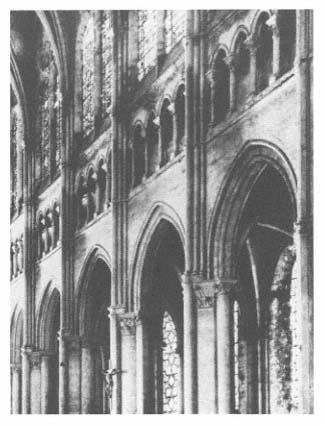
25
"Bay after bay, chapel after chapel, seemed to stretch across
and hold down and conquer not merely a few yards of soil,
but each successive epoch from which the whole building
had emerged triumphant." (Chartres Cathedral)
And it is, perhaps, the principal admirableness of the Gothic schools of architecture, that . . . out of fragments full of imperfection, and betraying that imperfection in every touch [the architects] indulgently raise up a stately and unaccusable whole.[8]
[Plates 6 and 7]
These "fragments"—like "surprises," "accidents," sudden "changes" and incomplete images, reminiscent of Pater's literary architecture as well as of Hopkins's Denbigh Hill—do not violate "unity," but rather assume an importance of their own such that Ruskin singles out for
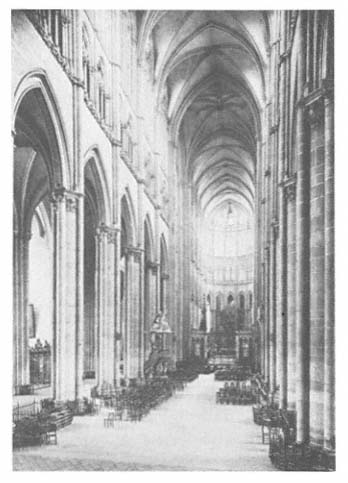
26
Here we see space-time, that is, time as and inseparable from space.
Distance measures, therefore, both time and space intervals at once;
it clearly requires two (di ) positions in space-time—where we stand
as viewers and where we look to ( di indicating subject and object
distinction). If we look down the center, we are actually looking
through—per-ceiving —space-time which we can only see in the
context of the surrounding or enclosing structure. Space-time throws
into relief the human scale: notice the chairs. (Notre-Dame d'Amiens)
description and analysis partial views and "pieces" of buildings. [Plate 3] In this, Ruskin, like Proust after him, breaks from traditional architectural concerns with the orders and unities, shifting his attention to qualities of craftsmanship and problems of truthfulness, of novelty, of accumulation of details. It seems a misreading of Proust to search for and describe a unity which reconciles opposites and neutralizes tension between discrete parts; for Proust's literary debt, in this instance, is to a man who does not value conventional wholes. Ruskin describes the changeful variety of Gothic architecture:
Undefined in its slope of roof, height of shaft, breadth of arch, or disposition of ground plan, it can shrink into a turret, expand into a hall, coil into a staircase, or spring into a spire, with undegraded grace and unexhausted energy; and whenever it finds occasion for change in its form or purpose, it submits to it without the slightest sense of loss either to its unity or majesty,—subtle and flexible like a fiery serpent, but ever attentive to the voice of the charmer.[9]
[Plate 27]
Daring interruptions of the formal plan would rather give additional interest to symmetry than injure it. Proust's cathedral Saint-Hilaire, partly in homage to Ruskin, likewise preserves what is broken and discontinuous. The "communication" which takes place between the separate naves and bays of Saint-Hilaire, like that communication between narrative incidents and characters in A la recherche , depends upon discontinuity, the gap or space between, which may receive or transport a charge, what Puskin calls tension: that communication is again at the basis of Ruskin's concept of the Gothic.
In Gothic vaults and traceries there is a stiffness analogous to that of the bones of a limb, or fibres of a tree; an elastic
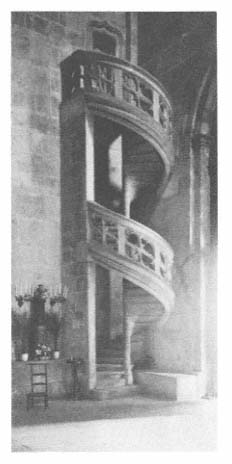
27
The splendor of Gothic architecture: the
elasticity of architectural form and structure
discovers an equivalence in style and structure
of literary architecture. (Church at Autun)
tension and communication of force from part to part, and also a studious expression of this throughout every visible line of the building.[10]
[See Plates 22 and 28]
Proust's critics Poulet and Macksey seem to ignore the important shifts in late nineteenth-century architectural tastes and the possible relationship between these shifts and Proust's self-conscious architectural analogue for literature. Poulet and Macksey argue that the steeple of Saint-Hilaire symbolizes the unity and connectedness of A la recherche because the steeple offers a view which connects fragments of countryside. Macksey writes:
This new law of temporal perspective was beautifully perceived by Georges Poulet in the emblem which crowns Combray, the spire of Saint-Hilaire. From the vantage of this point surmounting the work of centuries, the opposition of the mutually exclusive ways of Méséglise and Guermantes was resolved, the arch was closed.[11]
Poulet and Macksey furthermore overlook the explicit inadequacy of this view from the tower. While, it is true, the tower enables such an overview, it does so at the expense of a ground view—its enlargement or grounded extension—which is also necessary. The Curé of Saint-Hilaire points this out: from the steeple
you can see at the same time places which you are in the habit of seeing one without the other . . . from the top of Saint-Hilaire . . . the whole countryside is spread out before you like a map. Only, you cannot make out the water; you would say that there were great rifts in the town, slicing it up so neatly that it looks like a loaf of bread which still holds together after it has been cut up. To get it all quite perfect you would have to be in both places at once; up here on the top of Saint-Hilaire and down there at Jouy-le-Vicomte.
(I, 81)
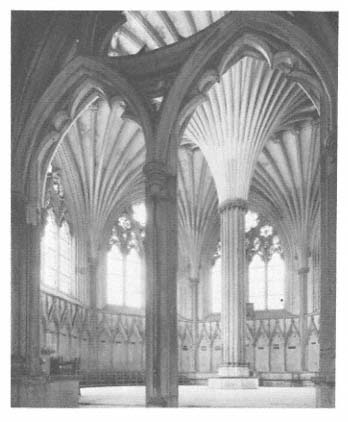
28
Gothic architecture organic: "bones of a limb, fibres of a tree."
(Wells Cathedral)
Poulet's and Macksey's concept of unity, in other words, violates the di-stance , that is, the space, hence time, of the novel. More crucial yet, it is the distance and the discontinuity of a ground view—the Martinville towers—which stimulated Marcel's first attempt at art, at discovering truths behind the appearances of things. Marcel's Saint-Hilaire, as "Time incarnate," spans epochs and ways, traverses them, crosses space, much as the narrative I spans and links the episodes of A la recherche , connecting characters in space-time while surprising the reader with accidents and changes. Marcel's A la recherche , his book as cathedral, carefully presents his "conception of truths" carved within the temple, truths which, "it is true, were very small but situated after off and each of them a world in itself" (II, 1118).
Two—
Rooms of Self:
The Quest for Definition
The Proustian equation is never simple.
Samuel Beckett
A la recherche opens with a simple equation. The context for the equation is this: Marcel awakes, recollects that he has been asleep, that while he was asleep he thought he was still awake reading, but that in this sleep-reading he had misconstrued the subject matter of his book. Then comes the equation, in the form of appositives, but constituting a definition: "I myself seemed actually to have become the subject of my book: a church, a quartet, the rivalry between François I and Charles V" (I, 3). If paraphrase suggests the complexity of a context which Proust's narrative grace had made seem of dreamlike ease, then perhaps the simple equation likewise dissembles a complexity which, if unwound, in fact consumes twelve volumes of text. Of course, in one sense, the dream-book is A la recherche ; and perhaps the subject of the book is all four—self, church, quartet, history. But is each individually the subject? Does the equation propose identification between each member (self equals church, but church also equals quartet, etc.)? And are self, church, quartet, history therefore interchangeable? Finally, if the structure of the book is that of a church, as Proust and his narrator claim, are subject and structure—church—the same? Is the subject of the book architectural/literary structure? I should like to suggest
an alternative to Marcel's equation: if a church is, as Proust states, a work of art (in addition to being the literal structure housing works of art, a treasure-house of frescoes, etc.), then the subject matter of A la recherche is art (and history is art, and music is history is art . . .). But what does architecture have to do with self? And what do the two of them have to do with subject and structure? While these questions seem endless, the entire "Overture" plays them out in narrative and dream sequences so that the reader, before he begins Book I proper, learns to read in one subject the language of another. In other words, the reader learns to translate one art form into another,[12] much as Swann, in order to remember Vinteuil's sonata, had to transform music into architecture.
He was able to picture to himself its [the music's] extent, its symmetrical arrangement, its notation, the strength of its expression; he had before him that definite object which was no longer pure music, but rather design, architecture, thought, and which allowed the actual music to be recalled.
(I, 160)
For Swann, memory must "toil to lay down firm foundations," to make "facsimiles," albeit in materia of something "fleeting, fugitive," and insubstantial. Swann's translation is richly suggestive. But perhaps, for the moment, it is enough to point out that such translation enables preservation and recall; that "design, architecture, thought" become equivalent parts of a new equation, perhaps suggesting something about the matrix of memory and the patterning of impressions; and that "extent," "arrangement," "notation," and "strength" qualify the plastic, dimensional potential of thought as well as the structure of architecture. Translation here, then, involves not only a change from one art into
another but also a corresponding change of sense from the audible to the visible and palpable.
In the "Overture," however, the narrator is less explicit; and description, even suggestion, do the service of analytic inquiry. The first and primary relationship that "self" establishes is with architecture, not yet the church at Combray, but the bedroom, its structure and the placement or displacement of furniture. The opening equation, at least between self and architecture, becomes manifest as a kind of exchange or metaphorical equivalence between self and room: both share the experience of sleep and unconsciousness; and Marcel himself figures as a piece of the furniture surrounding him. Marcel savors "in an instantaneous flash of perception, the sleep which lay heavy upon the furniture, the room, the whole surroundings of which I formed but an insignificant part and whose unconsciousness I should very soon return to share" (I, 4). Sleep and death are both unconsciousness, as if unconsciousness were the general condition whence Marcel came and to which he shall return, while consciousness—life—is but a brief interruption. Proust implies here that the perceiving and narrating self at this interval between sleep and waking resides nowhere, is neither in nor identical with the body (which is part of the room). Marcel's experience, itself narratively muted, is produced almost percussively, as if a shotgun should explode a soft, white magician's balloon: Marcel's sleepy, innocuous description is a "flash of perception." The experience asks to be registered and stored by the reader if he wishes to know, by the end of the "Overture," what the architecture of rooms and descriptions of self have to do with each other and with literature.
The first task of awakening—its connotations are in-
tended—is, strangely enough, the task of locating oneself spatially or architecturally; for, contingent upon external physical context, is identity of self. Shelved into his narrative strata is Marcel's explanation: "And when I awoke at midnight, not knowing where I was, I could not be sure at first who I was" (I, 5). "Place," and place memory, provide definition; and expectedly, place comes to express what it had defined, self, ego, identity. Place comes to be room for self and condition of self; and knowledge of place is knowledge of extent, how much space is filled or occupied by the self, where in place-space the self ends and other begins. The reader learns that domestic architecture, like a new double-duty litmus paper, registers and characterizes individual consciousness and the parallel consciousness of civilization. No knowledge of self ("not being") is an "abyss"; rudimentary knowledge is a "cave dwelling"; Marcel's self-knowledge is a French bedroom; and visual recall of past bedrooms enables Marcel to "put together by degrees the component parts of my ego" (I, 5).
As Marcel revisits his memory-rooms, an organic body-memory comes to aid his struggling mind:
And even before my brain . . . had collected sufficient impressions to enable it to identify the room, it, my body, would recall from each room in succession what the bed was like, where the doors were, how daylight came in at the windows, whether there was a passage outside, what I had had in my mind when I went to sleep, and had found there when I awoke.
(I,5)
From these memory-rooms, Marcel discovers feelings of that particular self who slept there and the relationship he had established with the outside world. Body recalls in an
order: what® where® how® where® what, from physical-room to mind-room; the final sequence moves from space to access to contents. This approximates the order to consciousness: space® contrast ("from" that is "in," "out," "center," "edge")® perception (seeing—the physical act requires contrast; form in fact comes from the Indo-European word meaning "to sparkle, gleam," while idea comes from a word meaning "to see")® conception (making of models, screening out or particularizing)® consciousness.[13] The self figures as the "heart" of these body-rooms, bed as a nest fashioned from those fragments of furniture and room appropriate to that time, that place, that age, season, and mood. One such nest, for instance, is built from "the corner of [his] pillow, the top of [his] blankets, a piece of shawl, the edge of [his] bed, and a copy of the evening paper" (I, 6). Marcel has concocted from fragments which remain discrete and identifiable a protective whole, just as Degas deliberately broke from traditions of pictorial composition, cutting-off and framing a partial scene which suggests that there is more outside, that the artist who grabs only a corner of the whole does so to show not only fragment and whole, but the selection itself as it reveals his private vision of himself in relationship to the outside world.[14] These remembered rooms, for Marcel and for the reader, come to signify, then, not only character but the shaping mind of the artist. The reader learns to read back from "structure" to "subject."[15]
Proust, however, does more than establish a deductive, contingent relationship (from room to mind): he posits an identity of sorts. The mind, like the liquid poured into a container, assumes the room's shape:[16] Marcel recalls a "room in which my mind, forcing itself
for hours on end to leave its moorings, to elongate itself upwards so as to take on the exact shape of the room"; he succeeds in "filling [the room] with my own personality until I thought no more of my room than of myself" (I, 7, 8). In this way, perhaps, rooms as literary structures—even A la recherche 's Gothic cathedral—release as much information about the nature (the shape ) of the artist's mind and his vision as do explicit statements or oblique references to the writer's craft. And, in the sense that "vision" or a particular subjective way of perceiving the world constitutes, for Proust, literary "style,"[17] then structure and style, form and language, also come together in an architectural image. At last Marcel makes it clear. The furniture Marcel's grandmother prefers, that "in which could still be discerned a flourish, a brave conceit of the past," was "as charming to her as one of those old forms of speech in which we still see traces of a metaphor whose fine point has been worn away by the rough usage of our modern tongue." The analogy is explicit: George Sand's pastoral novels are structured as rooms, and filled with the furniture of language:
In precisely the same way the pastoral novels of George Sand . . . were regular lumber-rooms of antique furniture, full of expressions that have fallen out of use and returned as imagery, such as one finds now only in country dialects. And my grandmother had bought them in preference to other books, just as she would have preferred to take a house that had a gothic dovecot, or some other such piece of antiquity as would have a pleasing effect on the mind, filling it with a nostalgic longing for impossible journeys through the realms of time.
(I, 31)
Thus for Proust concepts which seem primarily architectural, such as those of structure, space, shape, furniture, take on a literary suggestiveness as well. To know either "structure" or "subject," "room" or "self," is to know both sides of the equation, is to know the work of art. The reader may enter, with Marcel, the rooms of the past—the "vast structures of recollection"—and read therein those "subjective signs," the furniture which the artist has placed there. So, too, may the reader enter that public Gothic cathedral of A la recherche and find, in its innumerable carvings, the artist's private vision, multiple individual worlds. When Marcel suggests that all real knowledge, indeed all true perception of the Platonic essences of things, involves extension (projection) and penetration[18] —from self "imprinted" onto furniture and walls, back into self, symbolic forms and sense impressions—he also makes certain that the reader will be able to penetrate minds, especially the mind of the artist, by imaging those minds in terms of spatial extension, as architectural form.
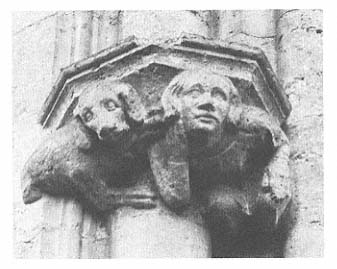
29
The imperfect, worn image in stone registers and preserves the
vision of the Gothic craftsman. Ruskin gives to Proust an
appreciation of such "rude" and expressive carvings. Proust
writes, "It is the very form of that syntax, stripped of all covering,
made honorable and lovely by his keen yet ever sensitive chisel,
that moves us." Here "syntax" suggests that Proust is speaking
not of architectural carving but of literary architecture.
Three—
Language and Architecture
Cathedrals are an original expression of French genius.
Marcel Proust
As for ices (for I hope that you won't order me one that isn't cast in one of those old-fashioned moulds which have every architectural shape imaginable), whenever I take one, temples, churches, obelisks, rocks, it is like an illustrated geography-book which I look at first of all and then convert its raspberry or vanilla monuments into coolness in my throat. . . . I set my lips to work to destroy, pillar after pillar, those Venetian churches of porphyry that is made with strawberries, and send what I spare of them crashing down upon the worshippers. Yes, all those monuments will pass from their stony state into my inside which throbs already with their melting coolness.
Marcel Proust
(Spoken by Albertine)
Proust puts into the mouth of Albertine literary language abused. Coming in the course of Marcel's apprenticeship to art, the naive narrator feels only unease at Albertine's speech, but his response, if insufficient, is
nonetheless an instructive beginning. Albertine's request is "too well expressed" for conversation. She fills her speech with "images so 'written,' which seemed to me reserved for another, more sacred use, of which I was still ignorant" (II, 468). What confuses Marcel is his own complicity in Albertine's new eloquence: he is flattered to think that he is exerting an influence upon her, and given his own lack of literary accomplishment, he overlooks her extravagances in the hope that these image flourishes prove her love.
To the Proust who wrote a series of Figaro essays on behalf of threatened French churches ("In Memory of a Massacre of Churches"), and who assiduously and lovingly translated John Ruskin's Bible of Amiens and Sesame and Lilies ,[19] Albertine's violations are more serious than Marcel, at once her jailer and her captive, can perceive. Albertine slays two arts in the name of eloquence: literature and an art no less sacred—architecture. And, as a final act of cunning, Proust has Albertine come to grief on the very trope that he and Marcel as artist solicit for exactly opposite purposes: architecture as metaphor for great literary art. Rather than an ice which melts, architecture, as an art of stone and marble, preserves and endures. It is an apt metaphor for one who admires literary style of old; in "Days of Reading," Proust's reverence replaces Albertine's rapacity:
Something of the pleasure that one finds in sauntering through a town like Beaune, which has kept intact its fifteenth century Hospital, with its well, its wash-house, its vaulted and panelled rooms with their painted beams, its high gabled roof pierced with dormer windows below a fretted covering of hammered lead (all of them things that a vanished epoch has . . . left behind it; things that belonged to it alone . . .) one can
still feel . . . in wandering through a Racine tragedy or a volume of Saint-Simon. For they contain all the lovely forms of a vanished manner of speech, such as preserves the memory of customs or of fashions in feeling that exist no longer, persistent traces of a past which nothing now resembles, but whose colour the obliterating passage of time can still revive.[20]
If Proust jests by sliding bad style—strawberry ices— into Albertine's mouth (for, to Marcel's delight, did she not "hold him there . . . whenever she spoke his name"?), he also casts Albertine as a kind of gluttonous iconoclast—a destroyer of churches.
Proust is able to imply much in this incident of light humor. In the character of Albertine, Proust indicts a subjectivity which only internalizes as Albertine ingests, unable to offer forth subjective experience in the unselfish service of communication and art. Whereas Albertine levels a Venice of ice, Marcel releases or springs from the flavor of his tea and madeleine the whole of Combray. It appears that the artist must recognize as necessary but limited these internalizations, either Albertine's subjective sensation or Marcel's involuntary memory.[21] The artist must then labor to penetrate the subjective impression much as he must learn to see behind outward sensuous signs; for all experience, even the memory re-creation of Combray, must release the reason it produces joy or sadness before it can be converted into art. Only then can the artist express as metaphor—that "indescribable bond of an alliance of words"—the results of his internal excavations, metaphors as delicate as those carved images preserved in Gothic cathedrals (II, 1015). The conversion into art thus has two steps: from matter or feeling is extracted dematerialized or spiritualized "essences"; essences are
then "imprisoned" in metaphors.[22] Albertine, at best, accomplishes only the first, literally decomposing a solid; but even then, hers is Proust's joke, a labor of jaws and digestive juices. In Albertine's world of ices, Proust condemns the misreading of art (architecture) as sensuous "signs" or "hieroglyphics" and the subsequent misuse of those sensuous signs in which there is no effort at real penetration.[23] The indictment is not only of an end-stopped subjectivism; it is also of the concomitant expressive—stylistic and literary—inadequacies. Albertine's inadequate vision and understanding, her denial of the two-fold, internal and external, nature of art and experience, likewise courts misused images which confuse external with internal and capture the essence of neither. Proust, however, finds that architecture performs a dual function, and it is partly for this reason that he selects it as the art analogue of literature. The cathedral's carved images may preserve the artist's private vision; but the building itself is not primarily referential, a vision of something else, as is the art of painting. Therefore, although Proust accepts painting as an analogue for literary style (which he defines as "subjective vision"), painting is insufficient for literary art as a whole. Proust distinguishes and praises literature as an art form capable of discovering and constituting truths, not only those of internal or private perception, but also those non-referential truths which actually "constitute the real essence of life" and are thereby universal, public, and accessible.[24] The images of architecture—a church, a room—may give to their particular literary worlds ideas of a complex, existential reality, which is relevant to the reader's experience of these worlds in several ways.
Comprehensively, the architectural images can seem virtually equivalent to a novel in its formal aspect—as a constructed entity, as a determinate, articulated object of the mind; an object which, even though purely ideal, seems independent of individual, subjective apprehension. The images of architecture can, at the same time, suggest the opposite idea of existential reality, which is no less complex and no less important to the experience of a literary world—that is to say, an idea of interiority, radically subjective, utterly peculiar to individuals; either the interiority of characters in a novel or the visionary authorial presence itself; Proust and, as we shall see, Henry James are among its denominations. Analogous to literary art, architecture can embrace and subsume these experiential and aesthetic possibilities, juggling each without ever demanding from readers or artists belief in one and repudiation of another. That architecture is out there, in the physical world, occupying and seizing space, flatters the expansiveness of minds and art worlds so small in their literal space extensity but so immense and space hungry in their capacity to conceive and invent.
The architectural analogue Proust finds so serviceable to literary art preserves, in its relative immunity to destruction, at least two strains of time. In the stones of architecture, which are to Proust "living thoughts," there shows "not only the light of a particular moment as it struck the surface; but the colours of the centuries as well."[25] In this statement, culled from the principles of Ruskin, Proust has distinguished the artist's carved image (particular light) from architecture's material (the centuries' colors). For Proust, the image and the material
have separate life histories in which there exists only a one-way contingency and identification: the artist's image cannot exist without its material embodiment, whereas the material has a history predating its emergence as architectural form. And Proust, like Ruskin before him, cautions the artist not to "mutilate" the stone itself, for, as Proust translates Ruskin,
there is history in them [the stones] . . . and in all their veins and bones and flame-like stainings . . . they write various legends, never untrue, of the former political state of the mountain kingdom to which they belonged, of its infirmities and fortitudes, convulsions and consolidations, from the beginning of time.[26]
Proust had discovered from Ruskin and then proclaimed for himself in his architectural essays and prefaces to the Ruskin translations, that cathedrals, with their two-fold geological and aesthetic lessons, are "books to be read," "written in a solemn language whose every character is a work of art."[27] In his literary essays, as in A la recherche , Proust simply takes Ruskin's coupling of architecture and literature and reverses the analogical relationship: books are built cathedrals, still to be read. But it is to Proust's advantage to preserve, in this exchange, the dual nature of architectural history or time. In so doing, he is able to present a notion of literature which distinguishes language as thought—particular carved images—from language as material—stones of old.
A Racine tragedy, a volume of the Memoirs of Saint-Simon are gracious things the like of which we have not with us now. The language in which they have been carved by great artists, with a freedom that brings out its soft gleam, and sets its native force a-leaping, moves us like the spectacle of certain marbles
now used no longer, but which once the artist worked in. Doubtless, in some of these old edifices the stone has faithfully preserved the craftsman's very thought, but also, thanks to him, the stone itself, of a species unknown today, has been preserved for us, clothed in all the colours which the master could draw from it, could bring to the eye, and set in harmonious order. It is the living syntax of seventeenth century France—and of customs and manners of thought now dead—which we love to find in Racine's lines. It is the very form of that syntax, stripped of all covering, made honourable and lovely by his keen, yet ever sensitive, chisel, that moves us, familiar though we are with its every oddity, its every daring turn, and whose concentrated design we see pass like a swift dart of light, or hang fire in beautiful, broken rhythms, in the gentlest and most tender passages.[28]
[See Plate 29]
With grace and subtlety, in an argument for preserving and revering the "old" literature of Racine and Saint-Simon, Proust has employed in his service a metaphor even older than the seventeenth century. Proust's trope reconverted from Ruskin—syntax as stone—is itself classical in origin. Thus Proust recalls the literary past and, in so doing, revives the rhetorical tradition which bequeathed notions of good literary style to the modern world.[29] Yet in this instance, even preservation is not enough for Proust: architecture, as analogue, in fact defies mutability and death. The image he ordinarily uses to elucidate a literature which records age—the passage of time—and does the office of memory, Proust uses here to suggest time immutable and its new but necessary handmaiden, forgetfulness.
It is these forms of language, wrested from the past, that are offered to our eyes as might some ancient and unruined city. In their presence we feel the same sort of emotion as when we
find ourselves confronted by certain architectural shapes, they, too, outmoded, which we can admire only in such rare and magnificent examples as have been bequeathed to us by the past that fashioned them: city walls, castle keeps and towers, the baptisteries of churches, the little cemetery close to the cloister or beneath the charnel-house at Aitre, which dreams in the hot sun, forgetful, under its butterflies and flowers, of the Funerary Urn and the Lantern of the Dead.[30]
Among the gifts of language made explicit by its architectural analogue are the notions of spatial extension with its variant, also spatial, enclosure. Like Marcel's reconstructed bedrooms of old, these may suggest the qualities or special dimensions of the writer's mind. But more strikingly, language may be hermetically sealed, preserving what is inside. Thus, much as the rooms of Marcel's aunt's house in A la recherche function as synaesthetic repositories or depots, sealing in "air saturated with a bouquet of silence," so, too, language may enclose a silence of synaesthetic richness. In Days of Reading , Proust writes languorously:
But it is not only the single phrases that give us the very shape and contour of vanished minds. Between the phrases—I am thinking now of ancient books that, originally, were recited—in the intervals that separate them, as in some inviolate shrine, filling the interstices of stone, there lies for us today a silence as old as all the ages. . . . I seem to hear the silence of the speaker pausing before beginning to intone the following verses. . . . That silence fills the pause in the phrase which, though broken to make room for the canticle, still keeps its form. More than once as I read it, it has brought to me the perfume of roses drifting through the open window and spreading through the lofty room where the Assembly sat. Though two thousand years have passed, that perfume has not evaporated.[31]
Proust is able to preserve and evoke, through his architectural analogue, the vestiges of an oral tradition impossible to record in its precise particularity. As architectural space can be defined by its antithesis, enclosing structure or not-space , so by a kind of imaginative reversal afforded by the image of space and walls, Proust presents silence and is able to infer its antithesis, sound. Proust's is a definition by opposition. While in this instance stones, as architectural/linguistic materials, separate or distinguish space, in other situations they unite or connect what is already separate. In his discussions of Racine and Flaubert, Proust reveals his fascination with modes of connection, and in his so doing, these essays of literary criticism suggest paradigms for Proust's own style in A la recherche . Proust writes:
Racine's most famous lines have become celebrated because they can produce this sense of delight by reason of a familiar piece of linguistic daring which stands like a dangerous bridge between two gently-rounded banks. "Je t'aimais inconstant, qu'aurais-je fait fidèle?"[32]
Racine's structural "bridge" finds a kind of parallel in Flaubert:
But if Flaubert took pleasure in such phrases, it was not, I need scarcely point out, because of their correctness, but because, by setting the root of a flying arch fast in the heart of one statement, and letting its other end touch earth in the middle of another, they guaranteed a narrow and closed continuity of style.[33]
[See Plate 24]
Proust's own "linguistic daring" likewise involves connection, and turns upon the architectural image of enclosure. Marcel, in A la recherche , writes, "The writer
must strive to imprison forever in a single phrase the two separate terms of the experience" (II, 1009). That single phrase, the metaphor, connects; but in so doing, it preserves the distinctness of each term.[34] The metaphor can do this because it comprises the "essences" of "the two separate terms of the experience," essences which are similar and extractable without threat to the terms themselves.
Truth will begin only when the writer takes two different objects, establishes their relationship—analogous in the world of art to the sole relationship in the world of science, the law of cause and effect—and encloses them in the necessary rings of a beautiful style, or even when, like life itself, comparing similar qualities in two sensations, he makes their essential nature stand out clearly by joining them in a metaphor, in order to remove them from the contingencies of time, and links them together with the indescribable bond of an alliance of words.
(II, 1008–1009)
Proust, or rather Marcel as writer, has come full circle. The final declaration of style throws into full relief those stylistic sins which Albertine had formerly committed but which Marcel could only recognize at the end of A la recherche . Albertine's earlier metaphors of architectural ices were based on conversion, not upon extraction, of the "essential nature" of two objects or two sensations: "Yes," Albertine had said, "all those monuments will pass from their stony state into my inside which throbs already with their melting coolness" (II, 468). The churches she "crashes down upon the worshippers" are the linguistic churches Marcel has come to cherish. The similarity between architecture and ices is coincidental and arbitrary; it is beautifully metaphoric and does not
reveal anything about their "similar qualities" except that both, or all three—architecture, ices, and language—can be destroyed or, to use Proust's term, "massacred," if they are misused and abused. Clearly Proust's sympathies go with "The Churches Saved," his lament with Albertine, with "Death Comes to the Cathedrals."[35]
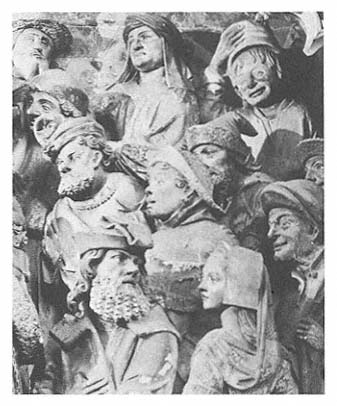
30
Literary architecture as a gathering device. The whole town
of Combray and all its residents seemed to gather at the Church.
(Notre-Dame d'Amiens)
Four—
Memorial Architecture
We may live without [architecture] and worship without her, but we cannot remember without her.
John Ruskin
We have slept too long, we no longer exist. . . . But then from the highest heaven the goddess Mnemotechnia bends down and holds out to us in the formula "the habit of ringing for our cup of coffee" the hope of resurrection.
Marcel Proust
Marcel's tribute to the goddess Mnemotechnia constitutes Proust's charge against her.[36] In his complex critique of memory, "habit" and the technics of voluntary memory are Proust's Janus-faced twins, friends to a practical, functioning life but enemies to an art of imagination and truth. To Proust, it is only in those moments when the controls of habit and memory are in abeyance, when they have not yet adjusted him to the conditions of the world, that "we can have before us . . . a truth composed of different realities among which we imagine that we can choose, as among a pack of cards" (II, 464). Dreams, accidents, sudden assaults on the senses—all experiences in which habit and memory have
not time to intervene—enable the artist to perceive new truths or to re-create a past freed from the contingencies of time (memory), reconstituted in the present and inseparable from it.
Proust's charge against Mnemotechnia is carefully couched in the language of praise, and for good reason. Because moments of involuntary memory, perception of essences, "are too rare for the work of art to be composed wholly of them" (II, 1015), Marcel expressly will write as he has lived—in Time. And Mnemotechnia is a goddess not only of memory (time past) but of method (technia): she offers a way of remembering and recording the passage of time and is therefore integral to the formal structuring of A la recherche , its narrative patternings of association, and the recalling of a different sort of past, one defined as relative to the present. Thus despite Proust's aesthetic hierarchy which relegates to second place memory and time, in deference to a past "sine materia, sine tempore ," Proust is careful to retain the method or device bequeathed by his goddess—architecture as model. Like its classical predecessor, Proust's architectural device stimulates and structures memory, helping Proust to reconstruct time past as fiction and helping Marcel to reconstruct it as history, sensation, and thought. Proust's book presents places or buildings, people, and art as the elemental images of Marcel's memory system, which distinguishes them architecturally, as cathedral or house (loci ), statues (imagines agentes ), and pictures or frescoes (notae ). Marcel's recreation of Combray is a paradigm of memory's dependency upon the architectural stimulus: no other art form "keeps in dependence on it a whole section of my inmost life as does the memory of those aspects of the steeple of
Combray" (I, 50). But architecture not only initiates and aids recall; it actually provides the image for the memory process itself, that "vast structure of recollection," raised from the "ruins of the past." Marcel observes:
My memory need only find in it [any church steeple] some dim resemblance to that dear and vanished outline [Combray] and . . . [I can be found] standing still on the spot, before that steeple . . . trying to remember, feeling deep within myself a tract of soil reclaimed from the waters of Lethe slowly drying until the buildings rise on it again.
(I, 51)
Reminiscence shares the architectural analogue with Marcel's book-as-art; in this way, reminiscence itself becomes an analogue of literary art.[37] Involuntary memory, being extra-temporal, is the analogue of metaphor and is thus in service to art. Marcel's final image of his book as cathedral, by incorporating memory or reminiscence, suggests how the architectural analogue becomes literary architecture: the book builds a memory system and stocks it while actually recording the building process. The book therefore finally produces and enables Marcel's reminiscence, hence his art. But since the book is his art, to produce, in this case, is also to constitute: the book is what it produces. Thus the paradox works; and only at the end of A la recherche can Marcel begin to write.
One of the first principles of the artificial memory system is that reminiscence, requiring a starting "place," may profitably use the childhood home and thereby gain access to "all those things which were raised in it."[38] Within the overall scheme of A la recherche , Marcel's childhood Combray functions as his starting place; but if this memory system is to work, it must presume that ideas or images—the objects of memory—cling in some way to place. When, at the end of A la recherche , Marcel
puts into operation his system, seeking to recall the women in his life, he proclaims as inseparable memory of person (object) and of place. In the course of his description, Marcel also distinguishes dream-places from memory-places. His brief discourse is worth repeating in its entirety.
In the case of the women I had come to know, this setting [place] was at least double. Each of them stood out prominently at a different point in my life, rising like a protecting local deity, first, from the midst of one of those dream-world landscapes which, side by side, made a checkerboard of my life and in which I had become fond of imagining her; secondly, seen with the eyes of memory in the setting where I had come to know her, which she recalled to me by fixed association—for even though our life be a roving one, our memory is sedentary and, no matter how ceaselessly we may rush about, our recollections, riveted to the places from which we tear ourselves away, continued to lead their stay-at-home existence there, like the temporary friends a traveller makes in a town and has to abandon when he leaves because it is there that they, who do not go away, will end their journey and their lives, as if he were still there, by the church, before the door, under the trees of the promenade.
(II, 1081–1082)
And it is thus that Marcel recalls Gilberte, as a shadow "before a church in the Ile de France" (II, 1082). There exists, it seems, a curious reciprocity between place and memory: place triggers or yields remembering and remembering yields place. Likewise, the memory process, in which recollections of people retain an imaged fixity, functions to throw into relief time's changes. Partly for this reason, at the coup de théâtre of the final book, Marcel mistakenly thinks his aged friends are in masquerade costume, so bizarre are the expressions of time passing in
comparison with Marcel's remembered images. If any evolution or change of these memory-images is possible, that change reveals a flaw in the memory process: change "is at the mercy of our forgetfulness" (II, 1071).
Since memories lead this "stay-at-home existence," so, too, the evocative power of memory, such as the "spell" of the Guermantes mansion, cannot "be carried over into another setting [as] memories cannot be divided into sections" (II, 985). Within the formal structure of the book, as within individual reminiscences, place thus grows into emblematic stature, fixed and inviolate. Specific buildings stand for and enable recall of entire towns: "Combray at a distance . . . was no more than a church epitomizing the town, representing it, speaking of it and for it to the horizon" (I, 37). The building becomes a kind of gathering device, and Marcel is able to introduce virtually all the people of Combray, with their genealogies, and all the events and thoughts occurring there, through his intricate description of the church.[39] [See Plate 30] Likewise, evocation of a church, as in the instance of Balbec, enables Marcel to give to the town "its place in the order of the centuries," its historical and aesthetic classification which, without the church's "stored consciousness of the romanesque epoch," the town and people would have lacked (I, 294). Here again, however, Proust plays with reciprocal evocations: for just as church recalls town, so town brings to mind church. Furthermore, into this system of recall, Proust introduces another triggering device for memory: words as place names. Like the classical art of memory which formed images for words and placed those images as paintings or art-objects inside architectural structures, that from the images words might be recalled, so Marcel
connects images and words as tools not only for recollection, but also for explanation or definition. This architecturally based memory device, with its classical ancestry, is striking; Proust presents it with ease, enriches it by a modern, even mundane, setting:
Words present to us little pictures of things, lucid and normal, like the pictures that are hung on the walls of schoolrooms to give children an illustration of what is meant by a carpenter's bench, a bird, an ant hill. . . . But names present to us—of persons and towns which they accustom us to regard as individual, as unique, like persons—a confused picture, which draws from the names, the brightness or darkness of their sound, the colour in which it is uniformly painted, like one of those posters, entirely blue or entirely red, in which, on account of the limitations imposed by the process used in their reproduction, . . . are blue or red not only the sky and the sea, but the ships and the church and the people in the streets.[40]
(I, 296)
From his discourse "Place Names: the Name," Marcel proceeds to "Place Names: the Place," in which "certain names of towns, Vézelay or Chartres, Bourges or Beauvais, serve to indicate, by abbreviation, the principal church of the town" (I, 500). The causal memory sequence itself—name to image, name to church to town—makes it possible for Marcel to form emblems or equations in which that causality ceases to be necessary as the linking device between name, church, and town. The colon in "Place Names: the Name" and "Place Names: the Place," signifies the new equivalence between name and place which Marcel carefully describes:
The partial acceptation [of town name as church], in which we are so accustomed to take the word, comes at length—if the names in question are those of places that we do not yet
know—to fashion for us a mould of the name as a solid whole, which from that time onwards, whenever we wish to convey the idea of the town—of that town which we have never seen—will impose on it, as on a cast, the same carved outlines, in the same style of art, will make of the town a sort of vast cathedral.
(I, 500)
In his explanation of the emblem and of its construction, the narrator has subtly transposed memory devices into imaginative or fantasy devices. His painstaking qualifications which interrupt his descriptions—"if the names in question are those of places that we do not yet know" and "of that town which we have never seen"—make room not only for the operation of imagination as fantasy but for the more important operation of imagination as fiction. Syntax itself, that connective tissue of style, is the space-place for artistic freedom, that is, context . The built combination of words calls attention either to individual words as they need to be noticed or to the shape of the creator's mind which constructs out of the words of others a new, not habitual, way of perceiving the world (i.e., objects of old). The passage suggests then, not only how Marcel comes to imagine Venice and Saint Mark's before he goes there, but also how Proust as writer can construct, emblematically and descriptively, the fictional ("never seen") Combray with its fictional cathedral, Saint-Hilaire. Thus remembering constitutes fiction-making just as much as does fantasy, either of the not yet seen and historically real, or of the never seen. Memory and projection utilize the same memory and architectural devices because they both comprise art. Once again, Proust has defined art while describing process; but even more, he has defined art in such a way that it assumes what is for Proust its proper
relationship to the "real," or "historical." Proust's counterpoint between the rhythms of the historical and the fictional, the real and the ideal, between Saint Mark's and Saint-Hilaire, Venice and Combray, is so loaded that the historical real is always less than its fictional analogue; for the latter enables and presents "truths" of creative perception, whereas the other can only be "described," with unavoidable distortion. Like all great visionaries, Proust must un-build the world and our conception of it in order to make room to show us how to see not the is but the might be , not that we walk in an imaginary world but that we remake our real world by a creative seeing of it. This is to abandon habit and convention (past) for the immediate and moving (unstatic). Syntax, as the linguistic space-place for arrangement of the new edifice built from old stone-words, is like imagines : imaginary churches are but the structured rearrangements of real churches, built from them, too; the benefit of these churches, like that offered by syntactical daring, is that they throw into relief what is. They change how we see, which is as close as we can get to changing what we see. This is an act of conserving rather than of replacing: the old monument remains, but comes to sit inside a larger whole, our newly constructed way of seeing, perceiving, conceiving. Within his inherited tradition, Proust's delicate critique of memory and her devices also constitutes his critique of contemporary realistic fiction with all its mimetic and imaginative inadequacies.
The literature that is satisfied merely to "describe things," to furnish a miserable listing of their lines and surfaces, is, notwithstanding its pretensions to realism, the farthest removed from reality, the one that most impoverishes and
saddens us, even though it speak of nought but glory and greatness, for it sharply cuts off all communication of our present self with the past, the essence of which the objects preserve, and with the future, in which they stimulate us to enjoy the past again.
(II, 1009)
So Marcel preserves the parallel between literature and memory. Realistic literature is like inadequate memory pictures; the one "lists lines and surfaces" while the other furnishes "façades" which seem to Marcel "only illustrations and not impressions" (II, 1069). While the analogues for poor literature and deficient memory devices are both architectural, they constitute only parts of architecture; what is noticeably absent from them is depth or spatial extension, that plastic, three-dimensionality necessary to an art which "penetrates" to truths.[41] But even more glaringly, a literature of realism "sharply cuts off all communication of our present self with the past" (II, 1009). The past and an art of truths are allies, sharing a whole architectural analogue, one preserving that three-dimensionality which distinguishes it from two-dimensional or surface arts such as painting. For all these reasons, the section titles Proust had rejected—"Porch," "Windows-in-the-Apse"—give way, in these sections at least, to titles no less architectural in substance ("Place-Names: the Name," "Place-Names: the Place") but formalistically and structurally far richer. These titles suggest those organizing architectural memory devices which Proust selects, the fictional process he believes in and uses, and the structure or order of evocations, either as memory or as fantasy, which he follows. By this memory system, the reader learns to supply the unstated half of any equation: for Combray he may read or recall Saint-Hilaire, for Saint-Hilaire, Com-
bray. Thus the reader translates not only from one art to another, but from emblem to elaboration or substance, from general to particular, and back again. Above all, the reader translates from "many churches [to] one church," from many perspectives to the cathedral of many perspectives, A la recherche (II, 1114).
Within A la recherche , the architectural memory devices, when not elucidated as such, often pose as interart or art associations; therefore the emotional impetus a device may give to Marcel's—and the reader's—memory is masked by the richness of texture which the analogue gives to the text. When, for instance, the young Marcel first sees Françoise, she is compared to a statue:
No sooner had we arrived in my aunt's dark hall than we saw in the gloom, beneath the frills of a snowy cap as stiff and fragile as if it had been made of spun sugar, the concentric waves of a smile of anticipatory gratitude. It was Françoise, motionless and erect, framed in the small doorway of the corridor like the statue of a saint in its niche.
(I, 40) [Plate 31]
Françoise is no ordinary statue—statue as free-standing sculpture—but one of a particular sort: like those statues in the classical memory tradition, she is made vivid by her frame and by a striking or unusual feature, her spun-sugar cap. Still more important, she figures as a saint-statue in a cathedral, statues so carved and placed by medieval architects as to strike the worshippers forcibly as a symbol, that they recall a particular virtue or vice. While Proust knew, and discussed in his essays on Ruskin, that conscious tradition of Gothic craftsmanship,[42] in A la recherche he translates the tradition into an art simile which appears not once but many times,[43] thereby creating a continuity of imagery and the possibility of ordered
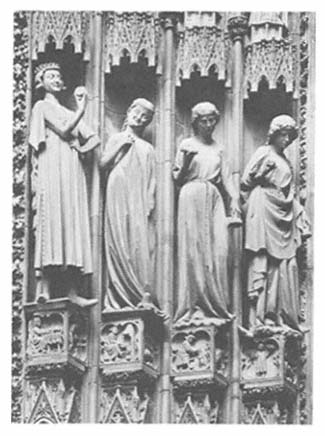
31
The Prince of Darkness and Foolish Virgins: West Portal,
Strasbourg Cathedral. This will recall for us Proust's statues
in niches as narrative and memory devices.
recall. The playing-card king in the stained glass of Combray, Gilbert-the-Bad, the Abbots of Combray, the arms and crests of the Guermantes—all occur and recur as images, but function as memory devices to preserve and create order. These characters are surrounded not only by frames but by space, their syntax or context being what distinguishes them. Feeling flies across space; from a window the thrust can be made. Proust may in fact present us with the memory device as context or setting, but if so, it may slip, as simile or allusion, into the text itself. In Venice, for instance, the same "statue in a niche" imagery that distinguished Françoise not only serves to place Marcel's Mamma in a vivid and therefore memorable setting; but the image-ingredients of that setting are also transposed and made to seem part of his mother in the description of her smile.
As soon as I called to her [Mamma] from the gondola, she sent out to me . . . a love which stopped only where there was no longer any material substance to support it on the surface of her impassioned gaze which . . . she tried to thrust forward to the advanced post of her lips, in a smile which seemed to be kissing me, in the framework and beneath the canopy of the more discreet smile of the arched window illuminated by the midday sun.
(II, 822)
For these reasons, Marcel continues, "the window has assumed in my memory the precious quality of things that have had . . . their part in that hour that struck, the same for us and the same for them" (II,823). The window, whether recalled or seen as "a cast in a museum" says "'I remember your mother so well'" (II,822–823). The window is at once place and space, access; and its shape mimes the shape of his mother. Recall thus re-
mains rooted to contexts which illuminate as much as their contents, but which may exist for Marcel, as for the reader, in "antipodal regions of my past memories" (II, 1070). Reconstruction of a memory whole—a whole retaining its fragmentary nature but not dissolving into disunity—depends upon recall of image and context. Somewhat like the art lover who "is shown a panel of an altar screen" and by remembering "in what church, museum, and private collections the other panels are dispersed," can "reconstruct in his mind the predella and the entire altar," the writer Marcel and his ideal reader can each reconstruct out of the many volumes and scenes stored in his memory the whole of A la recherche . But it is a whole which, like the Gothic cathedral, preserves its past and the beauty and individuality of its parts.