
2—
The Argonautic Hero in Question:
The Catalogue (Argo. 1.23–233)
The Catalogue of Argonauts might well appear to most modern readers an infelicitous delay of the expedition promised in the opening lines. Apollonius identified the Argonauts and their quest as the subject of his poem (1–4) but instead of going on to describe the building of the Argo (18–19), or Jason's trips to different parts of Greece to enlist his crew,[1] the poet immediately launches into a protracted list of all the participants, together with information concerning their families, home towns, and in several cases the reasons for their coming along.[2] The suggestion that Apollonius included a Catalogue because it was a required feature of the epic genre[3] may account for its presence but not its nature or position in the epic.[4] The remarkable success of such Hellenistic catalogue poems as the Ætia and the Phænomena , which exercised considerable influence on contemporary and subsequent poetry, makes it clear that catalogues were not simply an expected epic conceit but a highly esteemed and desirable art form per se , both in Apollonius's day and beyond. Far from being a defect, then, the Catalogue of Argonauts would appear to have been, given Alexandrian sensibilities, an auspicious starting point for the poet.
Homer's Catalogue of Ships (Il. 2.484ff.), as one might well imagine, is the primary model for the Argonautic Catalogue. Not
[1] Apollonius mentions some of the events that occurred prior to the first assembly at Pagasae in the course of the poem; cf. Vian 4 n. 5 for references.
[2] E.g., 32–34, 47–48, 97–100, 109–10, 139–41, 149–50.
[3] E.g., Blumberg 8.
[4] E.g., Händel 15 stated that Apollonius placed the Catalogue at the beginning of the poem so that it would not break up his narrative later on.
only does the prayer to the Muses for their assistance at the conclusion of the Proemium (22) parallel Homer's similar request just before he begins his Catalogue (Il. 2.484–93)[5] but, like Homer, Apollonius employs a geographical arrangement in listing the Argonauts.[6] In this regard, the Alexandrian poet even improves upon his archaic model by effecting what Vian styles "un nouvel exemple de 'composition circulaire'";[7] he begins his survey of Minyan Greece in Thrace[8] with Orpheus and completes it with the Thracian Boreads. Moreover, Apollonius introduces other technical and artistic improvements in his Catalogue: he updates Homeric geography and at times offers clever explanations of controversial names;[9] in line with Hellenistic poiesis, he employs greater variation in the introductions to each entry;[10] he has ensured that the heroic chronology to be inferred from his list of heroes commands plausibility and consistency, the result of eliminating the
[5] As observed by G. Kaibel, "Sententiarum Liber Quartus," Hermes 22 (1887) 511; cf. Blumberg 8.
[6] The first to make this observation was R. Walther, "De Apollonii Rhodii Argonauticorum Rebus Geographicis" (diss. Halle 1894); cf. Delage 38–39, and J. F. Carspecken, "Apollonius Rhodius and the Homeric Epic," YCIS 13 (1952) 38–58. On this and other geographical matters, cf. L. Pearson, "Apollonius of Rhodes and the Old Geographers," AJP 59 (1938) 443–59, who discusses Apollonius's debt to Hecatæus and the Ionian logographers.
[7] Vian 5.
[8] On the association of Pimpleia (25) with Thrace, see Sad 1.23–25b and Vian 240 ad 34.
[10] See Händel 16.
many contradictions inherent in earlier traditions;[11] finally, he offers greater variation in his presentation by including several delicately wrought vignettes, which, in a few strokes, provide crisp images of parents responding to their sons' departure on this celebrated expedition.[12] Yet Apollonius's Catalogue of Argonauts is much more than an updated Argonautic version of the Homeric Catalogue. The carefully balanced structure, the poet's emphasis upon certain mythological facts in pivotal sections of the Catalogue, and his allusion to a specific passage of the Homeric Catalogue together pose an important question regarding the nature of the Argonautic hero.
Structure
Apollonius executes a carefully organized sweep through the Greek world in his listing of the Argonauts, beginning and ending at the same place. As such the Catalogue of Argonauts, like the Proemium, is structured in ring composition. To this carefully balanced list, Apollonius appends the names of two men who ask to come along (224–27): Acastus, the son of Pelias, and Argus, the builder of the Argo. These two do not form part of the Catalogue proper, both because they fall outside the geographical ring of the Catalogue and because they put the number beyond the fifty-two crew members needed to drive the ship.[13] That they clearly stand apart from the others as supernumeraries becomes even more evident when they approach the Argonauts, who have already
[11] See especially Händel 17–26. A good example of the poet's manipulation of legendary material is the case of Nauplius, son of Poseidon and the Danaid Amymone (133–38; cf. Pherecydes FGrHist 3 F 4). Apollonius avoided the obvious problem of the generational gap between the age of the Danaids and that of Heracles by having two personages of this name; one the son of Amymone, and the other his Argonautic descendant; cf. Vian 246 ad 138. On the issue of relative chronology, cf. M. G. Palombi, "Apollonio e il dodecathlon," Prometheus 11 (1985) 126–36, who has shown that Apollonius established the time frame of the Argonautic expedition in relation to the labors of Heracles.
[12] E.g., 96–100, 148–50, 163–71, and 193–96; Fränkel's general comments on the Catalogue (pp.40–54) are particularly enlightening in this regard.
[13] The Catalogue up to the Boreads accounts for the 52 men that Jason must have to serve as crew of the Argo : 50 to row, one to act as keleustes[*] (Orpheus; for which see Euripides Hypsipyle fr. 1.3.8–14 Bond), and one to steer the ship (Tiphys); cf. Vian 13–14 n. 3.
gathered on the beach at Pagasae in preparation for departure; their arrival is greeted with surprise by all (321–23). After this brief addendum, the Catalogue section closes with a digression explaining why the Argonauts as a group were traditionally called "Minyans" (228–33).
One further structural detail requires comment. In addition to the geographical organization, Apollonius also structured the Catalogue proper (23–233) in such a way that it falls into two distinct halves:[14] Orpheus heads the first half, which Talaus, Areius, and Leodocus—the sons of Bias and Pero—bring to a close (23–121); and the second half begins with Heracles and concludes with the Boreads (122–223). Several features in the presentation of the Catalogue point to this bipartite structure. First, only in the cases of Orpheus (


Thus, two different structural systems operate simultaneously: on the one hand, the geographical ring frames and unifies the various strands of this long list of heroes from all over Minyan Greece, effectively separating the Catalogue proper from the wider section in which it is located; on the other hand, the bipartite structure makes a distinction between an Orphic and a Heraclean
[14] See Vian 9.
[15] A point noted by Blumberg 9. On a more speculative note, it may not be coincidental that both the Catalogue of Argonauts in the Argonautica and Callimachus's Ætia , framed as it is with Argonautic episodes (Ætia fr. 7–21 Pf. ["Argonautorum reditus et ritus Anaphæus"] and fr. 108–9 Pf. ["Ancora Argus navis Cyzici relicta"]) begin their second halves with depictions of Heracles engaged in one of his labors and associated with a nonheroic figure (Molorchus in the Ætia ; Hylas in the Argonautica ).
half, which will be seen to introduce a thematic antithesis that the poet sustains throughout the book and that is central to his consideration of the Argonautic hero. The whole Catalogue section thus has the following structure:
| ||||||||||||||||||
A—
The Catalogue of Argonauts (23–223)
The two-part structure of the Catalogue of the Argonauts, as I have suggested elsewhere,[16] reflects the structure of the entire Catalogue section of Iliad 2, which comprises both the Catalogue of Ships (Il. 2.494–759) and the Catalogue of the Trojans (ibid. 816–77).[17] The two halves of Apollonius's Catalogue, however, represent not two opposing armies but two opposing types of hero who achieve the goals of their respective quests with antithetical approaches.
Orpheus and Heracles, who introduce each of the two halves, perform comparable tasks through diametrically opposed means; as Lawall has noted, Orpheus brought oak trees from Pieria to Thracian Zone through the power of his music (28–31), while Heracles transported the Erymanthian Boar from Arcadia to Mycenae by virtue of his great strength (124–29).[18] This antithesis is echoed at the end of each half of the Catalogue, where Apollonius has set corresponding stories, stories that do not celebrate the exploits of the respective Argonauts themselves, but events leading to the way in which they were begotten. The Orpheus half concludes
[16] "A Mythological Thaumatrope in Apollonius Rhodius," Hermes 119 (1991) 484–88.
[17] The archaic poet arranged the Trojan catalogue too along geographical lines; cf. G. S. Kirk, The Iliad: A Commentary (Cambridge 1985) 1.250.
[18] Lawall 124 n. 10.
with Talaus, Areius, and Leodocus, whose entry contains a brief reference to the fact that these sons of Bias and Pero owe their existence to Melampus, who was imprisoned in Iphiclus's stables (120–21). The story was well known in antiquity.[19] On behalf of his brother, Bias, the seer Melampus went from Pylos to Phylace to fetch the cattle of Phylacus, which Neleus demanded as the price for the hand of his daughter, Pero. Although caught in the act of taking the cattle and imprisoned by the king, he won his freedom— and the cattle—through his prophetic skills (like Joseph in the Old Testament); the marriage that ensued produced the three Argonauts. At the end of the Heraclean half, Apollonius describes the begetting of Zetes and Calaïs (211–18): Boreas went from Thrace to Attica, where he seized Oreithyia as she danced along the Ilissus River, and, bringing her to the Sarpedonian Rock, there raped her.[20] Both terminal stories, then, involve distant journeys undergone to win a bride. Success in the case of Melampus, like that of Orpheus, results from his skill of communicating with nonhuman life forms;[21] Boreas, on the other hand, wins his bride, just as Heracles secured the Erymanthian Boar (and gained possession of Hylas, who is mentioned in the same entry, 131–32)[22] by brute force.[23]
In the Catalogue itself, then, Apollonius does more than list the Argonauts in a clever geographical arrangement, imitative of the
[19] For details, see O. Wolf, "Melampus," Roscher 2.1.2567–73; and Pley, "Melampus (1)," RE 15.1.394–95. It should be noted that Callimachus alludes to the story in the Victoria Berenices (SH 260A.5).
[20] I discuss the significance of this place name and its relationship with the Homeric Catalogue in the article cited above in note 16.
[21] The story goes that Melampus foresaw the collapse of the roof of his prison when he heard the worms talking about how much was left of the beam they were eating; cf. Apollodorus 1.9.12. C. P. Segal, in the preface to his recent collection of articles on Orpheus (Orpheus: The Myth of the Poet [Baltimore 1989] xiii), calls Melampus Orpheus's "mythical cousin" since both are able "to hear the music of the world, to know its sights and sounds that others cannot perceive."
[22] On the violence exerted in the "winning" of Hylas, cf. 1211–20.
[23] Segal (supra n. 21) 18–19 (= "The Magic of Orpheus and the Ambiguities of Language," Ramus 7 [1978] 122–23) notes a similar contrast between Orpheus and Heracles in Euripides' Alcestis : whereas Orpheus failed to bring Eurydice back through his musical skill, Heracles succeeded in bringing Alcestis back by means of brute force.
Homeric Catalogues. The first half begins and ends with stories involving heroes who achieved their respective feats through their communicative skills; the second half is framed with accounts of heroes who attained the object of their quest through their physical prowess. The Catalogue thus unfolds in such a way that the reader is invited to see the two halves as representative of two types of hero, the man of skill and the man of strength.[24] Not only will this overall heroic antithesis surface in different forms throughout this book and beyond, but more specifically, the quests undertaken by, or leading up to the births of, the Argonauts who begin and conclude both halves of the Catalogue parallel and, to a certain extent, symbolize the Argonautic expedition, which was getting under way: Jason must travel to a distant land in order to fetch a specific item, and, in the course of his expedition, he too will win a bride. The heroic dichotomy of the Catalogue thus raises an interesting question: since Jason must attempt to accomplish what Orpheus, Heracles, Melampus, and Boreas all did in their respective

B—
Appendix:
Argus and Acastus (224–27)
The appendix to the Catalogue, in which Apollonius adds the names of Acastus and Argus to the group, likewise does more than list names. As one will fully recognize only when the two
[24] The parents of the Argonauts could well be another factor in the thematic antithesis between the two halves. Of the twenty-seven Argonauts in the Orpheus half, only in five cases has Apollonius assigned gods as parents (Orpheus [Calliope]; Erytus, Echion, Æthalides [Hermes]; and Phleias [Dionysus]); and of the twenty-five of the Heracles half, the poet associates twelve with divine parentage (Heracles, Castor, and Pollux [Zeus]; Nauplius [indirectly], Euphemus, Erginus, and Ancæus [2] [Poseidon]; Idmon [Apollo]; Palæmonius [indirectly; Hephæstus]; Augeas [Helius]; Zetes and Calaïs [Boreas]). Moreover, in the first half, Apollonius could have made Orpheus the son of Apollo (cf. Sad 1.23–25a) and Polyphemus the son of Poseidon (cf. Sad 1.40–41), while in the second half, he could have made Idmon the son of Abas (cf. Argo. 2.815) and Augeas the son of Phorbas or Eleius (see Ardizzoni ad 172). It seems possible that the number (three versus six) and the nature of the divine parents who are associated with each half (Calliope, Hermes, and Dionysus, as compared with Zeus, Poseidon, Apollo, Hephæstus, Helius, and Boreas) are also factors that support both the structural and thematic distinction between the halves through the emphasis in the first on human parentage and gods associated with music, and the emphasis in the second on divine parentage and gods often associated with great strength.
heroes join the others at Pagasae (321–26), this addendum mirrors the heroic dichotomy between the man of skill and the man of strength seen in the Catalogue proper. A brief examination of the later passage will reveal that Acastus and Argus represent for Apollonius these two opposite types of hero. The lines in question run as follows:
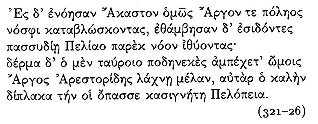
They noticed Acastus and Argus coming down from the city
together, and they were amazed as they saw them
heading their way with all speed contrary to the will of Pelias.
Around his shoulders, Argus, the son of Arestor, wore a bull's hide
black with bristles and stretching to his feet; but Acastus wore
an elegant
double-folded cloak, which his sister, Pelopia, gave him.
The conspicuous difference in the attire of the newcomers is significant: Acastus is dressed in an elegant cloak made for him by his sister, while Argus wears a bull's hide. Their arrival immediately precedes the choice of the captain. During this election, Jason, a man who wears a cloak of intricate design, made and given to him by Athena (cf. 1.721ff.), vies against Heracles, a hero famous for his lion skin. To show how Acastus and Argus reflect the thematic antithesis of the two halves of the Catalogue proper, I must for the moment anticipate a point that I shall make at greater length in Chapter 4. Jason and Heracles each represent one of the two types of hero of the Catalogue: Heracles, besides playing an important role in establishing one of the heroic types in the list, is throughout the poem—as everywhere in Greek myth and legend—the consummate man of strength. But Jason, who wins the election upon the insistence of Heracles, believes that the success of the mission depends on the cooperation of the group. For him, it is the skill of a leader who knows how to take care of details and exercise diplomacy that is all-important (332–40). This
is in fact how he will proceed in the course of the expedition. Another instance of this sartorial distinction between the two different heroic types is found near the beginning of Book 2 in the boxing match between Polydeuces and Amycus. The former wears a cloak given to him by one of the Lemniades (



C—
Conclusion:
Digression on the Term "Minyans"
After listing individually each of the Argonauts that Jason invited to participate and then adding the names of the two supernumeraries, Apollonius brings the Catalogue section to a satisfying conclusion by explaining the collective name used to refer to the heroes of the Argonautic expedition. The section ends, that is to say, with an etiology: why were the Argonauts as a whole called "Minyans"? The term was a traditional name for the group,[27] and Apollonius suggests a reason for its origin:

[25] On the thematic significance of dress in the Argonautica , see A. Rose, "Clothing Imagery in Apollonius' Argonautica ," QUCC 21 (1985) 29–44. It is noteworthy that in vase paintings of the Gigantomachy the (civilized) Olympians wear clothing and carry weapons that are manufactured, while the (barbaric) Giants wear skins and wield clubs; cf. E. Kuhnert, "Giganten," Roscher 1.2.1653–73; and LIMC 4.2 s.v. "Gigantes." A similar contrast can be seen in the Gigantomachy featured on the Hellenistic Altar of Zeus at Pergamon; cf. J. J. Pollitt, Art in the Hellenistic Age (Cambridge 1986) 97–110.
[26] See Vian 244–45 ad 112.
[27] See Vian 10 n. 2 for references.
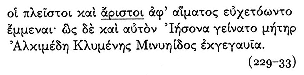
Such was the number of men who gathered to assist the son of
Æson. The people living in the vicinity called all these heroes
Minyans since the majority, and these were the best ,
boasted to descend from the blood of the daughters of Minyas.
Thus, even Jason himself had as mother Alcimede,
who was the daughter of the Minyad Clymene.
The explanation that most of the Argonauts were Minyan in origin can hardly be correct. Indeed, the poet records only seven Minyadae among the group.[28] But it is not Apollonius who has blundered.[29] He is not the ultimate source of the faulty genealogical assertion. Rather the poet reports that those who lived in the vicinity of Iolcus (

Yet there is more involved here than a passing etiology. The Homeric Catalogue of Ships ends with a question:


[28] They are Jason, Admetus, Iphiclus, Euphemus, Talaus, Areius, and Leodocus. Vian 10–12 offers a fine analysis of the problem.
[29] So Vian 11.
[30] For references, see Vian 11 n. 1.
[31] Cf. G. Nagy, The Best of the Achæans (Baltimore 1979) 27.
for the Argonauts resulted from boasts made by those considered the best among the Argonauts. With the question posed at the conclusion of the Catalogue of Ships in mind, the reader would seem to be invited to ask who the best of the Argonauts is, a question that arises all the more naturally given the arrangement of the Catalogue into two halves representing opposing heroic types. This is in fact a question that Apollonius will explicitly ask twice in the course of the first book in contexts where Jason and Heracles vie for this honor. The first instance occurs in the election (332–50); and the second, in the argument following the abandonment of Heracles (1280–1344).[32] Thus, like Homer in his Catalogue, Apollonius too questions the identity of the "best of the heroes," although in a less direct fashion. The thematic opposition between the man of skill and the man of strength in the Catalogue implies that the answer will involve one of these two types of hero. Finally, one might guess from Homer's answer to his own question that one of the heroes may turn out to be the best only in the absence of the other. The events in Book 1 will bear out the validity of both these suggestions.
It would be a mistake indeed to consider the Catalogue of Argonauts a mere listing of the dramatis personæ , required by the conventions of the genre and placed out front simply to get it out of the way. On the contrary, Apollonius has executed a remarkably original and brilliant adaptation of his Homeric model in such a way that he has not only provided the reader with the names, backgrounds, and in some cases revealing vignettes in the lives of the Argonauts; he has also raised—through the structure, presentation, and allusiveness of the Catalogue—the central question regarding the identity and the very nature of the hero of the Argonautica : Who is the best of the Argonauts? Will he bring back the golden fleece by means of some extraordinary skill, or through the exertion of brute strength?
[32] I shall discuss these passages in detail in Chapters 4 and 8.