
2—
To take film in, instead of being taken in by it, viewers cannot remain passive receivers of images. They must become engaged with film in a continual creative process of visual renewal, a typical example of which is offered by the conclusion to Dog Star Man (1961–64). Dan Clark's description of the closing moments of the fim is meticulous:
DSM [i.e., the Dog Star Man] chops, bare chested, in
sunlight—same as before
DSM walks through snow, looks up
daytime sky with clouds
night sky with stars
DSM chops, in b&w negative, in orange-toned color
DSM chops, in close up, medium shots, from below
flashes of a roll of film ending, orange, white
DSM chops
axe chopping roots of a dead tree
flashes, sprocket holes move slowly down frame
DSM chops
flashes
b&w roots chopped
black
orange
white
flashes
black
DSM chops
white
black
orange
b&w roots
flashes
sprocket holes
star in black sky
black
dark purple
dark green
orange
black
blue
black[15]
Although no verbal description can equal the experience of seeing the film, Clark's list of images is as accurate as one could hope to make it, given the film's extremely rapid pace (most of the images are on the
screen for only a fraction of a second). Drawing upon these images, I propose to show how visual renewal figures thematically and perceptually in the conclusion to Dog Star Man .
One line in Dan Clark's text clearly indicates Brakhage's method of integrating imagery and theme: "axe chopping roots of a dead tree." An axe chopping tree roots also appears earlier in Dog Star Man , usually in a context that seems to equate chopping with sexual intercourse. At the film's conclusion, however, the chopping is more specifically related to "cutting" film. In addition to sprocket holes, which remind us of the material strip of film itself, the images include pieces of film askew on the screen as if they were chips of the dead tree sent flying by the impact of the axe's blade. What Clark calls "flashes" are places where all film opacities seem to have been cut through, permitting pure light to burst forth.
The film contains within its own imagery the means of bringing itself to an end (as Clark notes, there are "flashes of a roll of film ending"). The act of chopping within the film cuts the film off with a few final "flashes," sputtering colors, and finally "black." The ending thus emphasizes the means of making the film, especially the editing, which can be thought of as cutting away the deadwood, eliminating the stale, familiar representations of the visual world so that new ways of seeing can have room to grow.
In its fusion of method and message, the film also joins and temporarily shapes the viewer's process of visual perception. This is its specifically perceptual significance, which emerges when Clark stops referring to recognizable objects ("axe chopping roots," "sprocket holes move slowly down the frame," and so on), and begins listing simple visual impressions ("flashes," "white/black/orange," "orange/black/blue/black," and so on). These impressions of changing light and color, combined with the quick, nervous rhythms of the editing, allow us to experience with our own eyes the intensity, the flashing and surging of energy that Brakhage has given to light moving in time. This is visual renewal, and to see film in this way is to know it sensuously and as immediately as the nervous system knows something is hot—or to use a subtler analogy and one truer to Brakhage's stated interests, as the body "knows" itself through the "movement of its own tissues," to quote Charles Olson.
In the interview preceding Metaphors on Vision , Brakhage refers specifically to Olson's "Proprioception," a collection of notes or "working papers" (as Olson's editor calls them) concerned with that sense of the self one derives from perceptions of one's own body: "PROPRIOCEPTION:
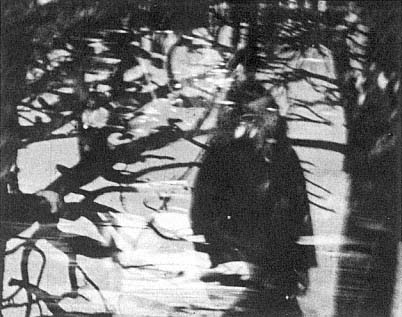
The Dog Star Man wanders in a maze of bare branches and
superimposed streaks and flares of light in Dog Star Man, Part 4 .
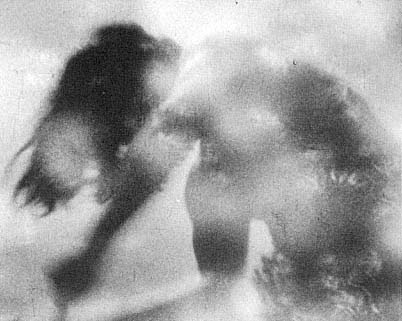
The Dog Star Man chops dead wood amid superimposed
lights and sprocket holes in Dog Star Man, Part 4 .
the data of depth sensibility / the 'body' of us as object which spontaneously or of its own order produces experience of, 'depth' Viz SENSIBILITY WITHIN THE ORGANISM BY MOVEMENT OF ITS OWN TISSUES."[16] It is a very short step from this definition and its corollary, "that one's life is informed from and by one's literal body,"[17] to Brakhage's goal of making films that must be "taken into the viewer in thru his experience of himself in the act of seeing." While taking in the lights, colors, textures, fleeting images, and darkness that bring Dog Star Man to a close, one can hardly avoid an immediate and nearly physiological sense of one's own "act of seeing."
In that sense, vision can be "proprioceptive." It can produce the opposite of the disembodied, objective "view" that Gibson labeled "the visual world" and that social convention (buttressed by orthodox studies of visual perception) takes to be the correct and normal way of seeing. Visual renewal arises from a more direct, physiological sense of light-eye-brain interaction.
Since Brakhage's goal as a filmmaker is to create equivalents of "the act of seeing," "film is, thus, premised on physiological sense—takes Sense as Muse," as he wrote in an article published in 1967.[18] To Jonas Mekas, Brakhage wrote, "I find myself feeling that it is the total physiological impulse of a man must be given form in the making of a work of, thus, called, art."[19] And to Michael McClure: "I am simply here involved with a process so naturally always existent its workings have been overlooked: that the light takes shape in the nerve endings and IS shaped, in some accordance we call communication, thru physiological relationship."[20] Visual renewal is a way of looking again at that "process so naturally always existent its workings have been overlooked." It depends on the filmmaker's ability to shape light's movement in ways that not only communicate with the viewer but retain some sense of the interplay of brain, nervous system, and the eyes that receive the light of the external world.
This is why Brakhage has taken exception to William Blake's neat couplet: "We are led to believe a lie / When we see with not through the eye." For Brakhage, the filmmaker engaged in "giving sight to the medium," as he writes in "A Moving Picture Giving and Taking Book," must see" 'with, not through , the eye' (William Blake), with , rather than thru, machine."[21] In Brakhage's dialectic of eye and camera, the "machine" is no more a "window" than the eye is. Both eye and "machine" make what is seen; hence, cinematic equivalents of seeing cannot be divorced from
the materials and processes of filmmaking, any more than human sight can be separated from the body's visual system.
It is, then, "with, not through , the eye" that Brakhage would have the viewer experience—not simply see depictions of—the process of visual renewal. Both the inspiration for his films and their means of communicating with the audience derive from the premise that in each moment of seeing, the world is made anew. "Everything is new to the eye. Everything at every instant is new," Brakhage has said. "Only in the long take, it begins to decay and get old. So that first impression, if fully realized, if fully lived, that is fixed for all time."[22] Equivalents of those first impressions are what Brakhage strives to fix for all time in his films: "So the whole point is, in bouncing light off things, or catching it howsomever, that everything shall be something integrally new. It will be new anyway, but if it doesn't maintain its newness then I have failed, because I am new at every given moment."[23]
The "flashes," brief glimpses of "white," "orange," "blue," and moments of "black" at the end of Dog Star Man summarize the process of seeing everything "integrally new." They produce a metaphor of vision in the most direct way possible: by making the viewer aware of seeing as a physiological, nerve-centered event before it becomes a conscious recognition of labeled and familiar objects and events. Visual renewal, in other words, restores the perceptions of the "untutored eye."