
The Ottoman Empire
Sultan Abdülaziz's desire to partake in the cultural life of Europe was reflected in the meticulous attention given to the design and construction of the Ottoman pavilions for the 1867 Universal Exposition in Paris. As noted in the preceding chapter, the Ottoman Empire was represented at the 1867 fair by an ensemble of buildings-as-objects: a mosque, a residence, a bath, and a fountain. Ottoman agricultural, industrial, and artistic products were displayed in the main exhibition halls. The 1867 pavilions marked a turning point in Ottoman architectural history as the end products of a theoretical study whose terms were defined in Europe. Although the change appears to have been enforced from the outside, it should be understood within the general framework of Westernizing reforms undertaken by the ruling elite. French architects initiated and practiced the academic approach, but it was endorsed wholeheartedly by the Ottoman commissioners to the exposition. Furthermore, the Ottoman buildings at the 1867 fair themselves affected European architectural thought. If they heralded a new theoretical viewpoint from which the Ottoman architectural heritage could be assessed and recycled, they also revised European architects' and architectural critics' stereotypes of Islamic architecture as a merely sensuous play of decorative devices.
The Ottoman pavilions were designed in Istanbul by a self-trained French architect named Léon Parvillée in collaboration with the Italian architect Barborini. Parvillée had been commissioned earlier by the Ottoman government to document and restore the fourteenth-seventeenth century monuments of Bursa.[2] An ardent follower of Eugène-Emmanuel Viollet-le-Duc, the proponent of rationalism in nineteenth-century architecture, Parvillée sought to discover some of the "rules" of Ottoman architecture in his measured drawings of Bursa's buildings. For example, in the Mausoleum of Mehmed I (known as the Green Mausoleum because of its colored tile facades) he discovered that the
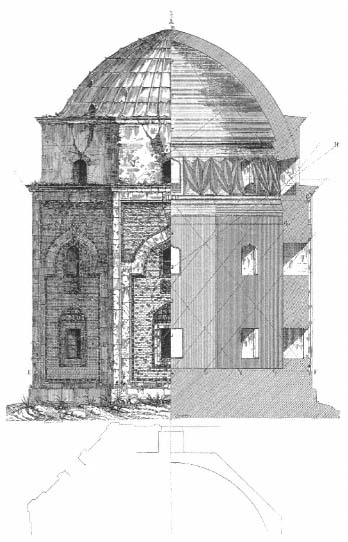
Figure 55.
Parvillée's drawing of the Mausoleum of Mehmed I
(Gazette des architectes et du bâtiment, special issue,
Paris, 1867).
height of the interior space from the floor to the top of the dome was obtained by the superposition of two Egyptian triangles, whose height equals five-eighths of the base (Fig. 55). On the basis of geometric analyses, Parvillée argued that Ottoman monumental architecture and its decoration were systematic and that the triangle was the primary form of geometric composition.[3] In Architecture et décoration turques (Paris, 1874), Parvillée presented his discoveries as a "key, a link, a reasoned explanation [une explication raisonnée ]" of the
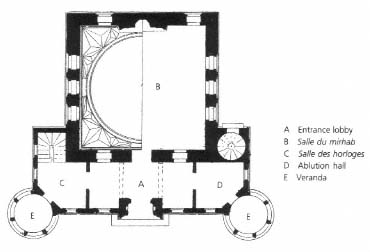
Figure 56.
Parvillée, plan of the mosque, Paris, 1867 ( Gazette des architectes
et du bâtiment, special issue, Paris, 1867).
compositional principles of Ottoman architecture. He claimed that he was correcting the interpretation of "Oriental art" as purely a product of fantasy.[4]
Viollet-le-Duc wrote the preface to Architecture et décoration turques, praising Parvillée's studies for their "spirit of examination and analysis, necessary for the discovery of truth in the sciences just as in the arts." Parvillée, he continued, demonstrated the role of "cold science" in these artistic productions, which on the surface seemed to belong to a world of dreams.[5] In his analyses Parvillée took part in a broad contemporary debate. The concern with science and geometry in architectural design and the links between Islamic architecture and geometric principles were widely discussed in France, and not only in Viollet-le-Duc's circle. For example, César Daly, a prominent architect and architectural theorist, in his review of Owen Jones's Plans, Elevations, Sections, and Details of the Alhamhra (1842–46), emphasized that "geometry [was] the base of all form studies" and that "to become a great artist, one had to combine science and art," science meaning geometry in this context.[6]
A similar line of thought was pursued by Anatole de Baudot, who reviewed Parvillée's pavilions in the Gazette des architectes et du bâtiment .[7] Baudot, looking for a theoretical premise in the Ottoman architecture in the 1867 fair, concluded that these buildings were based on harmonic proportions, in accord with Viollet-le-Duc's theory of proportions. Baudot felt that the pavilions of other countries lacked the serious, instructive, and novel aspects of the Ottoman (and Egyptian) pavilions. Although they amused the public, such structures failed to inform and interest the architect.[8]
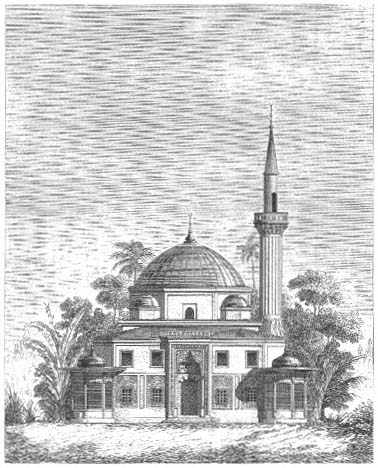
Figure 57.
Parvillée, facade of the mosque, Paris, 1867 ( Gazette des
architectes et du bâtiment, special issue, Paris, 1867).
The "rules" of Ottoman architecture "discovered" by Parvillée and acclaimed by Baudot and Viollet-le-Duc have not been challenged by historians of Ottoman architecture. While their premise is open to question, their impact was concrete in the Ottoman pavilions in 1867, which appeared as an awkward marriage of Ottoman architectural forms and the rules of French academicism.[9]
The mosque had a main hall, called the salle du mihrab by Parvillée, as well as a rectangular room divided into three parts: the ablution hall, the salle des horloges, and the entrance lobby where shoes were stored (Figs. 56–59). Two
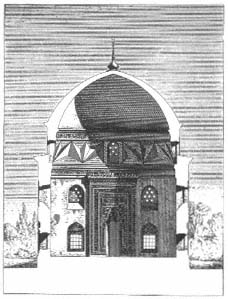
Figure 58.
Parvillée, section through the mosque,
Paris, 1867 (Gazette des architectes et
du bâtiment, special issue, Paris, 1867).
round symmetrical "verandas" framed the mosque. There were no precedents in Ottoman mosque types for such an arrangement of spaces and functions. Ablution fountains were either outside—in the courtyards or along the facades—or at the center of interior halls under large domes, as in the fourteenth- and fifteenth-century Bursa examples. A salle des horloges and verandas were not components of mosques. The architect thus had integrated these new elements into his mosque, using Ottoman forms to create a symmetrical Beaux-Arts plan. The verandas, for example, were shaped like sebil s, "drinking fountains." The only element breaking the symmetry was the inevitable minaret. Parvillée demonstrated his knowledge of Ottoman architecture and his sensitivity to scale and proportion by not doubling this element for the sake of symmetry. According to Théophile Gautier, because of Parvillée's care in reducing the scale of the Bursa mosque by exactly one-half, the re-creation gave the same impression as the original. The ornamentation, however, already very delicate in Bursa, became much too "cute" (mignonne ) for Gautier.[10]
Baudot approved Parvillée's use of a "very original" geometric canvas as well as his juxtaposition of green, blue, white, and yellow tiles on a blue background. The rich harmony of the decoration and the variety of its geometric combinations seemed to Baudot to offer valuable lessons to contemporary artists.[11]
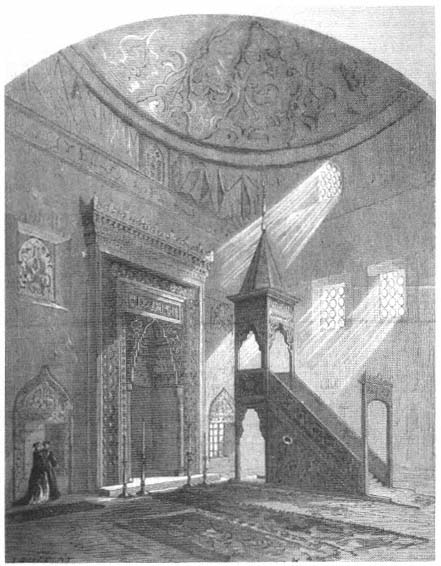
Figure 59.
Interior view of the mosque, Paris, 1867 ( L'Exposition universelle de 1867 illustrée ).
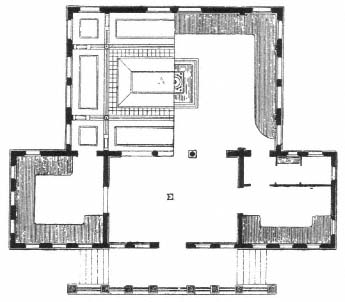
Figure 60.
Parvillée, plan of the Pavillon du Bosphore, Paris, 1867
(Gazette des architectes et du bâtiment, special issue,
Paris, 1867).
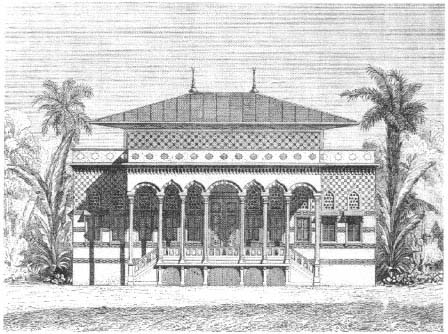
Figure 61.
Parvillée, facade of the Pavillon du Bosphore, Paris, 1867
(Gazette des architectes et du bâtiment, special issue, Paris, 1867).
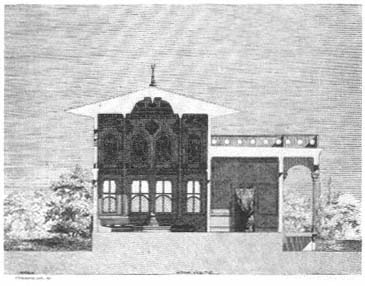
Figure 62.
Parvillée, section through the Pavillon du Bosphore, Paris, 1867
(Gazette des architectes et du bâtiment, special issue, Paris, 1867).
The residential structure, the Pavillon du Bosphore, consisted of a vestibule and a main hall (Figs. 60–63). The vestibule opened to a terrace and had service rooms at either end that communicated with the large main room,[12] which was surrounded by a built-in divan covered with colorful fabric. The water in the small pool in the center was perfumed with jasmine.[13] Baudot found the exterior of the building "picturesque and agreeable in its proportions but very simple." Inside, however, the main room was interesting, especially for its colors and light. Daylight entered at two levels from three sides, softened by the stained glass of the lower level's windows. The lower interior wall was defined by the windows and simple woodwork, the upper one by decorative panels; the ceiling was exquisitely detailed in wood. The dominant colors inside were green, blue, red, and white. Arguing once again that modern European art should learn how to use this rich resource, Baudot concluded that the contemporary French interior, covered with papier-mâché and "loud paintings," was "shabby" (mesquin ) and banal by comparison.[14] Such sentiments about ornamentation were not restricted to the architectural community but were also expressed in the popular press. One reporter wrote: "Ah, we Occidentals, who believe that we know all about the refinement of luxury; there is a lot for us to learn from the Orientals . . . on the art of interior decoration."[15]
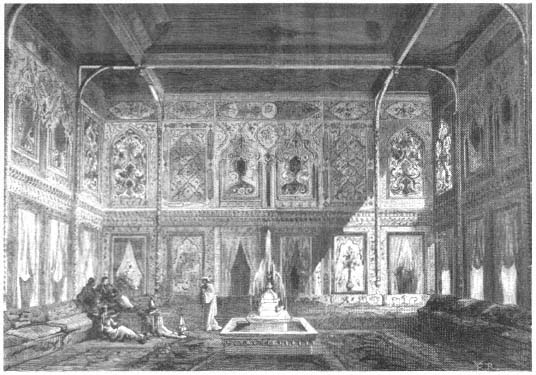
Figure 63.
Interior of the Pavillon du Bosphore, Paris, 1867 ( L'Exposition universelle de 1867 illustrée ).
Parvillée's bath had three rooms: a dressing room (at right in Figs. 64–65), a warm room (center), and a main room, lined with benches, with a small pool in each corner (left). A dome pierced by small lanterns in the Ottoman fashion rose over the main room. Symmetry was achieved on the exterior by a second dome over the dressing room. For Baudot, the point here was the faithful repetition of an Ottoman building type.[16]
Baudot was cautious in basing any conclusions about Ottoman architecture on these pavilions. He admitted that the construction raisonnée of Ottoman architecture could not be clearly understood through these temporary structures, but he claimed nonetheless that the high quality of their interior decoration, along with the coherence (unité ) and the "rather significant frankness of expression" of these structures, made them interesting to study.[17] Within the general framework of late nineteenth-century Western architecture, the key
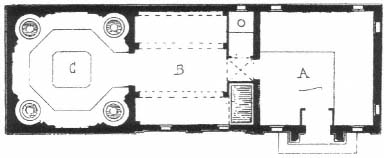
Figure 64.
Parvillée, plan of the bath, Paris, 1867 ( Gazette des architectes
et du bâtiment, special issue, Paris, 1867).
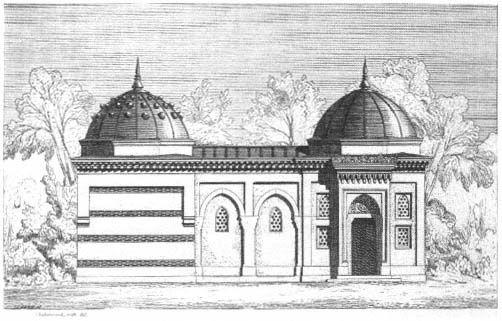
Figure 65.
Parvillée, facade of the bath, Paris, 1867 ( Gazette des architectes et du bâtiment,
special issue, Paris, 1867).
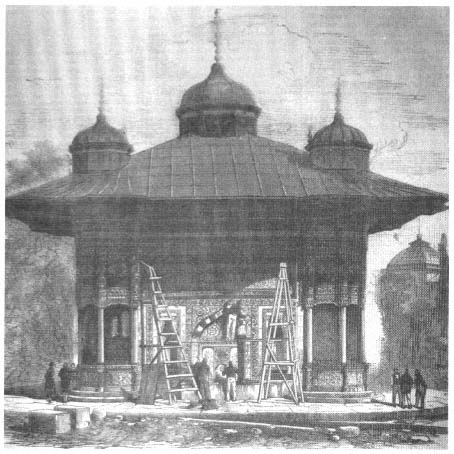
Figure 66.
Ottoman pavilion, Vienna, 1873 (L'Esposizione universale di Viena, no. 3).
terms are "coherence" and "frankness of expression," the interrelated goals of the time.
The "Ottoman style" (Osmanli biçiminde ) pavilion of the 1873 Vienna exposition, a replica of the Sultan Ahmed Fountain near Hagia Sophia in Istanbul, records a similar concern with historical precedent (Fig. 66). The Sultan Ahmed Fountain is a small pavilion with a sebil at each corner from which water and sherbet were served to the public. The elaborately carved facades and the rounded corners reflect a baroque influence on eighteenth-century Ottoman architecture in Istanbul. There were several reasons to exhibit this building abroad: its scale was appropriate for pavilions; it was a highly visible
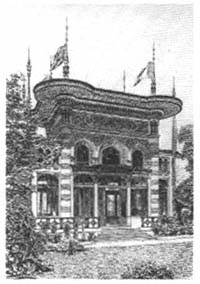
Figure 67.
Pavilion of Turkish Tobacco,
Paris, 1889 (Bibliothèque
Nationale, Département des
Estampes et de la Photographie).
public monument belonging to the recent past; it was a fresh interpretation of Ottoman forms under European influences; and, finally, it was a playful structure.
The 1873 building, unlike the pavilions of 1867, was a faithful full-scale copy. Ottoman artisans had crafted the details of the facade panels, and most of the materials (such as the tiles of the overhanging eaves) were brought from Turkey. Authenticity was a primary goal.
The other two Ottoman buildings erected in Vienna in 1873 were looser interpretations of Ottoman styles. The Sultan's Treasury was a two-story centralized structure, covered with a high dome, that may have derived from royal mausoleums (see Fig. 28). Outside, it had a large staircase to the main level and arcaded projecting porches. Because the building housed a valuable collection of jewels, its design was deliberately "luxurious" in detail.[18] Indeed, due to the exorbitant amount of money spent on it, the government ordered that some of the furniture be reused. The magnificent display cases were later placed in schools, museums, and other public buildings at home.[19]
The architecture of the Sultan Ahmed Fountain was recycled in the 1889 Paris exposition in the Pavilion of Turkish Tobacco (Fig. 67). Although it was
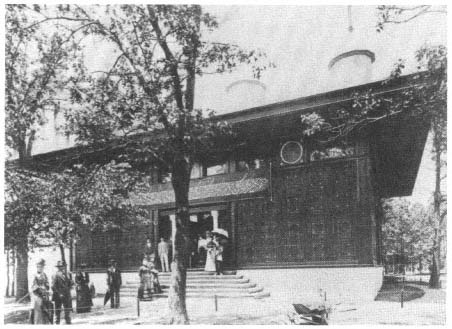
Figure 68.
Ottoman pavilion, Chicago, 1893 (World's Columbian Exposition, vol. 2).
not a major presence at this fair, with its overhanging roof, tripartite facade, rounded corners, and clearly delineated horizontal bands, it came to represent Ottoman architecture. As mentioned earlier, the Ottoman government had chosen not to participate in this exposition.
At the 1893 World's Columbian Exposition in Chicago the main Ottoman pavilion, placed with other national pavilions in Jackson Park, away from the Midway Plaisance, again referred to the Sultan Ahmed Fountain, described now as a "landmark of splendor and magnificence" by an Ottoman spokesman (Fig. 68). But the Chicago pavilion experimented with an approach different from that of the Vienna pavilion, for it was designed as an exhibition building—a new and consciously created type. Built on a larger scale than the fountain, the 1893 pavilion interpreted the formal and decorative principles of the historical structure, editing out some features (the curving sebil s at the corners) and adding others (the stairs leading to the central entrance). The pavilion's tripartite facade was simpler than that of the fountain. The rectangular structure, boxier than the original, had an overhanging roof, which further emphasized
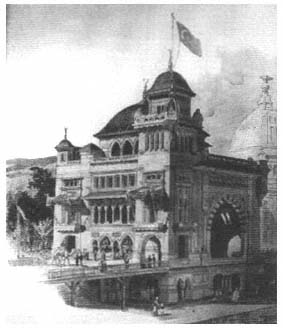
Figure 69.
Ottoman pavilion, Paris, 1900 (L'Esposizione
universale del 1900 a Parigi ).
its horizontality. Although the roof with its eaves and domes mimicked that of the Sultan Ahmed Fountain, the arches over the side door and windows, with their pointed tops (not visible in Fig. 68), were departures from the original model. The exterior decoration of the stone fountain was evoked in the wood panels of the facades, "carved in arabesques and traceries," fabricated in Damascus by local artisans and shipped to Chicago.[20] The orthogonal panels created an overall planar effect. This was almost a "modern" building, and according to some sources it was designed by a Chicago architect named J. A. Thain, although the scheme was specified by the imperial commission.[21]
The Ottoman pavilion at the 1900 Universal Exposition in Paris was an elaborate exhibition hall on the Rue des Nations (Fig. 69; see also Fig. 50). As if to compensate for its absence from the 1878 and 1889 expositions, the Ottoman government spent the considerable sum of $70,000 on the 1900 pavilion, designed by the French architect Adrien-René Dubuisson. A two-story porch delineated by a vast pointed arch dominated the riverfront. The structure had a bazaar, artisans' workshops, and a café on the ground floor; an in-
dustrial exposition on the first floor; and, on the second floor, a military museum modeled after the Military Museum in the Church of Hagia Eirene in Istanbul and a theater where operettas representing vignettes from Turkish life were performed.[22] Unlike other, earlier, Ottoman pavilions, which borrowed easily recognizable fragments from well-known monuments and combined them anew, this building made no direct reference to particular Ottoman monuments; it was an experiment in a broadly defined neo-Islamic style.
Western observers were puzzled by the style of this pavilion. An American observer described it as a "handsome structure, but Turkish throughout"; he seemed pleased that "no critic had yet ventured to place it in the renaissance style."[23] Others used known references to explain it. One French writer thought that Dubuisson had been inspired by "the most beautiful monuments of Constantinople, in particular the Mosque of Süleyman from the mid-seventeenth century [sic ]," accepted by many as the high point of the Turkish style. This same writer linked the great arch facing the river with the Mosque of Sultan Qaytbay in Cairo from the late Mamluk period, which had no relation to the "Turkish" architecture of Istanbul.[24] Another observer saw in it elements of architecture from the mosques of Qaytbay, Süleyman, Beyazid, and Murad IV as well as from Hagia Sophia and the Fountain of Top-Hane.[25] Still another proposed that here was a brilliant synthesis of pure Ottoman architectural forms:
Under the pretext of Orientalism, only Arab art—true or imitation—has been presented to us Occidentals until now. But Monsieur Dubuisson is showing us at last, for the first time, pure Ottoman art. . . . Here the eminent architect has made a synthesis of Ottoman art. In an ensemble that he brilliantly conceived, he grafted the important parts and true details of the most beautiful monuments of the pure style of Turkey.[26]
The discrepancies among the accounts reflect the building's potpourri of forms and elements, in most cases highly reinterpreted, from Islamic architecture of different periods and regions. Several buildings erected in Istanbul toward the end of the nineteenth century reveal a similar eclecticism—for example, the 1889 Terminal of the Orient Express, designed by the German architect Jachmund, who incorporated references from several regions of Islam (Mamluk, Moorish, and Ottoman) into the facades of a technologically advanced structure that was a well-established "type," the train station (see Fig. 103).