
Proposition 6—
Theorem 5
Proposition 6. If a body in a nonresisting space should revolve in any orbit around an immobile center and should describe any just nascent arc in a minimal time, and if the sagitta of the arc should be understood to be drawn so that it would bisect the chord, and when produced, would pass through the center of the forces ; [then ] the force in the middle of the arc will be as the sagitta directly and the square of the time inversely .
For the sagitta in a given time is as the force (by Proposition 1, Corollary 4 ), and on increasing the time in any ratio, because the arc is increased in the same ratio, the sagitta is increased in that ratio doubled (by Corollaries 2 and 3 of Lemma 11 ), and thus it is as the force and the square of the time jointly. Let the doubled ratio of the time be taken away from each side, and the force will be as the sagitta directly and the square of the time inversely. Which was to be proven .
The same thing is easily demonstrated by Corollary 4 of Lemma 10 .
Corollary 1. If a body P by revolving around the center S, should describe any curved line APQ, and if the straight line ZPR should touch that curve at any point P, and if to this tangent from any other point Q of the curve , QR should be drawn parallel to the distance SP, and if QT should be dropped perpendicular to the distance SP; [then ] I assert that the centripetal force will be reciprocally as the solid SP2 × QT2 / QR, provided that the quantity of that solid that ultimately occurs when the points P and Q coalesce is always taken. For QR is equal to the sagitta of double the arc QP, in the middle of which is P, and the double of the triangle SQP, or SP × QT, is proportional to the time in which that double arc is described; and thus it can be written as an expression of the time .
Corollary 2. By the same argument the centripetal force is reciprocally as the solid SY2 × QP2 / QR, if only there is constructed the perpendicular SY dropped from the center of forces onto the tangent PR of the orbit. For the rectangles SY × QP and SP × QT are equal .
See figure 9.8. As the point Q approaches the point P , then the arc QP approaches the tangent segment RP . Thus, the triangles TQP and YSP become similar and therefore SY / SP = QT / QP or as Newton states it, "the rectangles SY × QP and SP × QT are equal." The linear dynamics ratio QR / (QT2 × SP2 ) thus can be written as QR / (SY2 × QP2 ).
Corollary 3. If the orbit is either a circle, or touches a circle concentrically, or cuts it concentrically, that is, contains the minimal angle of contact or of section, having the same curvature and the same radius of curvature at point P; and if there is constructed the chord PV of this circle, drawn from the body through the center of forces ; [then ] the centripetal force will be reciprocally as the solid SY2 × PV; for PV is QP2 / QR.
Figure 9.9A is a diagram based on Euclid, Book 3, Proposition 35, in which it is demonstrated that the products AE × EC and BE × ED of the segments of the chords of a circle are equal (or from Proposition 15, Book 1 of Apollonius's Conics ; see figure 5.12). Figure 9.9B is a diagram of that Euclidian proposition applied to the circle of curvature at a point P of a general
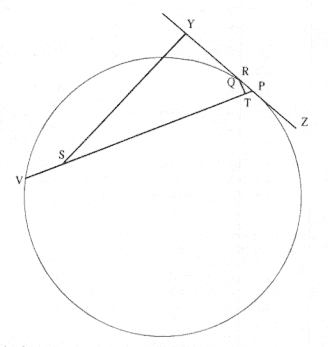
Figure 9.8
As the point Q approaches the point P the angle TQP approaches
the angle YSP , and triangles TQP and YSP are similar.
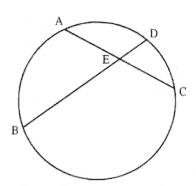
Figure 9.9A
Based on Proposition 35, Book 3 of
Euclid's Elements : AE × EC = BE × ED .
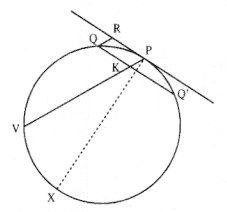
Figure 9.9B
Euclid's Proposition 35 applied to the
circle of curvature in Newton's Proposition 6:
QK × KQ' = VK × KP .
curve (not shown). Thus, QK × KQ' = PK × KP where KP = QR because PRQK is a parallelogram by construction. In the limit as the point Q approaches the point P , then PK approaches PV and QK approaches KQ' or QP . Thus, QP × QP = PV × QR or, as Newton states, "PV is as QP2 / QR ." Thus, the reciprocal measure of the force from Corollary 2, (SY2 × QP2 ) / QR , can be written as SY2 × (QP2 / QR ) or SY2 × PV .
Corollary 4. With the same suppositions, the centripetal force is as the square of the velocity directly and the chord inversely. For the velocity is reciprocally as the perpendicular SY, by Corollary 1 of Proposition 1 .
From Corollary 3, the force is proportional to 1 / SY2 × PV and from Corollary 1 of Proposition 1, the velocity v is inversely proportional to SY , the perpendicular to the tangent through the center of force S . Thus, the force is proportional to v2 / PV .
Corollary 5. Hence if any curvilinear figure APQ is given, and on it a point S is also given, toward which a centripetal force is perpetually directed, there can be found a law of centripetal force, whereby any body P, perpetually drawn back from a rectilinear course, will be confined in the perimeter of that figure and will describe it by its revolution. Of course there must be computed either the solid SP2 × QT2over QR or the solid SY2 × PV reciprocally proportional to this force. We shall give examples of this in the following problems .
In this demonstration of Proposition 6, the circular dynamics ratio is derived from the linear dynamics ratio. Newton has elsewhere reversed the procedure and obtained the circular dynamics ratio directly without any reference to the linear ratio.