
Instructions for Use
Learning was now to be separated from the practices in which it was entwined, assigning it a distinct place, the school, and a distinct period of life, that of youth. 'L'instruction publique' (al-tarbiya al-umumiyya in Arabic) was the novel phrase for this practice. It referred, it was said, to 'that which is studied by boys and girls in schools and colleges and in all establishments where a specific number of people are brought together for instruction'.[70] Schooling was to be an autonomous field, defined not by its subject or method, but as an activity that took place in a specialised location, among
a specific group of people of a particular age. The organisation (tartib ) of instruction, wrote Rifa'a al-Tahtawi, required that a room be taken in the market or the main street of the town and set aside for the purpose of teaching. Children were not to be taught in places that served other functions, particularly not in the mosque.[71] This coincided with the administrative separation, in April 1868, of what were to be called the 'civil schools' from the military.[72] The new civilian education was to be entirely separate from the military project, just as it was to be separate from the life and the learning of the mosque; its purpose was the discipline and improvement of every individual.
The word education (tarbiya ) in this sense was itself a new usage. In Rifa'a al-Tahtawi's well-known work Takhlis al-ibriz , published in 1834, the first modern Arabic account of Europe, the term tarbiya does not occur, except once or twice in the word's general sense of 'to breed' or 'to produce', as in a description of the Ecole Polytechnique in Paris: 'In the Polytechnique mathematics and physics are taught, to produce engineers (li-tarbiyat muhandisin ).' Nor is there any single word in its place, referring to the distinctive social practice of education.[73] The themes of the book's description of learning, like its description of Europe in general, are order and organisation. Its opening pages are addressed to those who criticised Muhammad Ali for building a military order using experts from Europe: 'Look at the workshops,' he wrote, 'the factories, the schools and the like, and look at the discipline (tartib ) of the soldiers of the army ... the order.'[74] The subject of the book is this same discipline and order as it was found in France, in all its aspects.
The section of the work which discusses learning in Paris in some detail begins with the title 'The progress in fields of knowledge, skills, and manufacture among the Parisians, and their organisation'. The editor of the 1973 edition of Tahtawi's works entitled the same section 'Knowledge, skills, and education among the French', substituting the word education (tarbiya ) for the similar-sounding word organisation (tartib ) and omitting the word manufacture which no longer fits.[75] In making the substitution the editor had repeated a transformation in vocabulary and in thinking that actually occurred in nineteenth-century Egypt. The word tartib , meaning such things as 'arrangement (into ranks)', 'organisation', 'discipline', 'rule', 'regulation' (hence even 'government'), was replaced in the field of learning where it had come to be universally used by the like-sounding word tarbiya . Until perhaps the last third of the nineteenth century tarbiya had meant simply "to breed' or 'to cultivate', referring, as in English, to anything that should be helped to grow - the cotton crop, cattle or the morals of children. It came to mean 'education', the new field of practices developed in the last third of the century.[76]
As schooling was introduced to achieve this discipline, those who were responsible for its organisation and inspection wrote books and manuals in which the new practices were discussed. In 1872, for example, Tahtawi published his principal work on education, al-Murshid al-amin li-l-banat wa-l-banin , a guidebook for boys and girls, in which he explained the need for the new educational practices in terms of human nature. 'Man emerges from the mother's stomach knowing nothing and capable of nothing, except by education (al-tarbiya wa-l-ta 'lim ).' Upon the process of instruction depended his ability to sustain himself, to use language, and to think. For these, Tahtawi explained, 'he needs to be equipped by endless drilling and practice and exercise over a length of time'.[77] The language suggests immediately an extension of the techniques originally introduced in the military. And it was towards the very possibility of the country's military and political strength that the language led back. The abilities formed by the endless drilling and exercise of education enabled people to harmonise and associate with one another, in order to create a community. By developing this capacity to the fullest extent, the community gained its strength and acquired the ability to dominate others.[78]
Thus Tahtawi now distinguished between two senses of the term education (tarbiya ). The first was what he called 'the tarbiya of the human species', using the word in its older sense as the cultivation, breeding or production of some particular thing. In this case it referred to 'the tarbiya of the human being as such, that is, making the body and the mental faculties grow'. The second sense was 'the tarbiya of individual human beings, which means the tarbiya of communities and nations'. It was the second meaning that was new and that came to count. The official government textbook on education published in 1903 began with the clear statement that 'the tarbiya of things does not mean making them increase in size'. Rather, tarbiya referred to the discipline and exercise of individuals, which would coordinate them to perform as a unit. 'It means putting them in readiness and strengthening them to perform their function as required, in the most efficient manner. There is no way to educate and strengthen something, except by training and drilling it in the performance of its function, until it can accomplish it with smoothness, speed, and precision.' The author of this textbook was Abd al-Aziz Jawish, who had spent three years training at the Borough Road School in London, the school set up by Joseph Lancaster to train teachers for his monitorial schools. He went on to become Inspector-General at the Ministry of Education, and was later a founder of the National Party and the editor of its newspaper al-Liwa '.[79]
The case of Jarwish can remind us that the new discipline of education was to be implemented not only through organised schooling. Schooling was only a part of the wider political process of discipline and instruction.
Husayn al-Marsafi, the senior professor at the new government teacher training college, set up in the same period to produce instructors for the village schools, explained that there were three parts to the meaning of education - three institutions in which this new hold upon the individual would be developed: the school, the political assembly, and the press.[80] Marsafi's more famous colleague at the training college, the great reformist thinker Muhammad Abduh, developed a similar view of tarbiya . Education, for him, expressed the necessary political role of the intellectual, who would use as his particular 'school' the new organs of the press.[81] Having discussed already both the government schools and the political assembly, I want to look briefly at the importance of the new printing presses.
In 1868 an organisation called the Society of Knowledge for the Publication of Useful Books (Jam'iyyat al-ma'arif li-nashr al-kutub al-nafi'a) was founded in Cairo by Muhammad Arif Pasha, one of the graduates of the Egyptian school in Paris. It was perhaps modelled on Lord Brougham's Society for the Diffusion of Useful Knowledge, the organisation set up to teach the values of self-discipline and industriousness to the working class of England. Muhammad Arif was a high-ranking government official, as were many of the other men involved in its founding. It was established by general subscription, and 660 people participated as shareholders, most of them landowners or government officials.[82] As part of the same process of 'education', the government also began the publication of journals, newspapers and books.
Since the year 1828 the government had produced an official gazette, al-Waqa'i' al-Misriyya , for the announcing of decisions, decrees, appointments, public works, and other domestic events, up until the 1850s, during the reign of Sa'id, when it had ceased to appear.[83] In December 1865 it was decided to produce the gazette again, but in a new form, with a new and more careful purpose. 'Rather than announce its affairs to the world through its own officials,' an internal order stated, 'the government has decided to give the right of producing the gazette to an editor, who will publish without the government's intervention.' This decision marked an alteration in technique, not a relinquishing of control. Two government servants, Ahmad Rasikh Efendi of the Office of Foreign Affairs and Mustafa Rasmi Efendi from the retinue of the Khedive, were appointed to the new Office of the Gazette, and instructions were issued to the Minister of Finance that 'they are to continue to be considered government servants and be given the salary and benefits of government employees, and are to receive pay from no other source.'[84]
The change in technique corresponded to a change in the nature of what was published. The gazette was no longer to be simply a written announcement of the government's orders and instructions, precisely as government
itself was no longer conceived as the mere issuing and enforcement of orders. Information and instructions were to become the method of politics, something 'useful' which the political process was to publish and make public. There was an entire realm of thought, of meaning to be made public (while the authors of this public knowledge were to become more hidden, to disguise themselves).
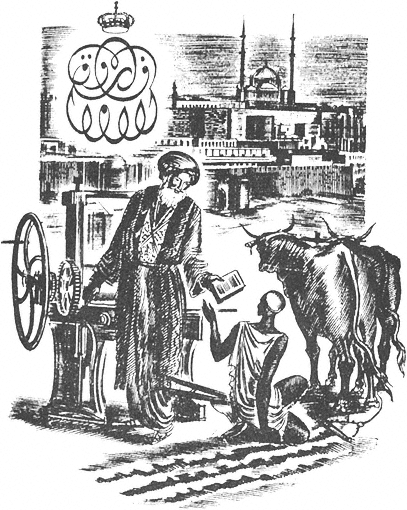
9 The ex libris of King Farouk.
Following the reestablishment of the gazette, the government became more and more involved in the publishing of journals. In 1867 a weekly journal named Wadi al-Nil , the first Egyptian journal that was not an official organ, was published under the editorship of Abdullah Efendi Abu Sa'ud. Abu Sa'ud, however, was an official of the Bureau of Schools, and the journal was actually established and funded by the government.[85] Three years later, in April 1870, another journal appeared, this time issued publicly by the Bureau of Schools, entitled Rawdat al-madaris . This monthly journal was devoted to the spread of modern subjects of knowledge, and was printed and distributed free to all students in the new government schools. It was under the supervision of Rifa'a al-Tahtawi, all of whose subsequent writings were first published in its pages.