
INTRODUCTION
A nation has no individuality. No single phrase can fairly sum up the characteristics of a people. But a town is like one face picked out of a crowd. . . . In all [its] slow development a character that is individual and inseparable is gradually formed. . . . It is to be found first in the geographical laws of permanent or slowly changed surroundings, and secondly, in the outward aspect of the dwellings built by man.
—Theodore Andrea Cook, 1899
Shaping the face of a great city is a complex task. Order within a metropolitan region results from the accumulation of layer upon layer of social, economic, cultural, and political sediment. For the vast majority of the inhabitants, much of what takes place in a city seems spontaneous. To the extent that conscious rationality determines a city's fate, it appears as a sum of the rationalities of its constituent parts. Otherwise, the ecology of a city emerges from a multitude of processes—small and large; local, regional, and national; micro- and macrolevel—controlled in theory, at least, by the market and/or autocrat looming mysteriously out of the sight of most residents.[1]
Decades, even centuries, of intellectual, financial, and political effort have been expended in the attempt to come to terms with the urban experience. Over the years, the veil concealing the motivational forces underlying urban growth and development has been turned up at the corner. Throughout much of this century, cities around the world have sought to gain control of their urban destinies through concerted government action intended to mold their economic, social, cultural, and architectural futures. Nowhere has this process of state interventionism gone further than in the Soviet Union, where socialist revolutionaries wrested ownership of all land away from landlords, granting the centralized state full command over physical and, eventually, economic planning.
In contrast, American observers of urban life find it difficult to conceptualize urban development in the absence of the market. So much of what we say, write, and think about our cities is dominated by an obsession with the most overt manifestations of the market: land
values, the fees of real estate agents, taxes of various kinds, utility rates, consumption levels, media markets, and the like. Americans intuitively defer to the logic of the market, understanding how its relentless energy imposes order on the chaos of metropolitan development. By examining such market-oriented factors, commentators predict with confidence such monumental events as the cloning of Manhattan in Hoboken, Weehawken, and Secaucus, or the construction of more commercial and residential "space" in the sleepy northern Virginia hamlet of Tyson's Corner than is found in the central business districts of many world capitals. The market is no mystery to American students of and participants in urban affairs. Nor, for that matter, are the various mechanisms (legal and otherwise) available to local politicians, planners, and real estate developers who wish to produce a given set of environmental and spatial outcomes in one metropolitan region or another. What remains largely shrouded from view, however, are the strategies used by local politicians, planners, and managers in a highly centralized and bureaucratized nonmarket political economy like that of the Soviet Union, as they attempt to shape and reshape their neighborhoods, cities, and metropolitan regions.
Nonmarket Metropolitan Strategies
The central purpose of this volume will be to explore some of the ways in which local and regional political, economic, and cultural leaders in a major Soviet metropolis, Leningrad, determine the physical and socioeconomic contours of their city and region. The study attempts to establish the importance within Leningrad of those economic variables deemed so crucial to sound development in the American milieu: maintenance and expansion of local productive capacity and labor supplies, enhanced access to resources of all kinds, and the like. It sets forth various bureaucratic and political strategies for obtaining economic objectives, searching for behavior patterns that differentiate market and nonmarket experiences. To what extent, for example, do competing national, regional, and local policy vistas determine planning strategies? The boundaries for autonomous action by local Soviet[*] politicians, planners, and managers emerge as we inquire into the nature and process of planning this major metropolitan region.
It is significant that, in searching out these varied patterns, three hitherto ignored features of the Soviet urban experience reveal them-
[*] "Soviet" (with an upper case "S") will be used throughout this work to refer to phenomena that are national in character and may be thought of as being "of the USSR"; "soviet" (with a lowercase "s") will be used to refer to the various local, regional, republic, and national legislative bodies of the USSR and their constituent parts.
selves. First, this study demonstrates that Leningrad's leaders play a dual role in urban governance in that they become political and bureaucratic brokers between the center and the periphery.[2] They serve this broker function as much as they merely impose central authority on the local scene or represent their distinctly local interests before central institutions. The resulting vision of regional and municipal leaders as being activist and vigorous intermediaries, between and among central and local institutions, stands at odds with more passive images deduced from the Soviet Union's centrally controlled political and economic systems.[3] This brokerage function may be seen both in the relationship between institutions physically located at the political center and those on the periphery and in the relationship among local institutions and representatives of central interests physically located on the periphery. While local municipal institutions such as the soviets (or councils)[4] are responsible for the balanced development of a given jurisdiction, industrial enterprises and other institutions directly subordinate to the ministries in Moscow are evaluated according to their fulfillment of central goals and objectives. This unending tension between economic center and territorial unit dominates strategies intended to guide socioeconomic and physical development in Leningrad, as well as more generally in other Soviet cities and their regions.
Second, this volume posits a regional policy innovation cycle that stands in stark contrast to existing notions of how the Soviet system operates. Indeed, the mere existence of such a cycle may surprise some readers. The cycle will be set forth in greater detail throughout the study. It is important to recognize, however, that it is precisely at the regional level that Soviet politicians and administrators struggle to bring local empirical reality into conformity with central policy pronouncements. The gap between reality and pronouncement produces small-scale creative responses that will have an impact on both central practice and central policy. In this manner, local officials attempt to recast central policy initiatives to reflect local conditions better and, in so doing, to influence future central policies.
Third, this book shows how city planning efforts in Leningrad have become ever more regional in scope. Prerevolutionary physical planning schemes, dating back to the initial ill-fated 1717 city design of Alexandre-Jean-Baptiste Le Blond through to Ivan Fomin's "New Petersburg" projections nearly two centuries later, sought to mold construction efforts essentially within the city and its immediate surroundings. The grandiose Soviet-era plans of the 1930s were similarly city-focused, even as they projected the abandonment of the nineteenth-century city center in favor of an expansive new socialist city to the south. By the 1960s, however, local planning efforts extended beyond physical concerns to encompass economic and, eventually, social variables. Simultaneously, the planning region grew beyond the juridical
bounds of the city soviet (hereafter referred to as the "city of Leningrad" or, more simply, the "city"), an area nearly the size of the city of Chicago, to incorporate the entire metropolitan area (hereafter referred to as the "Leningrad metropolitan area" or, more simply, the "Leningrad area"), an area approximately the size of the city of Houston. Finally, in large part as a consequence of the growing influence of Western systems approaches on Soviet urban and geographical thought, the 1986 general plan—which serves as the termination point for this particular study—incorporated within its scope the entire Leningrad region, or oblast (oblast' , hereafter usually referred to as the "Leningrad region" or, more simply, the "region"), a unit only slightly smaller than the state of Indiana (see Maps 1-2).
An Urban Future
While exploring these dimensions of urban management, we must remember that Leningrad long predates the coming to power of the Bolsheviks. Municipal and regional officials in Leningrad, as well as in many other Soviet cities founded prior to 1917, must struggle to match local reality with central decrees within a quite distinct pre-revolutionary environment. This necessary blending of pre- and post-revolutionary inheritances was initially complicated by the Bolsheviks' own ill-defined sense when they seized power that existing urban conditions must somehow be changed.[5] In February 1918, the new Soviet government nationalized land and, eight months later, abolished private property in cities.[6] These policies elevated the state to the status of single agent for all large-scale construction and planning—a condition that perhaps more than any other single factor explains the arid, monotonous, and even oppressive character of much Soviet urban development ever since.
During the 1920s, politicians, planners, and architects engaged in extensive theoretical debates on nearly every urban planning, management, and architectural issue.[7] Throughout most of the decade, the search for new forms of socialist urban settlement was often obscured by factional disputes, which engaged competing groups whose origins lay in prewar Europe and Russia. In essence, these debates narrowed to a disagreement between theorists such as Leonid Sabsovich, who demanded the urbanization of rural areas into nodal points, and their counterparts such as Nikolai Miliutin and Ivan Leonidov, who proposed the dispersal of cities along continuous linear communities adjacent to transportation and power corridors.[8] The second group offered what Sabsovich decried as "automobile socialism." They envisioned services and employment dispersed along efficient road systems linked by fast, flexible, and individually operated transportation.[9] While such a "Cali-
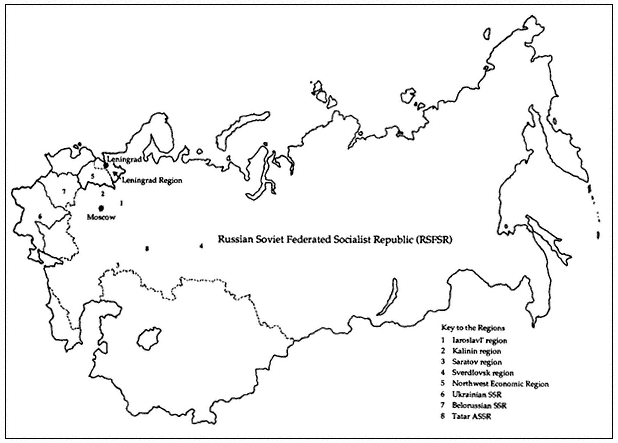
Map 1.
The Russian Soviet Federated Socialist Republic (RSFSR) in the Union of Soviet Socialist Republics (USSR),
showing the Leningrad region (oblast) and the major sources of postwar population migration to Leningrad.
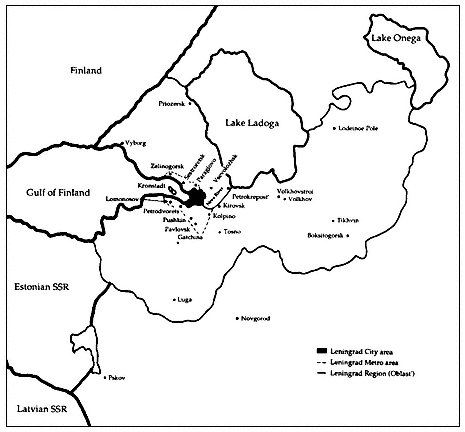
Map 2.
The Leningrad region (oblast), showing the city of Leningrad, the Leningrad metro-
politan area, Leningrad's suburban communities, and the Leningrad urban system.
fornization" of the Soviet hinterland has never taken place, the demands of the "deurbanists" for population ceilings, functional zoning, residential superblocks (or "minidistricts"), and new town development all became incorporated into Soviet holy writ.[10] More significantly, behind both positions lay an essentially antiurban orientation. The city—at least as it then existed—was an artifact of a capitalist or even feudal past. The Soviet future would be based on some new spatial configuration.
Few of the more radical proposals of the 1920s ever left the drawing board. Not only were financial and human resources in critically short supply, but the workers for whom many such projects were designed remained leery of the collective living arrangements of the more extravagant antiurban programs. In addition, by the 1930s, rapid industrialization had become the Soviet state's primary objective, and most political leaders were losing whatever interest they may have had in futuristic urban vistas. As tens of thousands of peasants streamed daily into bloating cities, expediency dictated an urban solution to the debate over the character of socialist cities. In 1931, Lazar Kaganovich brought the antiurbanist revolt to an abrupt conclusion with an address noting that the nationalization of private property made all Soviet cities socialist by definition.[11] He warned that the party would consider any effort to dispute such a position nothing less than sabotage, and this, it should be remembered, was a capital offense.
Kaganovich's declaration ended more than a decade of painful bickering among professionals charged with municipal management. By 1931 there could no longer be any doubt that the Soviet Union's future was to be urban. The massive industrialization drive, focused as it was on cities, necessarily meant that the Soviet Union would emerge as one of the world's leading urban societies.[12] In 1970, for example, the Soviet Union was one of the seven countries in the world with an urban population of over 50 million. By the 1980s, nearly two-thirds of the Soviet population had come to live in urban areas (in the United States, by comparison, almost three-quarters of the population resides in urban areas). Moreover, the Soviet Union has become a world leader in the number of urban centers with more than a million in population.[13] Stalin's industrial vision was an urban vision, so it followed that cities would emerge as pivotal elements in the overall industrial system.
Ministries vs. Municipalities
Stalin's new society was not only urban, it was also planned—planned from above. Soviet economic planning in its pure form has been all-encompassing, with every individual output predetermined by
central planners in Moscow, for whom no specification was too small to receive their undivided attention. Despite remarkable zealotry on the part of Stalin's planners, however, even they could not be everywhere at once. Hence, responsibility was delegated primarily to economic ministries organized along the production principle (i.e., each ministry was responsible for a limited number of interrelated economic sectors).
Such a chain of command established primary operating rules for a city's economic leaders, flowing downward from the national state planning agency, Gosplan,[14] through the industrial ministries to the individual enterprise, and eventually to the shop floor. At each regional level within the administrative hierarchy, however, ministerial officials were also attached to the primary regional governing body—the soviet—and were to act in accordance with the needs of the locality. This complex supervisory system created bureaucratic contradictions and tensions that have remained unresolved and continue to dominate Soviet municipal administration to this day.[15] Over time, it created an environment that required city and regional officials to serve as brokers and intermediaries between local and national interests.
State administration in the Soviet Union is based on a dual system of organizational subordination—a situation that prompted Mikhail Gorbachev's 1988 proposals for a reorganization of local administration. Local government agencies—the soviets—are responsible for the activities of their own constituent agencies and for the activities of institutions and organizations located within their territorial jurisdictions but not directly subordinate to them.[16]
As may be seen by examining the solid lines in Chart 1, "all-union" ministries are directly subordinate to the USSR Council of Ministers, while "union-republic" ministries are subordinate to republican councils, which, in turn, are subordinate to the USSR Council of Ministers. In other words, all-union ministries—which tend to be in heavy industry, such as the Ministry of Machine-Building—have no republic-level counterpart, operating as a single centralized unit for the country as a whole. Union-republic ministries such as the Ministry of Finance, on the other hand, are responsible for coordinating the work of ministries of the same name and similar purpose operating within each of the Soviet Union's fifteen republics. To complete this overview of the Council of Ministers, we should note that, in addition to ministries responsible for management of a single economic sector, several state committees retain responsibilities that cut across a number of economic branches and issue decrees that govern activities of more than one ministry. The USSR State Committee on Construction, Gosstroi, is one such institution that will appear from time to time in this volume.
Major enterprises are directly subordinate to either union-republic or all-union ministries. Less important enterprises, however, remain subordinate to regional or city soviets and to their administrative de-
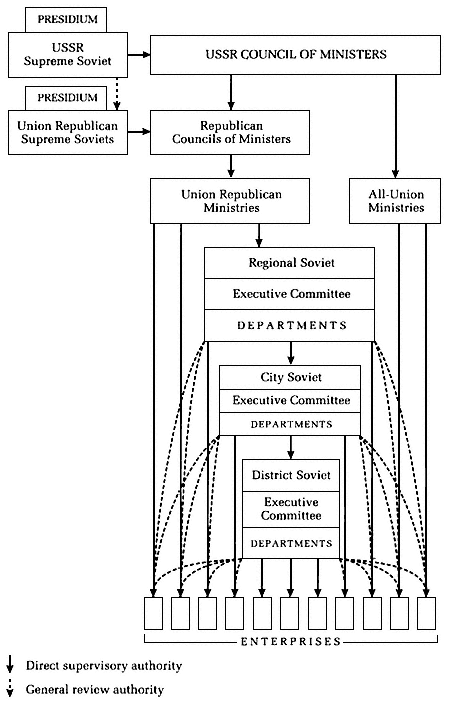
Chart 1.
Territorial/ministerial supervision of enterprises
partments and agencies. Moreover, the regional and city soviets retain indirect responsibility and general review authority for the activities of all enterprises within their respective geographic areas (see dotted lines in Chart 1). Consequently, any plant in the Soviet Union serves two masters: its own national ministry and the local city soviet. While the ministry retains responsibility for guaranteeing adherence to planning norms established in Moscow, the local soviet seeks to coordinate the activities of all economic institutions within its territory, to ensure the optimally balanced development of its jurisdiction.[17] In this way, the soviet theoretically serves as the "master of the city" (khoziain goroda ), a status confirmed by constitutional, legislative, and administrative statutes.[18]
As already noted, factory managers are in reality rewarded and promoted by the ministries and not by the local governments, so that the ministries frequently hold the upper hand in various interactions among ministries, factories, and municipalities. Moreover, the linking of territorial and sectorial planning dramatically expands the economic functions of Soviet local administration beyond previously known limits. Municipal administrators become industrial managers, with a considerable portion of the local bureaucratic effort being directed toward economic functions that in the West are reserved for the private production sector.[19]
Strict hierarchy was also a major feature of Stalinist economic planning. Individual enterprises as well as entire sectors gained priority, or in less fortunate instances were relegated to subordinate status by central planners in Moscow. Each economic unit was assigned a priority ranking, access to valuable resources being determined by this relative primacy. Similarly, cities, towns, and municipalities across the Soviet Union were identified as serving national, republic, regional, or merely local interests.[20] Once locked into this hierarchy, a given city could flourish or fail accordingly. During a 1984 interview, for example, Leningrad urbanist Marat Mezhevich argued that his city's designation as one of national status with an individual listing in the USSR state budget guaranteed adequate capital for future economic growth and development.[21] Moreover, just a year earlier, the Politburo had generally extended the rights and responsibilities of local Leningrad and Moscow officials.[22] By contrast, leaders of other cities without such status must negotiate for resources with competing jurisdictions without the benefit of supporting central policy statements.
The establishment of a highly centralized planning system, followed by the evolution of a system of territorial administration in which local soviets assumed responsibility for the overall balanced development of their jurisdiction, has created a primary tension within the Soviet Union's system of municipal administration—a tension between economic sector and territorial unit, between ministry and municipali-
ty.[23] This continuous strain runs throughout the efforts of Leningraders to shape the face of their city, discussed in later chapters. It constitutes a particularly fateful legacy of the introduction of centralized planning by Joseph Stalin in 1928.
Expanding Municipal Responsibilities
This institutionalization of centralized economic planning under Stalin proved to be of critical importance for both Soviet municipal administration and center-periphery relations. Municipal obligations multiplied to encompass previously unrecognized industrial responsibilities, as every economic unit from factory shops to urban districts to industrial ministries was locked into the same strictly hierarchical, centralized system. Soviet city elites soon found themselves responsible for entire areas of industrial planning and management hitherto left to the marketplace.
The launching of the first Five-Year Plan in 1928 doomed all but the most ephemeral private enterprise in Soviet Russia. Throughout the 1920s, Lenin's "New Economic Policy" (NEP, 1921–1928) had tolerated and at times encouraged small-to-medium-scale entrepreneurship, especially in agriculture and commerce. Stalin's forced collectivization, however, abolished all private agriculture (except for small family-cultivated plots), replacing small- and medium-scale private farms with behemoth state and collective farms. The era was dominated by Stalin's drive against private farmers and his accompanying rapid industrialization program. These policies were joined by a less momentous but no less disruptive drive against commerce in cities.
At the end of the First Five-Year Plan, the Soviet state had seized control of nearly all urban commercial activities and the vast majority of housing, as well as almost the entire range of entertainment facilities. Much of the daily administrative responsibilities in each of these areas fell to municipalities or, more precisely, to local soviets.[24] Local governments became grocers, haberdashers, and candlestick makers. By the early 1980s, for example, the 37 administrations of the Leningrad city soviet included separate administrations for housing, health, culture, local industries, trade, consumer services, hotels, public dining, film production, TV and radio broadcasting, publishing and the book trade, individual tailoring services, cottage (dacha ) services, and distribution and storage of potatoes and other vegetables.[25] These were in addition to those administrations controlling such traditional municipal functions as education, water and sewerage services, highway and bridge maintenance, parks, transportation, and trams and trolleybuses. Many of these administrations did not limit their activities to supervision, as they might have in the West, but maintained production
capacity as well. Indeed, ever since the launching of the First Five-Year Plan in 1928, there has scarcely been a human activity beyond the bounds of municipal administration. Every basic human need—from food to shelter to clothing—has fallen essentially under the operational control of one or another municipal agency.[26]
Even if we set aside the issues of efficiency and rationality, we must note the expansion of municipal administration beyond any limits known under the NEP or anywhere else, although we must concede that such tendencies were already evident during the Civil War period (1917–1921) and, although to a far lesser degree, even before. This explosion of administrative and operational capacity had a profound and all-encompassing influence on Soviet (and, later, socialist) municipal governance. Its impact was hardly reduced during the 1951–1986 period under examination in this volume, although the 1986 Law on Individual Labor Activities, which took effect in May 1987, may come to represent the beginning of a departure from the previous pattern in the delivery of consumer goods and services.[27] That law legalized the establishment of cooperative stores and services that minister to the interests of society and have been registered with local district administrators. We might note that initial experimentation with private-run services began as early as March 1987 within Leningrad's taxi industry.[28]
Overall, then, the state socialist character of the Soviet political economy had enormous consequences for urban governance. The responsibility for planning every aspect of city life, managing major industrial operations, and performing a score of secondary and tertiary social, economic, and cultural functions previously relegated to non-municipal institutions was thrust upon Soviet municipal administrators.
The Place of the Party
Local institutions in the Soviet Union are also subject to a dual system of political subordination: that within the state system of ministries and soviets, and that within a parallel network of party agencies.[29] This system of subordination and supervision is represented in Chart 2: the solid lines show the flow of direct administrative authority within the state bureaucracy; the dotted lines highlight the flow of party review over state institutions at various administrative levels. The broadly political and ideological obligations established by the party for state bodies are imposed on soviet municipal leaders and institutions and have few if any counterparts in the West.
The Communist Party constitutes a network designed to coordinate the establishment of policy that is to be implemented by the state.
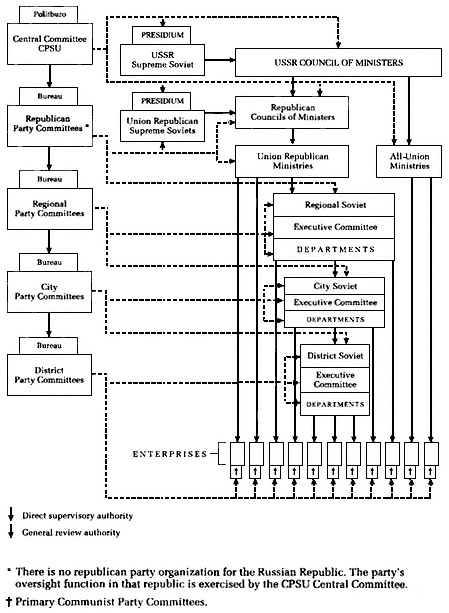
Chart 2.
System of party/state dual subordination.
There is no republican party organization for the Russian Republic. The party's oversight function in that republic is exercised by the CPSU Central Committee.
Primary Communist Party Committees.
The state bureaucracy, in turn, is intended to coordinate policy implementation. The end result is a bureaucratic structure that at first glance appears needlessly complex but can actually function as a rather streamlined and wholly integrated system. Anatomically, government and party organizations at any given level of this total administrative matrix are equivalent; in daily practice, the Communist Party dominates the entire system.
At the local level, municipal party institutions (the dotted lines in Chart 2) assume responsibility for general supervision and coordination of all economic, social, political, and cultural activities within their jurisdiction. Unlike the local soviets, which have an administrative role, local party committees supervise the commanding policy heights of management, leaving the soviets to wrestle with details.
Party supervision of local state institutions takes three primary forms. The first is the least formal: party members within state institutions are required to adhere to principles of party discipline by working to implement party policies. Whenever there are more than three party members within a given institution, those members are to form a party group that monitors the implementation of party pronouncements.[30] During the early 1980s, for example, there were over 21,000 such party groups throughout the Leningrad region.[31] In this manner state institutions become inexorably tied to their party equivalent through an invisible net of crosscutting membership ties.
The second mode of party supervision is the most formal and visible. State bodies officially cooperate with their party equivalent, and both sets of institutions prepare fully integrated plans of action.[32] Equivalent party and state institutions frequently have interlocking and overlapping executive councils. Moreover, as is illustrated in Chart 2, they have parallel organizational structures, with party committees exercising superior authority over partner state bodies (see once again the dotted lines in the chart). In Leningrad, for example, the regional party committee elects a bureau parallel to the regional soviet executive committee and operates sixteen departments parallel to the regional soviet executive committee's thirty-nine departments and administrations.[33] The Leningrad city party committee, for its part, similarly elects a bureau with a dozen members and operates twelve departments, while the city soviet's executive committee has established some forty-one departments and administrations.[34] The smaller number of party departments reflects their more general policy and supervisory mission, while the larger number of soviet departments and administrations illustrates a penchant among state agencies for more circumscribed bureaucratic vigilance.
The third form of party supervision, which is neither formal nor particularly visible, has become the subject of intense scrutiny by Western political scientists. We speak here of the integrated system of per-
sonnel appointment known as the Communist Party's nomenklatura , whereby higher-ranking party and state institutions are responsible for the personnel placement of cadres in subordinate organizations. This pattern is repeated throughout the state and party hierarchies up to careers that fall within the domain of the most senior nomenklatura agency of all, the Central Committee of the Communist Party.[35]
Shaping Leningrad
Thus far, we have discussed conflicts between ministries and municipalities. We have noted the place of the soviet in urban life, the institution most responsible for linking a city's administrative structure to national and republic bureaucratic institutions (the Soviet Union's fifteen union republics form the core units of the Soviet federal system).[36] We have also reviewed the role of the only municipal institution capable of providing a broad policy framework, the party committee. Taken together, these institutions and the rules of their operation provide the institutional world and establish the strictly defined limits within which local officials in Leningrad and elsewhere in the Soviet Union must function. To appreciate how they succeed or fail in achieving various physical and socioeconomic objectives, or even in coming to terms with the process by which such objectives are established in the first place, this study will explore the ways in which central and local elites have sought to mold Leningrad during the period 1951–1986.
Leningrad offers a useful case with which to begin an examination of the strategies by which local officials within the centralized non-market Soviet political economy set out to shape a city. With a population of some 5 million people, Leningrad's metropolitan region is the second largest in the Soviet Union and the sixth largest in Europe, being surpassed only by London, Rhein-Ruhr, Paris, Moscow, and Milan.[37] Despite efforts to inhibit further growth, the population continues to expand as nearly a million new residents have moved to or been born in the city during approximately the past 15 years.[38] Moreover, Leningrad is the Soviet Union's second most important industrial center, with an economic profile encompassing precisely those sectors that either dominate the Soviet economy at present (machine construction, shipbuilding, and other heavy industries) or are likely to be vital to that system's future success (radio technology, electronic-instrument making, and the biochemical and chemical industries).[39] These are industries that have benefited disproportionately from the historic Stalinist emphasis on development of "Group A" (generally heavy) industry, an emphasis that continued well into the Brezhnev era.[40]
Leningrad has an extensive scientific establishment. Scientific in-
stitutions and related service industries represent the second largest employer in the city, behind industry. The city's 300-odd scientific research establishments and forty-one institutions of higher learning employ almost one-fifth of the Leningrad workforce, and the city is second only to Moscow in the number of scientific workers employed.[41] The city's powerful industrial base and enormous scientific community interact. The close ties between these sectors are apparent in a growing emphasis on applied rather than basic research. Their increasingly close coordination has put the city of Leningrad ahead of all other Soviet industrial centers in various measures of technological innovation. It has also contributed to the city's primary role in the Soviet defense program at all levels, ranging from R&D and defense production to training facilities and military bases.
Leningrad has an additional resource that few other Soviet cities can draw on: a tremendous symbolic presence, rooted in its unique history. The city has long been identified with major forces shaping post-Petrine Russian history: Westernization, industrialization, and revolution. To these powerful forces was later added the truly heroic defense of the city during World War II. The existence of these powerful historic images, aided by the preservation of the physical environment identified with them, constitutes a symbolic resource as important as the industrial and scientific resources we have described.
We should also observe that Leningrad political leaders have greater political power than do many of their counterparts in other Soviet cities outside of Moscow. The city so dominates its regional unit, the oblast, that regional officials serve as the primary overseers for the city itself. For example, the most powerful political figure in Leningrad is the regional, as opposed to the city, Communist Party first secretary. Rather than diminishing the city's political standing, however, this situation enhances its status, as the future careers and reputations of influential regional officials depend more than normally on the success of the city itself. The local Leningrad party organization has experienced unusually long-standing cadre stability throughout the period of this study, thereby engendering a sense of cohesion and knowledge of local traditions that has historically been absent from many other regions of the Soviet Union. Indeed, the regional party organization has emerged as the primary integrative institution within the oblast, a territory that, as already noted, is only slightly smaller than Indiana. Beyond increasing the political visibility and influence of city officials, the dominance of regional party institutions helped make possible the continued expansion of physical, economic, and social planning strategies until the 1986 Leningrad general plan set for itself the task of shaping the face, not just of the city and its metropolitan area, but of the entire Leningrad region as well. This latter development will be a major element of the study to follow.
Each of these distinctive features of the Leningrad scene makes the city and its surrounding metropolitan area a particularly appropriate starting point for an attempt to explore and explain many of the ways in which Soviet urban officials seek to shape the face of their communities. All these features accentuate the various ways in which the political periphery seeks to maximize its operational space vis-à-vis the political center. The city's long-standing economic prominence and reputation for architectural excellence provide benchmarks against which current urban planning performance in both its physical and its socioeconomic dimensions may be evaluated. The size and importance of the regional economy lend a visibility to local management and planning that is not found in less significant urban centers. The city's extensive network of scientific and educational institutions provides critical expertise for local decision-making largely independent of central dominance. The political power and prestige of Leningrad municipal and Communist Party leaders and institutions offer a considerable power base. Moreover, we should expect Leningrad politicians, planners, and managers to be concerned with the fate of their city, to have resources on which to draw for local initiatives, to be well disposed to political and economic activism, and yet, unlike Moscow, to be firmly attached to the political periphery rather than to the center. An examination of Leningrad's physical and socioeconomic planning experience should help illuminate Soviet practice more generally. In short, the study of Leningrad can serve as a beginning for more general investigations of the means by which local urban officials in the Soviet Union function.
Four Policy Studies
To explore the Leningrad experience, the remainder of this volume is organized around four interrelated policy studies: (1) physical planning innovation, (2) integrated scientific-production" associations," (3) vocational education, and (4) enterprise and urban socioeconomic planning. These studies cover the period from the promulgation of the region's section of the Fifth Five-Year Plan (1951–1955), the first economic plan that was dominated by a science-oriented development strategy, to the enactment of the most recent general development plan for the city, metropolitan area, and region in 1986.
Our studies begin with physical planning . Over the course of these years, urban planners and architects, acting in concert with municipal leaders, have altered architectural and land use practices through a series of pragmatic solutions to pressing design problems. These solutions—including the introduction of social variables into city planning, concern over historical preservation standards, and regional as
opposed to merely citywide planning approaches—came to the fore in the period between the 1966 and 1986 Leningrad general plans. Many of these changes have subsequently been adopted as national planning norms. Their emergence will be examined in Part 1.
Leningrad Communist Party officials have also supported efforts to integrate entire production cycles under a single managerial unit, through the creation of integrated associations combining several factories, research centers, and scientific facilities engaged in related activities. Ever since the Fifth Five-Year Plan (1951–1955), Leningrad managers have led attempts to enhance industrial innovation through the institutional integration of research-development-production cycles. While many Western observers had become skeptical of the effectiveness of various Soviet innovation programs, they nonetheless acknowledged Leningrad's success at implementing the new managerial arrangements, particularly during the 1960s and 1970s. Our examination of these innovation efforts will open Part 2, devoted to the socioeconomic environment. We will review Leningrad's shift to a technology-driven city economic plan in 1951 and continue through to the incorporation into the 1986 Leningrad general plan of measures to motivate regional economic performance through technological innovation.
Leningrad's educational and industrial planners and factory administrative personnel sought the resurrection of prewar networks of enterprise vocational educational facilities , with the result that nearly a majority of Leningrad school-age children now attend some form of vocational education center. These activities gained prominence during the educational reform debate in 1958, and the emphasis on vocational education continued to be reflected a quarter-century later in the April 1984 national educational reforms adopted by the USSR Supreme Soviet. In a related move, local Leningrad plant managers, economic planners, and sociologists cooperated during the 1960s to foster the integration of social and economic factors into single all-encompassing socioeconomic plans for enterprises, urban districts, and eventually the city as a whole. By the mid-seventies, factories and towns across the Soviet Union were required to establish similar plans, based on models created by Leningrad social scientists, and the national Five-Year Plan had also incorporated social and economic development. As these third and fourth policy initiatives both confront the city's, area's, and region's chronic labor shortages, and as they have both been incorporated into the 1986 Leningrad general plan, they will be discussed at the close of Part 2.
Individually and in concert, these local efforts suggest ways in which Soviet, or at least Leningrad, urban elites have been able to adjust central policies and constraints so as to foster new opportunities for themselves and their communities within the context of a centrally
planned political-economic system. Leningrad municipal leaders have pursued economic development policies that enhance their community's economic position and political power. They have done so by combining economic and political resources and by manipulating existing vertical and horizontal administrative relationships. These governing traditions and relationships emerge from the city's distinctive physical environment, the historical dimensions of which form the central focus of our first chapter.