
Madrigali a Cinque Voci (1542): Petrarchan Woods in the Shadow of Dante
The twenty poems of Rore's First Book form a corpus of intriguing thematic tendencies. Several overlapping textual motifs recur often enough to raise the possibility that a loosely related thematics influenced the way the book was shaped, even if it carried no overarching lyric program. Central to these thematics is what I have elsewhere described as a dissident strain of Danteism manifest in extremes of materia and forma — harsh subjects delivered in rough-hewn language — that most contemporary critics must have sensed as dangerously uncontained.[8] To be sure, the book's outward alliance with the puristic variety of Petrarchism found in Venice, which was just then being adapted to musical repertory, belies this "Dantean" strain: twelve of the book's twenty settings are of Petrarch. Nonetheless, the combination of dramatic Petrarchan sonnets and starkly graphic modern ones betrays leanings quite alien to the orthodox Petrarchism of Bembo and his adherents.
To its audience in 1542 what must have seemed most remarkable about the collection were the sixteen sonnets, grouped contiguously as nos. 2-17, that make up the main body of the print, as shown in Table 6.[9] No previous book of music had collected so many sonnet settings in one place or rendered them with such intensity. Situated at the peripheries of the print are four lighter poems in less weighty forms — one at the start and three at the end. An informed observer might have noticed symmetries in the placement of these outer numbers too. At the book's extreme ends are its only two ballate, both by the Venetian poet Giovanni Brevio, whose reputation in the city included his minor role in Bernardino Daniello's La poetica published six years earlier.[10] Just inside them sit, toward the front, Petrarch's sonnet Hor che 'l ciel e la terra e 'l vento tace (no. 2) and, at the back, an anonymous cinquecento madrigal Hor che l'aria e la terra (no. 19) that glosses some of the former's famous themes and lexicon. Rore's Hor che l'aria reinforces the parallel by dividing the madrigal's eleven lines (quite unusually) into two halves along the lines of his sonnet setting.
These structural features of the book's layout are compatible with its systematic (and more widely recognized) organization by mode.[11] The Primo libro is the first book known to have been successively ordered by mode according to the traditional numbering 1 to 8 (see Table 6). The plan extends only through no. 17,
[8] See my "Rore's 'selva selvaggia': The Primo libro of 1542," JAMS 42 (1989): 547-603.
[9] The many later editions of the book altered this arrangement substantially through additions, deletions, and reorderings. For listings of these see Il nuovo Vogel 2:1479-85 (nos. 2389-2400) and for Gardane's edition of 1544, Mary S. Lewis, Antonio Gardane, Venetian Music Printer, 1538-1569: A Descriptive Bibliography and Historical Study, vol. 1, 1538-49 (New York, 1988), pp. 429-35 (no. 57).
[10] See Chap. 5 above, n. 10. The poems appear in Giovanni Brevio, Rime e prose volgari di M. Giovanni Brevio (Venice, 1545), fols. B V and C III'.
[11] On modal organization in Rore's madrigals see Bernhard Meier, The Modes of Classical Vocal Polyphony Described according to the Sources, trans. Ellen S. Beebe, rev. ed. (New York, 1988), and Jessie Ann Owens, "Mode in the Madrigals of Cipriano de Rore," in Essays in Italian Music in the Cinquecento, Altro Polo, ed. Richard Charteris (Sydney, 1990), pp. 1-15.
| ||||||||||||||||||||||||||||||||||||||||||||||||||||||||||||||||||||||||||||||||||||||||||||||||||||||||||||||||||||||||
(Table continued on next page)
(Table continued from previous page)
| ||||||||||||||||||||||||||||||||||||||||||||||||||||||||||||||||||||||||||||||||||||||||||||||||||||||||||||||||||||||||||||||
however, the same place that marks the end of the bank of sonnets.[12] What was given modal order, in other words, was essentially the sonnet.[13] And what was new about the print was therefore not just modal ordering, but the nexus of modes and sonnets.[14]
All in all, then, Rore's book was a novel essay in sonnet setting. Despite the many occasional sonnets written in the mid-sixteenth century, sonnets remained a primary vehicle for remote, archetypal forms of expression (as we saw in Chap. 7). Accordingly, the book avoids occasional verse almost completely,[15] emphasizing instead two interrelated themes: death — both feared and augured — and the untamed wilderness. The recurrence of these themes casts a veil of despair over the whole book, a feeling epitomized by the burst of vengeance that opens Petrarch's Far potess'io vendetta di colei (Canzoniere, no. 256).
Far potess'io vendetta di colei Could I but take vengeance on her
Che guardando et parlando mi distrugge Who gazing and speaking destroys me
E, per più doglia, poi s'ascond'e fugge, And then, to increase my pain, hides herself and flees,
Celando gli occhi a me sì dolce e rei! Taking from me her eyes so sweet and cruel!
Far potess'io vendetta explores a soundscape that challenges the limits of what Bembo later described as "materia grande" and the vocabulary he called "gravi, alte, e sonanti."[16] Consonantal clusters and abundant a 's and o 's slow the poem's rhythmic pace, especially in v. 2 ("Che guardando e parlando mi distrugge"), and fill its
[12] Does this mean that nos. 18-20 must have been a "foreign body incorporated only after the original had been submitted for printing," as Bernhard Meier assumed (Rore, Opera omnia 2:iii)? Apropos, we might consider that had the two madrigal texts (nos. 18 and 19) been interpolated among settings in modes 1 and 2 and Brevio's second ballata (no. 20) among settings in mode 3, the book's solid bank of sonnets would have been interrupted. Why the first Brevio ballata (no. 1) should not have been relegated to the back of the book as well apparently had to do with the bookmakers' notion that madrigal prints should not open with a sonnet but with something lighter. To judge from the makeup of subsequent collections published by Willaert's students, the Primo libro set a precedent for avoiding weighty sonnets at the starts of books in which they otherwise dominated. All of the following sonnet-filled prints open with cinquecento madrigals: Perissone Cambio, Madrigali a cinque voci (1545), with twelve sonnets out of sixteen settings; idem, Il segondo libro de madregali a cinque voci (1550), with fifteen sonnets out of twenty-three; Girolamo Parabosco, Madrigali a cinque voci (1546), with eight out of twenty; and Baldassare Donato, Il primo libro d'i madregali a cinque & a sei voci (1553), with thirteen out of twenty-six.
[13] It may be relevant here that the one ballata that departs from the pattern, no. 1, consists of fourteen lines of endecasillabi.
[14] This is not at all the same as saying that the meanings of the individual sonnets were keyed to modal affect, a different matter that I will take up briefly below. It does seem likely, however, that there is a connection between modal ordering and a highly literary vernacular. For a suggestion that composers sought "pathic and ethic effects" of modes particularly in secular (hence almost always vernacular) music, see Chap. 6 above, n. 26.
[15] Even Altiero sasso (no. 6), described by Einstein as a "threnody on the death of a Roman" (The Italian Madrigal 1:393), is couched in a generalized poetics, with no direct hint of its subject's identity. The only other quasi-occasional text in the book is no. 18, a chivalric madrigal for an anonymous "Rosa": "Ben si conviene a voi / Così bel nome, alma mia rosa poi / Che con quella beltà che 'l monda honora, / Vincete i più bei fiori / E i più soavi odori" (Well does such a lovely name suit you, my life-giving Rosa, since with that beauty that the world honors, you surpass the loveliest flowers and the sweetest aromas).
[16] Prose della volgar lingua, ed. Mario Marti (Padua, 1967), p. 55.
rhymes with what Bembo had called a "meravigliosa gravità.[17] This "grave" diction culminates in the clamorous rhymes of the sestet ("caccia" / "sciolta" / "minaccia", "volta" / "abbraccia" / "s'ascolta") and the bitter rebuke of its final point, where Petrarch embeds the o 's in a slew of hissing s 's: "Non rompe il sonno suo s'ella l'ascolta" ([My lamenting soul] does not break her sleep, if she is [even] listening).
Even though Far potess'io vendetta does not explicitly portend loss, it comes from a sonnet cluster that brings the entire Canzoniere to a nadir of despair with Laura's death in no. 264, and the beginning of the sonnets "in morte." This sonnet cluster, beginning with no. 250, positions the poet's fantasy on the edge of reality by slipping repeatedly into scenes of tormented sleep. Rore also set the very first of the group, Solea lontana in sonno consolarme (Accustomed from afar to console me in sleep), in which Laura announces in a nocturnal vision her imminent death ("Non sperar di vedermi in terra mai" [Do not hope to see me on earth ever again]). Several other poems in Rore's book deal centrally with death — Poggiand'al ciel coll'ali del desio (no. 3), an anonymous gloss on the motif of Icarus who flies so high from love that his wings are melted by the sun, Altiero sasso lo cui gioco spira by Francesco Maria Molza (no. 6), a eulogy on a Roman (see n. 15 above), and Petrarch's La vita fugge e non s'arresta un'hora (no. 8) and Chi vol veder quantunque po natura (no. 14) — and most of the other poems in the book touch on death at least tangentially.
The related topos of the savage wilderness staged at the center of Rore's book had its most gripping prototype in Dante's Divina commedia, particularly (as I have argued elsewhere) as the "selva oscura" with which Dante begins his prologue scene.[18] In the Commedia, of course, the dark woods represents a space of primitivity and spiritual blindness. Its power to terrorize the soul motivates the beginning of a conversion that will take the poet on a harrowing odyssey through Hell and into those linguistic regions that were forbidden by the codifiers of Tuscan who later prevailed in Venice.
The three sonnets that pursue the topos in Rore's Primo libro (nos. 6, 7, and 11) aspire to varying degrees of Dantean intensity. The most moderate, Petrarch's Per mezz'i boschi inhospiti e selvaggi (no. 11), mediates between Dantean and Petrarchan extremes. Its evocative nature scene is painted as a familiar symbol of spiritual loss, but also of comfort — a symbol caught, in typically Petrarchan fashion, in a web of uncertainties.
Per mezz'i bosch'inhospiti e selvaggi Through the midst of the inhospitable savage woods,
Onde vanno a gran rischi'homini et arme, Where even armed men go at great risk,
Vo secur'io, che non po spaventarme I go without fear, nor can anything terrify me
Altri che 'l sol, c'ha d'Amor vivo i raggi; Except the sun that has rays from living Love. 4
[17] Ibid., p. 81.
[18] Feldman, "Rore's 'selva selvaggia,'" from which some of what follows is drawn. For antecedents to Dante's exploration, particularly those of Virgil, see The Divine Comedy, ed. and trans. Charles S. Singleton, 3 vols. (Princeton, 1970), vol. 1, pt. 2, pp. 4-5; and John Freccero, "The Prologue Scene," Chap. 1 in Dante: The Poetics of Conversion, ed. Rachel Jacoff (Cambridge, Mass., 1986).
E vo cantando (o pensier miei non saggi!) And I go singing (oh my unwise thoughts!)
Lei che 'l ciel non poria lontana farme, About her whom the heavens could not put far from me,
Ch'i' l'ho ne gli occhi, e veder seco parme For she is before my eyes and with her I seem to see
Donn'e donzelle, e sono abeti e faggi. Ladies and damsels, and they are but firs and beeches. 8
Parmi d'udirla, udendo i rami e l'ore I seem to hear her when I hear the branches and breeze
E le frondi, e gli augei lagnarsi, e l'acque And the leaves, and birds lamenting, and the waters
Mormorando fuggir per l'herba verde. Murmuring, fleeing across the green grass. 11
Raro un silentio, un solitario horrore Rarely has the silence, the solitary horror
D'ombrosa selva mai tanto mi piacque, Of a shady wood pleased me so much;
Se non che dal mio Sol troppo si perde. Except that I lose too much of my Sun. 14
Unlike the dread that shadows Dante's journey, here the lover willingly seeks uninhabited places since nothing can harm him but the sun — metaphor, that is, for Laura and for the enlightened, hence civilized, life. In this pagan forest love is ubiquitous and comforting, yet also ambiguously elusive, as we learn in v. 4 and again in the last tercet. There the shaded woods of Dante's Commedia reappear, but since they offer solace (protection from the sun) their meanings are enervated by Petrarchan ambivalence. They point at once to the presence and absence of the beloved. By contrast with the sonnets of Rore's southern contemporaries that I will take up shortly — sonnets that delve deeply into the penumbral wilderness Dante had explored — Petrarch's sonnet leans at once in and out, tempering and softening its linguistic signs in a way that appealed to Venetian literati.[19]
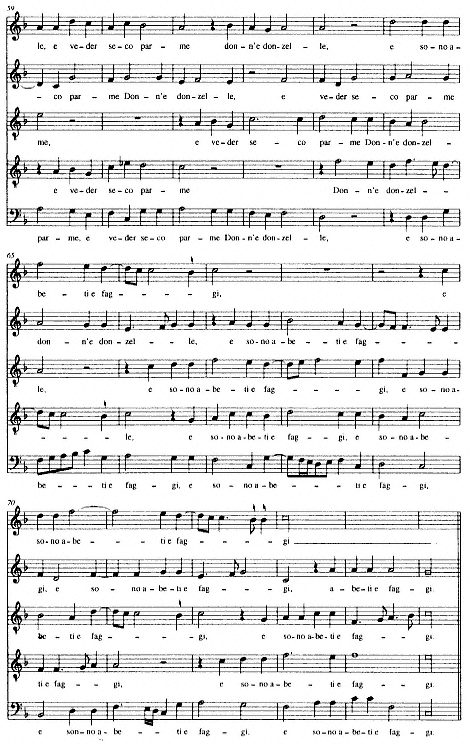
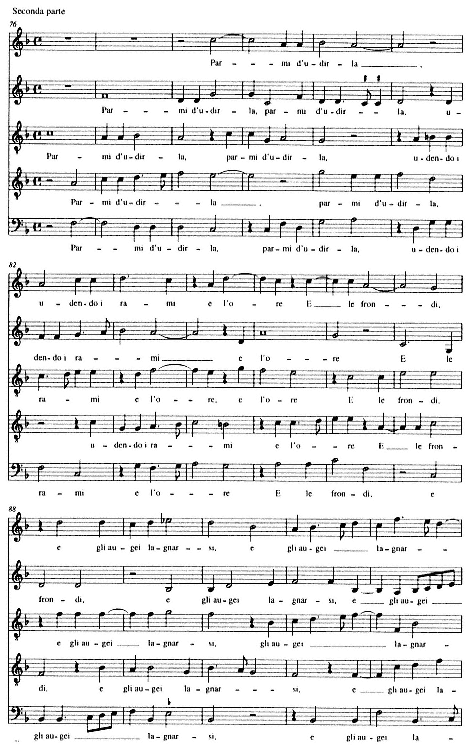
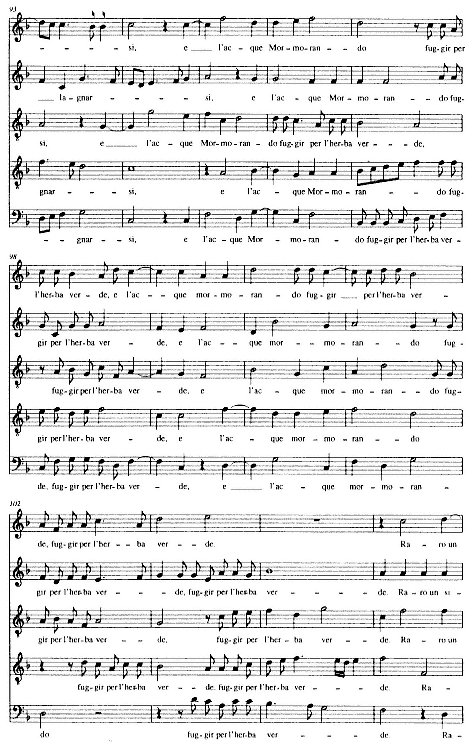
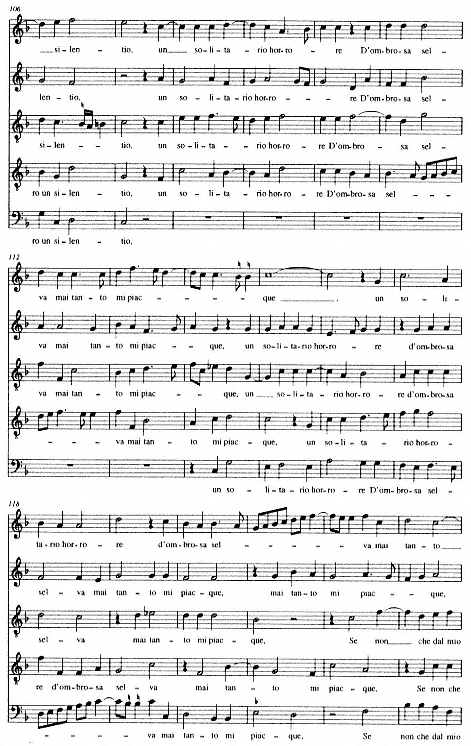
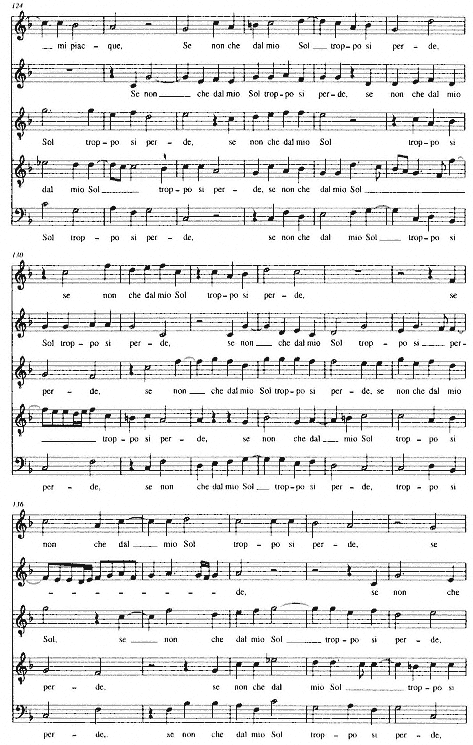
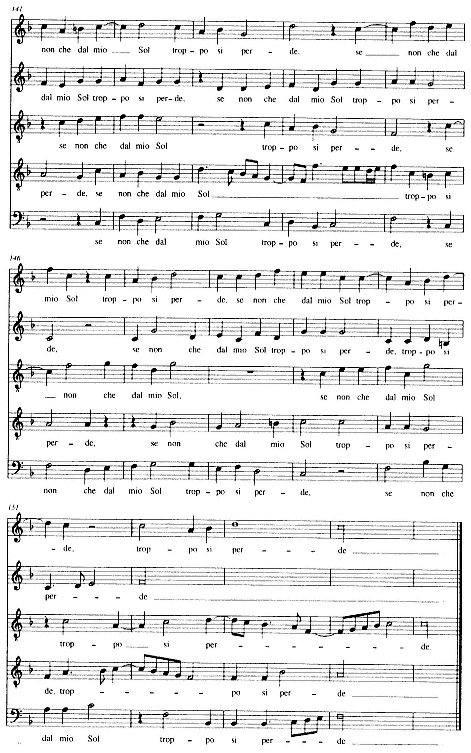
As a text that reconciles these verbal-thematic extremes, Per mezz'i boschi offers a valuable way to consider the range of discursive possibilities that Rore's readings made use of. His setting is far more animated than those of Willaert, defined by clear contrasts and lively gestures (see the complete setting in Ex. 18). This squares well with the Rore of the late fifties whom Claudio Monteverdi later called the father of the seconda prattica — those experiments in extravagant harmonic and voice-leading effects in the service of text expression that he compared with the more constrained prima prattica employed by composers from Josquin to Willaert. Yet in the early forties Rore's language evinced virtually none of the harmonic experiments or overt text painting that were to invite that label. How his earliest settings managed to construe text so vividly is a question that must be searched out in other domains — in the way his rhetoric simultaneously shapes verbal syntax and meaning.
[19] Meier misrepresents the sonnet by reducing it to an expression of Petrarch's fearlessness in imagining Laura — this by way of explaining Rore's use here of fifth mode, traditionally conceived as cheerful (The Modes, p. 394). Petrarch's contradictory relationship to sun and light, and thus to Laura, is a theme that runs throughout the Canzoniere (e.g., nos. 18 and 22). Indeed the originary fiction of the Canzoniere describes the day he first sighted Laura as "il giorno ch'al sol si scolararo / per la pietà del suo fattore i rai" — that is, the anniversary of Christ's Crucifixion (no. 3, vv. 1-2). Far from being avoided by madrigalists, such contradictions were sought out.
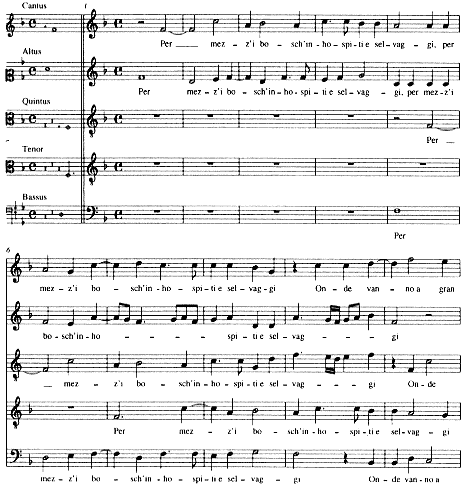
Ex. 18.
Rore, Per mezz'i bosch'inhospiti e selvaggi (Petrarch, no. 176), incl.; Madrigali
a 5 (Venice, 1542), no. 11.
(continued on next page)
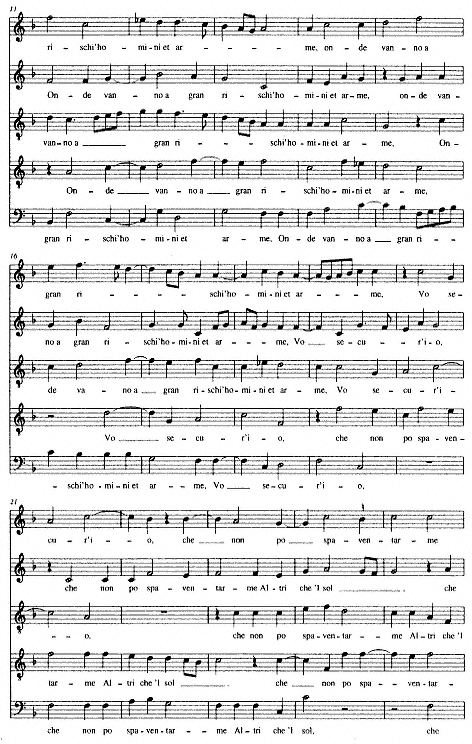
Ex. 18
(continued)
(continued on next page)
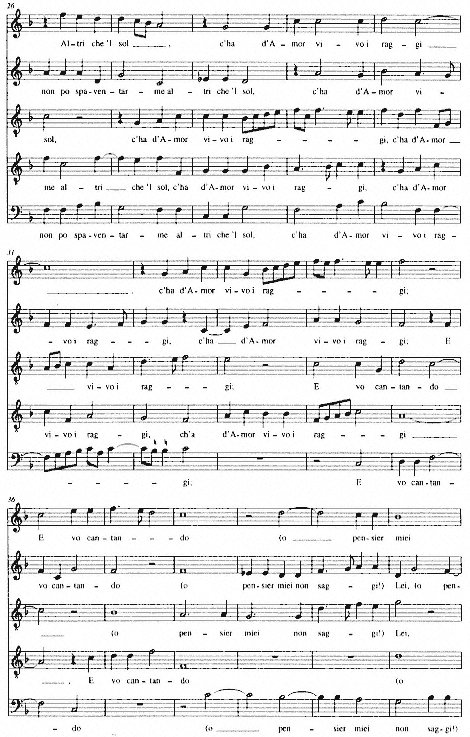
Ex. 18
(continued)
(continued on next page)
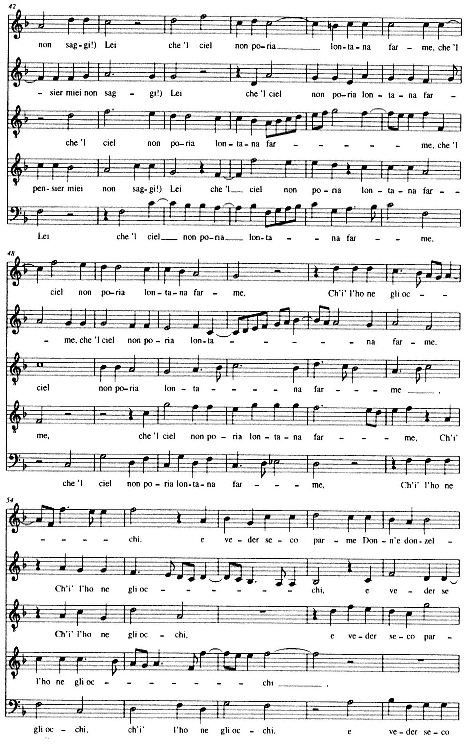
Ex. 18
(continued)
(continued on next page)
Ex. 18
(continued)
(continued on next page)
Ex. 18
(continued)
(continued on next page)
Ex. 18
(continued)
(continued on next page)
Ex. 18
(continued)
(continued on next page)
Ex. 18
(continued)
(continued on next page)
Ex. 18
(continued)
(continued on next page)
We can begin to uncover this rhetoric by looking at Rore's treatment of the sonnet's formal articulations, as provisionally described in Table 7. Although the ambiguities of Rore's counterpoint render such descriptions problematic,[20] Table 7 nonetheless shows that his setting foregrounds the sonnet's verse structure by using suspension cadences repeatedly at the ends of all but one of the sonnet's main sections (cf. vv. 4, 8, and 14). The only section that lacks such a cadence is the first tercet, with a single cadence to end v. II at m. 105, but here Rore reinforces the articulation through other means (as I discuss below). Furthermore, suspension cadences sound at the ends of virtually every clause (the only exceptions are the very last cadences that close each of the two parts).
This structural overview allows us to see profound differences between Rore and Willaert. Rather than trading in suspension cadences and sharp motivic differentiations, Willaert tended to work with speechlike recitation, often marking textual cadences through the simple use of rests.[21] Willaert's madrigals must have offered trenchant models for how to define formal details of text with subtle rhythmic and harmonic nuances and delicate textural shifts; but Rore sought out more explicit rhetorical definition.[22] While Willaert's madrigals usually deploy few contrapuntally conceived cadences, Per mezz'i boschi typifies Rore's tendency toward a highly articulated reading.
This profusion of contrapuntal cadences was just one way Rore's articulation differed from Willaert's, however, and perhaps not even the most obvious one. For Rore, semantic content held equal sway with linguistic form. More than Willaert's, his music indulged in vivid text painting and sharp verbal contrasts, bold motivic shapes and striking expositions. One result of these tendencies was a less regular rhythmic surface. Thus, where Willaert's declamation distributes durations fairly evenly over words in the course of a sonnet, Rore's moves between this Willaertian "speech time" and what we might usefully distinguish as "expressive time," time played out in alternately lingering or quickening affective gestures and pictorial effects. In short, Rore forewent some of Willaert's rigorous adherence to the
[20] As with Willaert's Pien d'un vago pensier (see Table 5), Rore's setting is not wholly congenial to this kind of simplified description. Both the contrapuntal ambiguities and the subtle and diverse means by which articulations are made defy efforts to summarize the forms of many cadences or even to identify all their locations. Rore parses the text not just through contrapuntal devices but through textural shifts, changes in declamatory speed, text repetition, and a host of other means. Table 7 lists all of the cadences involving suspended dissonances, as well as others that I deem especially significant, but for the reasons given above I do not aspire to a universal or wholly systematic approach in tabulating cadences.
[21] The total lack of suspension cadences in the prima parte and inclusion of only two in the seconda parte of Willaert's Mentre che 'l cor find no equivalent in Rore's books. Meier's tabulations of cadences for several madrigals from the Musica nova might seem to suggest otherwise, but his examples happen to be drawn from the most cadence-laden works in the book. See the sections on Giunto m'ha Amor and Quando fra l'altre donne in The Modes, pp. 144-45 and 159 (I do not count the seven-voice dialogues that Meier discusses on pp. 126-27 and 145 because they operate according to different principles of articulation).
[22] For a study aimed at demonstrating Rore's mastery in reflecting textual structure through bass patterns, tonal structure, and cadential repetitions see Jessie Ann Owens, "Music and Meaning in Cipriano de Rore's Setting of Donec gratus eram tibi," in Music and Language, Studies in the History of Music, vol. 1 (New York, 1983), pp. 95-117, on his setting of an ode by Horace.
| ||||||||||||||||||||||||||||||||||||||||||||||||||||||||||||||||||||||||||||||||||||||||||||||||||||||||||||||||||||||||||||||||||||||||||||||||||||||
tempos, accents, and cadences of a spoken reading in favor of a more semantic interpretation.
Per mezz'i boschi carefully balances such formal and expressive considerations in the transitions between major structural divisions. When the first quatrain draws to a close, for example, a series of brilliant melismas gestures the word "raggi" repeatedly toward cadence (quintus, mm. 28-30; bassus, mm. 30-32; cantus, mm. 33-35). Crowning the quatrain with their whimsical swirling motions launched across
sevenths and propelled in thirds and fourths, these melismas bring about the quatrain's tonal-grammatical resolution to the final, F. At the same time, by calling attention with their sudden absence to the poet's singing in v. 5 ("E vo cantando") and the beginning of the new poetic thought, they also exaggerate retrospectively the loss of motion in m. 35. To employ stasis for the sake of contrast at such a moment is a touch ironic, of course, since Rore can exploit it only by slighting the prevailing convention that prescribed florid melody for allusions to singing. But in pitting such a spare passage against the previous spate of melismas — condemning the poet's reckless song to a spell of semantic impoverishment — Rore found an efficacious formal-cum-expressive solution to the structural transition.
"E vo cantando" forms only the first part of a clause whose direct object "Lei" is displaced in enjambment to line 6 through an extraordinary interruption. It is worth pursuing these verses a little further to notice the ingenious syntactic solution given to Petrarch's exclamatory "(o pensier miei non saggi!)"; for Rore offset it with rests, as if to mark it as a parenthetical mental flash, and also reintroduced a declamatory rhythm at the semibreve (mm. 37-38) not heard since the opening. The new pacing marks the poet's "unwise thoughts" as intrusive and other, an effect heightened by the flat-footed binary figures that declaim "E vo cantando." Only when the phrase elides into v. 6 to complete the interruption — — "E vo cantando . . . Lei" — is the stasis of v. 5 lifted; trace the quintus from m. 37 to 41, for instance, and note the continuous and rising phrase that accompanies "saggi!) Lei" at each appearance.[23] The quintus, leading off as surrogate bass, immediately introduces a proliferation of voice crossings with the tenor that obscure and destabilize the sense of a bass line (mm. 37-39 and 44-45). Shortly afterward, the altus's flatted inflections herald a raft of minor triads, which otherwise scarcely appear in the madrigal (note the c, g, and a of mm. 39-41). None of the polyphony to this point has been tied off with a cadence. Indeed, for the first time in the madrigal, two whole verses go by before a suspended cadence sounds at the end of v. 6 (m. 53) — both the first Phrygian cadence and the first on the medial degree aa/a (altus and quintus), albeit immediately extended.
To summarize, vv. 4-6 gloss Petrarch's text in a way that moves between two different rhetorical goals: syntactic clarification and semantic expression. Whereas Willaert made interpretation of localized grammar an overriding concern — indeed often the sole means of enhancing the sense of the words — Rore's music wrested meaning directly from text. So doing, it balanced the competing demands of linguistic form and meaning.
[23] As Willaert did with the interruption in v. 8 of Pien d'un vago pensier (see Chap. 7 above, nn. 56-58), Rore clarified the words' syntactic autonomy by setting them off musically from the first part of the clause they interrupt, "E vo cantando." He also, like Willaert, linked the delayed completion of the main clause, "Lei," to the disruptive interjection: hence "(o pensier miei non saggi!) Lei" became a single syntactic unit.
Such balance proves expressively vital for the wonderfully pictorial first tercet, a catalogue of natural phenomena that Rore depicted in vivid musical images. Each item — branches, breeze, leaves, and birds — forms collectively part of a sonorous contrapuntal thicket used to animate Petrarch's scenery. To mimic the sound of the breeze whipping light rain over a field, for instance ("e l'acque / Mormorando fuggir per l'herba verde"), Rore set voices fluttering from part to part (mm. 93-105) and underpinned the effect with a rocking bassus at mm. 94-97 and 99-102. Such rich iconic tapestries were unusual at the time, even in Rore's own madrigals. In the future, rapid declamation combined with repeating note pairs such as Rore applied to "fuggir per l'herba verde" were to become a prominent musical topos for depictions of pastoral landscapes. They surface in black-note madrigals of the 1540s, of which those in Rore's Primo libro are early, if atypical, examples, and they continue to appear in madrigals of the seconda prattica. Rore's Terzo libro of 1548 is the first to make extensive use of such pictorial passages, which finally became part of an established tradition in the pastoral settings of Andrea Gabrieli, Wert, Marenzio, and Monteverdi.[24]
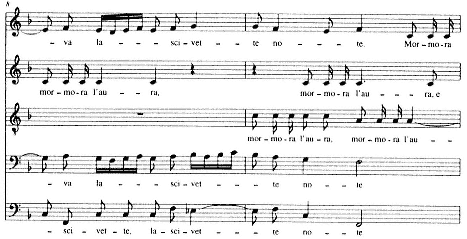
Even the bravura multiple counterpoint Wert fashioned for Vezzosi augelli, a stanza from Tasso's Gerusalemme liberata published in his Ottavo libro a 5 of 1586 (Ex. 19), finds its prototype in Per mezz'i boschi. Wert's madrigal pits a melodious trio of "singing birds" for Tasso's first two verses against monotonal chanting for the murmuring breeze of v. 3. Not dissimilarly, Rore assigned separate motives to "l'acque / Mormorando" and "Fuggir perl'herba verde." To do so he had forcibly to disengage the verbal parts, for their syntax alone does not call for them to be parsed as such. The separations he artificially forced on them provide the basis for what we might call prospectively a Wertian counterpoint, which takes shape in the overlappings of mm. 95-97 and 100-102. They form a striking precedent for the sort of simultaneous counterpoint Monteverdi was to cultivate so extensively beginning in his Secondo libro a 5 of 1590.[25]
Rore projected another efficacious rhetorical-grammatical shift by articulating the division of the tercets with the perfect cadence on f/F in m. 105. The reasons for this are evident, as Rore starts the brief "Raro un silentio" in near homorhythm and quickly ends with yet another perfect cadence in m. 107 (these being the only two to bring as many as four voices to a simultaneous close). The textural tranquillity thus achieved and enhanced by an all-vocal rest in turn sets up the poem's key phrase, "un solitario horrore / D'ombrosa selva mai tanto mi piacque." At this point the texture unravels just slightly until, reaching their second statement, the voices begin to hurtle toward an enormous coda.
Rore placed unprecedented weight on the last verse. Melismas now proliferate as each voice echoes the final verse six, seven, or more times, working out at last the
[24] See Gary Tomlinson, Monteverdi and the End of the Renaissance (Berkeley and Los Angeles, 1987), pp. 49-50, and Chap. 7 above, n. 53.
[25] Tomlinson, ibid., relates Wert's Vezzosi augelli to Monteverdi's setting of Tasso's lyric poem Ecco mormorar l'onde, another paratactic nature scene, which was published in Monteverdi's Secondo libro.
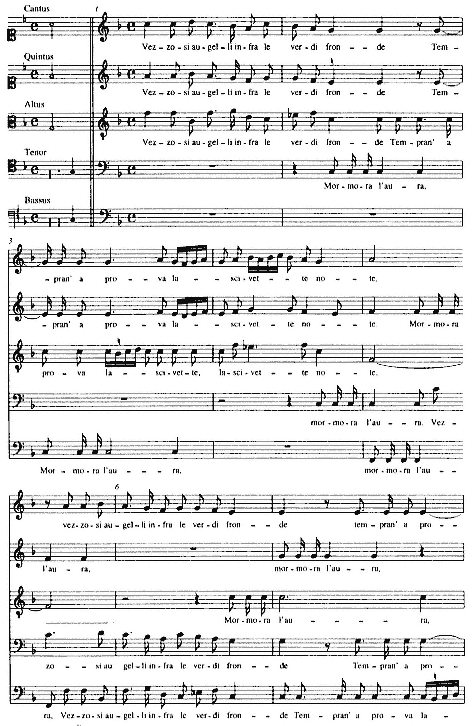
Ex. 19.
Giaches de Wert, Vezzosi augelli infra le verdi fronde (Torquato Tasso), mm.
1-9; in Ottavo libro a 5 (Venice, 1586), p. II.
(continued on next page)
Ex. 19
(continued)
abundant polyphonic energy collected in the previous hundred-plus measures. Through all this the bass leaps back and forth between the two tonal axes, F and C, as if purging the tonal terrain of all the alien inflections that had invaded earlier. This is a fitting climax to a work that set new standards of vigor for polyphonic madrigals.
Both of the other sonnets that explore the topos of the woods were the work of poets contemporary with Rore, and both are darker than Petrarch's Per mezz'i boschi. The first (no. 6) is Molza's Altiero sasso.
Altiero sasso lo cui gioco spira Proud stone whose ridge breathes
Gli antichi honor del gran popul di Marte, The ancient honor of the great populace of Mars;
Fiume che fendi questa e quella parte, River that breaks this way and that,
Hor quieto e piano, hor pien di sdegno et ira, Now quiet and still, now full of rage and fury; 4
Piaggie che 'lmondo ancor ama e sospira, Slopes that all the world still loves and desires,
Consecrate da tante e da tai carte, Consecrated by so many and such writings;
Memorie eterne e voi reliquie sparte Eternal memories and you, Spartan relics,
Ch'ogni bon'alma con pietà rimira: On which every good soul gazes with devotion: 8
Parmi d'udir fuggendo a voi d'intorno I seem to hear flying all about you,
Sospirar l'onde e i rami e i fiori Sighing, the waves, and branches, and flowers,
e l'ora and the breeze
Lagnarsi, e per dolor romper i sassi; Lament, and the stones break from grief, 11
Che già del pianto s'avicina el giorno Since already the day of tears draws near
Che 'l bel viso ch'Italia tutta honora, When the beautiful face that all of Italy honors,
Cinti d'horror al suo partir vi lassi. Wrapped in horror at his departure, will leave you. 14
Altiero sasso apostrophizes deserted formations in the Roman out-of-doors — a stony mountain face, raging river, slopes, and Spartan relics. The poem sustains a level of Dantean gloom throughout the octave, then shifts to a lighter Petrarchan vein, conjuring up in waves, branches, flowers, and breeze the memory of the beloved. This first tercet is, of course, a gloss on the analogous one in Per mezz'i boschi. But here day breaks to provide a mere foil for the final tercet. The sonnet resumes its lamenting tone at v. 12, now draping the octave's rocky landscape in a Dantean "horror" to convey the air of deathly departure at the sonnet's end.
Rore set Altiero sasso in

Strane ruppi, aspri monti, alte tremanti Strange cliffs, harsh mountains, high quivering
Ruine, e sassi al ciel nudi e scoperti, Ruins, and stones naked and exposed to Heaven,
Ove a gran pena pon salir tant'erti Where with great effort such steep clouds
Nuvoli, in questo fosco aer fumanti, Of smoke rise in this gloomy, fuming air, 4
Superb'horror, tacite selve, e tanti Proud horror, silent woods, and so many
Negr'antr'herbosi, in rotte pietre aperti, Black grass-grown caves in broken-open stones,
Abbandonati, sterili deserti, Abandoned, barren deserts
Ov'han paur'andar le belve erranti: Where even wandering wild beasts go in fear: 8
A guisa d'hom che da soverchia pena As a man who, with a sad heart, torn with
Il cor trist'ange, fuor di senn'uscito, Excessive pain, out of his mind,
Se 'n va piangendo, ove la furia il mena, Goes crying wherever his madness leads him, 11
Vo piangend'io tra voi, e se partito I go weeping among you: and if Heaven does not
Non cangia il ciel, con voce assai più piena take my side, with a much fuller voice
Sarò di là tra le mest'ombre udito. Will I be heard from there among the sad shades. 14
Though attributions of its authorship are mixed, Strane ruppi appears to be the work of the Neapolitan Luigi Tansillo, who was noted for his extraordinarily raw diction.[26] Its trembling rocks, clouds of smoke, and lifeless woodland depict the spoils of a volcanic eruption. In evoking them with such graphic language, Tansillo departs radically from the Petrarchan mainstream, as well as from the idyllic Arcadian world of his Neapolitan predecessor Sannazaro.[27] Here the poetic persona is set in a stark and terrifying place that transforms the usual pastoral scenes of Petrarchan verse: unlike their docile woods and groves, these spaces are rugged and
[26] I expand on questions of authorship in "Rore's 'selva selvaggia,'" pp. 565-66. On Neapolitan Petrarchism see Aldo Vallone, "Di alcuni aspetti del petrarchismo napoletano (con inediti di Scipione Ammirato)," Studi petrarcheschi 7 (1961):355-75, and Giulio Ferroni and Amedeo Quondam, La locuzione artificiosa: teoria ed esperienza della lirica a Napoli nell'età del manierismo (Rome, 1973).
[27] On settings of Tansillo in the sixteenth century see my "Rore's 'selva selvaggia,'" p. 566 n. 30.
uninhabitable. All the poet's emotions are projected through this violent landscape, whose images express a total loss of civilization and, by extension, the loss of reason that defines a cultivated being. At the verbal level madness is dramatized most acutely in the octave, with its fragmentary vocatives distancing it from the equivocal syntactic convolutions of Petrarch's verse.
Elsewhere I have proposed that Tansillo drew from Dante's Commedia for specific words and meanings and more generally from the cacophonous sounds of the Inferno.[28] The "tremanti ruine" of Strane ruppi recall the rumblings of Purgatory Dante feels in Hell, to which he is doomed but for the grace of Heaven.[29] In the Inferno he learns through a series of cryptic allusions that the tremors signify a soul's completion of penance in Purgatory.[30] In Purgatory 20, the pilgrim and his guide hear violent quaking accompanied by cries of "Gloria in excelsis Deo" given out by shades ("ombre") who afterwards return to a state of eternal weeping.[31] This final point (as I have argued) confirms the specific inspiration of Tansillo's sonnet in the Commedia and provides a Dantean key to the whole poem, with its final allusion to the underground shades. More than this, it reveals a precise musical association with the quaking that must have made the poem appealing for musical setting, despite — or even because of — its lyric eccentricities.
The extravagant Neapolitanism of Strane ruppi finds a unique place among Venetian collections, a place that is unthinkable in Willaert's oeuvre. But it forms part of a distinctly southern stream running through Rore's Primo libro, also fed by poets like the Roman Molza and (so it seems) the anonymous author of the Neapolitan-styled Icarus sonnet Poggiand'al ciel.[32] Sitting at the extreme end of Rore's early expressivity in a style that borders on expressionism, Rore's
[28] I am indebted to Linda Armao, who first brought the thematic connection to my attention.
[29] According to Christian tradition, the rumblings commemorate Christ's Crucifixion and his harrowing of Hell. In Matt. 27:51, for example, the earth shudders after the Crucifixion: "And behold the veil of the temple was rent in twain from the top to the bottom, and the earth did quake, and the rocks rent." See also Mark 15:38: "And the veil of the temple was rent in twain from the top to the bottom."
[30] For the specific references and lexical connections see Feldman, "Rore's 'selva selvaggia,'" pp. 567-68.
[31] Purg. 20.124-44: "Poi cominciò da tutte parti un grido / tal, che 'l maestro inverso me si feo, / dicendo: 'Non dubbiar, mentr' io ti guido. / 'Gloria in excelsis ' tutti 'Deo ' / dicean, per quel ch'io da' vicin compresi, / onde intender lo grido si poteo. / No'istavamo immobili e sospesi / come i pastor che prima udir quel canto, / fin che 'l tremar cessò ed el compiési. / Poi ripigliammo nostro cammin santo, / guardando l'ombre che giacean per terra, / tornate già in su l'usato pianto" (Then began such a cry on all sides that my master drew toward me saying, "Do not fear while I guide you." "Gloria in excelsis, Deo, " all were saying, by what I understood from those nearby, where the cry could be heard. We stood motionless and in suspense, like the shepherds who first heard that song, until the quaking ceased and it was ended. Then we took up our holy way again, looking at the shades that lay on the ground, already returned to their wonted plaint).
[32] Vallone, "Di alcuni aspetti del petrarchismo napoletano," stresses southern poets' use of comparison and simile, their wielding of naturalistic imagery to heighten contrasts between the poet's interiority and the physical world, and manipulations of naturalistic invocations to balance rhetorical artifice — all qualities found in these poems. Vallone cites Tansillo's employment of the winged-flight motive in comparative form on p. 367. For Ernest Hatch Wilkens's description of the Icarus motif as an emblem of "soaring inspiration," see A History of Italian Literature, ed. Thomas Bergin, rev. ed. (Cambridge, Mass., 1974), p. 245.
settings of Southern imagery stimulated unexpected antecedents to his late madrigalian style.
Expressionistic qualities are most striking in the opening quatrain, where Rore ignored the norms of classical vocal counterpoint that assigned one main soggetto to each word group by threading a descending tetrachord through four distinct verbal phrases in the way of a virtual leitmotif. (See Ex. 20, where the four are numbered in the cantus and other instances bracketed.) With their staggered exordial entrances, these tetrachords translate musically the jagged cliffs of v. I. They find their most gripping exposition in the opening measures — texturally spare, broad in rhythm, jostled by ubiquitous suspensions, and hardened in parallel major thirds
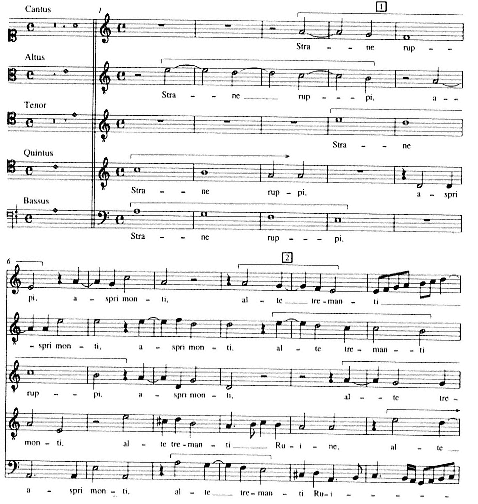
Ex. 20.
Rore, Strane ruppi, aspri monti, alte tremanti (prob. Luigi Tansillo), mm. 1-28;
Madrigali a 5, no. 7.
(continued on next page)
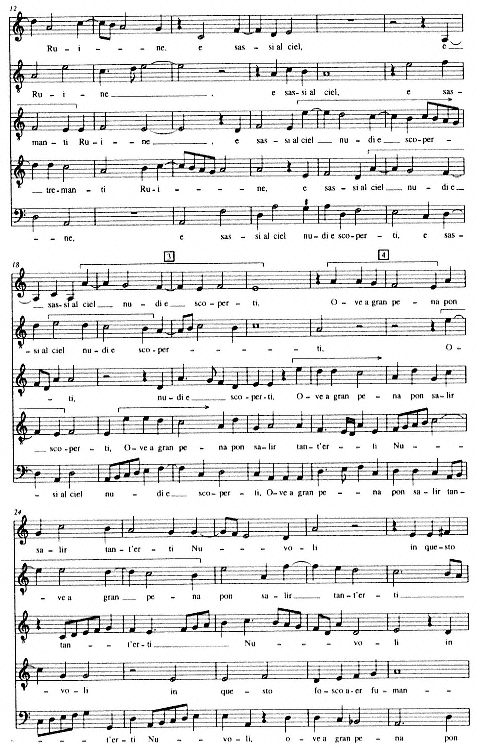
Ex. 20
(continued)
(the quintus and bassus of mm. 2-3).[33] Obsessively repeated, they give special force to the melodic whole tones that Zarlino later mentioned in connection with "asprezza, durezza, crudeltà [ed] amaritudine" (harshness, hardness, cruelty, [and] bitterness).[34]
From this stark beginning Rore drew the tetrachords into increasingly turmoiled counterpoint. With the appearance of "harsh mountains" and "trembling ruins" in m. 5 come more dissonances, declamatory ruptures, and shifts of texture. By m. 7 the suspension chains, now in diminution, generate faster harmonic shifts and remarkable dissonances. The bassus's suspended a of m. 8 becomes the middle member of a tone cluster whose outer notes (tenor g and quintus b) arrive by leap; its note of resolution, g, sounds with it not only simultaneously but in unison. As if to underscore the dissonance, the bassus rumbles through a subterranean run on "Ruine" to bring the noun phrase to an end.
In all of this, Rore made the most of the poem's noisy vowels and consonants by chiseling each of its paratactic parts into a separate musical phrase. The chain of broken syntactic bits thus receives an asymmetric musical parsing that Daniello (for one) had linked to proselike gravità in verse.[35] Deliberately measured, Rore's setting stuffed the poem's bloated diction — its a 's and o 's, r 's, s 's, t 's, and consonantal clusters,[36] with jarring discords compounding its instabilities of theme and phraseology.
The gritty style that emerged has much to do with Rore's individuality as a contrapuntist. Within the bounds of post-Josquinian, continuous polyphony, the music's surface is unusually restless. No sooner are words cranked up to a clattering, speechlike tempo than the surface turns lushly melismatic.
These two declamatory styles — recitational and melismatic — always stand in a kind of counterpose, one quickly mutating into the other. Rore individualized them contrapuntally by linking each of them to different types of chordal events and different kinds of voice leading. Crisp syllabic declamation — even and metrically stable — is usually accompanied by passages that are tonally less stable. Thus Rore often unleashed a succession of quick, erratic chordal shifts while holding the declamation steadily at the quarter note (here semiminim), as happens at the allusion to caves and stones of v. 6 (see Ex. 21, especially mm. 49-50).[37] Conversely, when the declamation unfolds in luxuriant melismas, harmonic changes become slower and
[33] Recall here that conjunct motion by major thirds, as well as from major sixths to perfect fifths, were later explicitly linked to gravity and harshness by Vincenzo Galilei in his Fronimo dialogo, nel quale si contengono le vere, et necessarie regole del intavolare la musica nel liuto (Venice, 1568), p. 13 (quoted in Claude V. Palisca, Humanism in Italian Renaissance Musical Thought [New Haven, 1985], p. 357 n. 60); see also Chap. 7 n. 60 above. Zarlino proscribed parallel major thirds in Le istitutioni harmoniche (Venice, 1558) because of the cross relations they cause (Part III, Chap. 29, p. 177).
[34] Istitutioni harmoniche, p. 339.
[35] See above, Chap. 5 n. 124.
[36] All of these were variously remarked by contemporary literary theorists for their fullness, gravity, and dissonance. On a 's and o 's see the views of Bembo, Tomitano, and Parthenio cited in Chap. 5 nn. 109, 110, 123, 138-39; on the consonants r, s, and t, see Bembo cited Chap. 5 nn. III-12 and Tomitano, nn. 123-25, among others. See also nn. 117-18 on vowel- and consonant-filled syllables.
[37] Still more so are the erratic shifts at "questo fosco aer fumanti" from v. 4, esp. m. 33; see the complete setting in Rore, Opera omnia 2:29-34.
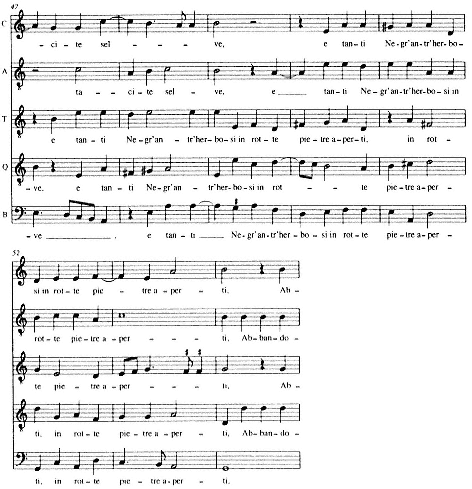
Ex. 21.
Rore, Strane ruppi, aspri monti, alte tremanti (prob. Luigi Tansillo), mm. 47-54;
Madrigali a 5 (Venice, 1542), no. 7.
less adventuresome: witness the poet's "fury" in v. II (Ex. 22), where melismas weave their way through a mild progression of fifths, C-G-C-F-C-G (mm. 100-105). Despite the wide registral spans and wild contours in some of these melismatic passages (e.g., quintus, mm. 106-7), however, Rore's voice leading minimizes the destabilizing effects of voice crossing. In this respect, such melismatic passages contrast with the many instances of chordal declamation, where voice crossing often abounds (in Ex. 20, note mm. 13-16).
This process of broadening out from syllabic textures to more florid ones that resolve instabilities of tonality and voice leading takes place repeatedly in the madrigal. It seems unlikely that Rore developed the technique by simply extending expressive possibilities he learned from Willaert, for Willaert made such pronounced
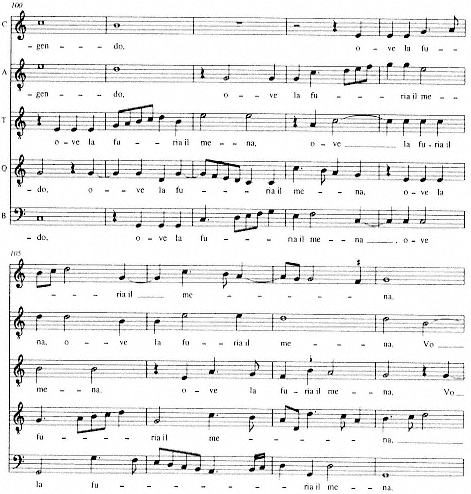
Ex. 22.
Rore, Strane ruppi, aspri monti, alte tremanti (prob. Luigi Tansillo), mm.
100-108; Madrigali a 5 (Venice, 1542), no. 7.
juxtapositions only at the most exceptional passages, like his setting of the paradox that opens Cantai, hor piango (see Ex. 45a). More typical is the diffident rhetoric of Pien d'un vago pensier (Ex. 14).
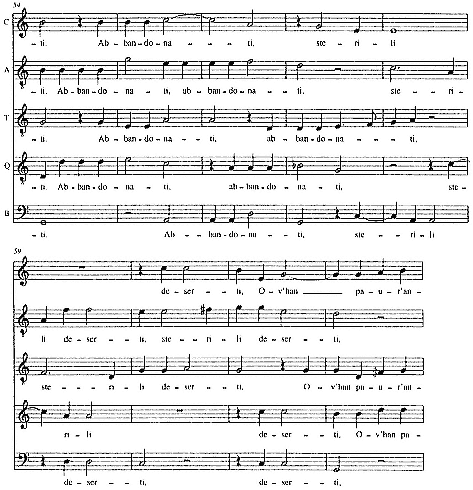
Almost invariably Rore's settings make use of Willaertian rhetoric but only for expressive contrast and rarely in so reticent a state as Willaert's own. Even a passage that explicitly recalls Willaert's plain idiom such as "Abbandonati, sterili deserti" (Ex. 23) is too idiosyncratic for Willaert in its contrapuntal construction. Here the passage earlier seen in Ex. 21 (mm. 47-54) devolves into an unsettled motivic counterpoint once all the voices have formed a perfect cadence on G. Pulled apart grammatically, the separate nouns and adjectives create ephemeral effects of a kind generally unknown in midcentury Venetian madrigals — contrapuntal disintegrations
Ex. 23.
Rore, Strane ruppi, aspri monti, alte tremanti (prob. Luigi Tansillo), mm. 54-62;
Madrigali a 5 (Venice, 1542), no. 7.
that we might call, after Anthony Newcomb's descriptions of the cadences in late Ferrarese madrigals, "evaporated."[38] In mm. 55-57 the fifth motion that animates the bassus provides a little momentum and direction to help the music retain its bearings, but by mm. 57-61 a sense of disorientation begins to set in again. The lowest-sounding note constantly migrates from part to part, switching back and forth from tenor to bassus as the texture is intermittently abandoned by one voice and then another. Finally these stark motives seem to go nowhere and end in the empty major third at m. 61. Both the textural disorder and spare, sharply etched motives foreshadow Rore's later experiments of the 1550s, as well as the Luzzaschian and Monteverdian madrigals of the 1590s. The eloquent minor-sixth leap in the altus of
[38] The Madrigal at Ferrara, 1579-1597, 2 vols. (Princeton, 1980), 1:120 n. 6.
mm. 54-55 even brings to mind the kind of barren pathos evoked in the famous opening of Monteverdi's Vattene pur crudel.[39]
Strane ruppi shows other extremes foreign to Willaert beyond those exemplified here. Occasionally they crop up quite unexpectedly, as in the madrigal's voluptuous, sequence-filled fioriture — one in the cantus on "erranti" (mm. 72-76), for example, and another for the final "ombre udito" (mm. 141-42). Other melismas are surprisingly angular, like the triadic tenor at m. 27 and the quintus at mm. 22-24, seen in Ex. 20.
What is remarkable, then, is not the boldness of any one such gesture viewed in isolation, but the general saturation of them. When the book first appeared, the public was unused to such intense expression applied to vernacular poetry; nor would it have been used to hearing such dramatic poetry sung to music. In fact, neither Strane ruppi nor Altiero sasso was ever set again, despite the popularity of Rore's book, and the same can be said of a number of other poems Rore published in it.[40]Per mezz'i boschi was not reset until later decades, by the Nicosian Pietro Vinci and the Mantuan Wert. Only late in the century did its topos become a favorite in the form of Petrarch's Solo e pensoso, i più deserti campi, where it found memorable expositions at the hands of Wert and Marenzio in the 1580s and 1590s. In 1542 that topos was — and would remain for many decades — a rarity.
There is a lighter side to the Primo libro, however, one that is mostly evident in its settings of madrigals and ballate. Of these, the former evince more realism than the book's other poems, though all four settings differ poetically from even the book's most restrained sonnets. The least facile — and most influential — of them was the opening madrigal, Cantai mentre ch'i arsi del mio foco, which will figure in the next chapter in connection with resettings by madrigalists even younger than Rore, the San Marco musicians Perissone and Parabosco. For the other poems Rore turned to a more cantabile idiom, a more modest elocution, and a style that is altogether less weighty and highly wrought.
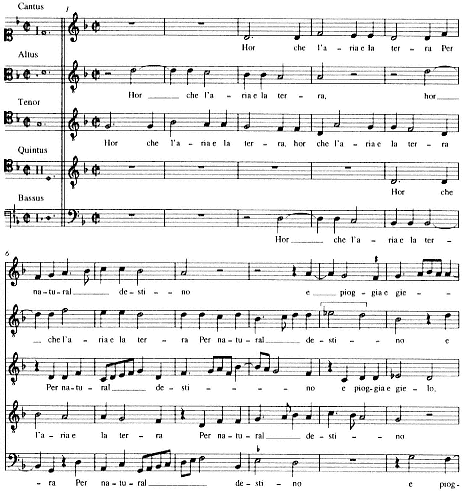
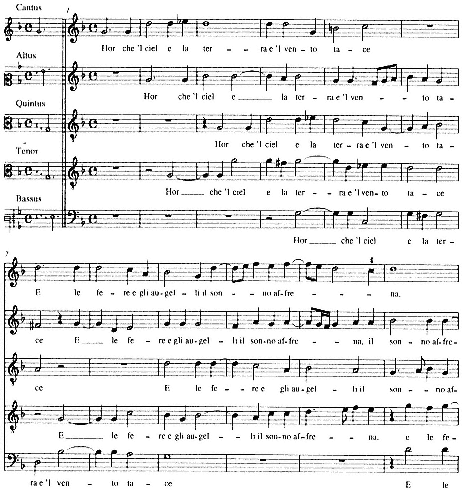
The contrast of light and weighty styles reveals itself in the exordia Rore wrote for the madrigal Hor che l'aria e la terra and the sonnet to which it is loosely related, Hor che 'l ciel e la terra e 'l vento tace (Exx. 24 and 25). The two share the same basic declamatory rhythms through the first eight syllables. But in the usual high Venetian manner Hor che 'l ciel pits a syncopated entrance of the quintus against unsyncopated entrances in the other voices and a moment later varies the soggetto in the altus with a new dotted rhythm (mm. 3-4). These irregularities instantly complicate the metric edifice. By contrast, the exordial rhythms of Hor che l'aria are
[39] See Claudio Monteverdi, Tutte le opere, ed. G. Francesco Malipiero, 17 vols. (Asolo, 1926-42; Venice, 1966), vol. 3 (1926), p. 48. Rore achieves a similar effect for the exposition of Altiero sasso.
[40] These include no. 3, Poggiand'il ciel, no. 9, Tu piangi, no. 10, Perseguendomi amor, and no. 15, Quel sempre acerbo, as well as both of the madrigals (nos. 18 and 19).
Ex. 24.
Rore, Hor che l'aria e la terra, mm. 1-11; Madrigali a 5 (Venice, 1542), no. 19.
virtually uniform through all five entrances and only vary with the reentry of the tenor in mm. 3-4. Similarly, while the opening measures of Hor che 'l ciel are drenched in semitones —

The vigorous rhetoric Rore fashioned for a poem like Hor che 'l ciel was unsuited to most madrigals, ballate, and small canzone stanzas. Perhaps the most unequivocal expressive departure of Hor che 'l ciel from the milder Hor che l'aria comes at the ravishing contrasts of vv. 5-6, where Petrarch jolts the sonnet from the serenity of the first quatrain to introduce a sudden shift to first-person parataxis. By contrast with the tranquil scene painting of vv. 1-4, the verbs of v. 5 move along in an unsettled, if weary, dissolutio. Suddenly, as the parataxis breaks, the verse tumbles in enjambment toward the oxymoron of v. 6.
Ex. 25.
Rore, Hor che 'l ciel e la terra e 'l vento tace (Petrarch, no. 164), mm. 1-12;
Madrigali a 5 (Venice, 1542), no. 2.
Hor che 'l ciel e la terra e 'l vento tace Now that the heavens and the earth and the wind are silent,
E le fere e gli augelli il sonno affrena, And sleep reins in the beasts and the birds,
Notte 'l carro stellato in giro mena Night drives her starry chariot around
E nel suo letto il mar senz'onda giace And in its bed the sea lies without a wave. 4
Veggio, penso, ardo, piango, e chi mi sface I am awake, I think, I burn, I weep; and she who destroys me
Sempre m'è inanzi per mia dolce pena; Is always before me, to my sweet pain;
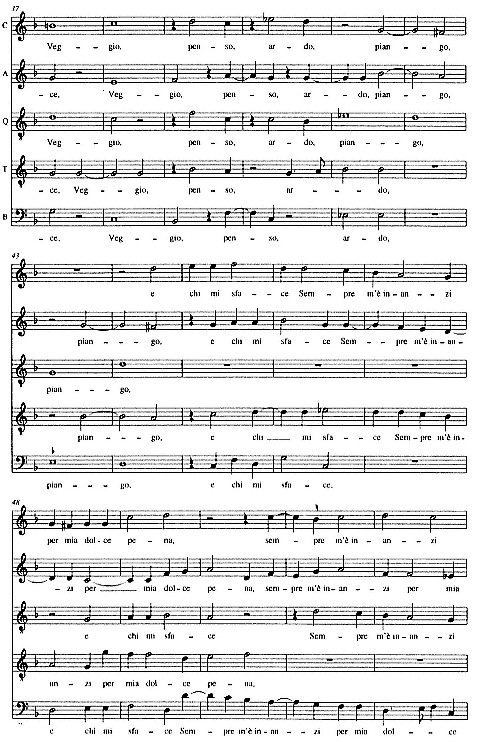
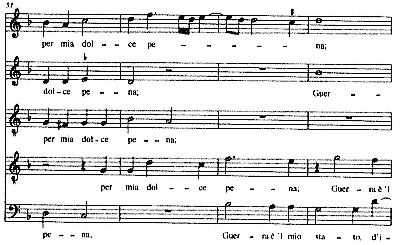
Rore's setting orchestrates the resultant interplay of syntax and rhetoric in vv. 5-6 while maximizing the expressive possibilities broached by the instabilities of the exordium (Ex. 26). It sets off the syntactic disjunction of the verbs in v. 5 by
Ex. 26.
Rore, Hor che 'l ciel e la terra e 'l vento tace (Petrarch, no. 164), mm. 37-56;
Madrigali a 5 (Venice, 1542), no. 2.
Ex. 26
(continued)
suddenly slowing the declamatory speed. Each verb is declaimed in a plaintive two-note gesture (often a simple minor second) and isolated by rests. Measures 37-44 move through an unpredictable harmonic course, irregular rhythms, and a texture wholly variable in density and weave. Ultimately, this passage forms a foil to the music starting at mm. 44-45 by distinguishing the shift to third person at the end of v. 5 ("E chi mi sface / Sempre m'è innanzi") with a return to the standard declamatory rate and counterpoint. First set off by rests, the clause is realized in a rhythmic parallel that energizes the enjambment and embodies it iconically through various rising and falling melodies, at the same time as it accentuates the words' expressive asymmetries.
Rore's Primo libro — and especially the play of these two text settings — nonetheless attests to the continued vitality of lighter poetic forms in Venetian printed repertories, not least because it represents the first printed madrigal book of such weight. Some of the lighter settings published alongside sonnets undoubtedly carried a whiff of nostalgia for the prettier, more chansonesque idioms of Verdelot and Arcadelt. Others offered more neutral versions of the new Venetian style, possibly more congenial to the amateurs who had purchase on printed books. Rore's Second Book, a printer's compilation drawn from a variety of styles and authors, furnished numerous examples of these earlier idioms, along with retrospective settings and new-styled Venetian sonnet settings.