
The Impact of Widowhood on Co-Residence
With all the studies of household composition in the European past that have appeared over the past two decades, rather few have considered the impact of widowhood on the surviving spouse's co-residential circumstances. The issue, though, is of considerable importance, not only for understanding the social meaning of widowhood in the past and not only for understanding more about the lives of other people but also for understanding the very nature of the household system. Just as the moment of marriage is a key component in defining household formation systems, so, too, is the moment when the marriage is broken. Where marriage entails the formation of a new household, for example, we may still find extended family units as a regular part of people's life course co-residential experiences if taking in one's widowed parent is the norm. Thus, we need to avoid an exclusive focus on marriage as the diagnostic element of household systems. One implication of this is that rather than simply dividing household systems in Europe into nuclear, stem, and joint, based on postmarital residence rules, we need to consider the complication added by rules governing the residence of the widowed.
Perhaps the most active setting for work on the impact of widowhood on co-residence has been England. Here the issues have not only been framed in demographic terms but have also been related to debates over the Poor Laws, with their controversies over where the family's responsibilities end and the community's or state's begin (J. Smith 1984).
Laslett (1977: 199-200) concludes that in preindustrial England the loss of a spouse entailed no change in household arrangements for the survivor, though the whole remaining family might move to another community. It is striking, however, that evidence from mid-nineteenth-century Preston reveals another pattern. Looking at widowers and widows over age 65, Michael Anderson (1971: 140) finds that 50 percent of the former and 41 percent of the latter lived with a married child, compared to just 15 percent and 17 percent of married men and women, respectively. He finds a similar pattern in his agricultural village sample (ibid.: 84). If this represents a change from the preindustrial pattern, it would be instructive to know just when, how, and why this change took place. Jean Robin's (1984) finding of a high proportion of elderly living with kin in nineteenth-century Colyton brings into question Laslett's earlier generalization. The lack of separate data on the widowed in Robin's stud),, however, makes conclusions here difficult.
Studies of the co-residence of widows and widowers in Italy are only now getting under way and focus largely on the situation of women (Palazzi 1990). Yet the Italian case is an interesting one given the prevalence of complex family household arrangements in much of Italy. Insofar as people live not in nuclear family households but in larger households surrounded by various kin, we would expect the co-residential impact of widowhood to be considerably reduced. In particular, loss of one's spouse would not entail isolation, nor would it have the same economic impact on the household unit.
A first view of where the widowed population of Casalecchio lived and how they differed from people who were still married is provided in table 8.3. There we look both at 1881 and 1921, comparing widows and widowers over age 50 with their married counterparts of the same age. In both years, a slight majority of the married men and women lived in simple family households, while around two-fifths lived in multiple family households. Fewer than 10 percent of the married men and women lived in extended family households. In comparing 1881 with 1921, what is striking is the lack of change in household arrangements of older married adults during a period of dramatic economic, social, political, and demographic change.
Compared to those still married, the widowed were much more likely to live in extended family households, largely at the expense of simple family co-residence. The changes associated with "modernization" and urbanization did not bring about any notable increase in the proportion living by themselves or in nonfamily situations (a proportion that, in total, hovers around a tenth for both widows and widowers). The lesser proportion generally living in multiple family households can be attributed to the impact of spousal death on households consisting of two conjugal nuclei. Using the standard typology, this has the effect of transforming a multiple family household into an extended family household.
TABLE 8.3 | ||||||
1881 | 1921 | |||||
Married | Widowed | Married | Widowed | |||
Women | ||||||
Solitary and no family | — | 8% | — | 12% | ||
Simple family household | 54% | 19 | 52% | 22 | ||
Extended family household | 9 | 38 | 6 | 43 | ||
Multiple family household | 41 | 34 | 42 | 22 | ||
N | 123 | 84 | 321 | 185 | ||
Men | ||||||
Solitary and no family | 0% | 11% | 1% | 13% | ||
Simple family household | 54 | 32 | 57 | 19 | ||
Extended family household | 9 | 21 | 6 | 38 | ||
Multiple family household | 37 | 37 | 36 | 30 | ||
N | 185 | 57 | 418 | 103 | ||
SOURCE : Casalecchio manuscript censuses. | ||||||
Another view of the co-residential situation of the widowed is provided in table 8.4, which looks at the relationship of widows and widowers to the head of the household in 1881 and 1921. Again, we find rather little change over time. Most widows live not as household heads but in households headed by a son, generally a married son. A woman is many times more likely to live in her married son's household than in the household of her married daughter. This, by the way, contrasts with the picture painted in nineteenth-century England by Anderson (1971: 56), who found that two-thirds of all widows who lived with married children lived with a married daughter. Robin (1984) found a similar pattern of residence with married daughters rather than married sons in nineteenth-century Colyton. Clearly, in this part of Italy we are dealing with a strongly patrilateral system, and this system affected not only postmarital residence choices but also choices of residence for those who became widowed.
The influence of gender on the impact of widowhood is clear from a comparison of the widows and widowers in table 8.4. Before widowhood, the large majority of women had been the wife of the household head and, with him, codirector of the household. For most of these women, widowhood meant loss of this status, as they became—at least formally—dependents of their sons. The lines of authority between the widow and her daughter-in-law in such situations remains one of the most pressing questions of historical inquiry on widowhood in this part of Italy. The impact of losing a spouse was quite different for a man, for in the great majority of cases, losing one's
TABLE 8.4 | ||||
1881 | 1921 | |||
Widows | ||||
Head | 16% | 25% | ||
Mother of head | 50 | 54 | ||
Mother-in-law of head | 8 | 9 | ||
Other kin | 13 | 5 | ||
Nonkin | 13 | 7 | ||
N | 84 | 185 | ||
Widowers | ||||
Head | 79% | 74% | ||
Father | 7 | 13 | ||
Brother | 5 | 2 | ||
Other kin | 2 | 5 | ||
Nonkin | 7 | 6 | ||
N | 57 | 103 | ||
SOURCE : Casalecchio manuscript censuses. | ||||
wife did not mean any formal change in household status. He remained, as he was, a household head.
The database we have compiled for the Casalecchio population allows us to take a more direct look at the impact of loss of one's spouse on household arrangements. We created a file consisting of all those whose spouse died while they were living in Casalecchio at any time during the period 1865-1921. Identifying the household in which they lived at the time of the spouse's death, we asked what impact the death of the spouse had on household composition. We retrieved household composition six months before the death and compared it with household composition six months later. The results are shown in table 8.5.
The majority of women lived in simple family households before widowhood. Death of a husband had the immediate effect of leaving the widow in a household by herself in one-fifth of the cases. Other relatives came to join the household of the widow in only 6 percent of the cases, while 16 percent of the widows (with any co-resident children they may have had) left Casalecchio within six months of the husband's death. The other important co-residential situation in which women found themselves on the eve of their widowhood was in multiple family households (in which 36 percent of the women lived). Husband's death here rarely meant either the immediate departure of the household from Casalecchio or the formation of a simple family household (presuming the departure of the widow). In 69 percent of the cases, in fact, the household continued to have two or more
TABLE 8.5 | ||||||||
Household Composition | Household Composition Six Months before Widowhood | |||||||
Simple | Extended | Multiple | Other | Total | N | |||
Women | ||||||||
Moved | 16% | 9% | 2% | 19% | 10% | 56 | ||
Solitary | 21 | — | — | 10 | 12 | 65 | ||
No family | 0 | — | — | 5 | 0 | 2 | ||
Simple | 57 | 13 | 5 | 52 | 36 | 194 | ||
Extended | 2 | 74 | 25 | 10 | 14 | 74 | ||
Multiple | 4 | 4 | 69 | 5 | 27 | 147 | ||
Total | 56% | 4% | 36% | 4% | ||||
N | 299 | 23 | 195 | 21 | 538 | |||
Men | ||||||||
Moved | 9% | — | 3% | 16% | 6% | 23 | ||
Solitary | 20 | — | — | 16 | 11 | 39 | ||
No family | 1 | — | — | — | 0 | 2 | ||
Simple | 67 | — | 4 | 32 | 37 | 134 | ||
Extended | 2 | 94% | 24 | 10 | 15 | 56 | ||
Multiple | 2 | 6 | 69 | 21 | 30 | 109 | ||
Total | 50% | 5% | 40% | 5% | ||||
N | 184 | 17 | 144 | 18 | 363 | |||
SOURCE : Casalecchio population register. | ||||||||
simple family nuclei within it, while in one-fourth of the cases the death meant the widow was left living simply with one of her married children's (almost always a son's) family in an extended family unit.
A look at the men whose wives died reveals that the sex of the deceased had very little effect on the impact of widowhood on household composition. Death of a husband more commonly resulted in the departure of the remaining household from Casalecchio in a short period of time, but, otherwise, there is very little to distinguish the co-residential impact of widowhood for men and women.
How frequently loss of a spouse meant emigration from the community of residence is a question that has seldom been studied empirically, either in Italy or elsewhere. We look into this question in Casalecchio, considering differences both by sex and age at widowhood.
As seen in table 8.6, where we show proportion of widows and widowers who leave Casalecchio within one year of widowhood, loss of a husband was more likely to lead to the widow's emigration than was loss of a wife in the
TABLE 8.6 | |||||
Men | Women | ||||
Age | % | Total N | % | Total N | |
16-39 | 9 | 55 | 22 | 102 | |
40-49 | 5 | 61 | 16 | 100 | |
50-59 | 17 | 83 | 17 | 136 | |
60-69 | 16 | 88 | 16 | 144 | |
70+ | 17 | 71 | 37 | 54 | |
Total | 13 | 358 | 20 | 536 | |
SOURCE : Casalecchio population register. | |||||
case of the widower (20 percent of the women left within a year of widowhood, compared with 13 percent of the men). Interestingly, the most pronounced gender differences are found for the young and the old, with those widowed at ages 50 to 69 showing no gender difference at all in propensity to migrate. In the case of the young widows and widowers, this might be attributable to patrilocality, with the widow and her young children returning to live with family members in her own community of origin. The young widower, by contrast, would be likely to seek the help of his own kin, who would tend to live in Casalecchio. Why the oldest widows should be so much more likely to leave Casalecchio on the death of their spouse than men who are widowed at the same age is less readily explicable.
A fuller view of the likelihood of emigration for widows and widowers is provided through survival analysis, which is not limited simply to a single year following widowhood and which takes into account the effects of death of the survivor.[14] These results reveal a clearer pattern of age differences in emigration among both widows and widowers and also allow us to compare the propensity of emigration of men and women on widowhood with the propensity of their married counterparts in the population.
Figure 8.1 simply divides all those who experienced widowhood by age, looking at their cumulative survival, that is, the proportion over time remaining in Casalecchio, controlling for death and the end of the period of observation (1921). We note here no difference in tendency to emigrate between the two youngest age groups (16-39 and 40-49 at widowhood) but a progressively sharp increase in migration propensity among the next two groups (aged 50-59 and 60+).
This in itself may tell us nothing about the impact of widowhood on propensity to emigrate, since the results could simply reflect underlying age-specific migration rates in Casalecchio. We thus needed to identify an ap-
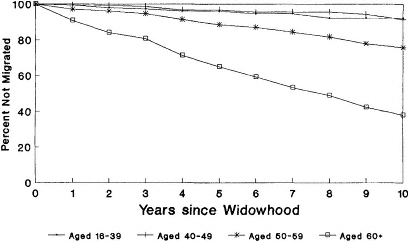
Fig. 8.1.
Migration, by age widowed, 1865-1921: Cumulative
survival after widowhood (Total N = 906).
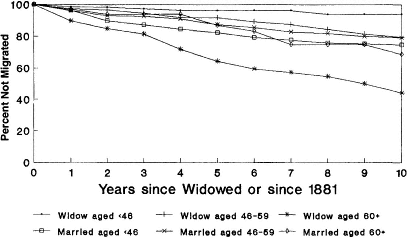
Fig. 8.2.
Migration following widowhood for women versus
migration of married women after 1881, by age:
Cumulative survival.
propriate control group to see if the experience of widowhood itself affected migration propensity. We took all those in the 1881 census who were married, following them over time to see when, and if, they migrated.[15] The results are shown in figures 8.2 (for women) and 8.3 (for men). The most striking result here is that older widows (over age 60) are considerably more
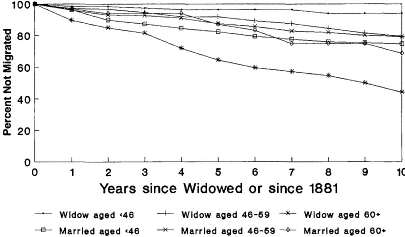
Fig. 8.3.
Migration following widowhood for men versus migration
of married men after 1881, by age: Cumulative survival.
likely to emigrate than are older married women. Moreover, age differences in migration propensity among married women are minor compared to the substantial differences found among women who are widowed.
To test the significance of these relationships, we employed the Lee-Desu statistic comparing survival curves. No significant difference (p << .10) in survival curve was found among the three age groups of married women. By contrast, among those who were widowed, all relationships were significant. [16] Identical results were found for the men, with no difference in emigration propensity for married men among the three age groups yet significant relationships found for those who were widowed. Loss of a spouse for older people—whether men or women—meant a significantly greater prospect of departure from the community than that faced by their married age-mates.