
4—
Catalysts in Action
Although Milwaukee provides an especially clear example of the potential of catalytic urban design, the principle is demonstrated in other cities as well. It is noteworthy that the size of a city is not a condition; small cities as well as large can undergo and benefit from catalytic transformation.
Kalamazoo:
The New Element Modifies the Elements around It
In Milwaukee the Grand Avenue inspired and supported subsequent developments, including the riverwalk system, skywalk system, theater district, and the Third Ward historic district revitalization. These events in turn gave impetus to new housing, the revival of the brewery district idea, and so forth. In Kalamazoo, Michigan, a similar series of events and consequences may be seen.[1] Kalamazoo is a midsize regional center with a population of approximately 100,000. The Upjohn Company (pharmaceuticals) is a major force in the community. As in many other small cities, in the 1950s and 1960s the retail center in Kalamazoo was challenged by suburban shopping centers. The first response seems to have been to imitate suburban complexes. When that approach failed, other tacks were taken, not always successfully. The key to Kalamazoo's achievement is a collection of efforts that support one another. Several mileposts mark the city's efforts to regenerate its core over a period of years through a catalytic chain reaction.
Antedating the redevelopment efforts of Kalamazoo was a key 1957 – 1958 study by Victor Gruen Associates. It identified the causes of center city decline and recommended a radical restructuring of the city's core. Like systemic/functionalist schemes of the same period, the Gruen recommendation called for an efficient one-way traffic loop around downtown, tied to vast parking areas ringing a pedestrianized commercial precinct. Conceptually, downtown Kalamazoo would be an urban, rather than suburban, shopping center. Gruen's scheme for a 180-acre area in Kalamazoo may be compared to the 164-acre development for Detroit's Northland shopping center, which Gruen designed at about the same time.
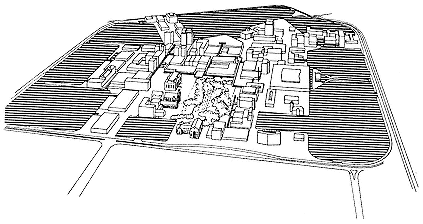
47.
Kalamazoo as it might appear if developed like a shopping center. Shade dareas
represent peripheral parking.
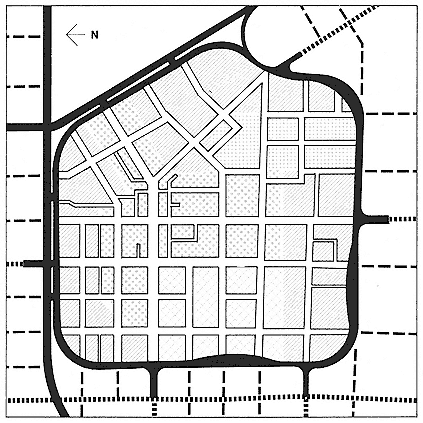
48.
Land use plan for downtown Kalamazoo suggested by Victor Gruen Associates.
The central dotted area would be commercial; areas to the west and east would be,
respectively, civic and cultural, and research and hospital. Parking for cars would be
on the periphery.
Gruen's recommendations were beyond the capabilities of a town of eighty-five thousand. The purchase and clearing of land for parking lots, the transformation of city streets into pleasant malls, and the construction of a circumferential roadway would cost too much, even if they were politically feasible, which they probably were not. The Gruen plan gave Kalamazoo an impossible, unbuildable vision of the future.
Although studies like Gruen's can have positive effects, arousing public interest and changing perceptions, they can also be dangerous. Because total redevelopment is seldom economically feasible, piecemeal redevelopment is sometimes attempted. But in a scheme like Gruen's each part depends upon the others; it is unlikely that any one element can succeed on its own. Isolated restructurings, left uncoordinated, can devastate and rend a city. Furthermore, impossible visions can engender cynicism; people who recognize that the vision proposed is impossible conclude that nothing can be done.
In Kalamazoo the Gruen vision was not rejected, nor was it built. Instead it prepared an attitudinal base from which more modest and appropriate urban design action could grow. Grandiose visions like Gruen's that arouse interest and change attitudes should not be built; it takes more than an efficient (functionalist/systemic) traffic scheme to revitalize and reaffirm a city center.
Kalamazoo Mall (1959)
The first reaction to the stimulus of Gruen's plan was a three-part program:
1. To recast the congested main shopping street as the first permanent (if modest) pedestrian mall in the United States. This change was accompanied by facelifts of and improvements to the stores and office buildings along the new mall.
2. To streamline the downtown traffic system. Instead of constructing a new high-speed ring road, the city converted existing streets to one-way, multi-laned arterials.
3. To form a nonprofit development corporation empowered to buy, sell, and manage property, especially near the mall. It is worth noting that Gruen disapproved of this approach. From his point of view, the pedestrian mall could succeed only when the traffic problem was solved in a comprehensive and up-to-date way:
The creation of pedestrian areas downtown can be successful only if it is accomplished as an integral part of an overall plan. In fact it is probably one of the last measures for implementation within a carefully scheduled revitalization plan, and it just cannot be the beginning. Only after proper access from suburban areas toward the central business district has been achieved for private as well as public transportation, only after a belt road system around the downtown core together with directly adjoining terminal facilities for public transportation and storage facilities for private cars has been constructed, only after a system for servicing downtown buildings has been implemented, can the creation of pedestrian districts be accomplished.[2]
Central Parkway South Urban Renewal Project (1963–1967)
If the scope and sequence of revitalization in Kalamazoo did not satisfy Gruen, the community's attitude must have. Kalamazoo did not stop with a modest mall and streamlined traffic system but looked for other action that needed to be taken.
Barton-Aschman Associates recommended changes to an extensive area south of downtown, including the rehabilitation and conservation of one-third of the area's structures; the development of Gruen's ring road through the area; the construction of medium- and high-density housing; the expansion of the pedestrian mall; and increased facilities for offices, light industry, and parking. This scheme, like Gruen's, was too extensive for its political and social setting. It failed to achieve a balance with other ingredients of the community. It failed to acknowledge the realities of its time and place and was rejected in a 1968 referendum for several reasons. First, though some housing was designated for rehabilitation, other housing would have been demolished. This seemed wasteful and unnecessary to the townspeople. Second, the projected ring road appeared to be a barrier to movement between the neighborhood and downtown. Third, the city's subsidy of private development seemed wrong. That the city would purchase private property, level buildings, and resell the land at a lower price seemed un-American in conservative Kalamazoo. Finally, the specter of public housing frightened some voters.[3]
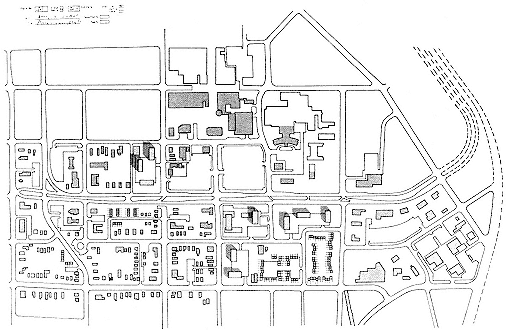
49.
The Barton-Aschman scheme for the area south of downtown Kalamazoo,
based on the architects' drawing.
In summary, the Central Parkway South project was too big for and alien to Kalamazoo in the late 1960s. Instead of growing conceptually from what Kalamazoo was, it was to have been a vast formulaic urban renewal scheme imposed upon the city. It was not part of the catalytic chain reaction begun by other events; it was too far from the mall to be an inevitable next step. Moreover, it became a political issue, so it could be voted down.
Extension and Refurbishment of the Pedestrian Mall (1971)
The success of the pedestrian mall gave impetus to its extension and refurbishment, evidence of both its success and its perceived value as an ingredient of downtown. This kind of improvement is not visionary but evidences sound catalytic action.
Improvements to Bronson Hospital (1972–1981) and the Upjohn Company (1974–1985)
Investments by Bronson Hospital and the Upjohn Company demonstrated local confidence in the city and its downtown. These employment centers in turn contribute pedestrian traffic that supports other developments like Kalamazoo Mall.
Kalamazoo Center and Mall Expansion/Renovation (1975)
Though the Kalamazoo Mall was innovative and successful, by itself it could not spur the revitalization of downtown. It needed enhancement. The technique chosen was to create a "magnet" and a "generator" at the most important intersection downtown, the crossing of Michigan Avenue and Kalamazoo Mall. This would give downtown a visual and experiential focal point and would encourage further development of the mall to the north.
Kalamazoo Center is a mixed-use complex including a high-rise hotel, a shopping and entertainment center, and a convention complex. Mixing activities within the complex was intended to guarantee the use of both the complex and downtown beyond conventional shopping/office hours. A hotel, convention center, shops, parking garage, and restaurants are collected around a soaring space that has been called the city's living room. The critic Suzanne Stephens saw in Kalamazoo Center a linking of "two strongly traditional urban forms: the town square and the market place in their 20th-century manifestations (shopping center and convention center) to create urbanity. . . . Unexpected was the public's appropriation of the mostly privately owned atrium space. Most of the visitors regard it as public turf—much like a street."[4]
Although the hotel, which symbolically marks the center of downtown, is the focus of Kalamazoo Center, it does not dominate the intersection. Set back at a diagonal, the hotel creates an edge for the public realm, not a center. Diagonal approaches and setback corners are visual cues indicating accessibility, suggesting that the building is not conventionally self-contained and pulling pedestrians to it.
At the time the complex was conceived, the legality of certain public-private ventures was questioned. The city wanted a civic center; Inland
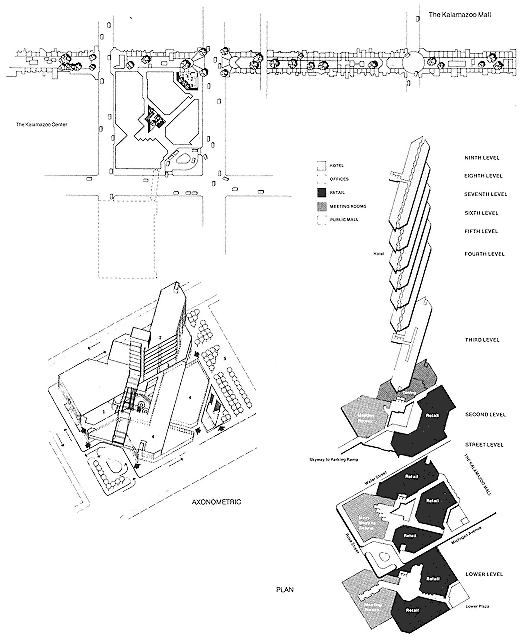
50.
Kalamazoo Center, ELS / Elbasani and Logan, architects, 1975. The Center, at a key intersection along
Kalamazoo Mall, was conceived as the focus and crossroads of a revitalized downtown.
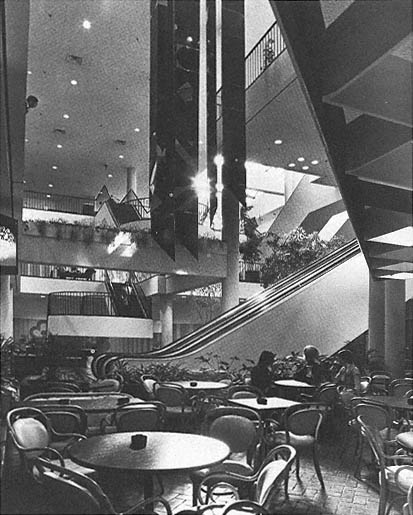
51.
Kalamazoo Center atrium.
Steel Development Corporation wanted to build a mixed-use center. To avoid possible problems, the complex was erected as two separate structures on separately owned parcels of land.
Building Kalamazoo Mall had been a first step, but by itself the mall could not have withstood the competition of suburban shopping centers. Kalamazoo Center enhanced the mall by focusing activity on it.
Haymarket Historic District (1981)
A group of commercial and office structures associated with Kalamazoo's nineteenth-century haymarket has undergone renovation and has been adapted for reuse, forming a cohesive historic district. The area is of strategic importance
for its location adjacent to the pedestrian mall and for its role in giving character to Michigan Avenue, the principal artery downtown.
Housing:
Hinman South Mall (1983), Arcadia Creek (Proposed, 1985)
Housing is acknowledged to be a crucial component of downtown renewal in Kalamazoo, but it must be seen as an integral element rather than an isolated one. Successful housing must make gestures toward further development; it must have "hooks" onto which existing and further development may attach. Hinman South Mall offers luxury condominiums and apartments for senior citizens in conjunction
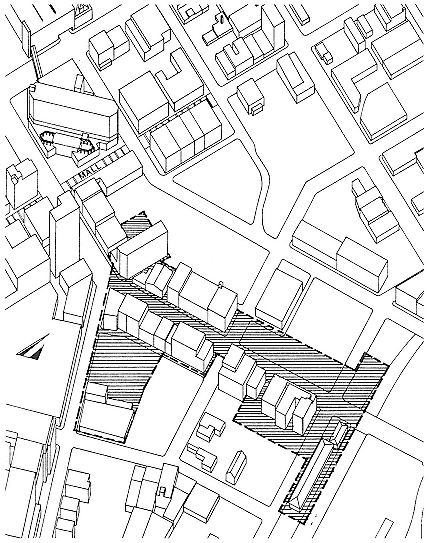
52.
Haymarket Historic District (shaded), Kalamazoo.
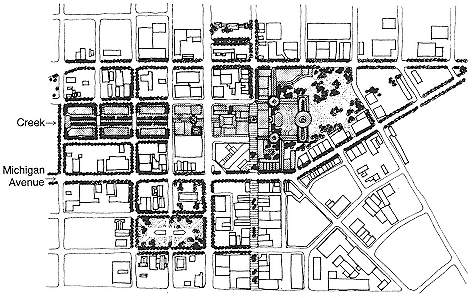
53.
Arcadia Creek development, Skidmore Owings and Merrill, architects. Based on the architects'
drawings. Housing is conceived as an element of a scheme to renew a declining area on the edge
of downtown. An existing creek / drainage ditch would be transformed to create a linear waterside
pedestrian spine linking new housing to refurbished loft/office structures and Kalamazoo Mall.
Beyond (to the right in the drawing), a conservatory and public garden might be added, too.
with office and commercial space. It appears to be a weak element in the catalytic chain of events, for it is isolated and seems self-contained. It does not acknowledge its context either functionally (when it was built there were few services within walking distance) or architecturally (it makes no effort to recall its context or to guide future development of its neighborhood).
Arcadia Creek seems more promising. An underutilized tract of land near the north end of downtown has been identified for housing development. But instead of quitting at that point, just building housing, the development becomes a vehicle for improving other aspects of downtown. For example, a creek that had been undergrounded through the site will be opened up to become a focal point. Then walkways along the creek will be extended into the existing fabric of downtown—particularly the spaces behind buildings—and will thus transform low-quality residual spaces into positive pedestrian areas.
A related proposal by SOM to transform a vast parking lot into an English garden with a conservatory is more visionary than likely. But this vision alerts us to the possibility that what has been understood as the backsides of Michigan Avenue buildings could become a positive feature
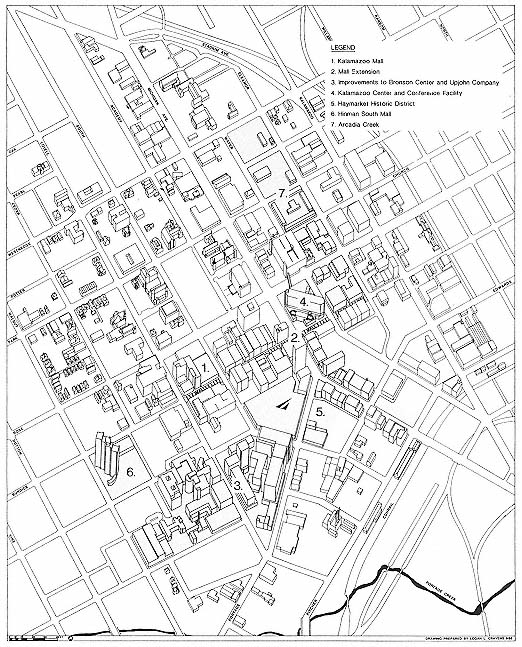
54.
Kalamazoo since 1957, showing some of the projects undertaken and recently proposed.
of downtown rather than a residual evil. Informal back elevations can mold and enhance a different kind of urban place. In chapter 5 we characterize this opportunity as a "realm in between."
Although certain elements of Kalamazoo's transformation have been problematic, many have succeeded because they relate to other efforts around them. A proposal to consolidate and redevelop the railroad yards was defeated by voters, but at the same time a twelve-storey office building has appeared across from Kalamazoo Center, and rehabilitations of other buildings downtown have been undertaken. As a whole, events in Kalamazoo support the concept of urban catalysis, in which well-conceived action can impel and support subsequent action.
As important as development projects themselves are vision and leadership like that offered by the Kalamazoo Downtown Development Authority. It calls for a downtown that is
a fascinating, dynamic, unique and pleasant place to work, live and play. Downtown should be more than an eight-hour per day office complex, a noon-hour shopping mall or a part-time center for cultural events. Although it must retain its role as the premier commercial center for the community and Southwestern Michigan, it should also entice us with its liveliness and variety. It should be constantly moving, changing and growing. And, it should be different from every other locale.[5]
San Antonio and Phoenix:
Existing Elements Are Enhanced or Transformed in Positive Ways
The Grand Avenue enhanced retailing and employment opportunities in downtown Milwaukee and provided a new architectural setting for the Plankinton Arcade, the Woolworth Building, and several other existing structures. The Kalamazoo pedestrian retail district is reinforced by new developments and renovations nearby. By contrast, numerous shopping mall streets in other cities seem to have speeded up the decline of retail businesses and of employment. Clearly, effective reclamation of existing structures and uses needs strategic, subtle, and well-orchestrated intervention. In a case like Milwaukee's Grand Avenue, where a focus for pedestrian activity was removed from the street, there was a danger that the traditional sense of the existing Main Street along Wisconsin Avenue might be lost, that former fronts of stores might become "backs," that the inward-looking character of shopping centers might turn downtown streets into mere traffic arteries. Although routine development can have such unwanted side effects, thoughtfully conceived catalytic action does not.
The key to saving the pedestrian character of Wisconsin Avenue while introducing an internal pedestrian precinct at midblock was to provide retail space that fronts both on the mall and on the street. This was the pattern in the existing Plankinton Arcade; it was retained and employed elsewhere in the project as well. The existing department stores already
stretched through the block; adding midblock circulation increased access. Admittedly, had the census of pedestrians remained constant, the new internal circulation would have reduced pedestrian traffic on city streets. In actuality, the Grand Avenue attracts more people to it, thereby justifying the addition of new pedestrian precincts.
A mixed-use project proposed for downtown Indianapolis similarly demonstrates how a catalyst can enhance existing elements of an area. The program was for retail, office, and hotel uses interwoven with two blocks of existing buildings. Like the Grand Avenue in Milwaukee, the development would be barely noticed from city streets. Circulation and accompanying new construction would occur through the interiors of blocks.
Where new facades are needed, they would be designed in sympathy with existing ones. Although new elements, like a pedestrian bridge and two office towers, are introduced, the overall effect is one of carefully controlled design to protect and strengthen the character of existing buildings.
The case for preserving and recycling existing elements of the urban scene is well established. Ghirardelli Square in San Francisco (1962) provided proof on both aesthetic and economic grounds. Adaptive use is in fact so well established that it is difficult to find a city in which a warehouse or factory has not been reclaimed for another use. Thus it is the
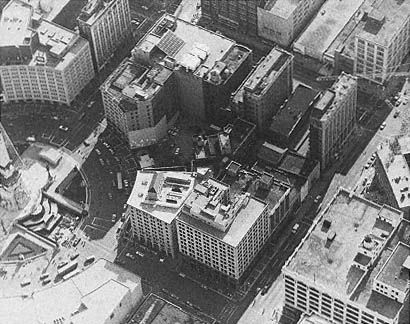
55.
Indianapolis: the urban context.
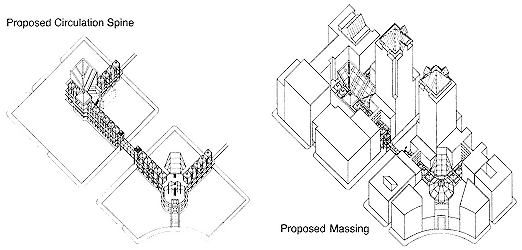
56.
Proposed development to be fitted into the Indianapolis context, ELS / Elbasani and Logan, architects.
catalytic role of adaptations, not adaptive reuse itself, that must be argued, for rehabilitation alone does not ensure new and continuing vitality.
The river in downtown San Antonio, Texas, was not merely reclaimed; it was used as a catalyst to reinvigorate downtown. It is important that the process of rejuvenating riverfront developments did not destroy the very context it was meant to enhance. In some cases, existing buildings addressing the river were merely refurbished. In other instances new developments like the Hyatt and Hilton hotels were pieced into the riverside fabric. At the Hyatt, development created a strong link to the Alamo, thus integrating previously isolated elements of downtown. Larger developments like the convention center and River Center add new elements to the Riverwalk and link the river level to city streets and activities above. River Center, a new shopping complex, ties an existing department store and adjacent city streets to riverside activities. Hence, parts of the city are reclaimed by the intervention of the catalyst. The most common approach, however, was to turn the backs of buildings carefully into river-fronting facades. In most cases this was accomplished while keeping their informal warehouse character.
Finding the value in existing elements of a development like Paseo del Rio is crucial. To recast them would have involved costly artifice. The unique character of the place, so different from that of a commercial downtown, was its central virtue.
In 1985 the city of Phoenix sponsored a competition for the design and planning of a new municipal government complex. Among the objectives were two kinds of effect: to stimulate downtown development and to suggest patterns and attitudes for subsequent design in Phoenix. Many of
the competitors approached the problem as though the complex were self-contained. Their dramatic proposals would produce a focal point, an architectural monument, even, that could capture worldwide attention. The new municipal center would upstage the rest of Phoenix.
Other competitors sought to weave the new complex into the city fabric, to make it integral. This meant retaining several of the existing, still usable, structures on the twelve-block site. It meant respecting the reality of downtown Phoenix, which is not a traditional center city commercial district but largely an area of office structures with only limited retail support. It is unrealistic, these competitors argued, to think that shopping patterns can be changed simply through the introduction of shops as part of the new government center. More reasonable is an approach that attaches the new complex to existing services and retail facilities and provides for incremental growth. This approach, instead of surgically implanting an extensive new complex, would graft new facilities incrementally onto existing ones.
Grafting does not mean the uncritical preservation of what exists. Even a modest intervention necessitates some changes in the existing urban
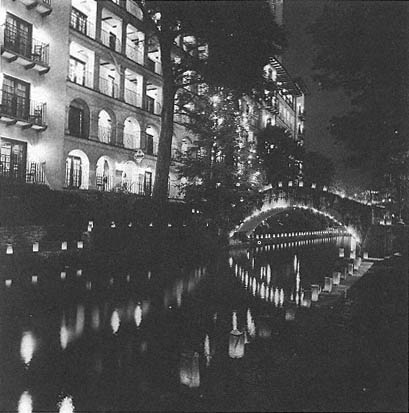
57.
San Antonio. Buildings fronting the river.
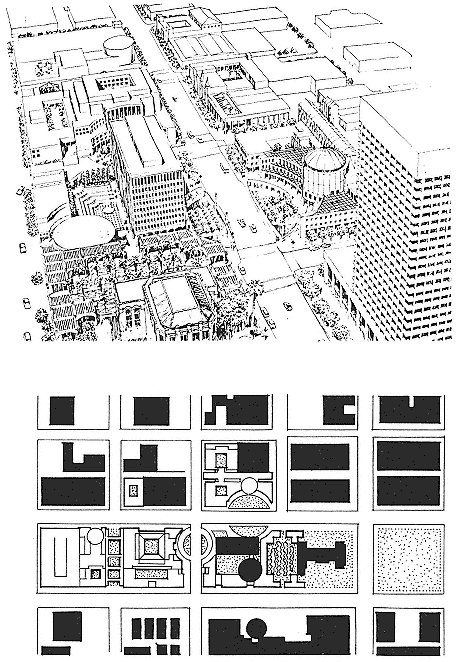
58.
"Grafting" of new elements. Competition entry to the Phoenix Municipal Government
Center by ELS / Elbasani and Logan and Robert Frankeberger, architects. Instead of
upstaging the urban context with an extensive, entirely new complex, this approach
recommends gradually attaching new elements to existing ones in a process that
evolves a new government center rather than implants it. In the plan
(lower part of figure), existing buildings are darkened.
fabric. New and old can mix to produce transformed urban elements. So, for example, competitors proposed that in addition to the historic Dorris Opera House, other buildings in the twelve-block site be refurbished for new use until such time as the city could afford to construct additional government buildings. Instead of planning to clear and build slowly over ten, twenty, or more years, they worked out an incremental strategy to evolve a municipal government center through gradual replacement.
That a catalyst acts moderately, not catastrophically, indicates two values: there is economic value in salvaging existing elements for new uses; and elements with intrinsic urban value continue to enhance the city. It is not necessary to rebuild as though nothing of worth had already been accomplished.
Unfortunately, in an effort to retain the past, historic buildings are too often disfigured and their essential qualities lost. An urban setting can effectively be destroyed even when it is "saved." The practices of patching historical facades as ornaments on much larger buildings and of constructing new buildings to loom over a smaller historical remnant do not
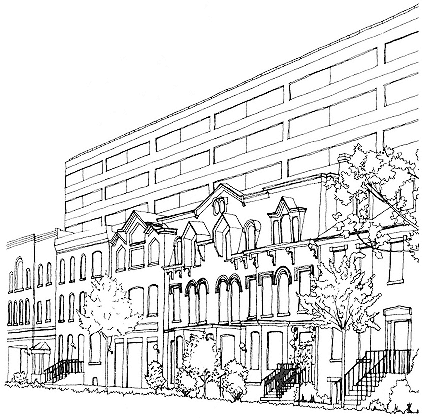
59.
Historical facades lose value and significance when treated as an appliqué on
much larger new buildings.
transform and enhance the earlier elements but emasculate and caricature them. The issue in preservation is not buildings but the spirit of places. A better policy than preservation at any cost, is to seek a new hybrid of old and new.
Georgetown, Washington, D.C.:
The Catalytic Reaction Does Not Damage Its Context
In addition to preserving and enhancing elements of value in a project area, urban catalysts treat their contexts with care—in striking contrast both to bulldozer techniques that clear entire areas and to unmoderated changes. Instead, selective demolition and renovation knit new developments into the existing urban fabric. Figure 38 shows how new and renovated buildings have been interwoven.
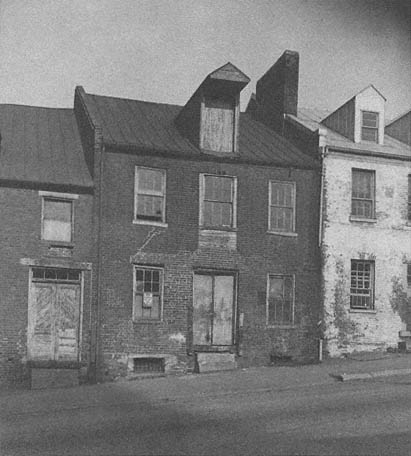
60.
Historical character of Georgetown.
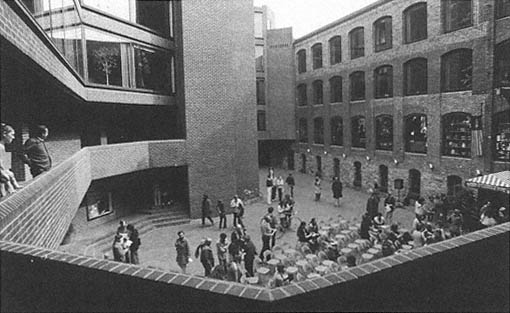
61.
Canal Square, Georgetown, Arthur Cotton Moore / Associates, architects, 1971. This complex
set a standard for subsequent design. It retained the character and scale of street frontages
while inserting a respectable modern building within the block. The development makes
connections to the C&O canal with a restaurant deck, to historic Georgetown in the
selection of materials, and to the pedestrian web with a "town square."
Georgetown was a port that blossomed in the eighteenth and nineteenth centuries. For years it remained a backwater, its residences principally Georgian, its other structures industrial or Victorian. By the twentieth century its waterfront had declined though its residential areas were gradually being reclaimed and refurbished. A Georgetown address began to carry status for residences, though along the Potomac River and Chesapeake & Ohio Railroad canal an industrial slum developed.
Until the early 1970s the few new structures built in Georgetown emulated Colonial styles: brick boxes with regularly spaced double-hung windows, shutters, and occasional ornamental porches. Beginning in the 1970s the potential of the industrial area became evident, and for the most part the approach of architects and developers and those who review their designs has been to build sympathetically but without historicizing pastiche. The pedestrian experience and the pedestrian scale have been important considerations in revitalizing Georgetown.
Canal Square
The first significant deviation from this pattern of mock-Georgian building in Georgetown was Canal Square. While decidedly un-Colonial, it paid sufficient attention to its context to establish a precedent for contemporary architecture in Georgetown. It connected
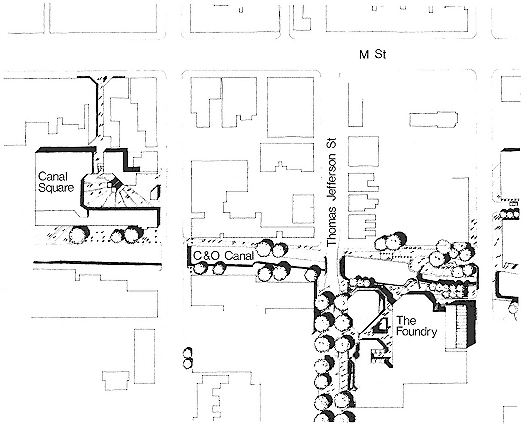
62.
Canal Square in its context and some of the subsequent context it engendered.
© Arthur Cotton Moore / Associates.
with an existing stone warehouse, demonstrating the value of reusing existing industrial buildings in new ways. It retained the scale of Georgetown and used materials sympathetic to Georgetown's character. Canal Square established a new precedent for the locale in site planning as well in creating a semipublic space at the interior of a block. Its program was mixed: specialty-retail and office uses.
Although Canal Square generated controversy for deviating from Georgetown traditions, its sympathetic design response to the context was recognized by local authorities, who gave the necessary approvals. It became an architectural catalyst as well as a precedent-setting economic development, demonstrating that office and retail developments were marketable in the area between M Street and the Potomac River. Equally important, it demonstrated that new development need not damage this fragile historical context. Canal Square set a standard and offered suggestions for other architects and developers who might follow, suggestions for a controlled yet still profitable response to context.
The Foundry
Taking cues from Canal Square, the Foundry features an existing industrial building, dating from 1856, reclaimed and tied to a new office and retail structure, using similar materials but in a contemporary style. The tone of the new structure is conditioned by the existing foundry and its Georgetown context, yet it is crisp, efficient, and modern. Together the structures create a semipublic space associated with the C&O Canal. Respectful restraint is evident throughout the complex. The new structure steps up gradually from the two-storey historic foundry, ultimately reaching six storeys. The diagonal wall of the office wing helps to define the plaza and permits sunlight to reach it. Fenestration patterns are adjusted to context, with large glass openings facing the interior of the site and smaller window modules, based on historical townhouse traditions, facing neighboring streets. The glazed mansard roof (on the street side of the building, not visible in Figure 63), is a familiar local form. With this strategy the architects and the developer hoped to prove "that excellent architectural design and careful consideration of the environment are basic to a fair return." Even within a few months they were satisfied that the building, "with all that has been going on around it and in it, looks like it has already been in Georgetown quite a while. I would say that is a very fair return, for everyone."[6]
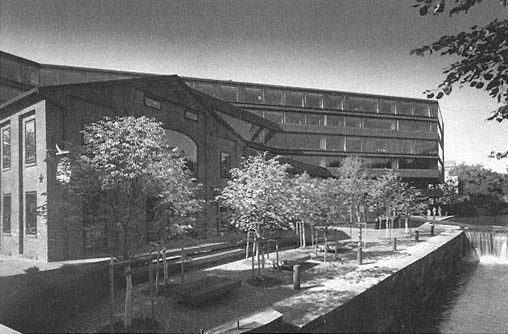
63.
1055 Thomas Jefferson (the Foundry), Georgetown, by Arthur Cotton Moore / Associates
and ELS / Elbasani and Logan, architects, 1977.
Photograph by Ronald Thomas.
Critical reaction was appreciative of the effort to defer to the setting: "The new neighbor on Thomas Jefferson Street has not only accommodated the history of Georgetown, it is making some . . . people realize that new construction, stirring new uses in among what already exists, can reveal the scale, texture, and character of a community in a telling, enjoyable manner."[7]
These two projects set off south of M Street a controlled chain reaction of commercial and residential building that was even more dramatic than in Milwaukee and Kalamazoo, a reaction that has both transformed and renewed an area that might well have been neglected or obliterated in other cities. The whole history of revitalization in Georgetown offers several lessons:
1. "Controlled reaction" does not mean that the architect is bound by narrow stylistic constraints. The Georgetown context offers at least three building traditions that architects have been able to reshape to more contemporary taste: Georgian, Victorian, and industrial vernacular. SOM's Four Seasons Hotel and Jefferson Court office building refer to different traditions (Georgian and Victorian) yet are rendered in a similarly straightforward way.
2. Although one might hope that all architects would understand a district's inherent chemistry, this is unlikely, so external controls in the form of design review are needed. In the case of Georgetown, several review bodies must approve designs. Whereas design review is often con-
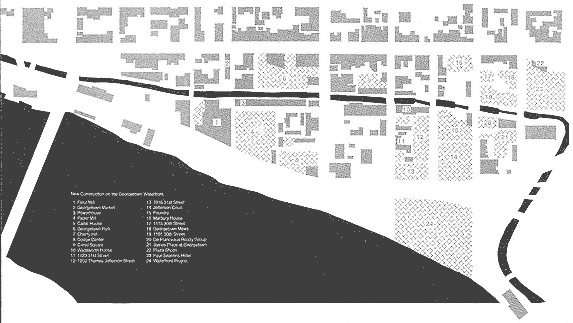
64.
Georgetown, showing the addition of new structures within the grain of the town. Size, scale, and
preserving the sense of a pedestrian web are key qualities in sympathetic additions to Georgetown's
traditional fabric.
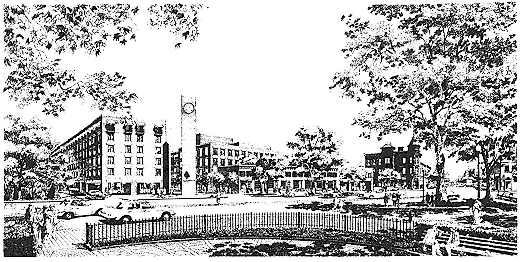
65.
Four Seasons Hotel, Georgetown, Skidmore Owings and Merrill, architects, c. 1980.
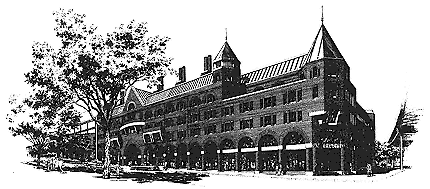
66.
Jefferson Court, Georgetown, Skidmore Owings and Merrill, architects, 1985.
servative, in Georgetown the Federal Fine Arts Commission has recognized that because waterfront buildings tend to be large, it would be a mistake to insist upon the strict historical styling associated with small structures and far better to seek designs that harmonize with, rather than imitate, the setting.
3. Contemporary needs and preferences can be accommodated even within the limits of a particular architectural or urban design setting. For example, the desire for informal semipublic spaces both indoors and outdoors has been satisfied even though the local Georgian tradition emphasized the street as a public realm. Similarly, larger windows, provision for parking, and other contemporary preferences have been included in new structures that nonetheless retain an overall sense of architectural and urban coherence.
The Georgetown case demonstrates that seminal developments like Canal Square and the Foundry can release and guide a chain reaction (rule 1), that existing buildings need not be destroyed (rule 2), and that the reaction need not be harmful to the context as a whole but can be contained while still allowing room for imagination and change (rule 3).
Portland, Oregon:
A Positive Catalytic Reaction Requires an Understanding of the Context
A single solution or formula will not work in all situations. There is no best form or best goal in urban design; forms and goals depend on specific situations. Milwaukee is different from Georgetown, which is different from Kalamazoo. In Phoenix, for example, the existing street grid is understood as a neutral framework that allows aggregation and subdivision (see Figure 90). But in Portland, the street grid itself is a valued element of downtown.
The importance of understanding a place is demonstrated in the efforts to revitalize the traditional retail core of Portland, centered near the
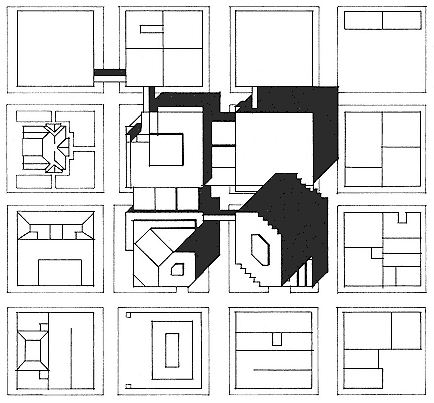
67.
Cadillac-Fairview proposal by Zimmer Gunsul Frasca Partnership, 1979–1981.
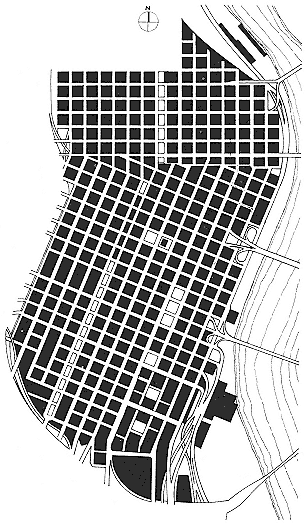
68.
The fabric of Portland, with its distinctive street grid and parks,
including the linear park called South Park Blocks (lower left).
Portland's role as a regional production and distribution center
began in the nineteenth century, with timber as a major commodity.
This role continues but has been diversified. In response to
urban decay in the 1950s and 1960s, the city has engaged in a
number of successful regenerative projects; for the most part,
the valued heritage, the inherited urban fabric, has been
respected; often it has been reinforced.
Pioneer Courthouse at Fifth and Morrison streets. Cadillac-Fairview developers proposed a multi-use scheme covering four blocks near this important intersection. The blocks would be linked by skybridges. But even though the Cadillac-Fairview scheme included up-to-date concepts and images for a multi-use urban center and would have been acceptable—even praised—in many cities, it was perceived to be undesirable for Portland. In the course of extensive public discussion, several shortcomings were identified, many of which had to do with the local context, with misunderstanding Portland:
First, the scheme seemed too much like "a suburban shopping mall turned inwards. It ignored streets, the neighborhood, the historic buildings, and the people who care about the fabric of our city life."[8] The
metaphor of fabric is popular for talking about the ingredients that give an urban center a sense of cohesiveness. Portland's fabric includes a distinctive, delicate grid of streets: the blocks are unusually small (200 by 200 feet) and the streets unusually narrow (60 to 80 feet). As a consequence of this fabric, pedestrians seem to belong downtown; the city is scaled for people on foot. Streets are not gulfs to be negotiated. Buildings, even when tall, do not loom. Although functionalist theory would propose linking these small blocks into superblocks and eliminating some "obstructing" streets and widening others as major arterials, Portland's fabric is as it should be, with intensive development of the small blocks and enrichment of the pedestrian realm on the periphery of those blocks. Although the scale of many American street grids works against what is called street life, in Portland the grid was made for it. There, anything that reduces pedestrian use of and access to streets is suspect. The complaint that the Cadillac-Fairview scheme was turned inward, like a suburban shopping mall, was a response to this concern.
Another ingredient of Portland's fabric is its collection of highly prized open spaces. These are of two kinds: block-sized parks that provide relief from the intensive development of the grid and a linear park stretching along the west edge of downtown.
Second, the Cadillac-Fairview proposal to violate the grid pattern with skybridges (some of them wide enough to contain shops) was offensive to some people. Not only would these destroy the sense of the city's fabric, but they would also block sunlight on the streets (infrequent enough in Portland to be valued) and the views down streets (to the hills, possibly even to the city's totem, Mt. Hood). The skybridges would also mean a loss of pedestrian traffic on the sidewalks.
Third, although Portland's older buildings in themselves are not remarkable, that there are so many of them left is . In the last decade or two the merit of the architectural heritage has been recognized, first in the form of historic district designations on the edge of downtown, then in the renovation of individual structures throughout the city center. For some critics, the Cadillac-Fairview proposal was incompatible with many older buildings, particularly the historic Pioneer Courthouse, which would be dwarfed by the new complex. There was concern, too, about the adverse impact of such a large project on the adjacent Yamhill Historic District. Even though the design and planning controls of the district were probably strong enough to minimize adverse effects, concerns were voiced that a large project, one that violated the existing scale of the city, might also violate other valued elements of the downtown.
Fourth, the scale of the complex was also of concern. The idea of a single "imperial" (and foreign—Canadian) corporation turning four city blocks into a self-contained complex seemed more appropriate to Los Angeles (one critic called it a "Star Wars" concept) than to Portland. Portland prides itself on its up-to-date achievements, but its values are inclined to be more humanistic than systemic. A project of this scale would focus too much attention on itself, would turn its back on the smaller retailers in the area, and would threaten the charm of downtown.
Fifth, the politics and economics of the project caused some complaints. Housing for low-income residents would be lost and not replaced. Municipal funds would be used to subsidize a private enterprise.
Partly because of negative public reaction to the concept and design, partly because of the economic climate at the time, and partly because the developer and the Portland Development Commission could not agree on terms, the Cadillac-Fairview project did not proceed. As a result of the discussion, however, the value of a combined retail and mixed-use project on this site was realized, and other developers were invited to submit proposals.
Ultimately, the Rouse Company was chosen to build a project that is more responsive to downtown Portland—that is to say, one that is a better urban catalyst because it recognizes and accommodates the local ingredients. It acknowledges the elements that make downtown Portland distinctive. Instead of plunking a multi-block complex across the street from historic Pioneer Courthouse, the development, named Pioneer Place, will move the largest elements back one block and thus make the courthouse the center of an implied three-block-long downtown public place. Its edges will be defined by the facades of the surrounding office
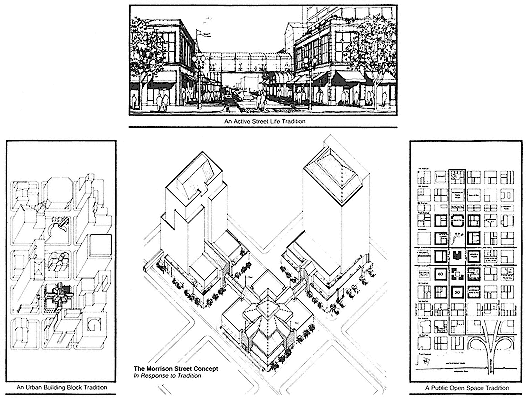
69.
Morrison Street scheme, Portland, ELS / Elbasani and Logan, architects, 1983.
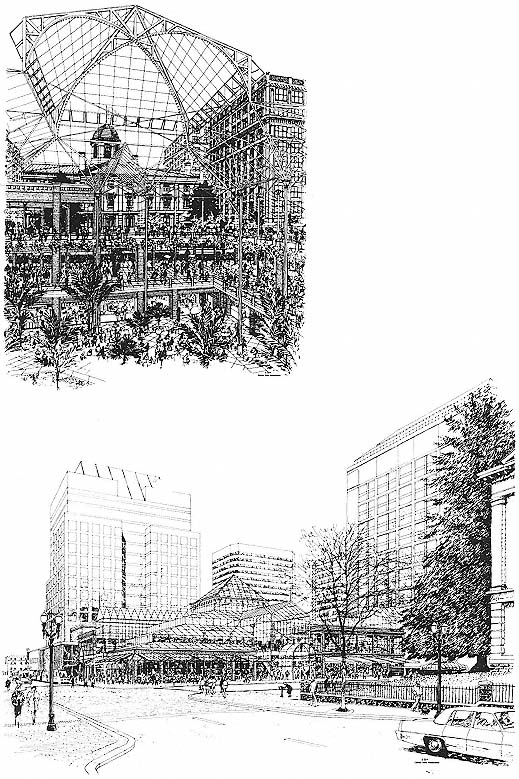
70.
Morrison Street scheme, Portland.
buildings and department stores. The new, extended, public realm will include the Pioneer Courthouse at its center, the recently completed Pioneer Square (the city's first real piazza) at the west end, and to the east a new, highly accessible, retail pavilion that is perceived as complementing the traditional retail pattern of downtown as well as the courthouse. Thus the fabric of downtown open space will be reinforced and enlarged to include a new focal feature, the pavilion. The sense of the valued Portland grid is retained by treating each piece of the development as a separate element. Even though there are skybridges, they are as narrow as possible and do not contain shops.
Oakland:
All Catalytic Reactions Are Not the Same
As these examples show, there is great diversity in urban settings, in the potential role of urban catalysts, and in the forms that catalysts take. In some situations the goal is to preserve the urban fabric while introducing new elements. In other places it is necessary to reinforce a fabric that has been eroded by poorly conceived developments and other causes. In still other, newer, cities, there may be no discernible order; there the catalytic effort introduces an ordering principle to guide subsequent development.
Many of the examples cited above are of the first type. Milwaukee's Grand Avenue, for example, required a cautious interweaving of existing buildings and the retention of the traditional character of downtown. If too much were removed or changed, the sense of the downtown could be lost. Although the strong character of existing buildings downtown was a positive feature, retail locations there were attenuated and disconnected, a liability that suburban shopping centers had overcome. Consequently, the approach was to connect existing blocks through a linking building. As a result, the feel of a downtown grid, with its traditional buildings, was retained and a readily accessible, integrated shopping complex was created.
In Georgetown, too, the existing character needed to be retained while modern development was introduced. This was accomplished through the use of familiar materials, by maintaining a respect for street edges and major pedestrian paths, and by limiting building heights.
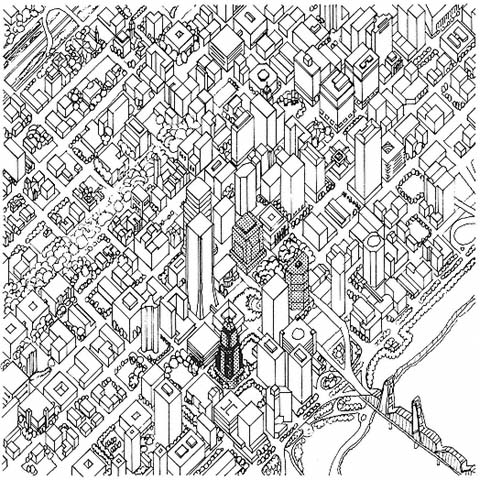
By contrast, in Portland's Pioneer Place development it was not so much the existing architectural character that had to be preserved as the block pattern of two-hundred-foot squares. In recent years the development pattern has been to place a single major building on each small block. The Pioneer Place project follows this pattern established by the Portland Building, the Justice Building, the KOIN Center, and several other recent complexes that have a tower as the centerpiece of each block. To preserve the block system, have a single focal point on each of the three blocks, and still facilitate economical retailing, an innovative layout was needed, one that makes use of the level below grade. Thus
71.
Several recent buildings (shaded) fill their block-sized sites, thus reinforcing the urban pattern and
the sense of the street. From top to bottom in the drawing: Portland Building, Michael Graves,
architect, 1983; Justice Building, Zimmer Gunsul Frasca Partnership, 1983; KOIN Center, Zimmer
Gunsul Frasca Partnership, 1983.
the needs of both urban design and retail planning are satisfied in the development.
Another city, Oakland, California, provides an example of the need to reinforce what is left of its original urban fabric. Oakland developed as a hub at the eastern edge of San Francisco Bay, across from its more famous neighbor. Its fortunes were those of other turn-of-the-century cities responsive to westward expansion, the settlement of California, and commerce with the Far East. Its problems are those of late twentieth-century
cities: competition with suburbs and a concentration of the poor and disadvantaged. Consequently, the city center is rich in the architecture of commerce but has less and less commerce to support it. Landscaped parks and cultural amenities testify to decades of civic pride and commitment, but more often downtown Oakland is known for poverty and decay. Retail activity has declined in Oakland's downtown, the dramatic diagonal intersection of Broadway, Telegraph, and San Pablo avenues. The city's turn-of-the-century character is eroding. Parking lots abound.
Once again, however, Oakland has an opportunity to blossom as the San Francisco Bay area grows. It is a crossroads of transportation and offers an alternative to San Francisco's more intensive and expensive business and residential districts. A reconstituted retail center would offer an alternative to typical suburban shopping complexes.
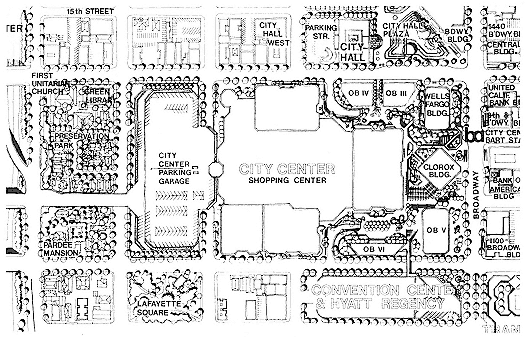
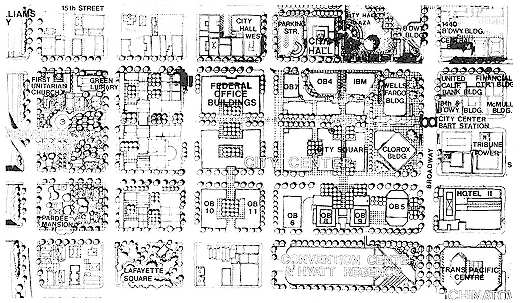
A city center redevelopment scheme was initially conceived as a total clearance to create a superblock that would erase not only the few remaining Victorian buildings but the unique intersection of streets as well. Fortunately, another approach has been chosen, one that seeks a resurgence of the urban character inherent in Oakland's unique plan and history. The overall plan for the City Center project has been redefined as a finer-grained office, retail, and housing complex. The earlier proposal for a suburban-style shopping center is gone, and the idea of the superblock has been partly recanted. Martin Luther King Jr. Way will be drawn into the project, becoming the primary address for many of the buildings. Re-
72.
Original Oakland City Center design ("OB" indicates the location of an office building).
73.
New scheme for Oakland City Center.
placing the proposed large department stores will be offices and a smaller specialty shopping area with an emphasis on restaurants. Thus in the new City Center plan part of the original street grid is reintroduced, the buildings are smaller and more in keeping with the scale of the surroundings, and the overall structure of the city is strengthened rather than rebuilt.
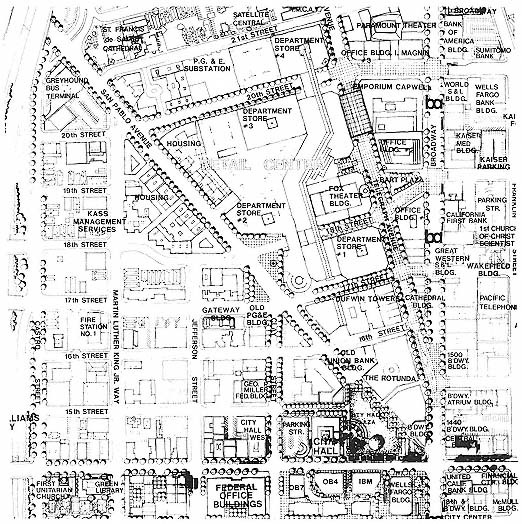
Rethinking the City Center project provided an opportunity to reinforce retail shopping patterns in an adjacent area. Because the single remaining department store in downtown Oakland (Emporium-Capwell) is located six blocks north, some critics suggested that the first plan for the new City Center misplaced the retail component, that it would make more sense to locate new department stores and shops nearer the existing one. In fact, this is what will happen. A recent plan places a new retail and mixed-use complex in the triangle bounded by San Pablo and Telegraph avenues and Twentieth Street. This scheme reinforces Oakland's urban fabric in several ways:
1. It is keyed to the existence of the Fox Theater, an important landmark. The Fox will provide a "front door" and work as part of a new plaza linking Telegraph Avenue, Broadway, and the BART (Bay Area Rapid Transit) station, thus uniting the most important loci of pedestrians downtown.
2. The scheme further re-establishes Telegraph Avenue as a major shopping and pedestrian precinct by both locating new stores there and creating a setting for additional stores there in the future.
3. Emporium-Capwell is tied in by a glazed canopy spanning Telegraph Avenue and by second-level bridges.
74.
Plan for revitalizing retail core of Oakland, ELS / Elbasani and Logan, architects, 1985.
4. Frontage on San Pablo Avenue becomes a focus for affordable new housing, which is badly needed.
Recipes for effective urban chemistry are probably as numerous as cities themselves. Seldom will an approach appropriate to one locale work without adjustments in another. But it is possible to generalize about the approaches available in reconstructing a city. One method is to preserve the fabric, to work within it, as most architects have done in Portland. Another is to reinforce a fabric that has come undone. Milwaukee's commercial core has been tightened by the Grand Avenue. A third is to repair a fabric that has lost its power to order the city. This is the direction Oakland is taking. A fourth is to create a new format for the city,
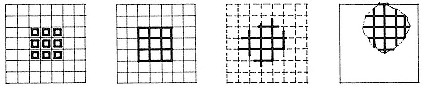
75.
Diagrammatic representation (read left to right) of preserving, reinforcing,
repairing, and creating urban fabric.
to give it a new order. Phoenix is taking this direction, as we shall see below.
Phoenix and Glendale:
Catalytic Design Is Strategic
At first glance it would seem that a comprehensive plan is a prerequisite of strategic urban design. Like a chemical formula, a plan tells what needs to happen before something else can happen; it indicates what will happen when two, three, or more elements interact. In part this is true. In Portland a highly controlled plan for the city center provides "guarantees" for investors and developers, guarantees that necessary ingredients will be there so that the anticipated chemical reaction can take place. For example, sections of downtown are given land use identities. For those sections, like the retail core, that depend on other ingredients, strategic elements are offered. A transit mall was identified as crucial, so it was built first. Parking structures were also key elements, so they appear on each end of the retail core. A light rail system that crosses the transit mall was built. These are the support conditions that can precipitate and sustain a strong retail activity that will focus on the Pioneer Place development (described above). At the same time these elements were being coordinated, related concerns like middle- and upper-income housing, nighttime activities, and the waterfront as an amenity all were considered and introduced strategically.
Of course it is possible for a plan—a formula—to be wrong. Having an urban design plan does not guarantee success in achieving its goals. It also is possible that a plan constrains reactions as it attempts to guarantee future ends. One need only look at controlled shopping-mall alternatives to downtown to see the problem. Even though they mix uses, offer plenty of parking, separate pedestrians from vehicles, and give "life" in the form of skating rinks, they and similar functionalist alternatives to traditional downtowns lack richness, spontaneity, a sense of community; they are the product of one idea, one hand at the helm, one class of people. Their sound is not that of life being lived (people talking, street life), but that of omnipresent Muzak.
There is a danger that master plans for downtown can have a similar stultifying effect and that downtowns will become little more than inner
city suburban malls. A key to success in revitalizing a downtown is to think strategically about the impact one element can have on another rather than to specify how each element should look and how each part should be designed. An urban design plan for catalytic reactions must be formulated with sensitivity to the ingredients at hand and should provide opportunities for infusing new ideas and the sense that we are evolving the future—not, as in many shopping centers, that the future has arrived.
In locales like Portland, Milwaukee, and Georgetown, the building history is sufficiently rich to inspire subsequent development. The character of each city is itself strong enough to guide development and to resist being consumed, sanitized, or disfigured by new events. But many cities do not have this kind of inherent character to guide and moderate development, so formulas for rationalizing change need to be introduced. Cities with little evident character, or those where growth is exploitative rather than formative, need guidance and control.
There are two ways to proceed where the urban context is weak or out of control. Where both growth and decay are occurring in a vast urban field, as in Phoenix, strategic design can create a series of catalysts to crystallize and focus the energies of growth and to counteract decline . Where an existing town center is redeveloping too rapidly and to the detriment of urban character and quality, as in Glendale, California, the strategy can be to integrate the changes and to coordinate the various potent reactions that are under way . One approach captures energy; the other guides it.
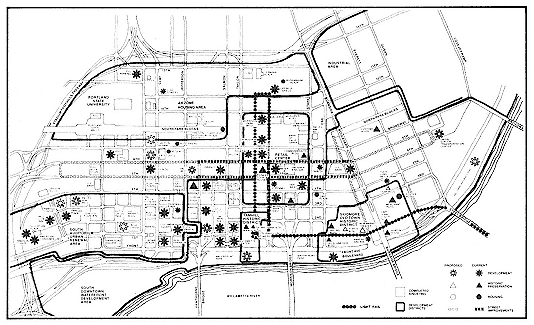
76.
Downtown Portland: the ingredients that support and reinforce one another.
The focus of one of the fastest-growing metropolitan regions in the United States, Phoenix has suffered from the dispersal of investment from its center to suburban regions. Yet as one of the nation's ten largest cities, Phoenix has a role to play as an urban center. The development strategy for Phoenix is to attract and focus investment and other resources to shape a workable and rewarding urban center and thus counteract decline and random development.
In terms of the chemical analogy, development in Phoenix has been characterized by incidental low-grade reactions, some new construction downtown, and a great deal of typical suburban spread. As in many American cities, conventional wisdom said that profits were to be made not in the core of the city, but on its edges. The result is a vast urban field with little distinction, little character, and little "image."
Strategic development in downtown Phoenix calls for crystallizing centers that can harness unfocused growth and in turn can have catalytic side effects. Such a process has been under way in the city's downtown since 1979. It began with a strategy to achieve two goals: to create an overall framework that clarifies the grid of downtown Phoenix and to work within that framework to produce the greatest side effects. Conceptually, the strategy is a "necklace," a loosely related set of situations or opportunities. Specific development/redevelopment can take place incrementally and with catalytic impact, according to a larger set of guidelines that identify likely development districts, circulation and parking
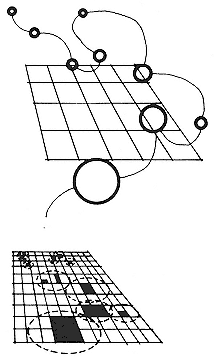
77.
A "necklace" concept for development is
recommended for Phoenix, a loosely related
set of opportunities for development/
redevelopment. Opportunities are not related
chronologically, over time, but physically,
reinforcing each other while seeding catalytic
reactions nearby.
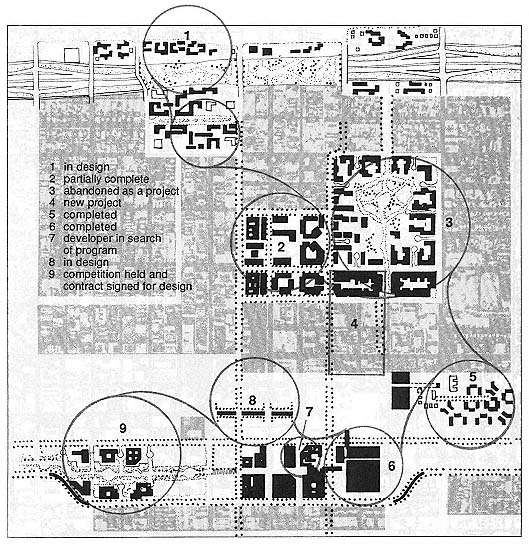
78.
Elements of the development strategy for Phoenix, circa 1980, with 1987 status report.
systems, appropriate building form, and ways of giving character and appeal to streets and pedestrian routes.
The necklace concept of key projects envisions a three-phase period of development extending over approximately fifteen years. Within each five-year period a series of critically important projects would be implemented through a combination of public and private initiative. The nature and timing of each project should respond to the findings of a market evaluation. In Phoenix the projects were located in critical areas where land could be made available without causing undue hardship and where the projects could have a positive impact on surrounding land uses. Because they are identified as significant or having potential, these
79.
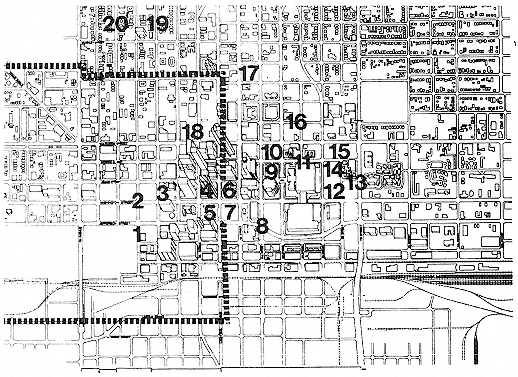
Downtown Phoenix, showing projected "catalytic" projects in 1988, including a new government
center, the renovation of an old theater, an urban park, a performing arts center, a streetscape
program, and several private commercial projects.
settings attract both human and financial interest and investment. Thus an anonymous urban field begins to have identifiable districts and nodes that improve comprehensibility and inspire confidence that the future is in some ways managed and consequences are in some ways predictable.
One advantage of strategic approaches to urban design is flexibility. Once the overall formula for shaping urban Phoenix is laid out, it need not be implemented in any particular sequence or period of time. (In this case, fifteen years is suggested.) The "necklace of opportunities" is just that, opportunities that can be exploited in response to need and circumstance, not according to a fixed sequence.
The necklace concept was laid out in 1980. In subsequent years many of the initial recommendations have been followed, such as the location and construction of the expanded convention center, the rerouting of Jefferson Street, the designation of a new hotel site, and the selection of a developer for a new specialty retail development to be called Square One. The Adams Street mall concept is moving toward realization. The ten-block office park project has begun. Late in 1984 the Phoenix Community Alliance, a group of local business and civic leaders, decided to inject more energy into the redevelopment of downtown to aid the city's redevelopment agency. The alliance took action by commissioning an
evaluation of the downtown retail core and a study of the downtown area as a whole. Both of these efforts follow the method of the 1980 study, which recommended that developmental actions be formulated around key catalytic projects. As a result of the Phoenix Community Alliance effort, a new mixed-use project known as the superblock is under way and will play a major role in realizing the necklace.
Whereas in Phoenix development was too dispersed and needed focusing, in Glendale redevelopment was so strong that the city was in danger of losing what was already good about its main street and, more important, of being harmed, not improved, by what was happening. For Glendale the goal is to give visual coherence to new developments. It is not to design all the buildings on Brand Boulevard; it is not to set a land use plan; and it is not, as in Phoenix, just to attract development. Instead there is a development control plan that establishes certain relations, densities, and features for every parcel in the downtown but is silent about land use, except for street-front retail uses. The notion is to shape the physical character of the city while promoting mixed land uses of housing, offices, shops, hotels, and cultural facilities.
The development control plan is supported by other plans that guide public circulation and detail design and "furnishing" of streets and sidewalks. These plans work in the context of a set of urban design guidelines to make sure that new buildings, when completed, complement each other. Although some design guidelines can be straitjackets, specifying everything to the smallest detail, strategic guidelines can give direction and consistency without imposing uniformity or limiting interpretation and subtlety in individual architects' designs. The Glendale guidelines do the latter. Visual coherence is achieved in downtown Glendale by guiding the form, relation, and materials of buildings:
1. Ground floor facades should be differentiated from upper storeys in recognition that the pedestrian level differs from levels above.
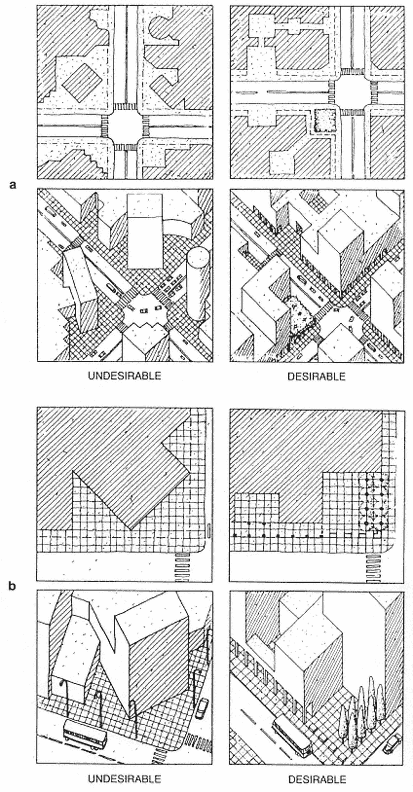
2. Retail, restaurant, service, and other high-intensity pedestrian uses should be at the ground level in buildings fronting major streets, including parking structures (Figure 81f).
3. Materials used on the exteriors of buildings should lend an air of permanence and encourage civic pride.
4. Exterior colors on tall buildings should have light-to-medium values to reduce their visual bulk on the skyline. (Dark colors also increase heat gain in a climate like Glendale's.)
5. To improve overall visual coherence, new buildings should respond to the design features of earlier buildings adjacent to them. Such design features include cornice lines, colonnades, proportions, fenestration, and materials.
6. Buildings should address the street in ways that reinforce the sense of the street as a space. Lower floors of buildings should align with the street except where open areas have been specifically designated (Figure 81a).
[
80.
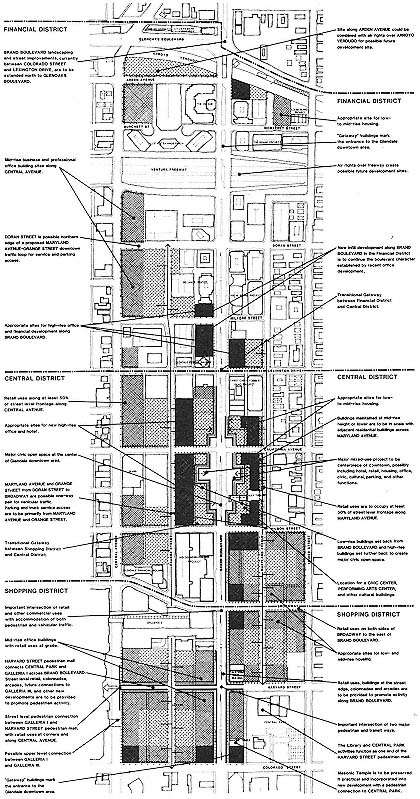
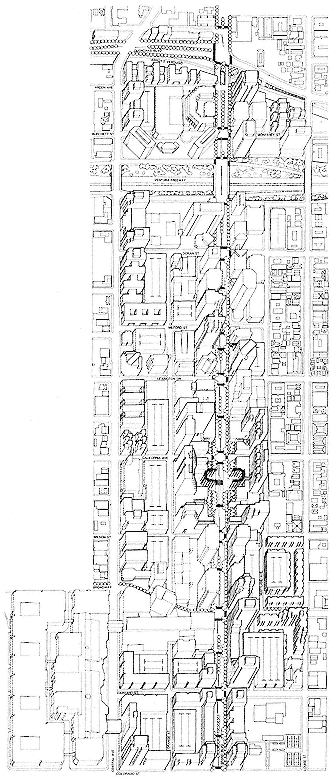
Development controls and anticipated results, Glendale,
California.ELS / Elbasani and Logan, architects, 1985.
While many cities need a catalyst to unleash regenerative
forces, Glendale needs to moderate and focus the energy
that is already evident there. Glendale is next to Los Angeles
but is not its suburb; it is a strong and diversified city in its
own right.
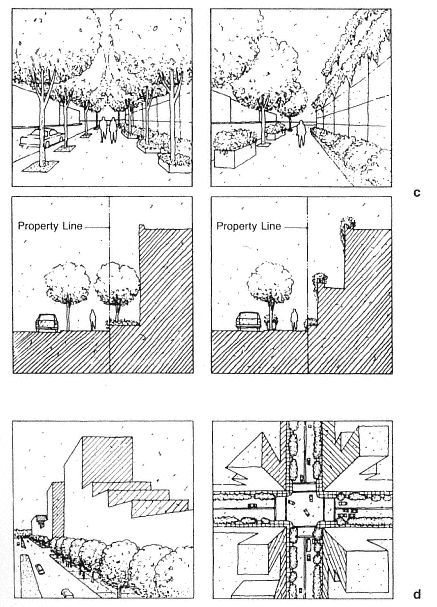
81.
Urban design guidelines for Glendale, California. ELS / Elbasani and Logan,
architects, 1985. The guidelines are intended to shape new development so
as to enhance the city enter and reinforce its incipient urban character.
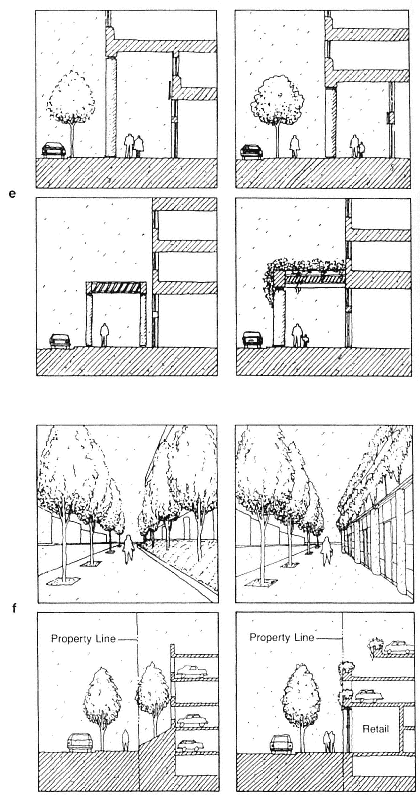
7. Open spaces, to have a strong character, should be defined on at least three sides by buildings, walls, or landscaping (Figure 81b).
8. Where retail or office uses on the ground floor are inappropriate, pedestrian ways should be enhanced with landscaped setbacks, trees, or similar elements (Figure 81c).
9. The bulk of high buildings should be minimized with offsets, changes in plane, terracing, or similar techniques.
10. The tallest buildings should be located at the corners of blocks, where their scale and prominence can be appreciated and their mass is appropriate to the scale of street intersections (Figure 81d).
11. Pedestrian areas and sidewalks should be enhanced with arcades, colonnades, and shading structures where appropriate. Alternatively, awnings or landscaping can be used to create a sense that areas are specifically for pedestrians (Figure 81e).
12. Visible sections of parking structures should harmonize with neighboring buildings through the use of similar materials and landscaping. In height, parking structures should not exceed forty-five feet unless they are enclosed by nonparking uses.
Catalytic urban design can be strategic in various ways. In some cases there will be measurable limits, as in Glendale; in other cases generic elements, like colonnades, will be specified; in still other instances the strategy will be to seed particular areas (as in Phoenix) to attract, coalesce, and channel latent development energy. The kinds and extent of the strategies must necessarily be determined according to place and need.
Portland:
A Product Better Than the Sum of the Ingredients
Milwaukee's Grand Avenue is more than a shopping center; Kalamazoo Mall is more than a pedestrianized street; San Antonio's Paseo del Rio is more than a walk. To have elements of a plan work together and reinforce one another is the goal in urban design. Recognizing opportunities and shaping symbiotic relations is the challenge.
The ingredients of Portland's new Performing Arts Center would seem inconsequential, even incompatible: an old, though handsome, movie theater and an adjacent hotel; parking lots and anonymous low-rise office buildings; a striking old church and a collection of increasingly shabby movie theaters on a honky-tonk street just one block from a group of dignified edifices (art museum, historical society, Masonic Temple, club) along the linear park known as South Park Blocks.
The strategy was simple: replace the inconsequential with something of consequence; join incompatibles in an original kind of union. The union is achieved in a theater district that recognizes the popular cinematic arts associated with Portland's Broadway and the classical performing arts associated with the cultural institutions along South Park. The
classic and popular arts are united by two blocks of renovation and new construction that are themselves united by a newly defined public realm, a block of Main Street marked by theatrical gateways. The activities of lobbies and foyers will spill out into this area.
Several strategies can work in transforming devalued buildings into positive urban features. One is simply to recapture intrinsic value through refurbishing and adaptation. In this way existing buildings change from disregarded to focal elements. The investment itself and the revelation of hidden value have a positive catalytic effect on adjacent areas. Countless examples can be cited, notably Ghirardelli Square, the Cannery, Boston's Quincy Market, and Seattle's Pike Place Market.
Another strategy is to incorporate existing buildings into a new urban construct. A designated-use district, for example, a performing arts district like Portland's, collects existing elements into a new form that has catalytic potential. In Sacramento deteriorating historical structures were revived as a tourist mecca that now draws people downtown. Because of its location at one end of a pedestrian mall, Old Sacramento has an impact probably greater than that of any other component of the mall. Its buildings are generic rather than exemplary, but in concert they have had a strong catalytic impact. San Antonio's Paseo del Rio is another ex-
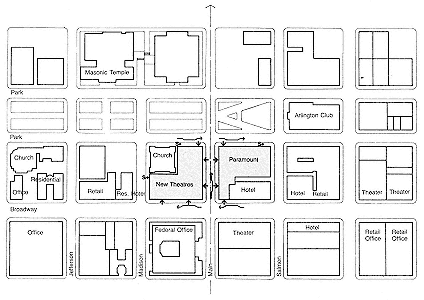
82.
Performing Arts Center, Portland, by Broome, Oringdulph, O'Toole, Rudolf and
Associates; ELS / Elbasani and Logan; and Barton Myers Associates, architects, 81.
Urban design guidelines for Glendale, California. ELS / Elbasani and Logan,
architects, 1985. The guidelines are intended to shape new development so
as to enhance the city enter and reinforce its incipient urban character. 81.
Urban design guidelines for Glendale, California. ELS / Elbasani and Logan,
architects, 1985. The guidelines are intended to shape new development so
as to enhance the city enter and reinforce its incipient urban character, 1985.
a.
A movie theater reclaimed for symphony use, along with an adjacent hotel, creates
a link between the Broadway entertainment district and cultural institutions along South
Park. The consequence is a strong theater / leisure district composed of all three elements.
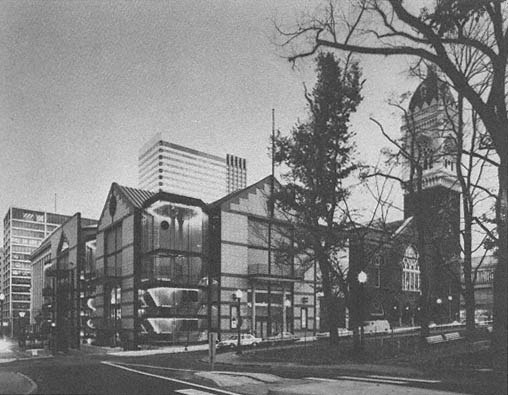
b.
Park side of Performing Arts Center, Portland.
Photograph © 1987 Strode Eckert Photographic.
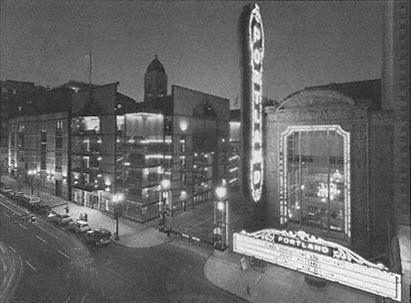
c.
Broadway side of Performing Arts Center.
Photograph by Timothy Hursley.
ample of a new urban construct that redefines the town and increases the value of already-existing elements.
A third strategy is to augment and reconfigure existing elements. A web of new structures added to an existing context can create a powerful urban focus, as Milwaukee's Grand Avenue demonstrates. This reconfiguration is happening in Oakland, too, where new linkages between a collection of existing structures, most of them modest, will create a highly visible new retail core.
In Each City:
The Catalyst Can Remain Identifiable
Design guidelines, the hiring of the right person to get the job done, the careful restoration that produces a building that looks "original"—in each of these cases the catalytic element can be difficult, if not impossible, to see. But more often the architecture of urban catalysts is visible, a working element of the urban scene and a testimony to the people and visions that gave it life. It combines with elements it has engendered and takes on a permanent role. Although the concept of a "necklace" of development opportunities for central Phoenix will not be recognizable, each development will be.
In the case of Milwaukee's Grand Avenue, the steel and glass structures that link elements of the complex with the rest of downtown become a constant restrained feature of the revitalized urban center. Along with glimpses of the new, one has at all times a strong sense of earlier elements and demeanors of the city. Downtown Milwaukee testifies about rival urban grids, about changing visions for the Milwaukee River, about technological innovations in the building industry, and about the cycling process through which uses migrate yet leave valued edifices to shelter and enhance new activities. Street widths change. The role of pedestrians broadens. Cities are enriched by such evidence of change and the people who shape change.
In Georgetown, Canal Square testifies to the period of its development and the talent of its architects while at the same time it is respectful of its historic neighbors. In Portland, each element in the catalytic chain of events betrays the hand of its author as well as the influence of its context.
That the efforts of individuals who had a role in catalytic change are recognizable is important. Wanting to leave one's mark, whether as an architect, developer, owner, or sponsor, is natural, and the mix of individual initiatives and marks makes our experience of cities rich. The collage of identifiable parts is central to the urban aesthetic and the appeal of cities.