
The Historicization of the Sublime
Nationalism most consciously engineered monumentalism within the limitless domain of popular historical representation. Compared with the Old World, whose traditions and customs stretched across centuries, America seemed a blank historical slate. Yet this very blankness opened up a virgin domain of history for America. Like the lands beyond the Mississippi, the unwritten history of America was ripe for discovery, exploration, and development. Jefferson's mammoth had more than biological interest; as an inhabitant of the American landscape, the anticipated mammoth announced a natural history predating the most ancient artifacts of European culture. This corollary between nature and history, however, simultaneously registered America's discomfort with its own historical virginity. "Our
historical works are attempts, not achievements," confessed one critic of the American art scene, who then sought a more hopeful cultural vista: "But in landscapes the sky is brighter.... there is the inspiring theme."[19] And yet, the Edenic scenes produced by Durand or Church did little to allay this insecurity. No matter how monumental portraits of Niagara Falls may have seemed to the antebellum public, these scenes could never be properly monumental. The represented innocence of a garden wilderness shirked any sense of monere , of memory, reminding, restoring, and transmitting an instructive past to a younger generation. If anything, nineteenth-century landscape painting dedicated itself to advertising a memoryless tabula rasa, inviting the marks of settlement, inviting history, even as it forgot that the land had ever been populated by others. This incipient character of the national project marked America with an inexperience that, no matter how endearing, denoted a glaring lack of history necessary for foundations, continuity, and political ritual. To fill this void, filial America argued that it had lost its innocence in the trials of the Revolution.
The National Symbolic requires an official history; national culture can hardly be authoritative if it lacks the legitimation of the past. George Washington's death on the eve of the nineteenth-century provided one such source of legitimation, turning over a mythic ancestor to be embalmed by a collective imagination. Gilbert Stuart, the artist famous for his portraits of Washington taken from life, perceived the potential for profit when a culture saw him not simply as an artist, but as a living oracle of America's past. Working from "originals" he had painted of the deceased president, Stuart and his daughter turned out their Washingtons and found a market eager for artifacts of national history. Until America found a new martyr in Lincoln, Washington remained the supremely popular topic for oratory and iconography, and the anniversary of his birth never failed to gather speakers to discuss his exemplary character or his sacred understanding of national union. As a monumental icon, the founding father inspired sublime lessons of citizenship; speaking on the centennial of his birth, Daniel Webster proclaimed that the name of Washington secured the "unity of government which constitutes us one people ." All these gravediggers unearthed a mummified memory of Washington and made it part of a mythic culture. This translation and resurrection of Washington into "Washington," of lived body
into mythic corpus, of natural body into a reified text, represented the most sublime moment of historical monumentalism. Thus, urging the preservation of Washington's home, one orator noted how Mount Vernon far exceeded "the sublime cataract of Niagara" because it is not a natural site, but a topos rich in the historical material of national narrative. With history, America ascended from the natural to the national.[20]
As a mythic-historical figure who dominated antebellum imagination, Washington relocated the sublime on a national scale. The private matters of his life did not remain mere details, but as with Cole's "minutest parts," which served to reinforce the "whole mass" of nature's unity, trivial memories of the founding father extended beyond the particular to represent America as an encompassing union. In Kirkland's Memoirs of Washington , even as Washington administers the federal government, he pays attention to local affairs at Mount Vernon: "not a broken fence or dilapidated negro hut but was repaired under his direction." Within the biography of the national father, even the most irregular particulars—such as human bondage—could be subsumed under the project of union. The dynamics of the sublime lent symmetry and order to a culture that contained potentially jarring social and institutional practices. Washington's simultaneous management of the nation and his plantation repeated the overall harmony of landscape paintings of Niagara Falls: particular sprays of water and jagged rocks give way to a larger scheme of a natural wonder that seems divine. As Kirkland puts it to her young readers, Washington's mind was expansive, able to encompass "now the shadow of an eyelash, now the perspective of Niagara."[21] As the founding father was allied with the most prominent image of grandeur and spiritual order, he translated and extended these themes of power and hierarchy to the ideological continuity of the United States.
A genealogy attempting to date the transformation of the natural sublime into a monumental historical culture might pinpoint Washington as the great man who, by an array of symbolic actions, most notably his own death, ushered America into history. A mezzotint engraving entitled A Symbol of America (Figure 4) graphically represents the symbolic interplay among nature, Washington, and history. Published in 1800, just after Washington had lost his natural body to acquire a corpus, this engraving centers upon the allegorical
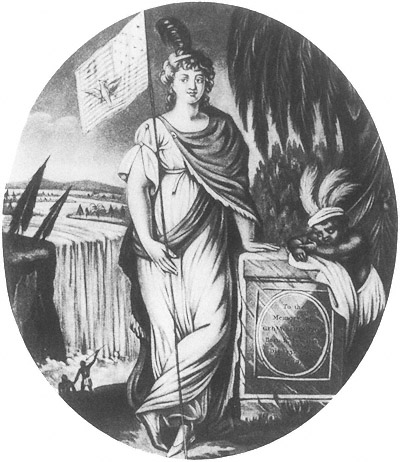
Fig. 4.
Anonymous British artist, A Symbol of America, 1800, mezzotint
engraving. Print Collection, Miriam and Ira D. Wallach Division of Art,
Prints, and Photographs, The New York Public Library, Astor, Lenox, and
Tilden Foundations.
representation of Columbia as a female figure holding the national banner. This figuration of America evokes the fertile nature of the continent via the ample body of a woman. Washington's tombstone lends support to her graceful attitude and gives rest to a crippled, despairing Native American. The posture of these figures, accented
by the downward slant of the branches, directing the spectator to the site of remembrance, makes Washington's absence the source of an extravagant historical symbolism. Inscribed with the bare facts of biography, the monument in the engraving reveals the national history that has "naturally" evolved from the savage state of the degraded original inhabitant to the confident and civilized demeanor of Columbia. Washington's iconographic presence, made possible only by the memory of his absence, provides a solid foundation for her emblematic being. Niagara Falls flows in the engraving's background as testimony that the inexhaustible splendor of the landscape is found in the historical legacy. Although Elizabeth McKinsey points to this image as "a moment when national and natural impulses came together," the authority of writing—"To the Memory of Geo. Washington"—makes this union a relation of power in which historical wonder overcomes natural splendor.[22] The engraving maps a predestined story of progression and development: the nation emerges from an aboriginal, ahistorical context to acquire the dominant stability of a monument to its patriarchal sire.
A discordant note enters this family romance of legendary father, mythic mother, and infant nation a year later, in 1801, when a variation of A Symbol of America replaces the humbled Native American with a dejected black slave. Yet within the economy of the sublime as national history, how disruptive is the presence of the slave? The slave serves the allegory of this engraving, America , updating the representation in the same way that the altered details of Columbia (rustic hair style, simple sandals, and a liberty cap instead of a diadem) more correctly identify the nation as an agrarian republic rather than a classical polity (Figure 5). The slave—to use Kirkland's formula—is "the shadow of the eyelash" whose reduced state contributes to the overall "perspective of Niagara;" or, using Cole's account of the sublime, the slave is "subordinate and administrative" to the larger national narrative the engraving imparts. Just as the speaker in "Self-Reliance" imagines himself dismissing the distraction of the "angry bigot [who] assumes this bountiful cause of Abolition, and comes to me with his last news from Barbadoes" in order that he can better love those at home, in an analogous move in America , the detail of the slave is subsumed by care shown to another community—the whole of the United States ("Self-Reliance," 262). Whereas Emerson prefers to pay attention to neighbors who fell

Fig. 5.
Anonymous British artist, America, 1801 mezzotint engraving.
McAlpin Collection, Miriam and Ira D. Wallach Division of
Art, Prints, and Photographs, The New York Public Library,
Astor, Lenox, and Tilden Foundations.
outside institutions, the allegory of America cherishes a country replete with institutions. The fact that America could accommodate this forlorn racial body testifies to the triumph of the ideological concordance of institutional practice, unique natural wonder, and the unique historical personage, Washington, represented by the urn and bas-relief. Union—as aesthetic principle and political imperative—dominates.[23]
Narrating a monumental history was at first analogous to painting a portrait glorifying America's landscape. But these engravings indicate that the natural sublime was not the final vision, but a conduit that invested icons with the power to narrate history. This transition from pristine wilderness to written memorial, from nature to culture, signified the triumph of an American project that created a historical imagination as potent as the natural forces it displaced. Whereas the Natural Bridge once humbled and then "elevated" Jefferson "up to heaven," now history served as the vehicle of transcendence. The foremost spokesman of monumental history, Emerson, outlines the dynamics that inform a new sublime historical sense revolving around participatory, temporal insights rather than geographic vistas: "all public facts are to be individualized, all private facts are to be generalized. Then at once History becomes fluid and true, and Biography deep and sublime," ("History," 246). Remembrance promises to elevate the citizen to the height of democratic vistas, where the subject becomes a "transparent eye-ball" and captures sight of the universal. Not only does the spirit of the citizen's fellows circulate through his or her body and being, but the mind domesticates time and renders its barriers meaningless; the individual's soul, according to Emerson, can worship across the centuries with the soul of Plato or Pindar. When in his 1825 address delivered at the laying of the cornerstone of the Bunker Hill Monument, Daniel Webster said "we are among the sepulchres of our fathers," he hoped the thousands of Americans gathered in front of him would disregard time and skip across the years to recover the storied viability of democratic origins.[24]
Having harnessed the forces of the sublime, democracy became a transcendental image. As an exalted political idea, however, antebellum democracy had more in common with Ahabian abstraction than Melville's "ruthless democracy." Its constituency could only be ideal: mid-nineteenth-century America attained an ascendant, self-
satisfying representation by dismissing enduring concerns over the political and social status of women, slaves, and those who held no property, all of whom were denied elective franchise, much in the same way that Emerson achieves self-reliance by shunning the "last news from Barbadoes." Still, a monumental culture assured of its own democratic principles demanded an illusion of vibrant civic participation, making history subjective, rather than making the individual subject to history. As Emerson understands the process: "The student is to read history actively and not passively; to esteem his own life the text, and books the commentary. All history becomes subjective; in other words there is properly no history, only biography" ("History," 239–40). In his schema, iconic symbols act as the nuts and bolts of monumental history, enabling the viewer to transcend his or her limited being as well as the material form of the symbol itself. Berlant notes the operation of a similar symbolic force in Hawthorne's representation of the American eagle outside the custom house as an icon that leads to the "transcendence of local history, narrative, and desire."[25] Governed by the metaphoric grammar of symbols, monumental history engenders the collective flowing together of citizens. The overwhelming crowds that gathered to inaugurate the Bunker Hill and Washington monuments dramatize the manner in which icons pervaded and shaped the culture's consciousness. Available to citizens of every class, symbols created an egalitarian outlook: as Emerson writes in "The Poet," "this universality of the symbolic language" caused "the distinctions which we make in events, and in affairs, of low and high, honest and base [to] disappear" (454). From the Greek symbollein , meaning "to throw together," symbols encouraged popular confluence around monumental historical icons—though, as we will see, that assemblage could bear alarming resemblance to Nietzsche's "dancing mob" that memorializes the forgetting of the past.
The symbol effects transcendence by rendering an event or person universally intelligible to the common mind through the stripping away of restrictive particulars—just as Ahab does in his demono-logical reification of the pagan harpooners. Historical events and people are subject to a similar Ahabian process of abstraction that prepares entry into national narrative. Harper's spelled out the criteria for determining what was qualified to be incorporated into the National Symbolic. For instance, to assess the symbolic resonance
of March 5, 1770, a citizen might ask: "What the masses were doing.... But even could this be ascertained it would not be history. On that day the three millions of our land were engaged in the various avocations connected with their ordinary life and ordinary interests." Hardly worth memorialization, the people are not the stuff of history. Instead, history resides solely in the national. Thus March 5, 1770 has significance because, as the date of the Boston Massacre, it "was thought by all, felt by all, and therefore became, for the time in which it was thought and felt, the one common history of all." In the same manner, for Washington to evolve as national symbol, for him to be represented as A Symbol of America , the restrictive peculiarities of his life had to be transformed and made "universally" significant. "Oh no! give us his private virtues ! In these , every youth is interested, because in these every youth may become a Washington," exclaims Parson Weems at the outset of his biography of the general, which then magnifies to epic proportion childhood peccadilloes such as chopping down a cherry tree.[26] Childhood transgression is elevated to the height of a national myth. Antebellum historiography defies distinctions between public and private to posit a universal memory of the past common to all citizens; as Emerson's first sentence in "History" asserts: "There is one mind common to all individual men" ("History," 237).
Actualizing a monumental history with symbols thus necessarily generates a degree of forgetfulness.[27] Monumental history is paradoxical; as a mode of history, it encourages a departure from the materiality of facts to embrace what Nietzsche called "unhistorical" representation. Only through forgetting could Washington be made a historical symbol of national dimensions. Consider what happened on a small scale when biography exhumed the body of Washington. Besides ignoring a natural body subject to decay and restricted by temporality, a biographer preparing the body of George Washington for a monumental history visible from every corner of the republic would necessarily reconstitute that body. Remembering the natural body he never saw, Weems unabashedly writes: "It was at Bermuda that George took the small-pox which marked him rather agreeably than otherwise." In other biographical accounts, monumental history must forget the general's tactical blunders and sublimate them as prudent military strategy. A national symbol can include neither the history of public dissatisfaction with the Washington adminis-
tration's treaty with the British nor the subsequent denunciations of the president as a new King George. In fact, most popular nineteenth-century biographies of Washington tended to gloss over his eight years of presidency and remember the more glorious days of cannon fire and captured enemy colors. So when the 1855 edition of Jared Sparks's Life of George Washington admits to "omissions ... mostly of a political or general nature," it can nevertheless insist that the essence of "the narrative [has] been preserved without change and nearly complete."[28] The generalized form of narrative—a story of youth achieving a heroic destiny—is what makes such omissions possible, even desired.
Lapses in memory underpin monumental history. Only forgetfulness can produce a sublime history in which specificities like smallpox scars or details of Washington's less than glorious foreign policy dissolve into a allegorical and repeatable pattern of national narrative. Lacking some amount of amnesia, antebellum historiography never could indulge in the unhistorical sense that invests icons and myths with a federal, unifying power. But even as Nietzsche declares that "it is altogether impossible to live at all without forgetting," he modifies this assertion with the caution that a zealous disregard for the past can become a "seductive" pursuit that tyrannizes a culture. Though Nietzsche warns us about "this kind of history in the hands and heads of gifted egoists and visionary scoundrels,"[29] neither Parson Weems nor Sparks fits this description. Instead, the threat of tyranny, the most severe danger to democratically inspired political and narrative representation, stems from a citizenry that actively, monomaniacally participates in national mythology.