
JAPANESE BUSINESS NETWORKS AND THE KEIRETSU
This study tackles this issue by focusing on the network of alliances among the major corporations that make up the Japanese economy. Intercorporate alliances, as defined here, are institutionalized relation. ships among firms based on localized networks of dense transactions, a stable framework for exchange, and patterns of periodic collective action. As a form of economic organization, they are distinct from both ideal-type bureaucratic organizations, on the one hand, and ideal-type market organizations, on the other. The organizational model is neither that of Alfred Chandler's "visible hand" nor that of Adam Smith's "invisible hand"-neither the solid structures of formal administration nor the autonomously self-regulating processes of impersonal markets- but of hands interlocked in complex networks of formal and informal interfirm relationships.
In the traditional model of formal organization, actors are linked under a common, unified hierarchy. This command structure is designed to ensure high degrees of control over a limited set of exchanges among a prespecified set of actors. Actors within this structure subject themselves to the restrictions imposed by an authority relation (Simon, 1937) and the organization's internal decision-making machinery (William-son, 1975, 1983). No such unity of command exists in alliance forms. Whether operating through specific institutional arrangements, such as joint ventures, or through more loosely coupled structures, such as informal business groupings, alliances preserve a relatively large degree of formal decision-making independence for their initiating organizations. At the same time, relationships among alliance partners differ from the impersonal, arm's-length markets of textbook theory in that the identity of actors and the history of their relationships are important
considerations in actual patterns of trade. Whereas perfect competition implies "social atomization" (Granovetter, 1985) among economic actors-temporary exchanges of convenience among faceless traders- alliances represent coherent dusters of preferential exchange among traders often linked together over the course of decades. In summarizing the distinctive features of Japanese industrial organization, we may point to five general tendencies. Although none of these is unique to Japan, what distinguishes Japan from the United States (which perhaps lies at the other extreme of the transactional continuum) is their pervasiveness and continuing visibility. These defining tendencies are:
1. Affiliational ties. Transactions often take place through alliances among affiliated enterprises, creating a vast sphere of economic life intermediate between anonymous markets and vertically integrated firms.
2. Long-term relationships. Intercorporate relationships in their ideal form are stable and long-term, relying on diffuse sets of obligations extending over time.
3. Multiplexity. Transactions tend to be overlapping, with equity investment and personnel interlocks used to consolidate financial, commercial, and other business ties.
4. Extended networks. Bilateral relationships are set in the context of a broader family of related companies.
5. Symbolic signification. Active efforts are made to infuse intercorporate relationships with symbolic importance, even in the absence of formal, legal arrangements or contracts.
Networks of business relationships in Japan are most evident when they become institutionalized into identifiable keiretsu. The keiretsu are of two distinct, though overlapping, types. The vertical keiretsu organize suppliers and distribution outlets hierarchically beneath a large, industry-specific manufacturing concern. Toyota Motor Corp.'s chain of upstream component suppliers is a well-known example of this form of vertical interfirm organization. These large manufacturers are themselves often clustered within groupings involving trading companies and large banks and insurance companies. The six major groups in Japan comprise three historical alliances directly linked to the former zaibatsu of Mitsui, Mitsubishi, and Sumitomo, and three banking groups centered on Fuji, Sanwa, and Dai-Ichi Kangyo. These large clusterings, the intermarket keiretsu, provide for their members reliable sources of loan
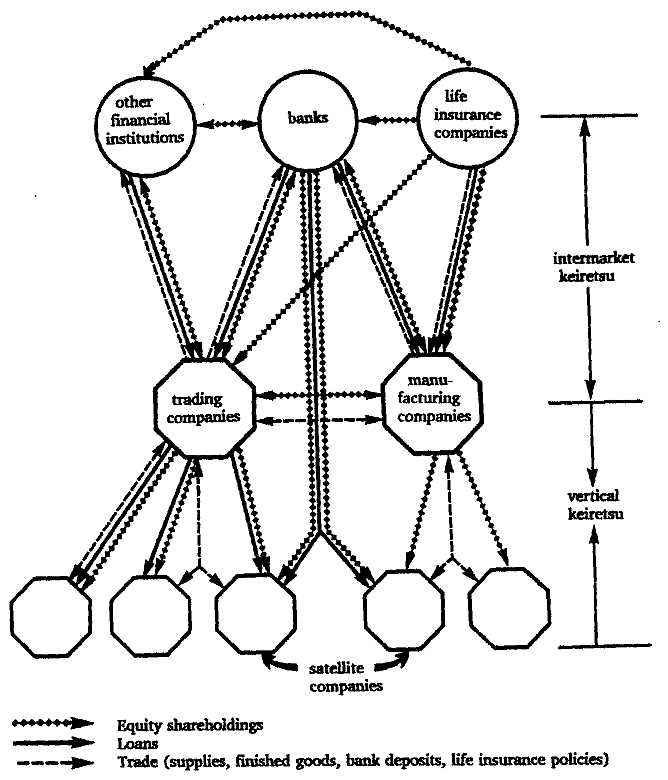
Fig. 1.1. Debt, Equity, and Trade Linkages in the Keiretsu.
capital and a stable core of long-term shareholders. Moreover, like the vertical keiretsu, they establish a partially internalized market in intermediate products. A basic schematic of linkages within and between the vertical and the intermarket keiretsu is shown in Figure 1.1.
However, it is important to recognize that these are only the most formalized of a wide variety of different cooperative groupings that dominate the Japanese industrial landscape. The keiretsu should be seen as a metaphor for general patterns of interfirm organization in Japan-
as an ideal type in interfirm networks marked by the five characteristics outlined above. As we see in the core empirical chapters, these characteristics are pervasive throughout Japanese industrial organizations (although often varying in precise form). Intercorporate relationships within the most formalized keiretsu therefore share many characteristics with those among ostensibly more independent firms. The alliance terminology captures more flexibly the overlapping richness of these relationships than terminologies based in bounded notions of enterprise groups. For the sake of convenience and consistency with other studies, "keiretsu," "enterprise group," and related terminologies will continue to be used at various points in the chapters that follow; but the loosely coupled sense in which they are interpreted here should be kept in mind.