
2—
Eliza and Elizium
Out from the world, yet on the ground, Even in a place of bliss.
—Thomas Blenerhasset, A Revelation (1582)
The year Elizabeth I came to power, England itself seemed to have lost its last claim to imperial grandeur, its sole remaining foothold on the Continent, Calais.1 The accession at so awkward a time of a female prince, and an arguably bastard heretical female prince at that, made England's new isolation look all the more dangerous: the following year an Englishman at the court of Philip II likened England confronting the far greater Catholic powers of France and Spain to "a bone thrown between two dogs."2 As Elizabeth began her rule, in other words, one would probably not have expected the next forty years to produce what has usually been considered England's greatest literature; and even modem criticism, with all the advantages of hindsight, has had a hard time accounting for the paradox. Those scholars interested in associating Elizabethan England's literary and political fates have offered basically two explanations for Elizabethan literature: what might be called an expansive and a repressive hypothesis, neither of which entirely fits the facts.
The first, the expansive hypothesis, is more obviously inaccurate. According to Sir Walter Raleigh the critic, "That marvelous summer time of the imagination, the Elizabethan age, with all its wealth of flowers and fruit, was the gift to England of the sun that bronzed the faces of the voyagers and of the winds that carried them to the four quarters of the world" (English Voyages , 151-52). But by the 1590s, the period of Elizabethan England's greatest literary activity, Elizabeth's voyagers had very little to feel expansive about: no one had found either a northeast or a northwest pas-
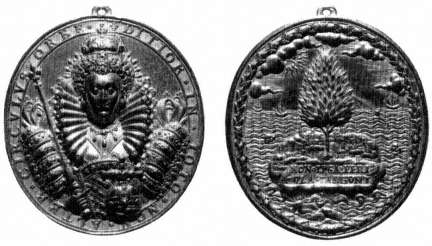
Figure 3.
Medal of Queen Elizabeth I (obverse) and England (reverse), probably by
Nicholas Hilliard, c. 1590. A bulging Elizabeth personifies little England's
illimitable potentiality. The obverse is inscribed " Ditior in toto non alter
circulus orbe " (There is no richer circle in all the world). The reverse inscrip-
tion reads "Non ipsa pericula tangunt " (Not even dangers can touch).
(By courtesy of the Trustees of the British Museum.)
sage; England's only New World colony (in Virginia) had failed, twice; and the most famous voyagers themselves—Drake, Cavendish, Frobisher, Hawkin—had all died at sea.
G. K. Hunter sees the same depressing fortune dogging the lives of the Elizabethan poets; for Hunter and the repressive hypothesis, Elizabethan literary sublimity is the product precisely of frustration, a sublimated expression of repressed anxiety about the political careers of both poet and nation.3 The work of Frances Yates and her followers presents the bizarre cult of Elizabeth as the perfect illustration of a nation increasingly shunning the truth about the inconsequence it shares with Elizabeth: "The lengths to which the cult of Elizabeth went," argues Yates, "are a measure of the sense of isolation which had at all costs to find a symbol strong enough to provide a feeling of spiritual security in face of the break with the rest of Christendom."4 Yet, in the manner of most psychologistic explanations of social phenomena, this repressive hypothesis exaggerates a likely response of some Elizabethans into the essential response of all. The limitations of Yates's position, for instance, become apparent as soon as one turns to a fan of Eliza-
beth's who is both foreign and papist, who is, indeed, the pope: "She certainly is a great Queen," exclaims Sixtus V,
and were she only a Catholic she would be our dearly beloved. Just look how well she governs! She is only a woman, only mistress of half an island, and yet she makes herself feared by Spain, by France, by the Empire, by all.5
For Sixtus, Elizabeth's overt insignificance—her gender and her small dominion—is not an embarrassment to be hidden, but rather the very basis of Elizabeth's real claims to grandeur. This chapter will argue that the paradoxical literary ebullience of Elizabethan England derived in the same way not merely from a suppressed recognition of the inconsequence of country and queen, but also, and more definitively, from an embrace of that inconsequence. A poetry intimidated by classical and modern Italy, and more generally by a traditional contempt for its uselessness, came increasingly to perceive its common cause with a polity as marginal to the world of new Rome as it had been to the world of the old. In other words, poetry's poor reputation now seemed paradoxically to transport it into the heart of a depreciated nation's affairs. I will conclude by indicating how this coincidence of national and poetic marginality helps explain why what was perceived by many at the time as the major instance of Elizabethan literary sublimity, the epic declaring England an empire that "both first and second Troy shall dare to equalize," should have been a poem about a subject so ostensibly trifling as a fairy queen.
I
For the Elizabethans, the conception of England as an embarrassment was a very old one. In Virgil's first eclogue, as I have said, Meliboeus laments his exile to the ends of the earth, perhaps to penitus toto divisos orbe Britannos , the Britons wholly divided from all the world. Divisos here means more about England than its distance and barbarity relative to Rome;6 quoting Virgil's line, Holinshed's Chronicles (1587) note that, because the ancients excluded England from their tripartite world, "it is not certain unto which portion of the earth our Islands . . . should be ascribed." Though in one sense simply a final indignity, this geographical ambiguity already begins to suggest an altogether different valuation of En-
gland. Holinshed elsewhere notes that when Aulus Plautius announced his plan to conquer Britain, "the soldiers hearing of this voyage were loath to go with him, as men not willing to make war in another world." The Otherworld, the land of spirits and of the dead, had often been presumed to lie in the western ocean; according once again to the Chronicles , England's westward location, along with the surprising, almost supernatural mildness of its climate, caused Plutarch to affirm "a part of the Elisian fields to be found in Britain."7 England's otherness could, then, be construed either as barbarous or as heavenly; and one would naturally expect the English to incline toward the brighter side of the question: a medieval anecdote invoked by Camden (1590), Speed (1611), and Selden (1613), among others, relates how, when the pope "had elected Lewis of Spain , to be the Prince of those fortunate Islands [the Canaries], . . . our countrymen were verily persuaded, That he was chosen Prince of Britain. "8 Yet what is especially interesting about postclassical English history is the development of a tradition that refuses merely to reject the bad barbarous view in favor of the good heavenly one, but rather attempts to forge an essential relation between the two.
One catches an early glimpse of this paradoxical tradition in Bede's famous anecdote about the English-loving pope Saint Gregory. Before Gregory became pope, relates Bede, he encountered some boys for sale in a Roman marketplace, and asked
what was the name of that nation, or people? And when answer was given, that they were called Angles , or english. Truly not without cause, quoth he, they be called Angles , for they have an Angels face . And it is meet such men were partakeners, and inheritors with the Angels in heaven. (History , 48v)
Barbarity and otherworldliness meet here not only in the narrative connection between slaves and angels but in a triple pun: angels as Angli, and Anglia as an England so named because located, as Spenser declares, in "the utmost angle of the world" (see figure 2).9 Both sorts of loose relation—the narrative and punning connections—reappear on a more worldly level with Geoffrey of Monmouth's Brutus, the eponymous founder of Britain. As I explained in my previous chapter, Brutus journeys to the wilderness of England at first because, in obvious contrast to Rome's founder, pious Aeneas, he has been exiled from civil Italy as a patricide, but
later because Phoebe promises him that "a race of kings will be born there from your stock and the round circle of the whole earth will be subject to them" (History , 65). These apparently disparate threads in Brutus's story are matched by contradictory associations in his name—either Brutus the noblest Roman or Brute the barbarian that a Tudor writer like John Weever (1601) can nevertheless combine as if they were easily compatible: Weever defends England by arguing that "If we be brutish, you must it impute, / That we be so in memory of Brute" (Whipping , 431-32). Uncannily, a Lollard named Walter Brute, in a sermon reprinted by Foxe, is the first writer I have found who gives the ambiguity in Bede and Geoffrey, and the strange joke in Weever, a solidly explicable, indeed scriptural basis. Since "it is well known," Brute argues, "that this kingdom is a wilderness or a desert, because the philosophers and wise men did not pass upon it, but did leave it for a wilderness and a desert, because it is placed without the climates," then Britain must be the wilderness to which the woman of Revelation 12, the True Faith, flees.10 Brute decides, in other words, that Britain's exclusion from the Roman, now corrupted papistical world, is precisely what constitutes its real heavenliness.
With the Reformation, and the excommunication of both Henry VIII and Elizabeth, the Tudors found this account of England's greatness as it were thrust upon them. But of course, Protestant Elizabeth in particular also seemed to vindicate Brute's faith in the English heterocosm, the sort of optimism that could lead George North (1581) to regard Gregory's Angle/angel pun as a prophecy that England would become "the place of [God's] elect" (Stage , 87).11 First, it was said, Elizabeth reestablished England's otherness, both temporal and spiritual, by freeing England from the influence of Mary's Spanish and Catholic husband Philip II.12 John Stubbs (1579) affirms that "it hath been always yielden unto her Majesty for the chief and first benefit done to this kingdom that she redeemed it, and yet not she but the Lord by her, from a foreign king" (Gaping Gulf , 36); while Nicholas Bacon (1571) considers "the first and chief" benefit of the queen's reign her "restoring and setting at Liberty God's holy Word amongst us" (D'Ewes, Compleat Journal , 138). (Naturally, English Catholics took a dimmer view of England's renewed otherness: for them, a nation "severed in faith and communion from the whole world [a toto orbe fide & commu-
nione distracti ]" deserved to be considered "the desolate Isle of pitiful England."13 ) Second, Elizabeth brought England peace, a blessing that, as an orator before the queen in 1578 remarked, the Continent itself sorely lacked:
There be that call England another world, which I think may be most true in this our age: for whereas all lands on every side of us are afflicted with most grievous wars, and tossed with floods of dissension, your Highness governing our stern, do sail in a most peacable haven, and severed from the world of mischiefs, do seem after a sort to be taken up into a heaven of happiness.14
Most extraordinary about Elizabeth herself, however, was the virginity, the "impregnable virginity,"15 that seemed not only to figure England's separateness and purity but actually to help preserve them, by literally fending off "foreign kings"; as Lyly in Euphues' Glass for Europe (1580) declares about England's inviolability, "This is the only miracle that virginity ever wrought, for a little Island environed round about with wars, to stand in peace" (Works 2:210).16 The miracle, one might say, was the very fitness of Elizabeth's virginity in relation to her other achievements, the astounding contingency that this virginity (itself a type of contingency) should appear at so apt a moment in English history. Elizabeth could seem, in other words, the providential consummation of England's efforts to realize itself as an island.17 William Patten (1575) lists "Ad Insulam" or "To the Isle" (Calender , 64r) as one derivation of the queen's name; and Henry Constable boasts that even if the seas surrounding England were to dry up, Elizabeth's personal unattainability alone would keep England insular: "Thine eye hath made a thousand eyes to weep / And every eye [a] thousand seas hath made / And each sea shall thine Isle in safety keep."18
From the very start of her reign, Elizabeth herself made sure that the story of her life—whose "whole course," North declares, "is miraculous" (Stage , 95)—would seem to epitomize England's struggle to free itself from Rome's dominion. Her triumphal procession into London in 1558 began from the Tower that had once held her prisoner and now heard her thanksgiving prayer:
I acknowledge that thou hast dealt as wonderfully and mercifully with me, as thou didst with thy true and faithful servant Daniel thy prophet whom thou deliveredst out of the den from the cruelty of
the greedy and raging Lions: even so was I overwhelmed, and only by thee delivered. (Queenes Majesties Passage , 38-39)19
If her spectators missed the implicit analogy between Mary's reign and the Babylonian Captivity, or between England's future and Elizabeth's journey from her former prison to the rich pageants of London, "her grace's loving behavior" toward the people, so opposite to Mary's aloofness, "indeed implanted a wonderful hope in them touching her worthy government in the rest of her reign" (16). This hope comprised, though as yet only vaguely, more than the conviction that England's government had at last come home. Representing in procession the active personification of England's latent strength, Elizabeth by her winning condescension illuminated the peculiar logic of that strength:
What more famous thing do we read in ancient histories of old time, than that mighty princes have gently received presents offered them by base and lowly personages. If that be to be wondered at (as it is passingly) let me see any writer that in any one prince's life is able to recount so many precedents of this virtue, as her grace showed in that one passage through the city. How many nosegays did her grace receive at poor women's hands? how ofttimes stayed she her chariot, when she saw any simple body offer to speak to her grace? A branch of Rosemary given to her grace with a supplication by a poor woman about fleetbridge, was seen in her chariot till her grace came to westminster, not without the marvelous wondering of such as knew the presenter and noted the Queen's most gracious receiving and keeping of the same. (Queenes Majesties Passage , 38)
Elizabeth can see the value in what the world deems valueless, the worth in particular of "the poor and needy" who "may look for [hope] at her grace's hand" (38), in general of poor excluded England; and primarily that value is, as the passage labors to establish, the very quality of vision exhibited by England's "worthy" queen.
But then Elizabeth had a special incentive to read the value in English poverty, for she herself was what the (Roman) world deemed valueless—a bastard, a woman, and finally an excommunicate. In a letter to Burleigh, Calvin demonstrates that even the friends of Elizabeth could openly call her trifling, as long as at the same time they attested to her providential value in improving their own vision: while Calvin admits that he believes "the government of women . . . a deviation from the original and proper
order of nature, . . . to be ranked no less than slavery among the punishments consequent on the fall of man," yet
there were occasionally women so endowed that the singular good qualities which shone forth in them, made it evident that they were raised up by divine authority; either that God designed by such examples to condemn the inactivity of men, or for the better setting forth of His own glory. (Quoted in Neale, Queen Elizabeth , 64)
By this account, it is Elizabeth's very immateriality that allows God to shine through her, and therefore the less powerful Elizabeth appears, explains William Lightfote (1587), the more powerful should be God's interest in her: "And forasmuch as thy glory is chiefly showed by bringing to pass thy will through weak means & feeble instruments, assist her we pray thee with thy spirit, that being weak in herself she may be strengthened by thy arm" (Complaint , I2r-v).20 James Sanford (1576) accentuates the disparity between weak woman and godly might in another etymology of Elizabeth's name, which he follows with topoi of disparity already familiar to us:
God surely preserveth her grace, having the name of ELIZABETH , to wit, god's fullness , god defendeth us Angli , as Angeli , according to saint Jerome's [Gregory's] allusion: God keepeth us, as if we were not of this world, for so Virgil calleth us divisos orbe Britannos. (Houres , A3r-v)
A virgin queen was, however, not simply more of the same old story about otherworldly England; the conflation of Elizabeth with older topoi made more pressing a particular interpretation of them. The corner of the world that classical England occupied had seemed to antiquity immense—Solinus, for example, asserted that England "deserveth the name almost of an other World" because of "the largeness thereof every way" (quoted in Bennett, "Britain," 115)—but the break with Catholic Europe, the loss of Calais, the extension of Spanish power throughout worlds old and new, and finally England's personification in an ostensibly trifling queen, increasingly committed the English otherworld to a sense of its own apparent inconsequence: as Anthony Marten (1588) says, "We be here removed in a comer from the rest of the world, and may be measured with a span, in comparison of all Christendom besides" (Exhortation , B2r-v). Significantly, perhaps the most
extravagant praise of the queen, Edward Hellwis's Marvell, Deciphered (1589),21 stresses again and again the weakness of both Elizabeth and her England. Hellwis adopts Walter Brute's reading of Revelation 12, though with crucial modifications.22 The residence of True Faith in the English wilderness has now become a last-ditch defense: "This said Church of Christ and son of God, by the malice of Sathan, is brought unto her last decay, and left as desolate but only in an angle of the world, the engine of man being utterly incapable of all remedy or relief for the same" (Marvell , Bv). Yet Revelation's woman crying in pain is at the same time no longer simply the True Faith but the new Virgin, who "hath travailed to bring forth this man child Christ Jesus, notoriously in the sight of the world: which is to say, confessed, published, and advanced his holy laws, his sacred word, and most glorious Gospel" (6-7). England's material weakness, personified in the frailty and infertility of Elizabeth, has become a pledge of its spiritual strength.23
What makes Hellwis so confident about this strength is the fact that his commentary follows, and celebrates, England's victory over the Spanish Armada. No event, no seemingly providential realization of English insularity, better enabled the English to elaborate the traditional topoi of their disproportionate potentiality. The disparity in apparent strength between the Spanish and English navies became a set piece of English literature almost before the battle began. Daniel Archdeacon's True Discourse (1588) supposedly reproduces a pamphlet that Philip published in order to terrorize the English with the thought of "so many and mighty Monarchies against so small and little an Island: such huge ships against so small pinnaces" (11); but Archdeacon translates the pamphlet, he says, in order to display in turn England's scorn for Philip's vaunts, "so little account in respect of the Lord we make of the power of man" (10).24 After the battle, Maurice Kyffen (1588) declares the Armada a victory by God in which "our Might and Means he did exclude, / That so himself most Gloriously may stand."25 Elizabeth proved the inescapable figure both of these excluded means and of God's grace, or on a more worldly level, of an England eerily self-disparate, "like little body with a mighty heart" (Henry V 2.chorus. 17). Before her troops at Tilbury, she her-
self exploited the propaganda value of her material insufficiency to the fullest:
I know I have the Body of a weak and feeble Woman, but I have the Heart and Stomach of a King, and of a King of England too, and think foul Scorn that Parma or Spain , or any Prince of Europe should dare to invade the Borders of my Realm. (Quoted in Wilson, England's Eliza , 89)
The virgin's scorn for invasive princes becomes here a more general contempt for the power of mere body or matter per se.26
An unusual piece of post-Armada propaganda, James Lea's Birth, Purpose and Mortall Wound of the Romish Holie League (1589), nicely illustrates how the particular character of England's defeated enemy helped bring England's spiritual virtues into more striking relief. First, and inevitably, Lea notes that Spanish power seems, materially speaking, big: Philip had hoped to "swallow up little England , as the ravenous Crocodile doth the smallest fish in the seven mouthed River Nilus " (A3r). And what makes Spain look so big are two very different yet analogous modes of worldliness: on the one hand, papistry, the stocks-and-stones worship cementing the Holy League in the first place; and on the other, the American riches that have led Spain to occupy the New World and that stoke the fires of Philip's imperial ambitions. Lea envisions "Philip King of Spain made drunk and deceived with the superstitious cup of Romish abhomination, . . . whetted on according to his promise in the Holy League, champion-like to prepare his people, and discharge his abundance of Indian earth"; while the very pendants of Philip's ships bear witness to this double incitement, portraying "painted Saints, (sufficient guides for superstitious sots) full gaudily adorn'd with the finest gold, rak't out of wretched India's Womb, whose senseless bowels the Spaniards (slave-like) ceaselessly tear out" (A2v-3r). Lea's map (figure 4), the centerpiece of his work, takes the sexual imagery here quite literally (L): the threat to Elizabeth is unmistakable, all the more since the map seems at first glance to have placed America where England (actually, where Norway) should be. And indeed, the fear that Spain might do to England what it had done to America galvanized Protestants from as early as Mary's reign. After recounting the atroci-
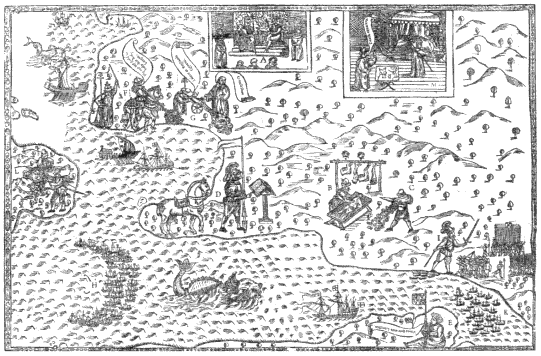
Figure 4.
Frontispiece to The Birth, Purpose and Mortall Wound of the
Romish Holie League , by I[ames]. L[ea]., London, 1589. Key:
A. Satan enthroned beside the pope; B. The Duke of Guise committing butchery;
C. A papal nuncio pouring treasure at the duke's feet; D. Navarre, the Protestant champion;
E. Queen Elizabeth; F. The pope and King Philip of Spain, whose gun shoots gold;
G. Exiled English Catholics shooting libels at Elizabeth;
H. The Spanish Armada; I. Parma, the Spanish general; K. The outnumbered English fleet;
L. America raped of her treasure by the Spanish; M. The Holy League languishing.
(By permission of the Folger Shakespeare Library.)
ties of the conquistadores in New Spain that Peter Martyr had described, the Marian exile John Ponet predicts that, if Spain invades England, as seems to Ponet ever more likely, the English will not only be enslaved like the Indians, but in fact "be by shiploads . . . carried into new Spain . . . [where] ye shall be tied in chains, forced to row in the galley, to dig in the mines and to pick up the gold in the hot sand" (Shorte Treatise , 91-92, 94, 165).27 Yet the Armada demonstrates to Lea that the Spanish are the ones who have become "slave-like," brutalized by their hunger for gold and blood to such a degree that they encourage their ally the Guise to turn cannibal himself (B).28 The poetical key to the map explains why Spain's wealth and power should not deceive England about its own very different strength. True, says Lea, God "makes our Land abound" with many goods "which other Nations lack":
But yet a greater grace, we have his word in peace,
God grant it may continue, and bring forth more increase.
Let Spaniard then go delve and dig for hidden gold;
Let him go rend rich Indies ' bowels out.
(Bv)29
And so England's queen, at the bottom of the map and almost off it, sits unruffled (E), while what in the earthly and victimized form of the Other World, America, represents the forced birth of material wealth, becomes in Elizabeth, America's virginal and other-worldly counterpart, the triumphantly free birth of spirit breath and faith: Unica spes mea Christus , "My sole hope, Christ."30 (Even Lea, however, is not without an almost instinctive ambivalence toward the idea of England's otherness, since the barbarian enemies of England all speak English, while England's sublime faith appears, oddly enough, in Latin.)
Yet such antimaterialism—a logical effect of England's classical otherworldliness, as I have tried to show—was not inevitably insularist. After all, as the papists delighted to point out, England's otherworld was not actually insular; commenting on a typical paean to "our little Island, " Robert Parsons (1599) advises the author: "You must take in Scotland also, or else you err in Cosmography" (Temperate , 2).31 Such a critique could find supporters even among some of Elizabeth's devotees, who believed that the anti-materialist articulation of an essential relation between England's
material littleness and its spiritual greatness was only half the story , a story completed by the better material correlative of an empire. Once again, one need not have been English to appreciate the force of this argument, as the praise of Giordano Bruno (1584) for Elizabeth demonstrates: "If her earthly territory were a true reflection of the width and grandeur of her spirit," declares Bruno,
this great Amphitrite would bring far horizons within her girdle and enlarge the circumference of her dominion to include not only Britain and Ireland but some new world, as vast as the universal frame, where her all-powerful hand should have full scope to raise a united monarchy.32
But as Bruno's oddly subjunctive rhetoric seems to betray, how can Elizabeth enact this materialization of her great spirit? Philip already owned the only new world in sight, and had, as Elizabethans less optimistic than Lea always complained, been applying the material treasure he found there toward his goal of conquering the Old World too. Lea might mock the bestiality of Spanish absorption in such worldly rubbish as gold , and celebrate England's spiritually centered integrity instead, but how was little other-worldly England to win the world?
It comes as no surprise that Elizabeth and her Privy Council, cognizant both of England's spiritual strength and of its material weakness, should have fallen victim so persistently to alchemical frauds—for example, by Edward Kelley, the assistant of John Dee who remained in Bohemia after Dee's mysterious sojourn there. Kelley somehow convinced Sidney's friend Edward Dyer that he, Kelley, had manufactured a powder capable of turning trifles into gold; Dyer told Burghley, who demanded Kelley's return to England; and Kelley naturally demurred. In a letter of Burghley's (1590?) that sounds slightly desperate—how, after all, is one to entice home a man who can spontaneously produce his own unbounded wealth?—Burghley plays his trump card, a lure transcending mere worldly value: he commands Dyer to remind Kelley that no impediment should "stay a man of his valor from the honoring of his sovereign; whom all princes honor; yea, whom the grand seignor, who despiseth others, hath reverence for her princely virtues and royal acts." As internationally standard a value as gold, miraculous Elizabeth represents the only possible correlative England can offer Kelley's powers; which is to say,
she represents England's own alchemical "powder," capable, in Burghley's mind, of securing Kelley's, which is capable in turn of preserving little England. Burghley continues:
But if I might have my wish, next to his coming home, I wish he would, in some secret box, send to her majesty a token, some such portion [of powder], as might be to her a sum reasonable to defer her charges for this summer for her navy, which we are now preparing to the sea, to withstand the strong navy of Spain, discovered on our coasts between Breton and Cornwall within these two days.33
Yet the very insufficiency of England's resources could itself seem to encourage expansion, in the same way that Hakluyt, beginning his Principal Navigations (1598), says King Arthur had been encouraged: "This kingdom was too little for him, & his mind was not contented with it" (1:6).34 In other words, just as weak Elizabeth could seem to accentuate God's might, so the absence of any objective correlative to England's desires could seem to clarify and liberate those desires. When praising "the invincible minds of our English nation, who have never left any worthy thing unattempted, nor any part almost of the whole world unsearched," George Best (1578), for example, must speak of deeds for which England has as yet nothing to show, but which therefore seem promises of a greater, unfulfilled destiny: "We may truly infer, that the Englishman in these our days, in his notable discoveries, to the Spaniard and Portingale is nothing inferior: and for his hard adventures, and valiant resolutions, greatly superior" (True Discourse , 6-7).35 Indeed, some claimed that the otherworldliness of the English, their material shortcomings and spiritual strength as the people divisos orbe , produced in English voyagers a peculiarity hybrid form of antimaterialism, a contemptus mundi that ended up enlarging the scope of their worldly desires. Writing to applaud Sir Humphrey Gilbert's first attempt at colonizing America, Thomas Churchyard (1578) describes Gilbert's adventurers as "more than men, half gods if I say troth," who from their superhuman vantage point "deeply look into these worldly toys" of quotidian life; and yet such otherworldly detachment turns out to indicate only how "whole kingdoms scarcely can suffice their minds and manhood both" ("A Matter," 231). Churchyard on the start of Gilbert's imperialist venture sounds like Prospero on the vanity of human wishes:
Now they have taken leave of worldly pleasures all,
That young and lusty were to live; and now to toil they fall
That finely were brought up; yea now they bid adieu
The glitt'ring court, the gallant town, the gorgeous garments new;
The bravery of this world, the pride and pomp of earth,
And look not backward any way to riches, race, or birth;
To worthy wife or friend, to babes nor nearest kin;
But only to the Lord above, and journey they are in.
(228)36
When one considered that spirit alone—the True Faith of which these adventurers were the proclaimed agents—had its own expansive power, prophesied by Christ himself, this demi-contemptus could seem surprisingly close to orthodoxy. In his advertisement for Gilbert's second, and this time fatal, American venture, Sir George Peckham (1583) encourages prospective colonists to "be of good cheer therefore, for he that cannot err hath said: That before the end of the world, his word shall be preached to all nations. Which good work, I trust is reserved for our Nation to accomplish in these parts" (True Reporte , 476).37 A commender of Peckham imagines this process of conversion as itself alchemical, an exchange now of spirit for gold: the natives' "gains shall be the knowledge of our faith, / And ours such riches as the country hath" (440); or, as a later tract (1610) puts it, "[we] do buy of them the pearls of earth, and sell to them the pearls of heaven" (True Declaration , 9).38 But England's otherworldly imperialists usually favored a more businesslike system of exchange, albeit one still as nearly antimaterialist and alchemical as possible, an economy once again requiring an especially deep vision into "toys": the English would hand the natives "trifles: As looking Glasses, Bells, Beads, Bracelets, Chains, or Collars of Bugle, Crystal, Amber, Jet, or Glass etc." (Peckham, True Reporte , 452), for which natives would give their goodwill, service, and ideally, gold. Marginalized by skeptical modem historians, this theory about the surprising power of English insufficiency actually dominated English colonialism at least through Jacobean times (as I will later show), so much so that in 1620, for example, while hundreds of Virginian colonists were starving, the treasurer of the Virginia Company
declared that the Commonwealth and State of the Colony in Virginia began generally to prosper so well as they did not desire any
more provision of Meal to be sent unto them but rather prayed that the Company would be pleased to be at some charge to send them a few trifling Commodities As Beads and such like toys whereby to truck with the Indians for Corn and other necessaries to increase and maintain thereby a Christian Commerce. (Kingsbury, Records , 1:423)
Against all odds—but then England's greatness had seemed to depend on such counterevidence—England like "another little world" (Greene, Friar Bacon and Friar Bungay 4:7) was to be augmented by trifling.
II
Now this expansive trifling was a conception to which, even aside from the circumstances of their nationality, Elizabeth's poets were in a sense professionally inclined. Sidney (c. 1581) adopts the conventionally dismissive view of poetry when he describes his Arcadia as filled with what was, coincidentally, standard ware to trade with the Indians, "no better stuff than as in a haberdasher's shop, glasses or feathers" (57); and yet this is the same writer who elsewhere boasts that not Nature but "the poets only deliver a golden [world]" (Apology , 15). George Chapman (1598) includes both disparate positions that poetry is less yet also more than what the world values—in a single passage: he argues that poetry was born when the soul, in disgust with "that worm-eaten Idol" the body, devised
another fruitless, dead and despised receptacle to reserve her appearance with unspeakable profit, comfort and life to all posterities—and that is this poor scribbling, this toy, this too living a preservative for the deathful tombs of nobility, being accounted in our most gentle and complemental use of it only the droppings of an idle humor, far unworthy the serious expense of an exact Gentleman's time. (Chapman's Homer , 503)
Sidney and Chapman speak of poetry, in short, as other Elizabethan writers speak of England. Where Sidney claims that "Nature never set forth the earth in so rich tapestry as diverse poets have done," which proves that the poet, not "captived to the truth of the foolish world," "doth grow in effect another nature" (Apology 15, 35, 14), Camden around the same time presents England as
Nature's own heterocosmic poem: "For Nature took pleasure in the framing thereof, and seemeth to have made it as a second world, sequestered from the other, to delight mankind withal" (Britannia , 4).
In other words, for the Elizabethans, both poetry and England could be understood as trifling and grand—a coincidence that England's poets could exploit in more or less conscious ways. At one end of the scale, trifling poetry could profit from the general enthusiasm about trifling England without having to acknowledge any debt; the idea that a nation could be at once inconsequential and sublime—"divided from the world as better worth" (Daniel, Delia , sonnet 44)—simply made more credible the notion that poetry, "not tied to the laws of matter," therefore participated in "divineness" (Bacon, Works 3:343). Just as ostensibly weak Elizabeth could be seen to overmaster her fellow princes, so could the English reader recognize what is to Samuel Daniel (1599) the equally miraculous potentiality of poetic Eloquence:
Thou that canst do much more with one poor pen
Than all the powers of princes can effect:
And draw, divert, dispose, and fashion men
Better than force or rigor can direct:
Should we this ornament of glory then
As th'unmaterial fruits of shades, neglect?
( Musophilus , 945-50)
But then Elizabeth was "her selfe a peereles Poetresse" (Spenser, Teares of the Muses , 576), whose "excellent" poetry George Puttenham (1589) defines as not simply her verse but also her political alchemy, "by your Princely purse favors and countenance, making in manner what ye list, the poor man rich, the lewd well learned, the coward courageous, and vile both noble and valiant" (Arte , 4-5; cf. 63).39 In the more sophisticated applications of England's grand littleness to poetry, poets could argue that as professional triflers— indeed, as trifles themselves:" 'Tis a pretty toy to be a poet" (Marlowe, Tamburlaine Part 1, 2.2.54)—they, like their queen, were especially capable of seeing the value in English poverty, and thus should themselves be valued as the true defenders, even the prophets, of little England's great potential. Answering an attack
by Philocosmus or World-Enamored on "neglected lays" (11), Daniel's Musophilus soon finds himself defending what Philocosmus considers equally "thrust from the world"—"this little point, this scarce discerned Isle" (427-28); while the later apostrophe to eloquence and its "poor pen" modulates into an extraordinary vision of otherworldly England's great potentiality—an empire of, and achieved by, supposedly "ungainful" (2) English poetry:
And who in time knows whither we may vent
The treasure of our tongue, to what strange shores
This gain of our best glory shall be sent,
T'enrich unknowing Nations with our stores?
What worlds in th'yet unformed Occident
May come refin'd with th'accents that are ours?
Or who can tell for what great work in hand
The greatness of our style is now ordain'd?
(957-64)
Such an elaborate conception of the affinity between England and poetry informs Lyly's post-Armada play Midas (written 1589), whose title figure evokes the most obvious reason for considering both nation and poet mere triflers—their "ungainful" lack of gold. As my previous chapter noted, the last poem of the first book of Ovid's Elegies presents the classic defense of the poet on this score: Ovid does not lack gold, he disdains it. In the elegy, Envy can carp that Ovid's "time is spent so ill" on "fruits of an idle quill" because it misunderstands the nature of true value: "Thy scope is mortal," Ovid replies, "mine eternal fame." "Immortal" and therefore free from the quotidian standards that esteem gold the best that mortality has to offer, verse enables the poet to surpass the reach of even the most gold-intensive occupation: "To verse let kings give place, and kingly shows, /And banks o'er which gold-beating Tagus flows." The Elizabethan poets never tired of reiterating the sentiment. Marlowe, for instance, whose translation of Ovid I have been quoting, may be less sanguine about poverty than his master, and may imagine the distance between poet and gold as a punishment inflicted on the patron of learning, Hermes, by the Fates; yet even as affliction the poet's poverty positively distinguished him for Marlowe from more earthbound wit:
And to this day is every scholar poor;
Gross gold from them runs headlong to the boor.
Likewise the angry sisters . . .
. . . have concluded
That Midas' brood shall sit in honor's chair,
To which the Muses' sons are only heir.
( Hero and Leander 1.471-76)40
When Lyly devotes an entire play to Midas himself, one naturally expects a still more elaborate version of the inevitable argument: Ovid's account of the king foolish enough to proportion his desires solely to gold, and then foolish enough to favor Pan's over Apollo's music, seems for coherence's sake almost to demand an opposition between gold and true poetry that will work in poetry's favor. The surprise of Lyly's play, however, is that in his hands a myth ready-made for an argument about poetry becomes at the same time a contemporary political allegory—an argument about poetry and England.
Lyly's Midas is Philip II, who hopes his golden touch will make him "monarch of the world" (1.1.116-17), but who finds instead that his seemingly boundless worldly power—exemplified by his Armada has mysterious limits: "Have I not made the sea to groan under the number of my ships: and have they not perished, that there was not two left to make a number?" (3.1.31-33). This reversal is all the more unsettling to Midas because the only thing that blocks his advance is as it were the very opposite of his might: the mere "Island" (47) of Lesbos, which is ruled by a "petty Prince" (51-52). Yet Midas realizes that the prince of this island— Elizabeth, obviously41 —must only look petty, that pettiness inheres not in the ruler Midas cannot conquer but in the exclusively golden system of value that makes Elizabeth seem conquerable in the first place: "A petty Prince, Midas? no, a Prince protected by the Gods, by Nature, by his own virtue, and his Subjects' obedience" (52-54). This standard vision of little England's ungolden greatness—and standardly uneasy too, since Lyly cannot resist claiming later that the English (whom he imagines ruled by a king, not queen) are also "too rich" (4.2.41) to be troubled by Midas's gold42 —marks the final stage of a revolution in Midas, who now decides to humble himself before the giver of his golden touch, Bacchus, in order to rid himself at once "of this intolerable disease
of gold" and "that untemperate desire of government" (3.2.61-62). But Midas's overtly political change of heart leaves his troubles only half over. Bacchus cures him of his golden touch, but Midas then proceeds to wander into the midst of an argument between Pan and Apollo and win himself ass's ears by foolishly preferring the earthly to the heavenly god. This demonstration of a bestiality apparently deeper than the love of gold, deeper because unmotivated by hope of gain, actually reveals the continued yet indrawn power of that love; for Midas's ears quickly provoke him to lament his river-cure: "Is Midas that sought to be Monarch of the world, become the mock of the world? are his golden mines turn'd into water, as free for every one that will fetch, as for himself, that possessed them by wish?" (4.1.176-78). "Song" in Lyly's account represents, then, the touchstone of one's relative sophistication, which is inseparable from one's relative indifference to gold; and again higher powers of judgment get associated with England: mortified by his ears, Midas wonders, "What will they say in Lesbos?" (171).
In fact, Midas's final cure requires him to re-renounce his desire for both gold and England now in the context of what amounts to a kind of literary criticism. Midas decides he must seek the advice of Apollo's oracle, a course of action which his empire- and gold-loving councillor Martius rejects as "superstition" (5.1.38-39) about "a blind God" (5.3.16). But it is Martius, and then the rest of Midas's entourage, who reveal. themselves as blind at the end of the play, when only Midas seems to catch Apollo's climactic pronouncement. For Midas this special access to Apollo's hidden wisdom represents a great change in sensibility. Before, he had preferred the univocality of Pan's pipe—associated with mere worldliness—to the "sweet consent" (4.1.96) of Apollo's voice, lute, and lute-strings, associated with the presence of a heavenly god on earth: "I brook not that nice tickling of strings," Midas had declared, "that contents me that makes one start" (129-30). Yet the orade's verse, even though substituting the more rarefied double-ness of allegory for song, leads Midas nonetheless to a newfound appreciation of "Poesy's King" (136): "I see that by obscure shadows, which you cannot discern in fresh colors. Apollo in the depth of his dark answer, is to me the glistering of a bright sun" (98-100). What Midas has learned is the primary Renaissance apology
for poetry, employed the same year as Lyly's play by Nashe in his Anatomie of Absurdity : "I account of Poetry, as of a more hidden & divine kind of Philosophy, enwrapped in blind Fables and dark stories, wherein the principles of more excellent Arts and moral precepts . . . are contained" (Works 1:25).43 In other words, Midas sees the value in Apollo's oracle as Lyly has seen it in Ovid's myth and as Lyly's auditors should see it in Lyly's mythological play. And this better appreciation of the "superstitious" fables that seem to convict poetry of trifling44 enables Midas to reach at last a more extravagant, though for us familiar, appreciation of England: "I perceive (and yet not too late) that Lesbos will not be touched by gold, by force it cannot: that the Gods have pitched it out of the world, as not to be controll'd by any in the world" (4.1.101-3). A "barbarous" (17) gold lover like Martius continues to believe both poetry and England mere trifles; kingly Midas learns to recognize the ostensibly petty as the actually divine; and the great-hearted English auditors of Midas come to see not only the likeness between England and poetry as divine trifles, but the inseparability of England's spiritual strength, its otherworldly worldliness, from the highest estimation of poetry.
Or, by the same token, from its lowest estimation: Lyly obliquely maintains that the love of England, as of poetry, will always seem to some a kind of superstition. This invidious view of England has, again, classical roots: as I noted in my previous chapter, Plutarch reports that "many ancient writers would not believe that it [England] was so in deed, and did make them vary about it, saying that it was but a fable and a lie" (Lives 5:25). And indeed, as an analysis of Renaissance nationalism, in particular of the cult of Elizabeth, the accusation of superstitiousness persists into our own century. According to influential historians like E. C. Wilson and Frances Yates, "patriotic Englishmen" in the sixteenth century "unconsciously half shifted their affection for a sacred Virgin to a profane" (Wilson, England's Eliza , 219).45 But many Elizabethans were far less credulous in their virgin worship than these historians allow. Sidney's entertainment The Lady of May (1578/79?), for example, delights in the substitution of Elizabeth for the Virgin Mary as a chance to feign superstition. Presenting Elizabeth with "a chain of round agates something like beads," a pedantic character in the entertainment, Master Rombus, worries that the gift
betrays the degree to which its giver, Leicester, "is foully commaculated with the papistical enormity":
I have found unum par , a pair, papisticorum bedorus , of Papistian beads, cum quis , with the which, omnium dierum , every day, next after his pater noster he semper suits "and Elizabeth," as many lines as there be beads on this string. (Miscellaneous Prose , 31)
Unlike the papists who desire material props for their worship or the puritans who fear "commaculation" from such props, however, Sidney's Leicester toys with "enormity," and thus presents his love for Elizabeth as both devoted and urbanely detached.
Dekker's Old Fortunatus (1599) turns such feigning of superstition into a sophisticated worship not just of the queen but of England generally. The play begins with the entrance of "two old men":
1. Are you then traveling to the temple of Eliza?
2. Even to her temple are my feeble limbs traveling. Some call her Pandora : some Gloriana , some Cynthia : some Belphoebe , some Astraea : all by several names to express several loves: Yet all those names make but one celestial body, as all those loves meet to create but one soul.
1. I am one of her own country, and we adore her by the name of Eliza .
2. Blessed name, happy country: Your Eliza makes your land Elizium .
(Prologue 1-10)
Once again, as with Angle and Brute, England's surprising potentiality gets expressed in a pun—Eliza/Elizium—that represents not only the value hidden in English trifles but the trivial means of realizing that value: one need merely adjust one's vision. Yet now overt superstition seems an essential component of more than the partial or typological vision that figures the queen a pagan deity like Cynthia; for the higher value that the partial name Eliza ultimately signifies is itself pagan, Elizium. One explanation of this compounded superstition would be that Dekker wants to avoid representing Eliza's potentiality as already fully realized, in order to encourage instead the kind of expansive contemptus Churchyard discerns in England's voyagers. That is, by characterizing other-worldly England as a heaven, and yet a heaven pagan and superstitious, Dekker may want to continue to excite a desire for tran-
scendence in Eliza's subjects even as they transcend appearances to celebrate their other-worldly bliss. A land both in and out of the world, Elizium by this account would be blessed insofar as its people have learned to enjoy and disdain the world at once.46
Such an interpretation of Dekker's apparent superstition seems to gain support from the fact that the pilgrim who praises Elizium is an actor, his identity as pilgrim already overtly disposable, just like the play-world that transforms the setting of its performance, Elizabeth's Court, into Eliza's temple. In other words, the play as a play already dramatizes how easily and with what sublime re-suits one's vision may be adjusted, and yet at the same time how misguided one would be to accept this adjustment as final. The special self-consciousness encouraged by the play—a self-consciousness at once indulgent toward and detached from superstition—is, moreover, nothing other than what the fables of the poets can always seem to demand.
Yet the tenuousness of fables and play can just as easily seem to suit misgivings about the sublimity they represent. By questioning the status of Elizium in his epigram "In Elizabetham," John Weever (1599) can seem to highlight not only the hidden potentiality of ostensibly trifling England but a peculiar incompleteness and uncertainty, a negativity either instinctive or deliberate, that English optimism about trifles finds hard to avoid:
If that Elizium be no fained thing,
Whereof the poets wont so much to sing;
Then are those fair fields in this Faerie land,
Which fair Eliza rules with awful hand.
( Epigrammes , 18)
III
If Dekker and Weever appear to demonstrate, then, how English trifling—and especially English poetical trifling—naturally gravitates toward an unstable alliance with superstition, just as Eliza seems naturally to entail her Elizium, they also provide a revealing name for the result: Weever calls England not just Elizium but "Faerie land," and one of Dekker's pilgrims refers to Eliza as the "Dread Queen of Fairies" (Old Fortunatus , Prologue, 55). Such allusions indicate the preeminence of one poet—Spenser—within
the tradition of trifling, of combining England and poetry as transcendent trifles, that I have described. Just by apposing Elizium and Fairyland (as Gabriel Harvey does in his commendatory poem to The Faerie Queene ),47 one can already begin to grasp Spenser's centrality to this tradition. And indeed, an English Catholic named Anthony Copley, rewriting the first book of The Faerie Queene to suit his faith, decides that Elizium and Fairyland represent one and the same heresy.
The Argument to Copley's Fig for Fortune (1596) describes the Spenserian adventures of "an Elizian out-cast of Fortune, ranging on his jade Melancholy through the Desert of his afflictions," who encounters and then escapes the temptations of Despair and Revenge to find new hope in the teaching of a religious hermit. By depicting the hermit as surprised "to see a distressed Elizian in those parts," the Argument implies—orthodoxly for a reader like Dekker or Weever—that an unhappy Elizian is a contradiction in terms; but then the argument also deceptively defines the poem's evil Duessa-figure, Doblessa, as Fortune (A4r), whereas the poem itself makes quite clear that Doblessa also represents Protestantism:
She had no Altar, nor no Sacrament
No Ceremony, nor Oblation,
Her school was Cavil, & truthless babblement
Riot her Reign, her end damnation.
(70)
In fact, the term Elizium first crops up in the poem proper not in praise of Eliza but as the pagan ideal of Despair and Revenge (4, 7, 18); and when, as the Argument promises, the hermit Catechrysius expresses his surprise at the melancholy narrator—"Rare, yea all too rare are now adays / Eliza's subjects seen to pass this ways"—he quickly adds that the narrator's troubles cast less doubt on the man than on his country:
Belike ye are a Paradized people
That so contain your selves in home-delights,
As though that only under your steeple
And no where else were all May-merry Rights:
A blessed people ye are, if it be so
And yet me thinks thou seem'st a man of woe.
(25)
The narrator tries to deflect this skepticism by dismissing himself as "The Rag of Fortune" (32), yet such self-stigmatization only underscores his theological errors. Just as Despair and Revenge have misled him from the true image of suffering, the Crucifixion, and from the matching knowledge that to "suffer for our Lord" is "more dear than sweetest Lullaby in Fortune's lap" (51-52), so Eliza's Elizium fools him into believing that worldly pleasure is bliss. As he guides the narrator to Mount Sion (in part, the Catholic Church), Catechrysius teaches him that
Not all the flush of thy fore-frolic state,
The worship of thy birth, thy rich revenue,
Thy country's high applaud and estimate
And all that fair Elizium can yield you,
Is of the worth to countervail this hap
Fallen from Fortune into Grace's lap.
(58)
In short, the poem inverts the terms of Dekker's and Weever's otherworldly patriotism; Copley claims that it is the English who love "the trash of earth" (28) and Catholics who are the true anti-materialists: "For we are no Eli zium -bred wights / Nor have we such like merry days; / We have our joys in another kind / Ghostly irmated in our soul and mind" (59).48 But Elizium is not the only name for Protestant England that, to Copley's mind, unwittingly betrays English superstitiousness: the clear light of Sion helps some of Doblessa's followers realize the error of their ways and flee "the witch, as wak'd from out a dream / Of Faery " (78; my emphasis). Again, it would be a mistake to dismiss such accusations of superstition as merely partisan: we have seen that many English Protestants actively court the charge, and in equating Elizium with Fairyland the Catholic Copley only seconds the Protestants Dekker and Weever. But Spenser himself, I will argue, wants Fairyland to mean both less and more than Elizium. He, like Copley, attacks the Elizian view of England, and yet he embraces superstition more radically than either Dekker or Weever seems prepared to do.
Spenser, it could be said, takes his trifling more seriously. In fact, his works represent the most elaborate and influential at-
tempt by an Elizabethan to combine the fate of poetry and England as trifles, even to model England's destiny on the course of his own poetical career, which was itself modeled on the career of Virgil. Spenser was, of course, not the only European poet at the time who hoped to do for his country "what Virgil had done for Rome" (Rathborne, Spenser's Fairyland , 128), but his choice of precursor also involved Spenser in two sorts of paradoxicality associated with Virgil that, I have tried to show, would have had special significance for an Elizabethan poet: on the one hand, the view, identitled with Virgil's first eclogue, of England as either barbarous or heavenly, "divided from the world"; on the other hand, a more strictly literary tradition, also grounded in the Eclogues , that linked ostensible trifling to ultimate grandeur. This literary tradition has its own different though intertwinable threads: first, a pastoral thematics of disparity, of comparing great things to small (Eclogues 1.23), itself made portentous by the progress of Virgil's career from eclogues to epic;49 and second, a faith in the allegorical nature of otherwise dismissable fables which finds its supreme evidence in the fourth, or "Messianic," eclogue's supposed prediction of Christ's birth.
After the work of Frances Yates, no scholar can forget that this Messianic eclogue, so useful in the defense of poetry, also possessed special political significance for the Elizabethans. The virgin—Astraea or Justice—whom Virgil describes returning from heaven with the golden age in tow (iam redit et Virgo, redeunt Saturnia regna , 6) could seem a prophecy come true with Elizabeth— "not the image or picture, nor by imagination, but a virgin indeed truly representing Justice, and effectually executing it."50 This account of Elizabeth had, as Yates maintains, extraordinary implications for her, and therefore also for the Virgilian pastoral that could seem to have predicted her coming. Constantine identified Virgil's heavenly virgin with the Virgin Mary; Augustine with the true faith; and Dante with the world empire into which the true faith chose to be born. If Elizabeth as virgin mother of reformed religion seemed to extend two of these allegories, Yates argues, then why should she not have reawakened hopes about the third also, about a reformed world empire?
The suggestion seems plausible, though Yates oddly—and re-
vealingly—omits citing the most likely source of evidence for her claim, the Elizabethan poem that actually offers to rewrite Virgil's praise of the Virgin in terms of Elizabeth, the fourth, or "Aprill," eclogue of Spenser's Shepheardes Calender :
Tell me, have ye seene her angelick face,
Like Phoebe fayre?
Her heavenly haveour, her princely grace
Can you well compare?
The Redde rose medled with the White yfere,
In either cheeke depeincten lively chere.
Her modest eye,
Her Majestie,
Where have ye seen the like, but there?
(64-72)
On a strictly pastoral view, this "flowre of Virgins" (48) is merely "Elisa , Queene of shepheardes all" (34). But her "heavenly haveour" seems capable of evoking both Astraea and Mary, and the red and white mingled in her cheeks—an icon for "the uniting of the two principal houses of Lancaster and of York," Spenser's commentator E. K. reminds us—seem capable too of evoking a new golden age of empire, "because [the union] established pax under One Monarch, in place of discord and war under two rival houses" ("Queen Elizabeth," 51). The slimness of the evidence here would not necessarily defeat a Yatesian argument. After all, Virgil's own pastoral had not been particularly explicit about the imperial side of the golden age he envisioned; as Yates again notes (33), only in book 6 of the Aeneid does Virgil overtly attribute the new golden age of the fourth eclogue to Augustus's future world rule. In fact, Spenser's eclogue can seem more urgent than Virgil's about moving from pastoral to epic because it closes, as Virgil's eclogue could not, with two quotations from the Aeneid . At the end of "Aprill," Thenot's emblem asks Elisa O quant te memorem virgo , What shall I call you, virgin, how shall I properly understand you? and Hobbinol's emblem answers O dea certe , Surely a goddess—in the Aeneid (1.327-28), Venus, who guides Aeneas toward the founding of Rome. As Yates might maintain, such allusions to Elisa's unexpectedly sublime identity preview in trifling pastoral form the Elizabethan empire, and epic, to come:
But a third kingdom yet is to arise,
Out of the Trojans scattered of-spring,
That in all glory and great enterprise,
Both first and second Troy shall dare to equalise.
( FQ 3.9.44 )
Yet these esoteric hints about Elizabeth's potentiality are resisted in Spenser's eclogue by other hints perhaps equally esoteric. For one, "Aprill" 's "laye / Of fayre Elisa " (34-35) is a song that Colin, the Calender's hero, used to sing, before what E. K. calls "that boy's great misadventure in Love, whereby his mind was alienate and withdrawn not only from him, who most loved him [Hobbinol], but also from all former delights and studies"; it is Hobbinol, not Colin, who "records" the lay as proof of Colin's now forsaken ability. In the light of Colin's unrequited love for Rosalind, Hobbinol's decision to rehearse the Elisa song in particular looks almost comically ironic: what Colin can no longer celebrate, understandably, is virginity as an ideal. In fact, Colin's frustration throughout the Calender , his new inability to see England as a paradise pristine and intact, threatens to fulfill not Virgil's hopes but Meliboeus's fears, to make England seem a land of exile.51 "Januarie," Spenser's own first eclogue and a monologue by Colin, even dismisses Tityrus's voice of content, and presents exile as a fate on which Colin has already embarked:
A thousand sithes [i.e., times] I curse that carefull hower,
Wherein I longed the neighbour town to see:
And eke ten thousand sithes I blesse the stoure [i.e., fit],
Wherein I saw so fayre a sight, as shee.
Yet all for naught: such sight hath bred my bane.
Ah God, that love should breede such joy and pain.
(49-54)
Since E. K. identifies Tityrus as Virgil and the Meliboean Colin as Spenser himself, Spenser the English pastoralist seems to be portraying himself as an exile both from Rome and from Virgil's sublime career as an imperial panegyrist.
Hobbinol's evocation in "Aprill" of the old Colin helps clarify the surprising political implications of Colin's love-woe. He describes Colin's former praise of the queen as, again,
his laye
Of fayre Elisa , Queene of shepheardes all:
Which once he made, as by a spring he laye,
And tuned it unto the Waters fall.
(33-36)
The lines depict the pristine complacence from which Colin's "madding mind is starte." The "laye," deriving from a stasis that it homonymously mirrors ("Which once he made, as by a spring he laye"), celebrated the virgin genius of this pristinity, and proportioned both the political order and the praise of that order to nature (Colin "tuned" the lay "unto the Waters fall"). Not only Colin's abandonment of the song but also Hobbinol's elegiac rendition of it break the fullness of relation, the perfect fit, that once obtained among poet, queen, and countryside,52 and that Colin's admirers unwittingly threaten even in their celebratory emblems. Those emblems are, again, culled from the Aeneid's first book, when Aeneas meets his mother Venus, who is disguised as a huntress, asks what name he is to call this maiden ("O quam te memorem virgo?") since she does not seem human, and then decides she is certainly a goddess ("O dea certe")—Diana, in fact, or at least a nymph. Aeneas's comic uncertainty and misapprehension, first in thinking his mother and the goddess of love a virgin, then the goddess of virgins, oddly reflects on Colin's erstwhile praise of Elisa as "the flowre of Virgins," with a face like Diana's other person, "like Phoebe fayre" (65). In other words, by their very appreciation of the queen, the emblems raise doubts about the fitness of describing Elizabeth as both a pastoral figure and a genius of virginity.
When Spenser turns in "October" to another unhappy poet, Cuddle, who has abandoned poetry for the baser and more traditional motive of poverty, dissatisfaction with Engiand's political order becomes correspondingly more direct. If Cuddie's oaten reeds bring him no reward, Piers observes, then why not attempt some epic theme instead:
There may thy Muse display her fiuttryng wing,
And stretch herselfe at large from East to West:
Whither thou list in fayre Elisa rest,
Or if thee please in bigger notes to sing,
Advance the worthy whome shee loveth best,
That first the white beare to the stake did bring.
(43-48)
Piers recommends, in other words, that Cuddie turn his alienation from innocent pastoral into purposeful motion, so that his Muse may imperially range "from East to West "; and this transformation can be achieved, Piers assumes, by the ennobling praise of Elizabeth or Leicester (the name that E. K. supplies for Piers's "worthy"). Startlingly, Cuddie rejects the idea, and Piers accepts the terms of Cuddie's rejection. England is no place to "rest," Cuddie argues, because it has nothing to offer. The kind of epic singing Piers proposes may have worked for Tityrus, who had a patron to support him and a living hero (not to mention an empire) to inspire him,
But after vertue gan for age to stoupe,
And mighty manhode brought a bedde of ease:
The vaunting Poets found nought worth a pease,
To put in preace emong the learned troupe.
(67-70)
Piers does not, as one might expect, berate Cuddie for so thoroughly dismissing Elizabeth and her court from what current heroic exploits could an English poet have derived inspiration?—but shakes his head along with Cuddle and offers one more alternative:
O pierlesse Poesye, where is then thy place?
If nor in Princes pallace thou doe sitt:
(And yet is Princes pallace the most rift)
Ne brest of baser birth doth thee embrace.
Then make thee winges of thine aspyring wit,
And, whence thou camst, flye back to heaven apace.
(79-84)
Cuddie defers to Colin on this, and the following eclogue sees Colin helping poetry on its way; E. K. believes "November" "far passing his [Marot's] reach, and in mine opinion all other Eglogues of this book." Yet this renewal and extension of Colin's virtuosity seems only to ratify Cuddie's implicit correlation of resting in Elisa with mankind's present shameful bed of ease, for Colin's song has now become elegiac, and his alienation contemptus mundi .
What is worse, the elegy seems to be about Elizabeth. In the obvious sense that Colin's new preference for elegy marks the passing of his interest in paeans to Elisa, the mere fact of this change is an elegiac commentary on Colin's "Aprill" vision of the queen. The particular death that Colin laments, however, transforms the repudiation of "Aprill" into a revision:
For deade is Dido, dead alas and drent,
Dido the great shephearde his daughter sheene.
("November," 37-38)
E. K. is careful to dismiss the obvious but bizarre suggestion of the last line: the great shepherd, he cautions, "is some man of high degree, and not as some vainly suppose God Pan"—not, that is, the father predicated for Elisa in "Aprill" (51). And yet E. K.'s own discussion of the poem's argument, explaining as it does that "this Eclogue is made in imitation of Marot his song, which he made upon the death of Loys the french Queen," already implies the connection to Elizabeth; while the extensive formal and thematic similarities between "Aprill" 's lay of Elisa and "November" 's elegy53 make it increasingly easy for the reader to "suppose":
Sing now ye shepheards daughters, sing no moe
The songs that Colin made in her prayse,
But into weeping turn your wanton layes.
(77-79)
"Aprill" haunts the final line here—what was once "tuned" to the "Waters fall" has now been "turn[ed]" to "weeping": "The flouds do gaspe, for dryed is theyr sourse, / And flouds of teares flowe in theyr stead perforse" (126-27). As Elisa "in her sex doth all excell" ("Aprill," 45), so Dido "for beauties prayse and plesaunce had no pere" ("November," 95); Elisa was "the flowre of Virgins," Dido "the fayrest flowre our gyrlond all emong" (75); Elisa "another Sunne below" (77), Dido "the sonne of all the world" now "dimme and darke" (67); and where the "Ladyes of the lake" (120) brought Elisa "of Olive braunches . . . a Coronall" (123),
The water Nymphs, that wont with her [Dido] to sing and daunce,
And for her girlond Olive braunches beare,
Now balefull boughes of Cypres doen advaunce.
(143-45)
One could say that these parallels kill Elisa in all but name, if it were not for the fact that Dido's other name in the Aeneid is Elissa.54
Yet Dido replaces, and in replacing kills, more than "Aprill" 's queen; the elegy per se also comprehensively erases Rosalind by refiguring the sign and motive of Colin's alienation, his "mourning" ("January," 48), to be the result not of Rosalind's disdain but of Dido's death. Indeed, the figure of Dido, elsewhere famous as queen and lover, seems to combine consideration of Elisa and Rosalind as lost causes.55 "October" already suggests the possibility of this conflation. By revealing that the object of pastoral complacence (Elisa in whom one rests) can also be involved in desire (Elisa who loves a worthy), the eclogue raises a question that follows logically from Colin's dilemma. It is no wonder that love for Rosalind alienated Colin from the fullness of Elisa's virgin pastoral: "Shepheardes devise she hateth as the snake, / And laughes the songes, that Colin Clout doth make" ("January," 65-66). But what, "October" begins to ask, would happen to a shepherd's complacence if he were to fall in love with the benign genius of pastoral herself? Especially if Dido's beloved Lobbin is supposed to represent, as Malone suggests, "October" 's Robin Leicester, "November" answers the question by translating desire for the pastoral genius into her death, the deflowerer of "the fayrest floure" (75) whose wholeness kept pastoral intact: "shepheards wonted solace is extinct" (106); "Now she is gon that safely did hem keepe. / The Turtle on the bared braunch, / Laments the wound, that Death did launch" (137-39). Colin falls in love with Rosalind accidentally—he need not have visited her town, need not have seen her, need not have loved her when he saw her— and accidentally "cannot purchase" her ("Aprill," 159)—Rosalind just happens to loathe shepherds. But as the daughter of Pan and Syrinx (50-51), Elisa/Dido is pastoral and therefore an inescapable cynosure,56 while her benignity that entertains all ("Ne would she scorne the simple shepheards swaine," "November," 97) and her virginity that bars all ("No mortall blemishe may her blotte," "Aprill," 54) make no contingent distinctions among potential lovers. After the incursion of desire, Elisa as a necessarily desirable and necessarily unobtainable object makes the pastoral ideal she embodies seem itself unpurchasable, so that by "November" frus-
tration is perceived as the truth not just about loving a particular woman but about all worldly hopes:
O trustlesse state of earthly things, and slipper hope
Of mortal men, that swincke and sweate for nought,
And shooting wide, doe misse the marked scope.
(153-55)
Yet the shepherd's desire for Elisa is not, indeed by definition cannot be, abandoned; it survives as Dido does, though in new and unearthly form. Though the "layes" of innocent pastoral, its songs and its leisures, could no more resist the stain of mortality than Dido could, the best "in earthlie mould" (158), death ultimately frees Dido's soul from the taint of her "burdenous corpse" (166), and thus promises the triumphant realization of pastoral where Dido has gone:
No daunger there the shepheard can astert:
Fayre fieldes and pleasaunt layes there bene,
The fieldes ay fresh, the grasse ay greene.
(187-89)
During the course of The Shepheardes Calender , Rosalind's unpurchasability has, in other words, helped to clarify and then liberate the otherworldliness inscribed at the heart of the worldly pastoral Colin used to celebrate, the pastoral of the virgin Elisa:
I see thee blessed soule, I see,
Walke in Elisian fieldes so free.
(178-79)57
Far from celebrating Eliza's England as a true Elizium, then, The Shepheardes Calender seems to attack the idea of applying the golden-age topos of Virgil's fourth eclogue to Elizabeth in any materially realized or realizable fashion. The poem appears to claim instead that both the empirical inadequacy of Elizabethan England to this topos, as in "October," and the logical incompatability of Elizabeth's virginity with material fulfillment, as in "November," should force Englishmen to turn their eyes heavenward: "Make hast ye shepheards, thether to revert" ("November," 191). Many Elizabethan writers make a similar case: that like the early Colin
the English generally have become enmired in the material benefits of the Elizabethan pax, have become like all pastoralists mere triflers. Anthony Marten (1588), for instance, interprets the Armada threat as God's making trial "whether you more esteem dainty fare, costly apparel, gorgeous buildings, and other vain delights of this world, than the loss of so happy a kingdom, of so excellent a Prince, of so sincere a Religion, and of so pure a Gospel" (Exhortation , D3r-v). But Spenser appears to take Marten's antimaterialism still further, in the direction Copley also takes it, toward a repudiation of all worldly desires—even those concerning England—as merely trifling. In imagining the Virgin Queen to have already reconciled material and spiritual hopes, already embodied an Elizium in little, as if she were a "heaven on earth, or earth that heaven contains,"58 Elizabeth's worshippers, the Calen- der seems to claim, forget that the very word Elizabeth signifies not her own fullness but God's, and that her value consists precisely in her inadequacy to her own significance, a definitive lack that frustrates the desire for material realization and encourages the desire for a spiritual one. By proportioning Elizabeth and England to its own inherent insufficiency, Spenser's pastoral seems to stress the contemptus always latent in the Elizian ideal, along with England's need to value that detachment exclusively.59
IV
The peculiar thing about The Shepheardes Calender , however, is that, by making Elizabeth a crucial link in both the materially and the spiritually directed views of England's potentiality, Spenser so obscures his criticism of the queen as to turn the Calender into the locus classicus of the view it seems to attack.60 In fact, the poem that "contains the first imitation of the Shepheardes Calender to appear in print"—Thomas Blenerhasset's Revelation of the True Minerva (1582)—champions England's material insufficiency from the opening sentence of its dedication: "How far little England . . . doth in perfect felicity surpass all the large kingdoms of the world, that travel and small experience which I have had, hath sufficiently taught me" (v, *3r). Blenerhasset too styles himself a pilgrim, though he has erroneously wandered from an England divisa
ab orbe , and has thus recognized the otherworldly splendor he had otherwise failed to appreciate: "By travel I did think to climb up higher, / Thus not content in paradise to dwell, / seeking for heaven, I found out hateful hell" (B2r). The narrative proper begins with Mercury describing to an assembly of the gods a similarly misguided and fruitless search. An oracle has prophesied that the gods require a new Minerva "so all the world true knowledge will embrace" (A2v); Mercury sets out to find her, but following the westward course of empire—from Troy to Greece to Rome to Spain, through "the firm of all the world" (A3r)—he finds no one. What Mercury does not realize is that the world extends beyond the world, into the ocean, where the gods eventually meet the "true" Minerva—Elizabeth, of course—"ruling a world "—"Troyno-vant "—"at her will" (A3v, A4v). Not only the discovery of "little England's worthy Queen" (F3v) but also the means of her discovery vindicate littleness: ignorant how to find Minerva, the Olympians finally overhear a shepherd named Epizenes—"the Greek equivalent of [Blenerhasset's] pseudonym, Pilgrim," as Bennett notes (Blenerhasset, Revelation , viii)—who describes the English "Eutopia " (B2v) to Pan and some fellow shepherds. The gods follow Epizenes home, find Elizabeth beset by enemies like the pope and Mary Stuart, and then, in homage to the pastoral state Elizabeth keeps, rally round her with a fight song introduced in strikingly familiar pastoral terms:
Apollo thou the best that ever played
Take lute in hand, tune to the water's fall,
Minerva lives, whom Pallas honor shall.
(C4r)61
For Blenerhasset, at least, the "Aprill" vision of Elizian pastoral not only survives intact Colin's repudiation of it, but approaches nearer a claim even the happy Colin never quite made. In the Revelation , the prophecy, the transferral of empire, the true virgin, and now pastoral so knowledgeable and weighty as to enlist even Apollo in its cause, all suggest the English fulfillment of Virgil's golden-age eclogue that Spenser refuses to accept. If Colin's d'lsruptive plight signifies at all for Blenerhasset, it is only as a threat Elizabeth has already avoided. The virginity that for Colin meant the lack at the heart of pastoral, the impossibility of worldly
satisfaction, now guarantees for Blenerhasset a paradisiacal fullness:
Fancy shall build no nest
Within her blessed breast,
the great increase
of perfect love, and peace,
shall never cease.
(D4r)
Two years later, George Peele's Araygnement of Paris likewise imagines the Olympian gods bowing to a greater virgin goddess in the west, and likewise finds Spenser at the heart of the conceit, but Peele handles the potential problem of Colin more directly. For Colin now surfaces as a character in the play, dying of the morbid eroticism that is about to ruin Troy, a threat to which the new western goddess, and consequently her pastoral kingdom, are blessedly immune:
There wons within these pleasant shady woods,
Where neither storm nor Sun's distemperature
Have power to hurt by cruel heat or cold,
Under the climate of the milder heaven,
Where seldom lights Jove's angry thunderbolt,
For favor of that sovereign earthly peer
. . . . . . . . . . . . . . . . . . . . . . . . . . . . . .
That honors Dian for her chastity,
And likes the labor well of Phoebe's groves:
The place Elizium hight, and of the place,
Her name that governs there Eliza is
. . . . . . . . . . . . . . . . . . . . . . . . . . . . . .
Ycompast round with a commodious sea:
Her people are ycleped Angeli,
Or if I miss a letter is the most.
(5.1.1139-56)
It is, perhaps, no surprise that both Blenerhasset and Peele should fail to recognize the "death" of Elizabeth in "November," but less understandable is their apparent indifference even to the eclogue's unexceptional scruples about mortality. The Fates in the Araygnement proclaim Elizabeth an earthly goddess whom they have learned to spare (5.1.1231-33); the Revelation similarly declares the woman "who once was but a mortal Queen . . . / The greatest goddess now on earth":
She is not now as other princes be,
Who live on earth to every tempest thrall,
Desert hath crownd her with eternity.
(Gr-v)
Blenerhasset's printer reminds the reader that it is "no heresy to affirm that every good man having the place of a Magistrate is a god"; borrowing a Catholic defense of saints, he adds that one worships "not the man, but the virtue" (*v). The poem itself dramatizes this commentary by having Elizabeth lump Mercury with the heathen "Idols" that "I by God's spell did deface," until Mercury explains that he and his colleagues are only personifications: "Saturn doth signify / good government," "Apollo how divinely to endite," and so on (B3v-4r). Elizabeth can without offense come to seem immortal, then, insofar as she may be said to represent a "heavenly wisdom" (*2r) that encomia like the Revelation will eternize—"her fame shall never fade" (Fv).62 But the peculiar constitution of Elizabeth and England the one an otherworldly virgin, the other a land "Out from the world, yet on the ground, / Even in a place of bliss" (A3v)—makes their materiality seem an essential part of their spiritual significance, makes them as it were actual allegories, material spirit, in which the abstracted allegories of the Olympians can find "the chiefest place of rest and quiet peace / upon the ground" (C4v). In other words, Elizabeth's immortality in the Revelation seems tacitly to depend on the identification of her as the true Minerva, the fulfillment to dim heathen previsions like Virgil's, just as England itself completes the westward march of empire. Freed from mutability in a poem that is, after all, the "Revelation" in "this the last and latter age" (A2v) of a virgin in the wilderness, Elizabeth and her England seem to look toward an earthly millennium—"on earth heavenly felicity" (F4v).
For Elizabethan theologians, however, a fully realized mediation between heaven and earth, a "carnal" reign of the blessed, was indeed superstition and heresy: rather than embrace Revelation 20 as a prophecy of Elizian England, "the vast majority of Tudor Protestant writers . . . interpreted the millennium of that chapter as a period in the past history of the church" (Bauckham, Tudor Apocalypse , 209).63 In this light, the self-conscious pastoral trifling in Blenerhasset and Peele, like the "superstitious" machinery both writers share with Lyly and Dekker, seems to turn Spenser's
own method in The Shepheardes Calender on its head. Where Spenser had highlighted Elizian immateriality so as to insist, it seems, on the exclusively spiritual nature of the ideal that Elizabeth represents, Blenerhasset and Peele use pastoral inadequacy as a way both to assert millenarianism and to detach themselves from it; indeed, for them the already realized paradise of Elizian England seems in part to consist of such theological freedom. Yet the negative method on which this freedom—or rather hedging—depends, the method to which the ostensibly trifling Elizabeth and England seem perfectly suited as both means and proof, betrays its inherent constraints when Blenerhasset and Peele turn to another, more traditional ideal than "Elizium," one in which they have a more obvious interest. Both writers call England "Troynovant," "a second Troy," and this belief in England's imperial destiny encounters the same problems in realization I described earlier. As long as Elizabeth's empire is of the spirit, like the one the pope condemns in the Revelation —"The Gospel now my mortal enemy / By means of her is preacht both far and nigh" (C3r)— England's slim material power can, with difficulty, be overlooked. But when Peele later in his career urges forward the expeditionary forces of Drake and Norris (1589)—"Whatever course your matchless virtue shapes, / Whether to Europe's bounds or Asian plains, / To Affrick's shore, or rich America, / Down to the shades of deep Avernus' crags, / Sail on, pursue your honors to your graves" ("A Farewell," 43-47)—either this hell-bent expansionism or the virgin pastoral that earlier constituted English bliss must suffer.
The disastrous conclusion to the Drake and Norris venture certainly made it easy for Peele to choose, and he does return in Des-census Astraeae (1591) to his previous vision of Elizabeth as a pastoral genius, but, as my next chapter will try to demonstrate, the pastoral conception of England that Peele helps promote also encourages the expansionist disasters, the honorable graves, that in turn reinforce it. A peculiar combination of imperialist ambition on the one hand and complacence about English pettiness on the other led Blenerhasset to extol England's military might only in a game of war, a joust (E2v-4r); and more than a decade later Peele finds himself able to reconstitute in a martial context his earlier celebrations of England's otherworldly worldliness only in de-
scribing an Accession Day tournament: his Anglorum Feriae (written 1595) implores the Muses to descend to "Eliza's Court, Astraea's earthly heaven," where "England's Empress," the "fair Queen of Brutus' New Troy," is also "England's lovely shepherdess" (8-9, 113, 44). But, it seems, the strains of the post-Armada years—the military setbacks, the death of one hero after another, the aging of Elizabeth, and finally Peele's own unprofitable career as Elizian England's panegyrist—occasionally force the game to appear more otherworldly and unreal than Peele overtly intends. When the sons of Sir Francis Knollys enter the lists, Peele imagines that "three of great King Priam's valiant sons/had left Elizium and the field of Mars / to celebrate Eliza's holiday" (266-68): the New Troy looks momentarily like the old one, the English Elizium like the classical land of the dead.
In fact, Peele's post-Armada poetry increasingly grapples with the pessimism of The Shepheardes Calender in particular, as if the Calender had indeed charted the inevitable course that a celebratory English trifling must take. In Peele's "Eclogue Gratulatory" (1589), for instance, two Spenserian shepherds, Piers and Palinode, debate first whether Piers as a mere shepherd should attempt a "lofty note" (12), and then whether the unsuccessful Drake and Norris voyage deserves such a note.64 By insisting that his paean is proper both for himself and for the returning expedition, Piers only emphasizes rather than avoids the invidious conflation of pastoral and defeat. "The Honour of the Garter" a few years later (1593) recounts what could have been a subject of high jingoism, Peele's dream vision of past Knights of the Garter, and Peele at least sinks to sleep with an allusion to the Armada triumph (10-15); but the ghostly procession of former conquerors now merely "appointed well / For tournament" (42-43) produces even in the celebratory ending of the poem a very different sense of England's military prowess: the spirit of the order's founder, Edward III, heaves a sigh for the loss of France (350-53). The prologue to the poem shows more directly how Peele has come round at last to "October" and "November." Heroes and patrons like Sidney and Walsingham "are fled to heaven," and Peele wonders "why thither speed not Hobbin and his pheres" (38-39)—"Hob-bin" presumably Peele's interesting mistake for Spenser. After cataloguing the other great poets England has failed to reward, Peele
finds himself, like Colin, spiritualizing the pastoral whose material manifestation he now forsakes:
Why go not all into th'Elizian fields,
And leave this Center, barren of repast,
Unless in hope Augusta will restore,
The wrongs that learning bears of covetousness
And Court's disdain, the enemy to Art.
Leave foolish lad, it mendeth not with words,
Nor herbs nor time such remedy affords.
(64-70)65
By the decade's end, Peele and "Colin" both have made the pilgrimage Peele recommends; the procession of spirits swells with ever more recent heroes. But it is not until Elizabeth's own death and the elegies mourning it that Spenser's logic in The Shepheardes Calender seems to receive wider recognition, and the ideal of pastoral virginity, of Elizian insubstantiality, seems always to have meant a longing for an otherworld separate even from England: "Her Maiden-head with noble virtue crown'd, / Hath now attain'd the hav'n of her desire" (Nixon, Memoriall , A3r); "For sweet Eliza in Elizium lives" (Petowe, Elizabetha , A4r); "Reign ever there on that Elizian green: / Eliza , well may be Elizium's Queen " (Lane, Elegie , B1v-B2r).66 Now "November" 's allegory looks transparent:
Oh, come, and do her corse with flowers embrave,
And play some solemn music by her grave,
Then sing her Requiem in some doleful Verse
Or do the songs of Colin Clout rehearse.67
V
Yet the ostensible subject of mourning in "November" seems by the evocative name Spenser gives her Dido—to complicate Spenser's position on English worldliness as I have so far presented it, to suggest that Colin's separation from English pastoral and its lost genius is a step not only toward contemptus mundi but also, mysteriously enough, toward empire. We have already encountered this connection between contemptus and empire in More, Wyatt, and Churchyard; but a passage from John Dee's General and Rare Memorials (1577), a tract written in part to promote the New World
voyages Frobisher undertook around the time of The Shepheardes Calender , makes the transition from otherworldly detachment to an enhanced desire for attachment especially clear:
I have oftentimes . . . and many ways, looked into the State of Earthly Kingdoms, Generally, the whole World over: (as far, as it may, yet, be known to Christian Men, Commonly:) being a Study, of no great Difficulty: But, rather, a purpose, somewhat answerable, to a perfect Cosmographer: to find him self, Cosmopolites : a Citizen, and Member, of the whole and only one Mystical City Universal: And so, consequently, to meditate of the Cosmopolitical Government thereof, under the King Almighty: passing on, very swiftly, toward the most Dreadful, and most Comfortable Term prefixed.
And I find . . . that if this British Monarchy, would heretofore, have followed the Advantages, which they have had, onward, They might, very well, ere this, have surpassed (By Justice and Godly, sort) any particular Monarchy, else, that ever was on Earth, since Man's Creation. (54)
If the movement here from spiritual liberation to material expansion sounds anticlimactic, however, if the vision of time sweeping to its final crisis seems also to magnify a sense of England's lost opportunities, as if Dee cannot decide whether he sees a door opening or closing, the source of indecisiveness would appear once again to be the theological trickiness, the potentially heretical superstitiousness, of basing an imperialist hope on an apocalyptic one.
Spenser's next Virgilian effort after The Shepheardes Calender looks even more uncertain about how to ground England's other-worldliness. Were Spenser to continue emulating Virgil's career as closely as he had begun, he would follow his own eclogues with georgics, which even in their name (from the Greek geo- , earth, and organ , work) imply an engagement with the world. The life of Virgil commonly included in sixteenth-century editions of his works added to this sense of the georgic as inherently worldly a more specifically political resonance, associating Virgil's georgics with the consolidation of empire: "It was related that Vergil joined Octavian at Atella, where the latter, returning victorious from Actium, was delayed by a minor illness. For four days Vergil and Maecenas read to Octavian the recently completed Georgics. The leader who had emerged victorious from what was to prove the last battle of the civil wars was thus confronted with the poet's fervent and hopeful celebration of the arts of peace" (O'Connell, Mirror , 3). Unfortunately, the years following the publication of
Spenser's eclogues ended peace for Elizabeth. Except for the remarks, mainly figurative, in agriculture's direction that appear in "December" 's retrospective (73-126), Spenser omits writing about such georgic "planting"; he describes his next work instead as "wild fruit," from a land "through long wars left almost waste."68 And more fatal still, it would seem, to the imperialist project "Dido" appears to announce, the contested ground about which Spenser actually writes is Fairyland.
Yet The Faerie Queene begins with the story of an erstwhile fairy peasant who discovers that his true identity is both English and "georgic"—England's patron saint, George. If first eschewing georgics and then offering the name George as the object of an epic quest look like mixed signals, Spenser's choice of a saint for his model of English heroism increases the confusion. To most Protestants, the veneration of the saints seemed not only a misguided celebration of worldly life but even a kind of necrophilia. For example, after enumerating some of the wonders of God's power, Jean Veron in A Stronge Battery Against the Idolatrous Invocation of the Dead Saintes (1562) asks,
But do not our adversaries most sacrilegiously, robbing god of his glory, attribute all those things to his dead creatures, I mean, to those that be already departed out of this world? what have they left unto god? what help what aid and succor that they have need of, do they not crave at the dead's hands? (A2v-A3r)
Help comes instead, says Veron, paraphrasing Romans 8.34, from "Christ which is dead yea, rather which is risen again" (A6v); to feel the need for the intercession of the dead means for Veron to fear God's hatred of life, as if the dead were all He loved to believe that "life . . . shall be able to separate us from the love of God, which is in Jesus Christ" (Romans 8.38-39). The pagans personified their fear in their idols, and in Veron's account Saint George figures as nothing but a new bloodthirsty pagan god: "The English men had in stead of god Mars, whom the heathen worshipped for the god of Battles, that lusty knight Saint George of Cappadocia" (A3r).
Spenser does more than appear indifferent to this kind of attack, however; he seems to dare his reader to think still worse of him. As if choosing a saint for a hero were not enough of a problem, Spenser further courts Protestant antagonism by placing
his English knight in a country that Protestants believed superstition had invented. Even E. K. reveals Spenser's perversity:
The opinion of Fairies and elves is very old, and yet sticketh very religiously in the minds of some. But to root that rank opinion of Elves out of men's hearts, the truth is, that there be no such things, nor yet the shadows of the things, but only by a sort of bald Friars and knavish shavelings so feigned; which as in all other things, so in that, sought to nousel the common people in ignorance, lest being once acquainted with the truth of things, they would in time smell out the untruth of their packed pelf and Masspenny religion. (V 7:64)
In mocking elsewhere those "fine fablers and loud liars, such as were the Authors of King Arthur the great and such like" (V 7:44), E. K. moreover shows The Faerie Queene astoundingly on the wrong side of a third tradition of Protestant hostility, an animus this time against the Arthurian romances Spenser imitates and in which fairies so often figure.69 The extremely popular Elizabethan homilist Edward Dering (1572) in fact manages to denounce saints, fairies, and quest-romances in one continuous tirade. Our forefathers, declares Dering,
had their spiritual enchantments, in which they were bewitched, Bevis of Hampton, Guy of Warwick, Arthur of the round table, Huon of Bordeaux, Oliver of the Castle, the four sons of Amon , and a great many other of such childish folly . . .. And yet of all the residue the most drunken imaginations, with which they so defiled their Festival and high holydays, their Legendary , their Saints' lives, their tales of Robin Goodfellow , and of many other Spirits, which Satan had made, Hell had printed, and were warranted unto sale under the Pope's privilege, to kindle in men's hearts the sparks of superstition, that at last it might flame out into the fire of Purgatory. (Briefe , A2v)70
As so many "heathen fancies" that belong to the death of life without true faith, and that moreover lead to delusions about life after death, the saints, fairies, and romance so adamantly embraced by Spenser would seem to convict The Faerie Queene not of grounding Colin's contemptus but of falling victim to the ungroundedness that a contemptus may encourage. By this account, the trifling evasion of dualism in Blenerhasset and Peele that still ends up reducing English value to either the worldly or the otherworldly Elizium, to the English island or heaven, looks far less
idle and delusory than Spenser's rejection of such a compromise. And yet, I have argued, Spenser seems to court such a critique, as if he has decided that the best way to avoid a debased trifling and instead reveal little England as both temporally and spiritually grand is to embrace superstition even more radically than his opponents—as Drayton described it at the time, "Colin. . . is to fayrie gone a Pilgrimage."71 The advantages of this more extreme trifling, of basing an epic, and the imperial claims for England which that epic tries to articulate, on "such fabulous and ludicrous toys" (Harvey, Discoursive , 68-69) as fairies, romances, and saints, are not obvious. Poetry and England may meet—what Nashe (1589) calls the "feigned nowhere acts" of papist romance may assimilate The Faerie Queene to England's "nowhere" status in the European world72 —but they meet only under what are apparently the worst possible conditions for both. This displacement of poetry and England to "nowhere" is, however, the key to Spenser's imperialist project even in the Calender , where Spenser attacks the reduction of England to the present materiality of its "Elizian" island. In The Faerie Queene , my next chapters will argue, Spenser decides to replace the heroic trifles of that island with the far more insubstantial heroic trifles of his poetry, so as continually to suggest England's transcendent spiritual and material potentiality without risking the absorption of that potentiality by any trivializing material embodiments.73 Ironically engaging the skeptic's complaint about Fairyland in the proem to The Faerie Queene book 2—"Right well I wote most mighty Soveraine, / That all this famous antique history, / Of some th'aboundance of an idle braine/Will judged be, and painted forgery" (1)—Spenser goes on to claim that what looks like Nowhere actually represents a more other-worldly extension of Elizabeth's virgin power than even "fruitfullest Virginia": "And thou, O fairest Princesse under sky, / In this faire mirrhour maist behold thy face, / And thine owne realmes in lond of Faery" (4).74 I will argue, in fact, that by exaggerating the traditional inanity of poetry, by composing an epic that, to the literal-minded, seems groundless, Spenser believes he can even substitute The Faerie Queene for Elizabeth as the more heroically "superstitious" motive to empire. For Spenser, Fairyland, not "Elizium," becomes the otherworldly weakness that liberates English strength.