
PART THREE
DETAILED ANALYSES OF PARTS OF COSTUMES
In Decorating the human body two methods are generally employed: painting the body in one or more colors, and hanging divers objects upon it. Body paint is the simplest—and it may have been the first—form of covering employed.[1] The origin of the idea of covering the body has been attributed variously to consciousness of sex, the ego, the aesthetic urge, and the desire for protection from the elements and from the evil spirits.[2] Today, the Pueblo Indian colors his body in patterns which he believes were dictated by his supernaturals. These pigments are supposed to set him apart from his ordinary, human self and to give him the immortality of the gods as long as he wears them in ceremony. He associates the colors with good and evil spirits, and he attributes special power to certain hues and pigments, not only because they are hard to obtain in his limited world of natural resources, but also because he believes that they act favorably upon the supernaturals when they are employed in the proper patterns, which are rigidly prescribed. Body coverings play an important role in all ceremonials, and certain body paints are associated with particular types of impersonations.
Body Paint
The colored pigments are considered the "most sacred part of a dancer's regalia,"[3] and their power is superseded only by the masks of the god impersonators. When these masks are omitted, the body paint is imbued
with their magical power. With the colored pigments on his body, the man is charmed as he goes through the ritual, and no one should touch him, for he is not of this world. At the end of the performance he must be discharmed and his human self returned to him by the ceremonial washing of his hair and body. Until this is accomplished he is not permitted to go to his home. At Zuñi this discharming rite is performed, for a kachina impersonator, by his mother or some female relative.[4]
Women performers and the male impersonators of the female deities are rarely colored except for their hands and feet. Generally, the upper torso and the arms and legs of the men are nude and thus provide space and form for a variety of designs and hues. The most frequently used colors are pink, red, and black; white, blue, purple, and yellow are seen occasionally. Colors are combined in patterns which are significant for a particular impersonation or ritual, or which constitute a conventional body design for a group or a pueblo. In the Corn Dance at Jemez the bodies of the men dancers were colored according to the moiety to which they belonged: orange for the Squash or Summer people, and blue for the Turquoise or Winter people.[5] One of the conventional patterns at Hopi for the body paint of the god impersonator is red on the torso and upper legs, with blue on the right shoulder and breast, the left lower arm, and the right lower leg. Yellow is on the left shoulder, the right lower arm, and the left lower leg, and two vertical lines of alternate blue and yellow run from breast to waist and from shoulder to elbow as well as around each knee (pl. 24). This may possibly bear some relation to the Indian conception of the duality of life, in which blue signifies female and yellow male. A similar pattern is found in which the whole body is black or red, with the shoulder, arm, and leg design in yellow (pl. 35).
At Zuñi a double row of dots from waist to shoulder and down the arm, front and back, represents drops of rain and at the same time tends
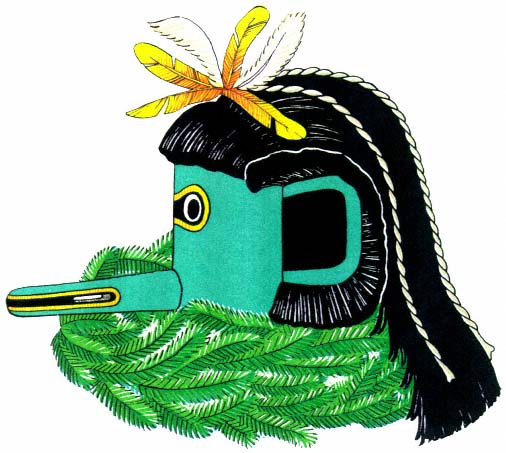
Plate 17.
Upoyona mask, Zuñi. Three strands of cotton cord hang from a topknot
of parrot and downy eagle feathers. The domino eye design is painted on.
to slenderize the figure.[6] "The loins are always painted white, regardless of whether kilt or breechcloth is worn. This is 'for the sun'. One informant offered the explanation that the white paint was used to protect the light-colored clothing. When full costume is worn the whole body is said to be painted white."[7]
Sometimes the body is painted in halves,[8] divided medially with the right side, arm, and leg black, and the left white.[9] Marsden Hartley saw, in what he calls a "Mercy Dance", a "warm tawny reddish earth tone with black stripes painted tiger-like at intervals down the entire right half and the other half a light greenish hue."[10] Knees are painted red to suggest speed; runners in ceremonial races always have red-painted knees.[11]
The bodies of the Buffalo impersonators are painted black broken by white crosses (pl. 21), "the sign of the bow."[12] This same design is used to signify the track of the road runner, a bird which leaves a footprint so perplexing that it is not possible to determine in which direction it was traveling.[13]
All these body paints are made up of earth pigments and plant stains which do not require the use of a glue to make them adhere. Thus the mixture is not injurious to the body, as there is no foreign matter to clog the pores and prevent the natural breathing of the skin. The pigments are mixed with water and applied in the liquid state, so that there is no caking of the colored powders upon the skin. Corn smut is used for black, ochers for yellow and reds, clays for white and pinks, and oxide of copper ore for the turquoise color. Stains are applied by rubbing a fruit, like barberry, over the body, or by chewing the stalk or leaves of other plants and applying the fluid thus obtained.
Mantles
The use of mantles over the shoulders, for the purpose of concealing and protecting the upper part of the body, is not common among male Pueblo actors. Whenever used, they signify a special character or a person of
eminence. On the other hand, impersonators of female characters always wear some kind of blanket or shawl. The most prized is the embroidered white blanket (pl. 34), hand-woven from native cotton by the Hopi in a plain basket weave. This, minus the embroidery, is the specification for the large white robe of the Hopi bride. It is decorated in woolen yarns of black and green, with touches of red and yellow in the wide borders at the top and bottom, and the corners are finished with tassels of black yarn. It is whitened with a paste made of finely powdered white clay (kaolin) to keep it clean.[14] This blanket is a rectangle about four feet by five and one-half feet[15] and when used as a mantle is always worn over both shoulders.[16] This form of blanket is probably not prehistoric, since "no embroidered wedding blankets antedate the period when dyed yarns could be procured from the trader and all known specimens are worked with worsteds, but many were collected before aniline colors came into use. Of the character of the wedding blanket before wool was introduced there is no information, though following the method employed in the kilts of the snake society the garments may have been ornamented with painted designs."[17]
The Maiden's shoulder blanket is of white cotton with wide, dark blue, or dark blue and red, woolen borders woven on two ends (pl. 38). The weave is a diagonal twill, and the shawl measures thirty-six by forty-eight inches. It is worn either over both shoulders or over the left shoulder and under the right arm, and it is knotted in front. The over the left shoulder and under the right arm manner of wearing the shawl is the most common, as this leaves the right arm free from restriction. Formerly, most Pueblo girls wore this dress-up garment on festival days. Today it has been replaced by gaudy, printed Mexican squares or overbrilliant plaids of machine manufacture.
In dress for ceremonial occasions the Maiden's blanket is worn by impersonators[18] and by participants in the Women's Society rites and dances.
Formerly, an all black or dark blue woolen shoulder blanket served the
women as an everyday dress. It was worn in the same manner as the Maiden's blanket, or over the head with the ends hanging in front or thrust behind the shoulders. Mrs. Stevenson says that even in 1879, when she made her first visit to the Southwest, "a Pueblo woman or child would no sooner appear without this special piece except in certain ceremonials than a civilized woman would leave off her dress."[19] Even today, women and girls wear some kind of shawl or scarf over their heads or around their shoulders, regardless of its incongruity with their American store clothes.[20] Some female impersonators wear these dark shawls in place of the Maiden's blanket. It is also not unusual to see them side by side in a long line of dancers. The shawl is of the same size and weave of material as that worn as a woman's dress.
Occasionally there are special mantles, such as the ancient, painted cotton cloth seen on the Aholi (pl. 30), or the Pueblo and Navaho woolen blankets worn by the leaders or chiefs. Certain personages may also wear, on occasion, one of the rare rabbitskin robes which are still in existence.
Deerskin and other dressed hides are variously worn, either over both shoulders or over the right shoulder and under the left arm. They are often untrimmed, with the leg pieces hanging but knotted so that they will not drag (pl. 33), or they may be shaped to make a rectangular or square garment. The pelt of a deer, mountain lion, goat, or sheep sometimes makes a shoulder cape[21] or small mantle to distinguish a character.
Body Garments
Breechclout.
—The breechclout is the only undergarment worn by the men, both in everyday life and in ceremonies. It is used to protect the person even when trousers are worn. It is always worn under the dance kilt except by the Mudheads, the Zuñi clowns, who are "just like children"[22] and are symbolized in myth as supernaturals "in semblance of males, yet like boys, the fruit of sex ... not in them."[23]
The size of the breechclout varies. In Taos it is broad and long, hanging
nearly to the ground,[24] while in the west it is short and narrow, the ends merely folding over the belt, front and back. The most desired material for this garment is hand-woven cotton cloth, but dark blue native cloth is often used, and sometimes even the woven ceremonial sash itself is used, its gay-hued ends contributing greatly to the color of figure and dance.[25]
The ordinary breechclout often has fringed ends or ends finished with embroidery or bright cording in geometric patterns. Decorated ends form a design element in the costume when drawn out over the belt and allowed to hang free (pl. 35).
Kilt.
—The most characteristic ceremonial garment is the kilt. The forms and materials for this garment are numerous, but most frequently the kilt is of white homespun cotton cloth in a plain basket weave. It is about fifty inches long and twenty inches wide; it is wrapped around the loins and held in place at the waist by a belt. Generally made by the Hopi, the kilt is decorated by them with two embroidered panels symbolizing rain, clouds, and life—a characteristic design which always follows the same pattern, in black, green, and red.[26] Other pueblos often purchase from them kilt lengths of the white cloth and embroider or paint them in their own designs.
A band of black about an inch wide is often embroidered or crocheted around the bottom of the kilt, with small black squares or terraced shapes breaking into the white body at intervals above this lower border. The entire kilt is sometimes outlined with a thread of black, thus giving the garment definite limitations and forming a thin line of accent.
Special kilts of white cotton are painted or stained in the desired colors and designs. It has been suggested that this is the original method of decorating all white cotton garments.[27] The Hopi Snake Dance kilt is the most noticeable example today. On a background of tawny red a black band
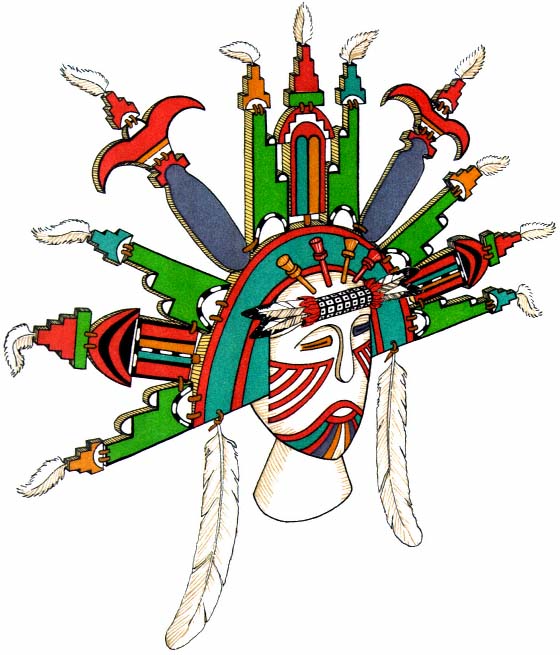
Plate 18.
Sio Shalako Maiden, Hopi. Mask of one of the giant
goddesses. The elaborate headdress of symbolic shapes is
held together by pegs and thongs. (Reconstructed from an
antique mask at the Laboratory of Anthropology, Santa Fe.)
with white borders zigzags through the center, "representing the plumed snake, the arrow-shaped marks representing the footprints of ducks and short parallel marks representing the footprints of the frog, both water animals."[28] This serpent band is continuous, with neither head nor tail. At the bottom of the kilt are two lines of color, yellow and blue, bordered by black and white interrupted lines. A fringe of metal cones, useful as noisemakers, finishes the lower edge.[29] Painted cotton kilts are used by the Rio Grande Pueblos for their Buffalo Dances. These were probably preceded by kilts of deerskin bearing a similar design. Native cloth kilts, dark blue or black, are often seen. They have a straight band of red and green through the center and are characteristic of the impersonators of the Mountain Sheep and other Rio Grande personifications (pl. 26).
Occasionally the Maiden's shoulder blanket is folded in the center and worn as a kilt, with the dark border at the lower edge.[30] These kilts are most frequently worn with the opening on the right side; occasionally the embroidered ones are adjusted so that the panel comes to the back to be covered by the fringe of the plaited sash. There is possibly a symbolic relationship between this fringe and panel.
One other cloth garment of this type should command attention. It is called the Salimapiya kilt because it is worn especially by impersonators of those gods.[31] As there are openings up each side, this kilt is apparently made of two pieces, a front and a back. The bottom has a wide, embroidered border similar to that of the great mantle but with characteristic medallions of colored butterflies and flowers (pls. 5, 6).[32]
The deerskin kilt, similar to the white cotton garment, is worn by dancers associated with the hunt or with war. The most primitive form is a simple, untrimmed skin, with trailing legs knotted up around the bottom. It appears to have been but half a hide cut longitudinally. The peg holes made when the hide was cured can be seen along the irregular edges.[33] The trimmed deerskin kilt, either white or stained with earth colors, is a garment of great luxury today because of the scarcity of wild animals. A
particular painted pattern found among the eastern pueblos has through the center a writhing black serpent (pl. 21) with a plumed head and a tapering tail.[34] This is the symbol for the mystical being who lives in the earth, for "who can know her secrets so intimately as a serpent who penetrates her bosom?"[35] The pictured reptile may be surrounded by various symbols: the cross of the road runner, or signs representing the sun, moon,
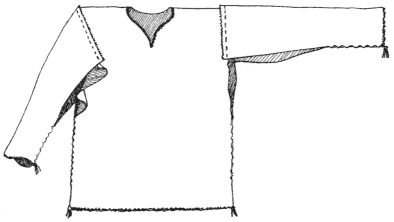
Figure 16.
Pattern of shirt made of dark hand-woven wool.
The sleeves are separate and sewed on the outside.
and stars. The lower edge is bordered in black and colored bands and around the ends of deerskin strips created by fringing the bottom are triangular tin pieces bent into cones. These replace the earlier animal-hoof and shell rattles with which these garments were formerly trimmed.
Special kilts are worn by certain dancers. One is fashioned of long horsehair stained red (pl. 35) and knotted on a cotton cord about the waist. It is held in place by a belt and hangs almost to the knee.[36] Another is made of long yucca leaves bound together on a single band, hanging straight and stiff in repose, but breaking and parting when the dancer is in motion.
Different materials or ornaments have been worn as overkilts. Narrow strips of cloth of a contrasting color, a fringe of leather, and a series of eagle feathers hung on deerskin thongs serve as examples.[37]
Shirt.
—"The typical body garment of the Hopi man in historic times was a length of dark blue or black woolen cloth with an opening made in the middle for drawing over the head, equal lengths of the garment hanging over the back and front like the Mexican poncho."[38] With the addition of sleeves, this garment makes a distinguishing feature of a costume, being worn on the outside either with or without a belt. It was made of three pieces of flat cloth, the two sleeves sewn to the poncholike piece at each side midway down the length. Each side and the lower sleeves from wrist to elbow were sewn together with a simple running stitch. This left an opening under each arm minus a gusset—a pattern never fully understood by the Pueblos. They never mastered the art of cutting and fitting, but depended upon cloth in the piece, either rectangular or square. They created all their garments on geometrical lines, in contrast to the tailored garments of the skin-clothed Plains Indian. This cloth shirt was probably the successor to the deerskin shirt of the Plains; the deerskin shirt is believed to have been universally worn by the Pueblos when animals were more plentiful.
Two special shirts were introduced by the Spaniards and can be seen today among the eastern pueblos. At Isleta a garment of fine stuff, fulled to a yoke and with gathered sleeves, has a small flat collar and tight cuff of white embroidered material edged with a thin strip of red. From San Juan have come a few examples of crocheted garments of white cotton string with fringes down the underarm and sides, copying in modern materials the age-old leather garment of the Plains warrior.
Women's dress.
—The ordinary dress of the Pueblo women is fashioned from a blanket of hand-woven woolen stuff which is dark brown, black, or blue. The brown and black are natural colors from the great number of brown and black sheep in the Indian flocks;[39] the blue was first obtained by dyeing the wool with indigo and later with aniline dyes.
This blanket is about four feet long and about three and one-half feet wide, a width sufficient to reach from the shoulder to the middle of the
lower leg. The weave is a twill in which use is made of the diagonal pattern for the body of the dress and a diamond pattern for the two borders, which are seven inches wide at top and bottom. These borders must both be completed before the center is begun, because of the complicated heddle setup required for the diamond weave. One border is finished and then the entire loom is inverted for the completion of the second border. Subsequently, the diagonal pattern is set up with a new heddle division and the weaving continues upward toward the first border.[40] The center section differs from the borders not only in weave, but often also in color; for instance, a black center may have dark blue borders, or a brown center may have black borders.
These blankets may be used as shawls and mantles as well as dresses. To fashion one into a dress, it is wrapped about the body and joined with red yarn part way up on the right side. The upper edges are drawn over the right shoulder and fastened there, leaving an opening for the right arm with the ends forming a kind of sleeve. The left arm and shoulder are bare and free. The break between the border and the center is often covered by cording or stitching of red and green yarn (pl. 19).
The Hopi men weave these blankets, which are in great demand among all the pueblos. In each village the inhabitants decorate the borders and sew the dresses in their own way. The Zuñi use a strong, embroidered border in dark blue. At Acoma, Tesuque, and Laguna red and green yarns have been introduced.
On rare occasions is seen a dark dress made of two pieces of cloth sewn up each side.[41] It is worn in the same manner as the one-piece dark dress. It is obvious that the smaller pieces of cloth would require a correspondingly small loom for the weaving.
In these native homespun woolen blanket dresses we see one of the last stands of the native culture. No matter how decadent and Americanized a village has become, it is still possible to find one of these original dresses
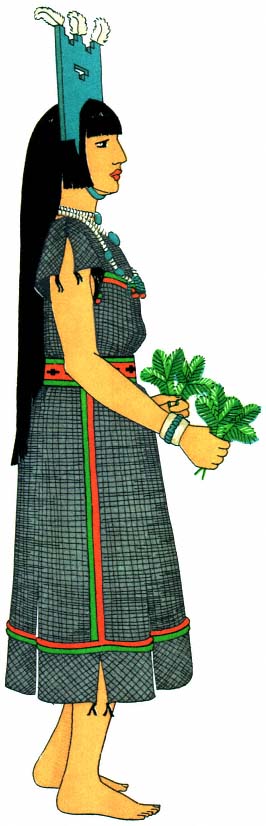
Plate 19.
Simple costume for women.
Tablita Dance, Santo Domingo.
on some old grandmother puttering about her daily work, or on some actor performing in a dance which has its roots deep in native custom.
There is a special white ceremonial dress (pl. 22). It is woven of cotton, a plain weave, and decorated with wide bands of colored embroidery at top and bottom. So is the white mantle. The two garments are often interchangeable, although there is supposed to be an appreciable difference in size. The mantle originated from the great white robe and the dress from the smaller robe, both of which were woven for each Hopi bride at the time of her marriage. Today there are worn under these dresses other dresses of manufactured cloth with long sleeves and high necklines and trimmed with lace and fancy braid. The impersonators of female characters have sometimes taken over this added garment, as in the Kokochi ceremony at Zuñi.
Trousers.
—During the period of Spanish settlement and influence, a kind of trousers became a part of the men's everyday dress. Its origin is uncertain. It could have come with the colonists from Spain by way of Mexico and it could have developed from the hip-length leggings made of animal skin. In any event, there appeared loose white cotton trousers, of about ankle length, made of two straight pieces of material seamed on the outside of the leg. These trousers were gathered on a cord about the waist, the top was concealed under the long tails of the shirt, and the breechclout protected the opening. A slit from the bottom almost to the knee was made on the outside of each leg.[42] Similar hip-length leggings of skin and colored flannel are found among the Rio Grande Pueblos. At Taos today, by a ruling of their council of governors, a man is not permitted to wear modern trousers.[43] As a compromise, the seat is removed and the breechclout substituted.
Trousers are not often worn in the ceremonial dances. One may, however, see them on members of the choir, the standard bearer, those who impersonate hunters, and a few supernaturals (for example, the Nataka men, pl. 33).
Leg Coverings
Leggings.
—In the northern Rio Grande pueblos knitted or crocheted leggings of white cotton cord are often worn by dancers today (pl. 27). They may be fringed on the outside or up the front with cotton cord, and by various groupings of stitches patterns are worked into the body of the garments. Some of these leggings appear to cover the knee; others are only of knee length and are held in place by woven garters. A kneelength knitted legging of dark wool is also found in nearly all the villages. At Zuñi the leaders who are priests, and the impersonators of the female deities, often wear them (pl. 38). Investigators who visited the pueblos in the latter part of the nineteenth century saw them on both old men and old women as part of the everyday dress in cold weather.[44] As a protective garment, red-brown deerskin leggings (pl. 33) were worn above the moccasins by men. Each one was made of a single piece of tanned skin wrapped about the leg and secured by a woven garter tied just below the knee. They may be seen today in the western pueblos.[45]
Garters.
—Woven garters are made on a loom similar to the one used for belts. With a tapestry weave, vertical strips and small geometric designs are made in red, green, and white or black yarn. The garters are wrapped twice around the leg and tied at the front or side. When worn with the slit trouser leg, the ends show at the opening. They are used simply to hold the leggings in place or as a decorative motif at the knees of the dancers, whose legs are otherwise bare or painted. Strands of yarn—red, dark blue, or black—are also used as garters or leg bands. They are knotted so that the long ends swing free about the legs (pl. 20).
Anklets.
—Anklets, worn on the lower leg, are of leather or small sprigs of evergreen (pl. 6) bound together in a festoon. The leather bands are stained a solid color or striped with various pigments; or a rectangular piece of leather is slit into internal strips which may be wound with colored yarns, or with porcupine quills and horsehair in geometric patterns.
All these forms may be worn when the feet are bare, or the leather bands and the slit and wound anklets may make the heelpieces of moccasins.
Moccasins.
—Moccasins are made with hard soles and soft deerskin uppers. The soles are cut from rawhide or the tanned, thick, neckskin of the deer, which is exceptionally strong and heavy. These soles, after shaping
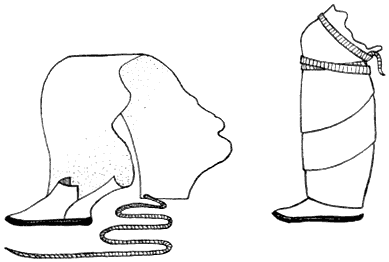
Figure 17.
Woman's wrapped moccasin of white
deerskin with polished black sole.
and puckering, come well up at toe and sides. The man's brown moccasin is usually made from a one-piece upper which overlaps at the outside of the leg. It is tied with thongs or buttoned with small silver conchs of Navaho workmanship. This moccasin is high, reaching several inches above the ankle (pl. 35). Another type has a two-piece upper (p1. 8), one piece being sewn to the sole from instep to instep around the toe, covering the front of the foot and making a tongue. The second piece is sewn around the heel and then wrapped about the ankle. This piece also overlaps on the outside of the foot and is tied with two or three thongs. The top is turned down to make a cuff with the longer tab outside, concealing the opening. To add a decorative touch an extra flap may be sewn in front to the lower edge of this wrapped piece.
The special Hopi and Zuñi dance moccasin is made in this latter pattern, with turquoise blue paint covering the body of the footgear, the cuff and added piece in front being stained red or yellow.[46] The sole is painted black and highly polished. Among the Rio Grande Pueblos the ceremonial moccasins are whitened with kaolin, which makes a strong contrast with the shiny black soles (p1. 20). Occasionally, lower moccasins are worn. These fit snugly and barely cover the ankle (pl. 25). They are sometimes beaded, and are obtained by purchase from the Plains tribes.
In ceremonial dress, heelpieces are worn with the moccasins. At Hopi a fringed piece of red-brown deerskin is secured around the ankle. It is worn by dancing Kachinas as well as the Snake Priests, whose entire costume is blended harmoniously with the red-brown skin. Solid, rectangular pieces of leather; or pieces slit and wound with different-colored yarns, or porcupine quills and horsehair; or strips of buffalo, bear, or skunk fur—all are tied about the ankle and knotted over the instep with one or two thongs. The skunk fur is said to keep the evil spirits from entering the body of the dancer by way of the earth, and it is the only part of a dancer's costume which symbolizes death.[47]
Patterned like the two-piece footgear of the men, the women's moccasins are white with black soles. They have a high ankle flap, very long because it consists of a whole, white, tanned deerskin.[48] This is wrapped many times, spirally, about the leg and ends well above the knee, and is held in place by a well-tied thong of buckskin. The many folds give these moccasins a clumsy look, but they make the feet appear very small and dainty.[49] The size of the moccasin leg indicates the wealth of the Pueblo woman. The deerskin is whitened with a wash of kaolin which approximates our white shoe cleaner. It is considered fashionable, among the Keres and the Tewa, to stain the toes of these moccasins pink or red.[50]
At Taos, and frequently among the Tewa, one other form of woman's moccasin is seen. It is a kind of boot with a hard black sole and an upper
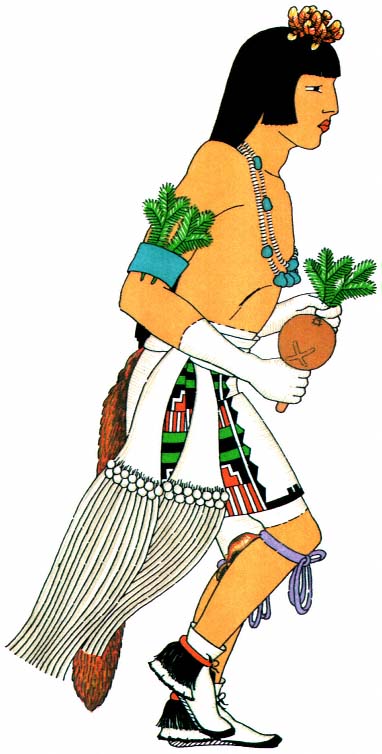
Plate 20.
Men's simple costume. Tablita Dance, Santo Domingo.
made of two pieces of deerskin sewed together with seams on each side. The top comes up very wide from the ankle, and from the side gives an appearance of flatness. The width depends upon the size of the skins and the wealth of the individual who purchases them. There are from two to five pleats of the skin above the ankle, around which is a drawstring of
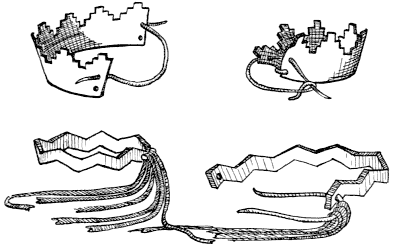
Figure 18.
Leather arm bands.
deerskin.[51] As the soles wear through, a pleat is loosened and the top pulled down to sew on the new soles. A pair of moccasins made for a woman at the time of her marriage will last her the rest of her life.
Arm Ornaments
Arm bands.
—Because of his love of ornament the Indian wears above his elbow decorative bands in which he can place pieces of evergreen or tie soft, bright feathers or tassels of yarn. These ornaments represent the sacred butterfly, a love charm which is supposed to have the power to make people crazy.[52] They may be merely strips of leather, striped or painted a solid color, and some are cut with dentate edges. They are tied together with thongs or tassels of yarn. Arm bands are also made of the
hair of buffalo or goat to conform in color and spirit with the other details of the costume (pls. 21, 22). The goat's hair is often dyed.
Strands of colored yarns are used to decorate the wrists. Wrist guards are worn on the left arm during the Hunt Dances, because originally this guard was a leather band worn to protect the wrist from the sharp impact of the bowstring when an arrow was released from the bow. Since the introduction of silver, a curved plate, often set with turquoise, has been applied to the upper side of this decoration.[53]
Accessories
Sash.
—A brocade sash (p1.31)is worn by the men who take part in public ceremonies. Each sash is made up of two "panels of plain weaving of cotton or wool, decorated at the end with designs in colored yarns and terminating with a fringe".[54] Two-thirds of each panel is plain-woven; then the heddles of the loom are adjusted to work the pattern in yarn. At the point where this decoration begins, a finer weft is used so that the addition of the colored yarns does not widen the cloth. The designs are virtually alike, being made up of bands of black, green, and blue with a red diamond design in the center. At their plain ends the two panels are sewn together with a roving of cord. This produces a long sash which can be wrapped about the waist and knotted on the right side with the ends hanging to the calf of the leg. The origin of the sash appears to be unknown, but the form was fully developed in the earliest modern examples collected by James Stevenson in 1879.[55] The sashes are brocaded today with commercial yarns; "however, old specimens show hand-spun wool for both the body of the sash and the brocading".[56]
The plaited white cotton sash with its long fringe is one of the most significant and potent of rainmaking garments. "A typical example of the sacred sash is composed of 216 threads of white cotton about the size of small package cord braided into a band eight inches wide and sixty-one
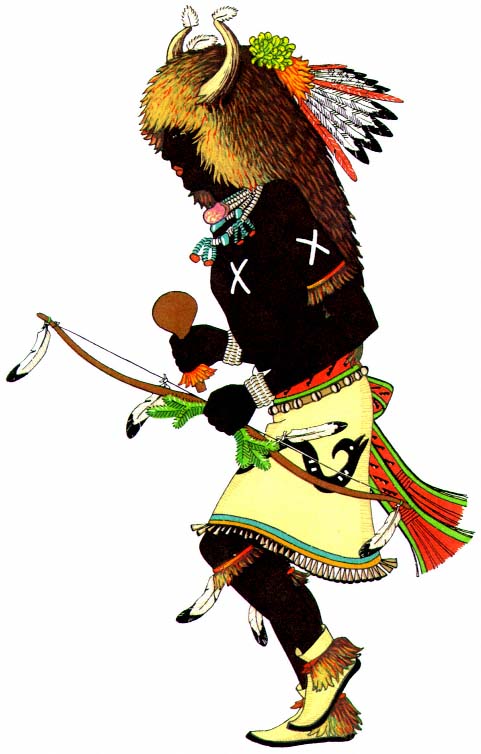
Plate 21.
Animal impersonation. Buffalo Dance, San Ildefonso.
inches long to the termination of the solid braiding. The work is started midway of the cords when a twining is applied temporarily, and proceeds toward either end when the cords are divided into twelve tresses braided into narrow tapes for a short distance".[57] Over each tape end, rings of cornhusk wrapped with cotton cord are slipped and tied in place. The cords are then divided into sixes and twisted together to form a long fringe, which symbolizes, in the Indian mind, the falling of the rain in its long, parallel lines (pl. 20). These sashes are kept clean and white by rubbing with liquid kaolin.
Belt.
—The woven belt, ordinarily worn by the women around their everyday dresses of dark wool, became a part of the ceremonial costume because of its usefulness and its striking colors. Walter Hough remarks that "the greatest play of fancy in the Hopi textile art is the weaving of belts".[58] In this article of apparel there could be produced small and greatly varied patterns not limited by ceremonial rules (fig. 10, p. 58).Woven on an easily manipulated small loom, warp threads to form the designs could be picked out by hand. "The warp and weft are often of the same yarn, giving uniformity of texture, but usually the warp is partly of yarn of the same thickness as the weft yarn and partly smaller. This arrangement furnishes a fertile field for the play of design. The warp in the central or pattern band of a belt is generally of small white yarn and another color of larger yarn, usually red, the former working out white pattern grounds, having raised figures in red warp, the latter contrast being produced by the difference in size of the yarns, the small warp being worked singly and the larger in pairs".[59] The use of small and large warps gives an uneven surface to the material and is the only example in Pueblo weaving in which this method of obtaining variety is found. The most prevalent color scheme is composed of a wide center of red broken by black designs and edged with two stripes of green which in turn are bordered by two narrow lines of black. Other combinations show a red center with white designs, a black and red stripe, and a final line of white on each side; or
a red center with white patterns, a stripe of blue-green, one of ultramarine followed by one of red, and a final edging of white. The patterns are manifold geometric forms made up of small triangles and with lines repeated in different and varying combinations.
The women wear this belt wrapped several times around the waist, drawn in tightly, with part of the loose fringe tucked under a lap so that the rest falls down on the left side. The brilliant color of the belt is a conspicuous accent on the dark garment (pl. 1). The width varies from three to five inches and the tight wrapping helps to confine the figure. The men dancers use this belt to hold their kilts in place or to encircle their bodies over the brocaded sash. When worn in the latter fashion, one part is looped over and the fringe of the two ends hangs to the middle of the calf of the leg. In the Peace Dance of the Tewa, which depicts a combat between chiefs of opposing forces, "a description of the battle which brought peace to the tribe",[60] the wife of each chief appears holding one end of a belt which is fastened to her husband's waist. The significance of this is that behind all warfare the ties of family and home life are vital incentives to valorous deeds.[61]
Foxskin.
—A noticeable feature of many of the costumes is the pendent foxskin, worn tail downward at the back of the belt (pls. 24, 35). This particular fox, formerly indigenous to the mountainous country of the Pueblos, is a small animal with gray hair intermingled with amber. It was hunted during the season of the year when the hair was long and thick and the hide tough. When killed, the body of the animal was skinned very carefully and all the parts were retained: the paws remained on the legs, and the ears were kept on the full head covering. Ruth Bunzel says that the foxskin tail is "considered as a relic of the earliest days of man, for the katcinas were transformed while mankind was still tailed and horned".[62] For several days previous to each occasion on which they are worn, the pelts are buried in damp sand in order to bring suppleness to
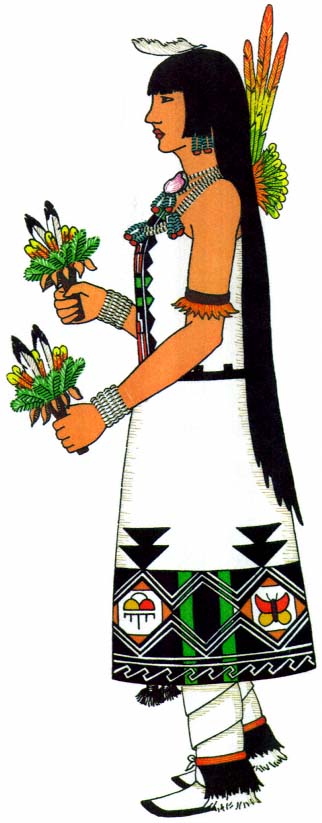
Plate 22.
Women's costume. Buffalo Dance, San Ildefonso.
the skin and a soft, live quality to the fur. In most of the ceremonies the men dancers wear foxskins. This custom evidently carries for the Rio Grande Pueblos no association with animal tails, for none of their hunt impersonators wear them, but, instead, affect the fringes of the plaited sash (pl. 26) or a fan of eagle feathers (pl. 23) on the belt at the rear. The Hopi and Zuñi animal impersonators wear pendent foxskins, but not as animal tails; their use by these performers conforms entirely to the conventional kachina dress.
Bandoleers.
—Many kinds of bandoleers are worn over the right shoulder, and at the same time they encircle the body to the waist on the left side. The more common and concededly less potent kinds are broad bands of ribbon,[63] beadwork from the plains, red woven belts,[64] twists of yucca cord or leather and cedar berries. Conch shells (Conus ) strung on thongs or yucca cord are highly prized for their rarity.[65] "Warrior katcinas wear the bandoleer of the bow priest over their right shoulder. This is made of white buckskin, decorated with fringes under the left arm and ornamented with a zigzag pattern of shells, four for each scalp taken. A little of the hair from each scalp is sewed into the broad fringed portion. The bandoleers of the bow priests hang by outer doors of their houses. They are never taken into back rooms. They must always be removed before going into the room with the corn, or before drinking, lest the spring from which the water was drawn be contaminated.[*] The bandoleers of the bow priests may be borrowed or imitated".[66] Double bandoleers are also worn, hanging from each shoulder and crossing on the chest and back.[67] Impersonators concerned with the hunt often have pouches suspended, like the bandoleer, from the right shoulder (pl. 5). They are similar to those which "hunters use to carry their animal fetishes and prayer meal".[68]
Jewelry.
—Above all else among his purely private and individual possessions, the Pueblo Indian prizes his jewelry. Apparently he has done so
* The enemy are supposed to be very dangerous and often are witches who weave magical spells.
from the earliest time. Archaeologists have unearthed many smoothly turned disks of stone and shell pierced with a hole in the center for the purpose of being strung on thongs of deerskin. Furthermore, great numbers of crude beads and pendants have been found, which undoubtedly were worn as necklaces and earbobs by the prehistoric men who lived in cliff houses and communal towns.
The Indian first used as jewelry whatever was near at hand of a decorative nature. Seed pods, acorn hulls,[69] the teeth and bones of animals picked up promiscuously and perforated and strung together to be hung about his person—these were the early and crude expression of this intimate kind of ornamentation. As his culture evolved, his amazing capacity for painstaking labor developed new forms of beads from the more precious materials. Soon he was not only adorning himself with the graywhite sea shells obtained from the far Pacific or from the scintillating waters of the Gulf, and with the reddish coral brought back by runners from their trading expeditions into Mexico, but was also decking his neck and arms and ears with ornaments made of the brilliant turquoise with its matrix of soft brown. This was mined from the rough stretches to the east of the Rio Grande and to the south of Zuñi. Beads were also made from the chunks of lignite and the dull pink quartz which crumbled from the outcroppings along the rocky ridges.
Many kinds of shells were used as bead and ornament. The small, barrelshaped olive shell (Olivella ) with its tapering ends and the tiny conch with its reducing spiral could be strung together one after the other on necklace or bandoleer, or tied to buckskin and fabric as tinkler and fringe. Multitudinous flat shells, either whole or in part, were brought into use as bead and pendant. The larger, oval abalone shell (Haliotis ) was often hung at the base of the neck, where its iridescent, pearly inner surface gleamed softly against the rich brown tones of the skin (pl. 21).
With its piercing blue, the turquoise reflects the power and glory of the daytime sky from which come life and beauty in the warmth of the
purifying and nurturing sun and the repose of the rain-bringing and shadowing cloud. Turquoise is the most highly prized of the Indian gems, and it has been worn throughout the entire historic period of Pueblo life; in the records of the Coronado expedition it was noted that the Pueblo Indians wore turquoise in their ears "as well as on their necks and on their wrists".[70] Moreover, it has value as an economic investment, At Zuñi, "after the sale of wool in the spring a man liquidates his debts and invests the balance in turquoise".[71]
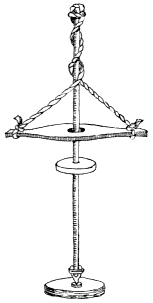
Figure 19.
Rotary drill.
The bright, soft red of the coral is used to offset and intensify the beauty of the turquoise. Thus the Indian is able to combine two natural elcments which complement each other in color an dequal each other in tone value.
Since the earliest times, small disk-shaped beads have been made by the Pueblos. In excavations and ruins many examples of exquisite workmanship have been found. The process by which these beads are now made is as follows. The material is roughly chipped out to a little more than the desired size, and then a hole is bored in the center with a drill pump. This is a device like the spindle, with a flywheel on a long, slender shaft. A stone or metal point is attached to one end, and at the other two buckskin thongs support a crosspiece with a large hole in which the shaft may move freely. The buckskin thongs are twisted around the shaft, and the point of the drill is placed in the center of the bead and made to revolve by a pumping motion with the crosspiece, while the flywheel produces rotation which unwinds the thongs in one direction and rewinds them in the other. The bead is drilled halfway through from one side and then is turned over and the drilling is completed. Shell beads require but few strokes, whereas turquoise, jet, and
coral require much drilling. When a number of rough beads have been drilled, they are strung in a tight column on a length of cord and the whole string is ground to an even size on a slab of sandstone or between two stones.[72] The beads are then sorted and matched by color and size, and strung in necklaces of one, two, or even four strands. White shell is often interspersed with small symmetrical beads or large, rough chunks of turquoise, and short strings of turquoise with a few beads of coral are looped over the long strands and bunched together at the bottom. These same small strings of turquoise are sometimes tied with thongs in the ears and from this position peep from beneath the black, bobbed side hair.
Another form of jewellike decoration is the mosaic pendant, delicate and of beautiful design. Mosaics consist mainly of small, flat pieces of turquoise, coral, quartz, and jet set together in simple patterns. Their base is the softly curving back of a clamlike shell or a glittering piece of jet, to which they are glued with piñon gum.
When the Spanish colonists came, silver was introduced to the pueblos. For a long time this new material had little or no effect on the Indian, and then suddenly there sprang up a remarkable silver-working industry. This was dominated by the Navaho.[73] Today the foremost jewelers among the pueblos are the people of Zuñi and Santo Domingo. Here, round silver beads, and occasionally the conventionalized silver squash blossoms, are strung into necklaces terminating, like those of the Navaho, in a curved pendant set with turquoise. Turquoise and the soft, rich silver are used together in a hundred patterns. "The Zuñs are freest in combining these two elements; with them a silver bracelet is hardly more than a setting for fine, deep blue stones".[74]
Silver earrings are shaped to resemble the dragonfly, the butterfly, or some bird, and all are set with turquoise. Silver and turquoise rings are ubiquitous, as jewelry is worn by all: men, women, and children. Proud is the mother whose baby wears about his neck a string of tiny turquoise
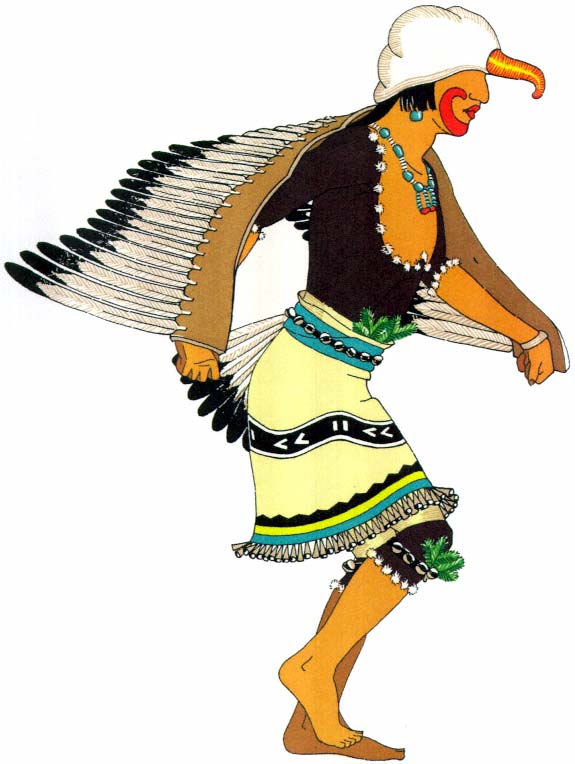
Plate 23.
Realism in bird impersonation. Eagle Dance, Rio Grande.
beads, or on his arm a little silver bracelet. "The amount of turquoise worn by an impersonator is limited only by his borrowing capacity. The necklaces cover the whole chest, frequently also the whole back.... The way of wearing the necklaces is indicative of rank and position. Necklaces front and back indicate a Katcina of importance; necklaces doubled over and worn close to the throat are a badge of society membership."[75]
Sun-disk ornament.
—A disk surrounded by feathers is the most prominently used of the separate ornaments. It symbolizes the sun and often has stylized features painted on its buckskin face. Sometimes the disk is a round bunch of gaily colored feathers, and the diverging rays are reduced to a few long shafts of brilliant colors across the top (pl. 22); at others, the entire circumference is decked with the severe black and white of the eagle wing feathers shot through with long, waving strands of red horsehair.
A similar disk is fastened to the end of a pole and used in kiva rituals when the ceremony has to do with the sun. It is raised, lowered, or twirled as the action in the rite demands."[76]
Dance Properties
Rattles.
—Rattles accompany every Pueblo dance. Frequently they are incorporated as decorative elements on separate garments, as, for example, the shell, hoof, and cone tinklers on the kilt and the legging fringes. Nowadays, American-made sleighbells are seen on straps around the knees and arms and on belts around the waist.
Perhaps the most interesting rattle is that of tortoise shell (pl. 20) worn by almost every masked dancer. It is a rattle of especial sacredness because the tortoise lives in the water and has influence with the Rain Gods. When the men wear tortoise shell in the dance, the belief is that the supernaturals hear the rattle and thus know that the Indian needs rain for his crops. The tortoise is captured near the water holes or sacred springs. After the shells are cleaned and dried, the toes of deer are tied
on by a piece of buckskin rove through holes in one side of the shell. A second piece of thong, passed through holes in the other side, ties the shell around the leg just under the knee. As the foot is lifted in the dance, the leg hits the pendent hoofs, sending them up to strike the back of the shell with a loud, sharp clatter.[*]
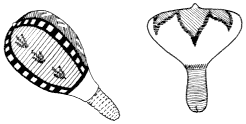
Figure 20
Gourd rattles
Shells and the dewclaws of various animals are hung on thongs and fastened to little sticks so that they produce a clicking noise. The gourd rattles are the ones most frequently carried. The dried shell of the gourd is thoroughly cleaned; then the seeds are removed through a small hole and replaced by pebbles of white quartz, colored stone, or small crystals.[77] When the gourd has no neck by which the rattle may be carried, a corncob or wooden handle is inserted in the hole. Occasionally, a tapering handle goes all the way through the gourd and is held in place by a peg on the other side. These rattles are painted in divers colors and in designs appropriate to the suggestion of motion.
Skin rattles are made of pieces of rawhide sewn together in rectangular or ring shapes. Pebbles are enclosed and a handle is affixed. A special Antelope-fraternity rattle at Hopi is made of a dampened skin stretched over a wooden hoop perpendicular to a wooden handle, the whole forming a kind of frame. The skin is pulled completely around this frame, the rattle is put in, and the skin is fastened and painted white. The sound of this rattle is similar to the warning of the rattlesnake, a rattle with a rustling quality rather than the loud sharpness of the gourd.
Before it is carried in a ceremony, each rattle is 'blessed' by tying on it with cotton cord a downy white eagle or 'breath' feather. At the top
* At Isleta a distinction is made: shells of the water turtle are worn by one group, and those of the land turtle by another (Parsons, 1932, p. 355).
of the long standard carried by the leader of the chorus there are a decorated gourd rattle and many feathers, as well as the swirling white kilt or banner. Bunches of horns from cow and mountain sheep may be carried noisily about by the Rain Makers, while hoofs of cattle, shoulder blades of sheep, and bones of other animals serve the purpose of rattles and noisemakers. A thin, rhomboidal piece of wood tied to the end of a string or thong is whirled rapidly through the air like a bull-roarer and
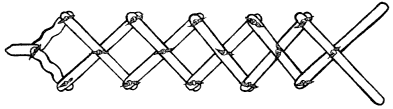
Figure 21.
Lazy tongs lightning frame.
adds its appreciable measure of noise (pl. 40). In the ceremonial dance it is often handled by one of the clown priests.
Wands.
—The priest leaders carry several different feather wands. These are the insignia of the kiva or organization which happens to be performing. Moreover, these brilliantly clothed fetishes are works of art by reason of the careful selection and arrangement of feathers and the remarkable precision with which each feather is bound in place.
There is a lightning wand which is cut from wood in a zigzag shape to imitate that phenomenon of nature. It is carried by certain impersonators in dances devoted to rainmaking.[78] The quick striking of the lightning is represented to the Indian mind by a mechanized frame of strips of wood, pegged or tied together like a lazy tongs, folded and unfolded by two handles at one end.[79] This is one of their most highly developed mechanical devices, and the ceremonial lightning thus created never fails to inspire the spectators with wonder and amazement. Representations of lightning end in arrow-shaped points because the Pueblo Indian believes that each flash is tipped with a stone knife.[80]
Warriors and those concerned with the hunt always carry brightly painted, curved rabbit sticks or bows and arrows trimmed with downy eagle feathers which float from the tips and interspacings along the strings. Sprigs of evergreen are carried in the hand, parallel to the bow.
At Santa Clara a section of gourd is mounted on a short stick and carried by each male dancer in the Zuñi Basket Dance. This piece of gourd is painted green on the concave surface and decorated with four eagle feathers. It is said to represent the sun, especially when stick and emblem are held aloft.[81]
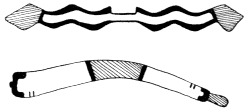
Figure 22.
Hopi dance wands: upper, lightning dance
wand; lower, rabbit-stick dance wand.
The women's dance wands are rectangular tablets with a handle at one end. In dancing for rain these are carried vertically in each hand. A single, wide tablet may have two handles side by side; it is then carried with both hands in front of the body.[82] In the center is painted a figure of a rain god with curving cloud shapes and streaks of rain above him and a stylized ear of corn below. The whole is topped with downy feathers and crisp yellow heads of seed grass, and puffs of eagle down float at intervals from each side. At Zuñi another hand wand, of great beauty, is carried. It is made of slender sticks "about eighteen inches long, painted white and adorned with delicate white duck feathers in groups of two, the space between being the width of the first three fingers placed crosswise within a few inches of their ends".[83] There are also little, formal bouquets made of feathers beautifully arranged with respect to color and size, and having borders of evergreens and a final edging of shells or dainty, bone-colored dewclaws of the deer or antelope (pl. 22).
Many of the dancers carry tall staffs to indicate their office or to give
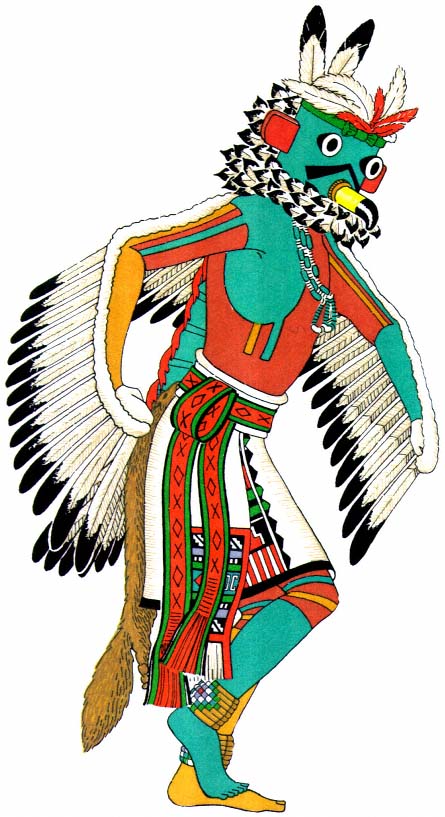
Plate 24.
Eagle Kachina, Hopi. Bird form stylized by introduction
of all the elements of the conventional kachina costume.
dignity to their impersonations (pls. 29, 30). The staffs are variously ornamented with feathers, evergreen, cornhusks, ears of corn, and other sacred symbols.
Baskets.
—The round, flat, basket plaques, made by the Hopi or purchased by other villages from nomadic neighbors, are used most significantly in the Basket Dance. This is definitely a woman's dance, though sometimes the services of a few men are utilized. The major symbolism is centered in the food basket, the usefulness of which is inestimable since it covers the span of life. It holds all the seeds to be planted in the earth, in due time to flower and become grain. It carries the ripened harvest and winnows the seed from the chaff. When the harvest is ground, it bears the meal, and later it brings the thin, colored rolls of piki bread which is made for the sustenance and ceremony of the tribe.[84]
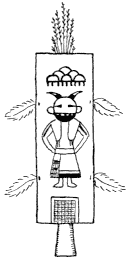
Figure 23.
Zuñi dance wand carried by women dancers.
Designs represent cloud, rain god, and corn.
The Hopi baskets are made with both the coil and the wicker technique. They are constructed of the tough, strong stems and small twigs of various desert plants which have been cleaned and dyed the pleasing soft colors of earth and herb. The two techniques are very different. The wicker designs diverge as they leave the center, growing larger and more effective, whereas the coilwork restricts the design to a radial pattern which is forced out from center to circumference and has a tighter and more concentrated feeling. Baskets are made specially for this ceremony and at the end of the dance are thrown to the onlookers, to the accompaniment of clamor and agitation.
In the Sun Basket Dance of Santa Clara, performed by two boys and two girls, each of the girls "carries a basket decorated inside with an orange-colored sun symbol and on the edge with long fringes of red-dyed angora wool. In the principal movement of the dance these baskets are
swung in a double arc, with graceful drooping of the entire body, the flame-colored corona flashing out in a conventionalized but quite realistic picture of the sun".[85]
A greater number of symbolic elements are to be found among the objects carried in the hands of dancers and impersonators than in the colors and designs of dress and mask. With their background in literal fact and phenomena, these objects have outgrown their material phase and have become ceremonial. Devices making use of mechanics in construction are here displayed in their most advanced form. The Pueblo Indian has never been mechanically gifted; even today he has an utter lack of knowledge and interest in the mechanistic features of civilization; his most advanced development in this direction is gauged by his childish delight and wondering belief in the reality of the serpent effigy and its simple manipulation by stick or horsehair thread. His talent lies in another field. By neglecting the mechanical forms he has advanced in the art of surface decoration. He has gained mastery in the field of design.
Make-up
There are two modes of approach to the decoration of the face for the ceremonial dances. On the one hand, the Indian used the patterns of the body paint, continuing the color and designs up over the face and into and over the hair. The "Chiffoneti" is a striking example. His black and white striped body is topped with a neck, face, and exaggerated hair-dress which are also striped and circled in black and white (pl. 39). On the other hand, the Indian treated the face as a separate and distinct element of the figure and provided for it a make-up which, like the mask, characterized the impersonation. In neither mode was there any attempt at realism, even in the animal forms. The colors and patterns of make-up depend, like the body paint, not only upon the impersonation, but also
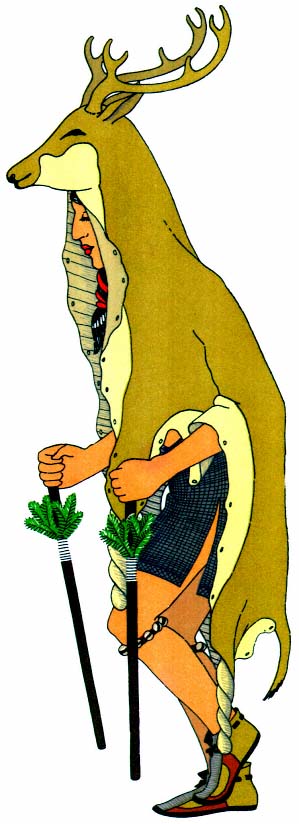
Plate 25.
Deer dancer, Taos. The simplest and most
realistic form of animal impersonation.
upon the pueblo and the society or group which is performing. The Deer Dancers at San Ildefonso paint their faces black with a white rim around the edge (pl. 26). At San Juan the same group paint the face red with no relief trimming (pl. 27).
Face paint may well have originated from the application of a coating of earth to the face in order to protect it from the elements. At Taos today, "red paint is smeared on the faces of the men in very cold weather, against the wind".[86] However, there is hardly a rite from which make-up is omitted. The simplest form of it is found in the brilliant carmine dots which accent the faces of the men and women in the Hopi Butterfly Dance.
The face may be painted a solid color. Occasionally, streaks of another hue may be added under the eyes. Sometimes each side is painted a different color and the division is a vertical line in the exact middle of the face. Racers at Cochiti are painted thus, one side of the face red and the other green.[87] Sometimes the face is divided horizontally. Hopi Snake Dancers are painted black to the mouth and white to the neck. Often other and more brilliant colors are used.
When carefully applied, the paint practically conceals the identity of the impersonator. Dancers often wear make-up under their masks so that they will not be recognized by the children if by chance they are caught without their masks during the rest periods. At Zuñi the face paint under the mask consists of two lines drawn across the face in iridescent black paint or red pigment, or it consists of red or black dots on cheeks and chin.[88] There is never any attempt to delineate human features, as the paint is used for concealment and ceremonial significance. The color and pigment are applied in stipulated patterns to satisfy the occasion.
Headdresses
The true marks of identification in ceremonial costumes are found in the headdresses. The hair is generally permitted to float free. From the banged forelocks to the bobbed side hair and thence to the long back
strands there is recognizable the geometric stepped form so often associated by the Indian with cloud terraces. Impersonators whose hair has been cut wear wigs of long horsehair. Certain actors who are impersonating comic characters wear short wigs of different kinds of hair and wool. There are also fringes and bangs of horsehair, goat's hair, and sheep's wool which are tied across the forehead or worn all the way around the head. Sometimes the hair is worn in a wrapped club at the neck or wound into whorls or tied with yarn over wooden frames (pl. 38).
Every performer wears some ornament in his hair, even if it is no more than the white, downy, "breath" feather or a red, downy badge of office. Sometimes the green or yellow pompon of gleaming parrot feathers (pl. 20), from its place on top of the head, moves in accordance with the dancer's steps. More elaborate ornaments of feathers and carved gourd are worn from side to side or from front to back.
The narrow bandeau of deerskin, or fillet of yucca leaves, may be worn alone on the head or it may serve as a base for other ornamentation. Flower symbols of gourd or cornhusks, painted in simple colors, can be fastened at the side or front, and elaborate forms made of little sticks set at angles to a small round piece of wood are twined with colored yarns to represent a squash blossom, from the center of which floats a gently swaying downy feather (pl. 9). Buffalo or cow horns, or imitations of these made from long gourd necks, are fastened to one or both sides.
The war bonnet, generally associated with the fiercer Indian tribes, has its counterpart in the Pueblo dress. It is made with the buckskin cap base or the simple bandeau, in which feathers are stuck upright around the head and down the two side streamers. In contrast to more generally recognized forms, these streamers reach to just below the shoulders, and in all probability are influenced by the attire which has been borrowed or purchased from other tribes. The simple roach of tall feathers stands upright from the forelock across the crown and ends in a long streamer floating to the middle of the back. This is popular in many villages.
The basic form of the women's headdresses is a strip of deerskin crossing the crown of the head from ear to ear and secured beneath the chin. Ornaments may be applied at the top and sides (fig. 13, P. 83). A common headdress is the tablet, or flat upright plaque of wood, or the wooden frame covered with deerskin or cloth. The simplest form is found among the Rio Grande pueblos, where a rectangular tablet (pl. 19), terraced at the top and with incisions in the center, is worn across the head and held in place by a band or thong tied under the chin. This form is prevalent throughout the Pueblo span and its shape and elaboration appear to develop, as has been noted of the mask, as one goes westward.
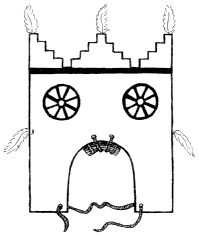
Figure 24.
Wooden head tablet worn by women,
showing pad which protects the head.
At Zuñi, a thin board terraced at the top is perched upright on a caplike base made of strips of deerskin sewn on one end to the bandeau and attached together at the crown of the head (pl. 10). This is worn by the Corn Maidens when they return to the village in their special ceremony, a ritual which originally took place every four years. This slender form is decorated with symbols of the sun, moon, and stars, and at the terraced top are two downy feathers. Small, geometric wooden forms of the various directional colors are set on the bandeau where the cross strips intersect.[89] In the Butterfly Dance of the Hopi, a dance performed by the Butterfly Clan,[90] who are said to have been prehistoric colonists from the Rio Grande pueblos,[91] a tablet similar to those of the east is worn by the women. However, among the Hopi the form is often elaborated, as it is made of many separate shapes each suggesting some symbolic form. These shapes are put together by means of pegs and buckskin thongs until they are built up to a mass which assumes very large proportions. The most familiar design elements employed are clouds,
butterflies, sprouting corn, and rain, and the bright colors are sharply contrasted. Black is frequently used to outline the separate shapes and to accent the divisions of various patterns.
Another common headdress is one which completely covers the top of the head. This is used mainly in dances requiring more elaborate impersonations. It may likewise be made on a base of deerskin with the decorative incorporation of horns, flowers, and feathers.
Closest to the mask forms, but without actually concealing the wearer, are the animal headdresses of the Rio Grande pueblos. They vary from the simple deerskin cap to which the horns have been applied, to the actual animal head (pl. 25) cured and with the horns intact. When the horn-ornamented deerskin cap is used, the long space from the neck to the waist is filled with sheaves of various feathers which are bid in series and accented with dotlike puffs of down (pl. 26).
Masks
The mask is the most individualizing and most highly developed article worn by the Pueblo actors in their prayer dramas. Through the various combinations of shapes, colors, and decorations used to distinguish one character from another, unlimited characterizations are possible.
The Indian believes that the spirit of the supernatural whom he portrays is incorporate in the mask which he wears, and that he takes on the personality of the god by assuming the god's mask. "The mask is one of the variable features that arise out of the spirit-traffic of primitive man. It is a sort of animated fetish through which he works magic and controls the spirits".[92] The Pueblo Indian dons the mask and becomes the transubstantiated kachina. He then proceeds, through the medium of the song and the dance, to offer prayers to the all-powerful spirits, entreating them to come to his aid. It is necessary that the mask conceal the identity of the
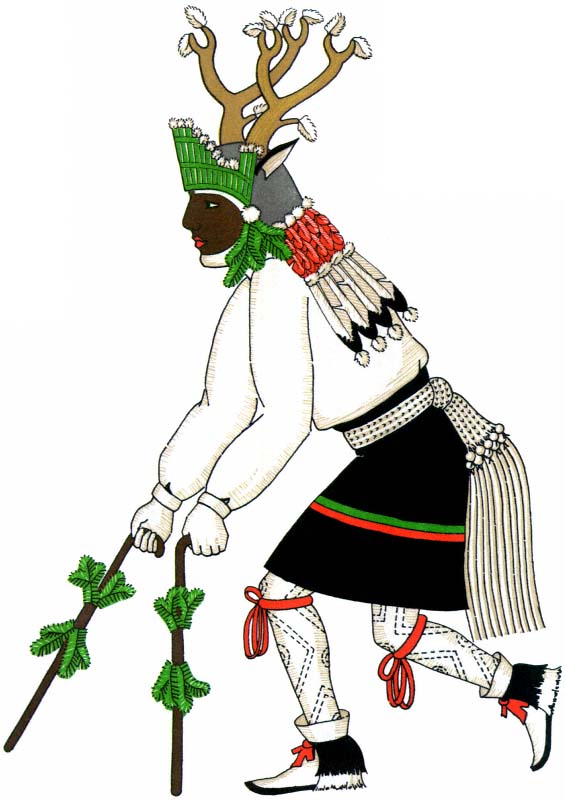
Plate 26.
Deer dancer, San Ildefonso. A step toward stylization; the
impersonator has put on conventional ceremonial dress.
actual person because that person is no longer believed to exist after assuming the personality of the god.
It cannot be learned whether the first mask was a strip worn over the face or a bag worn over the head. These two mask types may have originated simultaneously. It is a fact that at Zuñi the Kokochi, who is said to be the prototype of the earliest kachina, wears a half mask which consists of a simple strip of leather across the face (pl. 37). The myths say that he is the first-born of the "old dance woman;' the mother of the kachina. Her husband and her other nine sons become the Mudheads,[93] who are distinguished by their baglike masks of cotton cloth (pl. 40). Thus the contemporary affinity between the strip mask and the bag mask is established.
Half mask.
—We may begin, then, with the simple strip of leather, the half mask (pl. 11). It is deep enough to cover the face from hairline to mouth, and it reaches across the face from ear to ear. It was doubtless intended to conceal the features only, leaving the bangs and side hair of the wearer to cover the edges. Half masks seen today are made of pieces of heavy buckskin or rawhide, secured by thongs passing over and around the head. There are small slits for the eyes, and, around these, eye designs are painted with little regard to conformity with the slits. A bang is made across the upper edge with a thick fringe of horsehair or goat's hair. Across the lower edge is a strip of leather about two inches wide. Sometimes it is painted in blocks of black and white or in various colors, symbolizing clouds. From the under side hangs a long beard of shiny black horsehair which covers the mouth and chin of the wearer[94] and eliminates the need of a hole for breathing. This form of mask permits a dancer's voice to be heard clearly when he accompanies his movement with song. The removable beard is made of long strands of horsehair held in place by three cotton strings which are braided together between each strand or sewn to a strip of cloth. The beard can be tied in place by deerskin thongs provided on the inside of the leather half mask. Sometimes the smooth
black surface of the beard is broken by white downy eagle feathers hung from the lower edge of the mask by white cotton cords. The horsehair may be replaced by numerous small bunches of the tail feathers of many little birds. These feathers form a fringe about five inches deep across the bottom of the mask.[95] It splays out at the bottom and shows feathers of many colors as each bunch rises and falls with the movements of the dancer. In the center, hanging on longer cords beneath the fringe, are four or five additional bunches of feathers interspersed with white downy eagle feathers.
These half masks are often worn by female deities (pl. 38). The design on the lower borders, and the color, either white or yellow, distinguish the wearers from the male deities, who wear blue half masks.
Face mask.
—From this half mask to the face mask (pl. 12) was only a step. The simple strip of leather grew longer and was drawn under the chin with another and triangular piece of leather sewn into the gap. This mask, still depending upon the bangs and side hair of the wearer, has evolved into forms which closely approach realism. Sometimes simple lines of color suggest stylized features,[96] or a rolled piece of leather may be sewed on for a nose.[97] The more advanced forms display molded features, a nose with a flattened tip and wide nostrils, and lips fashioned with pleasing curves. The leather is molded while wet and allowed to dry in the desired form, then applied by tying with thongs through the mask itself.[98] Along the upper edge, horsehair is fastened to simulate the line of the hair. This 'wig; when pulled back, may be clubbed into a knot at the back of the head or allowed to hang free. In this form of mask the Indian has definitely progressed toward realistic features and actual human contours. His painting, however, lacks reality. There is little attempt at natural tones, there is no blending of colors, and the designs possess the flat, geometric quality characteristic of woven textiles and the surface of pottery. On the other hand, and in a contrary direction, by the use of this same form the Indian has accomplished caricature and extreme exaggeration
by the application of projecting snouts and bulging eyes, or horsehair beards, consistent, after all, with the fantasy of other Pueblo masks.
Helmet mask.
—The simultaneous use of his two forms of masks, the strip and the bag, suggested to the inventive mind a third form, the helmet (pl. 13). By elongating the strip to encircle the head and then giving it a top like the bag, he had a mask which could rest on his head and shoulders and completely conceal his face and hair while at the same time it would provide space for more elaborate appendages on the outside. In the western pueblos the helmet masks have tops which round up over the head. Those found in the Rio Grande pueblos are flat.[99]
The helmet masks are made of heavy deerskin, buffalo hide, old Spanish saddle leather with the tooled markings of the Continental craftsmen turned inside,[*] or cowhide purchased nowadays from the local trader. After the skin is prepared, it is buried for hours in coarse wet sand in order to make it soft. The wearer's head is then measured and a rectangular strip is cut long enough to go around it and deep enough to cover the face. A circular piece is cut for the top. These are assembled and sewed with deer sinew, which is twisted by rolling it against the thigh. The sewing is very difficult and must be carefully done with small and close stitches in order to avoid tearing. The wet form is tried on the wearer and shaped in conformity with the contours of his head. When it is removed, the inside is smoothed and shaped by working it with a stick. It is then placed in the sun to dry beneath the kiva hatchway opening. Mouth and eye holes are next marked and cut. The deerskin thongs are adjusted: one on either side to tie under the chin, four pairs around the base with which to tie a separate collar in place, a pair at the top and one at the back for feather ornaments, and one or two pairs on each side for eartabs or appendages. A size of kaolin is rubbed over each mask to fill the pores and make it smooth, and over this the colors are applied either by blowing them on or by painting with rabbitskin swatches.[100]
* There are two such masks in the Fred Harvey Collection in Albuquerque, New Mexico.
There is one other mask form, which depends upon a slightly rounded plaque of basketry (pl. 14). This mask is put over the face and held in place by thongs around the head. It is finished at the back by a piece of cloth or deerskin which is fastened to the edge from side to side, crossing the top and completely covering the head.[101] Banded by a braid of cornhusk, in the periphery of which horsehair and feathers may be set, this mask displays ingenuity and cleverness. Undoubtedly other methods of construction are possible. One is to make an elongated base of small twigs or yucca leaves and cover it with leather or cloth (pl. 30); another is to shape leathers into other forms, such as the conical mask from Jemez. This is fashioned from one large triangular piece of leather in which the two long sides are sewn together, covered with a braid of cornhusk, and set with eagle feathers. It has a single slit for the eyes and is placed on the head with the point high in the air.[102]
Ornamentation of masks.
—The secret of the changing personality of the performer is to be found in the ornamentation and the features applied to the masks. In the simpler forms the masks are constant, but they are always renovated before each dance and often are given a new character. The paint is scraped off and the appendages removed, new colors are applied, and snouts, eartabs, and ornaments are put on in conformity with what is prescribed by the dance to be performed and at the direction of the priest in charge of the ceremony.
The eyes of the mask are made by applying perforated leather circles (pl. 4), stuffed rims of leather or cloth, bulging wooden spheres, or cotton-stuffed knobs of deerskin (pl. 14). Mouths are made of jagged pieces of leather painted to suggest teeth, or braided cornhusk outlined with leather or fur. Snouts and beaks are made of corncobs or the round bodies or curved necks of gourds (pl. 13), or flat, round, or shaped pieces of wood or cottonwood root, all variously trimmed, cut, and painted to suggest
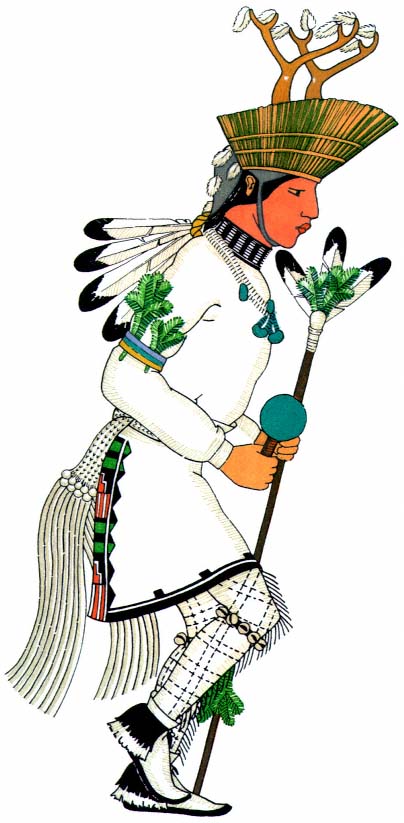
Plate 27.
Deer dancer, San Juan. The more conventionalized
forms result in further stylization.
teeth and lips. Snouts are often hollow, and this forms a resonance chamber for the actor, who as a kachina must voice no earthly sound. They may also be hinged to open and shut with a great clacking noise (pl. 7). Eartabs (pl. 4) are curved or square, large or small, of leather or wood. Their place is often taken by elaborate blossoms of colored yarn (pl. 9) or closed buds of painted wood edged with horsehair. Animal horns are pierced and fastened to the top of the mask, or imitation horns of the mountain sheep are ingeniously molded from deerskin (pl. 15); often substituted for horns are two matching gourd necks (pl. 35), or two slit ones, or two shaped strips of wood. The visors of the mask stand upright from the crown, or encircle the entire mask, or merely extend from side to side. They may be formed from crude strips of yucca bound together with braids of yucca cord,[103] or from neatly wound sections of coiled basketry[104] filled with kaolin and painted as a part of the mask (pl. 15).
Several masks have large terraced or scalloped tablets set upright over a helmet. A square opening is cut into the lower edge and this permits the tablet to fit down over the mask and be tied in place at the top and sides. These tablets are decorated with different painted designs and with ornaments of fluttering feathers and waving grasses (pl. 16).
Wooden ornaments are also used to enhance the decorative features of masks. Carved sticks are set vertically in the top, or zigzag strips, cut and painted to represent lightning, are fastened at the sides or upright at the back. The tops of the masks are covered with goatskin, horsehair, and various furs to simulate hair; evergreen to represent everlasting life; and raw cotton to suggest snow. The crown may be encircled with fillets of yucca leaves (pl. 24), twisted cornhusk, or spruce twigs.
Feather ornaments are numerous and are made in many different sizes, shapes, and combinations. Single tail feathers may be thrust through eartabs or tied upright at the back or sides, and downy white eagle feathers may wave from tablet points, visor rims, or topknots. One mask has eagle's down attached to the eartabs (pl. 15) so that the kachina may hear well;
"just as the downy feathers move in the slightest wind, so he can hear the smallest sound."[105] Long tail feathers are shaped into high, open fans standing upright at the back, or marching across the top from ear to ear, or forming a crest from front to back. Sheaves of feathers of various sizes, bound to a stick with wrappings of cotton cord, are sometimes fastened in a horizontal position at the top of the mask. One such sheaf is seen on the Salimapiya (pl. 5) as a special badge to denote the office of the wearer. Long, bright, parrot feathers, iridescent duck feathers, and gray-brown feathers of the sandhill crane are wound to a stick of sagebrush because "sagebrush is hard to get through and they want the Salimapiya to look dangerous."[106] Sometimes the head of a duck is mounted on the end of the stick. A similar ornament, utilizing the wing feathers of the eagle combined with white downy eagle and iridescent duck feathers fastened to a thin reed, is the "great feather" badge of the bow priest at Zuñi.[107] This is worn by warrior impersonators, and the direction in which the tips of the feathers point is believed to be prophetic. If they point backward the god will come in peace, but if they point forward he will come in a hostile mood. Other sheaflike ornaments are made of different feather combinations and tied upright at the side of a mask or at the back.
Very long feathers which project in opposite directions may be bound together in the center by their quill ends, and the joining covered by a bunch or topknot of small feathers. Or long feathers may be made to point at right angles to each other in four directions and the ends, curving upward, tipped with eagle's down. There are many loose pompons of small feathers (pl. 17), eagle's down, or the limber ends of larger feathers. Whenever the last-named are used, the ribs are slit and trimmed in order to make them quiver and dance in the breeze, or when the wearer moves in his routine dance pattern. These pompons are useful as topknots or as side or back ornaments, from which may rise a single feather or a gracefully fashioned sheaf.
Occasionally a crown of tall feathers, eagle or turkey, stands upright
from the fillet of cornhusk about the upper edge of the mask, or a horizontal stick (p1. 3) with a series of feathers projecting at an angie may be worn forward from the center of the head, giving to the wearer a pompous and regal mien.
Occult symmetry is skillfully handled by the artistic Indian craftsman. For example, he places a long, pointed blue horn with a single fringe of black horsehair on one side of a mask, and balances it with a round, flat eartab of white broken by a horizontal black line, the whole completely surrounded by heavy fringes of horsehair in gleaming black. By carrying the black horizontal line of the ear across the mask to the eye, he is able to offset the simple square of the other eye, the blank space of vertical white, and the horizontal length and accent of color in the horn (pl. 3). The Indian uses the pointed bud of the Jimson weed (Datura stramonium ) in the same manner. It sticks out on one side of a mask surrounded by red, dyed horsehair and is balanced by the heavily accented vertical line of two tall eagle feathers tied to the other side (p1. 13). Rarely, this symmetry is achieved by the use of color alone.
Unsymmetrical patterns, however, are not the usual forms. Bisymmetrical design is more common and can be seen in painted features or applied appendages. Variety is often obtained by the interchange of colors in exact space relations, as in the Humis mask, on one side of which the large, turquoise blue square is outlined in black and earth red while on the other the earth-red square is outlined in black and turquoise (pl. 16).
Small decorative designs painted on the masks may have a definite symbolic relation to the characterization. An example is the black chevron of the birds of prey (p1. 24) or the spots of color on the Zuñi Fire God. However, these designs are ordinarily nothing more than decorative pictures of rain, clouds, lightning, corn, frogs and tadpoles, bird tracks, feathers, or any number of other things executed in stylized form on pottery and altar slats as well as on masks. All these painted forms have their origin in the dependence of the Indian on the natural elements,
sunshine and rain, for the germination and maturity of the corn and other vegetation. In some way each design is concerned with the constantly revolving pattern of life and the symbolism connected with it; the general and not the specific need is stressed.
On the masks of individual gods certain designs appear as marks of decoration and association rather than as symbols of characterization and identification. Often butterflies, frogs, dragonflies, and flowers are painted on the blank spaces just to make them pretty.
Noticeably ingenious and original is the manner in which the lower edge of the helmet mask is handled. Seldom is the appearance crude or unfinished. The desired elaboration is often accomplished by the use of those animal pelts which are plentiful, especially gray fox (pl. 29), coyote, mountain lion, rabbit, and goat; or great collars of evergreen (pl. 17) or feathers (pls. 5, 24) are used, which are effective but more difficult to construct. Occasionally a scarf of dark, native cloth, or an embroidered dance kilt is draped over the shoulders and fastened in front. A collar characteristic of Zuñi is a large roll of leather stuffed and painted either in a solid color or in black and white stripes (pl. 3). This same identifying feature is displayed on many Hopi masks the origin of which can be traced directly to Zuñi.
Sometimes the horsehair beard is used on the helmet mask; it then hangs down over the collar (pl. 35). On this kind of beard as used by the Hopi and the Zuñi are found horizontal strips of kaolin or eagle's down, stuck in place with yucca gum. Jemez displays beards of the hair of buffalo and bear, the latter with the center stained red.[108]
It is among the Hopi and the Zuñi that the craftsmanship and artistry of the Pueblo masks reach their highest development. Masks made in the villages of the Rio Grande are, by contrast, primitive, and lack variety.
The Indians hold in great reverence a certain type of sacred mask which, they believe, have been given them by the supernaturals. This
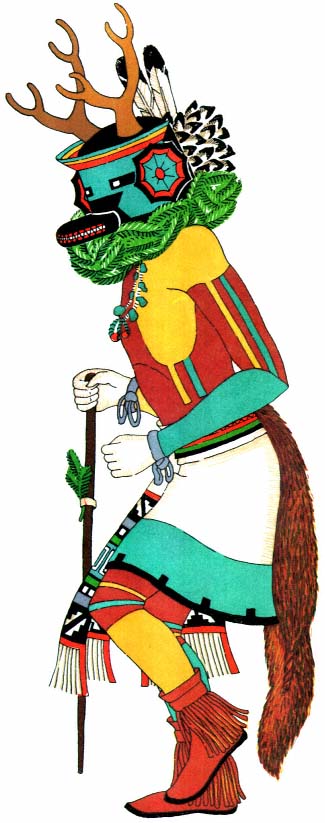
Plate 28.
Deer dancer, Hopi. Complete stylization.
mask is owned by a clan and is handed down from one generation to another. To the household which keeps it, it is supposed to bring a sacerdotal distinction because of its power, and an eminence because of their knowledge of the secret rituals which concern it. Such masks are stored in sealed jars and are very carefully handled. They are considered 'dangerous' and must not be touched by those who are not in possession of their secrets. Although the masks may be renovated and redecorated, the individual characters which they depict are believed never to change.
Another type of mask is made for an individual and is owned exclusively by him. At Zuñi it is thought of as "his personal fetish so long as he lives, and is his guarantee of status after death."[109] Whenever a dance is performed, these masks are redecorated and made over into the likenesses of other supernaturals. In order that he may be able to take part in whatever dance is being performed, a man of standing owns several of these masks, one of each form. The masks are made by the priest, usually the kiva head, and his assistant, and they are made inside the kiva, where all their work is done. After the first ceremonial appearance of the mask, it may be taken home by its owner, and thenceforward it becomes his most prized possession. It is always treated with reverence and is kept in secret in the back room of his home. It is put on and taken off with the left hand only. If it needs to be renovated, he carries it to the kiva and does the work there.
There are two other masks, and they go a step beyond the scope of normal impersonation, becoming doubly effective because of their great stature and impressive bearing.[110]
At Zuñi there are six Shalako who are believed to be the messengers of the gods (pl. 7). They appear for the one great ceremony, the culminating event in the annual cycle of rites observed by the kachina priests. This occurs shortly after the winter solstice. Each of these giant figures is ten feet high. His huge blue mask, scaled to his size, has a long, hinged snout which clacks and clatters when operated by strings controlled by
the wearer. The great, bulging, black and white eyes stare unblinkingly at the world. On each side of the mask is a long blue horn tipped with a downy red feather. A large fan-shaped crest of eagle feathers spans the head, and standing upright behind it is a sheaf of brilliant orange macaw feathers combined with downy white eagle feathers. The wig is of shiny black horsehair banged at the forehead, bobbed at the sides, and hanging down at the back with three puffs of eagle's down at intervals. The body, made on a series of hoops, is covered with two of the white ceremonial robes, a skirt and a mantle. A white embroidered kilt covers the top section, and two foxskins encircle the 'throat' below the ruff of glossy ravens' feathers. The tails of the foxskins serve as 'arms.' "The effigy worn by the Shalako is so ingeniously arranged that the wearer has only to step under the hoopskirt structure and carry it by a slender pole, which is supported by a piece of leather attached to the belt. The top of the blanket skirt has a triangular opening through which the bearer of the effigy sees."[111]
This same Shalako figure has been introduced from Zuñi to the Hopi. It is possible that the more ingenious western artists went further and produced a goddess who accompanied the Shalako god. In the Laboratory of Anthropology at Santa Fe there is a fine example of an antique head with the elaborate headdress of such a female effigy (pl. 18).[112] This head was no doubt carried above an impersonator and dressed in a feather robe with a white ceremonial mantle about its 'shoulders; and adorned with many strings of beads about its 'neck'.[113] "The tablet represents terraced rain clouds ... the object with bifid tips on each side of the tablet represents the squash blossom, symbolic of maidens' hair dress. Across the forehead is a symbol of an ear of corn, with two feathers attached to each end. ... There are imitation flowers made of wood represented in the hair."[114] Each part of the tablet is separate, and it is either pegged to the main form or tied together with thongs.
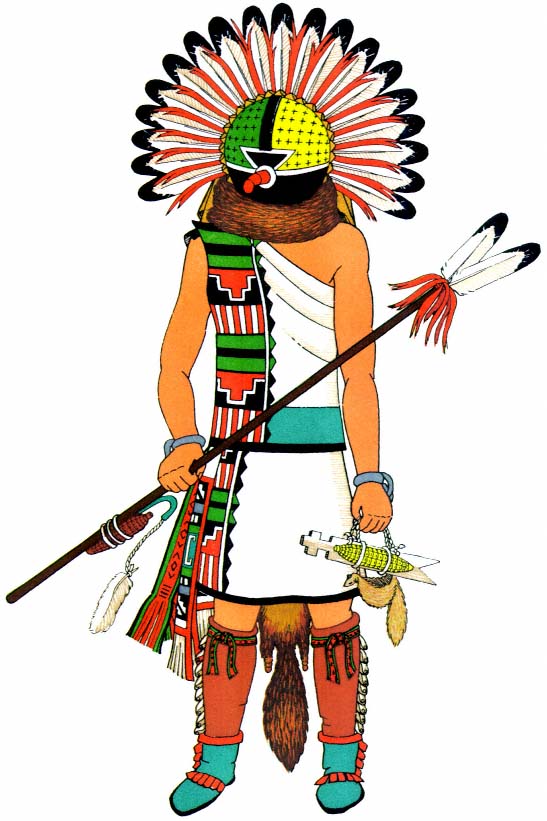
Plate 29.
Ahül, the Sun Kachina, Walpi, Hopi. Radiating
eagle feathers represent the rays of the sun.