
One
The Lasky Company and Highbrow Culture: Authorship Versus Intertextuality
The Consumption of Culture: Highbrow Versus Lowbrow
When Cecil B. DeMille decided to abandon an unspectacular stage career for filmmaking in 1913, he was undeterred by the low repute of one-reelers associated with workers and immigrants in storefront nickelodeons. Such a rash move, however, prompted his older brother, William, a celebrated playwright, to react: "You do come of a cultivated family . . . . I cannot understand how you are willing to identify yourself with a cheap form of amusement. . . which no one will ever allude to as art. Surely you know the contempt with which the movie is regarded by every writer, actor and producer on Broadway." William's condescending attitude toward motion pictures was not unrehearsed. Previously, he had corresponded in a similar vein with Broadway producer David Belasco when Mary Pickford, who had appeared in one of his father's well-known plays, abandoned the stage. The playwright was so contemptuous of films that not even curiosity could induce him to enter a nickelodeon to see one-reel adaptations of his own works.[1] Cecil had the last word, however. A year after the formation of the Jesse L. Lasky Feature Play Company, William himself succumbed to the lure of motion pictures as a new democratic mode of expression. What led to this dramatic reversal of convictions regarding the nature of cinema? What role did Cecil play in persuading not only his playwright brother but respectable middle-class consumers that film was indeed an art form? To put it another way, what intertextual relationship existed during the Progressive Era between the legitimate stage and early feature film as a photoplay?
Adolph Zukor, president of the Famous Players Film Company, commented on successful stage productions as a standard for filmmakers when
he affirmed in a trade journal: "The moving picture man must try to do as artistic, as high-class, and as notable things in his line of entertainment as such men as . . . Charles and Daniel Frohman were doing in high-class Broadway theatres."[2] A chapter in film history that has yet to be thoroughly investigated, the legitimate theater rather than vaudeville served as a model for the production of feature film exhibited in movie palaces. A mode of representation intended to legitimate cinema for "better" audiences, multireel film adaptations of stage plays constituted a significant industry development that requires a study of the intertextuality of cultural forms in the genteel tradition. Although motion pictures were most likely patronized by the lower- as opposed to the upper-half of an expanding middle class before World War I, filmmakers like DeMille developed representational strategies for sophisticated audiences conversant with highbrow culture.[3] Pivotal to the success of the Lasky Company was exploitation of the well-known DeMille family name, for it had been associated with the celebrated stage productions of impresario David Belasco. Indeed, DeMille's contract stipulated that he would obtain the motion picture rights to the "plays and scenarios. . . controlled by the. . . DeMille Agency [his mother's company] and the . . . DeMille Estate."[4] Consequently, the director's arrival on the West Coast was part of a wholesale importation of Broadway producers, actors, playwrights, art directors, and music composers to legitimate cinema as art. The production of feature film adaptations was thus based on the name recognition of established writers and stage artists as signifiers of cultural legitimacy. Such an emphasis upon intertextual modes of address, however, rendered the question of early film authorship problematic, a dilemma that was resolved once cinema achieved recognition as an art form in its own right.
Understanding DeMille's contribution to the legitimation of cinema and of film authorship first requires a consideration of American cultural practice in relation to class dynamics during the late nineteenth and early twentieth centuries. Concepts of cultural hierarchy that pervade our thinking today, as Lawrence W. Levine argues, did not always exist. For the first half of the nineteenth century, a fairly homogeneous American audience enjoyed such art forms as Shakespearean theater and Italian opera as "simultaneously popular and elite." Shakespeare was thus not infrequently "presented as part of the same milieu inhabited by magicians, dancers, singers, acrobats, minstrels, and comics."[5] Similarly, museums displayed "Indian arrows, mammal bones, [and] two-headed pigs alongside casts of Greek sculpture and paintings by Gilbert Stuart and Thomas Sully."[6] Such cultural juxtapositions, seemingly incongruous today but for the intervention of postmodernism, were emblematic of a social formation that had receded into the past before the Victorian era drew to a close. During the latter part of the nineteenth century, American culture was subject to a process of sacralization accelerated by an increasingly professionalized cul-
ture industry and by the impulse of the genteel classes to distance themselves from urban workers and immigrants. Although the differentiation of cultural consumption according to class was an urban phenomenon that also occurred in Europe, the legacy of evangelical Protestantism and a more secularized Unitarianism predisposed the American patrician elite to recast culture in moral and didactic terms. Furthermore, the influence of Matthew Arnold, who emphasized a perpetual striving for self-improvement in pursuit of human perfection, was not only considerable but had strong religious overtones. Arnold's concept of culture as a force that could transcend individual and group differences was severely tested, however, as the urban scene became increasingly pluralistic. American intellectuals, already concerned about the debasement of cultural forms by the middle class, were undoubtedly alarmed by the practices of the lower orders. As the consumption of culture became an expression of class and ethnic hierarchies, the genteel classes not only attempted to reform the recreation of the lower classes but also mapped out a cordon sanitaire for their own forms of conspicuous leisure. Consequently, performances of Shakespeare, opera, and symphonic music for the edification of the elite were elevated above popular entertainment. A sign of the increasing fragmentation of cultural production, the term "legitimate" denoted stage plays enshrined in the pantheon of art as opposed to cheaper amusement such as vaudeville, burlesque, and the circus. Pursuit of recreation and leisure became part of social practices that reinforced class and ethnic lines as the mid-nineteenth-century model of a harmonious civic culture receded into the past.[7]
The differentiation of American culture into highbrow and lowbrow—originally phrenological terms based on cranial shapes to equate racial types with intelligence—occurred at a time of demographic change associated with rapid industrial and urban growth. Unprecedented immigration from southern and eastern Europe, which crested in 1907, resulted in a more heterogeneous population in bustling American cities. The arrival of large numbers of seemingly unassimilable immigrants, especially Italians and Jews, and labor unrest culminating in the Haymarket riot and the Homestead and Pullman strikes were interrelated developments that sparked a revival of nativism. Characteristically, the response of the Anglo-Saxon elite to the centrifugal forces of a market society resulting in fragmentation was to impose cultural and moral order. As arbiters of good taste, they established the canon of legitimate theater, music, and art; validated modes of representation; and dictated audience reception that was respectful. Cultural refinement thus became part of a distinctive style of living in which ritualistic attendance at theaters, concert halls, and museums represented a sign of gentility vis-à-vis urban workers and immigrants.[8]
Since the genteel middle class defined its social identity in terms of its cultural practice, film entrepreneurs intent on escaping the lower-class stigma of storefront nickelodeons were determined to upgrade both
production and exhibition. Significantly, their effort to uplift motion pictures coincided with that of the custodians of culture who were motivated by a sense of Progressive reform and moral rectitude. Although historians disagree about the nature of the relationship between these two factions, the attraction of cinema as entertainment for workers and immigrants influenced reformers to establish mechanisms of censorship and to regulate exhibition practices restricting the industry.[9] Ultimately, film magnates, pursuing respectability as well as profit, and Progressive reformers, intent on mediating film spectatorship to educate the urban masses, were at cross-purposes. Whereas the self-appointed elite struggled against the erosion of their authority through a process of sacralization to reinforce the status quo, profit-driven film entrepreneurs developed economic practices, such as vertical integration of the industry, that resulted in an increasing homogenization of cultural production if not reception. As filmmakers like DeMille exploited the genteel tradition to legitimate cinema, cultural forms became more interdependent and less amenable to concepts validating hierarchies of aesthetic modes. Within this context, the accelerating growth of the leisure industry meant that class and ethnic divisions reinforced by cultural consumption became less distinctive with each succeeding decade. What emerged, therefore, was a significantly different basis for a homogeneous population than had existed in mid-nineteenth-century civic culture. As opposed to a sense of community based upon shared commitment and moral values, twentieth-century popular culture represented the homogeneity of democratized access to commercialized amusement—specially as a form of visual appropriation—if not to actual consumer goods like tableware and furniture signifying upward social mobility.[10]
Texts and Intertexts: a Question of Authorship
The Jesse L. Lasky Feature Play Company, cofounded by former vaudeville producer Lasky, his brother-in-law and glove salesman Samuel Goldfish (later Goldwyn), attorney Arthur S. Friend, and DeMille, was quick to announce its strategy to upgrade cinema for respectable middle-class audiences. As Motion Picture News reported in December 1913, the production company would film adaptations of "familiar novels and plays for presentation on the screen."[11] Although the company was named after Lasky because he was the best-known of the four cofounders, DeMille's theatrical legacy represented cultural capital that could immediately be exploited. Adolph Zukor, who merged his Famous Players Film Company with the Lasky Company in 1916, recalled that the DeMilles were "so closely associated with the stage that he was surprised Cecil. . . was becoming associated with the screen."[12] A Photoplay writer anticipated Zukor's reaction in 1915: "For more than a generation the name of DeMille has been closely linked
with that of Belasco, both synonymous with high altitudes of dramatic art. Consequently when the first DeMille turned to the screen there was marked the beginning of a new epoch in film annals."[13] A beneficiary of the cultural legacy established by his father and brother as well-known playwrights, DeMille quickly attempted to validate his authorship in a related new medium. Problems that he encountered resulted from the questionable status of motion pictures compared then to more traditional forms of genteel culture. Although the director was able to establish the validity of his signature within a relatively short period of time, narrative and marketing strategies that exploited stage and literary works proved at first to be a mixed blessing.[14]
Consider, for example, DeMille's first three releases, The Squaw Man (1914), The Virginian (1914), and The Call of the North (1914). All were adaptations of stage Westerns that, in the last two instances, were in turn adapted from novels written by Owen Wister and Stewart Edward White, respectively. A fourth feature, What's His Name (1914), was a domestic melodrama based on a minor work by George Barr McCutcheon, a best-selling author whose earlier fiction had been successfully adapted as stage plays and feature films. Significantly, the credits of all four features attribute authorship to well-known writers, whereas DeMille is only acknowledged as having "picturized" the screen version. Not until his fifth feature, The Man from Home (1914), an adaptation of a Booth Tarkington and Harry L. Wilson play about American innocents abroad, did DeMille begin to identify himself in the credits as a producer equivalent to the Belascos of the stage. But his claim to authorship remained tenuous until the industry ceased to foreground writers, signifying cultural legitimacy, and represented cinema as the artistic expression of the director.
Credit sequences of early Lasky Company features illustrate the extent to which novelists and stage actors rather than directors were privileged as film authors. An intertitle in The Call of the North , for example, reads "Mr. DeMille Presents the Cast to Stewart Edward White," author of The Conjuror's House , a novel previously adapted for the stage by George Broadhurst. DeMille is seated on the extreme left, at times practically out of the frame, whereas White, seated prominently in the center, meets the costumed actors who represent the characters he invented in his novel. Robert Edeson, the Broadway actor starring in the dual role of Canadian frontiersmen, père et fils , is introduced last, turns to his left, and shakes the hand of his creator. In What's His Name , trumpeted as an adaptation of "The Celebrated Novel by George Barr McCutcheon," Lolita Robertson and Max Figman emerge on screen as poster board characters who come to life. Figman, interestingly, bows to the audience as if he were acknowledging applause on stage. Dustin Farnum, hero of the stage version of The Virginian , claimed that he was criticized for prostituting himself in the film adaptation of The Squaw Man ,
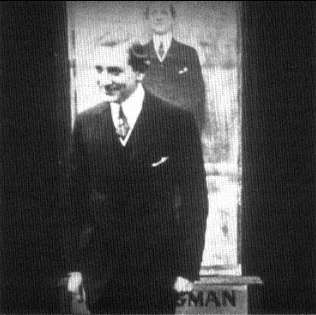
1. Broadway actor Max Figman bows to the audience as if
he were taking a curtain call in the credits of What's His Name,
an adaptation of the novel by George Barr McCutcheon ( 1914).
(Photo courtesy George Eastman House)
but a succession of theatrical stars, including Ina Claire, Marie Doro, Fannie Ward, Charlotte Walker, Theodore Roberts, Thomas Meighan, and Elliott Dexter appeared in DeMille's early features and became part of the Lasky studio's equivalent of a stock company. Since the appearance of Broadway actors on screen was considered a noteworthy event, trade journals regularly publicized the recruitment of theatrical stars who signed contracts with film studios. In March 1914 Photoplay claimed that more actors were abandoning the stage to appear in motion pictures on a permanent basis, a sign of the growing financial profitability as well as increasing cultural legitimacy of the cinema.[15]
The authorship of early film adaptations constructed as intertextual modes of address is an issue complicated by the role of talent behind the camera as well as publicity accorded writers and stage stars. When DeMille boarded a train to film The Squaw Man on the West Coast, he had never before directed a motion picture and was thus accompanied by filmmaker Oscar Apfel. Calling attention to this event, the New York Dramatic Mirror headlined, "Oscar Apfel to Direct Company Leaving for Pacific Coast
Soon," and described the director in a follow-up article as "well-known in film circles." Previously, Apfel had enjoyed a successful theatrical career as stage manager and director of several stock companies and worked with Belasco's assistant director, Will Dean. After leaving the theater, Apfel had also written and directed scores of motion pictures for the Edison Manufacturing Company, the Mutual Film Company, and Pathé Frères Film Company. According to Robert Grau's characterization of the struggle of independent film producers against the Motion Picture Patents Company, which was declared in restraint of trade in 1917, Apfel's Reliance productions for Mutual "contributed more to the 'Independent' cause than any single factor one max, name."[16] The Lasky Company had thus recruited a considerable talent for its first filmmaking venture, but DeMille fortunately proved to be a quick study.
A consideration of The Squaw Man illustrates some of the basic filmmaking techniques that DeMille learned from Apfel, credited as codirector. Adapted from Edwin Milton Royle's stage play (1905) and starring Dustin Farnum, the film was a melodrama in the tradition of dime novels about the Wild West and foregrounded issues regarding class, ethnicity, and gender. Apfel and DeMille adroitly used parallel editing[17] to narrate the adventures of Captain James Wynnegate (Farnum), British aristocrat turned cow-puncher, who settles on the frontier after assuming blame for a crime committed by the husband of the woman he secretly loves. As evident in The Squaw Man , Apfel's filmmaking style was technically advanced and distinguished by composition for depth, a high ratio of medium shots, camera movement for teframing, parallel editing, eye-level shots with occasional use of high angle and even reverse angle shots, superimpositions and split-screen effects to show a protagonist recalling past events, and intertitles as exposition and dialogue, all characteristic of DeMille's early features. Significantly, the use of low-key lighting effects in night scenes with a fireplace or a match as naturalistic light sources are not as dramatic as in later DeMille films that would benefit from the expertise of Belasco's former set designer, Wilfred Buckland. Yet such lighting is used in two scenes to convey intimacy in Jim's tabooed relationship with an Indian chief's daughter, Nat-u-ritch (Red Wing), and thus prefigures the way in which DeMille typically constructed mise-en-scène to express moral dilemmas. Indeed, the director's striking use of "contrasty" lighting in a succession of feature films not only achieved product differentiation for the Lasky Company but also contributed to recognition of his own claim to authorship.
The reaction of enthusiastic film critics, who recognized Apfel's work when The Squaw Man was premiered in New York, must have been instructive for DeMille as he sought to establish himself as an author in his own right. Aside from this first acclaimed Lasky Company film, the director's collaborations with Apfel were never listed as titles in his filmography. Apfel
continued to direct features as one of the studio's stable of filmmakers but was soon eclipsed in reputation by his apprentice. Probably, DeMille, who was extremely competitive with his brother William, was not predisposed to advance the career of yet another rival. At the beginning of its history, however, the Lasky Company profited from Apfel's mastery to establish a reputation for quality film with its very first release. A Moving Picture World critic who admired The Squaw Man claimed, "I have not seen Oscar Apfel's name made prominent in connection with this winner, but I recognize his handiwork without difficulty." The New York Dramatic Mirror tactfully stated, "As director-general, we presume the first credit for a skillfully directed drama belongs to Cecil B. DeMille, but this need not detract from the honor due Oscar C. Apfel, who, we understand, bore the brunt of the actual work." Indeed, a photograph taken on December 29, 1913, the day shooting commenced on the film, shows Apfel in command as director while DeMille is standing unobtrusively with cast and crew. One account of the production attributes camera angles and editing to Apfel and acting direction to DeMille.[18] Such a division of labor is feasible given noticeable contrasts between The Squaw Man , a collaborative work, and The Virginian , DeMille's third release, second feature, and first solo effort. An adaptation of Owen Wister's acclaimed best-seller about a Westerner (Dustin Farnum) who delays his marriage to an Eastern school teacher (Winifred Kingston) for a shootout, The Virginian is the most technically flawed of the director's early features. DeMille violates screen direction in editing several scenes, represents contiguous space in separate shots that are awkward with respect to scale and direction, makes erratic use of fades, and has a lower ratio of medium shots for intimate scenes such as one in which the Virginian bids farewell to a friend about to be hanged for cattle rustling. DeMille's later features, especially Carmen (1915), were reedited as reissues, but such was apparently not the case for this Western. Yet The Virginian does feature dramatic low-key lighting effects, as in nighttime campfire scenes repeated in The Warrens of Virginia (1915)—a Civil War saga based on William deMille's play—which are absent in The Squaw Man and most likely attributable to the genius of Belasco's set designer, Wilfred Buckland.
Although DeMille boasted, "I brought the whole Belasco crew out here . . . the men who had made the Belasco productions great," he attributed Buckland's recruitment as art director to the persuasive powers of his mother, Beatrice DeMille.[19] She was able to capitalize on professional ties dating back several decades because Buckland had acted in her husband's play, The Main Line (1886), and taught makeup at the American Academy of Dramatic Arts, where he counted Cecil and William among his pupils and had himself studied under Belasco.[20] Acclaiming him as a "decorative artist and an electrical expert in stage lighting," Moving Picture World announced his move to Los Angeles in May 1914 in a piece titled "Getting
Belasco Atmosphere."[21] Because Buckland's arrival at the West Coast studio coincided with the use of low-key lighting in campfire scenes in The Virginian , DeMille's attempt to establish his authorship was still problematic. But "Lasky lighting," also labeled "Rembrandt lighting," became the most distinctive if not dramatic aspect of the director's visual style before the First World War. Although Buckland served as art director until 1920 when set and costume design became decidedly more outré, DeMille in all likelihood proved himself to be once again a quick study. Scripts of the early feature films include details about the use of lighting effects, occasionally in the director's own handwriting. As he later recalled, cameramen were rated at the time according to "how clearly you could see under the table. . . how clearly you could see the back corner of the room—both corners . . ." Undeniably, the filmmaker's rapid progression from flat, uniform lighting that flooded the entire set, to modeled lighting with highlight and shadows that could be attributed to naturalistic sources, to dramatic low-key lighting that was combined with color tinting were technical advances reinforcing his claim to authorship.[22] DeMille never ceased to acknowledge Buck-land's contribution, however. Studio correspondence attests that he was personally involved in the art director's salary negotiations in the midst of the Famous Players-Lasky merger.[23] At the end of his decades-long career, he still observed: "Buckland is a man who has not been given credit that he deserves . . . . Belasco's productions were something nobody in the world could equal, and that was because of Buckland."[24]
At the time that Buckland abandoned the legitimate theater, the Lasky Company was still exploiting audience perception of stage and screen as intertexts by negotiating for the rights to Belasco's plays. Moving Picture Worm touted an industry coup by announcing "the greatest tour de force of the season": "Lasky Gets Belasco Plays." According to Goldwyn, DeMille's family connections with Belasco were useful in outbidding Adolph Zukor's Famous Players in negotiations with the Broadway producer.[25] Given Belasco's stature, the significance of the Lasky Company acquiring the rights to his plays cannot be minimized. Belasco pontificated on the occasion: "The main feature of my agreement with Mr. Lasky and his company is their promise to put my plays on film in a manner befitting their success and reputation." Apparently reversing an earlier opinion regarding the cultural legitimacy of cinema, the producer shrewdly realized that motion picture rights would provide lucrative income after a stage play had completed its engagement and exhausted its stock company value. The transaction was worth one hundred thousand dollars.[26] For its part, the Lasky Company proved adept in exploiting the coup to attract middle-class patrons of the legitimate theater to its films. Ads in trade journals emphasized the intertextuality of stage and film productions in order to influence exhibiting practices and thereby audience reception. For example, an ad for
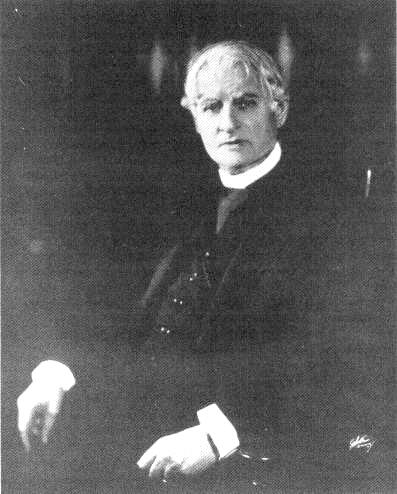
2. Broadway producer David Belasco wearing his everyday attire,
a clerical collar. (Photo courtesy Brigham Young University)
DeMille's first Belasco adaptation, Rose of the Rancho (1914), set in California after the Mexican War, trumpeted "Jesse L. Lasky in association with David Belasco presents. . ."
Such billing was not lost on DeMille, attempting to assert his own authorship, as he learned to model his persona after Belasco's. Although the director succeeded in dictating details about the display of his name when he achieved status as an author two years later, the marquee value of
Broadway personalities was then unquestioned. Ads for The Warrens of Virginia thus featured Belasco as producer of the stage hit and William deMille as playwright. Underneath and in smaller letters, Cecil was identified as film director. But events in early film history, including the legitimation of cinema in relation to the stage and as a separate art form, developed very quickly. By 1916 the announcement of Lasky's acquisition of the rights to additional Belasco plays was buried at the bottom of a page in Moving Picture World . By 1918 Photoplay was contemptuous of Belasco's judgment that stage drama was superior to the screen and described "this greatest of American producers" as "speaking in ponderous generalizations of things concerning which he has, obviously, almost no knowledge."[27]
As filmmakers who relied upon intertexts to address educated middle-class audiences, DeMille and Lasky initially considered scriptwriting to be the key to success. During his first year in Los Angeles, DeMille wrote to Goldwyn, who dealt with distribution and exhibition in the company's New York office: "I had always thought. . . that if the same technical and dramatic knowledge were applied to the scenario as to the play, the result would go far toward raising the standard of the photoplay." Similarly, he stated in an interview two years later, "If the scenario were written with the same care that is given to the writing of a drama, and were produced with. . . care and thought . . . . it would create an absolutely new clientele for motion pictures." When the West Coast studio was reorganized in 1915, Lasky announced, "We paid particular attention to the scenario department. . . [it] wholly controls the whole situation for the producer."[28] At the very least, DeMille must have been aware that his own assertion of authorship depended on his control of the scriptwriting process. A significant development occurred, therefore, when his brother William agreed late in the previous year to become the first head of the newly organized scenario department. The New York Dramatic Mirror reported his defection from the legitimate stage in September 1914: "Some surprise was caused [because] deMille. . . was one of the great playwrights of the decade and at the hey-day of his success on the stage." Shortly after he arrived at the studio and was cast as an extra in Rose of the Rancho , William wrote to his wife about his new craft: "There is very much to be learnt about the structure of a scenario . . . . It is very tricky work and requires absolute concentration."[29] Assisted by former New Yorkers who had also abandoned the stage, namely Margaret Turnbull, a novelist and playwright with whom he had collborated, and her brother Hector Turnbull, a former drama critic of the New York Tribune , William quickly wrote several scripts. As part of a public relations effort to promote screenwriting, he even exploited his affiliation with his alma mater, Columbia University. The Lasky Company supported the institution's decision to establish a special course of lectures on filmmaking by announcing a scholarship for the student who wrote the most original scenario. With
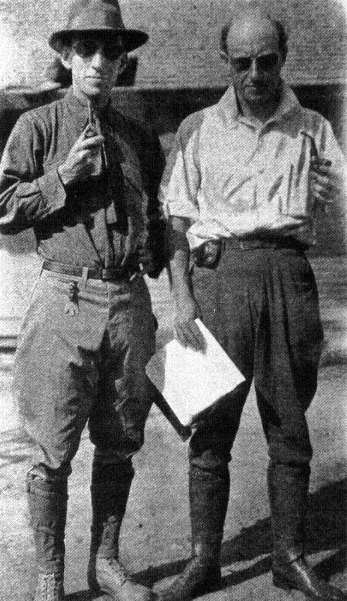
3. DeMille, on the right, and his brother, William, dressed as
adventurers in their early days at the Lasky studio in Hollywood.
(Photo courtesy Brigham Young University)
respect to film authorship, however, William quickly surmised, as did Lasky, that the role of the director was pivotal despite movie ads trumpeting Broadway names. Several months prior to the Lasky Company's merger with Famous Players, he stated, "really good directors in this game are worth almost any amount," and renounced writing in favor of directing. Although Lasky wrote to Goldwyn, "I have been concentrating on. . . directors and scenario writers," he also concluded, "the fate of a picture is so much in the hands of the director, even though the scenario department turns out first-rate scenarios."[30]
A bold move to consolidate feature film production for middle-class audiences, the merger—contemplated in 1915 but negotiated a year later— strained an understaffed scenario department but demonstrated the astuteness of focusing on screenplays to upgrade films. When DeMille wired that his scriptwriting methods were being undone in the midst of reorganization, Lasky, now headquartered in New York, countered that he was overwhelmed because Famous Players lacked not only a scenario department and a backlog of scripts but positive reviews of recent releases. By contrast, the Lasky Company had been in a strong position to negotiate favorable terms for the merger. According to Lasky, "I always claimed we made better, if fewer, pictures than Famous Players in the early days." Indeed, DeMille had boastfully written to Goldwyn during his first year on the West Coast, "I can make Zukor productions for you in three weeks; in fact I will guarantee to turn you out a half a dozen 'Eagle's Mates' [a Famous Players film] weekly."[31] Under pressure to consolidate and streamline the newly formed corporation, Lasky, who assumed the role of vice-president under Zukor, named Hector Turnbull as head of a scenario department relocated in New York. Although the executive remained committed to producing high-quality films, he was impressed with Famous Players' cost-cutting practices, if not its organization, and quipped to DeMille, "my slogan is 'Dividends first and art second.' Or rather a blend of the two."[32]
As the Lasky Company and Famous Players demonstrated even before their well-publicized merger, the cultural legitimacy of feature films meant increased profit. And as the cinema became increasingly recognized as an art form in its own right, DeMille began to assert his claim to film authorship. On this subject, Lasky sided with his director-general and explained to Goldwyn a year prior to the merger:
Cecil showed me a copy of a letter he had written to you on publicity for himself. It seems that this has been in his mind for some months . . . . Cecil has proved his value to the firm in many ways and. . . there can be no question of his loyalty to us. That being the case, I think it a very good business move for us to build up his name as we are trying to build up Blanche Sweet's name. You know the public go to see a Griffith production, not because it may have a star in the cast, but because Griffith's name on it stands for so much. It seems to me that the time has come for us to do the same with Cecil's name. If we
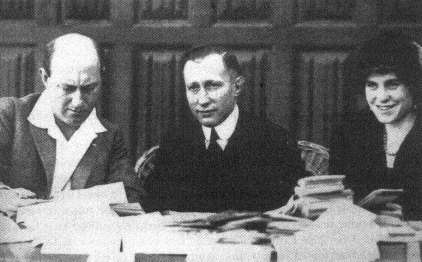
4. Casually dressed as director-general of the studio, DeMille confers with executive
Adolph Zukor and scriptwriter Jeanie Macpherson. (Photo courtesy Brigham Young University)
can accomplish this, we could let Cecil stage the plays that have no stars and his name in large type on the paper, advertising, etc., would undoubtedly in time take the place of a star's. In a word, he is the biggest asset we have, so let's use it for all it is worth.[33]
But before DeMille's reputation as an auteur eclipsed the stars in his productions, the arrival of Metropolitan Opera soprano Geraldine Farrar resulted in extraordinary fanfare for the debut of a spectacular leading lady.
Geraldine Farrar: A Diva Comes to Hollywood
A year before merging with Famous Players, the Lasky Company advanced its strategy to exploit the congruence of cultural forms in the genteel tradition by focusing on the intertextuality of feature film and grand opera. A standard exhibiting practice for releases distributed through Paramount at first-run theaters was a balanced program that included the engagement of an orchestra and vocalists to perform operatic music before and after screenings. At the Strand Theatre in New York, for example, audiences who attended screenings of DeMille's comedy Chimmie Fadden (1915) heard the overture from Cavalleria Rusticana , a duet from La Forza del Destino , and the sextet from Lucia di Lamermoor .[34] Considerable publicity was thus generated
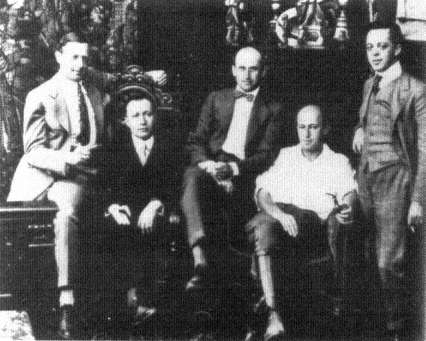
5. DeMille poses with Jesse L. Lasky, Adolph Zukor, Samuel
(Goldfish) Goldwyn, and Albert Kaufman after the Famous
Players-Lasky merger. (Photo courtesy Brigham Young University)
when Geraldine Farrar, an internationally acclaimed soprano who had refused offers to sing in big-time vaudeville, signed a contract to star in DeMille's feature films. She became an asset to the Lasky Company equivalent to Famous Players' biggest marquee attraction, Mary Pickford.[35] Grand opera, especially in an age when culture was sacrosanct, was the citadel of highbrow culture. Farrar, an American-born singer and Hohenzollern protégée, had made her debut in Berlin and was an accomplished diva who could sing in German, Italian, and French. She brought to film the aura of high culture patronized by European royalty. Moving Picture World pronounced: "Next to the entry of Belasco . . ., the distinguished apostle of American art to the . . . screen, the resolution of this marvelously gifted young woman to employ her talents in . . . films is the greatest step in advancing the dignity of the motion picture, in freeing it from the bane of prejudice, in winning for it the good opinion of the public." A sign of the correspondence between theater and opera as intertexts appropriated by
film entrepreneurs, Farrar's contract was negotiated on her behalf by Morris Gest, a close personal friend who was also Belasco's son-in-law.[36] An admirer of the Metropolitan Opera diva, Belasco had consulted her about the premiere of Puccini's opera, La Fanciulla del West , which was based on his stage play about a California romance, The Girl of the Golden West . She had previously appeared with Enrico Caruso in Puccini's Madama Butterfly , also based on a Belasco play, in a performance that had been attended by the composer himself.[37] Years later when Farrar left the Lasky Company after a dispute over the career of her husband, Lou Tellegen, best known as Sarah Bernhardt's leading man, she again worked with Belasco to stage the operatic version of his play, Zaza , a role that became part of her repertoire.[38]
Farrar's screen debut in Carmen in October 1915 was the occasion for immense publicity that is very revealing about marketing strategies to elevate the status of motion pictures in relation to highbrow culture.[39] By coincidence, Fox Film Company also released an adaptation of the opera starring Theda Bara, but Farrar's prestige guaranteed that the Lasky Company version would be the focus of unusual attention. Prior to the release date, trade papers announced that Farrar's film would be exhibited only on the Paramount program and that exhibitors could expect to "add . . . clientele that have never before been approached by the motion picture." Similarly, The Opera Magazine predicted that lines of automobiles, a sign of well-heeled patrons, would be drawn up in front of movie theaters. Ads for the film were printed in script to simulate formal invitations to upper crust social and cultural events.[40] Arranging a premiere attended by a glittering audience composed of the Brahmin elite, certainly more blue-blooded than the social register in New York, Jesse L. Lasky engaged Boston's Symphony Hall and a full orchestra. Significantly, William's name as scriptwriter was billed over Cecil's in a strategy to dignify Farrar's first film release with emblems of respectable middle-class culture. Publicity accorded the soprano's screen debut in a silent version of a well-known opera was a bonus for the Lasky Company but, for the moment, obscured DeMille's effort to establish himself as an author in his own right.
Because the Lasky Company could not obtain the rights to Georges Bizet's opera, William deMille based his screenplay on the Prosper Mérimée novel that had inspired librettists Henri Meilhac and Ludovic Halévy. Dispensing with minor characters and subplots, William focused instead on the characterization of the fiery gypsy heroine, a move that paid off because Farrar proved to be as riveting on screen as she was on stage. An equivalent to the ominous chords of the operatic overture foreboding violent death, the art titles in the credits show Carmen and Don José in dramatic low-key lighting that establishes the mood of their doomed relationship. As opposed to introducing all the main characters before the first sequence of the narrative, DeMille presents them as the plot unfolds so that Farrar's ap-
pearance is delayed until she sights gypsy smugglers on a mountainside. Surrounded by foliage in dappled sunlight, she is playful and confident as she appears in a medium long shot that identifies her with nature. When she overhears that Don José (Wallace Reid) cannot be bribed, she boasts to her compatriots, "I will give you this incorruptible officer bound hand and foot—by love."
Apart from the clamor that resulted from Farrar's screen debut, Carmen deserved critical acclaim for its visual style albeit the only print extant is a reedited version reissued in 1918.[41] DeMille used art titles with drawings that prefigure the shot beginning the next sequence; low-key lighting in conjunction with color tinting in shades of red, pink, amber, and blue to produce shimmering textures; a high ratio of medium shots and medium close-ups, especially of the diva; a spectacular high angle shot of the bullfighter with Carmen, seated in the foreground of the ring, as she throws him a favor; and several deep focus shots of the gypsy campsite and tavern. A closer analysis of the amber-tinted sequence in which Carmen dances for her admirers reveals how artfully DeMille staged Farrar's screen debut. Escamillo, the toreador (Pedro de Cordoba), arrives at the tavern and queries its owner Pastia (Horace B. Carpenter) about the gypsy's whereabouts. DeMille cuts to a darkened screen. Suddenly a door swings open to reveal Carmen, an ornament in her hair and flowers pinned to her neckline, standing in the light emanating from the room behind her. Advancing to the stairway railing in a close medium shot, she is maddeningly provocative and flirts with several admirers while sighting Don José in the distance. A close-up of Escamillo in a profile shot in low-key lighting, as he gazes to his right, complements a close-up of Don José staring to his left while the light plays on his helmet and epaulettes. Pinned between the gaze of these two possessive suitors, Carmen has fewer options than her free spirit warrants.
Farrar, who had proven herself a drawing card for operagoers on two continents, won kudos for her screen debut despite Pennsylvania censors objecting to her impassioned portrayal. According to the New York Times , which did not yet review films on a regular basis, "among movie actresses she is one of the best," but "her playing is . . . bold, bald, and in dubious taste." Undoubtedly, Farrar's portrayal of Carmen as a sensual woman unbound by the conventions of romance violated Victorian definitions of womanhood. The soprano retained her realistic film acting style, however, and slapped Caruso during a controversial performance of the opera at the Metropolitan. Jerry, as she was called, became a magnet for throngs of filmgoers who crowded the so-called "high-class" theaters. Motion Picture News commented on the significance of this development by repeating that "nickelodeons are bound to be very largely superceded by the better class of motion picture entertainment." Advertising suggests, however, that while the Lasky Company was courting "better" audiences, an opportunity to
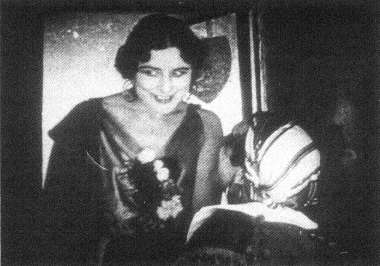
6. Metropolitan Opera soprano Geraldine Farrar appears in her screen
debut as Carmen (1915), a film with dramatic low-key lighting, billed in
the industry as "Lasky lighting." (Photo courtesy George Eastman House)
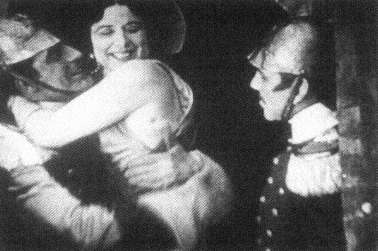
7. As the audacious and seductive gypsy, Farrar flirts with
several admirers, including Wallace Reid, on the left, in the
role of Don José (Photo courtesy George Eastman House)
attract segments of the lower-middle and upper working classes, drawn to highbrow culture as a status symbol, was also being exploited. At the Chicago Strand, refurbished for an engagement of Carmen , the program stated, "To see Miss Farrar in 'Carmen' at the Metropolitan Opera House would cost five dollars a seat. The work of Paramount Pictures Corporation has enabled you to see her in a film at regular motion picture admission prices," ranging from fifteen cents for the balcony to one dollar for loge seats.[42] Fittingly, in the 1918 reissue, Carmen was preceded by shots of Farrar costumed in her various operatic roles including Butterfly, Tosca, and Manon.
Critical response to Carmen in the trade papers was self-congratulatory. Motion Picture News headlined, "Critics of the Dailies, Who Had Shown Inclination to Hold Aloof from Photo Plays, Are Compelled to Acknowledge by the Lasky Presentation the Importance of Film Drama." The New York Dramatic Mirror crowed, "What is to become of opera if singers learn to act? About the first innovation would be a new set of Metropolitan critics who . . . recognize the relationship between operatic and pantomimic art, as practiced in the despised 'movies.'" As a matter of fact, opera critics objected to the "violent wrenching of Mérimée's text" as adapted by William deMille and the reorchestration of Bizet's music as accompaniment. Controversy about the artistic merit of feature film compared to opera did not, however, prevent seasoned reviewers from observing that the use of dramatic low-key lighting and location shooting resulted in a technically superior production.[43] Assessing the film decades later, Kirk Bond praised the composition, lighting, and acting of the film and concluded, "DeMille tells the old story with such brio, such power indeed, that it becomes new."[44]Carmen represents a milestone because DeMille's artistry, though overshadowed by Farrar's acting debut, equalled her international renown and charismatic screen presence. As the director continued to earn critical acclaim in 1915, he would become less indebted to established forms of genteel culture in order to legitimate cinema and to establish his own credentials.
Critical Discourses
As Jesse L. Lasky recalled, perhaps with more nostalgia than accuracy, "feature pictures were established in 1914, [but] they didn't become respectable until late in 1915."[45] Discourse in trade journals supports his argument that cinema was not then widely recognized as an art form. Geraldine Farrar's sensational debut and attendant press reaction could have occurred only during the early years when the industry had yet to achieve cultural legitimacy. Such events demonstrated that producers like the Lasky Company and Famous Players deployed the right strategy to establish multi-reel features as the industry standard to attract middle-class audiences. According to discourse in trade journals and fan magazines,
however, as late as 1914 there was by no means unanimity on the subject of features, a term coined by Motion Picture News in the previous year. Captain Leslie T. Peacocke, who was affiliated with Universal Film Manufacturing Company and wrote Photoplay 's column on scriptwriting, cautioned that "all the companies are vieing [sic ] to secure . . . leading attractions without taking into consideration whether the five and ten cent audience—who constitute the big patrons of the film drama and will always do so—will enthuse themselves over a play . . . or a book . . . of which they have never heard."[46] Asserting an opposite point of view in Moving Picture World , Jesse L. Lasky and Adolph Zukor disputed William Selig and Carl Laemmle on the desirability of features as against one- and two-reelers. Lasky argued:
Features . . . have accomplished what the "one reel" subjects failed to attain in fifteen years . . . to interest the classes. . . . Fronts were changed, interiors rearranged, music improved, prices elevated, and advertising in the press resorted to. Features compelled recognition in the daily press. Regular reviewers . . . began reviewing feature photoplays from the same angle that the legitimate dramas are criticized. . . . The production of features have attracted [sic ] a large number of men to the ranks of motion picture purveyors who could do naught else than dignify the industry.[47]
As Lasky recognized, feature films prompted critics to write reviews comparable to those of stage plays in newspapers and periodicals that influenced middle-class reception. The New York Times , for example, did not yet review films on a regular basis, as did trade papers and fan magazines, but it devoted space to adaptations starring celebrated artists like Farrar. Discourse in trade journals was more consistent, but critics still valorized screen adaptations in terms of intertextual references to traditional art forms. Consequently, they too legitimated film according to the standards of genteel culture but in so doing diminished the authorial claim of filmmakers like DeMille. Critics, in other words, were still expressing uncertainty regarding the nature of film aesthetic during an important transitional period in the evolution of cinema. DeMille's first release, The Squaw Man , for example, was hailed as "one of the best visualizations of a stage play ever shown on screen." Yet the critic also asserted that the director should "realize the art of producing moving pictures is to be measured by its own canons alone." Another critic reacted to Rose of the Rancho with this comparison: "If the best stage plays can be picturized with such success then the picture even excels the play." Belasco's favorable response to the film, "This is better than the play," was widely publicized to validate the screen version. Significantly, the production of spectacles that surpassed those orchestrated on stage called attention to increased realism as a desirable characteristic distinguishing the new medium. Critics were thus impressed with "a real soda fountain" in What's His Name , "the ambushing and destruction of the
supply train" in The Warrens of Virginia , and "picturesque settings" in The Captive (1915). Anticipating such reviews, DeMille had written to Goldwyn in 1914, "The scope of the photoplay is so much wider than that of the legitimate drama. In the first place we DO things instead of acting them. When a big effect is necessary, such as the burning of a ship, the blowing up of a mine, the wrecking of a train, we do not have to trick the effect with lights and scenery, we DO it."[48] As critical response became focused on the formal properties of a new mode of representation, film acquired greater currency as an art form. Within this context, the publication of Vachel Lindsay's The Art of the Moving Picture (1915), one of the first serious and extended essays on film aesthetic, is telling: the work asserted an independent status for cinema while discussing it with reference to traditional art forms like architecture and sculpture.[49]
DeMille's attempt to establish his credentials as an author when film had yet to achieve cultural legitimacy was initially compromised by his reputation for lighting effects. Given the fact that low-key lighting and color tinting on nitrate prints resulted in a pictorial mise-en-scène, critics referred to famous paintings as intertexts. Artwork such as chromolithographs had long since been commercialized for middle-class consumption, but paintings exhibited in museums still retained the aura of unique art objects. Critics thus simultaneously conferred and withheld authorship by focusing on DeMille's mise-en-scène. W. Stephen Bush, for example, claimed in Moving Picture World that the director's representation of a tenement district in Kindling (1914) was "as graphic as anything that ever came from the hands of Hogarth or Rembrandt." After viewing the The Golden Chance (1915), a Cinderella story based on an original screenplay, Bush exclaimed: "If the paintings in a Rembrandt gallery or a set of Titians or Tintorettos were to come to life . . . and transferred to the moving picture screen the effect could not have been more startling." Similarly, the New York Dramatic News praised "the masterly handling and lighting of Cecil deMille [sic ]" in Carmen and noted that "the use of direct and only mildly suffused light in almost every picture emphasizes the figures and the play of facial muscles, and creates a quality akin to the tone of oil painting." DeMille himself maintained in a much-repeated anecdote that when Goldwyn objected to the shadowy effects of low-key lighting—most likely in scenes in The Man from Home or The Warrens of Virginia —he replied, "To Hell with it—tell them it's Rembrandt lighting." Since DeMille's claim to authorship had not yet been substantiated, credits of his early features signified his role as filmmaker with the phrase "picturized by" as opposed to "produced by" or "directed by." Aptly, an article in the New York Dramatic Mirror was titled, "The Director as a Painter and the Players His Colors," a comparison that would cease to be accentuated when film became an independent art form.[50]
Although the intertextuality of cultural forms in genteel society served to
dim as well as illuminate his achievement, DeMille exploited convictions regarding the sanctity of culture to assert his status as an author. Consistent with Protestant beliefs as well as Arnoldian concepts stressing human perfectibility, artists were then prompted to produce realistic representations that could be read as spiritual messages.[51] Belasco, not coincidentally, wore a clergyman's collar as part of his everyday dress and was dubbed an "apostle of art." As his heirs apparent in the cinema, the DeMille brothers reinterpreted the tradition of Victorian pictorialism so that it became an essential aspect of their mission as filmmakers. While still a playwright, William had claimed that "the primary essential of a play is that it shall teach a lesson." Cecil asserted that "to preach is to invite disaster, but . . . to be afraid to develop a message in the story is to miss a great possibility." Although the brothers shared a belief in the didactic function of art, they had serious ideological differences that would later become more apparent. William, a liberal, had married the daughter of single-tax reform advocate, Henry George, and sympathized with the people against the "highbrows" and "uplifters"; he had even championed stage drama as "the art of the people as a whole" rather than "for a cultivated few."[52] Cecil was conservative and retained toward the public a stance of cultural stewardship that he shared with the elite classes of the Progressive Era.
Within the context of Progressive reform based on moral imperative, film critics too were proponents of the sanctity of culture and responded to DeMille's features in language saturated with didacticism. Such expressions accorded with the objectives of genteel reformers intent on assimilating immigrants and workers by emphasizing the value of education. Motion pictures were thus not just entertainment; they were "a titanic engine for popular education . . . [and] for the cultivation of the public mind." Accordingly, one critic waxed rhapsodic about film in relation to "the refining and intensifying of the emotions, the logic of civilization, and the development of the soul." Critics also used the rhetoric of uplift to describe the improving quality of feature film. A reviewer of The Call of the North proclaimed in Moving Picture World that the feature had reaffirmed his "faith in the approaching kingdom of quality." Similarly, Photoplay announced with awe and anticipation, "We stand at the threshold of the full-length screen play, as the living body of a higher and finer programme."[53] In sum, critics demonstrated that the sacrosanct language associated with highbrow culture could be employed to legitimate the emergence of a popular mass medium. Although this practice was useful in securing for DeMille the status of a cultural custodian in his endeavor to establish authorship, ultimately the interpenetration of cultural forms contributed to a process of desacralization. The intertextuality of grand opera, stage melodrama, and feature film, in other words, signified that the elite would find the preservation of a cultural hierarchy unmanageable in a technological age.
Although film entrepreneurs initially exploited the intertextual relationship between feature film and traditional art forms, they were not shortsighted about the future of the industry. At the time he abandoned vaudeville for motion pictures, Jesse L. Lasky predicted, "Eventually we will have stories by authors of recognized standing and written expressly for the screen." The mode of production of earl), feature film was so fast-paced in response to market demand that filmmakers could not indefinitely rely on theatrical and literary sources for adaptations. DeMille therefore resorted to formulaic screenplays that not only gave him more stature as an author in his own right, but proved cheaper than negotiating for costly rights and was more tailored to the abilities of actors under contract. Studio emphasis on original scenarios also streamlined production because expensive delays attributed to scriptwriting problems, as Lasky complained to Goldwyn, meant that directors and stars had to be paid while awaiting rehearsals. Working at breakneck pace, DeMille doubled the number of his releases from seven in 1914 to thirteen in 1915, including three features, The Captive, The Cheat , and The Golden Chance , that were based on original screenplays. As director-general, moreover, he supervised the production of twenty-one features, including his own films, in 1914 and thirty-six in 1915.[54] Toward the end of 1915 and prior to the Famous Players-Lasky merger in June 1916, he began to include in his output original screenplays written by Jeanie Macpherson and Hector Turnbull. Macpherson, interestingly, had previously been employed under Oscar Apfel at the Edison Manufacturing Company and had written scenarios and directed films for Universal Film Manufacturing Company and Criterion Features.[55] After the merger, DeMille relied almost exclusively on Macpherson's formulaic scenarios, even though a general manager assumed his supervisory duties as director-general so that he could produce special features at a slower pace.
Undoubtedly, the extraordinary success of The Cheat and The Golden Chance , films based on original screenplays that DeMille simultaneously directed during a hectic production schedule, influenced his move away from adaptations. Critics responded with hyperbole even though they still compared film with the legitimate stage. The Motion Picture News critic, for example, referred to the theater when he claimed that "in staging 'The Cheat,' [DeMille's] genius reached a climax," but he also noted that the film "should mark a new era in lighting as applied to screen productions." Acknowledging film authorship, the New York Dramatic Mirror critic detected "the master hand of Cecil DeMille . . . throughout 'The Golden Chance'" and claimed the production could "be favorably compared to anything that either the stage or the screen has brought forth." As both Goldwyn and William deMille later recalled, critical acclaim for The Cheat , a sensational
melodrama focused on an interracial relationship, elevated DeMille to the pantheon of early film directors.[56] After a series of successful features during a year when the names of Belasco, Farrar, and his brother William had been emblazoned above his own, Cecil was finally in a position to dictate that his name be "prominently displayed upon all motion pictures." When he signed a contract with Famous Players-Lasky shortly after the merger, he achieved recognition in the industry equivalent to that accorded luminaries of the legitimate stage and opera.[57] Fittingly, DeMille, hailed as "Creator of Artistic Productions Embodying High Box-Office Value," was the only director besides D. W. Griffith to be inducted into the Motion Picture News Hall of Fame in 1922.[58]
What was the significance of filmmakers like DeMille who came of age during the sacralization of culture and exploited a theatrical legacy to legitimate cinema and film authorship? Since motion pictures were a popular attraction for workers and immigrants in storefront nickelodeons before entrepreneurs sought legitimacy, middle-class film reception signified an important shift in patterns of cultural consumption. A number of social and cultural historians as well as film historians have debated whether early film attendance exemplifies a trickle-down or bottom-up model with respect to class and ethnic interaction in an urban environment. Were middle-class audiences patronizing nickelodeons at a much earlier date than has been assumed, as Russell Merritt and Robert C. Allen argue? Or was filmgoing, as Roy Rosenzweig asserts, a working-class diversion as late as 1914 and thus evidence of a radical change in middle-class cultural practice? Significantly, Merritt and Allen do not distinguish between the upper and lower middle classes in their empirical studies, although Tom Gunning points out that by 1910, 25 percent of filmgoers were lower-middle-class salaried workers. Were lower-class immigrant women indeed setting trends for middle-class women by patronizing commercialized amusement, as Kathy Peiss claims? Or were they, as Elizabeth Ewen contends, subject to the assimilative process of Americanization as represented on the screen? Were sociable immigrants translating Habermas's concept of the public sphere into neighborhood nickelodeons only to be textually constructed as spectators, as Miriam Hansen maintains? Or was the filmgoing experience of the working class, as Lizabeth Cohen asserts, significantly mediated by subcultures well into the 1920s? With respect to representational strategies and reading practices, were producers creating a mass audience by persuading the lower classes to join their "betters" in nickelodeons, as Janet Staiger argues, or were they in league with elite constituents, as William Uricchio and Roberta E. Pearson contend, to make films that could be read by the middle as well as working classes?[59]
The formation of producers like Famous Players and the Lasky Company, as well as distributors like Paramount, in my view, meant that entrepreneurs purposely developed a strategy to resituate cinema for "better" audiences
during the years 1912-1915. Given the importance of cultural rituals and commodities to signify genteel status, industry leaders chose to upgrade production and exhibition practices to legitimate cinema and to enhance profit. Although filmgoing was most likely entertainment for the lower as opposed to upper middle class before World War I, the practice of showcasing features in downtown movie palaces overlapped and to some extent displaced a preexisting plebeian film culture. A reading of specific DeMille texts will show, moreover, that the representational strategy of feature films based on traditional cultural forms articulated genteel middle-class ideology to appeal to cultivated audiences. What appears ironic in retrospect is that filmmakers unwittingly contributed to the homogenization of culture that threatened the social identity of the very classes whom they were courting. Writers in trade journals did employ terms like "high-class" and "low-class" to differentiate clientele, but the eventual legitimation of film rendered such distinctions less meaningful. According to Douglas Gomery, by the mid-1920s approximately 50 percent of audiences in large urban centers were patronizing first- and second-run theaters.[60] The reception of cinema as entertainment that began to transcend established patterns of cultural consumption based on class and ethnicity thus proved to be a meaningful development.
The Lasky Company strategy to upgrade film in terms of intertextual readings indeed heightened contradictions that attenuated the sacrosanct status of genteel culture in an age of commercialized amusement. Distinctions between highbrow and lowbrow , for example, were difficult to sustain even in the legitimate theater whose aura filmmakers sought for the cinema. Critical discourse on the Henry C. DeMille-David Belasco domestic melodramas staged in fashionable theaters in the 1880s and 1890s was not always appreciative, as will be discussed later. As theatergoing became pervasive among genteel middle-class audiences demanding Broadway productions, critics expressed concern about such issues as style over substance. When William deMille's Civil War melodrama, The Warrens of Virginia , went on tour in 1908 after a successful run at the Belasco Theatre in New York, the Cincinnati Inquirer observed that it "proved more interesting as a production than as a drama." A few years later, The Bookman reacted to William's popular melodrama The Woman as "the best directed play Mr. Belasco ever yet produced" but "distinctly a well made play [that] expands no theme . . . of permanent importance to humanity."[61] As the new stagecraft displaced Victorian melodrama in the 1920s, Belasco was dismissed for stage plays that were more notable for pictorial realism than for literary merit.[62] Subject to the leveling impact of market conditions, the cultural consumption of the genteel classes, as shown by their taste in theatergoing, did not always adhere to Arnoldian standards of excellence.
Within this fluctuating context, the marketing of feature film adaptations further undermined cultural distinctions that were based on notions of
excellence and buttressed by class and ethnic hierarchies. Fan magazines such as Photoplay , for example, published novelizations of motion pictures illustrated with stills that not only served as advertising but rendered film narrative as well as its intertexts more accessible. The May 1914 cover of the magazine read, "In This Issue: The Squaw Man. A Complete Novelette From the Feature Film." Adapted for the screen by DeMille, Edwin Milton Royle's stage play was subsequently novelized for fan magazine readers. At times, this circuitous practice led to novelizations of already existing novels. DeMille's The Virginian was "Novelized from the Film . . . Based on the Original Novel by Owen Wister [and the stage version by Kirk LaShelle]." Staff writers did not feel compelled to refrain from invention, as was the case when Bruce Westfall concluded his version of DeMille's Rose of the Rancho —adapted from the Belasco and Richard Walton Tully play—on a more conciliatory and less realistic note.[63] Aside from generating publicity, novelizations were probably useful to less educated audiences who were unfamiliar with the novel or stage version of convoluted plots such as DeMille's The Call of the North , a Western set in Canada that spanned two generations.[64] Yet narrative forms were undeniably diluted in the recycling process that screen adaptations set in motion. As more space in fan magazines was allocated to articles about movie stars, a sign of growing preoccupation with celebrities rather than narrative, a smaller percentage of pages was devoted to novelizations. Possibly, these recycled stories became redundant when film narration advanced to the point where an audience could follow complicated plot developments. As early fan magazine staples, however, novelizations illustrate the impact of filmmakers who, while claiming the aura of art for feature film, unwittingly collapsed distinctions between highbrow and lowbrow and paved the way for categories like middlebrow. The term middlebrow , which signified a decline of Arnoldian standards of excellence, was not coined until 1925, but the leveling impact of the market on cultural commodities had been in evidence for many decades. DeMille could not have exploited the genteel tradition so artfully if middle-class consumers had not already been seduced by stage plays and best-sellers whose titles would scarcely merit recognition today. As a description of class and ethnic distinctions in patterns of cultural consumption, the term highbrow has its uses as a label, but it was not necessarily synonymous with high art and could thus be reconfigured as middlebrow by the culture industry.[65]
Although the success of feature film ultimately contributed to the increasing homogenization of culture as an index of social status, could it then be argued that the cinema succeeded mid-nineteenth-century theater as a new democratic art form?[66] To be sure, film reception continued to be mediated by a number of variables including gender, class, ethnicity, religion, age group, and geographical region.[67] The significance of film as a revolutionary and powerful new medium with widespread appeal, however,
was not lost upon the filmmakers themselves. William deMille was quite prescient when he observed in 1915 that "for the first time in history a new art is being born that is more democratic than the drama." Indeed, his abandonment of a prestigious stage career can in some measure be attributed to his liberal politics and to his vision regarding the future of the cinema. Asserting a similar viewpoint, Photoplay observed, "films . . . are a basic amusement, recreation and instruction for the entire world—for the highbrow and for the fellow whose cowlick grows into his eyebrows."[68] Given the context of turbulent class and ethnic relations in the early twentieth century, this industry development was not inconsiderable. Despite the conclusion of a trade journal survey that the building of picture palaces had not diminished the importance of small houses as the "bread and butter" of the business, the existence of first-run theaters in major cities signified not only the increasing cultural legitimacy of film but its broad appeal.[69] Certainly, the newly built or renovated movie palaces had seating arrangements, as in nineteenth-century theaters partitioned into boxes, gallery, and balcony, that reinforced social distinctions. Specific showtimes meant less accessibility than continuous screenings at nickelodeons. Notwithstanding the preference of workers and immigrants for neighborhood venues, "high-class" theaters proved more accessible for them than other forms of middle-class culture. Granted, programs offered a selection of orchestral and vocal music that appealed to more educated listeners, but feature film, newsreels, educational footage, and comedies were hardly inaccessible to a younger generation of working-class and ethnic groups. As Richard Koszarski has pointed out, the diverse components of a balanced program at first-run theaters had more in common with vaudeville, initially a working-class and ethnic diversion, than with the legitimate theater.[70] Whether exhibited in movie palaces or neighborhood houses, feature film ultimately represented a form of expression that merged art and entertainment to exert an appeal transcending social barriers. What resulted was a shared cultural experience based to a significant extent on representations of genteel values that would become pervasive even as the cultural distinctiveness of the middle class, especially its lower rungs, became tenuous in an age of mass culture. A contextualized reading of DeMille's early feature film adaptations therefore demonstrates how middle-class cultural practice became the basis for a redefinition of cinema as a democratic art form.