
Chapter 4
Audition
The Quran became the basis of instruction, the foundation for all the habits acquired later on. The reason for this is that the things one is taught in one's youth take root more deeply.
Ibn Khaldun
Going to Quranic school for me, and for all children, was like being taken to the slaughterhouse . . . it had a meaning akin to death.
M. al-Akwa' (n.d.:33–34)
Prompted from time to time by the deep voice of their teacher or by the rap of his rod, the high-pitched chanting of children reciting their lessons in Quranic schools was a familiar sound in town neighborhoods. In his memoirs, Muhammad al-Akwa' provides a vivid account of his youthful experiences in such a school. Born in 1903, al-Akwa' went on to become an Ibb teacher of advanced students, a political activist jailed in conjunction with the early nationalist stirrings, and, upon release, a judge in a district near Ibb. After the Revolution, he was appointed minister of justice and held other offices while pursuing a career as one of the most distinguished of contemporary Yemeni historians.[1]
It was by playing on his father's "compassion" for an only male child that initially enabled al-Akwa' to delay his entrance into Quranic school. But when all avoidance stratagems had been exhausted, he was forcibly taken to the mi'lama in the village where he grew up. To accomplish this task his father sent a close and trusted friend.
He caught me by surprise, and I yelled and kicked trying to get out of the man's grip, but I couldn't because his hold on me was very firm. I found no way to get free, but I managed to leak on him without his noticing. The urine flowed and he suddenly started and shouted loudly in consternation. He put me down as he tried to avoid getting his clothes soiled, but he didn't let me escape from him or show pity for me. At the same time, we smiled a little, and part of the fear went away. (n.d.:33)
A few years earlier, another young son of a scholarly family had begun attending a similar school in Ibb. Ahmad bin Muhammad
al-Haddad, grandson of 'Ali Naji and nephew of 'Abd al-Rahman al-Haddad, and himself a future mufti and judge in the town, was about eight years old when he entered a mi'lama located in the tiny prayer room of the little Humazi Mosque near his house. With Ahmad at his Quranic school were a group of boys from his quarter, the same ones who stood with him in the regular sundown children's battles.
For generations in Ibb, as the sunset prayer call went out over the town, youths from opposing quarters met in combat under the spreading branches of a large tree in the central market square. As adult shoppers hurriedly dispersed to get out of the way, and merchants closed up their shops, the side alleys would be clogged with boys armed with sorghum stalks waiting to converge on the square. In his day, young Ahmad led the boys from his own and allied quarters. "I used to hit and be hit, but I don't ever remember retreating," he recalled. "In those days I was full of play, and my father tried to correct my behavior with punishments. But they say that when a boy is full of jinn (spirits) as a youth he will have great intelligence as an adult."
Pupils addressed their teacher as "Our Master," Sinna in colloquial. Sinna's place was a slightly raised dais of cushions while his pupils sat cross-legged on a mat in a semicircle around him. As a child entered in the morning he formally greeted Sinna and kissed him on the hand or knee. Then he retrieved his personal wooden lesson-board, which had been washed and recoated at the end of the previous day with a clay solution that left a grey-white writing surface. Board in hand, he assumed an accustomed place. Thereafter, a pupil could leave only with permission. To be excused to go to the bathroom, for example, a pupil in al-Akwa"s school had to rise and say, "May God forgive Our Master," and then make the appropriate indication with his little finger. Permission could be denied to those suspected of faking a call of nature as a subterfuge to go out and play, although then Sinna might have to put up with whining and complaints. Formally excused for the morning meal, or at the end of the morning session just before the noon call to prayer, the children escaped from the mi'lama "like sparrows from a cage."
Though often a humble individual, Sinna was treated with great respect when entertained at meals at pupils' houses. On such occasions he would replace his everyday school clothes with his best attire, including his scholar's turban and multilayered, pure white gowns. In al-Akwa"s school there was also a daily institution of bringing blessing upon the teacher and the activities of the school. As they were excused,
the children gathered outside the mi'lama, and one pupil led the others in shouting out their blessing at the tops of their young voices.
"May God forgive Our Master and his parents," cried the leader. "May God forgive Our Master and his parents," responded the others. "And our parents with his parents." "And our parents with his parents," in unison. "And those who study with him and learn from him (lit. "in his hands," bayna yadayhi ). "And those who study with him and learn in his hands," shouted the class. (n.d.:44)
Sinna had means at his disposal to ensure proper discipline among his unruly pupils. With legal guardians, husbands, and governors, such teachers occupied a social role with a legally recognized capacity for discretionary discipline.[2] The rod was commonly used, and al-Akwa"s teacher had in addition a simple pole-and-strap bastinado device, which restrained the legs of a child so that the soles of his feet could be beaten. In problem cases, Sinna put a pupil in a dark corner where he was not allowed to speak or even gesture to the others. As a still harsher measure, one that al-Akwa' remembers caused feelings of desolation and fear (n.d.:49), Sinna could keep the pupil in the corner when the others had been dismissed for lunch. In a procedure exactly analogous to the political process used to obtain the release of an official detainee, Sinna would entertain the interventions and appeals of some of the pupil's older friends, who would offer their "guarantee" (kafala ) that the delinquent pupil would not repeat his offense. In cases of grave offenses, Sinna might not accept these mediations, and the pupil would languish in the corner, at which point, just like a prisoner in jail, his lunch would have to be brought from his house.
Corporal and other forms of explicit correction, frequent and fear-inspiring though they might be, constituted only an overt aspect of the broad and subtle disciplining that was an important Quranic-school objective. This was to instill adab ,[3] a complex of valued intellectual dispositions and appropriate behaviors. A verb from the same root (addaba ) means to educate, to discipline, and to punish, while adab the noun can refer specifically to either literature or manners. In a general sense, adab was the primary responsibility of a child's parents. The Quranic school specialized in correct comportment, both among a cohort of pupils and especially in relation to Sinna, and in the memorized acquisition of the Quran, the sacred text.
Quranic-school formation was integral to a later stage of a child's upbringing and development, matters that are elaborated upon in general terms in several law-manual sections.[4] The responsibilites of the
mother and the father are differentiated in a section providing for the special circumstance of parental separation. Child rearing (hadana ) concerns the care of dependent children prior to the age of discernment (tamyiz ), and in this the mother, or in her absence or refusal, another woman of her family, has the basic right and duty.[5] The responsibilities include such things as proper raising (tarbiyya ), nursing and later providing food and drink, the cleansing of body and clothes, and care during illness. Specifics for infants, enumerated in a discussion of the hire of nurses, include "washing his head and body and clothes, anointing him with oil, putting kohl in his eyes, swaddling him in the cradle, and rocking him until he sleeps." The mother's child-care responsibility continues until the child is seven, or the point at which the child reaches discernment. At this point, given separated parents, the child must choose which parent to reside with. The implications of a decision to reside with the mother differ for boys and girls: "If a male child chooses her, he resides with her during the night and spends the day with his father, who (should) educate/discipline him [the addaba verb], and place him in Quranic school or in a craft apprenticeship;[6] if a female child [chooses her] she resides with her night and day."
In the manual discussions, a child's later development is broken down into the attainments of intellectual and physical maturity. The transition from minority to majority entails the onset of full responsibility in one's actions, including both obligations of the faith such as prayer and fasting and full capacity with respect to one's social undertakings such as contracts. In his or her affairs the minor is under a protective interdiction, which is only lifted with the attainment of this two-part maturity. "Interdiction of the minor," al-Nawawi writes, "is lifted with his physical and intellectual maturity" bulugh and rushd (1883:16).
Bulugh is marked by reaching fifteen years of age, or by the emission of semen. The earliest moment it is possible is nine years of age. The growth of public hair is a decisive indicator of bulugh in a non-Muslim but not a Muslim boy, according to a preferred but contested view. [Bulugh ] in a woman is indicated by menstruation and pregnancy. Rushd [in a boy] involves competency in ritual and financial matters, and that he not engage in sinful acts that would invalidate trustworthiness ('adala ), or be a spendthrift.
It is possible that a youth can mature physically without being mature intellectually, and in such cases the interdiction continues; when a youth matures physically, and he or she is also mature intellec-
tually, the interdiction is lifted. Physical maturity, bulugh , is associated implicitly with adult articulateness, with the bodily production of appropriately constituted voicings. From the same b–1–gh root comes the word baligh , meaning "eloquent," and also balagha , the name of the formal discipline of rhetoric. Bulugh thus represents a sexual maturity or puberty that also implies a physical maturation in the capacity to articulate the word. At the onset of a youth's capacity to produce semen, which carries a fertile seed, his word likewise begins to convey a matured intention and is therefore binding when communicated in the social world. Semen and words are the associated ejaculations of potent male maturity.
As an analytically separate issue, intellectual maturity, rushd , a prerequisite for adult intentionality, can be examined in a youth, but significantly it is not connected with knowledge that may have been gained in school. The rushd indicators are instead those of practical sorts of competency. For boys this examination should take different forms according to the father's occupation; for girls it is undifferentiated.[7] Presumed here is the existence of the sorts of compartmentalized informal knowledges that necessarily attend a complex society and a developed division of labor.
The rushd of a minor can be examined and should differ according to status (al-maratib ). The son of a merchant is examined about selling and buying and the negotiations involved in them; the son of a cultivator about agriculture and the financial management of those who undertake it; the (son of a) craftsman about that which concerns his craft; and a girl about that which concerns spinning and cotton and the protection of food from the cat, etc.
Set against this backdrop of conceptualization concerning child raising and maturation, the Quranic school was a specialized institution in which most town boys (and some girls) spent at least a few years. It was not by any means limited in its enrollments to the children of scholars or jurists. The result was a wide exposure to an authoritative intellectual world only a few would go on to master. In its later stages the Quranic school amounted to an apprenticeship in the specialized craft of knowledge. Mi'lama training ideally culminated in an individual who had embodied, and was capable of appropriately reproducing, the interrelated forms of both text and behavior. Such training was part of a general process of "inscription," the social construction of what De Certeau terms a "corpus juridique," a legal corpus or body of law. Two
complementary processes are involved: humans are entextualized and texts are physically embodied.[8]
Construable in such terms are a series of ritual activities that serve to fix the social identities of children. These are described in manuals and enacted in Ibb. At birth, for example, it is established Sunna to recite the call to prayer in the ears of the newborn. Shouted out five times each day from the minarets, rooftops, or doorways of mosques, the call to prayer is the public summons to the fundamental communal activity of prayer. An infant is by definition unable to engage in prayer, an act that requires the physical capacity for articulation, the memorized Quranic verses, and the conscious formulation of the intent to pray. According to the manuals, at about age seven, or the age of discernment, children should be exhorted to begin praying, and by age ten they should be punished if they fail to pray. In the absence of an ability to pray, the infant can nevertheless be initially imprinted with the heard recitation of the call. The verb for "to call" to prayer is from a root that also gives the word for "ear" and might be more literally translated as "to make hear." Hearing is the paradigmatic opening step in all recitational processes, and what is passively "heard" as the lines are spoken into a newborn's right and left ears is not only a call to community but also the first citation of what will become his or her central recitation, the testimony of the faith, the shahada . The call to prayer contains the shahada lines "There is no god but God" and "Muhammad is the Prophet of God." This first call, a recited word conveyed in the voice of the parent, is an opening social impression upon a human tabula rasa.
On the infant's seventh day of life there are further recommended ritual undertakings, which are accompanied by animal sacrifice.[9] The manuals specify that two young sheep should be slaughtered for a boy and one for a girl. This is an initial expression of a pattern of gender-based distinctions played out in many other domains of life, including some set forth in manual sections—for example, those concerning relative inheritance shares, blood money payments, and witnessing statuses. In Ibb, rituals surrounding birth include both the activities specified in the manuals and other local elaborations. On the third day after birth, for example, women gather to sing and celebrate with the mother; and on the fortieth day the period of a special food regime for the new mother, visiting by women, and separation of the husband and wife come to a close with a present from the husband.[10]
The gender differentiation in sacrifice is reinforced by the accom-
panying and also manual-mandated act of naming, the fundamental form of societal, familial, and gender labeling, which also occurs on the seventh day. In addition to this linguistic form of marking, boys in Ibb are also circumcised at this time. According to the manuals, male circumcision is not absolutely required until physical maturity (bulugh ) is attained; it is recommended, however, that it occur in conjunction with the rites of the seventh day. Dramatized and concretized in this intersection of blood sacrifice, the bestowing of the name, and violent bodily marking are the broader contous of the general reproduction of scciety.
While boys maintained their own separate and unruly activities of play and combat outside the mi'lama,[11] as pupils under the control of Sinna they represented the primary liminal group, one temporarily separated from society in order to be prepared for eventual full adult participation in society. The Quranic school experience was an extended rite of passage that, for some at least, gradually effected a social transition from an undisciplined and ignorant child to an adab -formed youth. In the sense that all such passages involve the loss of an old social identity and the acquisition of a new one, al-Akwa"s association of going to the mi'lama with the slaughterhouse and death is apt. Youthful play was eventually silenced.
The pupils' special liminality is demonstrated by the role they assumed in the vanguard of rites associated with death and burial. "Among the enjoyable times for pupils," al-Akwa' writes (n.d.:53), "was when someone died and the relatives of the deceased called upon the school to perform its recitations at the head of the funeral procession." To the relief of the pupils, the school's normal activities were interrupted so that their youthful voices, repeating the names of God and the testimony of the faith, could lead the way to the cemetery.[12]
The conclusion of Quranic school studies was marked by a semi-public ceremony known as the khatam , which, in Yemen,[13] occurred when a boy had successfully memorized a portion of the Quran. Guests, including Sinna as the guest of honor, were invited to a meal at the pupil's house. His luha , his personal writing board, which had been repeatedly written upon, washed, and recoated over the years of his memorizing efforts, would now be retired. For the occasion, it was decorated by Sinna with Quranic verses in painted calligraphy and hung with herbs and flowers. Khatam ceremonies among the wealthy and powerful, such as that for the governor's son photographed in Ibb in the 1950s (see fig. 6), could be extremely lavish events attended
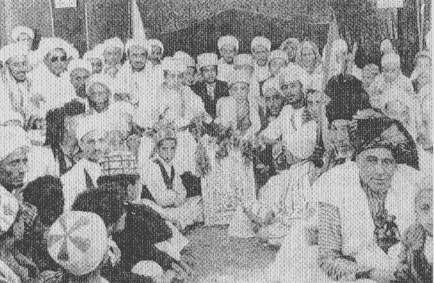
Figure 6.
Khatam celebration for Ibb governor al-Sayaghi's son, with local officials
as guests, 1950s.
by local dignitaries. For others, the khatam was a far more modest rite to conclude the mi'lama passage.
Many pupils simply dropped out earlier without reaching the point of the khatam. Until the time of the Revolution of 1962, the three or four years spent in one of the twelve neighborhood Quranic schools in Ibb would be the extent of many children's (and virtually all girls') exposure to the literate skills. For the sons of governors and of scholars, such as Ahmad al-Haddad and Muhammad al-Akwa', and a small but consistent number of boys of modest and untutored backgrounds, however, the khatam represented the conclusion of only the primary stage of instruction. Already at this level, the characteristic pyramid of traditional instruction had begun to reproduce itself, providing, as always, a modicum of opportunity for upward mobility.
For the scholar-to-be the khatam marked the end of a time of early moral and intellectual formation. When a youth such as Ahmad al-Haddad began to join the madrasa , the advanced lesson circles in the prayer room of the Great Mosque, he stopped wearing the simple embroidered headpiece worn by a boy of his status and began to wear the elaborate 'imama turban of a scholar. Instead of the striped gown in
which he led his fellow combatants at dusk he would now wear white. For special occasions he had white overgarments with long, wide sleeves, and a sheathed dagger and embroidered dagger belt from his father to complete his formal attire. People in the community began to call him "al-Qadi Ahmad," using the appropriate term of address for a young male from a qadi family who had embarked on the path of knowledge.[14]
Ahmad began to adhere to a more elaborate set of rules of conduct, for he had become one of the muhajirin , the collective name for the advanced madrasa students. The term derives from the verbal root hajara , meaning to emigrate, to separate, to dissociate oneself, to abandon and relinquish.[15] Devoting themselves to the pursuit of knowledge, the muhajirin passed their student lives in a kind of seclusion, entailing a still more developed liminality. The madrasa students were set apart from the rest of society by their special routines of study, to which they had initally been adapted by their years in the mi'lama. Ahmad rose with the dawn call to prayer and made his way from his house through the dark alleyways to the Great Mosque. Following the prayer and until sunrise, lessons were held by lamplight; even after sunrise light is slow in reaching the town because of the high peaks that rise immediately to the east. Following these early lessons, the students returned to the residence, known as the Hazr, a building located up an alley from the Great Mosque. Boarding students, such as Ahmad's friend Qasim Shuja' al-Din, a future teacher and doctor (tabib ),[16] and some of the teachers shared rooms in the Hazr. All the students ate their meals together there, beginning with an early morning "lunch" of sorghum bread and sorghum porridge. During the day many of the teachers occupied themselves in such lucrative work as writing contracts and other documents, while the students worked among themselves on their lessons until the afternoon prayer, following which they had a "supper" consisting of the same meal as earlier. They continued to study in the Hazr residence, pausing to pray at sundown, until the fifth and final evening prayer, after which they retired.
The muhajirin passed their days between the madrasa of the Great Mosque and the Hazr. They were expressly forbidden to enter the nearby marketplace, the center of mundane contact among males going about their daily business. The muhajirin were also not permitted to smoke tobacco or chew qat , the ubiquitous focus of everyday afternoon gatherings for adults. The Hazr was a place of retreat, and the muhajirin were a community of scholars in training, who studied, took
their meals, and (among the boarders) shared small sleeping cells in communal fashion. They led an existence apart from ordinary society, in a seclusion that was a fundamental part of their lengthy initiation into the world of knowledge.
In demeanor, the students were typically shy and retiring, at least in forays outside their circle of fellow muhajirin. The rude and brash childish behavior that persisted well into Quranic school days was now thoroughly eradicated. Although they were legally mature, and while other youths their age had already embarked upon adult careers in trade and the crafts, the muhajirin retained a distinctive immaturity, a "bashfulness,"[17] when confronted with ordinary social life. It was during his years at the Great Mosque and the Hazr, for example, that Ahmad was engaged to be married to the daughter of his uncle 'Abd al-Rahman al-Haddad. He later described himself as "so shy I could not bring myself to attend the large engagement feast given by my uncle." This shyness associated with the muhajirin identity is as patterned as the stern, often assertive, and even immodest character typical of many scholars who had left their formative years of study behind to become active in public affairs. Yet there were also a few men who seemed to retain that retiring quality, so pronounced among the muhajirin scholars, for their entire lives.
Darasa
In the Great Mosque lesson circles and at the nearby Hazr residence in Ahmad al-Haddad's day teachers and students enaged in a complex of activities known collectively as darasa .[18] At its conceptual base, darasa was a pedagogy of recitation, a practice already thoroughly inculcated in youthful rote memorization of the paradigmatic text, the Quran.[19] It was the ability to recite the Word of God that was marked and celebrated in the khatam ceremony. In Quranic school, recitation occurred in its simplest form and in association with the most sacred of texts. The problems of meaning and interpretation, however, remained to be addressed. The classical Arabic of the Quran was itself not immediately clear to the colloquial-speaking pupils who learned to recite it; beyond the Arabic words were complex exegetical issues. In Morocco, where students regularly undertook the considerably more lengthy and challenging effort of committing the entire Quran to memory, they did so without the aid of comprehension. They asked "no questions concerning the meaning of the verses, even among themselves, nor did it
occur to them to do so."[20] In advanced darasa instruction in Ibb, recitation continued to be fundamental, but it was set in combination with interpretive commentaries and elucidating discussions. The essential relation discussed earlier of text and commentary, of recited matn and explanatory sharh , underpinned darasa pedagogy.
An early suggestion of the key progression from recitation and memorization to understanding and application is found at the Quranic school level. Al-Akwa' writes that when the alphabet was introduced the pupil was initially told to repeat the letters, "alif, ba, ta, tha, jim, etc. . . . until they were memorized" (n.d.:39). Later, he "went on to the second stage, which involved learning how to place the letters in the written form of script on the writing board." This progression, from instructor recitation, to student repetition leading to memorization, and finally to the supplementation of memory by writing and learned understanding, also characterized the main routine of darasa learning. The relationship of Quranic school to advanced darasa instruction in the madrasa represents more, however, than the simple replication of a structural principle, initially embryonic and later elaborated. The shift from Quranic school to darasa instruction also recapitulates the general movement from the Quran (and the Sunna) to the jurisprudence of the shari'a, a movement from basic text to expansive commentary, from sacred to humanly constituted discourse.
In Ibb the Quran was not much memorized after Quranic school, although there were occasional individuals who went on to earn the title of hafiz , one who had learned the whole text by heart.[21] Among them were the blind students in Ibb,[22] who devoted themselves mainly to Quran memorization and the art of recitation (tajwid ). Their study, in the absence of any capacity for visual reference to a physical text that could be read or otherwise used as a cue, is a pointed reminder of the oral/aural nature of textual transmission and acquisition.
As a pedagogical complex, darasa was concerned with jurisprudence and an array of supporting disciplines, including the language sciences, Quranic exegesis, and the science of hadith. Darasa was broken down into several specialized modalities of learning, although some of the terminology involved is misleading, especially in the light of contemporary usage. Verbs that have come to mean separate activites, such as "to recite" (tala, tilawa ), "to read" (qara'a ), and "to study" (darsa ), were once much closer in their referents. All were used interchangeably, for example, to describe the ritual activity the local muhajirin collec-
tively engaged in on the eves of Friday and Monday, namely, the recited repetition of the Ya Sin chapter of the Quran.
Beyond the Quran, in darasa proper, there were three distinct categories of texts and associated modes of relating to texts. In an autobiographical sketch, al-Shawkani (A.H. 1348, 2:214ff.) provides an unusually detailed example of this tripartite breakdown of textual relations in the scholarly habitus. In his enumeration of the texts he studied in his own formation, al-Shawkani begins with a listing of those he memorized, texts that are referred to as mahfuzat , "memorized texts." All were short, abridged works (he also calls them mukhtasarat ), and a few of them were versified. All are similar in their concision and suitability for rote acquisition to the matn of Abu Shuja', which was among the memorized works forming the textual core in the advanced formation of Ahmad al-Haddad and other Shafi'i jurists. First among the texts al-Shawkani mentions in this category is in fact the matn of the key Zaidi text, Al-Azhar . These texts designed for memorization were closest in structural identity to the Quran and were usually learned in a similar manner.
Such mahfuzat , or memorized texts, constituted a first category of post-Quranic textual learning, which al-Shawkani says he began after his Quranic school khatam and before he embarked on his regular course of advanced study. Ahmad al-Haddad likewise recalled that he studied the Abu Shuja' text and the Minhaj of al-Nawawi when, as he put it, he was "still young," in his first years at the madrasa of the Great Mosque of Ibb. Al-Shawkani notes, however, that some of his total of eleven mahfuzat were accomplished after his formal studies had begun, so that this first category should be considered both an initial stage and a category of basic acquisition coexisting with the other two types of textual relations.
Although he consistently identifies his teachers in connection with the second and third categories of texts, in listing his memorized works al-Shawkani makes no mention of any instructional intervention, indicating that he acquired them directly on his own. As with the Quran, this mode of relating to a text was not concerned with exegetical issues. Unlike the Quranic school process, however, which was guided by Sinna, this memorization usually involved a form of unmediated individual acquisition, designed to build a solid base for later study with teachers focusing on commentaries and interpretive problems. In this instructional absence—from both teachers and their own peers—students labored in the pure presence of the text.
Standard formulas for describing memorization use the verb hafaza ,
which also means to conserve and protect, and to store or place in safekeeping. The two main (and interchangeable) expressions using this verb and referring to memorization are h–f–z 'an zahr al-qalb (by heart, lit. "on the surface of the heart") and h–f–z 'an zahr al-ghayb . This usage of al-ghayb , a difficult word, which can mean such apparently diverse things as "absence," "concealed," "invisible," and "the supernatural," and as a verb, "to vanish," "to be forgotten," and "to lose consciousness," conveys the paradoxical qualities of memorization as a type of internal inscription. Memorization involves a knowledge Socrates understood to be "written in the soul of the learner"; in the Muslim tradition this knowledge is closest to the true self and yet absented, partaking of the genuine but elusive nature of the divine.
The great majority of al-Shawkani's textual efforts are of a second type, classified as maqru'at , from the already mentioned q–r–' root. These are the "recited texts" studied in the pattern of qara'a 'ala (or darasa 'ala ), a verb-plus-preposition formula indicating the standard recitational-commentary lessons guided by a teacher. This format was by far the most typical of darasa instruction. Lessons usually focused on works of commentary; these contained embedded basic texts, which some students had already committed to memory. An example in al-Shawkani's case is the Sharh al-Azhar , the important commentary on the basic Al-Azhar text. For the al-Haddads of Ibb and other Shafi'is the relevant texts were al-Ghazzi's commentary on Abu Shuja' and Ibn Hajar and al-Ramli on al-Nawawi. While the scale alone of these multivolume works was prohibitive, the essentially disputed nature of commentary as a genre also rendered a memorization approach to them inappropriate. In Ibb some texts of the type memorized by a scholar such as al-Shawkani were learned in the maqru'at pattern.
In the typical lesson, oral presentation by the teacher of a section of the work under consideration was followed by his commentary—his lesson sharh . Later there was an opportunity for questions from the students. Isma'il al-Akwa' (1980:11) describes the pedagogical technique of the northern highlands as follows:
Among the Zaidis, the teacher recites (yaqra'u ) the lesson and then comments upon it to the students. They listen to him and then he asks them during the commentary: has the meaning become clear? If one of them poses a question, he repeats the commentary, clarifying that part of the meaning that had not been clear. The second day, the teacher asks his students for a summary of the previous lesson, and this summary is called al-dabit .
Recitation is coupled with attentive listening, whereas commentary is associated with questioning. The situation in Yemen regarding student interventions during or immediately following the commentary portion of the lesson seems to fall midway between what occurred in Morocco, where no questions at all could be asked (Eickelman 1985:95), and Iran, where there were regular questions and extensive formal training in disputation (Fischer 1980; Mottahedeh 1985).[23] It is reported of Sayf al-Sunna, the twelfth-century hadith scholar from Ibb, that he engaged his students in a discussion of the text he was teaching and that he eventually licensed all of them to transmit the text, except for one, who is said to have persisted in a disagreement with him.
The teacher's oral presentation frequently took the form of recited dictation, as is indicated in the already quoted memorial poem referring to the jurisprudence text, "which he used to / Dictate to me in the early morning darkness." This dictation was the beginning of an instructional process the ideal end product of which occurred when a student could return to the teacher to recite back to him (qara'a 'alayhi ) the learned material. The pattern was established in the Quranic school, where the teacher demanded of the pupil, "Recite your lesson-board" (iqra' luhaka ). The pupil stood before the teacher, holding the lesson-board with the writing facing the teacher. The request was for the pupil to recite from memory a section of text originally taken as dictation from or written out by the teacher and then committed to memory on his or her own. In advanced study, the equivalent activity involved the accurate, correctly voweled recitational reproduction of the originally dictated work. It was the capacity to accurately reproduce the text that was taken as evidence of a learning achievement. Between the two moments invested with instructional weight—the opening recitation by the teacher and the closing recitation by the student—a great deal went on, but these activities of the interval were rarely remarked upon.
Although the aim of this second and principal type of darasa learning was not memorization, the day-to-day work of repetition of the successive segments of a text could result in an extreme familiarity verging on memorization. In accord with the theory of legitimate textual transmission, the established ideal was to "receive" the text directly from the teacher, but in practice the students frequently did a major portion of their learning independently of the lesson circle. Al-Haddad explained that the procedure in Ibb was to have recourse to teachers only when students could not resolve a question among themselves. "For the most part," he said, "the method of study rested upon
independent student efforts prior to formal instruction, with consultation with the teacher only in cases of intractable issues."[24]
"Peer learning," as Eickelman (1985:98) has labeled the key activity of the interval, has been underappreciated in studies of Islamic education "because it is characteristically informal." Vital though it was, peer learning was typically left out of formal accounts of the learning process, including those appearing in biographical dictionaries (cf. Eickelman 1985:42) because authoritative significance in this culture of knowledge was anchored in teacher-to-student nodes of transmission. After the early-morning lessons in the madrasa of the Great Mosque, most of the Ibb student's day, including long hours spent at the Hazr residence, was devoted to study without guidance from teachers. During these same hours, some of the teachers went out to work as part-time notaries preparing legal documents to supplement their incomes. The pattern of separation was similar in Quranic school. After lunch the pupils pursued their lessons alone while Sinna passed the afternoon smoking his water pipe and chewing qat (cf. M. al-Akwa' n.d.:44). In Ibb, the importance of peer learning for the acquisition and maintenance of the scholarly habitus was not confined to formal study; often a practice of informal study among learned friends continued in later years.
The theory of legitimate transmission meant not only that significance was attached to emphasized opening and closing moments of the instructional cycle but also that a predominantly oral/recitational character was attributed to the process as a whole. The necessities of theory obscured not only peer learning but also the crucial role of writing. The unmarked activities of the interval were structured by an equally unrecognized reliance upon the activity of the pen. One of the features that distinguishes books by contemporary Yemeni scholars such as the al-Akwa' brothers from accounts in the old biographical dictionaries is their attention to formerly unnoticed aspects of the instructional process. Thus Muhammad al-Akwa' writes (n.d.: 39) in minute detail about the Quranic school (a subject innovation in and of itself) and mentions that at the outset the pupil was shown how to "hold the pen" and "place the writing board in his hands."
From Isma'il al-Akwa"s book on Islamic schools in Yemen we learn that a potential artifact of day-to-day study by many of the advanced muhajirin was a written manuscript copy of the text worked on. In a passage very much unlike accounts found in old biographical dictionaries, al-Akwa' (1980:269) describes the behind-the-scenes prac-
tices of former students in the important Zaidi school in the northern plateau town of Dhamar:
Most of the students studied without one of them owning a book. They borrowed books from private owners or from their teachers and copied (yanqulu ) the section for study from them every day. By the time he had finished a book, a student had his own manuscript copy of what he had studied. In a few years he had all of the books of instruction.
Contrary to ideal expectations, it is evident from this description that instructional transmission of the text often involved a mundane physical transfer, a simple borrowing of a book for the purposes of copying and study. Texts were not only carried in the "hearts" of scholars, they were often preserved as well in the form of personal manuscripts. The oral-medium formula of authenticity was quietly buttressed by the services of reading and writing. The existence of such handwritten texts also must be presupposed as a necessary accompaniment to many of the routines of memorization study, just as the "dictation" opening the standard lesson often required a written text as a cue.
Reading and writing figure importantly in the instructional activity of darasa. At the same time, however, their roles were systematically kept in the background while oral dimensions of the same complex of activities were placed in the foreground. This culturally specific devaluation and valuation of the respective roles of written and oral communication was integral to the larger theory of transmission upon which the legitimacy of knowledge hinged. The "dictation" relationship involved both a dictating teacher and note-taking students, but it was the oral recitation-like activity of the teacher and the listening of the students rather than his reading and their writing that were taken to be of consequence. An analytic identification of the important role played by reading and writing in this "recitational" complex should not be overstated, however. There were significant instances of memorization and aspects of transmission that occurred without the aid of a written text, including the mentioned case of the blind students and also the instruction of some teachers, especially those not teaching lengthy commentary works, who "dictated" their lesson texts straight from memory.
In view of the conceptual subordination of reading in the intellectual mainstream, represented by darasa instruction, it might be concluded that there existed no notion of "reading" in a sense equivalent to the Western "silent" and "comprehension" forms. This sort of reading was in fact common and routine, but it flourished without conceptual im-
pediment only outside the instructional core, in subjects and activities relatively marginal or mundane in comparison with those associated with darasa. Such reading was considered an appropriate mode of relating to a number of textual genres, none of which were so rigorously "recitational" in either the character of their authorship or their mode of transmission as the basic darasa texts. In Yemen, the terms for such "reading" tend to be derived from the root t-l-'['–l–'], as opposed to the several verbs, such as q–r–', which referred to recitation-reading or dictation. Al-Shawkani, for example, uses words from both sets of roots to set his precocious reading of historical works and literature apart from his formal academic training. Referring to himself in the third person, he writes:
Before formally commencing his advanced studies he worked hard in the reading (mutala'a[mu'ala'a] ) of history books and collections of literature, and this was in the days when he was [still] in Quranic school. He read (tala'a['ala'a] ) numerous books and many collections, then he commenced formal instruction and studied with/recited to (qara'a 'ala ).[25]
Most of the reading that went on outside the instructional sphere, that is, reading minus the concern for authoritative transmission which is by definition associated with face-to-face encounters and oral-aural connections, was of the t-l-'['–l–'] type. A word from the same root is used, for example, to describe what an administrator does when he is handed a document: he "reads" the document, silently and for comprehension. Mutala'a was what one did with most library books.[26]
The issues surrounding the relative importance within darasa of reading and writing skills versus verbal ones are posed more sharply in connection with a third and final category of study. Al-Shawkani concludes his listing of the works he studied with a category that he calls masmu'al , or "heard texts." This comprises a short set of titles (a bit more numerous than his list of "memorized texts"), many but not all of which are the annually recited authoritative collections of hadiths, such as the Sahih of al-Bukhari and the Sahih of Muslim. The second of these was the work Sayf al-Sunna had traveled from Ibb to Mecca to hear in 1184. During the month of Rajab in many locales in Yemen, regular instruction was customarily interrupted as these hadith collections were recited in the local scholarly community.[27] Many scholarly biographies mention that such texts were "heard."
What is especially interesting about the category of "heard texts" is that it separates out audition alone as a self-sufficient and authoritative
mode of textual acquisition. In fact, of a total of eight distinguishable methods of receiving knowledge from a teacher, "hearing" and the recitational study method of the maqru'at are considered "the highest and the best."[28] On the transmitter or teacher's side, adjusted for the different sort of text being handled, this mode of instruction is similar to the maqru'at style; the terms "dictate" and "recite aloud" (qara'a ) are both used in this connection. This instruction always departed from a written text because the lengthy compilations of hadiths, containing lists of linked transmitters' names, were not memorized (although, again, the originally spoken words of the mutun or individual hadiths frequently were).
It is on the student or listener's side that the "hearing" mode is markedly different. Through oral-recitational means the words of the author were directly and authoritatively reproduced, as in maqru'at ; but with the masmu'at , no taking of dictation, no note taking, no writing, intervened to capture the words. Oral production is matched by aural reception alone: the great value placed on this sort of communication finds a model both in the initial transmission of the Quran and in its subsequent recitational use in ritual. It is in the "heard" texts mode that instruction most closely approximates the ideals of the legitimate transmission of knowledge. The fully reproduced presence of an original text—here including the quoted words of each matn , the textual core of the hadith—is associated with an authoritative conveyance, via the voiced and heard word, across the human linkages between a teacher and the students assembled in his presence.
License
There are a number of general formulas applied to what transpires in the teacher-student instructional exchange. One, concerning a teacher, is that "a number of scholars benefited from him (intafa'a bihi )." This was a direct response to the fundamental condition placed upon the acquisition of knowledge—that it be communicated to the benefit of the community. Since the principal field of knowledge in advanced darasa was jurisprudence, or fiqh , one of the standard ways of stating that an individual "became educated" was tafaqqaha , a verb derived from the same f–q–h root. Another important general expression for the reception of knowledge was akhadha , meaning "to take." The student "took" some portion of what the teacher had (ma 'indahu ) in the
way of knowledge. In his autobiography, al-Shawkani says, not immodestly but appropriately in this conception of knowledge transmission, that he "took" all of what his several teachers had, "until there did not remain with any of his teachers anything that he [al-Shawkani] had not acquired."[29] He literally exhausted the text-knowledge of all of his teachers except for one, the very distinguished Zaidi scholar 'Abd al-Qadir bin 'Abd Allah,[30] who died before al-Shawkani had completed his studies.
The intense concern for specifying the human links in the transmission of knowledge is expressed through the detailing of precisely which texts were studied, how they were studied, and with whom. Al-Shawkani's seemingly obsessive recounting of a long list of texts, including both his maqru'at and his masmu'at , his "recited" and "heard" texts, with the title of each work followed by the name of the teacher in question, provides a measure of the significance that he attached to the careful demonstration of the particulars of authoritative textual transmission. In addition, he includes the repetition of such key works as the Sharh al-Azhar with several different teachers, and he regularly mentions just how much of a book in question was covered. "From the beginning to the end of it" and "all of it" are common in al-Shawkani's lists, but he also frequently notes portions not covered—for example, "except for a missed bit at the end of the middle third"—or that he only worked on "some" of the treatise in question. The same sort of meticulous interest in the minutiae of textual interchange is found some seven hundred years earlier when Ibn Samura (1957:149) says, concerning a student and a teacher, that "he studied with him some (ba'd ) of Al-Tanbih ." "I asked him about that," Ibn Samura continues, "and he said, 'Up to the chapter on Marriage.'" Elsewhere, Ibn Samura summarizes what occurred as one student received instruction from his teacher as follows: "He took from him and became educated with him with regard to part of his [the teacher's] heard texts and part of his memorized texts" (p. 95).
Equivalent to the khatam of Quranic school was the ijaza of advanced instruction. Neither should be understood as a diploma delivered at the conclusion of a set curriculum and sequence of academic classes—these were notions that would appear later. Rather, both were "documents," the first an event, the second often a written text, giving evidence of a specific textual transmission, through a specific student-teacher link. Al-Shawkani names the individual with whom his Quranic khatam
occurred, just as he names the human mediators of the other texts he learned.
An ijaza typically authorized the student to teach in his turn the text that had been learned, using the formula for "oral transmission" (riwaya ).[31] Such usage represents an important further expression of the oral construction of darasa instruction. In an explicit fashion, ijazas articulate the genealogical manner in which knowledge was handed down through the generations. Ijaza documents could cover all types of texts and modes of learning. Zabara (1956:4–5) quotes an ijaza that gives the student the right to transmit the teacher's maqru'at and masmu'at , which the teacher says he had likewise received from his own teacher. Ijazas could be either general ('amma ), or restricted, pertaining to anything from a single text—as in the case of the ijazas Sayf al-Sunna granted to his students for Muslim's Sahih —to a delimited discipline.
In provincial Ibb, at least by the turn of this century, the issuing of written ijazas was rare. Oral and biographical history accounts of the last decades of the old darasa system do not refer to a practice of formalized licensing; they mention only the names of teachers, and possibly, but normally separately, the titles of the principal texts studied. In any case, if the older ijaza institution had seemed to offer a marking of the transition from student to teacher, the transition was usually not abrupt. Al-Shawkani describes a period of his academic life during which he simultaneously took lessons from some scholars and gave lessons to others. The historian al-Burayhi describes an individual as "studying with those more learned than he and teaching those less so."[32] Isma'il al-Akwa' (1980:11) points to the practice of charging advanced students to recite the lesson aloud as a distinctive feature of Shafi'i instruction. In Quranic schools, as Muhammad al-Akwa' notes (n.d.: 47), it was customary to have "the older instructing the younger and the ones who understood teaching those who did not."
Just as the ijaza was not a diploma in the contemporary sense, so the "books of study" (kutub al-talb ) did not represent a conventional curriculum. For the darasa student, the works studied represented at most a specific madhhab , they were the standard texts of a particular school of shari'a jurisprudence. The biographical histories give evidence of specialization among some scholars; others dabbled, or in unusual cases such as al-Shawkani, went profoundly into numerous subjects. All, however, began with the key manual texts of their madhhab.
Endowments
The teacher may not ask payment .
Hadith
Providing for the expenses of instruction was a venerable charitable and pious activity, one that usually took the form of a special institution known as awqaf (sing. waqf ).[33] These "pious endowments" supported not only students but also the physical plant of instruction, the mosques and residences. The four categories of public endowments in Ibb included separately earmarked funding for the Great Mosque of Ibb (known as waqf al-kabir ), the town's other mosques (masajid ),[34] local saint-tomb complexes (turab ), and advanced instruction (darasa ). In-kind revenues came from extensive endowment landholdings in the Ibb hinterland, and cash rents were derived from town real estate, including building lots, houses, shops, warehouses, and the public bath.
In the official darasa-endowment register (see fig. 7),[35] document texts refer to waqf s "for the darasa of the muhajirin in the Great Mosque of the town of Ibb"; or simply, "endowment for darasa" (waqf li-l-darasa ). The management of the endowment properties, the collection of the revenue, and the disbursement of food and money to the students was the responsibility of an official known as the 'aqil 'ala al-darasa . During Ramadan the normal endowment-supplied fare of sorghum bread and porridge was changed to wheat bread, meat gravy, and clarified butter. For the 'id al-kabir , the major feast day of the Muslim calendar, two bulls were slaughtered for the students at endowment expense. In Ahmad al-Haddad's day there were more than fifty muhajirin, half boarders, half day students, who were served together with some teachers and a few poor men in groups of four at as many as sixteen tables.[36]
The endowment mandate for its student beneficiaries was to study "the magnificent Quran and the noble knowledge ('ilm )," one text reads, "under the supervision of the darasa official, in the assembly mosque of Ibb town." Jurisprudence was to be studied in both its "usul and furu' ," its "roots and branches."[37] As a condition of, and in return for, the support given them, the muhajirin accomplished specially dedicated recitations on Monday and Friday eves. These were in memory of the Prophet and of the local founders: "to the soul (ruh ) of the Prophet," a typical text says, "and to his [i.e., the founder's] soul, using his name."[38] As such donors accumulated over the years, their names
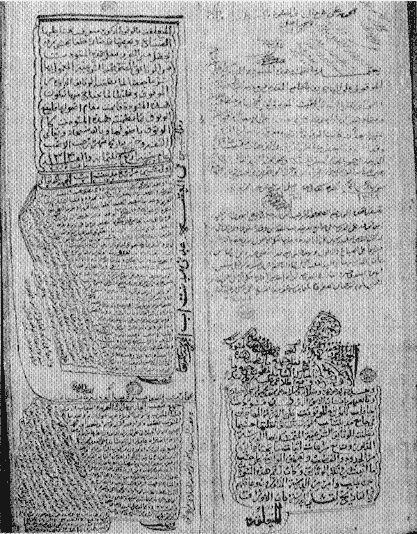
Figure 7.
Opening pages of register (musawwadat al-darasa ) listing endowment
properties for the support of instruction in Ibb. Dated 1896.
were added to a list read out at the conclusion of the recitation by a special Great Mosque functionary. An Ibb testament (wasiyya ) dated 1904,[39] for example, mentions two agricultural terraces set aside as endowments for "darasat Ibb" and "darasat Jibla [a nearby town]," respectively. These charities are intended, in the founder's words, "to enter me into the recitations (al-ratib )"—that is, by the muhajirin at the main mosques of both Ibb and Jibla. Another endowment was to be in memory of the founder's mother, "to enter her into the recitations."
This type of recitation by the muhajirin was actually a specialized public version of a much wider phenomenon. Recitation in memory of a deceased individual's soul could occur as a simple and uncompensated act of devotion. Relevant in this connection is an exchange Muhammad al-Akwa' (n.d.:56–57) remembers with his stepmother: "Muhammad," she asked, "when I die will you recite (tadrus ) to my soul, recite (taqra' ) for me the Fatiha [the opening sura of the Quran], and pray for me?" He answered "Yes" at the time, and as an adult he carried out these recitations. There is, in addition, a separate category of endowments (known as waqf qira'a ) that pertain to such recitation.[40] Such private endowments were administered directly by the reciter rather than by the Endowments Office. In the Ibb testament of 1904, there are several "recitation waqfs" enumerated, involving designated properties with revenues to be provided the reciters named. Other privately held documents attest to such developments as "stepping down" from reciterships, involving a transfer of both the right to the annual income and the duty of recitation.[41] Some recitational waqfs were intended as small charities provided to nonfamily poor, especially scholars; others were huge family trusts in which the recitational waqf formula shields an important allocation of an estate.[42] That various perils awaited endowments was clearly recognized by their founders: cautions and conditional curses are common in the formation texts.[43]
The several varieties of public and private endowments shared a common legal structure, which is set forth in the chapter on waqf in the jurisprudence manuals. In establishing an endowment an individual undertook a unilateral legal act whereby property was converted from private ownership (milk ) to endowment (waqf) status. There are three distinctive features of this legal transformation. The first is that the transfer to endowment status is an action in perpetuity, valid until Judgment Day, or as the establishing documents read, "until God inherits the earth and all upon it." Second, the property in question is
removed (the formulae are waqafa , "to stop," and habasa , "to restrain") from the circles of worldly transfer. As the documents state, the property may no longer be "sold, inherited, pawned, or given as a gift." The endowment properties are no longer property in the worldly sense that they may be alienated. A third essential feature concerns the intention of the founder. This must be qurba , which is "an act pleasing to God," or a "desire to draw near to Him." In theory at least, the legal transfer involved is not understood in terms of the this-worldly intentions associated with ordinary legal undertakings. The support of mosques is one such action pleasing to God; the funding of instruction is another. That the muhajirin were a set-apart group of initiates was thus reinforced by the special qualities of their material support.