
8—
The Catalyst Can Remain Identifiable
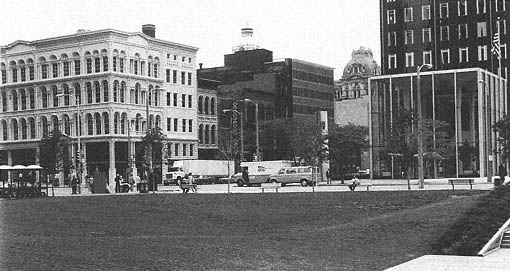
In chemistry the catalyst often disappears or is transformed in the course of a reaction, but this is usually not the case with urban chemistry. Instead, the ingredients of rejuvenation remain and contribute to the city's unique character and sense of depth. The layers of urban experience and urban history, the collage of styles and uses characteristic of a vital center city are the essence of urbanity. In fact, one of the pleasures of the center city is to trace and reconstruct the events that have produced its distinctive character: bold street grids; riverside industry; Main Street commercialism; technological bravado in iron, steel, and concrete; proud civic structures; and so forth. Total renewal and total design are largely discredited. A collage of overlaid urban visions and of identifiably different parts, an overlapping, sedimentary record of various decades and their architects, is much preferred. Cities are richer for the variety.
From the point of view of architects, that their contributions to the city are recognizable is good for business; at the same time they get credit for weaving in rather than imposing their own personal visions. In Milwaukee, the Grand Avenue intertwines with what has come before, amending and revising but not overwhelming.
45.
Sedimentation, accretion, and layering of urban form in Milwaukee.
It is taking the dedication of many individuals and organizations to regenerate Milwaukee. Institutional, civic, and political action set the process in motion and made possible the key factor, the Grand Avenue. Although the economics and politics involved in the catalytic process are of unquestioned importance, the focus of this analysis is catalysts as a tool in urban design. Just as investment begets investment, so too does (or should) good design beget good design. Buildings do set precedents, and these matter. The Grand Avenue is thoughtfully conceived and sensitively designed, and it has the potential to inspire other development, to improve the character and the quality of subsequent work, and to link up with existing and new construction.
To understand the importance of the catalytic concept in urban and architectural design, consider what might have happened had the Grand Avenue been different, had it been conceived and built as a suburban shopping center transposed to downtown. Would it have evoked the pride suggested in Brian Duffy's cartoon (Figure 36)? Would suburbanites have been induced to change shopping patterns and drive downtown instead of to the nearest mall? Would the Grand Avenue have restructured the rankings of commercial centers in the region?
There is a danger in urban development not only of failing to have an impact but of actually inhibiting new development through inadvisable actions. A negative catalyst is as much a possibility as a positive one. A development can act like a sponge in soaking up resources and activity, depriving adjacent areas. It can fail to inspire responses. Failure to light a spark can discourage others from investing time, effort, and financial resources. Programs, strategies, and designs need to be properly conceived if dynamic, productive catalysis is to happen.
We contend both that urban catalysis was necessary to accomplish what has been accomplished in downtown Milwaukee and what is continuing to happen there and that unilateral, univalent renewal could not have met the challenge. The accomplishment is considerable:
• A unique place is emerging, a place composed of and responsive to what was there before. It is both old and new.
• It is for many a new gateway to a city they had abandoned, thus helping to restructure the image of downtown.
• It establishes precedents for other developments—precedents in design quality, precedents for thinking about existing buildings, precedents for using the city, precedents for relating interior-oriented architecture to existing streets and street life, and precedents for an integrative urban architecture that is new in the experience of most Milwaukeeans.
Master plans could not have accomplished what has happened in Milwaukee and what continues to happen there; nor could functionalist,
46.
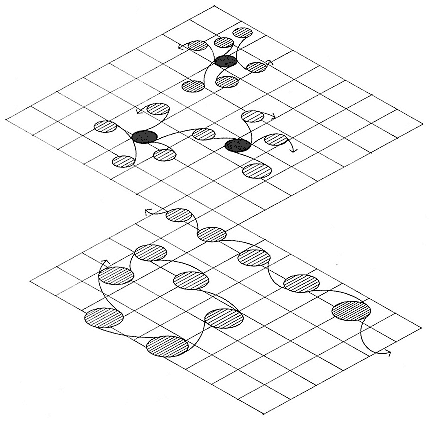
Catalytic reactions can take several forms: nuclear (top), multi-nucleated,
serial, and "necklace" (lower left).
structuralist, humanist, or formalist urban design concepts; nor could a raw pragmatic approach. To understand events in Milwaukee as well as in other American cities requires a concept like urban catalysis.
A discussion of the chemistry of urban architecture would be incomplete without reference to the people who make it happen. The urban chemist does not stand outside the process but is integral to and influenced by it. As Milwaukee demonstrates, effective people are as important to the catalytic process as a well-conceived, appropriately staged development. People get the process going.[22] In one city a corporation executive might be instrumental, in other cities a development corporation, a highly respected individual, a popular mayor, or an alliance of citizens.
The context in which urban design strategists work is less predictable than that of laboratory chemists. A collection of ingredients used according to a proven formula will not always yield a particular product or have a reliable consequence. The predictability of the laboratory setting decreases when the lab is a city. This is not to say that urban chemistry is entirely indeterminate and unpredictable, only that it is less predictable than chemistry in the laboratory and that it is subject to subtle influences. The catalytic process does not necessarily move methodically from step A through steps B, C, and D but might bounce around in a looser (though not random) fashion before achieving a desired end. The architect and urban designer Robert M. Beckley has related this semideterminate process to that of a pinball machine. The catalyst is unleashed within a limited field, but its precise path and its accomplishments are determined in part by inexorable forces (like gravity), skill with flippers, nudges, and accident. The human ingredient of urban catalysis is evident in efforts to set the process in motion; in considered use of flippers (knowledge, money, IOUs); and nudging at the right time and with appropriate finesse. In an indeterminate context, "chemists" are needed to keep the process going.
To elaborate further the concept of urban catalysis and to demonstrate that the process works in other cities and in cities of varying size, we examine a number of other cases in the next chapter.