
France: A Suggestive Extension
The French case illustrates the construction of labor as a commodity under circumstances that display two initial contrasts to those prevailing in Britain. First, the institutional frameworks for the formally free exchange of manufactures and of labor power were created simultaneously in France during the Great Revolution, not disjointly as in Britain. Second, France began the transition to a capitalist labor market with a legacy of feudal relations of work in agriculture. Both these conditions approximately paralleled the conditions obtaining in Germany during the same process of transition. But development in France diverged from that in Germany: during the initial transition to a formally free labor market, the guilds in France were not just stripped of their lawful monopolies over the marketing of
[26] "In this case," Ferrara continues, "the calculation of the 'duplication' will take place in his mind, by comparing that which the laborer demands to the total of sacrifices involved in personal execution of the work." Op. cit., p. 134. The extraction of a use value through domination of the worker utterly disappears from this analysis.
[27] Riccardo Dalla Volta, Le forme del salario (Firenze: Fratelli Bocca, 1893), p. 198.
[28] There is evidence that late-nineteenth-century Italian factories bolted latecomers out, as in Britain, rather than fine them. Luigi Guitto, La fabbrica totale (Milano: Feltrinelli Economica, 1979), pp. 197–198. Factory design in Italy stressed the need for control of border points as well as total visibility of the production process itself. Carlo Poni, "All' origine del sistema di fabbrica: Tecnologia e organizzazione produttiva dei mulini da seta nell'italia settentrionale (sec. XVII–XVIII)," Rivista storica italiana Volume LXXXVII, fascicolo III (September 1976), p. 489.
goods; they were eliminated altogether. In contrast to development in Germany, urban craftwork in France adapted to commercial liberalism without significant protection and could therefore serve as an institutional locus for the cultural definition of labor as a commodity. The major currents of economic thinking in France in the early nineteenth century gave expression to a distinctive specification of labor as a commodity which was eventually installed on the factory shop floor.
In the decades before the revolution of 1789, the constraints on trade and on the exercise of an occupation eroded in France, but they were not replaced by a formally free market regime in products or labor power. Louis XV's government declared in 1762 that manufacture in the countryside could proceed independently of the guilds, which were centered in the cities.[29] Despite this newly confirmed liberty, exchange in the rural outlands developed under a hodgepodge of shifting local ordinances. At least until 1779, many intendants in the provinces enforced requirements that rural textile makers produce only approved varieties of cloth.[30] In the north of France, by order of the intendant , inspectors from the textile guilds of Lille tramped through the backwoods districts to seize fabrics that deviated from approved patterns.[31] The surveillance of rural output and the fines levied on aberrant weavers did not halt the rise of outland manufacture, but they helped to attach a portion of that production to the regulated trade of the cities.[32] Urban brokers sometimes retained a statutory monopoly on the marketing of certain lines of fabrics created in nearby villages.[33] In some regions, rural
[29] E. Tarlé, L'Industrie dans les campagnes en France à la fin de l'ancien régime (Paris: Edouard Cornély, 1910), p. 53.
[30] Philippe Guignet, Mines, manufactures et ouvriers du Valenciennois au XVIIIe siècle (New York: Arno Press, 1977), pp. 89, 93; for an example of confiscation of cloth in Languedoc in 1773, see J. K. J. Thomson, Clermont-de-Lodève 1633–1789 (Cambridge: Cambridge University Press, 1982), pp. 422–423; William Reddy, The Rise of Market Culture (Cambridge: Cambridge University Press, 1984), p. 36; Harold T. Parker, The Bureau of Commerce in 1781 and Its Policies with Respect to French Industry (Durham, North Carolina: Carolina Academic Press, 1979), p. 33. After 1779, textile producers could manufacture cloth by any standard, but unauthorized fabric had to be stamped as such. Parker, op. cit., pp. 36–37, 108.
[31] Gail Margaret Bossenga, "Corporate Institutions, Revolution, and the State: Lille from Louis XIV to Napoleon," Ph.D. diss., University of Michigan, 1983, p. 301.
[32] Jean-Pierre Hirsch, "Négoce et corporations," in Gérard Gayot and Jean-Pierre Hirsch, editors, La Révolution française et le développement du capitalisme (Lille: Revue du Nord, 1989), p. 360. On the attachment of rural production to regulated urban trade, see also Charles Engrand, "Concurrences et complémentarités des villes et des campagnes: Les Manufactures picardes de 1780 à 1815," Revue du Nord Volume 61, Number 240 (January–March 1979), pp. 68–69.
[33] Bossenga, op. cit., pp. 290, 308, 351. In many branches of manufacture, the state also granted to its favored entrepreneurs exclusive rights within a region to produce a line of textilegoods. Parker, op. cit., p. 53; Serge Chassagne, "La Diffusion rurale de l'industrie cotonnière en France, 1750–1850," Revue du Nord Volume 61, Number 240 January–March 1979, pp. 99–100.
spinners and weavers were still required to sell their goods in an approved marketplace, to prevent unlicensed dealers from poaching on the business of the guild brokers.[34] Amid this forest of regulation, the abolition of guild jurisdiction over labor in the countryside represented only a partial clearing.[35]
Within the walls of the municipalities, officials upheld their right to control manufacture. In principle, magistrates in the textile towns remained the "natural judges" of economic activity. They could allocate yarn to various branches of weaving, authorize brokers to serve as intermediaries between producers and merchants, set up appropriate prices to be paid to both male and female workers for products, and decide whether new branches of enterprise should be established.[36] Finally, of course, the urban corporations used their royal charters and judicial rights to buttress their manufacturing privileges and to control the circulation of labor. Guild masters were officially forbidden to compete with colleagues to at-
[34] Bossenga, op. cit., p. 352; Gay L. Gullickson, Spinners and Weavers of Auffay (Cambridge: Cambridge University Press, 1986), p. 64. William Reddy points out that rural outworkers contested these efforts to regulate trade. He describes a riot that occurred in Rouen during 1752 in protest against a royal ordinance restricting trade in yarn to the guild-controlled Cloth Hall. According to Reddy's interpretation of events, the outworkers objected, not to an unwarranted regulation of commerce, but to the expected insufficiency of wages for the procurement of subsistence at a time of high grain prices. See Reddy's brilliant analysis in "The Textile Trade and the Language of the Crowd at Rouen: 1752–1871," Past & Present Number 74 (February 1977), pp. 70–74. In their comparison of France and Britain, Wadsworth and de Lacy Mann suggest that the subversion of regulation in Rouen comprised an exception for France. Alfred P. Wadsworth and Julia de Lacy Mann, The Cotton Trade and Industrial Lancashire 1600–1780 (Manchester: Manchester University Press, 1931), p. 203.
[35] Jean-Pierre Hirsch, Les Deux Rêves du Commerce: Entreprise et institution dans la région lilloise, 1780–1860 (Paris: Ecole des Hautes Etudes en Sciences Sociales, 1991), pp. 159–160. For an account of the climate of uncertainty in the 1780s brought about by policies that combined regulation and market liberty for textile putting-out systems, see Thomson, op. cit., pp. 379, 455.
[36] Guignet, op. cit., pp. 43, 78, 80–83, 126–138; Michael Sonenscher, Work and Wages: Natural Law, Politics and the Eighteenth-Century French Trades (Cambridge: Cambridge University Press, 1989), p. 67. The judicial authorities of the corporate order may also have discouraged the development of piece-rate lists. Ibid., p. 279. Apart from the prescriptions for textile production, city officials imposed controls on the import of cloth into their domain by checking seals of inspection from brand examiners and certificates proving that the transport duties had been paid on provincial routes. William Reddy, "The Structure of a Cultural Crisis: Thinking About Cloth in France Before and After the Revolution," in Arjun Appadurai, editor, The Social Life of Things (Cambridge: Cambridge University Press, 1986), p. 265.
tract journeymen by offering better terms of work.[37] The corporations' fetters on the exercise of an occupation came under increasing criticism from the reform-minded philosophes in the last decades of the old monarchy. Indeed, Turgot suspended the corporations for several months in 1776 after he began his brief tenure as controler-general. But his edict was never enforced.[38] The guilds were swiftly restored and consolidated between 1776 and 1780.[39] As a well-ordered hierarchy of associations subordinate to the monarch, they seemed indispensable to uphold the organization of society.[40] Even when, in the eighteenth century, the de jure monopolies of the guilds became less effective, the model of constitutory corporations remained dominant in popular conceptions of the social order.[41]
The revolution of course swiftly initiated the transition to liberal commercialism. Internal customs and tolls on the transport of goods disappeared in 1790.[42] The Constituent Assembly moved almost immediately to create a formally free market in labor power as well. In the period of the revolution from February to September, 1791, the assembly passed three decrees that demolished the old framework of corporate production. It first eliminated the guild associations of masters and workers. By contrast with the path of reform in Prussia, in France the guilds lost their function as official corporate sponsors of the employment of artisans. They were suppressed as associations for the training of workers, certification of masters, and cultivation of the trade. Then, in June, the Le Chapelier law put an end to all trade associations, including workers' collective organizations. The law provided instead for the establishment of wages by "freely contracted agreements between individual and individual."[43] Finally, in September of that year the
[37] Henri Sée, Economic and Social Conditions in France During the Eighteenth Century (New York: Cooper Square Publishers, 1968), p. 124.
[38] Ibid., p. 135.
[39] On the controversial survival of guild regulation for textiles in Lyons, consult L. Trénard, "The Social Crisis in Lyons on the Eve of the French Revolution," in Jeffry Kaplow, editor, New Perspectives on the French Revolution (New York: John Wiley & Sons, 1965), pp. 72–77.
[40] William H. Sewell, Jr., Work and Revolution in France (Cambridge: Cambridge University Press, 1980), pp. 73–74; François Olivier-Martin, L'Organisation corporative de la France d'ancien régime (Paris: Librairie du Recueil Sirey, 1938), p. 537; Ellen Meiksins Wood, The Pristine Culture of Capitalism (London: Verso, 1991), p. 88.
[41] Olivier-Marin, op. cit., p. 537. Even Turgot operated within the assumptions of a corporate order, as Reddy discloses in "The Textile Trade," op. cit., p. 72.
[42] Albert Soboul, The French Revolution, 1787–1799 (New York: Vintage Books, 1975), p. 191.
[43] Cited by Sewell, op. cit., p. 89.
assembly set aside the regulations that had prescribed the execution of labor: it dismantled all offices for inspecting the quality and specifications of manufactures.[44] Of course, no perfectly liberated bazaar in articles of commerce or in labor power appeared in France (or elsewhere) that would satisfy the economist's shining ideal of an unbridled play of market forces.[45] But there is a world of difference between community-supported, culturally prominent, foundational restrictions on trade and narrow exemptions from competition or implicit market imperfections such as de facto labor immobility. The revolution brought France across this divide. At one stroke, the outlines of an integrated national market in both products and labor came into view.
The dramatic change in governing economic principle did not allow the concept of labor as a commodity to spring ready-made out of the market stalls and workshops. The current of ideas that surfaced among the sans-culottes during the ensuing months of popular organization and insurrection verify that labor's commodity form had not yet taken shape. The sans-culottes founded their outlook upon the social contribution of concrete labor itself. As William Sewell's study of the language of labor reminds us, the common people of Paris sanctified those who worked with their hands.[46] In their eyes, manual effort provided the moral foundation of the new French republic. When the radical sans-culottes articulated their demands for bread on the morrow or their hopes for greater social equality in times to come, they did not reason from the commercial value of their labor. The dependent artisans and journeymen, Albert Soboul noticed, "did not go so far as to establish a relation between the amount of work and the amount of the wage."[47] They asserted only that their labor made them deserving members of the community and gave them title to a share of its wealth. When they advanced their claims, "wages were not
[44] Jean-Pierre Hirsch, "Revolutionary France, Cradle of Free Enterprise," American Historical Review Volume 94, Number 5 (December 1989), p. 1286.
[45] The literature on the efforts of the nineteenth-century French bourgeoisie to fix prices and establish trade cartels is ample. See, illustratively, Bertrand Gille, Recherches sur la formation de la grande entreprise capitaliste: 1815–1848 (Paris: S.E.V.P.E.N., 1959), pp. 147–162. Jean-Pierre Hirsch has emphasized the conditional and tactical use of a discourse of free enterprise among people of commerce in Les Deux Rêves . But he also acknowledges its power to structure practice. "Revolutionary France."
[46] Sewell, op. cit., pp. 111–112.
[47] Albert Soboul, "Problèmes du travail en l'an II," Annales historiques de la révolution française Number 144 (July–September 1956), p. 239.
in the least conceived as representative of labor."[48] Technically labor power might be acquired by contract, but it had not yet been culturally defined as a commodity.[49]
The fashioning of labor's commodity form in France during the first half of the nineteenth century relied upon the understanding of labor services that was inherited from the old regime. Feudal legacies in the countryside and corporate traditions in the towns encouraged French employers and workers to envision the employer's purchase of labor as his requisitioning of the worker's labor activity. The urban corporations of the ancien régime not only ordered French business and industry, but they formed the constituent units of society and were to serve as a model of social relations in France's early commercial society. Their charters and internal organization were similar to those for the universities and learned professions, grouping trade guilds with other associations as upholders of the arts rather than as organizations defined as providers of productive or manual labor per se.[50] "Labor" was recognized as a contributor to social welfare if it was governed by artistic and intellectual discipline.[51] Urban producers supposed that well-ordered activity, not the exchange of materialized labor, bonded society together.
Present-day historians can no longer romanticize the self-consciously corporate organization of the French urban trades by supposing that it ensured stable, communal relations in the workshops. The arduous research of Michael Sonenscher has demonstrated that artisanal manufacture in eighteenth-century France was characterized by rapid turnover in the work force and by reliance on far-flung chains of subcontractors.[52] In these flexible and dynamic networks, however, relations between outworkers and merchants were officially governed by an extensive code that
[48] Albert Soboul, Les Sans-culottes parisiens en l'an II (Paris: Clavreuil, 1958), pp. 453–454. If Sewell judges correctly that the sans-culottes had "a clear and consistent conception of labor and its place in society," so does Soboul in saying that they nonetheless lacked a definition of labor as an economic category. Sewell, op. cit., p. 109.
[49] What is characteristic about capitalism is not that the commodity labor power can be purchased—which held true even in so-called precapitalist societies such as ancient Greece—but that labor power appears in all events as a commodity. Marx, Das Kapital , op. cit., Volume 2, p. 119.
[50] Sewell, op. cit., p. 25.
[51] Ibid., pp. 22–24.
[52] Sonenscher, op. cit. On the omnipresence of subcontracting long before the destruction of the guilds, see Sylvia Thrupp, "The Gilds," in The Cambridge Economic History of Europe , Volume III (Cambridge: Cambridge University Press, 1965), p. 280.
prescribed the legitimate exercise of the craft.[5] The British model of independent, self-determining small producers exchanging their wares had little resonance against the background of corporate organization in eighteenth-century France.[54] Instead, the rhetoric of the corporate order portrayed production as the execution of an art which was certified, controlled, and protected by the monarch. Despite their revolutionary sentiments, the sans-culottes carried some elements of this outlook forward. They focused on labor executed for the welfare of the community, not on the exchange of contributions produced by autonomous commodity producers. Even as the laws of the corporate order inherited from the ancien régime disappeared, the sans-culottes emphasized mutual devotion to the labor activity rather than the exchange among independent manufacturers of products as vessels of materialized labor.
The ancien régime's definition of feudal work relations in the countryside, where by far the greater part of the population toiled, supplemented the emphasis on the delivery of labor services that prevailed in the towns. The feudal legacy in the countryside could play an important role in defining the labor transaction because the urban crafts under the old regime did not define the transfer of labor from dependent worker to employer. In the cities, no term for employer , such as patron , had yet become current.[55] Most craft masters employed only one or two assistants—or, very often, none.[56] Agriculture offered an important model for large-scale requisitioning of laborers.
Feudal agriculture in eighteenth-century France sustained a view of the transfer of labor as the obligatory delivery of a service. To be sure, the landed elite in France, compared to privileged landowners in German territory east of the Elbe, put scant economic reliance on the receipt of obligatory dues in labor. In the last days of the old regime, dependent peasants by and large tendered no more than twelve days annually of unpaid corvée labor to their landowners.[57] Yet, as in German territory west of the Elbe, these labor serv-
[53] Reddy, The Rise of Market Culture , op. cit., p. 26.
[54] Sewell, op. cit., p. 139.
[55] Michael Sonenscher, "Le Droit du travail en France et en Angleterre à l'époque de la révolution," in Gérard Gayot and Jean-Pierre Hirsch, editors, La Révolution française et le développement du capitalisme (Lille: Revue du Nord, 1989), p. 383.
[56] Ibid.; also F. Furet, C. Mazauric, and L. Bergeron, "The Sans-Culottes and the French Revolution," in Jeffry Kaplow, editor, New Perspectives on the French Revolution (New York: John Wiley & Sons, 1965), p. 247.
[57] Gerd van den Heuvel, Grundprobleme der französischen Bauernschaft 1730–1794 (München: R. Oldenbourg Verlag, 1982), p. 61.
ices were nonetheless essential in France in defining the relation of the laboring peasantry to persons of rural property. The tribute showed that title to the land conferred a claim not only to rents but to service and to authority over the activity of subordinates.[58] This connotation became explicit in an incident narrated by the abbé Clerget: he claimed that a seigneur at the Parlement of Franche-Comté asserted the right to impose a new corvée on the peasantry in exchange for relinquishing ancient rights over vassals to receive oblations and "lead them in the hunt."[59] Not that the corvée had become purely symbolic: peasants from the village of Haute-Marche in the district of Creuse complained in 1790 that they still sacrificed at least one day weekly to discharge their labor obligations.[60] In the last years of the old regime a few seigneurs tried to reimpose labor tributes that rivaled those of prior centuries.[61] Small wonder that the peasants included the corvées among their humiliating burdens when they compiled lists of grievances on the eve of the revolution.[62]
Memory of the corvées survived well into the nineteenth century. When the reins of power passed again to the Bourbons, the peasants associated the restoration of old political principles with the return of ancient relations in economic life. They feared the resuscitation of the unpaid days of labor.[63] As
[58] P. de Saint Jacob, Les Paysans de la Bourgogne du Nord au dernier siècle de l'ancien régime (Paris: Société "Les Belles Lettres," 1960), p. 115; van den Heuvel, op. cit., p. 64; Ernst Hinrichs, "Feudalität und Ablösung: Bemerkungen zur Vorgeschichte des 4. August 1789," in Eberhard Schmitt, editor, Die Französische Revolution (Köln: Kiepenheuer & Witsch, 1976), p. 133. The seigneurs who collected dues in services in the second half of the eighteenth century were reluctant to follow new economic arguments that urged a conversion to money rents. J. Q. C. Mackrell, The Attack on "Feudalism" in Eighteenth-Century France (London: Routledge & Kegan Paul, 1973), pp. 14, 146.
[59] Mackrell, op. cit., p. 121.
[60] Martin Göhring, Die Feudalität in Frankreich vor und in der grossen Revolution (Berlin: Emil Ebering, 1934), p. 20.
[61] Saint Jacob, op. cit., p. 426.
[62] Georges Lefebvre, Les Paysans du Nord pendant la révolution française (Bari: Editori Laterza, 1959), p. 137; P.-D. Bernier, Essai sur le tiers-état rural (Genève: Slatkine-Megariotis Reprints, 1974 [1892]), p. 137; Mackrell, op. cit., p. 4. The peasantry's resistance to landholders' corvées is described in P. M. Jones, The Peasantry in the French Revolution (Cambridge: Cambridge University Press, 1988), p. 52. Peasants complained of being "subject [sic ] en qualité de prévot à aller où il plaira au dit seigneur, pourvu qu'on puisse retourner en sa maison entre deux soleils." Bernier, op. cit., p. 138. The dues in labor formed part of a larger complex of peasant obligations. A landowner often required peasants to bring their grain to a designated mill, for the use of which they paid a fee. When the peasants delivered rents in kind, such as grain or fowl, they resented not just the amount but the method of the exaction: they had to carry the animals or grain to the lord's estate. This was defined as a kind of service and criticized as an obligation of "servitude." Göhring, op. cit., pp. 112, 226; van den Heuvel, op. cit., p. 64.
[63] Mackrell, op. cit., p. 189.
late as 1840 the procurator-general in Bordeaux attributed to the influence of "socialists" the widespread apprehension on the Dordogne about reimposition of the tithes and corvées.[64] The autobiography of the Parisian turner Jacques-Etienne Bédé shows that urban workers, too, used the corvée as a point of comparison. Bédé and his fellow workers on piece rates went on strike in 1819 to protest the unremunerated time they were obliged to spend waiting at the workshop. Their goal, they said, was to abolish "corvées," the supply of unpaid labor.[65]
As employers and workers developed an understanding of the capitalist employment relation in the nineteenth century, they viewed the labor transaction as the offering of a service capacity, paralleling the model of days of service delivered in agriculture. In keeping with the late abolition of feudal relations of work in their respective countries, French workers frequently used corvée and German workers applied Frondienst to characterize the capitalist employment relation.[66] The English and Italian languages, by comparison, did not retain catchwords referring to the delivery of unpaid dues in labor. Language testified to the fundamental forces at work on the route to the creation of a capitalist labor market.
The vernacular discloses how the specifications of labor as a commodity that prevailed in nineteenth-century France and Germany shared important similarities due to their legacies of feudal relations of work; yet there were also important differences between the countries, which were attributable to the annihilation of the guilds in France. The works of political economists reflect both the parallels and the contrasts in cultural outcomes.[67] Elite economists in France believed that labor was sold as a resource. For example, Jean-Baptiste Say, a former textile manager and one of the earliest economists to draw on French sources to counter some of Adam Smith's proposi-
[64] Ibid., p. 190.
[65] Cited in Sonenscher, Work and Wages , op. cit., p. 31.
[66] For France, see Paul Leroy-Beaulieu, Traité théorique et pratique d'économie politique , Volume 2 (Paris: Guillaumin, 1900), p. 291; Le Travailleur , April 4, 1894, "La Liberté du Travail." For Germany, see the transcript from a textile workers' meeting, Staatsarchiv Weimar, Landratsamt Gera, Nr. 2562, November 27, 1905; Stadtarchiv Cottbus, AII 33b, Nr. 33 Oct. 6, 1896, p. 92, "Frondienst"; Staatsarchiv Dresden, Amthauptmannschaft Glauchau Nr. 395, transcript of meeting in Meerane, Nov. 5, 1905, pp. 101–102, regarding "dues in labor services [Frondienste ] to be carried out for capital." Der Textil-Arbeiter , January 20, 1905, Chemnitz; Beilage zur Volkswacht , Bielefeld, Nr. 255, Oct. 31, 1907, Spinnerei "Frondienst."
[67] The destruction of the ancien régime and the popularization of political economy went hand in hand, as if the science were a natural accompaniment of the new commercial order. Gilbert Faccarello, "L'Evolution de l'économie politique pendant la révolution: Alexandre Vandermonde ou la croisée des chemins," in Maxine Berg, editor, Französische Revolution und Politische Ökonomie (Trier: Schriften aus dem Karl-Marx-Haus, 1989), pp. 82–84.
tions, grouped the "industrial services" of workers alongside land and capital in a list of the productive capacities of a nation.[68] He added, "When I hire a laborer by the day, he does not sell me his fund of productive skills; he sells me only the services his capacity can give in the course of a day."[69] Say thereby intended to indicate that renting out any "productive fund," be it capital or labor, equaled the vending of a service.
Say's comment implied that workers were contributing a resource to the production process that had the same status as the contributions of landowners and capitalists. The French concept of labor as a commodity resembled that of the British insofar as both treated the exchange as one that occurred among market equals without necessarily referring to relations of supervision in production itself. But Say's analysis and those of the French economists who followed him differed from those of the British in making a distinction between labor sold as a service and the product of that labor.[70]
The French classical economists highlighted the entrepreneurial function of combining diverse resources to create a product that had a value greater than the sum of its parts. From this perspective, of course, the worker could sell, not a product, but only a resource to be complemented by the employer.[71] To combine the factors of production employers needed only to put tools at the disposal of the workers; they did not require control over the immediate process of production.[72] Pellegrino Rossi, who succeeded Say to the most prestigious chair of economics in France, said that people who put cloth out to tailors to be finished by the tailors' labor bought not a product but a potential. "What do they buy?" he asked in his economics course of 1836–1837. "They buy a force, a means that will produce results whatever
[68] Cours complet d'économie politique pratique (Brussels: Société Belge de Librairie, 1840), p. 55. Say was the first holder of an academic chair for economics in France. Joseph Schumpeter, History of Economic Analysis (New York: Oxford University Press, 1954), p. 492.
[69] Say, op. cit., p. 55. The workers, he said, "sell their time and their effort, without being interested in the [financial] result. " Jean-Baptiste Say, Catéchisme d'économie politique (Paris: Guillaumin, 1881), p. 106.
[70] In contrast to Ricardo, the French economists who inquired into the origin of profit were able to distinguish between living labor and finished labor. "Il a fallu convenir que toutes les fois qu'il [the worker] échangerait du travail fait contre du travail à faire, le dernier [living labor] aurait une valuer supérieure au premier [materialized labor]." J. C. L. Simonde, De la Richesse commerciale (Genève: J. J. Paschoud, 1803), Volume 1, p. 37.
[71] Berke Vardar, Structure fondamentale du vocabulaire social et politique en France, de 1815 à 1830 (Istanbul: Imprimerie de la Faculté des Lettres de l'Université d'Istanbul, 1973), p. 64.
[72] Cours complet , op. cit., pp. 55–56.
the risks and hazards."[73] Workers sold their potential, but its use was not necessarily under the immediate command of employers and did not form part of the understanding of how the exchange of labor was effected.[74]
Still, the French concept of labor resembled the German concept insofar as it made a contrast between labor and labor power. As in Germany, vocabulary offers a suggestive, if preliminary, indicator of the concepts in operation. In the first half of the nineteenth century, French economists used labor power (puissance de travail) as well as industrial services to refer to labor as a commodity.[75] Rossi recognized that what the worker sold was the capacity to work, but he felt uneasy about this monetization of the laborers' life process. In his course on political economy, published in 1842, he said, "To conceive of labor power while abstracting it from the means of subsistence of the laborers during the process of production is to conceive of a phantom. Whoever says labor, whoever says labor power, means simultaneously workers and the means of subsistence, the laborer and the salary."[76] In this passage Rossi attempted to shift the emphasis from the sale of living labor to the provision of necessities of life. His discomfort resulted from the perception that workers in a capitalist regime seemed to be selling themselves, an unpleasantry that British economists avoided by focusing on the sale of labor materialized in a product.
If treating the workers themselves as commodities repelled the French economists, why did they not instead take up the British view of labor as a commodity? Where authors can gain a tactical advantage from altering their concept of labor but let the opportunity pass, the constraint laid by
[73] P. Rossi, Oeuvres complètes (5th ed. Paris: Guillaumin, 1884), Volume I, p. 221.
[74] This specification of labor's commodity form recurred in later French economics as well. Paul Cauwès, professor of political economy, declared that prices were determined by the need to pay people for their "labor services." He believed the compensation was set neither by the amount of the materialized labor delivered nor by the exchange value of the labor power purchased. Rather, labor services transferred to the employer were rewarded according to how much people were willing to pay for the products delivered—an amount determined only after the product had entered the market. Labor power as such had no determinable value. Précis du cours d'économie politique (Paris: L. Larose et Forcel, 1881), Volume One, p. 185. Analogously, see M. Ganilh, Dictionnaire analytique d'économie politique (Paris: Imprimerie de Fain, 1826), pp. 432–433, and Théodore Fix, "De la Mesure de la Valeur," Journal des économistes Volume 9 (Paris: Guillaumin, 1844), p. 3.
[75] Rossi, op. cit., Volume I, p. 237. In the second half of the nineteenth century, the term force-travail prevailed. Le Travailleur , Lille, February 28, 1894, p. 1.
[76] Rossi, op. cit., Volume II, p. 175: "Concevoir la puissance du travail, en faisant abstraction des moyens de subsistence des travailleurs pendant l'oeuvre de la production, c'est concevoir un être de raison. Qui dit travail, qui dit puissance du travail, dit à la fois travailleurs et moyens de subsistance, ouvrier et salaire."
an underlying assumption comes to the surface. A significant example appears in Pierre-Joseph Proudhon's System of Economic Contradictions , published in 1846. In the middle of this work's chapter on value, Proudhon wrote as if he were caught between two goals: he wanted to insist, against the prevailing skepticism in France, that embodied labor served as a measure of value; and he wanted to take the moral high ground by refusing to treat the workers themselves as marketable wares. He did not adopt the convenient escape of imagining that the commodity of labor was sold as materialized in a product. Instead, he presented a weak alternative:
Labor is said to have value , not as merchandise itself, but in view of the values supposed to be contained in it potentially. The value of labor is a figurative expression, an anticipation of effect from cause. It is a fiction by the same title as the productivity of capital. Labor produces, capital has value: and when, by a sort of ellipsis, we say "the value of labor," we make an enjambment which is not at all contrary to the rules of language, but which theorists ought to guard against mistaking for a reality.[77]
With this maneuver Proudhon sacrificed a chance to offer a coherent explanation of how labor determined prices in the contemporary marketplace. He could not compare the value of one person's labor power to another's.[78] Yet he retained the assumption that labor was sold as a potential even as he avoided setting a price tag on the workers themselves.[79]
The French concept of labor as a commodity was embodied not only in words but in legal and economic practice. How to define an employment contract was a difficult question for nineteenth-century French courts. Should home weavers who sold their products to middlemen be considered employees covered by labor law, or were they artisans in charge of an enterprise? Did it make a difference if they supplied their own materials and owned their own tools? The rulings of the French authorities emphasized the character of the market relation rather than the employer's immediate authority over the use of the labor.
[77] Système des contradictions économiques, ou philosophie de la misère (2d ed. Paris: Garnier Frères, 1850), p. 89. Emphasis in original.
[78] When Proudhon is forced to describe how people nonetheless set unequal prices on labor, he says they appraise only the products of this labor, not the labor itself. Op. cit., p. 89.
[79] French socialists in the second half of the nineteenth century emphasized that the market could not assign a value to the labor "force" expended by the worker. "Collectivisme et Socialisme," L'Égalité: Journal républicain socialiste , July 14, 1878, p. 3.
The employment relation in France received legal clarification when the courts ruled as early as 1836 that wage earners remunerated by piece rates were employees, not entrepreneurial contractors.[80] The courts found that the criterion for identifying an employee was the worker's "state of dependence and subordination," not the mode of payment.[81] Was the laborer who worked at home in such a "state of dependence"? The response that crystallized in France in the nineteenth century was distinctive. French officials defined domestic artisans as employees if they sold their products to one buyer at a time rather than offering them to the general public.[82] Home workers who sold products to a single buyer had the legal status of employees because they entered into an ongoing relation in which they cooperated to deliver labor on a regular basis, rather than formulating a separate contract for each piece of work.[83] When German officials in the nineteenth century were asked to decide the question, they did not see domestic artisans who sold products to a single buyer as dependent employees under the general business code, because they emphasized that these workers labored without supervision, off the premises.[84] True, the Prussian
[80] Alexis Martini, La Notion du contrat de travail (Paris: Editions des "Juris-Classeurs," 1912), p. 17. Apart from cataloging employment as a freely incurred contract, the Civil Code of 1804 was virtually silent on labor transactions. Jacques Le Goff, Du Silence à la parole: Droit du travail, société, état 1830–1989 (3d ed. Quimper: Calligrammes, 1989), p. 109.
[81] Martini, op. cit., p. 71.
[82] Ibid., p. 183. Correlatively, in the revolution of 1848 the bourgeois press defined a worker as a person who works "in the account of another." L'Union sociale , 1849, p. 94.
[83] Charles Goldenberg, De la Nature juridique des contrats de travail (Paris: V. Giard & E. Brière, 1908), pp. 39, 53.
[84] Philipp Lotmar, Der Arbeitsvertrag nach dem Privatrecht des Deutschen Reiches (Leipzig: Duncker & Humblot, 1902, 1908), Volume I, p. 311, and Volume II, p. 476; Otto von Zwiedineck-Südenhorst, Beiträge zur Lehre von den Lohnformen (Tübingen: H. Laupp, 1904), pp. 19–20. To be sure, the general German business ordinance offered home workers protection against such abuses as excessive fining. But it excluded them from other safeguards offered to those classified as dependent business employees. The Imperial Statistical Office excluded home workers from some surveys of employees even if they labored for a single contractor. A true "worker," by contrast, was "subject to the control and discipline of the entrepreneur," creating a "personal and economic relation of subordination." Germany, Kaiserliches Statistisches Amt, Streiks und Aussperrungen im Jahre 1900 (Berlin: Puttkamer & Mülhbrecht, 1901), p. 5*. Lotmar shows that German commentators, in contrast to the French, considered it less relevant whether the home worker had an "ongoing relation" with the employer. Lotmar, op. cit., Volume II, p. 480. The Business Ordinance specified that home workers were "independent trades people," since they maintained their "personal (not economic) independence." Germany, Die Gewerbe-Ordnung (Berlin: Carl Heymanns Verlag, 1910), pp. 36–37. For practical rulings, Arbeiter-Sekretriat, Luckenwalde, 2. Geschäftsbericht für die Zeit vom 1. Januar bis zum 31. Dezember 1905 (Luckenwalde: Selbstverlag, 1906), pp. 8–9; Fach-Zeitung: Organ des Niederrheinischen Weber-Verbandes , July 16, 1899. In the 1840s, dependent home workers were said to have "no real master" (keinen eigentlichen Herrn ). GustavDörstling, Die Arbeitgeber und die Löhne der Arbeiter (Chemnitz: J. C. F. Pickenhahn & Sohn, 1847), p. 9.
ministry of trade allowed home textile workers as early as 1856 to enroll as "factory workers" in the municipal funds for insurance against sickness that were administered for mill employees. Despite this administrative ruling to provide social welfare, however, officials noted that home workers, including those who worked for a single contractor without tools or materials of their own, did not stand in a "dependent relation of employment" since they labored "outside the workshop."[85]
In France, by contrast, whether the laborer worked at home rather than under the employer's eye made no difference "from the moment that a certain continuity in the relationship between the parties exists."[86] What defined the exchange of labor in business employment was not the employer's immediate exploitation of the use value of the labor, as in Germany, but the dedication, via the market, of the worker's labor potential to a single person. The definition of business employment in France focused on the offering of a potential but imagined that the employer consumed this potential through market exchanges rather than through immediate relations of domination, as in Germany.
This difference between the commodity form of labor in France and that in Germany derived in large measure from the isolation of German artisanal work from the development of commercial liberalism. As we have seen, even after the revolution of 1848 many German guilds continued their efforts to reacquire trade monopolies, and they blocked the intrusion of liberal commercial thought into the urban artisanal economy.[87] By the wiles of historical process, the very survival of the guilds in Germany placed their
[85] Zentrales Staatsarchiv Merseburg, Rep. 120 BB VII 3 7, May 1, 1856, pp. 25–26. The Chamber of Commerce in Krefeld reasoned that home workers must be viewed as independent producers for a second reason: some of them were responsible for apprentices and journeymen under their supervision. From the chamber's point of view, this position of authority made it all the more difficult to classify the chief workers as wage laborers. The chamber's rumination illustrates yet again the emphasis that economic agents in Germany placed on face-to-face authority relations for the definition of ordinary wage labor. Jahresbericht der Industrie- und Handelskammer zu Krefeld , 1872, p. 27, cited in Kenneth N. Allen, "The Krefeld Silk Weavers in the Nineteenth Century," Ph.D. diss., Stanford University, 1988, p. 74.
[86] Pierre Gerlier, Des Stipulations usuraires dans le contrat du travail (Paris: V. Giard et E. Brière, 1907), p. 24; Le Goff, op. cit., p. 77.
[87] Engels captured the fundamental distinctions among the developmental routes traversed by Germany, Britain, and France (see Figure 10, above). The feudal powers of the landed elites and of the guild masters, he said, were broken "in England gradually, with one blow in France, and in Germany it is not yet finished." "Ludwig Feuerbach und der Ausgang der klassischen deutschen Philosophie" (1888) in Karl Marx and Friedrich Engels, Marx-Engels Werke , Volume 21 (Berlin: Dietz Verlag, 1962), p. 300.
ideas at the periphery of the cultural development of capitalism.[88] In France, by contrast, the annihilation of the guilds meant that some of their collective premises were passed on in new guises, for the urban specialty trades were centrally involved in the development of liberal commercialism and helped shape its course.
Unlike some of their German contemporaries, the small producers in early nineteenth-century France rarely supposed that a refurbished guild system could be reinstated.[89] The corporate idiom inherited from the old regime nonetheless contributed to workers' early visions of an economy founded on association rather than proprietary individualism.[90] As might be expected on the basis of their corporate legacy, French workers in the first half of the nineteenth century sometimes viewed labor as a collective resource rather than as something alienated at a calculable loss or profit to the individual. The journal La Fraternité gave expression to this outlook in 1846. "Labor," it philosophized, "is a social act that gives value to the thing processed." This extrapolation from the cooperation of people of diverse talents for the manufacture of a single product bore implications for the claims to compensation that could be pressed by the laborers: "The true claim issuing from labor is the collective force. . . . None of the [individual] men employed on this piece of work can claim proprietorship of this piece, considering that it was made only by uniting his effort with those of others and that it issues only from the union and combination of heads and arms."[91] This emphasis on labor as a collective power could
[88] "In Germany, one might say, 'archaic' elements of the economy survived longest and strongest in domains that were bypassed by the main process of industrialization." John Breuilly, "Arbeiteraristokratie in Grossbritannien und Deutschland: Ein Vergleich," in Ulrich Engelhardt, editor, Handwerker in der Industrialisierung (Stuttgart: Klett-Cotta, 1984), p. 513.
[89] German small masters supposed in 1848 that a modified guild system was still viable. Toni Offermann, "Mittelständisch-kleingewerbliche Leitbilder in der liberalen Handwerker-und handwerklichen Arbeiterbewegung der 50er und 60er Jahre des 19. Jahrhunderts," in Ulrich Engelhardt, editor, Handwerker in der Industrialisierung (Stuttgart: Klett-Cotta, 1984), p. 529.
[90] Sewell, op. cit. The journal Echo de la fabrique , edited principally for textile workers in Lyon, counted "love of work, of order" as a requirement for joining a workers' trade association, as did the ancient guilds. November 10, 1833, p. 2.
[91] La Fraternité , July, 1846, p. 180. See also Les Droits de l'homme Number 1 (January 1849), "De l'Association"; La Fraternité universelle December 1, 1848, "Organisation du travail." Similarly, L'Echo de la fabrique discussed labor as a "social action." March 23, 1834, p. 1. The French emphasis on collaborative social production contrasts with the commercial dream of the early British labor movement, which envisioned "a community of independent small producers exchanging their products without the distortions of masters and middlemen." E. P. Thompson, The Making of the English Working Class (New York: Vintage Books, 1963), p. 295.
counter the conclusions offered by those who treated labor as a commodity like any other.[92] Yet the collective assumptions were retained when workers went on to describe, as they had to, the reality of their employment as individuals. They maintained that if the social resource of labor was alienated in practice by the individual, no natural price could be attached to it.[93]
The commodity form of labor in France supported the development of industrial practices that differed from those of both Germany and Britain. To be sure, French textile factory organization in the early nineteenth century superficially resembled that of Britain in several respects. For example, some French employers who made the transition from hand-powered spinning equipment to steam-driven machinery imposed weekly steam fees upon the workers in charge of the new, more productive equipment.[94] The weekly fee held workers responsible for covering the greater capital and operating costs of the powered machines in return for enjoying swifter output and correlatively greater returns from piece rates. This practice lent support to the notion that workers—sometimes called entrepreneurs d'ouvrage by the employers—were autonomous renters of the machines, who organized use of the apparatus and delivered finished products to the factory owner.[95] If the French workers were seen as deliverers of products, however, this superficial similarity enables us to ask more precisely what it means to say that labor has taken on a "commodity form."
To place the new form of labor in definitive perspective, let us not forget that even in ancient Mediterranean society, free laborers received payment
[92] In France, bourgeois economists emphasized the contribution of "collective labor" to the accumulation of surplus, but they rarely pointed to the empirical fact of cooperation and interdependence in production as grounds for declining to assign values to individual work. See, illustratively, Ganilh, op. cit., p. 410.
[93] La Fraternité , July, 1846, p. 180.
[94] William Reddy, "Modes de paiement et controle du travail dans les filatures de coton en France, 1750–1848," Revue du Nord Volume LXIII, Number 248 (January–March 1981), p. 142.
[95] Réglement de la filature, Roubaix, Bibliothèque nationale Gr. Fol. Wz 69 (1851). Some French employers gave workers options for how they would divide looms among weavers and assistants, provided, of course, that this did not raise the cost of production. For an example of a firm that constructed various payment plans from which workers could choose, based on how workers decided to divide the looms between weavers and assistants, see Archives départementales du Nord (henceforth cited as ADN) M625/86, February 4, 1908, Estaires. French mill proprietors let responsibility for hiring mule and loom assistants devolve upon each spinner and weaver. For parallel examples from metal-working, see Heinz-Gerhard Haupt, "Frankreich: Langsame Industrialisierung und republikanische Tradition," in Jürgen Kocka, editor, Europäische Arbeiterbewegungen im 19. Jahrhundert (Göttingen: Vandenhoeck & Ruprecht, 1983), p. 60.
for their products from regular buyers. But they did not thereby imagine that they were conveying abstract labor time.[96] Likewise, the rich evidence of William Reddy suggests that French textile workers at the start of the nineteenth century believed that they transferred items pure and simple, not that their products were the vessels for abstract labor. (As Reddy hints, the very term product may be ill-chosen for this period, since the word designates an article as the "produce" of labor rather than as a mere object suitable for exchange.)[97] This represents a major difference from Britain, where textile workers who saw themselves in part as renters of machinery rather than as employees per se also viewed the products they furnished as signs for abstract labor. French textile workers of the 1830s seem not to have referred to their earnings as wages or to have described themselves as deliverers of "labor." The employers at a spinning mill near Colmar showed that as late as 1842 they could take nothing for granted. They had to remind spinners that workers could not make products of their own choosing in the mill, reiterating in their factory ordinance that the decision as to what type of yarn to spin belonged to the employer.[98] Until labor practices in France embodied labor's commodity form, French factory workers presumed that they should receive the same piece rate for yarn whether it came from an old, short spinning mule or a newer, longer, and more productive one. They overlooked the difference in embodied labor times.[99] After all, from the standpoint of a trader, the goods from the old machine did not differ from the product of the new. The commodity form of labor in France was embodied in factory practice only when workers were conceived of as the sellers of labor services.[100]
With the benefit of a cross-national outlook we can ascertain the unique cultural mode by which labor power was sold in France. As in Britain and Germany, so in France the construction of the piece-rate scales for weavers exemplifies the specification of labor as a commodity. In France, as in Germany and parts of Britain, the mechanization of weaving was undertaken in
[96] Arjun Appadurai, "Introduction: Commodities and the Politics of Value," in Arjun Appadurai, The Social Life of Things: Commodities in Cultural Perspective (Cambridge: Cambridge University Press, 1986), pp. 8–9.
[97] This is the import of Reddy's "The Structure of a Cultural Crisis," op. cit.
[98] Règlement de police de la filature de Hausmann, Jordan, Hirn et Cie., August 17, 1842, Bibliothèque nationale, Gr. Fol. Wz 69 (1842).
[99] Reddy, The Rise of Market Culture , op. cit., p. 211.
[100] The textile workers' press referred to the labor transaction as a "contract for the rental of a service." L'Ouvrier textile , March 1, 1907, p. 1.
earnest only in the mid-nineteenth century.[101] In the north, which became by far the most important center for mechanized textile production, the weavers in the earliest factories were paid flat day wages.[102] By 1870, however, piece-rate scales applicable to several towns had emerged.[103] Early examples of district piece-rate scales for handweavers set workers' remuneration for a fixed length of cloth. But the schedules, unlike those in Britain during the same period, fail to reveal a linear relation between the increases in the density of the fabric and increases in remuneration.[104]
With the completion of mechanization in weaving during the second half of the nineteenth century, the French made equal use of scales that paid workers per thousand shots inserted in the cloth and of scales that remunerated workers for a fixed length of cloth.[105] But when they used pay per shot, too, they failed to find a linear relation between the density produced and payment for movement of the shuttle, as did German producers.[106] Through the pre–World War One period, the great majority of French lists display irregular rather than linear increases in pay as the density of the fabric increases.[107] Figure 11 plots onto a graph a schedule for merinos from the north of France. The slopes of the French scales, which indicate the rate at which remuneration rises as the density of the cloth increases, change erratically in woolens as in cottons, in moistened linen as in dry.
[101] Léon de Seilhac, La Grève du tissage de Lille (Paris: Arthur Rousseau, 1910), p. 25.
[102] Maurice Petitcollot, Les Syndicats ouvriers de l'industrie textile dans l'arrondissement de Lille (Lille: Coopérative "La Gutenberg," 1907), p. 299.
[103] Petitcollot, op. cit., p. 300.
[104] Archives municipales de Roubaix, FII ga(3), 1837; Paul Delsalle, "Tisserands et fabricants devant les Prud'Hommes," diss., University of Lille, 1984, p. 213; ADN M625/55 Seydoux, Sieber & Co., Bousies, 1886; ADN M625/66, Cambrai, 1900; ADN M619/19, Cambrai, 1900; Le Grand Écho du Nord , July 10, 1903; Le Réveil du Nord , July 11, 1903; ADN M619/32 Tarif général des façons de la Gorgue-Estaires , M625/55 pièce 84, 1885–1886. For an exception that displays linear relations on a list covering only three densities, see ADN M625/74, June 6, 1903, Estaires. One segment of the Tarif général des façons d'Armentières , for cotton warps, is linear. See ADN M619/32. For an early example of irregular tables from Lyon, see L'Écho de la fabrique , July 7, 1833, p. 221.
[105] Pay per thousand shots: ADN M625/48 Cambrai, December, 1878; ADN M625/51 St.-Rouplet, July 1, 1882; Industrie Textile , September 15, 1903, p. 327, Saint-Quentin; L'Ouvrier textile , November 1, 1907, Caudry; ADN M625/66, Bousies.
[106] For an early example of nonlinear scales, see L'Écho de la fabrique , June 23, 1833, p. 204. For pay per thousand shots, ADN M625/55, pièce 84, 1886; ADN M625/66 Boisies, 1893; ADN M625/56, 1887, Roubaix.
[107] The aberrancies appear whether the scales cover a single width or multiple widths of cloth. See ADN M625/55, 1886, Cateau.
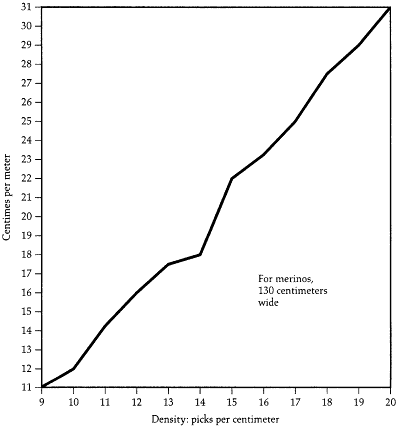
Figure 11.
Tarif of Seydoux, Sieber & Cie., Bousies, 1886
Source: ADN M 625/55
French piece-rate scales based on length of cloth delivered lacked the linear increases of the British scales because French producers did not view the product as the vessel of abstract labor incorporated in the material. Of course, by the second half of the nineteenth century, the fabric delivered may have represented "labor" effort in the eyes of the French producers. But that labor was not conceived of as a social substance, materialized in the product in standard fashion, capable of providing a detectable metric for the value of the good. Without the notion of an underlying substance corresponding to the physical dimensions of the cloth, the different sectors of the piece-rate scales were not unified in a linear system. Nor were those French
piece-rate scales that were founded on the unit of one thousand shots unified by linear relations between density and pay, as in Germany.[108] For the French view of labor as a commodity did not include the employers' appropriation of labor's use value, the supervised use of a concrete activity, which allows one to valorize each motion delivered to the employer. Instead, piece-rates for varying densities of cloth in France followed the vagaries of pricing for each traditional fabric "type" in well-established markets, the nonlinear tensile strengths of the manipulated yarn, and the readiness of heads of households to exploit the labor of family members as assistants in producing certain ranges of better-remunerated cloth densities.[109] If the French
[108] The Germans thought in terms of linear increases in pay per shot, not just for the density of the weave but for the breadth of the loom, another dimension French scales did not incorporate in linear fashion. Staatsarchiv Weimar, Landesregierung Greiz, n Rep. A, Kap. IXa, Nr. 165, p. 139, "Wechselstuhlarbeit," 1905.
[109] William M. Reddy, "Entschlüsseln von Lohnforderungen: Der Tarif und der Lebenszyklus in den Leinenfabriken von Armentières, 1889–1904," in Robert Berdahl et al., editors, Klassen und Kultur (Frankfurt am Main: Syndikat, 1982). Although the customs for entering French textile factories are not easy to document, evidence suggests that the French often combined the practices of the Germans and the British. As in Germany, latecomers paid a fine before they set their labor in motion, in keeping with the principle that the commodity of labor represented a potential. Georges Duveau, La Vie ouvrière sous le second empire (Paris: Librairie Gallimard, 1946), p. 260. As in Britain, the doorway became a symbolic point of contact between workers and owners and entry into the factory a ritual of submission. French employers used the shutting of the door to mark their authority but opened the door periodically for latecomers who paid the fine. The French understanding of labor as a commodity, like the British view, did not highlight the employer's systematic exploitation of the use value of the labor. Employers accentuated their control at the border zone, the entrance gate. Michelle Perrot, "The Three Ages of Industrial Discipline in Nineteenth-Century France," in John M. Merriman, editor, Consciousness and Class Experience in Nineteenth-Century Europe (New York: Holmes & Meier, 1979), p. 157. See Bibliothèque nationale, Gr. Fol. Wz 69, "Règlement de la fabrique de Blanzat" (Clermont: Typographie Hubler, Bayle et Dubois, ca. 1853); "Règlement de la filature" (Wazemmes: Impr. de Horemans, ca 1854); "Règlement pour la manufacture de Duval, Heurthauz et Cie" (Nantes: Impr. Forest, ca 1857); "Règlement du tissage mécanique de M. César Piat fils" (Roubaix: Impr. Béghin, 1866); "Règlement du tissage mécanique S. Willot et Cie" (Roubaix: Impr. Cocheteux, 1880). The concern with control of the perimeter emerges in another fashion through the printed factory injunctions of French textile employers: the rules had separate, sometimes extensive sections defining the responsibilities of the gatekeepers. See, illustratively, Bibliothèque nationale, Gr. Fol. Wz 69, Règlement des usines de Auguste Sourd à Tenay (Lyon: Impr. Chanoine, 1851); Règlement pour la police intérieure des ateliers de filature de M. Ch. Leyberr à Bootz (Laval: Impr. Godbert, 1855); Tissage mécanique de M. Constant-Delanoë à Barentin (Rouen: Impr. Surville, 1859). In contrast to Germany, the procedures for entering the factory became a prominent issue for strikes in France. Le Grand Écho du Nord , July 10, 1903. French workers contested the amount of the fine and the exact time at which the door closed on latecomers. Their strike leaflets discussed these issues in bold print. ADN M625/64, Armentières, factories of Dulac and Villard. Whereas in the piece-rate scales the French have neither the British nor the German idea of linearity, in the control of time and space they combine both techniques of control: employers make the doorway a symbolic divide, and they impose metric fines for loss of time, as ifthey have purchased a labor capacity but do not take for granted their disposition over the labor activity, as in Germany. When French employers adopted precisely delimited workdays, they defined the hours of employment by effective work time, as in Germany, rather than by mere presence within the factory perimeter, as in Britain. Mary Lynn Stewart, Women, Work, and the French State (Kingston: McGill-Queen's University Press, 1989), p. 109.
producers had managed perfectly well without resorting to linear gradations, the design of their scales might seem insignificant, attributable to simple lack of challenges requiring greater regularity.[110] But in fact linearity was not invoked as a natural principle even when it could have helped employers and workers in their efforts to agree upon schedules.[111]
The piece-rate scales held only a nominal status in the eyes of nineteenth-century French textile employers and their workers. Weavers and spinners saw them as an initial element in determining their remuneration, not as a critical measure of labor delivered and an essential yardstick for payment. Handweavers in the first half of the nineteenth century attempted to renegotiate the piece rate when they turned in the completed fabric, based on unforeseen difficulties encountered in the weaving process.[112] Even in the mature factory system it was not unheard-of for weavers to receive a fixed time wage provided they met a production minimum.[113] In some instances workers and employers saw the piece-rate scales as temporary conventions, to be adjusted as necessary to yield a target daily wage.[114] When strikers demanded higher earnings, on occasion they presented employers with alternatives: either the owners could dispense with fines on damaged fabric, or they could revise the piece-rate scales upward.[115] This open-ended request shows that workers looked at the scales as perfunctory contrivances influencing their earnings, not as definitive mechanisms designed to gauge the appropriation of a real substance, labor.
Workers' appreciation of labor as a commodity in France guided the formulation of strike demands. In contrast to their counterparts in Germany and Britain, French weavers on strike for higher piece rates focused their demands on particular densities of cloth, not on the overall construc-
[110] Until about the middle of the nineteenth century, some employers' weaving schedules were imperfectly linear even in Britain. See, illustratively, Kershaw Lees & Co., Weaving Prices Paid (Stockport, 1854).
[111] Le Réveil du Nord , "Les Grèves de la Gorgue-Estaires," July 11, 1903.
[112] Delsalle, op. cit., p. 213.
[113] ADN M625/86, February 4, 1908, Estaires.
[114] For spinning, see ADN M625/96 May, 1893, Roubaix. For weaving, the employers in Lille in 1909 declared that "the schedule is nothing, the wage everything." Seilhac, op. cit., p. 57. For examples of strikes hinging on whether the scales provide the agreed-upon daily average, see ADN M625/87, Fiche 1, 1907, Roubaix, ADN M625/86, 1908, Estaires.
[115] ADN M625/56, 1887, pièce 27.
tion of the schedules. Even when they lodged complaints about particular densities of many different types of cloth, they concentrated on isolated positions in the overall table.[116] In a strike at Avesnes in 1886, weavers asked for minute adjustments in ten different kinds of cloth rather than calling for an across-the-board revision.[117]
The French specification of labor as a commodity may have influenced not only the conduct of strikes on the ground but the economic theory propounded in the intellectual circles attached to the workers' movement. The chief economists who wrote for the French Workers' Party, a Marxist group supported by Engels, consistently misread Marx's economic theory. For example, Paul Lafargue, the country's most influential expert in Marxist analysis,[118] penned a defense of Marx's theory of surplus value in 1884. Lafargue assumed that production for exchange, including that of domestic workers, gave birth to capital and exploited labor. In his eyes, anyone producing goods for profit in a market (and not only a middleman) became a capitalist. Engels rebuked Lafargue for failing to realize that capitalism was distinguished by the social relations of production, in which ownership of the means of production allowed a proprietor to purchase and supervise another person's labor power. Yet Lafargue's analysis reflected perfectly well the French understanding of labor as a commodity, in which the immediate relations of domination were absent from the concept of purchasing another person's labor activity.[119] Marx's analysis of the extraction of surplus under capitalism resonated with the presumption
[116] ADN M625/55, June 17, 1886; ADN M625/66, Bousies; ADN M625/75, June 9, 1903, Tourcoing.
[117] ADN M625/55, Avesnes, 17 June 1886. Analogously, see ADN M625/51, March 27, 1882.
[118] Claude Willard, Les Guesdistes (Paris: Editions Sociales, 1965), p. 146.
[119] Friedrich Engels, Paul Lafargue, and Laura Lafargue, Correspondance (Paris: Editions sociales, 1956), letter of Friedrich Engels to Paul Lafargue, August 11, 1884, pp. 232–233. For parallel analyses of capitalism, see, illustratively, "Deux Conférences," in Le Socialiste , November 10, 1887, p. 2.
Further research is needed to explain why throughout the nineteenth century French workers put so much more emphasis than their counterparts in Britain and Germany on abolishing the subcontracting of labor. In March, 1848, the provisional government abolished "the right of subcontractors to organize labor" as "unjust, vexatious, and contrary to the ideals of fraternity." After the fall of the Second Republic and continuing into the twentieth century, workers demanded that middlemen be prohibited from selling the products of domestic workers to merchants. Perhaps the French drive against marchandage grew out of the emphasis on workers being able to conduct themselves as entrepreneurs to get an equitable price for their labor. Bernard Mottez, Systèmes de salaire et politiques patronales (Paris: Centre de la Recherche Scientifique, 1966), pp. 21–22, 59–60; P. Hubert-Valleroux, Le Contrat de travail (Paris: Rousseau, 1895), p. 62; Industrie textile , April 15, 1903, pp. 155–157.
in France that employers purchased a labor activity, but the French assumed that the exploitation of this activity was effected in the market.