
3—
Annie's Reaction to Enoch's Shipwreck
Both films feature cross-cutting to establish a psychic connection between Annie and her shipwrecked husband, though in the 1908 version Annie already knows of Enoch's misfortune. In the third shot of After Many Years , Annie leans over a crib and Philip enters holding a newspaper that he shows her, shaking his head. Annie conventionally displays feminine distress, placing her hand to her face and backing away from him. Phillip leaves Annie alone to externalize her misery with the aid of two props. Standing in the right background, she holds the newspaper in her fully outstretched arms and talks to a picture, which only repeated viewings have revealed as a portrait of Enoch. Because neither newspaper nor portrait is clearly shown, the histrionically coded performance serves as the
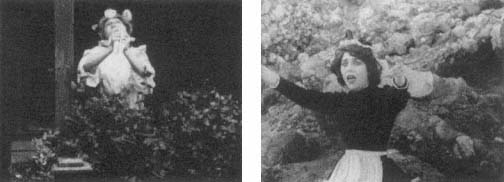
Left: After Many Years : Annie grieves for Enoch. Right: Enoch Arden : Annie grieves for Enoch.
dominant signifier in the shot, at least for a present-day viewer accustomed to the conjunction of narrative significance and compositional centrality.
Later in the film, Griffith for the first time experimented with cross-cutting between characters in different locations to create an emotional link between them.[25] In the eighth shot, Enoch on his island performs a gestural soliloquy of frustration and despair, ending by kissing a locket around his neck. The ninth shot shows Annie in medium close-up, the closest shot of this film, standing on the front porch where she had bid Enoch goodbye. She reaches out her left arm until it is fully extended perpendicular to her body, then her right hand in the same gesture, clasps a handkerchief between both hands and collapses crying. Aside from a rather general indication of loss and despair, the unchecked histrionic gestures here have no intrinsic meaning, gaining their intelligibility only from the conjunction with the previous shot. A more checked degree of the histrionic code might have worked here, but given the relative novelty of the closer camera and the experimental nature of the cross-cutting, it is not strange that the performance is constructed as if it alone revealed Annie's emotions.
In Enoch Arden , Annie reacts in much the same manner. In shot 33 Enoch is washed up on the island. In shot 34 Annie stands on shore facing the camera, then sits down, her back to the camera. Shot 35 returns to Enoch, and in shot 36 Annie realizes Enoch's peril. In medium long shot (the camera now having crossed the line to show her front), she shouts her husband's name, both arms extended outward like the 1908 Annie. Her eyes widen, she shouts again, her body bends forward, she gathers her children to her and looks heavenward. Since this shot constitutes Annie's emotional high point, it follows that the histrionic code, associated in the melodrama with extreme and exces-
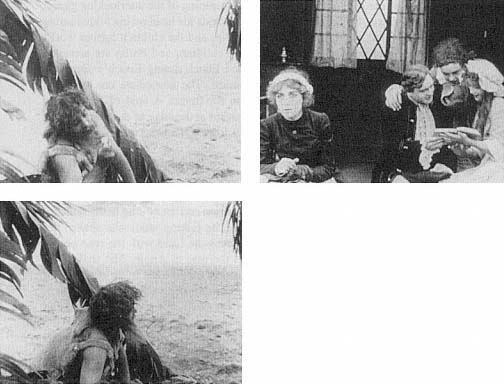
Above left: Enoch Arden: Enoch looks at the locket.
Above right: Enoch Arden: Annie thinks of Enoch.
Lower left: Enoch Arden: Enoch "looks" at Annie.
sive emotion, should be used, even though the repeated intercutting with Enoch closes off the meaning of the performance more than the editing in the 1908 version.[26]