
Explosive Eruptions and Geothermal Energy Sources
Pyroclastic rocks are the products of explosive volcanism. Many different types of volcanoes exhibit explosive behavior, as discussed by Fisher and Schmincke (1984). Table 2.1 summarizes the major types of volcanoes and their explosive behavior.
In his review of significant explosive eruptions, Wilson (1980) discussed Plinian, Strombolian, and Vulcanian models (for example, Self et al ., 1979), and showed the relationships among observed kinetics, such as ash ejecta velocity, eruptive plume over-pressure, and volatile content, by using forms of the energy equations explained in Chapter 1 of this book [Eqs. (1-5) and (1-6)].
Figure 2.1 shows an idealized Plinian eruption in which ejecta dynamics are directly related to the fragmenting magma dynamics in the throat of the volcano. The isothermal form of the energy equation is appropriate for Plinian eruptions because most
| ||||||||||||||||||
pyroclasts are small enough to transmit their thermal energy to expanding gases within the time frame of the eruption.
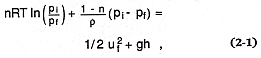
where n = the weight percent of water in the magma, r = the average density of the solid and gas mixture, pi and pf = the initial and final (atmospheric) gas pressures, and uf is the ejecta velocity at height (h) in the ejecta plume. Other parameters are those defined in Chapter 1 and summarized in Appendix C.
For Strombolian eruptions (Fig. 2.2), ejecta velocities are related to magma gas overpressure by an adiabatic form of the energy equation.
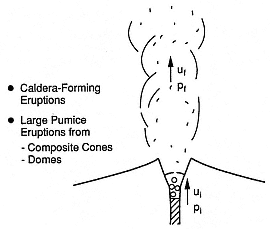
Fig. 2.1
Idealized Plinian eruption conduit and column. This diagram shows magma (cross hatch)
rising up the volcanic conduit, the growth of vesicles (circles) before complete disruption
(dashed line), and the ejection of gas and tephra mixture (stippled) from the vent.
The initial pressure (pi ) and velocity (ui ) of the gas and tephra mixture within the vent,
which are primarily functions of the gas content of the magma and the vent radius,
are related to the final pressure (pf ) and velocity (uf ) by an isothermal form of the
energy equation [Eq. (2-1)] because the gas draws heat from the entrained tephra and
maintains a nearly constant temperature during expansion. (Adapted from Wilson, 1980.)
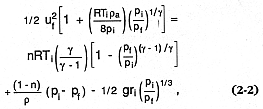
where r a = the air density, g = the ratio of specific heats for the gas, ri = the vesicle radius before burst, and n @ 0.2 for erupted materials (Blackburn et al ., 1976).
In the Vulcanian mechanism (Fig. 2.3), which applies to eruptions where the expanding gas may be either or both magmatic and hydromagmatic, a motion equation can relate pressure and velocity.
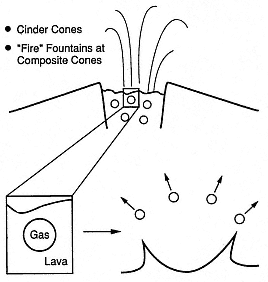
Fig. 2.2
Idealized Strombolian eruption model. Individual
centimeter-to-meter size gas bubbles burst at
the surface of the magma within the vent,
propelling scoria in ballistic trajectories. An
adiabatic form of the energy equation [Eq. (2-2)]
relates ejecta velocities to the initial pressure,
temperature, and radius of the gas bubbles.
(Adapted from Wilson, 1980.)
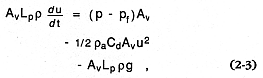
where Av = the vent area, Lp = the plug thickness, p = pi [xs /(xs + ym )]g, xs = the thickness of the steam cap for which the ratio xs /Lp is related to weight fraction water (n) by xs /Lp = [(rg RTi )/Pi ][n/(1-n)], rg = the steam density, and Cd (the drag coefficient) @ 1, and ym is the vertical distance over which the rock mass is moved. In Eqs. (2-1) through (2-3), our observations of ejecta velocities allow us to estimate the explosion overpressure, which we can assume is the volatile overpressure (magmatic or hydromagmatic). The thermal energy involved in the explosion (Et ) is related to the bulk isentropic exponent g = [(Cp + mf Cm )/(Cv + mf Cm ] by

where r b = the bulk density of the erupting mixture of vapor and tephra fragments, Cp and Cv = the heat capacities of the vapor at constant pressure and volume, respectively, Cm = the magma heat capacity, and mf is the mass fraction of fragments in the mixture of vapor and ash. On the other hand, the kinetic energy (Ek ) of the eruption is some fraction (x c ) of Et because not all the available thermal energy is converted to the kinetic energy of cratering and ejection of tephra. The exact value of xc , often called the thermodynamic efficiency or conversion ratio , is generally <0.1 but can vary over an order of magnitude depending upon eruption circumstances (Wohletz, 1986). Ek can be estimated from observed ejecta velocities (ve ) as


The above relationship between thermal energy and estimates of eruption energy
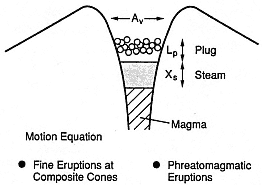
Fig. 2.3
Idealized Vulcanian eruption model, in which
magma (cross hatch) is covered by a steam
pocket of thickness xs , which is in turn
capped by a plug of solidified lava of
thickness Lp in a vent of area Av . An
equation of motion [Eq. (2-3)] relates these
dimensions to the pressure and density of
the gas pocket and acceleration of the
tephra after failure of the lava plug.
(Adapted from Wilson, 1980.)
depends on observations of actual eruptions and their ejecta. In cases where necessary ejecta masses and velocities are unknown but a crater is preserved, it is possible to empirically estimate explosion energy by using explosive-testing analogs for which there is data to relate crater dimensions to explosion energies. Assuming that the cratering efficiency of high explosives is the same (within a factor of 10) as that of volcanic explosions (Wohletz, 1986), crater dimensions scale as the cube-root of explosive energy. Johnson (1971) plotted observed crater radius, depth, and volume with respect to explosive yield, as is shown in Fig. 2.4.