
Chapter Five—
Remember the San Joaquin
George Warner
Historical numbers of salmon spawning in the San Joaquin River system probably equaled the size of runs utilizing the Sacramento River and its tributaries. The impact of water development, however, drastically reduced San Joaquin runs long before major losses occurred on the Sacramento. I have been unable to find any records of the size of the fall run on the main stem of the San Joaquin, but it is recognized that this run was the first to be eliminated by low flows and high water temperatures. On the other hand, the spring run remained in relatively good condition despite diversion dams and canals. Uncontrolled snowmelt runoff aided the upstream adult migration and simultaneously allowed juvenile salmon to migrate to the Delta before irrigation demands reached their peak.
Among early agricultural developments influencing the size of the spring run on the San Joaquin River was Mendota Dam, located in the Mendota-Firebaugh area. By the 1920s it was diverting water into three large irrigation canals. A few miles downstream another barrier, the sack dam (a seasonal dam made of burlap sacks filled with gravel and other material), supplied water to a fourth canal. Several other pumps along the river furnished water to riparian users. None of these diversions was screened.
Mendota Dam, a low concrete and flashboard structure, had a primitive pool and jump-type fish ladder extending downstream
This essay originally appeared in The Caddis Flyer, 1987, published by the Tehama Fly Fishers Club. Reprinted with permission. Epilogue, July 1989.
from the center of the dam. Since the entrance to the ladder was some distance below the barrier, fish had trouble locating it. Also, the pools were too short and the weirs too high. Many salmon did use it, however, and others succeeded in leaping over the dam by taking advantage of the hydraulic pattern of the flow over the crest. Minor fish passage problems occurred at the sack dam.
In the late 1930s the Division of Fish and Game recognized the magnitude of the problem facing the salmon runs in the Central Valley, and several biologists from the Marine Fisheries Branch were assigned to inland water project investigations. Their major objective was to determine the size and timing of the adult salmon runs in the various rivers as well as the downstream juvenile migration pattern. These studies were curtailed during wartime, but by 1946 attention was again given to problems such as screening the canals at Mendota. Here a fyke netting program conducted by Richard Hallock found significant losses of salmon migrants during the irrigation season.
In 1948, disaster struck. Friant Dam, a major unit of the Central Valley Project, had been completed and the Bureau of Reclamation assumed control of the river. Ignoring pleas from Fish and Game and local sportsmen groups, bureau officials diverted water desperately needed by salmon down the Friant-Kern Canal to produce surplus potatoes and cotton in the lower San Joaquin Valley. Only enough water was released in the river to supply downstream canals and some of the pumps. At that time there was no effective Wildlife Coordination Act, and the bureau argued that the enabling legislation for Friant Dam said nothing about protecting fish and wildlife.
Litigation over water rights followed and lasted through the 1950s. Attorney General Pat Brown and Governor Earl Warren, pushing for the development of the Central Valley Project, supported the bureau. The state's position was that water for agriculture was next in priority to domestic use, and salmon had no legal claim to San Joaquin water.
While negotiations continued, the Fish and Game crew, of which I was a member, tackled the almost impossible task of saving the 1948 spring run. Although time and funds were limited, it was apparent that the run would have to be trapped below the dry reaches of the river and transported somehow to the live stream
above either the sack dam or Mendota Dam. It was apparent that large numbers of fish would be involved, since the 1946 spring run past Mendota consisted of fifty-six thousand salmon and the 1947 run numbered twenty-six thousand.
The 1948 spring run salvage plan for the San Joaquin included three elements: a trapping and loading facility, tank trucks for transportation, and a suitable release site that would bypass the dry section of the river. A hurried inspection of the San Joaquin from San Joaquin City to Los Banos revealed that salmon would be stranded a few miles above its confluence with the Merced River. A weir was erected across the river at Hills Ferry above the mouth of the Merced so there would be enough streamflow to allow salmon to reach that point. The site had a number of advantages such as a fairly level streambed and vehicle access.
The weir, two hundred and fifty feet long, was constructed of stretched mesh netting suspended from a steel cable and anchored to the bottom with logging chains and sandbags. Adjacent to the west bank, at the upper end of the weir, a rectangular trap was constructed of pilings, stringers, and vertical slats positioned to permit flow through the structure while still confining fish. A funnel of webbing at the downstream end allowed fish to enter but not to leave. A gate was installed at the upper end that could be raised to permit fish to be crowded into a collecting device. This device, which we termed a "bucket," was a large watertight metal box with a circular trapdoor in the bottom and a mesh cover. Twenty or thirty salmon could be handled at one time.
To complete our collecting facility, a mast and boom salvaged from a San Francisco shipyard were erected on shore. Also salvaged was a winch that could be operated with a power take-off on my Jeep. We could hoist fish and water in our bucket and swing it in any desired direction. We were able to borrow from Coleman Hatchery three tank trucks with aeration gear for transporting trapped fish. These trucks had been standing idle during World War II, and the tires were in sad shape. Otherwise they were fine for the job, since the bucket could be positioned over the tank hatches.
It was determined that the Outside Canal could be used as a release site. This canal originated behind Mendota Dam and passed within eighteen miles of Hills Ferry. Fish would encounter no obstacles if they were hauled and released there. Once they
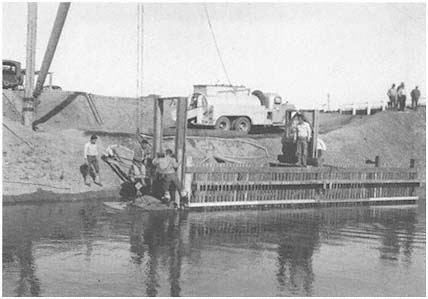
The anatomy of extinction. This California Division of Fish and Game
crew, adapting war-surplus equipment to fish rescue work, attempted to
save the spring-run San Joaquin chinook salmon in 1948. The species
became extinct when diversions from Friant Dam
"dewatered" the San Joaquin River.
(George Warner)
arrived at Mendota via the canal they could proceed upriver to the deep pools below Friant, where they could spend the Summer.
All systems go! The salmon arrived and the plan worked perfectly except for occasional trouble with the trucks. The operation went something like this:
1. Position truck under boom and fill tank half full of water.
2. Start aerator and start Jeep.
3. Crowd salmon into bucket.
4. Hoist bucket and swing over tank hatch.
5. Release salmon and water into tank.
6. Add water to fill tank.
7. Haul to release site.
8. Count fish as they leave truck.
Besides hauling fish, the crew was constantly cleaning debris from the weir, answering questions from the public, and discouraging poachers who stood around plotting how to raid the trap or tamper with the weir at night. There was no such thing as an eight-hour day, five-day week, or overtime.
After 1,915 salmon had been hauled successfully, disaster struck again. A heavy snowpack in the Merced River drainage started to melt rapidly, and the Merced flooded, backing the flow up the San Joaquin and inundating our weir and trap. With no barrier to block their way, the spring run moved to the dry reaches of the river, where spears and pitchforks ended their journey. A frustrated Fish and Game crew echoed the feelings of Fresno sportsmen who had suggested in a full-page newspaper ad that the agency responsible for the dry river should be called the Bureau of Wrecklamation.
Most of the spring-run salmon transported to the Outside Canal in 1948 spent the summer in the deep pools immediately below Friant Dam. From the north bluffs they resembled an accumulation of cordwood, lined up side by side facing the current, remaining almost motionless. By late September the salmon became active and were obviously ready to spawn. Since Friant Dam denied them access to the upper river, they dropped downstream to utilize the gravel riffles in the ten-mile stretch between Friant and Old Lanes Bridge.
Spawning was successful. In early 1949, substantial numbers of downstream migrants showed up at Mendota, where experiments with fish screens continued. Juveniles passing Mendota Dam reached the sack dam on the flow the bureau released for the Arroyo Canal. Below the sack dam, however, the trickle of water soon disappeared in the sand, stranding salmon migrants more than one hundred miles from the sea. The tragic conclusion to the history of the 1948 spring run was that the only beneficiaries of our efforts to salvage a valuable resource were the raccoons, herons, and egrets.
With little hope of obtaining water for progeny of a 1949 spring run, we decided not to repeat the 1948 trapping and hauling. The only hopeful alternative plan was to attempt to force the San Joaquin run to migrate up the Merced River, accompanying that stream's small native spring run. We installed a webbing weir, similar to the previous year's barrier, across the San Joaquin at the mouth of the Merced.
Salmon arrived as expected, but they refused to enter the Merced. Despite very poor water quality they pushed and probed at the webbing, trying to get up their home stream. The small San Joaquin was mostly warm return irrigation water loaded with salts and chemicals. In contrast, the Merced flow was clear, purer, and much cooler. But it was not home stream water. A few of the persistent San Joaquin fish were dipnetted, tagged, and released three miles up the Merced. These fish immediately turned downstream, almost beating the truck back to the weir!
Maintaining a fish-tight weir without night illumination was a problem. Poachers would slip in and slash the webbing to allow salmon to move upstream to shallow water where they could be speared or caught by hand. This damage would only be discovered and mended during debris removal operations the next day. This experience and others taught us about the salmon's uncanny ability to find even the smallest hole to get through a barrier. Another threat to the integrity of the weir was a tremendous migration of one- to twenty-pound carp that suddenly appeared. Tens of thousands of carp pushing on the webbing nearly lifted the heavy chain and sandbag anchors off the bottom. Some relief (and more problems) occurred when the Fish and Game Commission authorized a local fisherman to harvest carp at the weir.
Throughout May and early June, salmon continued to mill around, ignoring the ideal Merced flow. Those finding holes in the webbing quickly perished a few miles upstream. Below the weir, many salmon were taken by anglers using the "Armstrong Method"—snagging. Other fishermen used chickenwire dipnets on the pretext of bumping shad. While such poaching could not be condoned, it was difficult to condemn the taking of salmon illegally when a federal agency could eliminate an entire run of thousands of fish without qualms—and with no penalty whatsoever.
Probably none of the San Joaquin run ever migrated up the Merced River. These fish were either captured or succumbed to high water temperatures. The Fish and Game crews tried, but failed, to save the 1949 run. The final effort to salvage the lone remaining year class of San Joaquin spring-run salmon was scheduled in 1950. We knew that if we failed, this unique renewable resource would be lost forever. We also knew that the problems which had plagued us in previous years were still there: the dry
section of river still prevented adult salmon from reaching the holding and spawning area above Mendota, and downmigrant juveniles still could not reach the sea.
Early in 1950, a minor concession by the bureau caused a completely different approach to salvaging the spring run. The bureau's offer of a temporary, tiny, release of twenty-five cubic feet per second of water for fish life gave us the opportunity to do something besides building weirs. It is debatable whether this release resulted from pressure from sportsmen and the Division of Fish and Game or whether, because of a good water year, more water was available than was required by agriculture. Twenty-five cubic feet per second in the riverbed below the sack dam would merely dampen the sand, but it might prove useful if it could be routed around the dry area. Assuming we could save the adult salmon, there was still no guarantee of water for downstream juveniles, but perhaps we had a foot in the door.
The quickly developed plan proposed diverting the fish release at the sack dam into the Arroyo Canal and then spilling it into Salt Slough to augment the slough's small flow of irrigation drainwater. Salt Slough was a meandering, tule-filled drainage ditch with abundant populations of carp, frogs, beaver, and voracious mosquitoes. But it was tributary to the San Joaquin River below the dry section, and the Arroyo Canal crossed it in a large flume, making it feasible to discharge the fish flow at that location.
To implement this plan, a concrete diversion structure and control works for a fish ladder were constructed at the approach to the canal crossing. A fish ladder leading up from Salt Slough to the flow control device was then fabricated of rough lumber. It consisted of six pools and "jumps" anchored in place with timber pilings. Two webbing weirs were also erected. The one installed at Salt Slough was attached to supports for the canal flume and shunted fish into the ladder. A second was placed at the mouth of Mud Slough, a tributary to Salt Slough, to prevent salmon from straying into that drainage.
The ladder functioned perfectly. The depth of pools and vertical rise between pools were within acceptable limits. The maintenance of effective weirs was another matter, however. Keeping the webbing barriers clean and functioning, a most disagreeable task, involved wading chest deep in filthy water to remove rotting carp
and decomposing vegetation. It was also necessary to patch holes cut by beavers who objected to barriers on their water highways.
It would be gratifying to report that salmon streamed up the ladder in large numbers. This did not happen. Migration was deterred by high water temperatures, low flows, and, I suspect, poor water quality. In retrospect, I shudder to think what the levels of dissolved oxygen and total dissolved solids must have been, or the selenium concentrations. Furthermore, poaching was rampant along Salt Slough. Because the tule channel was narrow and shallow, salmon made "bow waves" as they moved along—easy targets for spears and pitchforks.
Only thirty-six salmon were counted at the ladder, and many of these were so weak they could barely swim from one pool to the next. I claim the dubious distinction of having had a personal involvement with the last four San Joaquin spring-run salmon. Some could just make it to the ladder, and I had to use a dipnet to carry them, one at a time, up the bank to release them in the canal. Probably none of the thirty-six lived to spawn.
So ends the saga of the San Joaquin River spring salmon. The Central Valley Fish and Game crew did the best it could, but that wasn't enough. Bureau of Reclamation officials and agricultural interests could now chortle that the troublesome Division of Fish and Game and irate local sportsmen no longer had anything to complain about. You may ask, "Why hasn't the bureau mitigated the loss of the San Joaquin run?" I could add, "Why haven't they mitigated damage to fishery resources caused by Shasta Dam, the Tracy pumping plant, or other of their projects?" I know the answer, but I won't state it here because you might resent the implication that I am pointing my finger at you.
Epilogue
Forty years have passed since the last spring salmon run ascended the San Joaquin River. During this time the Bureau of Reclamation, operator of Friant Dam, and its water contractors have never acknowledged their responsibility for causing the extinction of this irreplaceable resource, nor have they offered to mitigate the loss. In fact, as I write this, the San Joaquin water users are trying
desperately to renew their existing water contracts with the bureau without undertaking an essential environmental impact study.
In addition to the salmon debacle associated with Friant Dam, the Bureau of Reclamation continues to operate the Central Valley Project with little regard for anadromous fish. The huge losses of juvenile fish at the Tracy pumping plant, fish passage difficulties at the Red Bluff Diversion Dam, and unfavorable water temperatures in releases from Shasta Dam are some of the problems created by CVP. As a climax to these unmitigated conditions, the bureau now claims to have found 1.5 million acre-feet of unallocated water in the CVP system that it wants to sell. (Delta outflow and other fishery needs be damned.)
On the brighter side, we no longer find the Department of Fish and Game and a few local sportsmen fighting and losing a rearguard action to save anadromous fishery resources. In the 1940s and 1950s I don't remember ever hearing anyone labeled an "environmentalist." We certainly have them today. Whatever you call them—nature lovers, protectionists, conservationists, sportsmen, commercial fishermen, or even bird-watchers—they are becoming well organized and their influence is being felt at state and federal levels and in the courts. The day has passed when disasters like the operation of Friant Dam can go virtually unchallenged.