
The Cutter of IG II2 495
Dates: 304/3-303/2
General characteristics of the lettering (fig. 17)
When one considers the letters individually, this lettering is plain and solid enough. There is, however, a tendency for strokes to overlap slightly and for horizontals to be not quite horizontal. When, moreover, one considers the lettering as a whole, one becomes aware that the letters vary greatly in shape. Just as the hastae are placed imprecisely, so the letters seem to float both vertically and horizontally in the stoichoi . Although the texts of this cutter are stoichedon , the vertical alignment is not precise, with the result that the vertical lines meander some. This cutter had particular problems with iota, which he often places on the left side of the letter-space instead of in the center. In summary, while I would not characterize this lettering as sloppy, it is hardly careful.
Peculiarities of individual letters
Alpha | This letter is relatively wide. The crossbar usually is placed in the middle-to-upper part of the letter; it often slants and is thicker and deeper on the right side. |
Gamma | The horizontal is often longer than the vertical. |
Epsilon | This letter is very idiosyncratic. The three horizontals tend to be nearly the same length and longer than the vertical. Occasionally the central stroke is somewhat shorter than the other two. |
Kappa | The slanting strokes usually meet the vertical at the midpoint or below. |
Mu | This is a wide letter, with a central v which reaches to the base of the letter. The outer slanting strokes often join the inner strokes below the tops. |
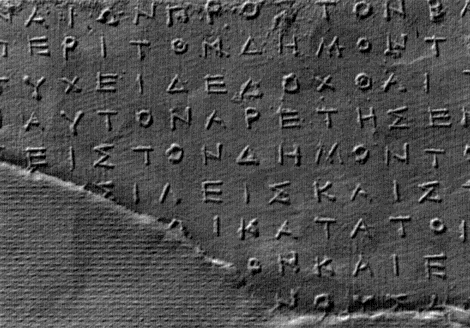
Figure 17.
IG II2 495 lines 15-23 (left part).
Nu | This letter is quite wide. The diagonal usually is placed below the top of the first vertical and often crosses the second. The second vertical often does not extend down to the base of the letter. |
Omikron | This letter varies in size but is usually quite a bit smaller than the other letters and placed in the upper part of the letter-space. |
Rho | This letter tends to be taller than the others; the loop varies in size and is often quite small. |
Sigma | The top and bottom strokes often slant, but sometimes they are virtually parallel to one another. The two strokes which make up the lower half of the letter are each usually positioned in from the ends of the strokes to which they are attached. The variety of this letter is one of the hallmarks of this cutter. |
Upsilon | The three strokes which compose this letter are of about equal length and thicken at the ends. This letter tends to be slightly taller than the others. |
Phi | This letter is the same height as the others. |
List of inscriptions
+IG II2 486 | Archon Pherekles (304/3). Osborne, Naturalization no. D45. See Horos 4 (1986) 13-14 for an improved restoration of lines 11-14. |
+IG II2 495 | Archon Leostratos (303/2). Osborne, Naturalization no. D60; Moretti, ISE no. 6.[1] |
Agora I 4484 | Unpublished. |
Agora I 4906 | Hesperia 26 (1957) 208-209. |
Agora I 5215 | Joins Agora I 6516. |
+Agora I 6516 + 5215 | Archon [Leostratos] (303/2). Hesperia 21 (1952) 367-368 and 58 (1989) 89. |
+Horos 4 (1986) 11-18 | Archon [Pherekles] (304/3). SEG 36 no. 163. |
Adnotatiunculae
IG II2 486, Horos 4 (1986) 11-18
These two decrees were passed at the end of the year at the same meeting as two others, viz. IG II2 597 (+ add. p. 662)[2] and Hesperia 7 (1938)
[1] M. B. Walbank, ABSA 85 (1990) 446, asserts (without discussion) that IG II 709 is by the same hand as IG II 495 and suggests that they are part of the same stele. IG II 709 is very worn. The one dearly preserved epsilon (the one in line 3) has a relatively short central horizontal and is uncharacteristic of this cutter. Both kappas reveal a lower slanting stroke which verges on the horizontal. The IG II 495 Cutter habitually makes his kappa with a lower slanting stroke that extends down at a much sharper angle. Finally, the omega with little points on its feet in line 3 (the one in line 4 also appears to have them, but it is worn and scratched) contrasts with the practice of this cutter, who makes definite lines of varying size at the base of his omegas. In short, I think it impossible that IG II 709 is the work of this cutter. The association should be discounted.
297.[3] All but IG II2 597 are well enough preserved to reveal that Stratokles of Diomeia proposed, at Demetrios Poliorketes' specific request, these honorary decrees for his followers. The two inscriptions which are the work of the present cutter are both relatively short decrees granting citizenship and could therefore have been inscribed by him in a timely fashion. The other two are not the work of this cutter, nor of any other known to me.
IG II2 495, Agora I 6516 + 5215
These decrees were passed on successive days at the dose of the year 303/ 2, the former on the thirty-first day of the prytany, the latter on the thirty-second. Both have a line length of 29 stoichoi and could, like the pair above, have been inscribed in a relatively short time. Two further decrees passed at the same session as IG II2 495, viz. IG II2 496 and 497, were inscribed by the IG II2 1262 Cutter (above 145).
[3] A. M. Woodward, ABSA 51 (1956) 5-6, suggested a restoration of the name. Koumanoudes, Horos 4 (1986) 14-17, has demonstrated that the restorations of Schweigert (the initial editor) and Woodward for line 16 of this text are incorrect.