
The Beginnings of the Chuangs
The Chuang lineage, particularly the second branch (erh-fen ) to which Chuang Ts'un-yü's family belonged, first came to prominence in Ch'ang-chou in the late fifteenth century. Like many other lineages
south of the Yangtze River, the Chuangs traced their line back to families that migrated from north China during the great social and economic dislocations that preceded the eventual fall of the north to the Jurchen. The Chuangs had already established a beachhead in Chiang-su Province in the eleventh century. They settled in Chen-chiang, on the southern bank of the Yangtze, from where the Grand Canal continued south toward Ch'ang-chou, Su-chou, and Hang-chou.
Robert Hartwell notes that the chief indicator of the profound social changes in China from 750 to 1550 was the major demographic shifts from north to south China. In the six centuries that preceded the establishment of Ming rule in 1368, successive waves of migration had filled in the frontiers of various southern macroregions. These dynamic inter-regional settlements were accompanied by rapid population growth and a "filling up" of the rice-producing areas in the Yangtze Delta.[1]
As participants in these important demographic shifts, some of the Chuangs left Chen-chiang (ca. 1086-92?) and settled in Chin-t'an County, further inland and south of the Yangtze River. Such moves to hinterland counties in search of fortune were a typical migration pattern for segmented branches of core lineages. Chuang I-ssu, in the fifth generation of the Chuangs who resided in Chin-t'an, achieved distinction as prefect of Ch'ang-chou Prefecture from 1102 until 1106. Later he was appointed to the Hanlin Academy. Thereafter, segments of the Chuang lineage continued to scatter throughout the Lower Yangtze.
Initially a lesser segment that had become allied to another family in the hinterlands, the Chuangs in Ch'ang-chou were a lineage to be reckoned with by the late fifteenth century. In the eighth generation of the Chin-t'an descent group, Chuang Hsiu-chiu married into a Ch'ang-chou family, surnamed Chiang, which had no male heir. Accordingly, he took the place of a son (chui ) for this family and moved to Ch'ang-chou. Uxorilocal marriage was a common strategy among important lineages in the Lower Yangtze since at least Sung times. The son of a family with higher social status could establish a new segment of the lineage by moving to another community and marrying the daughter of a family with no heir. But rather than carrying on the family line for the heirless family (the usual procedure in uxorilocai marriages), the son continued to use his own surname in a new community. By moving to Ch'ang-chou, Chuang Hsiu-chiu could take advantage of an entrenched
[1] Hartwell, "Demographic Transformations of China," esp. pp. 391ff.
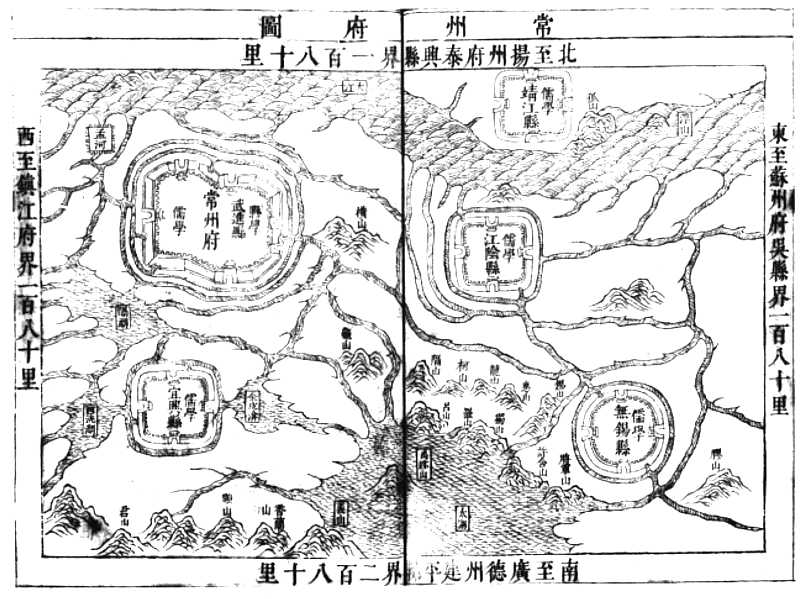
Map 4
Gazetteer Map of Ch'ang-chou Prefecture and Counties
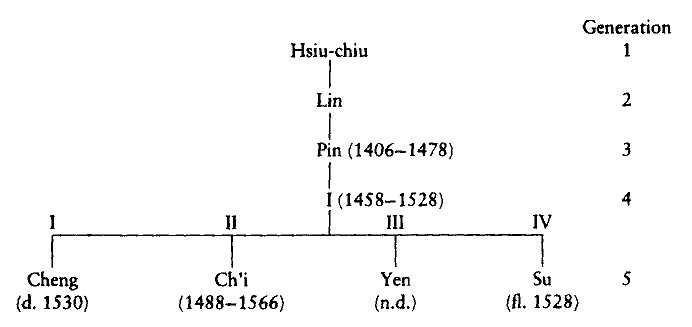
Fig. 4.
Major Segments of the Chuang Lineage in Ch'ang-chou during the Ming Dynasty
family that had become fused with the Chin-t'an Chuangs. Thus, by the fifteenth century another segment of the Chuangs bad come into existence, dating themselves back to Chuang Hsiu-chiu's move to Ch'ang-chou.[2]
The rise of the Ch'ang-chou Chuangs to high social standing began in the fourth generation (in Chuang Hsiu-chiu's line), when Chuang I took the chin-shih degree in 1496. Chuang I's academic success, and the high political office that such success brings, provided the financial resources from which four major branches in the Ch'ang-chou lineage developed (fig. 4). The second branch of the Ch'ang-chou Chuangs, who descended from Cbuang I, rose to particular eminence during the Ming and Ch'ing dynasties. They were able to produce in nearly every generation a highly placed government official who owed his success to high achievement on the imperial examinations. Through marriage politics, this second branch of the Chuang lineage had established relations with other important lineages in Ch'ang-chou—a sign of the emerging status of the Chuang lineage vis-à-vis other more established lineages in the area. The
[2] Ibid., pp. 405-20. On the Chuangs see Chu-chi Cbuang-shih tsung-p'u , partially unpaginated manuscript dated 1796, 2.1a-8a, 3.1a-2b. See also P'i-ling Chuang-shih tseng-hsiu tsu-p'u , (1935), 12A.36a, and Wu-chin Chuang-shih tseng-hsiu tsu-p'u (ca. 1840), 16.25b. Uxorilocal marriage could create allies out of other powerful and wealthy families lacking a male heir. See James L. Watson, "Anthropological Overview," pp. 284-85, and Dennerline, "Marriage, Adoption, and Charity," pp. 173-74 (both articles appear in Kinship Organization in Late Imperial China , ed. Ebrey and Watson). Cf. Pas-ternak, "Uxorilocal Marriage in China," and Zurndorfer, "Local Lineages and Local Development," p. 33.
Chuangs could now define themselves within a community of prestigious affines built around strategic marriages.
The eldest daughter of Chuang Ch'i (1488-1566), for example, was married to Tang Shun-chih (1507-60), one of the most celebrated scholar-officials of the Ming period. In addition, Chuang Ch'i's grandson, Chuang I-lin, a major patriarch in the second branch of the Chuangs, married a woman from the T'ang lineage and was intimate with Tang Shun-chih, whose distinguished family belonged to one of the most important Ch'ang-chou lineages during the Ming dynasty. T'ang and Hsueh Ying-ch'i (1500-73) were influential in all aspects of Ch'ang-chou's cultural life and were mentors to many of the subsequent leaders of the Tung-lin movement in Wu-hsi County.[3]
T'ang Shun-chin was a leading Confucian whose interests ranged from literary pursuits to statecraft issues. He championed the role of the charitable estate in lineage organizations by appealing to the classical ideal of broadly based kinship solidarity.
The ancients relied on kin [tsu, lit., "patriline"] to establish kinship groups for them. Those kinsmen who had surplus wealth then returned it to the kindred, and those who could not provide sufficiently for themselves partook of the kindred's wealth. These kinsmen treated one another as parts of a single body, like bone and sinew, hand and foot. Their resources covered ali like digestive juices, overflowing into interstices, filling up only the empty places, and there was no depressed or swollen places, no excesses or deficiency. Thus, in the whole kin group there were no wealthy and no poor families. Moreover, no kin group under heaven was without a kindred, and in this way there were no wealthy or poor families in the empire. Isn't this what was meant by saying that when everyone treats relatives as relatives the empire is tranquil?[4]
As an ancient ideal, kinship solidarity had begun to fade when private interests, according to T'ang, had increasingly penetrated Chinese society:
Only after the demise of the well-fields [ching-t'ien ] were there means for ranking property in the village. Only after the demise of kinship regulations [tsung-fa ] were there means for ranking by property within the kin group. At
[3] Chu-chi Chuang-shih tsung-p'u (1796), 3.lb. See also P'i-ling T'ang-shih chia-p'u (1948 ed.), vol. 9, pp. 1a-1b (Wu-fen shih-piao ), and T'ang Shun-chih, Ching-chuan hsien-sheng wen-chi, 15.27a-31b, for bis epitaph for his wife from the Chuang lineage, who died in 1548. Cf. P'i-ling Chuang-shih tseng-hsiu tsu-p'u (1935), 13.4a-5b, and Goodrich et al., eds., Dictionary of Ming Biography , pp. 619-22, 1252-56.
[4] T'ang Shun-chih, Ching-ch'uan hsien-sheng wen-chi , 12.24b. Cf. the translation in Dennerline, "New Hua Charitable Estate," pp. 45-47, and Wu-hsi Chin-k'uei hsien-chih (1881), 37.2a-3b.
the extreme there are cases where slave boys tire of meat and gravy while kinsmen grab for the ladle. The benevolent gentleman sympathizes and thereupon makes use of his position to create charity land to succor his kin. Thus, even though there is something that the great kindred bequeaths to them, yet as charity lands are established the term "great kindred" [ta-tsu ] is further obscured.
Ideals of ancient society, symbolized best by the well-field system canonized by Mencius, had declined to the point that T'ang Shun-chih admitted that kinship relations were by his time a pale shadow of the public-minded (kung ) values they once stood for. T'ang understood how the forces of commercialization and market specialization had affected idealized traditional values and transformed the context within which kinship values were expressed:
In essence, it is the case with charity land that it exists because there is a man of means, while under the kinship regulations [in antiquity] even the most valuable properties were shared, in the case of charity land, it is only the benevolent person as a part of the kin group who treats others in a public-minded manner [hsiang-kung ], while under [ancient] kinship regulations, even where the inheritance was small and niggardly, no one could treat others sparingly. Therefore, as a model, charity land leads to narrowness and one-sidedness, whereas the kinship regulations [of antiquity] lead to equity and universality.[5]
Nevertheless, T'ang continued to advocate an emphasis on distant agnates in order to reaffirm the primacy of kinship models from antiquity. Broadly based kinship relations were at least a means to overcome the contemporary suspicion of selfishness (ssu), when stress was placed on household and family line and not lineage group:
Still, since the understanding of the benevolent gentleman is already sufficient to attain this level, can the fact that no one shares his means with others really be owing to the differences between ancient and contemporary times? Might it not also be that charity land emanates from the ability of such a person to take responsibility upon himself, while [ancient] kinship regulations could only be imposed from above and never be established by joint responsibility.
Admitting the devolution of local power into the hands of gentry families and lineages, T'ang Shun-chih made the best of an irreversible process. If the communal ideals of the ancients could not be revived in contemporary sixteenth-century rural society, then well-intended
[5] T'ang Shun-chih, Ching-ch'uan hsien-sheng wen-chi , 12.24b-25a. See also Ku Yen-wu, Jih-chih-lu , pp. 649-55.
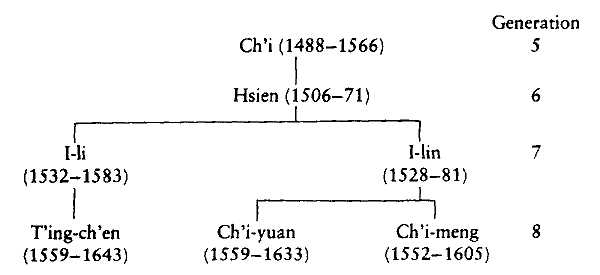
Fig. 5.
Major Segments of the Second Branch of the Chuang Lineage during the Ming Dynasty
kinship groups could at least approximate the classical ideal of equitable distribution of wealth through the creation of charitable land for their kin and descendents. T'ang was not speaking as a disinterested bystander. A key figure in the T'ang lineage in Ch'ang-chou with strong affinal ties to the Chuang lineage there, T'ang's views reflected the moral high ground on which late Ming lineages in the Yangtze Delta were taking a stand..[6]