
Mohani: The First Day
On the first day of the festival, as they will again on each succeeding day, people from all over the city go at dawn to the pitha of the day's Mandalic[*] Goddess. On this day, as they will on each day, people dressed in their better clothes (see fig. 31) walk together in groups, often accompanied by musicians, from the city's neighborhoods to the Brahmani pitha , the protective goddess of the east. People move on this day, as they will on all the subsequent ones. That is, they join the main jatra route, the pradaksinapatha[*] , at a point convenient to their homes, and take it in either direction until they reach the god-house of the day's particular Mandalic[*] Goddess (map 2). They then follow the conventional route from the god-house to the pitha . On their way from god-house to pitha they go via the tirtha , the sacred spot at pond or river associated with the day's goddess. At the tirtha they sprinkle water on themselves in a ritual bath. They then proceed on to the pitha , which is always close to the tirtha , and hold a brief puja , offering coins, grains of rice, flowers, incense, and the like. They bow to the goddess, circumambulate the pitha , and quickly move on to accommodate the crowds behind them. Most people then go on to the Taleju temple, and circumambulate the inner courtyard, as they will on their return from the pithas of the goddesses of the following days.
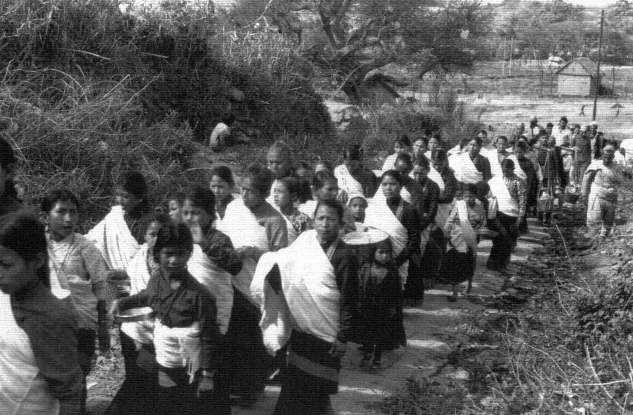
Figure 31.
Mohani. A group of Jyapu women going on the twice-daily visit to the day's mandalic[*] pitha.
On this first day it is the god-house, tirtha and pitha of Brahmani to which the townspeople go.
In most houses, usually on the middle floor of the house, and also in each Tantric temple and god-house, a room or area is selected to be a locus of worship to Bhagavati (referred to in this setting sometimes simply as the "Mohani Dya:," the "Mohani God") during the Mohani sequence. During Mohani this room is called the "Na:la swa(n) " room, or simply "Na:la room.[34] A layer of soil that has been gathered at one of the Mandalic[*] Goddesses' tirtha s is spread on an area of the floor of the room. Barley grains are to be planted in this soil in the course of an important puja later in the day. For the upper thars , Chathariya, Pa(n)cthariya, Brahmans, and those Jyapu thars that have some special relation to Taleju, the barley will include grains given to them at the Taleju temple on this day, mixed with other barley grains. A connection between the goddess Taleju and Devi as the warrior goddess Bhagavati is thus established for them at the start.
After the barley has been distributed at the Taleju temple, the Taleju priests gather in that temple's Na:la swa(n) area, which is in one of the temple's inner courtyards or cukas , the Kumari Courtyard, to begin chanting the verses of the Puranic[*] text the Devi Mahatmya in Sanskrit. The Devi Mahatmya will be read in successive divisions on each of the ten days of Mohani and completed on the final day. That text, as we have noted in chapter 8, provides many of the images and conceptions on which the forms, meanings, and arrangements of the dangerous goddesses in Bhaktapur are based. The sequences and images of Mohani follow it particularly closely. During and just prior to Mohani the stories of the Devi Mahatmya are told in Newari by storytellers in the public squares, and read out and recounted throughout the city by elders in many individual homes to assembled family members.
After the reading of the first portion of the Devi Mahatmya at the Taleju temple, barley will be planted in the soil in Taleju's Na:la swa(n) area in the course of a puja to Bhagavati. The planting must be done within a sait , a proper and auspicious span of time whose beginning and end are based on astrological considerations as determined by the Royal Astrologer of the central government in Kathmandu. The Na:la swa(n) planting in the Taleju temples of all three of the old Malla royal cities, Kathmandu, Patan, and Bhaktapur, will take place during this centrally determined span. There will be other such centrally determined saits on the seventh and the tenth days of Mohani.
There are common features in the contents and procedures in the Na:la swa(n) rooms in the Taleju temple, in the other temples and god-houses, and in private homes. We have noted the area of soil in which barley grains are planted on this first day. In the worship of the first day, prior to the time of the planting of the barley, it is also necessary to "establish" (sthapana ) the image that will represent Bhagavati most focally in the Na:la swa(n) room during the first phases of Mohani. Throughout most of Mohani Bhagavati is represented there by a particular kind of metal pot, a kalasa , or by a clay pot, thought of during Mohani as a kalasa , on which an image of Bhagavati as Mahisasuramardini has been painted on one side with, frequently, a pair of eyes painted on the other. On the eighth day of Mohani other images of Bhagavati will be added, usually a painted image on paper, and sometimes a metal image of the deity. As the barley sprouts the blades of the young plants will be a third reference to the warrior goddess. On this first day sacred water is poured into the kalasa and a small clay dish holding rice grains is placed as a cover over it. The kalasa is set on a bed of leaves of five different plants.[35]
Before the puja to be held in the Na:la swa(n) room to the properly established deity, people, as they always do prior to important household worship, go to their local Ganesa[*] shrine. Some people, in a reflection of the importance of the Mandalic[*] Goddesses during Mohani, also go for prelimimary worship at the local mandalic[*] areal pitha . The details of the home Na:la swa(n) puja vary for different thars and at different status levels. In general, the sequence has the following steps. The puja equipment and materials other than the kalasa have been gathered in an area in front of the patch of soil.
1. The sukunda , the oil lamp that contains representations of Ganesa[*] , Siva, and of Sakti, is first worshiped.
2. Then the kalasa , representing Bhagavati, which had been placed on the soil and arranged as noted above, is worshiped.
3. Now the barley is spread on the soil and worked into it.
4. The soil is worshiped.
5. The kalasa and the soil are then worshiped together by means of offerings of the light of an oil-soaked wick and with the smell of incense.
6. As is appropriate in the worship of dangerous deities, and introducing the theme of sacrifice, which is a dominant theme of Mohani and of the Nine Durgas, the meat-containing mixture samhae , as well as
sweetcakes, fruits, and flowers are offered to these combined representations of the Goddess—the kalasa and the mixture of soil and barley grains. There will be no actual blood sacrifice until the climactic ninth day.
7. The family takes back some of the offerings as prasada .
In contrast to Chetri women who, according to Lynn Bennett (1983, 138), are forbidden entrance into their equivalent of the Na:la swa(n) room until the tenth day of Dasai(n), Newar women take part in this worship.[36]
We may note here that the focus of worship is Devi, and not the Tantric Siva/Sakti relationship (although those upper-status families with Tantric initiations will, as in most pujas , add some reference to this relationship in a more or less peripheral fashion). The relation of the autonomous Goddess to the earth and to the processes of germination is established from the beginning.
The day introduces an activity that will reach a crescendo on the tenth day. Men, usually young men, from the mandalic[*] area of the first day's Mandalic[*] Goddess, Brahmani, who have made vows to that deity to perform a vrata on her special day during Mohani, perform a mata beigu , "a presentation of lights" at the Brahmani pitha . There are two varieties of this vrata . In one the man will sit on an armchair, with his forearms supported on the chair's arms. He wears a loincloth, a turban, and sunglasses (the latter two articles generally thought to suggest royalty). Seven oil lamps, small terracotta dishes with wicks floating in them, will be placed on his body,[37] supported by an asana , a "seat" or base of cow dung mixed with mud. The lamps are lit and then kept full of oil by friends and family members. The devotee will sit relatively immobile for at least two or three, and sometimes as long as seven or eight, hours (see fig. 35). In the other major kind of mata beigu the devotee will lie covered with a thick mixture of mud and cow dung, on which 108 oil lamps have been placed. The man, also dressed in loin-cloth and sunglasses (although his position prevents his wearing a turban) will usually lie there for the full eight-hour period. This practice is both more expensive[38] and more strenuous than the simpler mata beigu , and thus a greater offering.[39] Both of these vratas are performed adjacent to the Brahmani pitha . On each successive day of Mohani, people of the particular mandalic[*] area that is the focus of the day have their turn to fulfill pledges to perform a mata beigu vrata at their area's
pitha . On the tenth, the final day, men from all over the city as well as from hinterland villages outside it, do these kinds of vratas —and also, as we shall see, much more dramatic ones—en masse at the Brahmani pitha , which is once again on the final day the focus of an important part of the day's activities.
In the evening the stone that represents the goddess and its framing arch or torana[*] , which together constitute the Brahmani pitha , are elaborately decorated with flowers, in patterns that are thought to resemble a flight of stairs. Thus the act of decoration is called swa(n) taki tanegu , "erecting a flower stairway." This form does not seem, at least to contemporary knowledge, to have any special significance aside from being a traditional decorative form. These decorations are made by local mandalic[*] area groups, including areal guthis and groups of musicians, in honor of the goddess. Once again in the evening, as they had in the early morning, masses of people, accompanied by music, walk from their neighborhoods in groups to the Brahmani pitha following the same routes. They now emphasize flowers in their presentations to the Brahmani pitha . In contrast to the morning's procession, in the evening they do not bathe at the goddess' tirtha but go directly to the pitha . The routes they take through Brahmani's[*] area had been previously cleaned by the local people in preparation for this day, and now lamps and decorations have been placed on shrines, open sheds, and various buildings along the routes. Arriving at the pitha , people quickly present their flowers and other offerings. Their offerings are part of the swa(n) taki tanegu . They then return to their homes.
The special events in the Taleju temple on this day begin a period of dense activity for that temple, much of which involves the "Malla king" as represented by the chief Taleju Brahman. The king is responsible for the ceremonial management of many temple activities. He is the central worshiper in the temple's Na:la swa(n) worship of this day, and will be important for the later activities that center in the Taleju temple,[40] which also represents, as always when the Malla king is recreated, his palace. These activities require the assistance of representatives of many thars who perform what were their traditional specialities and responsibilities at the time of the Malla court.[41] Mohani is the time in the annual festival cycle that the segment of Bhaktapur's society centering about the king, palace, and court is ceremonially reconstructed. This is done in large part within the Taleju temple as the "royal palace," and is hidden from the larger city. This represents, as so much symbolic
activity in Bhaktapur does, the reconstruction or maintenance of one of the city's cellular components, in this case one whose output was once essential to the traditional organization of the city.