
Evarista Galdós
A final seer in whom Carmen Medina took special interest was Evarista Galdós y Eguiguren. Evarista was seventeen years old when she began to have visions in early July 1931. She came from a farm in Gabiria, not far from the vision site, and when the visions started she was in service in the home of a journalist in San Sebastián. The press described her visions in early July but did not mention her again until the fall. By that time she had had over thirty visions and went to Ezkioga on Thursdays and Sundays, presumably her days off from work.[61]
Her employer, Díaz Alberdi, alleged that she claimed she too would see the Virgin at Ezkioga: Juan de Urumea, El Nervión, 23 October 1931. First visions, ED and PV, 14 and 15 July 1931; also B 32, 714-715; Boué, 23-24. For October 1931 see SC E on 4 October, Rigné photo 261 on 17 October, PV and Easo, 20 October, and LC, 21 October.
The believers heeded Evarista more from mid-October. On October 18 and 19 the Jesuit José Antonio Laburu filmed her and Ramona having visions.[62]
Hermano Rafael Beloqui, Urretxu, 15 August 1982; Easo, 20 October 1931, p. 8; L 10.
On October 19 she told a reporter that both she and Patxi knew when the big miracle would be and that it would be soon: She predicted a miracle for the next day, which attracted a large crowd that was duly disappointed; with the seer girl from Ataun she predicted another for November 1 between 4:00 and 4:15 P.M. On December 4 she claimed to receive from heaven a medal on a ribbon like those others received previously. She announced this event in advance to a sympathetic priest and had herself searched beforehand. By this time she was important enough for Carmen Medina to take her to the bishop in France.[63]R 55; B 717.
On 17 January 1932 Evarista, Ramona, the Ataun seer, and six other girls from the district attended the spiritual exercises offered by the Reparadora nuns in San Sebastián. Carmen Medina may have paid for them. Her family patronized this elite order, whose first house in Spain was in Seville. Carmen's sister Dolores had founded the houses in San Sebastián and Madrid. Antonio Amundarain might have suggested the exercises; he had been the confessor of the Reparadoras in San Sebastián, and the Aliadas went for exercises there. Whoever was responsible probably also had a hand in the spiritual exercises at Loyola for male youths who were seers and converts. The Reparadoras based their rules on those of the Jesuits, and the Jesuits worked closely with them. Like the exercises of the Jesuits, those of the Reparadoras emphasized atonement, in which "a detailed contemplation of the scenes of the Passion … poses the question of acting and
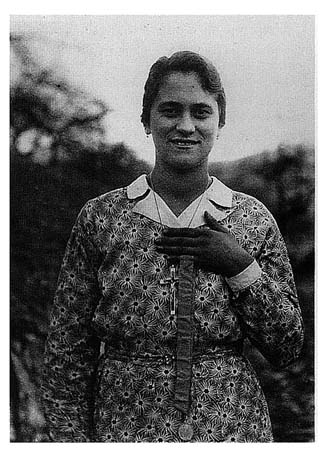
Evarista Galdós with ribbon and medal that on 4 December 1931 fell
to her from the sky. Photo by Raymond de Rigné, all rights reserved
suffering for Christ in return." Immediately subsequent to these exercises Evarista and other seers began to have visions in which they experienced the crucifixion.[64]
For exercises see SC E 278, citing letter from J. R. Echezarreta of 18 January 1932; for Dolores see the anonymous biography Padrón de Superioras, 173-185. Carmen's sister Concepción and a niece were also in the order. On Amundarain see the chronicles in LIS, passim. In Vitoria the Aliadas used the Reparadora house for ceremonies in 1929 and 1931. For Loyola exercises see SC E 278. Amundarain did exercises there in early 1920s: Pérez Ormazábal, Aquel monaguillo, 73-74, 85-86. Quote is from Édouard Glotin, "Réparation," DS 13 (1988), col. 385. Émilie d'Oultremont founded the Reparadoras in Strasbourg in 1857.
In 1932 Evarista and Ramona stayed for a time in Azkoitia in the house of a wealthy woman, who paid a driver to take them back and forth to Ezkioga daily. But the two seers had a bad falling-out. Only the concerted efforts of José de Lecue, the Bilbao artist, and Patxi in a meeting in Bilbao in April led them to make peace. In the fall of 1932 and early 1933 a young male convert recorded Evarista's visions. This friendship cost Evarista some of her more prudish followers. She lived for most of 1933 in Irun. There she convinced a priest after having a vision in his house, and he started taking down her messages. Many of these visions had to do with the adventures of the believing community. She saw specific churchmen conspiring against the visions, other seers having their final visions, the hostile clergy changing their minds and believing, and other mystics making prophecies.[65]
On Evarista's trouble with Ramona see SC E 279, 434-435; on José Atín, the male convert, see Surcouf, L'Intransigeant, 19 November 1932; Rigné to Olaizola, 2 October 1932; Rigné to Ezkioga believer, 29 January 1933. For Evarista in Irun and priest, B 312, 726; García Cascón visited her there 7 December 1933. For community visions, B 714-717.
In January 1934 Carmen Medina spirited Evarista off to Madrid. There Medina hoped to set up a refuge from the coming revolution for a "high dignitary," who was in all likelihood the papal nuncio, Federico Tedeschini.[66]
Ayerbe to Cardús, 18 January 1934. She and Carmen lived at Calle Alfonso XII 32, 3° (López de Lerena to Ezkioga believer, 19 April 1934, private collection). More on Evarista and Tedeschini below in chap. 6, "Suppression by Church and State."
Carmen Medina was in the class of grandees, enjoying powerful ecclesiastical, political, social, and financial connections. She was untouchable, even unmentionable. When the diocesan investigator went to Ormaiztegi to document Patxi's false prediction, his investigation included Medina, but he nonetheless accepted her hospitality and ate with her. The bishop and vicar general had no qualms about attacking other key figures openly, but they steered clear of Medina. Even in private correspondence Ezkioga believers mention her circumspectly. Only a complete outsider, Walter Starkie, could be frank about her.[67]
When Burguera referred to her he often called her C. M.; Picavea wrote obliquely about a "dama aristocrática"; and Laburu even in his private lecture script wrote C. Med., though he spelled out all other names (e.g., L 14).
The most overtly political of the Ezkioga patrons, Carmen Medina needed no one to tell her a civil war was imminent, and she knew which side she was on. Nor did the other patrons have any doubt about their sympathies. But they considered politics a distant second to religion. Amundarain is a case in point: what was foremost for him was the saving of souls and the spiritual mission of his new order in the unfolding divine plan. In the June 1931 issue of Lilium inter Spinas he put politics in its place:
Say it, dear Sisters. Hail Jesus in our hearts and in those of all others as well! Hail Jesus in those who love us and those who persecute us! Hail Jesus in those who rule and those who obey! Hail Jesus in the Republic, in its governments, and its laws! Hail Jesus in the Church, in its ministers, and in its faithful! Hail Jesus in the heavens, on earth, and in the depths! Hail Jesus now and forever, Amen, Amen![68]
Amundarain, LIS 35 (June 1931): 1-11.