
Los Hollman
The Hollman family history also reveals the patterns of mobility between the two Californias and the internal cohesion of family kin along the frontera. The Hollmans pattern of settlement in the frontera exemplifies the seeking out of other Baja Californios, the meeting of new friends and the links formed at this time between nonkin from Baja California. The chronological outline of their migration and settlement shows constant mobility over three generations between the Californias as well
as the movement between Calexico and San Diego that became a pattern for many of the early San Diego arrivals.
José Hollman originally emigrated from Berlin to South America. He then made his way to San José del Cabo, where he settled and married. His wife, Micaela Acosta, was a native San Joseña. The couple reared seven children and remained in the cape until José's death in the 1920s. Micaela then went north to San Diego where three of her offspring had migrated.
Marcos Hollman, son of José, had moved to San Diego in 1904 with his wife, Eulogia Gastelum, and two children, Bernardo and Josefa. They, like other natives of San José del Cabo, came north by steamer, disembarked in Ensenada and crossed the international line at San Ysidro. That year a daughter, Sarah, was born to the Hollmans in San Diego, but she died before the year was over. The following year Marcos went to Mexicali, while Eulogia and the children returned to San José, where they remained for about a year. They returned to San Diego again via steamer in late 1905. In 1907 they went to Calexico but crossed back into Baja California where they settled in Mexicali.
Los Hollman also illustrate the strong family networks that helped maintain a secure base for settlement along the border. Frequent visits to the south to see close kin, the arrival of close kin (maternal aunts and paternal kin), and the shared adoption of the Hollman children are obvious kin relations that fostered successful settlement in the towns of the frontera. During the next decade the Hollmans moved frequently across the border and in the peninsula. In 1910 Bernardo, the eldest son, returned to San José with a maternal aunt (who was living in San Diego) to visit his ailing grandmother. When Bernardo returned to Mexicali in 1910, revolutionary disturbances had begun to shake the town and the family crossed the border into Calexico. In 1919 both parents died, but other family members who had migrated earlier adopted the children.[5] First a maternal aunt who had married Narcisso Montejano (both natives of the cape) took the children (Bernardo, Josefa, Marcos, and Victor). Then in 1921 the children traveled to San Diego, where Josefa Gastelum de Ceseña, another maternal aunt, adopted them. Her husband, Daniel Ceseña, was also a cape native.
During these years the Hollmans also met a number of families with whom lifelong relationships were established. In Mexicali Bernardo met "Panchita," Juana, and all the Castellanos. There los Hollman also met los Salgado, another family that became incorporated into the growing Baja network. (Los Salgado are the family of my maternal
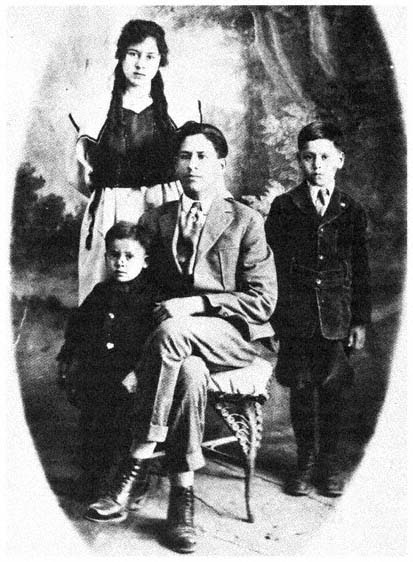
Josefa [standing], Victor, Bernardo [seated], and Marcos Hollman, c. 1917
grandmother, Dolores Salgado de Smith.) Bernardo and his family also knew los Smith in Calexico. These acquaintances fostered formal ties that would later pull a number of families into a tight social field around the San Diego area. In Calexico Marcos and Eulogia Hollman became compadres to the Salgados and Bareños (from Comondú) and in San Diego to the Alvarez and Smith families. Marriages between Hollmans and Salvatierras (also from the cape) occurred in the next decades. Such interfamily ties became common in the years following the initial period of settlement.