
A Tour of the Lower East Side: Kindling
A few days after he completed the first Chimmie Fadden film on May 18, 1915, DeMille began work on Kindling , an adaptation of a stage melodrama that demonstrates the extent to which realist representation of the poor was based on intertexts in middle-class culture. A well-received theatrical work, Kindling had been adapted for the stage by newsman Charles Kenyon from a novel that he had written in collaboration with Arthur Hornblow, editor of Theatre .[42] Part of a series of adaptations, their fiction was in turn based on a magazine article about tenement life and a New York Evening Sun human interest story.[43] As literature that addressed the social concerns of urban middle-class readers, metropolitan news stories, often in sensationalized accounts, frequently provided playwrights like Kenyon with dramatic material.[44] After a trial run in Los Angeles, the stage version of Kindling opened to respectful reviews at the Daly Theatre in New York in December 1911. According to the New York Telegraph , "the so-called high-brow contingent and sincere students of the drama pronounced the play one of the best of recent years." Given the reaction of critics to the DeMille-Belasco society dramas as confection, the equation of the term highbrow with realism is notable. The Chicago Record Herald declared that Kindling was "the most vital, vigorous specimen of American drama yet given to the stage." Several
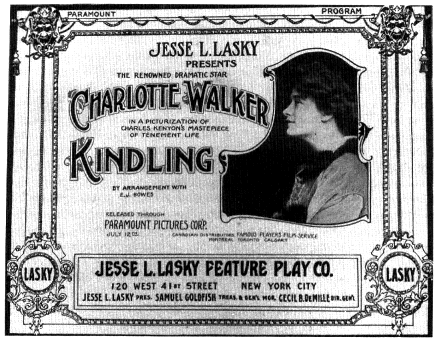
14. Advertisement for Kindling (1915). Ads in trade journals emphasized the
marquee value of Broadway stars like Charlotte Walker, rather than
filmmakers like DeMille who had yet to establish their authorship.
reviewers commented on the deleterious effects of urbanization, and one concluded that the play "ought to make people feel that they should do something to better these conditions,. . . to do something . . . for others." Although one of the critics emphasized class division by stating that "the poor have been made to feel like dime-museum curiosities as a result of the . . . visits of the uptown 'swells,'" another emphasized the melting-pot qualities of American life: "We are becoming one people, with a national pulse, infinite in its variations of beats, but one just the same."[45] In sum, realist representation as a response to urban pluralism provoked discourse on daunting social problems, but the reaction of the genteel middle class to these changes remained essentially conservative.
DeMille's adaptation of Kindling draws upon well-established visual conventions that circulated in middle-class culture to represent life on the Lower East Side. Indeed, an unprecedented revolution in visual media resulting from the use of halftones to reproduce illustrations and photographs had preceded and even anticipated the rise of cinema.[46] A pictorial
artist himself, DeMille was surely familiar with the iconography of engravings, halftones, paintings, photography, stereographs, and magic lantern slides. Particularly in representations of the city there existed in the cultural practice of this era a rich cross-fertilization between high and popular (as distinct from highbrow and lowbrow) culture. Artists like Winslow Homer, for example, preceded Jacob Riis into police station lodging houses to capture the plight of the homeless sleeping on the floor for Harper's Weekly (1874).[47] Captioned engravings of slums that focused on laundry hung out to dry on clotheslines—a practice that contradicted views of tenement life as filthy and unsanitary—became a cliché recycled by photographers of urban scenes and by painters in the realist tradition.[48] John Sloan, who was trained as a magazine and newspaper illustrator like the rest of the Ashcan school, produced paintings such as Backyards, Greenwich Village (1914) that showed the family wash dominating the skyline of an alleyway.[49] An example of the cinematic appropriation of visual conventions, a shot in Kindling shows clothesline laundry in the foreground of a tenement building fire escape.
Committed to inventing a visual style appropriate for the urban landscape, Ashcan painters, or New York realists, including John Sloan, George Luks, William Glackens, and Everett Shinn, emphasized a dark palette and sharp contrasts. Under the leadership of Robert Henri, this innovative group earned the epithet, "the black school."[50] An exhibit of their work held in a Manhattan gallery in 1908 attracted considerable notice in the press and several thousand visitors. Stylistically opposed to the New York realists, Alfred Stieglitz also affirmed that contemporary street scenes and ordinary people were appropriate subjects for serious art. An international figure who influenced the reception of photography as art, he produced several photographs of Manhattan, including subjects popularized in magazines and newspapers by graphic artists.[51] An innovator like DeMille could therefore draw upon several established conventions to represent the urban scene, but so inventive was he that exact quotations were never a part of his vision. What the director did replicate, however, was the didactic tone of pictorial realism as a tradition mediating the urban experience for the middle class. The widely held belief that the purpose of art was to provide spiritual inspiration rather than sheer aesthetic pleasure still pervaded an era on the verge of modernism.[52]
Characteristic of discourse on urban poverty, then, was a didactic tone motivated by genuine social concern as well as condescension that was evident, for example, in the work of genteel reformers. When Charles Loring Brace, founder of the Children's Aid Society, published an illustrated account of his work among the indigent, he called it The Dangerous Classes of New York and Twenty Years' Work among Them (1872). Similarly, James D. McCabe, Jr., drew a moral lesson in an exposé aptly titled Lights and
Shadows of New York Life (1872). Undoubtedly most influential was Jacob Riis's How the Other Half Lives: Studies among the Tenements of New York (1890), a volume with forty-three illustrations, including halftone reproductions of photographs printed earlier as drawings in a Scribner's article (1889).[53] Darkness and light, in other words, represented moral values in realistic urban discourse that was pervaded by sentimentalism. As a result, "Rembrandt" or contrasty lighting, advertised by the Lasky Company to achieve product differentiation for DeMille's films, functioned not only as a sign of highbrow culture but also as a Victorian trope familiar to middle-class sensibility. The director's reputation as an author was established, not coincidentally, by means of dramatic low-key lighting effects in a series of acclaimed films.
Since DeMille experimented with selective and low-key lighting to represent the tenets of Victorian moralism, he begins Kindling , as he does Chimmie Fadden , with a pictorial contrast. Rather than juxtaposing rich and poor by means of editing, however, he contrasts good and evil through lighting effects. Deleting from the script the intertitle, "The Eyes of the City," which indeed suggests voyeurism and Foucauldian panoptic surveillance, he opens the film instead with a didactic title, "Where the Devil Wins." An exterior shot of a street in the slums at nightfall is detailed in the script with attention to lighting as follows:
Typical summer night scene in New York slums. Light effect from all doors and windows. Light from street on corner. Standing light directly over "Private" entrance to saloon. One woman exchanges remarks from lighted doorway where she is standing to woman in lighted window above. Groups of men pass down street or lounge in doorways. One man and a couple of loudly dressed but very young girls come down street and enter "Private" door of saloon, laugh boisterously. As the shutters of the saloon on comer swing back and forth to let people out or in, men are seen from time to time drinking at bar. In the broad shaft of light from the saloon entrance, a "hurdy gurdy" and grinder have stopped. Into the light from somewhere come a couple of ragged little girls and start to dance delightedly. In the shadows near the "Private" to saloon, stands a rather languidly dressed woman who appears to be waiting for someone. Steve comes swaggering down street smoking. He exchanges a gesture with a man in lighted doorway as he approaches "Private" entrance.[54]
What does this tenement scene look like on film? It is dusk. A narrow street in extreme long shot is dimly lit although there are no visible awnings that cast dark shadows on the buildings. DeMille choreographs a great deal of movement so that the scene becomes animated with several characters, including a young boy seated on the curb before a littered street, two men stationed on or near beer barrels in front of the saloon, prostitutes soliciting men strolling by, a beggar picking through the trash, a belligerent man escorting a woman on his arm, and a cripple walking on crutches. Unlike
the description in the script, these details add up to a more depressing street scene and accord with the use of atmospheric lighting that creates a somber mood. By contrast, DeMille's next title, "Where the Devil Loses," precedes a medium shot that foregrounds stevedore Heine Schultz (Thomas Meighan) as he sits in the center of his apartment and reads a newspaper. Slightly in the background and to the right, his wife Maggie (Charlotte Walker) busily prepares the evening meal. On the left is a shelf with bits of crockery and dishes. A solicitous spouse, Maggie pours Heine a cup of tea. As the couple engage in an affectionate exchange, they deliver the message that a proper home based on traditional gender roles provides a positive environment to counteract degenerate slum life.
DeMille was inventive in constructing a realist representation of tenement life that was nevertheless aestheticized and didactic; to put it another way, he illustrated the extent to which Victorian pictoralism could be converted into a commodity. A filmmaker who articulated middle-class ideology, he also demonstrated the limitations of genteel culture with respect to representing the urban experience of workers and immigrants. The Schultzes, for example, are insulated in their apartment to avoid contact with squalid surroundings, but privacy was neither possible nor practical in slum dwellings. Unlike comfortable middle-class families in privatized suburban homes, the poor depended for their survival on mutual exchange and sharing. Further, DeMille's degenerate street scene in front of a saloon calls forth instant moral condemnation when in fact street life provided a vibrant contrast to dehumanizing factory work. According to Kathy Peiss:
Streets served as the center of social life in the working-class districts, where laboring people clustered on street corners, on stoops, and in doorways of tenements, relaxing and socializing after their day's work. Lower East Side streets teemed with sights of interest and penny pleasures: organ grinders and buskers played favorite airs, itinerant acrobats performed tricks, and baked-potato venders, hot-corn stands, and soda dispensers vied for customers.[55]
Despite the limitations of romantic realism as a form of sentimental discourse, DeMille struck the right chord when he began Kindling with an atmospheric street scene in contrast to the opening of the stage play, which begins inside a tenement building. Film critics who used the ideologically loaded term picturesque responded with rapt reviews. W. Stephen Bush, for example, commented that "to portray atmosphere and surroundings in one or two brief touches is art of the highest order. The scene . . . depicting a typical section of the tenement district of a big city, is as graphic as anything that ever came from the hands of Hogarth or Rembrandt."[56] As a matter of fact, DeMille most likely quoted Stieglitz rather than European artists in constructing this particular mise-en-scène. Founder of the Photo-Secessionists, whose gallery was a short walking distance from D. W.
Griffith's Biograph studio, Stieglitz had published and exhibited several photographs of New York street scenes.[57] Poetically titled Winter —Fifth Avenue or Spring Showers , these photos exemplified a "pictorial" as opposed to a "straight" or clearly focused style evocative of the camera as a mechanical instrument. Stieglitz, in short, favored impressionistic, atmospheric, and blurred images that subtly transformed quotidian subjects into art. Such decontextualization and appropriation of the lower classes, however, was an aesthetic equivalent of economic exploitation then condemned not only by reformers but by artists themselves.[58]
After an atmospheric shot of a street scene influenced by Photo-Secessionist style photography, DeMille quickly exhibits his brilliant eclecticism as he next quotes the work of Jacob Riis. Unlike the blurred outlines of Steiglitz's ragpickers and asphalters photographed in an ambient urban milieu, Riis's documentation of slum dwellers was a stark contrast in light and shadow. A journalist and reformer, he mediated the urban experience for middle-class consumers who comprised "the other half" ensconced in material comfort and bolstered by moral rectitude. The representational strategy of his photos, as contemporary critics argue, involved posed or even startled subjects who were objectified and commodified as spectacle.[59] Scrutinized by the camera lens, immigrants and workers were denied their subjectivity and appeared defenseless. Accordingly, DeMille constructs a similar mise-en-scène in Kindling . When Maggie goes to the dispensary to fetch Dr. Taylor, for example, she enters a waiting room that would have been an appropriate subject for Riis's camera. As described in the script, the patients who sit there passively include
a number of distinctive slum types sitting in line on bench waiting for their turn. A woman with utterly discouraged face and small consumptive boy. Woman is frail and delicate. A very old man who has a cane, almost in tatters. A young tough poorly dressed and scratched in probable street fight. And a young Italian girl with tragic eyes and ear rings, whose fate is not hard to imagine. Each expression is characteristic but all have the patient look of the very poor except the young tough who fidgets nervously.[60]
Although this gallery of characters appears slightly altered in the film, it is unquestionably drawn from Riis's social photography and magic lantern slides. DeMille's condescending and stereotyped description of the destitute, including the equation of a young girl's "tragic eyes" with "ear rings," was not atypical of the period. Consistent with his objectification of the poor in the film was the casting of a Mexican child suffering from malnutrition as the Jones baby, another victim of slum conditions.[61] When the sick infant dies, Dr. Taylor blames its mother for inadequate sanitation, when in fact a high rate of infant death in the tenements resulted from the practice of commercial dairies bottling contaminated milk.[62] Poverty is represented,
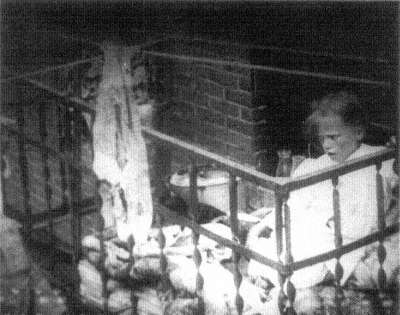
15. In Kindling DeMille's vision of the Lower East Side was influenced
by a rich tradition of pictorial realism, including the social
photography of Jacob Riis. (Photo courtesy George Eastman House)
according to middle-class ideological belief, as a personal failing rather than the result of capitalistic exploitation.
Further examples of DeMille's familiarity with Riis's social photography and magic lantern slide lectures are visible in several sequences in Kindling . A shot of Jones's apartment shows the dejected mother seated to the right so that the rear wall, pockmarked with filthy and deteriorating plaster, is plainly visible. As critics point out, Riis's use of magnesium flash powder to illuminate dark tenement rooms exaggerated blemishes and surface irregularities.[63] Perhaps most evocative of Riis's lectures is the sequence initiated by Maggie's argument with Heine about rearing children. Secretive about her pregnant condition, the heroine has purchased a cradle at a fire sale and hidden it beneath the kitchen table. When she learns about the death of the Jones baby, she claims, "All the kids born down here don't die." But her husband retorts, "The health officer says that half of them die—and the rest grow up to be crooks," and points to their neighbors. Panning right to follow Maggie's movement to the rear window, the camera cuts to a point-of-view shot of a forlorn child alone on a fire escape with empty milk bottles
and a clothesline. A scene that constitutes the beginning of a cinematic tour of the slums, this exchange is absent from the stage play and indebted to Riis's exercises in urban voyeurism.
Heine asks pointedly, "Would you like to have a kid of yours, cursin' you for the very life you gave it?" He then exits left into the littered hallway. Maggie, stealing a glance at the cradle hidden under the table, follows. The Schultzes emerge from the tenement building entrance, where a sullen young girl is caring for a child. A few moments later, a strategically placed medium close-up shows the couple as they glance left, a profile shot clearly intended to heighten spectator identification as they continue on their excursion. What they, as well as the audience, observe is a series of sordid incidents in slum life: a boy stealing a watch from a drunkard who is sleeping next to a trash can, a man emerging from a saloon with a pail of beer and offering a swig to a disheveled young girl, and two children fighting over refuse as they dig through garbage cans. Heine exclaims, "I'd rather kill a child of ours the day it was born than send it up against a game like that!" Maggie, looking crestfallen, agrees as they complete their tour. Such an exercise in voyeurism constitutes a narrative strategy that distances middle-class spectators who are concerned yet disdainful about "how the other half lives." The hierarchical relationship between the Schultzes and the degenerate slum dwellers whom they observe thus corresponds to existing social structures reenacted in the film theater as a form of film spectatorship.
As tour guides, Maggie and Heine enact the mediatory role of narrators and affirm for the middle class its perceptions about "the other half." The function of the magic lantern slide lecturer, in other words, has been incorporated into the text as characters whose point-of-view shots provoke a moral commentary reinforced by intertitles. Alternating with such views are composite shots in which motion picture stars are inserted into the sordid environment documented by social photography. Charlotte Walker as Maggie, for example, surreptitiously visits a neighborhood pawnshop (whose owner is stereotyped in the script as "an old nearsighted Jew"), photographed in low-key lighting that shows wire cages in the dim background. A mise-en-scène remarkably similar to Riis's photo, What the Boys Learn on Their Street Playground , focuses on the arrival of a chauffeured limousine in the slums. A scrutiny of both the photograph and the shot in the film shows a fire escape ladder dangling over a first story shop in the background.[64] Also notable is a long shot of Steve (Raymond Hatton), Maggie's disreputable neighbor, walking on a street in front of buildings papered over with large ads for barber shops and rooming houses, a familiar scene in magazine engravings and photographs. In sum, DeMille's representational strategy of alternating point-of-view shots with composite shots heightens spectator identification with stars as well as a sense of voyeurism that exploits class and ethnic differences.
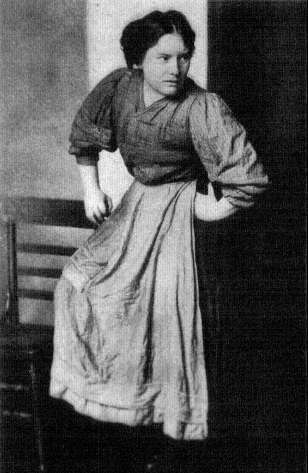
16. Actress Margaret Illington realistically portrays a
working-class woman who lives in a tenement
building in the stage play Kindling (1911).
Aside from engaging in visual strategies that reinforce class distinctions, DeMille also cast the leads in such a manner that, as in the Chimmie Fadden series, he muted the social commentary of melodrama. Particularly significant are differences in the characterization of Maggie on stage as opposed to on screen. As portrayed in the theatrical version by actress Margaret Illington, reviewers found Maggie "a tenement house woman with red hands, scalped hair and ill-fitting clothes," a "dull, sodden creature of the tenements"—"slow-footed, coarse-featured, awkward, dull-witted, [but]
good-natured"—a woman "bowed down with toil, crushed with the hopelessness of poverty and the dreary agony of living." Characterized as "ignorant and stupid," Maggie was redeemed by her longing for motherhood, a universal sentiment that, according to critics, transcended class barriers. Although Illington was not a conventionally beautiful woman, reviewers noted that as a slum dweller she "dimmed her beauty with ugly make-up and clothes" and submitted to a "courageous subordination of frocks and beauty."[65] The stage version of Maggie, in other words, was scarcely a character with whom middle-class audiences would identify on an excursion into the Lower East Side.
In contrast, Charlotte Walker, who plays Maggie in DeMille's adaptation, was an attractive actress noted for her portrayal of Southern belles on the legitimate stage. She had played the heroine of the Belasco production of William deMille's Civil War melodrama, The Warrens of Virginia (a role reprised by Blanche Sweet in DeMille's adaptation). As Maggie, she bore no resemblance to Illington's oppressed but spirited working-class character. She is, quite the contrary, an ingenue type. During the credits of the film, Walker is introduced in medium shot while scrubbing clothes. The lighting from an unidentified source to the right, presumably a window, defines her rounded form as soft and feminine. Pausing for a moment, she discovers a hole in Heine's sock, becomes quite amused, and expresses loving thoughts about her spouse. As opposed to the uneducated speech of the heroine in the play or the dialect spoken by the slum characters in the film, Maggie's dialogue titles are grammatically correct. Walker, in her screen debut, thus "plays" at being a slum woman in a performance that undermines realist representation but enhances spectator identification on the part of middle-class audiences. Critics, interestingly, agreed about the superior qualities of the narrative but differed about her effectiveness in the lead.[66] As a physical type, moreover, Walker is interchangeable with actress Florence Dagmar as Miss Alice, the socialite who does charitable work in her aunt's tenement buildings. When the two women encounter each other at the dispensary, they shake hands as if they were social equals. Maggie's neighbor Bates is rebuffed, however, when she extends her hand to Miss Alice's haughty aunt in the stage version. Clearly, the film adaptation of Kindling demonstrates that to the extent ethnic or working-class characteristics were being effaced on the screen, the star system promoted a process of Americanization based on Anglo-Saxon standards.[67]
A comparison of the portrayal of slum dwellers in the play with those on screen shows that in addition to casting glamorous stars in the lead, DeMille diluted social commentary by denying the characters their acerbic views. Among others, Bates, Heine, and Dr. Taylor are critical, if not caustic, about tenement conditions in the stage version. Further, Heine, dismissed by the rich as a tool of "demagogues" for going on strike, reads muckraking and
socialist literature and resents the voyeurism of the well-to-do. When Maggie claims that "they're just people what likes comin' around doin' good," he sneers, "Same's their children likes feedin' monkeys in the park The poverty and trouble o' me and my family ain't made for the pleasure of no man. They can go and do their . . . playin' somewheres else."[68] Such dialogue is excised in the film adaptation. DeMille himself changed Heine's sarcastic dialogue title, "The baby died from havin' too much food and sunshine! " to "The Jones baby downstairs is dead!"[69] The film adaptation thus mutes a chorus of voices raised against class privilege, on the one hand, and heightens a sense of voyeurism, on the other, to appeal to middle-class spectators.
Attention to the details of set design gives further evidence that class oppression articulated in the stage version of Kindling was vitiated in the film. DeMille's talented art director Wilfred Buckland did not replicate the stage sets representing utter squalor. According to a theater critic,
three acts pass within the four walls of a doleful, mouldy-green room. The paper is dropping from the walls, the plaster chipped. . . . a small window gives on a well. Another is let into the back wall to light the stairs and hallway. Out there stands the common sink, used by all the tenants on the floors above. For though the law requires it there is no plumbing higher up. Indeed the whole building is a mass of bad sanitation, disease-breeding dirt, and violations. . . of city ordinances.[70]
DeMilie shows the stairway of the tenement building littered with trash and in need of repair, but the Schultzes' apartment, as emphasized in the script, has a "cheerful, peaceful home atmosphere."[71] Indeed, the "picturesque" opening shot of the slums, though somber in mood, remains highly aestheticized on account of its atmospheric lighting effects. Significantly, the Lasky Company did not add Raoul Walsh to its roster of directors because his representation of slum life in Regeneration (1915), filmed on location in the Bowery rather than on a set, was an unsentimental indictment of class exploitation.[72]
Despite the fact that DeMille moderated the social commentary of the stage version of. Kindling , film critics protested the realism of the Schultzes' tour of the slums. Variety claimed that the two children fighting over garbage "like groveling scavengers. . . in front of one of the Hell's Kitchen hovels . . . is so strong that it is enough to cause one to become ill."[73] Genteel audiences apparently enjoyed tours of urban scenes in order to appropriate realistic detail, but not so realistic as to disturb their insulation from the poor. As a matter of fact, both the stage and film versions of Kindling avoid coming to grips with compelling social problems in a conclusion that is evasive and unsatisfying. Class conflict, represented according to the conventions of realism on stage and romantic realism on screen, remains
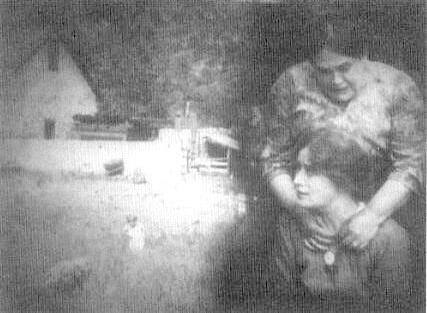
17. A split screen in Kindling shows actress Charlotte Walker envisioning
an agrarian landscape in the Far West as an ideal environment
for rearing her child. (Photo courtesy George Eastman House )
insoluble. Consequently, the only recourse is a nostalgic return to the agrarian past. When Maggie confides news of her pregnancy to Bates (Mrs. Lewis McCord), she seizes upon the suggestion that her child should be reared in an idyllic farmlike setting. A former inhabitant of Wyoming, Bates informs Maggie that "the government has a plan what would set yet up wid a farm out west." Preceding this dialogue title is a medium shot of Maggie seated on the right side of the screen in front of her neighbor. A cut to a longer shot of this same scene, after the intertitle, shows a split screen in which two children on the left play in the fields before a large farmhouse; Maggie, with hands clasped to her bosom, turns to face left as if envisioning this pastoral scene. She is quickly deflated, however, when Heine returns home with news that he is on strike. Furthermore, Alice's aunt, Mrs. Burke-Smith (Lillian Langdon), pronounces during a tour of the building she owns that "children. . . are an economic error in the tenements."
Due to increasingly straitened circumstances, Maggie accepts Mrs. Burke-Smith's offer to become a seamstress at her Fifth Avenue mansion. She even becomes an accomplice in a burglary scheme that lends credence to the fears of the well-to-do of expropriation at the hands of deprived masses.
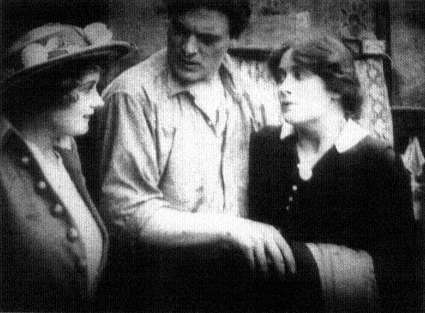
18. Florence Dagmar as a socialite and Charlotte Walker as a tenement
woman are stars representing interchangeable feminine types in Kindling .
Thomas Meighan stands between them. (Photo courtesy George Eastman House )
DeMille mitigates the fact of her collusion, however, by deleting from the film an insert of a map she has drawn of the mansion's floor plan.[74] Confronted by detectives at the film's conclusion, Maggie erupts, "I lied, I fought, I stole—to keep my baby from bein' born in this hell-hole of yours!" The wealthy matron, whose rent collector ruthlessly milks the poor, arrives on the scene, becomes instantly contrite, and refuses to prosecute. Miss Alice, who has just recovered her stolen brooch from the Jewish pawnshop, remains while the other characters leave to give Heine one hundred dollars for train fare to Wyoming. As the couple dream about their prospects, a dissolve from their apartment to an extreme long shot as they walk in an airy countryside signifies a happy ending. Audiences need not pause to reflect that their meager savings will not amount to the capital outlay required for a farming venture. Class conflict, temporarily defused, is left behind as part of urban blight absent in an Edenic paradise.[75]
A film about the social consequences of industrialization and urbanization, Kindling articulates American ambivalence regarding the machine age. Although the U.S. Census Bureau announced the closing of the frontier in 1890, Americans clung tenaciously to the myth of the West as a safety valve
for urban congestion and poverty. The Homestead Bill, enacted by Congress in 1862, had become a bonanza for railroad and land speculators rather than an opportunity for small farmers, but the image of a bountiful landscape persisted.[76] DeMille's representation of the West in wholesome terms, however, was not uncontested even at the time. Women writers who published sentimental fiction made it clear that life in the country meant, at best, unremitting toil and, at worst, brutalizing poverty and viciousness. Indeed, serious discussion about rural life as isolated, narrow-minded, and even pernicious countered nostalgia for a bucolic landscape in the late nineteenth century.[77] Although Kindling remains an exercise in the condemnation of urbanism in favor of the nation's agrarian roots, DeMille paired his stars, Charlotte Walker and Thomas Meighan, in a later work, The Trail of the Lonesome Pine (1916), that waxed far less nostalgic. Based on a novel by John Fox, Jr., and plot contrivances in The Warrens of Virginia , the film portrays clannish moonshiners who are incestuous, irrational, and violent in their rejection of modernity. For the most part, however, the director retained a morally ambivalent attitude toward the benefits of urban life even as he himself was seduced by the consumer culture and became one of its most celebrated architects.