
I—
LITERARY ARCHITECTURE:
WALTER HORATIO PATER
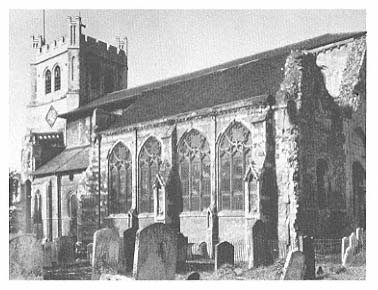
2
The literary architecture of association: Waltham Abbey leads Pater to
conjure history and rule. Stone, for Pater, was composed of "minute dead
bodies." Pater writes, "In architecture, close as it is to men's lives and
their history, the visible result of time is a large factor in the realised
aesthetic value, and what a true architect will always trust to." Here, in
Waltham Abbey we can see the visible result of time transform
architecture into organic nature. (South Chapel, Waltham Abbey)
One—
Pater's Rooms:
Concepts of Literary Architecture
Several years after Walter Pater's death, the anonymous "F," presumably a student of Pater's at Oxford, wrote a modest and suitably quiet memoir of his don, not a tribute properly, but more a brief sketch appropriately drawn just before the twentieth century foreclosed the Victorian era. The short reflection, called "In Pater's Rooms," includes only four paragraphs, each topically discrete and without connective links. The first describes the room itself, the second Pater's literary attitudes, the third his taste in architecture; the last is a single sentence conclusion remarking that although "that Oxford room" is tenanted by another, it will remain Pater's as long "as English literature lasts."[1] The opening paragraph describing Pater's lodgings begins:
The room was small, but the Gothic window with its bow enlarged it, and seemed to bring something of the outside Oxford into the chamber so small itself. The Radcliffe just a few hand-breadths away from the pane, the towers and the crockets of All Souls' beyond, and to the right the fair dream of St. Mary's spire, filling up the prospect with great suggestions—through the window one took in all these, and they seemed for a moment to become almost the furniture of the student's chamber.[2]
"F" then recalls his conversations with Pater, but in a tone so reminiscent of his master's that it almost betrays the motive for anonymity:
We talked of literary success, and literary prospects for a beginner of good talents, who is willing to work and wait. Dare it be said aloud? most of the modern minor poets might be using their endowments better in writing prose in this "prose age"; the same qualities that minister to a tardy mediocrity in poetry and the world of imagination, would develop grace and artistic finish in prose, the world of fact, which sorely needs to be more than fact, if it is not to be less than truth.[3]
With what seems a careless innocence and ease, "F" has described and synthesized complexities of thought Pater himself was at pains to express and document throughout his literary career. Our concerns now are those transitions "F" omits or, rather, presumes: what relationship might something so seemingly peripheral as Pater's rooms have to his literary and aesthetic values, and what, in turn, do those values have to do with architectural style?
"F," obviously familiar with Pater's fiction, permits of the suggestion that to Pater rooms were the externalized configurations of internal consciousness, descriptive not only of the quality and structure of minds but filled with a metaphoric furniture of thought derived from particular sensuous experience of an outside world as it intruded through windows and doors, making its impress felt. Pater himself had written:
Into the mind sensitive to "form," a flood of random sounds, colours, incidents, is ever penetrating from the world without, to become, by sympathetic selection, a part of its very structure, and, in turn, the visible vesture and expression of that other world it sees so steadily within.[4]
It is difficult for any reader of Pater not to conjure up the rooms which open up in his fictional writings, the se-
questered attic of Sebastian van Storck, the Rococo-frescoed halls of Antony Watteau, even the spare cell of the Prior Saint-Jean. But more elusive is the relevance of a mind-room equation to Pater's larger literary aesthetic. It is no secret that the aging Pater, in his essay "Style," made explicit the requirements for good and great literature:
Given the conditions I have tried to explain as constituting good art;—then, if it be devoted further to the increase of men's happiness, to the redemption of the oppressed, or the enlargement of our sympathies with each other, or to such presentment of new or old truth about ourselves and our relation to the world as may ennoble and fortify us in our sojourn here, or immediately, as with Dante, to the glory of God, it will be also great art; if, over and above those qualities I summed up as mind and soul—that colour and mystic perfume, and that reasonable structure, it has something of the soul of humanity in it, and finds its logical, architectural place, in the great structure of human life.[5]
The passage announces Pater's controversial break from stylistic considerations to substantive ones, those concerning the subject matter of literature and its scope; but what is important for us here are Pater's requirements and the terms in which he couches them. "F" suggests at least one reason for Pater's notorious volte-face in the "Style" essay: presumably, Pater saw what "F" calls a "tardy mediocrity" in modern imaginative literature. While "tardy" sounds like Pater, his own terms are rather different, in slight ways and yet momentously. After noting a quality of mind which, characteristically nineteenth century, is "little susceptible to restraint" and yields "lawless verse," Pater condemns what he terms removable decoration in all literature for having a "narcotic force . . . upon the negligent intelligence to which
any diversion , literally, is welcome, any vagrant intruder, because one can go wandering away with it from the immediate subject."[6] As remedy, Pater makes his request that literary style have two properties, "mind" and "soul."
By mind, the literary artist reaches us, through static and objective indications of design in his work, legible to all. By soul, he reaches us, somewhat capriciously perhaps, one and not another, through vagrant sympathy and a kind of immediate contact.[7]
Mind, however, Pater also calls architectural conception, and its literary effect is curative:
The otiose, the facile, surplusage: why are these abhorrent to the true literary artist, except because in literary as in all other art, structure is all-important, felt, or painfully missed, everywhere?—that architectural conception of a work, which foresees the end in the beginning and never loses sight of it, and in every part is conscious of all the rest, till the last sentence does but, with undiminished vigour, unfold and justify the first—a condition of literary art, which . . . I shall call the necessity of mind in style.[8]
Mind and soul fused Pater calls literary architecture. In literary architecture, the soul of style, while important, affords only secondary colorations, picturesque ones at that, the light and shade, a literary genius loci of atmosphere, playing on and around literature's overriding architectural structure:
For the literary architecture, if it is to be rich and expressive, involves not only foresight of the end in the beginning, but also development or growth of design, in the process of execution, with many irregularities, surprises, and afterthoughts; the contingent as well as the necessary being subsumed under the unity of the whole. As truly, to the lack
of such architectural design . . . informing an entire, perhaps very intricate, composition, which shall be . . . true from first to last to that vision within, may be attributed those weaknesses of conscious or unconscious repetition of word, phrase, motive, or member of the whole matter, indicating . . . an original structure in thought not organically complete.[9]
After describing the literary artist's task as one of "setting joint to joint," Pater concludes the passage with a double image, stating, "The house he [the writer] has built is rather a body he has informed."[10]
For Pater, the activity of great writing is the simultaneous activity of filling—informing—and of forming, the giving of full form/idea to that which is felt, sensed, or known but which has no embodied structure prior to the art act. Literary architecture is, consequently, an alive "reasonable structure": it is a body with a soul. In this context, the building of literary architecture is a composing of pregnant forms: it is pro-creative and full of care. The architectural analogue helps the reticent Pater to speak of such artistic making without embarrassment of exposure. But more significant for Pater, the analogue enables him to suggest that all structures mean regardless of scale, place, or occasion: Pater moves, in his passage of literary architecture, from art structure to human structure to life structure, from "colour" and "structure" (architecture) to "soul" and "mind" (man) to "soul of humanity" and "structure of human life."
There are more suggestive links between the materials and the structures of literary art. The mind-structure analogue—either Pater's room as "F" describes it or Pater's literary architecture—offers a distinct notion of inside and outside: the room "seemed to bring something of the outside Oxford into the chamber so small
itself." Some correspondence, even if only in the most literal sense, exists between inside and outside, between a room and its "vagrant intruders." This correspondence has fruitful consequences; the trans-parent window enlarges the inner room-world, informing it by and with the external prospect, which itself is already full of "great suggestions": "through the window one took in all these, and they seemed for a moment to become almost the furniture of the student's chamber."[11] The activity "F" describes here is one of receiving, the artistic activity of influence or impression. For the activity of creating literary architecture, the direction changes to one of expression. One comes to expect Pater's announcement, made later, in his "Style" essay: "Well! all language involves translation from inward to outward."[12] Figuratively, literary architecture enables transmission, if not translation, from the inside out, and it also provides checks to lawlessness: intruders cannot enter wantonly, nor can what is inside grow wildly without structural checks.
As easy as this notion of inside and outside is, it is worthwhile to look at it for another moment, since the idea persists, and has persisted throughout Pater's fictional and critical writings as well as throughout the work of others who also select architecture as their art model. The imprisoned self in the one-time suppressed "Conclusion" of Pater's The Renaissance —suffering the intractability of a relativist aesthetic—also occupies a room of sorts. We cannot help but recall Tennyson's woeful "Soul" locked within "The Palace of Art"; but Pater has morbidly reduced palace to a chamber of Poelike terror, just as elsewhere his rooms shrink still further to single cells, biologically and architecturally more minute and limiting:
At first sight experience seems to bury us under a flood of external objects, pressing upon us with a sharp and importunate reality, calling us out of ourselves in a thousand forms of action. But when reflexion begins to play upon those objects they are dissipated under its influence . . . the whole scope of observation is dwarfed into the narrow chamber of the individual mind. Experience, already reduced to a group of impressions, is ringed round for each one of us by that thick wall of personality through which no real voice has ever pierced on its way to us, or from us to that which we can only conjecture to be without. Every one of those impressions is the impression of the individual in his isolation, each mind keeping as a solitary prisoner its own dream of a world.[13]
Pater's "Conclusion" makes the otherwise neutral word "translation" from the "Style" essay appear tinged with optimism and therefore, appropriately, encouraging. In suggesting the possibility of movement from the inward chamber to the outside, Pater, in "Style," is also suggesting the possibility of creating viable literary works of art. His summation—that great literature "finds its logical, architectural place, in the great structure of human life"[14] —so expands the cloistral chamber of The Renaissance as to offer a positive alternative to the philosophic and psychological confines of a relativistic and, by default, virtually solipsistic existence.
It is important, then, that Pater's anonymous elegist concludes his memoir with a recount of Pater's taste in architecture. Out of "F's" rendering Pater looms as no less a Victorian man of letters for participating in the charged architectural controversies persisting throughout his century. According to "F," Pater felt that
things of quite the first rank had been produced in the 'seventies and 'eighties: gross and flagrant mistakes had been
made in modern Gothic and Renaissance; but churches and public buildings had lately been built as perfect in their way as the work of the twelfth or fourteenth century. He instanced St. Philips Church, which lies behind the London Hospital.[15]
"F" goes on to say that Pater's thinking about Whitechapel "led him to dwell with enthusiasm upon the perfect Norman of Waltham Abbey, that to the death of Harold, and that to the 'stirring, interesting writing of Professor Freeman, which I love to read.'"[16] [Plate 2] The attention paid here to Pater's stylistic sympathies throws into relief "F's" opening description of his don's rooms: no longer is it incidental that Pater's window was Gothic or that the metaphoric furniture of the room was towers and church-steeples of pre-Gothic (Norman), Gothic, and Gothic-Revival Oxford. The Gothic window qualifies Pater's vision: history and philosophy, political and aesthetic, cling to Gothic where they would not cling to buildings from another period or of a differing "mental style"; in turn, the towers and steeples cluttering Pater's room assume symbolic value, recalling to a reader religious and academic collisions of the past, perhaps the scarring Tractarian upheaval or the subsequent secularizing of an Oxford whose dons in the 1870s could relinquish celibacy vows. For Pater, too, as "F" well knew, architectural style triggers, intentionally, an associative remembering, buildings themselves sustaining qualities of expressive art-forms: one building beckons another, Whitechapel the Norman Waltham Abbey; Waltham Abbey then conjures history and rule, namely Harold, who finally solicits from Pater's memory affection for one man's writing, that of Professor Freeman.[17]
"F's" brief service to Pater's memory in 1899 managed to imply a great deal while saying little. In a few para-
graphs the associative pattern comes clear, and reminiscence turns upon a coupling of architecture with literature. This, in fact, is one extraordinary service Pater's concept of literary architecture performs: in every kind of writing that Pater undertook, he celebrates the power for memory and association that architecture bestows. If a generic architecture (home, church, school), or architecture still more abstracted into sheer structure (rooms), has implications for Pater's conception of literature, so, too, do particular manifestations of architecture. On a formalistic level alone, qualities resplendent in architecture specifically Gothic find literary parallels in Pater's essays. Craftsmanship in Gothic construction, architectural or literary, is meant to suggest the imposition of an artist's individuality, his tastes and skill, onto the structure he builds as he translates outward his private vision. The "irregularities" and "surprises" of Gothic cornices and capitals, the "intricacies" of carved ornament or tracery inseparable in function from church structure—all these find reciprocal terms or characteristics in the literary architecture that Pater delicately evokes and qualifies in his essay "Style." [Plate 3] If we return, for a brief moment, to Pater's own prose, in this instance to the passage of advice regarding literary architecture, we see that Pater himself carries out what he admonishes others to do:
For the literary architecture, if it is to be rich and expressive, involves not only foresight of the end in the beginning, but also development or growth of design, in the process of execution, with many irregularities, surprises, and afterthoughts; the contingent as well as the necessary being subsumed under the unity of the whole. As truly, to the lack of such architectural design . . . informing an entire, perhaps very
intricate, composition, which shall be true . . . from first to last to that vision within, may be attributed those weaknesses . . . indicating . . . an original structure in thought not organically complete.[18]
"If it is to be rich and expressive" comes as an interruption or "surprise," "the contingent as well as the necessary" as an "afterthought" to the first part of the sentence, "forming an entire, perhaps very intricate, composition" carrying an intricacy or detail within it.
It is misleading, however, it is all too easy, to index Pater's writing by a metaphoric system in which preferences in architectural style denote equivalent preferences in history, philosophy, or aesthetics. This is to reduce Pater's oftentimes protean values to one scheme, implicitly and temporally consistent. It is much more profitable to recognize that the architectural door which swings wide on an historical past and on literary style also swings wide on private memory, and that it postulates something about its interiors: they are accessible, recoverable, describable. In one of his Imaginary Portraits , "Emerald Uthwart," for instance, a reader may "dive" with the Oxford student Emerald along a "passage," not, as we might expect, of old buildings, but of "old builders."[19] [Plate 4] In the same way, Pater may move, by induction or deduction, from literal or imaginary edifices, so as to reconstruct, often fictionally, a past made replete through creative rather than historical detailing. In such a context, Piranesian ruins (or empty spaces where buildings once stood) provide materia and creating room for a writer of historical fiction or philosophic fiction. Shifts of time—from a Rome in rubble to a whole Rome before its fall, and so to a nineteenth-century-recon-
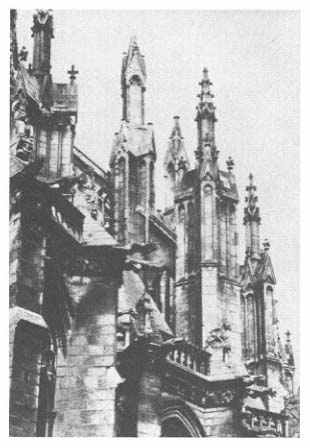
3
"Irregularities, surprises, afterthoughts": "just-jotting"
rhythms of the Gothic. It is not difficult to see how inspiring
the Gothic was, with its staccato intricacies and its pride of
territory. Such are the rhythms which attract Hopkins as well
as Pater. (Notre-Dame d'Amiens)
structed Rome (as in Marius the Epicurean )—show how effective architecture can be, as a provocation to synoptic fictions. Finally, a modern reader may look at "The Child in the House" or any other of the Imaginary Portraits , with an eye to architectural structure. In "Child," for instance, the "design"[20] which best describes "the process of brain building" is, by now predictably, the home of the story's central character, Florian Deleal: that structure then suggests mind-design, cognitive growth, nostalgia; and by implication, in accord with a terminology to be found in the aesthetic essays, it also suggests Pater's ideas about memory and fiction- or poetry-making. Such internal architecture does more than reveal the character's mind: through a perfect matching of thought to language or language to thought, the retreated writer himself goes public. Pater's careful literary monuments—his literary art entire—may be visited by all readers. Each may witness there the activity of growth itself of what would otherwise remain hidden, the private trains of thought (open sets) and of memory (closed sets) of the artist. Here we find another aspect of Pater's achievement: through his literary architecture readers may see the boundaries—the walls—of the artist's understanding and experience of the world at the same time that we see those limitations transformed into structures of meaning. Through creative expression Pater exposes the structural demarcations of his own collapsed life. These processes are tracked in detail, not only (subterraneanly) in his own fictions, but throughout his critical and historical writings. In the following section I shall concentrate on the interplay between fiction, architecture, and memory, especially as it was inherited by Pater out of a long tradition, and was then transformed by him.
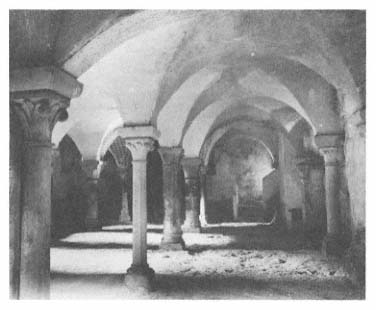
4
The mind of literary architecture: diving along a passage of old builders .
Here we see the world of time recorded as architectural style. (Vézelay)
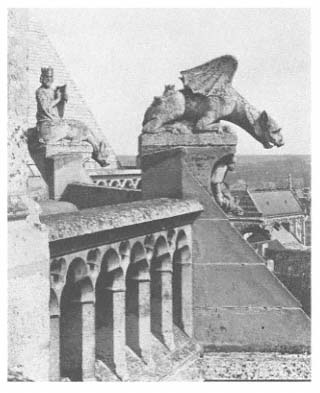
5
Notre-Dame d'Amiens: "L'église ogivale par excellence," Pater
claims in his essay "Notre-Dame d'Amiens." Pater sees in the
"queen" of Gothic churches "certain impressive metaphysical
and moral ideas, a sort of popular scholastic philosophy, or as
if it were the virtues and vices Aristotle defines, or the
characters of Theophrastus, translated into stone."
Two—
The Ars Memoria Tradition:
Architecture and Pater's Fiction
I come to the fields and spacious palaces of memory (campos et lata praetoria memoriae) where are the treasures of innumerable images, brought into it from things of all sorts perceived by the senses. There is stored up, whatever besides we think, either by enlarging or diminishing, or any other way varying those things which the sense hath come to; and whatever else . . . which forgetfulness hath not yet swallowed up and buried. When I enter there, I require instantly what I will to be brought forth, and something instantly comes.
Augustine
Our susceptibilities, the discovery of our powers, manifold experiences . . . belong to this or that other well-remembered place in the material habitation . . . and the early habitation thus gradually becomes a sort of material shrine or sanctuary of sentiment; a system of visible symbolism interweaves itself through all our thoughts and passions; and irresistibly, little shapes, voices, accidents—the angle at which the sun in the morning fell on the pillow—become parts of the great chain wherewith we are bound.
Walter Pater
How indelibly [sensible things] affect us; with what capricious attractions and associations they figure themselves on the white paper, the smooth wax, of our ingenuous souls, as "with lead in the rock forever," giving form and feature, and as it were assigned house-room in our memory, to early experiences of feeling and thought, which abide with us ever afterwards, thus, and not otherwise.
Walter Pater
Despite the lapse of time and the differences in tradition, it may be said that Pater and Augustine share assumptions about memory and place. For both, memory becomes a collection of mental images drawn from sense impressions and extended in time, linked associatively to place and figuring as edifices in the mind, or with Pater, edifices projected from the mental into material abodes. Pater, like Augustine, goes to places for their reconstructive value: "The quiet spaciousness of the place is itself like a meditation, an 'act of recollection,' and clears away the confusions of the heart."[21] But while Augustine summons up memories by an act of will, Pater and his fictional characters more often passively yield themselves to the influences of place and to the memories there associated. It is assumed that associations may be ordered in these memory store-houses, and that recollection of specific images or ideas, temporarily forgotten or buried, may be the aim of an associative ordering. Yet for Pater, order (or lack thereof) and association function, in ad-
dition, for a descriptive purpose, so as to portray what Pater calls the process of brain-building . If it is—and it is—unfair to say that Augustine is not concerned with cognitive processes, it would be as unfair to say that such was Pater's only concern. That "white paper" should figure as the recipient of sense impressions is far from incidental. It is here perhaps that Pater's purpose differs most widely from Augustine's: whereas Augustine reconstructs religious and meditative experience, Pater is concerned to suggest the active art of writing and creating. Sense images are recorded indelibly within the rooms of memory; but just as indelibly, and very much to the purpose for Pater, they may be recorded verbally as literary art. Quite simply, when Pater describes buildings—be they Vézelay or Notre Dame d'Amiens of his architectural histories, or else imaginative structures as in his fictions—he reciprocally talks not only about memory but about literature. Literature, by its analogous relationship to memory and architecture, comes to be defined as a process of recapituation, not only of a private past but of an historical one, what the nineteenth century might call racial, a past, as we have seen, recoverable through architectural renderings.
Pater, in his attitudes toward literature, architecture, and memory, holds assumptions and values which we shall find shared by others; and, in his own modest way, Pater attempts what flowers more fully elsewhere, especially in the subsequent literary creations of Gerard Manley Hopkins, Marcel Proust, and Henry James. Like these men after him, Pater inherits and brings together at the very least two seemingly separate and ancient traditions: the ars memoria tradition[22] which uses architecture as a quotidian structure for memory and
a convenient metaphor for the mind; and what I call the ut architectura poesis tradition which suggests that writers respect and imitate in their literary style principles of architectural construction or structure. It is important to our concerns with Pater and with the larger implications of literary architecture, that what seem to be vestiges of the classical mnemonic system, the one to which Augustine in fact subscribed, do survive in nineteenth-century architecture manuals;[23] and, perhaps to our surprise, we find that these very manuals also borrow and use poetic or linguistic terms to describe the art of architecture. In this context, then, Pater's careful argument for literary architecture—rather than a newly formulated analogy between literature and architecture—represents for literary art what might be considered a repossession or borrowing back of terms and concepts which had once been literary commonplaces but which had been used more recently to dictate not literary but architectural practice in the nineteenth century.[24]
Although Pater himself rarely addresses the relationship between architecture and memory with the seeming explicitness that his architectural mentor, John Ruskin, does in the "Lamp of Memory" section in The Seven Lamps of Architecture (1849), for Pater as for Ruskin, architecture serves a memorial function: it recapitulates the historical past. Pater comments in "Prosper Mérimée":
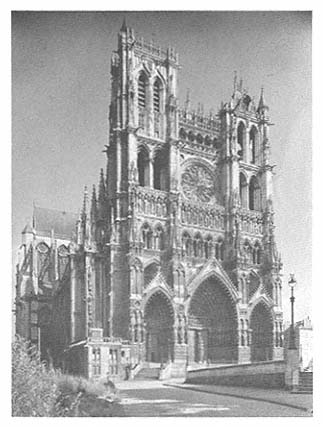
In that grandiose art of building, the most national, the most tenaciously rooted of all the arts in the stable conditions of life, there [are] historical documents hardly less clearly legible than the manuscript chronicle.[25]
Once again, the analogy between architecture and literature helps Pater to describe how he and others in the
6
Memorial architecture with historical documents.
(Notre-Dame d'Amiens)
nineteenth century view buildings. While Pater and Ruskin cautiously avoid identifying the two art forms, Ruskin by remarking that one does not "read" certain building styles as one would read Milton, Pater by carefully hedging on his analogical formulation ("hardly less clearly"), the two overtly sanction the notion of shared qualities, even the belief that one art could, to use Ruskin's term, subsume the other.[26] Only with qualifications, then, does Pater agree with Ruskin that architecture, like poetry, is a "conqueror of forgetfulness."[27] If nature can no longer retain records of the past as it did for Romantic poets, architecture can. In "Emerald Uthwart," Pater, for instance, links architecture to consciousness when he conveys how King's School Canterbury records the past:
Why! the Uthwarts had scarcely had more memories than their woods, noiselessly deciduous, or than their pre-historic entirely unprogressive, unrecording fore-fathers, in or before the days of the Druids. Centuries of almost "still" life—birth, death, and the rest, as merely natural processes—had made them and their home what we find them. Centuries of conscious endeavour, on the other hand, had builded, shaped, and coloured the place, a small cell, which Emerald Uthwart was now to occupy; a place such as our most characteristic English education has rightly tended to "find itself a house" in—a place full, for those who came within its influence, of a will of its own.[28]
That there should exist a relationship between the individual and architecture as it embodies memory or the historical past, between Emerald and his school, means that there is an overlap between the aesthetic and the moral worlds. In part because architecture reveals the mind of its builders and of its period, it may impress
its philosophical and ethical values upon those who dwell in it:
The very place one is in, its stone-work, its empty spaces, invade you; invade all who belong to them . . . seem to question you masterfully as to your purpose in being here at all, amid the great memories of the past, of this school;—challenge you, so to speak, to make moral philosophy one of your acquirements, if you can, and to systematise your vagrant self; which however, will in any case be here systematised for you.[29]
Pater is quite explicit that "impressibility" is a positive quality, especially for artists, and that architecture as physical edifice or literary structure, because it impresses aesthetically, determines or contributes to the moral quality of character impressed. If architecture assumes such power for Pater, we may begin to understand and anticipate how important architecture is for literature. We do know that Pater, throughout his own aesthetical, fictional, and philosopical writings, continually chooses to describe schools, churches, homes—structures in which a kind of learning is assumed to take place. In Plato and Platonism Pater comments:
There exists some close connextion between what may be called the aesthetic qualities of the world about us and the formation of moral character, between aesthetics and ethics. Wherever people have been inclined to lay stress on the colouring, for instance, cheerful or otherwise, of the walls of the room where children learn to read, as though that had something to do with the colouring of their minds; on the possible moral effect of the beautiful ancient buildings of some of our own schools and colleges, on the building of character, in any way, through the eye and ear; there the spirit of Plato has been understood . . . [as has] the connexion between moral character and matters of poetry and art.[30]
Memory housed architecturally becomes, thus, dynamic, to just the extent that its inhabitants become passively receptive.[31] The seesaw of static against kinetic, rest against motion, mind against soul, structure against inhabitant (not to mention structure against weather, territory against space) is endlessly in play; and just as in literary style, given optimum conditions, the passive and active coexist, so in the artistic personality the two work harmoniously if possible. In this way, an artist impressed may in turn construct or reconstruct, through memory, either the process of being impressed (his own growth), or else merely his particular, reflected, sense of an external world (his own decay).
It is possible to read Pater's fiction, then, in such a way as to take into account memory images and architectural structures as analogically suggestive, one of the other. As an example, we may look at a few passages from "The Child in the House," if only for the richness of interpretative possibilities. The story begins:
As Florian Deleal walked, one hot afternoon, he overtook by the wayside a poor aged man, and, as he seemed weary with the road, helped him on with the burden which he carried, a certain distance. And as the man told his story, it chanced that he named the place, a little place in the neighbourhood of a great city, where Florian had passed his earliest years, but which he had never seen since, and, the story told, went forward on his journey comforted. And that night, like a reward for his pity, a dream of that place came to Florian, a dream which did for him the office of the finer sort of memory, bringing its object to mind with a great clearness, yet, as sometimes happens in dreams, raised a little above itself, and above ordinary retrospect.[32]
The initial relationship between dream and memory[33]
is based on place association. Pater sets up an associative chain in which there exists ostensible movement from parable, Bunyan-esque and general, to the particular or idiosyncratic, Florian Deleal. The house recalled is "raised" by dream rather than memory "above ordinary retrospect." After the passage just quoted, Florian, in the act of recalling (as distinct from the act of dreaming) places himself inside the house and thus identifies himself with soul and with the passive. He does this in order to describe an active process ("brain-building"):
This accident of his dream was just the thing needed for the beginning of a certain design he then had in view, the noting, namely, of some things in the story of his spirit—in that process of brain-building by which we are, each one of us, what we are.[34]
Florian's verbal constructions betray, however, his assumptions about cognitive growth: they register passivity, that is, the refusal to take responsibility for growth of self. "With the image of the place so clear and favourable upon him, he fell to thinking of himself therein, and how his thoughts had grown up to him."[35] Florian then describes the old house:
The old-fashioned, low wainscoting went round the rooms, and up the staircase with carved balusters and shadowy angles, landing half-way up at a broad window, with a swallow's nest below the sill, and the blossom on an old pear-tree showing across it in late April, against the blue, below which the perfumed juice of the rind of fallen fruit in autumn was so fresh. At the next turning came the closet which held on its deep shelves the best china. Little angel faces and reedy flutings stood out round the fireplace of the children's room. And on the top of the house, above the large attic, where the white mice ran in the twilight—an infinite, unexplored wonderland
of childish treasures, glass beads, empty scent-bottles still sweet, thrum of coloured silks, among its lumber—a flat space of roof, railed round, gave a view of the neighboring steeples; for the house, as I said, stood near a great city, which sent up heavenwards, over the twisting weather-vanes, not seldom, its bed of rolling cloud and smoke, touched with storm or sunshine.[36]
The ordering of association (which, incidentally, involves all the senses, not only sight) in this passage depends at first on the wainscoting which leads Florian around a spatially conceived house. Florian's tour ends, finally, above the attic, outside, on the roof-top. The physical movement as such is one of ascent, not descent, to bird's nest, to pear tree, finally to attic and sky. Outside is something "wonderful, infinite and unexplored," while what is inside, by default, is relegated to the known and finite. The roof-top scene curiously repeats or imitates the aspiring or upward motion of Florian's physical progress through the house: "sent up heavenwards" are the cloud and smoke of the city mingled with natural atmosphere, storm and, alternatively, sunshine. The view reflects, rather oddly, Pater's conspicuously un-Ruskinian tolerance of the city with its effluvia, its fog, and smoke.
Architecture provides, then, not only a design establishing conditions of inside and out, but one making possible a direction of influences and soul growth. As home, it also suggests origins of feelings or moods as well as the beginnings of perceptual clarity: the distinctness between inner and outer yields to a fusion or blurring, which is how growth starts. "Inward and outward," so Florian says, are "woven through and through each other into one inextricable texture," half qualities from "the wood and the bricks," the other half "mere
soul-stuff."[37] It is interesting that association patterns elsewhere in the story, those not linked to the architectural device "house," also stop or end at "church," and that the penultimate stop before that conclusion is invariably "home." We begin to think that there is only one way to church. When association connects itself with structure, in this instance the church in the city, its movement once again becomes pyramidal, as if it were graphing spiritualization in space:
The coming and going of the travellers to the town along the way, the shadow of the streets, the sudden breath of the neighbouring gardens, the singular brightness of bright weather there, its singular darknesses which linked themselves in his mind to certain engraved illustrations in the old big Bible at home, the coolness of the dark, cavernous shops around the great church, with its giddy winding stair up to the pigeons and the bells. . . .[38]
Associative patterns based on buildings are not ordered temporally (there is no passage of time within Florian's home) but depend, rather, on spatial organization. Value judgments, too, link themselves to these spatial arrangements, the spiritual being above the attic, the soul within the house always escaping outward to spiritual light let in by windows or streaming onto the roof-top.
Pater's patterns of association, as we might fairly expect, do vary in important ways from those patterns used in classical memory systems.[39] Nonetheless, Pater's variations, while in some ways peculiar to him, may also suggest other services which the architectural analogy might provide for writers either familiar with Pater's work or inheriting a similar past. In classical theory,
architecture as an artificial memory model is used most generally by a rhetor who places objects within a conceptualized and particularized structure in an order so that he may remember specific points or ideas. The associations proceed then from the arbitrarily placed objects. In Pater's fiction, however, individual objects placed in specific locations, though they trigger individual memories, more often function symbolically, so that a reader may gather from them, or adumbrate, meanings he wishes them to contain. Whereas we might say that the rhetor's placement of an object usually demands a coherence and order subservient to his argument, Pater's associations generally do not presuppose a direction logically based or logically maneuvered to persuasive ends. And whereas it seems that the order of steps in this artificial memory system is controlled by the carefully crafted model, in Pater the order, and what connects two things, is found in the thing itself as often as it is found in the structure. In other words, the object as symbol frequently contains that which generates recall of the next. It is true, however, that in Pater's fiction the architectural structures are in fact as arbitrary and idiosyncratic as associative ramblings would be without those structures. There seems to be a pretence in Pater—that architectural orderings involve a reduction of randomness, and a consequent diminishing, in importance of the specific things mentioned. When the motive in Pater's associative memory system is to emphasize the final step, as is generally the case with a rhetor, his structure is generally pyramidal; however, when the associative links themselves are each more important than any last step or conclusion, Pater refrains from using a
7
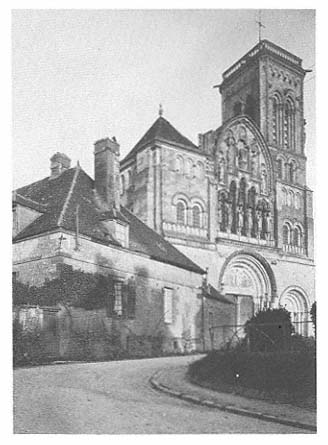
Rounding a corner of the mind: La Madeleine, Vézelay.
spatial structure having a top and a bottom. Indeed, it is not always clear that these structures have even an inside and an outside.
Pater insists that literary architecture should "foresee the end in the beginning," and this is a prescription which we shall encounter again and again as we read other writers who select an architectural analogue.[40] Foresight, in Pater's sense, is also characteristic of classical memory systems in which the end, or argumentative point, is preconceived and then broken down into a series of logical steps. In Pater's particular associative thought patterns, one similarly senses that he foresees the end of his associations in the beginning, that the enumeration of parts is a calculated elaboration of the points making up the whole. But for Pater, unlike classical rhetors, the component parts leading to the end never equal the end, and the last point is generally an added element that the constituent parts did not contain or do not produce. A holistic view of this sort allows Pater a retreat from an empirical position while in fact he has tempted the reader with a style seemingly empiricist, that is, the supposedly open-ended associative process. For Pater, the architectural device for associative memory has the advantage of avoiding the empiricist's bind of causality, seeming instead to establish fixed points and yet without becoming didactic and Cartesian. Whereas relativistic or impressionistic philosophy presumes to record impressions as they occur, without concern for the end, Pater's associations actually exist within a closed system in which the end is not only foreseen but prescribed.
From Pater's comments in "Style," if not indeed (and more compellingly) from his prose itself, one can see how he was attracted by stasis: a writer should "repeat"
8
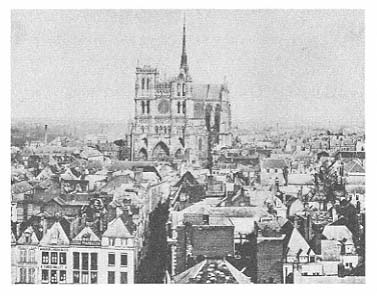
"Cliffs of quarried and carved stone . . . radix de terra sitienti. " For Proust,
this would be an example of "church epitomizing town, representing it
speaking of it and for it to the horizon." (Notre-Dame d'Amiens)
his steps only that he may give the reader a sense of secure and restful progress, readjusting mere assonances even, that they may soothe the reader, or at least not interrupt him on his way.[41]
Pater, it seems, slows down the reader almost so as to distract attention from the end, and so to expand the spiritual qualities of the associative components. Superficially then, the soul of style dominates the mind, camouflaging the clear outline, the stated but meticulously disguised limits of Pater's epistemological system. One thinks that Pater takes a dynamic system and freezes it; and he does that, it is true, when he talks about holding onto the moment of flux and expanding it. But more often than not, the entire system is one of rest (that flux is within the "narrow chamber"), and the dynamic that exists does so within strict limits. Pater's alternation between motion and rest seems to direct us away from his thought peripheries, those severely limited and limiting epistemological assumptions, and force us back into the midst of his elaborations, of what seem now Pater's fetish, his self-consuming (and self-deceiving?) processes. That stasis, or rest, does in fact circumscribe the entire system is something Pater fears, just as he and his characters fear being closed in. Thus there exists always a break through to open windows, to skies, to that which is spiritually transcendent, anything which distracts from or invigorates a deterministic, generally pessimistic world view.[42] All processes of ordering, be they through architectural memory or literary architecture or both, support what cannot but appear as a conservative aesthetic, an aesthetic allowing for growth only in recapitulation.
The arrested beauty of Pater's literary architecture registers his inspired transformation of his own limita-
9
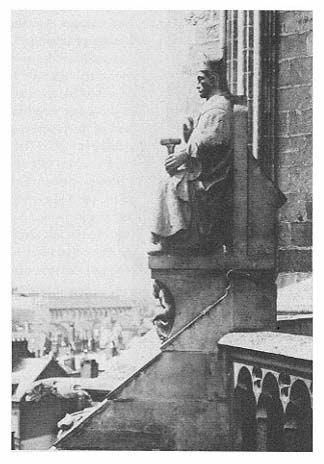
"It is a spare, rather sad world at most times that
Notre-Dame d'Amiens thus broods over."
tions into art: sensuous experience for Pater never occurs in an external or natural world, but manages, nonetheless, to live within his careful language of interiors. In this way Pater's language itself is an accommodation to his fear of unbounded energy or natural weather. In passages where his characters are out of doors, there invariably occurs a retreat; and yet this is not surprising given Pater's view of the world and of the function of literature. To Pater, all fine art should be turned to "for a refuge, a sort of cloistral refuge, from a certain vulgarity in the actual world."[43] Pater's literary architecture—whether the structure of his sentences, the houses in his fictions, or the monuments in his histories—look out over his world of pain and protect him from it just as they magically let us see what he fears. Pater concludes his essay on Notre-Dame d'Amiens with just this marriage:
It is a spare, rather sad world at most times that Notre-Dame d'Amiens thus broods over; a country with little else to be proud of; the sort of world, in fact, which makes the range of conceptions embodied in these cliffs of quarried and carved stone all the more welcome as a hopeful complement to the meagreness of most people's present existence, and its apparent ending in a sparely built coffin under the flinty soil, and grey, driving sea-winds. In Notre-Dame, therefore, and her sisters, there is not only a-common method of construction, a single definable type, different from that of other French latitudes, but a correspondent sentiment also; something which speaks, amid an immense achievement just here of what is beautiful and great, of the necessity of an immense effort in the natural course of things, of what you may see quaintly designed in one of those hieroglyphic carvings—radix de terra sitienti : "a root out of a dry ground."[44]
Here the peculiar pain of Pater discovers expression in his
odd, transitive move from a situation open to his own pre-established and closed view of the world, from an overview to a coffin. And yet Pater's built literary world is informing and in forming; he offers to those after him an economical device for speaking of relation—between self and world, mind and other—in terms of space and place, that is, as we actually experience and recall our being, our life, our death: the spatial richness of architectural structure as it governs our physical experience of the world and our language-thought of spatial experience about that world.