
II
The original manuscript of Las Casas's edition of the Diario and "Relación," preserved at the Biblioteca Nacional in Madrid, presents the two documents in sequence on seventy-six continuously numbered folios. The main text attributed to Columbus, the marginal comments, and the numerous corrections are all in Las Casas's handwriting. The text's appearance is striking in that the margins are very generous, in contrast to Las Casas's other holographs, where each page is typically covered with text, notes, and corrections.[8] The marginal commentary assumes various forms. There is a sketch (unique in the Diario ) of a quill pen in the left margin opposite the entry for 11 October, where the narrative of the discovery proper begins (see Figure 1, fol. 8r). The abbreviation nõ ("note") is used frequently to highlight certain passages. Las Casas also highlights portions of text by copying words or short phrases in the margin to summarize important passages or simply scores the relevant text. A more evaluative or interpretive form of commentary ranges from a single word to several phrases (see Figure 1, fol. 55v). Sometimes the main text is simply scored in the left margin or underlined. Las Casas was careful to distinguish the commentary from
his corrections to the main text by consistently placing the former in the left margin, while the revisions typically appear on the right-hand side.[9] The commentary usually appears boxed-off from the main text, further accentuating its presence and autonomy. The manuscript as a whole gives the impression of having been written with a careful hand, in reasonably clear and legible script.
The Diario and "Relación" were published for the first time in 1825 by Martín Fernández de Navarrete as part of his Colección de los viages y descubrimientos que hicieron los espaóoles desde fines del siglo XVI , a multivolume collection of writings about Spanish exploration. This edition appeared without most of Las Casas's annotations, however; nor was any mention made of the more than one thousand revisions to the primary text also contained in the margins and between the lines of the manuscript. In effect, Las Casas's pen was erased from the text, leaving the impression that the Diario and "Relación" had been achieved by the simple and straightforward transcription of Columbus's writings. All subsequent editions and translations of these texts between 1825 and 1892 were based on Fernández de Navarrete's; not until the Italian edition known as the Raccolta appeared in 1892 was the presence of Las Casas acknowledged, though only partially. This editor, Cesare de Lollis, returned to the original manuscript and included most, but not all, of the marginal commentary, without any explanation of the criteria employed in his selection.[10]
Most of the twentieth-century Spanish editions of the Diario and "Relación," and all the English translations I am aware of, also suppress in one way or another the presence of Las Casas's pen in the text.[11] Surprisingly, even the editor of the first facsimile edition, Carlos Sanz, silently omitted many of the marginal notes in his transcription. Recent editions and translations, beginning with Manuel Alvar's transcription in 1976, include most of Las Casas's commentary. But it is usually relegated to endnotes or footnotes, a practice that, at the very least, implies a statement on its subordinate status with respect to the main text.[12] The apparatus also makes it impossible for the reader to move from the main text to the marginal comments without interruption. Even the latest diplomatic edition and English translation, published in bilingual format by Oliver Dunn and James E. Kelley, omits the marginalia from the English half of the book. Thus demoted, isolated, and dismembered, the
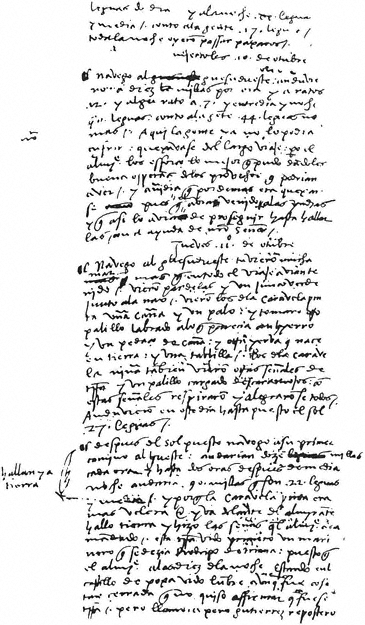
Figure 1.
Pages from the "Libro de la primera
navegación y descubrimiento de las Indias" (fols. 8r and 55v). From
Carlos Sanz's facsimile edition, Diario de Colón (Madrid: Bibliotheca
Americana Vetustissima, 1962).
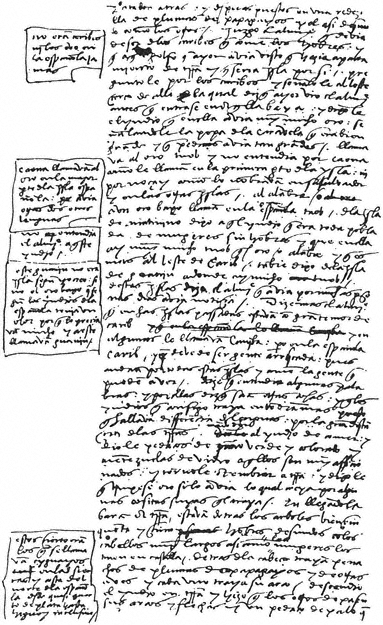
commentary is no longer the integral part of the Diario and "Relación" Las Casas conceived it to be.
The physical integrity of the manuscript is fully respected only by Consuelo Varela, who recently edited it as part of an edition of Las Casas's collected works. Varela appears to hedge her bet in the introduction, however, when she anticipates the surprise that the inclusion of the Diario and the "Relación" in the works of Las Casas is likely to cause. Rather than affirm Las Casas's decisive mediation in the transmission of these texts, implicit in their inclusion in the collected works, Varela gingerly sidesteps her own bold implication—that Las Casas's pen and not Columbus's defines these texts—by affirming that the merits of the annotations alone justify their inclusion.[13]
As this brief survey suggests, our reading of the Columbian texts has been wholly defined by the institutionalization of an editorial fiction that creates the illusion of the pristineness and absolute authority of Columbus's voice by enforcing the wholesale suppression or manipulation of Las Casas's commentary. Each of the editors recognized the presence of Las Casas's pen in the margins of the manuscript and, openly or silently, each made value judgments about which marginal notes to include or eliminate, where to place them, and how to use them in the interpretation of difficult or obscure passages. Fernández de Navarrete, for instance, chose to include notes of a geographical character but not those critical of Columbus's words and conduct. The degree of premeditation that governed his selection is evidenced in the fact that his fair copy did not include certain annotations that nevertheless appear in the published edition.[14] One can only conclude that he must have gone back to the original specifically to consider the marginal text.
The real issue is not, then, whether the annotations are indeed a part of the Diario and "Relación," but how they are treated in established editorial practice.[15] The positivist belief that the past can be essentially reconstituted in the present through the study of documentary evidence has undoubtedly contributed in no small way to scholars' persistent reluctance to acknowledge that the most complete source we have on the first and third voyages is not a fair copy, or even a copy of a copy, but a highly manipulated version of a copy of whatever Columbus may have written.[16] Even those who
acknowledge Las Casas's interventions typically feel obliged either to shield Columbus's integrity from the onus of the Lascasian violation by accusing Las Casas of fabrication or, conversely, to insist on Las Casas's absolute fidelity to the Admiral's ipsissima verba in the transcription of the first-person passages and to the substance, tone, and tenor of Columbus's lost original text in the paraphrases, which constitute some 80 percent of the Diario .[17] Although these two positions appear to represent opposite views with respect to Las Casas's handling of his source, they share a fundamental belief in the need to maintain the authority and integrity of the Columbian word. Both those who view Las Casas as a faithful and passive conduit for Columbus's voice and those who see him as a ventriloquist speaking his own mind through a Columbus-dummy ultimately maintain the privilege of the Admiral's testimony and the fiction that it is available to us in a fundamentally pristine text. Yet in the final analysis, neither those who chastise Las Casas nor those who hold him up as a model of editorial fidelity can afford to ignore the presence of his pen in his edition of the Diario and "Relación."
The unique physical appearance of the manuscript, with its ample margins and highlighted commentary, suggests that it not only served the likely purposes of aide-mémoire and citation source for Las Casas's treatises and histories, but that it was also intended for circulation among other readers. One thing is clear, Las Casas displayed the margins.[18] But the nature of the commentary itself is perhaps the strongest evidence that he was not writing for himself alone. While many of the annotations simply summarize or call attention to material contained in a particular portion of the main text, others correct Columbian errors (usually geographical or linguistic) or interpret passages of the main text on the basis of Las Casas's own experiences in the Indies. For example, a linguistic note on the Arawak word bohío , which Columbus apparently mistook as the proper name of an island, reads: "bohío llamavan los indios de aquellas islas a las casas y por eso creo que no entendía bien el Almirante, ante devía de dezir por la isla Española que llamavan Haití" (Colección 76–77; The Indians of those islands called houses bohío and for this reason I believe that the Admiral did not understand correctly; he must have been referring to the island of Hispaniola, which they called Haiti). It seems unlikely that this type of
simple linguistic correction, of which there are many in the manuscript (e.g., Diario entries for 23 November, 26 November, 5 December), would have been intended for Las Casas's own edification.
More importantly, implicit in Las Casas's corrective stance with respect to Columbus's linguistic incompetence is an ostentation of the commentator's superior familiarity with the subject matter and a questioning of the Admiral's perceptions and judgments. This oneupmanship, as it were, induces readers of Las Casas's edition to adopt a critical posture with respect to Columbus's testimony. Even the Admiral's knowledge of geography is put in question, as in the Diario entry for 1 November, which seems to have caught Las Casas's eye if the sheer quantity of notes is any indication. At the end of the entry, after describing the Indians' willingness to repeat Christian prayers taught to them by the Spaniards, Columbus makes two of his most famous geographical blunders. He asserts that Cuba is the Asiatic mainland and that he is now in the vicinity of Zaitó and Quinsay, two of the great Tatar cities described by Marco Polo in his Travels . Las Casas's comment is openly derisive, "esta algaravía no entiendo yo" (Colecdón , 75; I do not understand this gibberish). This is immediately followed by another correction in the subsequent entry, this time for Columbus's preposterous location of Cuba at 42 degrees north latitude.
A close analysis of the main text shows, however, that not all the commentary resides in the margins. Obviously anachronistic observations—some explanatory, others critical—are interpolated in various places, sometimes in parentheses or, more disturbingly for those concerned with the integrity of the Columbian word, embedded almost seamlessly in the paraphrase. Among the detectable interpolations are the concern expressed on 30 October about the integrity of the copy Las Casas was working with; the anachronistic intrusion of the Arawak name of the island of Guanahaní (Columbus's "San Salvador") before the first contact with the natives from whom Columbus could have learned it; the mention of Florida many years before it was discovered; and the comical exclamations of incredulity regarding the ephemeral islands Columbus was seeking in the vicinity of what later was to be known as the location of Florida. In each instance, the editorial voice is affecting to speak through Columbus, and the distinction between the author's enunciation and the editor's has been effectively blurred. As I observed
in the essay preceding, we have no way of knowing on how many other occasions, now undetectable, the primary text has been violated, not only by the comparatively benign operation of paraphrasing, but by the physical invasion of the marginal discourse into the presumably unadulterated Columbian discourse itself.
As we have seen, in the physical disposition of Las Casas's manuscript the main text takes shape inside and in relation to the margins. It is in fact impossible to read the main text without also reading the marginalia—unless one physically manipulates the page to block out the commentary. The eye continually and ineluctably skips from the body text to the border and back. Las Casas's explanations, additions, corrections, and signals train the reader to depend on the marginal writing to understand the primary text. And before long one begins to sense that the text is simply not complete without the annotations. The commentary's very existence bespeaks the insufficiency of the main text, the necessity of the supplement. First and foremost, the marginalia situate the reader in a critical stance with respect to the primary text. To the extent that the commentary puts in question Columbus's judgments, interpretations, representations, and actions, it renders his authority relative in value. Beyond questioning the accuracy of the source, the commentary also makes its physical integrity a relative phenomenon. The commentary leads to the conclusion that the primary text is neither an infallible nor even a stable and complete entity. Ultimately, it argues for the need to question, criticize, and revise Columbus.
Las Casas's strongest criticism is reserved for Columbus's treatment of the Indians. The marginal text draws the reader's attention to those portions of the primary text that speak of Arawak generosity, intelligence, and diligence, and their peaceable and welcoming reception of the Christians. The marginal text, however, casts these passages in an ironic light, since Columbus frequently complements such encomiastic observations with an affirmation of the ease with which Spanish domination and exploitation could be established and maintained. In the margins the editorial voice provides an explicit critical counterpoint to Columbus's patently unchristian intentions, often in bitingly sarcastic or openly denunciatory terms. In the entry for 12 November, for example, Columbus states that the previous day six young Indian men in a canoe had come alongside the ship, and when five of the six boarded he
ordered them to be detained. Las Casas remarks sardonically in the margin, "no fue lo mejor del mundo esto" (Colección , 81; this was not the best thing in the world). Columbus then says that he sent some of his crew ashore to take female captives so that the Indian men would behave better in Spain, having women from their own country along, and would be more agreeable to doing as they were told. Las Casas quips, "¡mira que maravilla!" (81; look how marvelous!) A few lines later Columbus relates that a sole man in a canoe had approached the ship later that evening and asked to be taken with the others, apparently because he was the husband of one of the captives and father of her three children, who were also being held on board. The marginal annotation demands, "porque [por qué] no le distes sus hijos" (81; why didn't you give him back his children?).
Indeed, Las Casas's harshest criticisms are expressed in the marginal commentary to passages where Columbus relates the capture of Indians to take back to Spain or makes observations regarding their exploitability. Las Casas categorically condemns the taking of any Indians against their will, for whatever purpose. In the entry for 15 January, Columbus tells of seizing four youths who had given him particularly good directions to nearby islands and making them guides for the return voyage. Las Casas's response is unequivocal: "fue muy mal hecho traerlos contra su voluntad" (Colección , 146; it was very wrong to take them against their will).
The entry for 16 December, which contains some of the Diario 's most lyrical descriptions of the land and people of the Indies, seems to have been of special interest to Las Casas, judging by the various notes ("nõ") that line the margins. It records a cordial meeting between the Admiral and a local cacique during which Columbus obtained information about the location of gold and elicited the full cooperation of his host. Columbus's closing remarks, however, turn to the suitability of the Indians for forced labor: "son buenos para les mandar y les hazer trabajar y sembrar y hazer todo lo otro que fuere menester, y que hagan villas y se enseñen a andar vestidos y a nuestras costumbres" (Colección , 111; they are fit to be ordered about and made to work, plant, and do everything else that may be needed, and build towns and be taught our customs, and to go about clothed, Dunn & Kelley, 237). This passage draws the follow-
ing comment from Las Casas: "algo más parece aquí entenderse [estenderse] el Almirante de lo que devría" (111; the Admiral seems to go farther here than he should).[19] In itself, the comment is strikingly subdued. But its ironic intent and biting sarcasm are salient in the context of the panegyric character of the rest of the entry; which accentuates the incongruity and the bad faith represented in these closing observations. The meaning of the commentary lies precisely in this contrast between idealization and exploitation, and in the understated tone of the annotation within the larger context of the entire entry, not just the closest passage. This is one of the clearest examples of the integrality of the marginal and main texts in the Las Casas edition.
On 25 December the Santa María ran aground and had to be abandoned. Columbus described at some length the invaluable help he and his crew received from the local Indian cacique :
El cual como lo supo dizen que lloró y enbió toda su gente de la villa con canoas muy grandes y muchas a descargar todo lo de la nao; y así se hizo y se descargó todo lo de las cubiertas en muy breve espacio; tanto fue el grande aviamiento y diligencia que aquel rey dio. Y él con su persona, con hermanos y parientes, estavan poniendo diligençia, así en la nao como en la guarda de lo que se sacava a tierra, para que todo estuviese a muy buen recaudo. De cuando en cuando enbiava uno de sus parientes al Almirante llorando a lo consolar, diziendo que no rescibiese pena ni enojo, qu'él le daría cuanto tuviese.
(Colección , 126)
When he [the cacique ] learned of it [the disabled ship], they said that he cried and sent all his people to unload everything from the ship. And thus it was done and in a very brief time everything from the decks was unloaded, so great was the care and diligence that king exercised. And he himself and his brothers and relatives were as diligent [unloading] the ship as in guarding what was taken to land in order that everything would be well cared for. From time to time he sent one of his relatives to the Admiral, weeping, to console him, saying that he should not be sorrowful or annoyed because he would give him all that he had.
(Dunn & Kelley, 281)
Las Casas's marginal note reads, "nótese aquí la humanidad de los indios contra los tiranos que los an estirpado" (note here the hu-
manity of the Indians in contrast to the tyrants who have extirpated them).
A few lines later in the main text Columbus affirms:
son gente de amor y sin cudiçia y convenibles para toda cosa, que certifico a Vuestras Altezas que en el mundo creo que no hay mejor gente ni mejor tierra. Ellos aman a sus próximos como a sí mismos.
they [are] a loving people, and without greed, and docile in everything. And I assure Your Highnesses that I believe that in the world there are no better people or a better land, they love their neighbors as themselves.
The first of Las Casas's marginal comments to this anecdote underscores the Indians' humanity but also establishes a significant contrast between Indian generosity and the Spaniards' subsequent tyranny—a point both alien and anachronistic with respect to Columbus's discourse. By interjecting the Spanish tyranny of the sixteenth century, the commentary affords readers a different vantage point from which to evaluate the events and words of 1492. The contrast intensifies the polarity: the kindness of the cacique and his people is enhanced in contrast to the later ingratitude of the Spaniards, and the Spaniards" genocidal crimes seem even worse in light of the Indians' generosity. The commentary thus sharpens the significance of the original anecdote ("in the world there are no better people") and uses it as a weapon by obliging the reader to consider the unwarranted violence of the Spanish conquest.
A second marginal note underscores Columbus's panegyric description of his hosts at the point where he affirms that the Indians followed the biblical commandment in their comportment. The criticism, by implication, is that the Christians did not. All of the above is written in the entry for 25 December, significantly identified by Las Casas (or Columbus?) in the section heading as "día de Navidad."
The image of the good Indians is the product ultimately of Las Casas's pen, not Columbus's; at best Columbus seems to have been ambivalent toward them. But Las Casas does not simply paint an edenic scene, the product of a bucolic nostalgia for a lost golden age. The marginal text lays bare the corrosive, subversive intentionality of the idealization.[20] Through contrastive, oppositional, polemical, and ultimately condemnatory annotations, Las Casas turns Colum-
bus's own words against him, rendering his testimony a witness against itself. Read from the margins, the image of the beatified Indian becomes a component of a rhetorical strategy of contraposition that sets "the humanity of the Indians" against "the tyrants who have extirpated them," who consider themselves to be Christians.
Even those marginal notes that are not explicitly critical frequently point an accusatory finger at the main text. The irony of such passages is superseded only by the shamefulness of Spanish action they imply. The following description of a trading expedition to the domain of Guacanagarí, where Columbus built the ill-fated fort La Navidad and left thirty-nine Spaniards, is simply noted with a marginal abbreviation "nõ" by Las Casas, without further commentary. His restraint seems justified, for the passage clearly speaks for itself:
Después que fue tarde, dioles tras (sic) ánsares muy gordas el señor y unos pedaçitos de oro, y vinieron con ellos mucho número de gente, y les traían todas las cosas que allá avían resgatado, y ellos mismos porfiavan de traellos a cuestas, y de hecho lo hizieron por algunos ríos y por algunos lugares lodosos. El Almirante mandó dar al señor algunas cosas, y quedó ól y toda su gente con gran contentamiento, creyendo verdadermente que avían venido del cielo, y en ver los cristianos se tenían por bien aventurados.
(Colección , 121)
Later, when it was afternoon, the lord gave them three very fat geese and a few small pieces of gold; and a large number of people came and carried for them everything that they had received in trade there; and they insisted on carrying the Spaniards on their backs; and in fact they did so through some rivers and muddy places. The Admiral ordered that they give the lord some things, and the lord and all his people, with great contentment, truly believing that the Christians had come from the heavens, considered themselves very fortunate in seeing them.
(Dunn & Kelley, 267)
The contrast between the helpfulness and reverence shown by the Indians toward the Spaniards and the implicit Spanish betrayal of their trust and goodwill are reminiscent of the discursive strategy employed by Las Casas in the denunciatory Brevíssima relación de la destrucción de las Indias , in which he painstakingly documents, is-
land by island, region by region, the genocide perpetrated by the conquistadors against their peaceable and unsuspecting victims.
Las Casas's commentary continues throughout the Diario and into the "Relación." The annotations to the latter, however, excepting several corrections of fact, are rarely critical. One explanation for this change may be that the two sources are very different kinds of texts, different in form, content, and ideology. The Diario is the account of an exploration, predominantly narrational and replete with detailed nautical, geographical, and commercial observations. The "Relación" has an essentially hermeneutical objective, summarizing the third voyage and, especially, interpreting its spiritual significance in the context of the larger enterprise of the Discovery for a king and queen whose commitment to Columbus was palpably wavering.[21] Yet the physical integrity of the manuscript suggests that Las Casas transcribed these two texts to be read as if they composed a unit or whole. Clearly, their perceived coherence is not temporal, since there was an intervening second voyage (1493–94) with an accompanying diario (since lost) and at least four cartas-relaciones . Neither is it generic, since the "Relación" is not a day-by-day account. But Las Casas must have had access to the diario of the third voyage, for he seems to have used it together with the "Relación" to compose his account of that voyage in the Historia .[22]
Las Casas never stated his reasons for choosing the "Relación" over the journal account for his edition of the third voyage, and the choice warrants at least some speculation. A comparison of the fragments in the Historia that appear to have been extracted from the since-lost diario of the third voyage and those that clearly derive from the "Relación" shows that the distinguishing characteristic is the interpretative thrust of the latter, absent in the former. On the finding of the mainland, for example, this journallike fragment is jubilant, but quite literal and to the point:
Volviendo al camino, el viernes, 17 de agosto anduvo 37 leguas, la mar llana; "a Dios, Nuestro Señor" (dice él) "sean dadas infinitas gracias." Dice que con no hallar ya islas le certifica que aquella tierra de donde viene sea gran tierra firme, o adonde está el Paraíso terrenal, "porque todos dizen," dice él, "que está en fin de Oriente, y es éste," dice él.
(Historia , 394)
Under sail again, on Friday, 17 August, he traveled thirty-seven leagues on a calm sea, "May thanks be given," says he, "to God
Our Lord." He says that since he no longer finds islands he certifies that land from which he comes must be a great mainland, or where the terrestrial Paradise is located, "because everyone says," he says, "that it is at the end of the Orient and this is it," says he.
There is a simple, matter-of-fact sailor's straightforwardness about the astounding conclusions Columbus draws here from his observations of geographical phenomena: Since he no longer sees any more islands, the large land mass he has just discovered must be the mainland, and since it is located at the extreme Orient, it must of necessity be the site of the Terrestrial Paradise, because everyone (i.e., all the authorities on the subject) says that is precisely where Paradise is located. Enough said on the question of Eden, the itinerary of the voyage moves on to the next day and the next place. On Saturday, 18 August, he traveled thirty-nine leagues; on Sunday, 19 August, he covered thirty-three leagues, arriving at Beata island, just off the coast of Española; and so on, as the Historia recounts by paraphrasing and probably summarizing its source.
The "Relación," in contrast, offers a convoluted erudite disquisition on the topic, which Las Casas transcribed verbatim or closely paraphrased. Paying special attention to the long interpretative sections concerning the nature and location of Paradise, Las Casas glosses Columbus carefully, adding authoritative references that support his interpretation of Paradise's location in the Indies over other competing sites because, as he puts it:
experimentaba tanta frescura de tierras, y tan verdes y deleitosas arboledas, tanta clemencia y amenidad de sotiles aires, tanta. y tan impetuosa grandeza y lago y ayuntamiento tan capaz y tan largo de tan delgadas y dulcísimas aguas, y allende todo esto, la bondad, liberalidad, simplicidad y mansedumbre de gentes, ¿qué podía otra cosa juzgar ni determinar, sino que allí o por allí, y aun cerca de allí, había la Divina Providencia constituído el Paraíso terrenal, y que aquel lago tan dulce era donde caía el río y fuente del Paraíso y de donde se originaban los cuatro ríos, Eúfrates, Ganges, Tigris e Nilo?
(Historia , 389–90)
he experienced such fresh lands, and such green and delightful groves, so much clemency and amenity in the subtle breezes, so much and such rapturous grandeur and [rapturous] lake and capacious and so large a union of such slender and sweet waters; and moreover, the goodness, generosity, simplicity, and gentleness of
the people. What else could he judge or conclude but that there, or around there, or even close to that place, the Divine Providence had constituted the Terrestrial Paradise, and that freshwater lake was where the river and fountain of Paradise emptied and where the four rivers Euphrates, Ganges, Tigris, and Nile originated?
So obvious is the edenic character of the Indies to Las Casas that he closes this passage with the categorical affirmation that whoever experienced this splendor and did not arrive at the same conclusions as Columbus would deserve to be judged for an idiot ("de ser juzgado por mentecato fuera digno"). Moreover, the paradisiacal qualities of the Indies constitute positive proof of the favor in which God holds these lands and their peoples, and therefore confirms the natives' special aptness for evangelization.
Las Casas's rationale for uniting the Diario and "Relación" in one volume is to be found, I think, not in the texts' similarities but rather in their differences. Read as integral parts of an evolving historical argument and as a preliminary exercise in historiographical methodology, the two-part manuscript provides the skeleton for book 1 of the Historia . First, the Diario presents a fractured protagonist-narrator, a Columbus devoted to the Faith, cognizant of the Indians' suitability for evangelization, and committed to advocating a Christian mission before the Crown. But it also presents Columbus as homo oeconomicus , obsessed with finding gold and spices in order to secure for Ferdinand and Isabella a good return on their investment. Las Casas's concern, as expressed in the commentary, is how the Indians were exploited and enslaved by the mercantile Columbus, who during the first voyage repeatedly took Indian captives to serve as interpreters and guides, and for display to the Court as human samples. Las Casas recognized these actions as preliminaries to the slave trade Columbus was contemplating in the Diario , and which he undertook during the second voyage, and as the basic model for the system of forced labor known as the encomlenda , which was approved by the Crown in the place of outright enslavement.[23] Every time the Diario relates the seizing of Indians, Las Casas condemns the action in a marginal comment.
The "Relación," in striking contrast, is devoted to establishing the paradisiacal nature of the new lands. Explicit economic concerns are subordinated to the spiritual value of the enterprise. Columbus relates the finding of the mainland, which he claimed was the site of the Terrestrial Paradise, as he had already predicted in
the Diario . Many of Las Casas's marginal notes appear precisely opposite those passages in which Columbus interprets the edenic geography of the new lands. Typically, Las Casas here offers no commentary per se, but a short phrase flagging the passage and summarizing its content. On the only occasion when Columbus tells of taking Indians, Las Casas simply notes the fact in the margin. Apparently he was satisfied to underscore some notable passages but otherwise allow Columbus to speak for himself.
Read together, as Las Casas presented them in his manuscript, the Diario and the "Relación" suggest a development in Columbus's thinking and mode of diction, away from the profane concerns of commercial exploitation so evident in the various accounts of the first and second voyages, and toward a preoccupation with the spiritual significance of the enterprise. The gold sought after so fervently in the Diario (and even more so in the relación of 20 April 1494) is replaced in the "Relación" of the third voyage by the spiritual profit to be derived from the discovery of a land that, according to Columbus, was "más propincua y noble al cielo que otra" (Colección , 189; closer and more noble to heaven than any other). In the "Relación" Las Casas's and Columbus's voices seem finally to be in agreement, and the commentary loses its edge. Nonetheless, the commentary effectively makes Columbus a witness against his earlier self, while at the same time confirming the correctness of Las Casas's indictment.
It is in the context of Las Casas's discourse against the conquest that his critical reading of Columbus must be situated. Read from the margins of the Diario and "Relación," the image of the good Indians contained in these texts becomes a disturbing, haunting testimony not just, or even primarily, to the Indians' character, but to the Europeans' injustice. The marginal writing inscribes Las Casas's reproach into the image that, in turn, becomes an emblem of the condemnation.
One final document helps complete the picture of Las Casas's marginal discourse on the Discovery, which culminated in the Historia de las Indias . Las Casas's copy of Columbus's letter (c. autumn 1500) to doña Juana de la Torre, governess of the prince don Juan, is second only to the Diario /"Relación" manuscript in the number and quality of Las Casas's annotations.[24]
The letter to doña Juana is perhaps the most anguished of all of Columbus's writings. It was composed at the darkest hour of his
career, between the third and fourth voyages, soon after he was brought back to Spain from Española in shackles, a prisoner of the Crown. It has all the earmarks of an apologia and a self-defense, composed for the sovereigns' benefit. Yet the addressee is not the Crown, nor one of the royal officials involved in overseeing the enterprise of the Indies, but a friend of Columbus's who was also close to Ferdinand and Isabella and therefore able to convey to them its sentiments. The tone of the letter is familiar, and Columbus openly acknowledges his bitterness and despair as well as his negative opinion of the Indians, who by then had rebelled against the Europeans on Española.
In the closing paragraphs of the letter, Columbus summarizes the difficulties he encountered and the benefits that accrued to Spain thanks to his labors. His words drew a series of sharp rebukes from Las Casas, comments that can be read as a synopsis of his views on the Discovery. The two short passages below, the focal point of his ire, are accompanied by no fewer than six marginal comments:
|
|
Read in counterpoint with the main text voiced by Columbus, the marginal commentary tells a story that goes something like this: Calling the Indians warlike is hypocritical and ungrateful on the Admiral's part; the truth of the matter is that he owed his life and
property to Guacanagarí, who, out of the goodness of his heart, helped him when he lost his ship. His ignorance regarding their customs and beliefs was astounding and therefore his (negative) opinions of them not to be trusted. God may have permitted the Spaniards to take possession of the Indies, but he did not sanction the way they went about it. He will punish Spain, rendering it the poorest of nations, for having enriched itself unjustly through the exploitation and abuse of the Indians. In fact, the Christian way of doing business was mercilessly to beat and whip the Indians into doing their work for them.
This reading strategy is no doubt self-serving, since Las Casas's authority is the direct beneficiary of the undermining of Columbus's. But it is more than that. It is consistent with the position Las Casas championed in all his written work and political advocacy: the negotiation for the Indians of a definitive and unassailable place at the center of the human community.[25] The ideological demarginalization Las Casas advocated for the Indians is mirrored in the interpretative strategy he applied to the Columbian texts, through a commentary that invades the primary text and ultimately transforms it. For Las Casas, writing in the margins of Columbus was a choice with profound ideological consequences. In the marginal text is Las Casas's reading of Columbus, an interpretation that becomes a creative act, fundamentally altering for future readers the text as it had existed.