
4—
Two Objections
I have been arguing that in order to understand what makes experiments special, what ensures that we can generalize from them, we must employ concepts repugnant to a Humean, such as nature, power, impediment, operation. The most obvious responses for a Humean to make would be either that the job can be equally well done by referring only to "occurrent properties" and their regular associations or else that this is a job that does not need to be done.
a . Consider the first objection. We want to figure out what factors are relevant—what factors need to be controlled in a given experiment if that ex-
periment is to be replicable. Imagine, for the sake of argument, that we have available an entire register of all lawlike regularities and that we are not going to quibble about the fact that most of these are as foreign to our world as unicorns. How are we to deploy them? What do we do to determine from this register whether a given factor in our experiment is relevant or not, and needs to be controlled? I suppose the procedure envisaged by the Humean is, very roughly, this: take all those laws whose consequents describe the same kind of behavior (for example, precessing in a gyroscope) as that of the law we wish to infer from our experiment; any factor that appears in the antecedents of one of these laws is a relevant factor—that is, a factor that must be controlled in any experiment to test the law at hand. But at which level of law are we to conduct our search?
At the lower level, there are a very great number of laws indeed. Gyroscopes of all shapes and materials and forms can precess, or fail to precess, in an inconceivable number of different determinate ways in a plentitude of different circumstances. The conditions are too numerous. They give us too many factors to control. Our experiments would be undoable, and the laws they entitle would be narrowed in scope beyond all recognition. But there is a deeper problem: how are these laws to be read? For the Humean, they must be the source of information about not only what factors are to be controlled but in exactly what way. Yet they cannot tell us that, for how a factor operates, at this very concrete level, is far too context-dependent. I give some examples of this kind of context dependence elsewhere.[8]
But I think the point is easy to see. To know exactly what to do with the superconducting coating in the Gravity Probe, one needs to know about the detailed construction of that particular experiment; and the laws one wants to look at are not more laws about precessions but rather laws about superconductors. The point is not whether these further laws are Humean in form or not but rather, how is the Humean to know to look at them? What is the prescription that sorts from among all the factors that appear in all the universal generalizations true in the world, which ones are to be fixed, and how, in this particular experiment?
Perhaps the answer comes one level up. Here I think is where we get the idea that there might be a relatively small number of fixed, probably articulable, factors that are relevant. We may think in terms of forces, how few in kind they are; or of long lists of causes and preventives. What is crucial is that at the abstract level, context seems irrelevant. Either it is or it is not the case that magnetic fields deflect charged particles; or that, as quantum mechanics teaches, an inversion in a population of molecules can cause lasing. Perhaps we can even find a sufficiently abstract law so that the problem seems to evaporate. For example, if we are thinking of an experiment where the effect we look for involves particle motions, we turn to the law F = ma, and that tells us that we must control all sources of force. In the gyroscope experiment, the law of
choice in this case would be

which gives the drift rate

The difficulty with this advice is that it does not justify the replicability we expect unless we join to it a commitment to stable powers of the kind I have been calling natures, or something very much like them. To see why, imagine a single successful run of the experiment, successful in the sense that first, we have indeed managed to set the total net torque, barring that due to relativistic coupling, equal to zero—or, as the Gravity Probe hopes to do, at least to an order of magnitude lower than that predicted for the relativistic effect; and second, it turns out that the observed precession is just that predicted. We seem to have succeeded in giving a purely Humean receipt for when to generalize, and this case fits. Roughly, we can generalize the quantitative relation we see between a designated input (here the relativistic coupling) and the precession actually observed in a given situation if that situation sets the remaining net torque equal to zero (or, more realistically, calculates it away), where the rationale for picking net torque = 0 as the relevant feature comes from the "Humean association" recorded in the functional law that describes the size of precessions.
The problem is that this does not get us the detailed generalization we expect (at the first, lower level). The Gravity-Probe team has worked hard to set the total net torque extremely low, by a large number of specific hard-won designs; and they are entitled to think that the results are replicable in that experimental design. What the Humean prescription entitles them to is weaker. It gives them the right to expect only that on any occasion when the net nonrelativistic torque is zero, the precession will be the value predicted from the general theory of relativity. But we expect the more concrete general claim to hold as well.
Consider the table of design requirements for the gyroscope experiment (diagram 1). The table tells how controlled each foreseeable source of torque must be in order for the total extraneous precession to be an order of magnitude smaller than that predicted from the relativistic coupling. Each such source—rotor homogeneity, rotor sphericity, housing sphericity, optimum preload, and so on—presents a special design problem; and for each, the experiment has a special solution. Using fused quartz to get maximum rotor homogeneity is, for example, the starting point for the solution of the first problem. What all this careful planning, honing, and calculation entitles us to is a far more concrete generalization than the one above about (near) zero
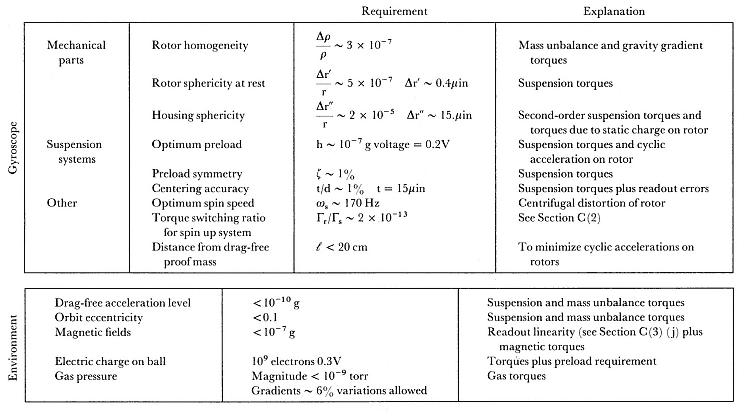
Diagram 3.1
Design Requirements for a Relativity Gyroscope with Limiting Accuracy of 0.5 × 10⁻¹⁶ rad/sec (0.3 milliarc-sec/year) (From C. W. F.
Everitt, coordinator, Report an a Program to Develop a Gyro Test of General Relativity [Stanford, Calif.: W. W. Hansen Laboratories,
Stanford University, 1980].)
external torque. We are entitled to infer from a successful run that in any experiment of this very specific design, the observed precession should be that predicted by the general theory of relativity.[9]
The table of requirements highlights the analytic nature of this kind of experiment, which I discussed in section 2. What happens if something goes wrong with the rotor housing as it was originally planned, and the fault cannot be repaired? With a lot of effort, the Probe team will make a new design and slot it into the old general scheme, making appropriate changes. Because we are working in a domain where we trust analytic methods, a peculiar kind of sideways induction is warranted: from the successful run with the original design plus our confidence in the new rotor housing and its placement, we are entitled to infer a second, highly specific "low-level" generalization to the effect that the precession in situations meeting the new design will be that predicted for relativistic coupling as well. Again, the new situation will indeed be one that falls under the "Humean" generalization involving zero torques. What is missing is the connection. The new situation is one of very small extraneous torque; but the expectation that it should be cannot be read from the regularities of nature.
The regularity theorist is thus faced with a dilemma. In low-level, highly concrete generalizations, the factors are too intertwined to teach us what will and what will not be relevant in a new design. That job is properly done in physics using far more abstract characterizations. The trouble is that once we have climbed up into this abstract level of law, we have no device within a pure regularity account to climb back down again.
b . The second argument is a more transcendental one. It does not attempt to show how it is possible to fix relevance in a world without natures but rather that it must be possible to do so. I borrow the form from arguments made by Bas van Fraassen and by Arthur Fine in debating more general questions of scientific realism. The argument presupposes that we can make available a pure data base, cleansed of natures and their non-Humean relatives. The objection goes like this: "You, Cartwright, will defend the design of a given experiment by talking about what impedes and what facilitates the expression of the nature in question. I take it this is not idle faith but that in each case you will have reasons for that judgment. These reasons must ultimately be based not in facts about natures, which you cannot observe, but in facts about actual behavior, which you can. Once you have told me these reasons, I should be able to avoid the digression through natures and move directly to the appropriate conclusions about relevance. Talk of natures may provide a convenient way to encode information about behaviors, but so long as we insist that scientific claims be grounded in what can be observed, this talk cannot contribute any new information."
But what about this decontaminated data base? Where is it in our experi-
ence? It is a philosophical construction, a piece of metaphysics, a way to interpret the world. Of course, we cannot do without interpretation. But this construction is far more removed from our everyday experience of the world as we interact with it and describe it to others than are homely truths about triggering mechanisms, precipitating factors, impediments, and the like which mark out the domain of natures. Consider an adaptation of van Fraassen's objection to causes, which is a version of essentially the same argument. The objection proceeds from the assumption that there is some defensible notion of a sensible property which is conceptually and logically distinct from any ideas connected with natures. We are then confronted with a challenge to explain what difference natures make: "Imagine a world identical with our own in all occurrences of its sensible qualities throughout its history. How would that world differ from our world?"
On one reading, this argument may be about sequences not of properties in the world but of our experiences of the world. These sequences are to remain the same, but we are to imagine that they are not caused in the usual way by what is going on in the world around us. This reading cannot be the one intended, though, since it does not cut in the right way, revealing special virtues for descriptions like 'is red' or 'is a jet-stream trail' in contrast with ones like 'has the power to relieve headaches' or 'attracts others, qua charged'.
I might further be invited to inspect my experiences and to notice that they are "really" experiences of successions of color patches, say, with powers nowhere to be found. The philosophical dialogue along this line is well rehearsed; I merely point in the familiar directions. My experiences are of people and houses and pinchings and aspirins, all things which I understand, in large part, in terms of their natures. I do not have any raw experience of a house as a patchwork of colors. Even with respect to colors, my experience is of properties like red, whose nature it is to look specific ways in specific circumstances. Sense data, or the given , are metaphysical constructs which, unlike natures, play no role in testable scientific claims. Once there was a hope to mark out among experience some raw pieces by using an epistemological yardstick: the "real" experiences were the infallible ones. After a great deal of debate it is not clear whether this criterion even lets in claims about felt pains; but it surely does not distinguish claims like 'The stripes are red' from 'Your pinching makes my arm hurt'.
The contemporary version of this argument tends, for these reasons, not to be in terms of sense experiences but in terms of sensible properties. But here there is a very simple reply. A world with all the same sensible properties as ours would already be a world with natures. As I remarked above, redness is the property whose nature, among other things, is to look just this way in normal circumstances, and to look systematically different when the circumstances are systematically varied.
Perhaps we are misled here by carrying over the conclusions of an earlier
metaphysics, conclusions for which the premises have been discarded. These premises involve the doctrine of impressions and ideas. In the immediately post-Cartesian philosophy of the British empiricists, sensible properties could be picked out because they looked like their impressions. Gaze at the first stripe on the American flag: redness is the property that looks like that . We do not have this copy theory; so we do not have properties that are identified like that. Correlatively, we can no longer make the same distinction separating powers and their properties as did these seventeenth-century empiricists. On their doctrine, the way things looked could get copied in the perceiver's impressions of them; but the various powers of a property could not. Since their ideas were copies of their impressions, necessarily their world, as imaged, had only inert properties. But we do not have the copy theory of impressions, nor do we adopt this simple theory of concept formation. For us, there are properties, and all properties have powers. (Perhaps, following Sydney Shoemaker, they are all just conglomerates of powers: cf. Identity, Cause, and Mind [Cambridge: Cambridge University Press, 1984], chap. 10.) What they are is given not by how they look but by what they do. When we use a particular power word to describe a property, we focus on one specific aspect of what it can accomplish. When we use an "occurrent" or "sensible" predicate, we refer to the property without highlighting any one thing it does, or any one particular way of identifying it. That is only a very rough characterization of the rules of use. But it points to the fact I want to stress: the distinction is one in language and in what we want to accomplish on specific occasions by using that language. Predicates can be roughly divided into types; but properties and powers are not separable in that way. The question of "How does the Hume world differ from ours?" may have made sense for Locke, Berkeley, and Hume; but without the copy theory of impressions and the related associationist theory of concept formation, nowadays it has an entirely trivial answer.