
5—
All Catalytic Reactions Are Not the Same
The chemistry for urban revitalization in Milwaukee depended on several elements, first among them the configuration of traffic and traditional uses of the setting. For example, the linear character of the Wisconsin Avenue commercial district is unlike that of cities whose shopping activities have developed around an intersection or a square. And because of land costs, access from freeways, and other considerations, parking tends to be concentrated.
Second, such unique ingredients as the Plankinton Arcade and service alleys parallel to Wisconsin Avenue give the Grand Avenue a configuration different from one in which stores fill whole blocks or where there is no inviting interior semipublic space. Further, the two existing department stores two blocks apart on the same side of Wisconsin Avenue argued for the linear character of the Grand Avenue. In a city with another set of existing elements, a different configuration for development would have emerged.
Third, socio-political and economic conditions were instrumental in facilitating changes. The individuals associated with the Milwaukee Redevelopment Corporation and those in city government helped both to make the Grand Avenue seem feasible and to implement it. The development of the Grand Avenue depended upon agreements to begin certain other developments, like the Hyatt Hotel and the new Federal Building. Then, too, the development probably would not have gone ahead with-
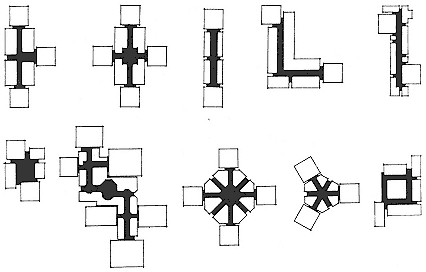
44.
Nodal, linear, and spread-form shopping centers. Stores in a cluster are the equivalent
of shops around a square; stretched out, they are like shops along Main Street. Either of
these configurations can be extended to create spread-form variations.
out tax-increment financing, which gave useful leverage: "We're taking something that doesn't exist to begin with and leveraging it to accomplish something else."[18]
In summary, center city developments must be conceived as unique collections of existing ingredients needing to be customized to satisfy new sets of requirements. Center city development calls for both idealism and pragmatism: idealism about the specialness of the place and pragmatism about making that place work in relation to contemporary traffic needs and local culture and values. This dual need calls for nothing short of a unique vision for each such urban place.