
The Deerskin Dance[11]
Songs of the Deerskin Dance have a solemn and dignified quality so striking that even the first-time listener can hardly fail to recognize their sacred purpose. Speaking of Yurok mythology, Kroeber repeatedly noted that stories of the wo'gey were filled with grief and longing,[12] and the character of this music seems to reflect these emotions. While very apparent in recorded examples, the impression is even stronger when one hears this singing in actual context.
Yurok, Hupa, and Karok versions of the Deerskin Dance are each slightly different, and in earlier times the dance was conducted according to slightly different rules at every village that had a dance. The ceremony always lasts several days, however, and includes several sets of dances each day. Different groups alternate in performing the dances, and there is a spirit of competition between these "teams."[13] Goldschmidt and Driver observed that the Hupa Deerskin dance of 1935 lasted eight days and included six dances each day (1940:110). By contrast, a Yurok Deerskin Dance held at Weitchpec in 1901 lasted eighteen days, with several dances each day (Kroeber and Gifford 1949:68).
A Typical Deerskin Dance
As the men walk from the dressing area to the clearing where they dance, each intones long notes using vocables such as "whoa." These foghornlike sounds are sustained for four or five seconds and are set in the lowest register of the male vocal range. Besides being independent with respect to tonality, these parts are also rhyth-
mically incongruent, yet there is a sense of order because all the tones have a similar timbre and seem to blend into a single body of sound. The effect is very striking when several voices are heard together in this manner.
Between nine and fifteen males generally perform in a single dance, and their procession moves gradually to the dance area where they stand in a line as indicated in the diagram below.
Once the dancers are in position, the main singer begins. Holding his deerskin pole like the others in the row, he starts patting time with his foot. Once all the others are also stamping in time with him, he starts to sing, the assistants singing faintly in unison or trailing the main part heterophonically. These songs are wordless, which is to say the singer uses vocables or syllables without lexical meaning.
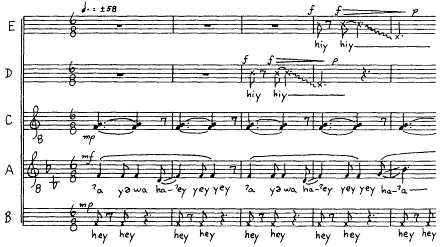
After a few phrases, the main singer is accompanied by the dancers who chant an ostinato figure that outlines the 6/8 rhythm as indicated in example 1 below. This "hey-hey" figure is not sung in focused tones; rather, the delivery is percussive in character and indistinct in pitch.[15] The dancers stamp their feet to the beat and hold out their deerskin poles, which bob up and down gently in time to the music. Soon the red flint carriers arise from either side and begin to move across the main line of dancers, holding the flints well out in front of them at arm's length.[16] As they display the blades in this manner, they each blow a constant note on their whistles, adding yet another level to the musical texture. The whistles were traditionally made from a bone of the leg of the blue crane, but toy whistles are often used as substitutes today. The whistles are blown softly and produce a breathy tone that is independent of the ensemble with respect to pitch.[17]
As the flint carriers pass before them, some of the dancers on one side emit a volley of whoops, sounding a high note loudly and letting their voices fade away as they descend in pitch. After a full measure, this whoop is answered by dancers from the other side of the line, so that an echo effect is produced. These whoops are also not related to the main song with respect to tonality, nor are they definitely coordinated with its phrasing.
The songs are brief in duration, lasting between two to three minutes, and the ending is signified by a whoop or "flourish" from the main singer. Usually, the song is ended after the flint carriers
o o o | ||
d D D D A S A D D D d | ||
F | F | |
M | ||
Diagram 2.
Position of performers in the Deerskin Dance.[14]
o | Stone seats used by singer and assistants between songs |
S | Principal singer |
A | Assistant singers |
D | Adult male dancers holding deerskins hung on poles |
d | Boys holding deerskins in same manner as the men |
F | Flint carriers holding obsidian blades |
M | Medicine man seated by fire burning angelica root and speaking prayers |
have passed in front of the line three times and returned to their original positions. The main singer then signifies conclusion at the end of the next phrase, even though his solo part might be incomplete from a formal standpoint. Between songs, there is a break of about thirty seconds, and during this period any of the dancers may sound one of the long foghornlike sounds described above. The song is sung three times, then a new one is sung and the red flint carriers are replaced by men carrying black ones.
A complete set of songs lasts about thirty minutes, after which the dancers proceed back to the dressing area to remove their ritual clothing and store the deerskin poles until it is time for them to dance again. In the meantime, another set of dancers prepares to appear, and the day passes with alternate periods of dancing and feasting.
The Musical Texture
The various elements in Deerskin Dance singing combine to produce a rich texture which is coordinated rather loosely. The main melodic part is augmented by sound layers of indefinite pitch, and the whole ensemble is unified mainly by rhythm. The musical texture of a typical phrase is illustrated in example 1.
| ||||||||||||
Example 1.
Elements of musical organization in the Deerskin Dance.
The Solo Part
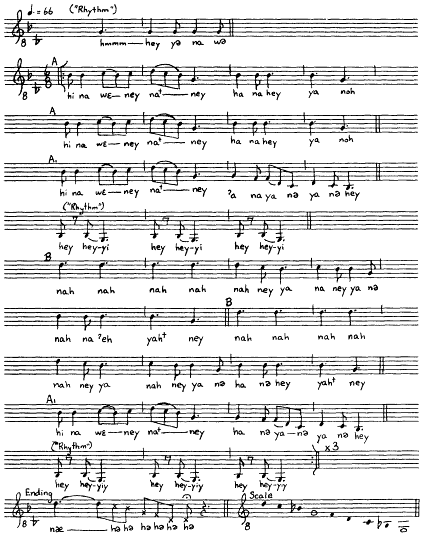
The late Abraham Jack (Hupa) was one of the most highly regarded singers in recent decades, and one of his well-known Deerskin Dance songs provides an excellent model for describing the genre in general. A rough transcription is provided in example 2. In keeping with its sacred nature, the song is sung entirely in vocables, as the use of lexically meaningful texts in ritual music is generally more frequent in secular songs such as the "light songs" heard in the Brush Dance.
One important characteristic in this music is the general tendency for the soloist to chant the tonic pitch at the beginning of a song and at the end of each major section. This chanting is called "rhythm" by the Indians themselves. In the song above, for example, the soloist begins by chanting a bit of "rhythm" to get his pitch
Example 2.
Deerskin Dance song sung by Abraham Jack (Hupa)
and recorded by Mary Woodward in 1953.
and to establish a rhythmic framework for the song to follow. After he has completed at least one major phrase-group, the soloist is joined by others who chant "rhythm" for an accompaniment as indicated in example 1 (part B).
In each major phrase group, the solo part begins at or near the upper limit of its range and gradually descends to merge with the chanting of the accompanists. This downward progression creates a sense of drama and climax in the music. It tends to integrate the solo part with the accompaniment, and at the same time it serves a cadential function by indicating the close of each phrase-group. As a compositional device, it is perhaps the single most important concept in group singing among the tribes considered here, for it occurs in various types of ensemble singing and is even present as an organizing principle in many of the medicine songs used by individuals.
The overall form of the song in example 2 may be described as a simple strophe[19] of the following shape: (Rhythm) A A A1 (Rhythm) B B A1 (Rhythm). The B sections generally feature long sustained notes sung somewhat higher in pitch than the A sections, and this basically binary form may represent a version of "the rise" as noted among the Yumans by George Herzog (1928:193) and among other California tribes by Bruno Nettl (1954:18-19).[20] In actual performance, the ending of the song is determined by the movements of the dancers (see above), and thus the form is not necessarily completed on the last repetition. Whenever the flint carriers complete their circuit, the soloist will signify conclusion by using the ending "flourish" notated in the last line of this example.
The 6/8 or 12/8 meter is a general characteristic of Deerskin Dance songs, and this is intrinsically related to movements of the dance. A strong sense of meter forms the basis for an interlocking relation between the solo part and other elements of the musical texture (see example 1), and there is not much syncopation in these songs. Also in keeping with the dignified character of the music, the tempo is always rather slow.
The melodic range spans an octave and a fifth, and this wide ambitus is a consistent trait which seems to go hand in hand with the use of rather long phrases and descending or terraced-descending melodies. Use of an anhemitonic pentatonic scale is also a general characteristic, and this type of scale is the one most frequently heard in all styles of vocal music. As noted previously, the singer chants "rhythm" on the tonic note at the beginning of the song and
again at the end of each major phrase-group. Therefore there is a strong sense of tonal center throughout the song.
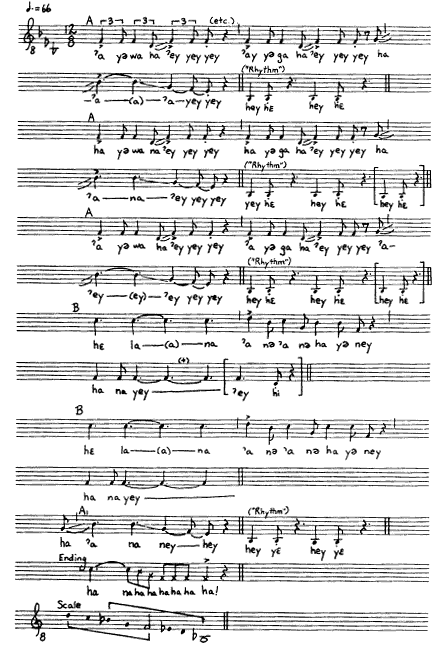
Although this style is generally rather consistent, it is interesting to broaden our analysis by looking at another modern Deerskin Dance that diverges from this one in certain respects. This one is sung by the late Ewing Davis (Hupa), another artist of legendary stature in Hoopa Valley, known locally by the nickname "Fido."
The song in example 3 is very similar to the previous one, but there are important differences. The basic form (AAA BBA) is the same, but Ewing Davis chants "rhythm" at more points during the song. The resultant formal structure may be described as follows:
A (Rhythm) A (Rhythm) A (Rhythm) B (Rhythm) B (Rhythm) A1 (Rhythm)
It is significant that there are extra beats of "rhythm" chanted in example 3 (indicated in the transcription by brackets). These tend to preclude a feeling of symmetry in the melody, and this occurs in so many recordings of various types of songs that it seems to be aesthetically significant. There appears to be a general distaste for overly symmetrical melodies, and this is also reflected in the occasional use of irregular metric groupings and other subtle variations that apparently serve to avoid an impression of perfectly balanced phrasing.
While the first example was clearly in 6/8 meter, this one is best notated in 12/8, mainly because of the melodic phrasing in the B section. Either meter fits nicely with movements of the dance and other elements of the musical texture.
The scalar material in example 3 provides a more significant point of contrast. While the earlier example used a standard pentatonic scale without half-steps, this one uses an irregular scale in which notes of the upper octave do not exactly correspond to those in the lower one. Regular scales such as the one in example 2 are far more common, but the repertory as a whole contains many examples that are unusual or idiosyncratic with respect to scale and tonality.[21]
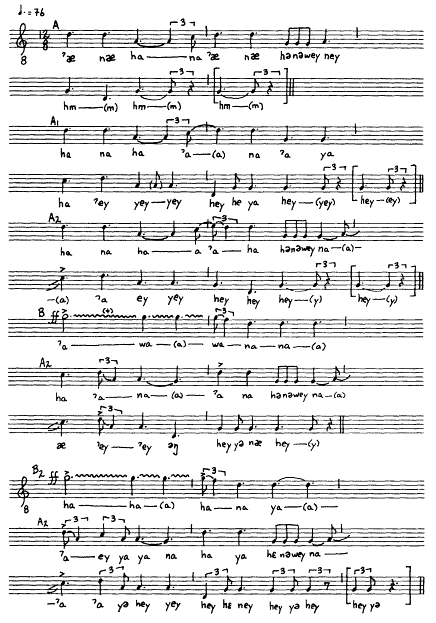
The transcription provided in example 4 allows us to compare these modern Hupa songs with a Yurok Deerskin Dance song collected by Kroeber in 1906.
In most respects, the style of example 4 parallels that of the
Example 3.
Deerskin Dance song sung by Ewing Davis (Hupa) and recorded by Mary Woodward in 1953.
Example 4.
Deerskin Dance song sung by Hawley (Yurok) of Meta and
recorded by Kroeber in 1906.
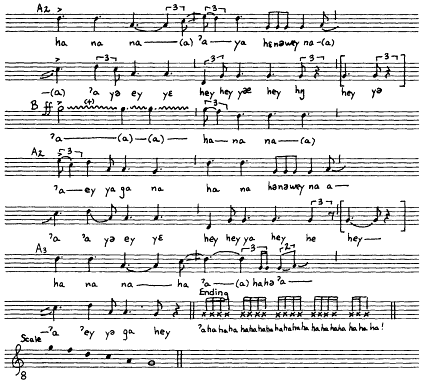
Example 4.
Deerskin Dance song sung by Hawley (Yurok) of Meta and recorded
by Kroeber in 1906. (continued)
previous ones very closely. This song is built on an anhemitonic pentatonic scale, and the rhythm is basically similar to that of the previous examples, even though the tempo is a bit quicker. As in the previous example, there are instances in which the singer has added "extra" beats of "rhythm" (indicated with brackets) which tend to reduce the feeling of symmetry in the phrasing.
The most important point of contrast involves the formal structure. Omitting consideration of the "rhythm" sung between sections, the more modern songs are most often based upon strophic repetition of an AAA BBA pattern. In example 4 there are traces of this general outline, but there is more repetition of the A section and phrase-groups are varied more on repetition. The song is not strophic but rather of a form that would be best coded as a complex
litany with moderate variation in terms of cantometrics terminology (Lomax 1968:58-59). The overall structure could be analyzed as follows:
A A1 A2 B A2 B A2 A2 B A2 A3 (Ending)
This comparatively loose formal structure seems to be typical in early recordings and it seems likely that the genre has become somewhat more regular in form over the past one hundred years. A similar pattern of apparent stylistic change will also be noted in the next chapter through comparison of recent and early Brush Dance songs.