
III
The practice of expressive doubling is closely bound up with the utopian esthetics and subject/object polarity of early Romantic culture. As illocution, doubling gives the utopian project of art a concrete lyric or dramatic shape. It inscribes the sought-for historical progress from the actual to the ideal within a definite temporal frame: the unfolding rhythm of the individual work or the developmental interval between two works.
It follows that the terms of an expressive doubling form a hierarchy; one term represents a freer, happier, or more enlightened condition than the other. Or, to be more exact, one term represents the transposition of the other to a higher or deeper plane, a more brilliant or profound register. Adrift in London, Wordsworth transforms a bewildering crowd of strangers into a "second-sight procession" until
. . . all the ballast of familiar life—
The present, and the past, hope, fear, all stays,
All laws of acting, thinking, speaking man—
Went from me, neither knowing me, nor known.
( Prelude [1805], 7.604–7)
Shelley, recalling a calm afternoon on which images cast in forest pools seemed to form microcosms, values the reflections as "more perfect both in shape and hue" than their originals ("To Jane: The Recollection," 63). The images are "Elysian," as if their serenity, unlike that of the actual landscape, were imperishable.
Romantic esthetic theories typically posit a human creative faculty based on organic metaphors: a "blending, fusing power," as Coleridge
[23] Schiller, Sämtliche Werke , 17:509; trans. M. H. Abrams in Natural Supernaturalism , 214. For discussion of this problematic duality in Schiller and Romantic esthetics generally, see Tilottama Rajan, Dark Interpreter: The Discourse of Romanticism (Ithaca, N.Y., 1980).
described it, that animates the parts of a whole as life animates a body, so that the whole and the parts are vitally interdependent.[24] Expressive doubling marks the blind spot in this organic model. Far from blending or fusing, it concentrates, repeats, reinterprets. One result—the most radical result—is that whatever conflicts or instabilities appear in the lower term of the doubling tend to be carried over into the higher term. This imported or transferred ambivalence acts to problematize the higher term, which must somehow overcome it, somehow answer this intrusion of the actual as a limit.
Transferred ambivalence goes to the very core of early Romantic esthetics. It forces the recognition that resistance to the ideal is a part of the effort to idealize: aspiration carries resistance on its back. Furthermore, it is by no means always possible to meet the psychological demands imposed by that resistance. Wordsworth eventually found a radical estrangement from familiar life too isolating or disorienting to affirm, at least for anyone past early childhood; he cut the "second-sight" lines I quoted earlier when he revised the 1805 Prelude .[25] Shelley ends "To Jane: The Recollection" by recalling how the Elysian imagery was erased from the pools by an "envious breeze," a negative breath of inspiration that corresponds to anxiety rather than rapture. The last lines ruefully acknowledge that the whole poem may have been wishfully overidealized:
Though thou art ever fair and kind
And forests ever green,
Less oft is peace in S[helley's] mind
Than calm in waters seen.
(85–89)
Beethoven's String Quartet in E Minor, Op. 59, no. 2, sets a highly demanding moment of transferred ambivalence at the climax of its slow movement. The movement opens with a tranquil chorale theme that subsequently recurs four times with variations in harmony and, in each case but the last, with increasingly elaborate counter-
[24] On this subject, see M. H. Abrams, The Mirror and the Lamp: Romantic Theory and the Critical Tradition (New York, 1958), 167–77.
[25] The Prelude , Wordsworth's poetic autobiography, exists in three versions, conventionally referred to by date: 1799 , in two books; 1805 , in thirteen books; and 1850 , in fourteen books. None of these is now considered "definitive."
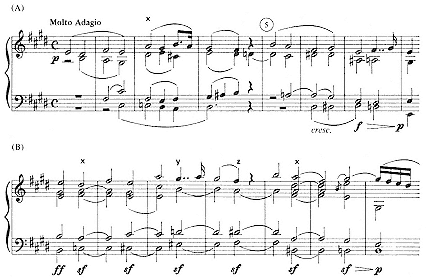
Example 1
Beethoven, String Quartet in E Minor, Op. 59, no. 2. (A) Theme. (B) Climax.
point. The last recurrence can be experienced as an expressive doubling rather than as a variation. After Beethoven has seemingly finished with it, the chorale intrudes on the coda; framed by six-four chords, it stands alone like a kind of sublimated cadenza.[26] Tranquillity gives way to extreme intensity: the chorale–quasi-cadenza begins fortissimo and continues at that dynamic through closely spaced sforzandi. The theme sounds an octave higher than before against block chords rather than countermelodies; the harmonies are strongly dissonant and slow to resolve. The communal aspiration of the chorale has been reconfigured into an individual moment of vision: and at that moment, it becomes impossible to tell rapture apart from anguish.
Crucial to the effect of this passage is the fact that its dissonances have been implicit in the chorale from the outset. As Example 1 shows, the climactic sonority is ruled by a pair of diminished-seventh chords: one a dominant-oriented chord (x ) that enters on the initial sforzando, the other (y ) a chromatic auxiliary of the first. Chord x , with the same bass note, also occurs on the downbeat of measure 3 of the original theme. As to chord y , it progresses in the climax
[26] Cadenzalike; see Kerman, Quartets , 129.
through the ambiguous diminished triad z (derived from x ) before resolving to a dominant; the progression anticipates the third of the dominant chord by means of a D–D


Some further insight into expressive doubling and its deferred ambivalence can be gleaned from an autobiographical fragment by Wordsworth, which I propose to examine rather closely. The passage, one of those visionary episodes that Wordsworth called "spots of time," was originally intended for The Prelude ; it wound up, in pieces and rather the worse for wear, in the didactic epic The Excursion (1814). Here is the original version:
Whether the whistling kite wheeled in the storm
Maze intricate above me or below,
As if in mockery or in proud display
Of his own gifts compared with feeble man;
Or facing some huge breast of rock I heard,
As I have sometimes done, a solemn bleat
Sent forth as if it were the mountain's voice,
As if the visible [mountain made the cry]
And hark, again [that solemn bleat, there is]
No other, and the region all about
Is silent, empty of all shape of life—
It is a lamb left somewhere to itself,
The plaintive spirit of the solitude.
In those same careless rambles of my youth,
Once coming to a bridge that overlooked
[27] Ibid., 128; Solomon, Beethoven Essays , 276 (entry 94d).
A mountain torrent where it was becalmed
By a flat meadow, at a glance I saw
A twofold image; on the grassy bank
A snow-white ram and in the peaceful flood
Another and the same. Most beautiful
The breathing creature was, as beautiful
Beneath him was his shadowy counterpart;
Each had his glowing mountains, each his sky,
And each seemed centre of his own fair world.
A stray temptation seized me to dissolve
The vision, but I could not, and the stone
Snatched up for that intent dropped from my hand.
(Unutilized draft of 1804)
The episodes of the lamb and the ram are set down and juxtaposed without interpretive commentary. The same rhetorical practice dominates Wordsworth's orginal attempt at poetic autobiography, the Two-Part Prelude of 1799. The memories of formative experiences are taken as primary; they are compelling in excess of any explanations that might be devised for them—explanations they will invariably evade in later versions of the poem. In this case, however, the mere juxtaposition of memories is revelatory. Wordsworth's impulse to shatter the image of the ram, and the happy failure of that impulse, represent a reversal of his attitudes toward the invisible lamb. One expressive doubling (ram and image) clarifies Wordsworth's deep-seated need to preserve another (ram and lamb).
In the lamb episode, Wordsworth twice represents the free-floating solemn bleat as the mountain's voice, then abruptly undoes this personification by explaining the sound rationally. In so doing, he also disenchants an apparently privileged spot of its presiding genius: the "plaintive spirit of the solitude" is just a lonely lamb. The motives for this rhetorical reversal are deliberately left obscure, but the plaintiveness of the cry, the blankness of the rock, and the lifelessness of the scene all carry hints of a pain that cannot be assuaged, an isolation that cannot be broken. The "huge breast of rock" is indifferent rather than maternal—or worse, indifferent and maternal: the cry is like that of an abandoned child. Faced with this subtext, Wordsworth understandably prefers an abandoned lamb. The lamb, a mere natural fact, displaces the fantasy of maternal abandonment.
It may even allow Wordsworth to form a screen memory for the loss of his mother, who died when he was eight.[28]
In the ram, Wordsworth finds a counterimage of self-sufficient maturity. The ram is in possession of a grassy meadow and a torrent wrought to calm, the oxymoronic "peaceful flood." His silence and stillness suggest a secure bliss at odds with the lamb's desolation, and his solitude is a measure of his commanding place at the center of "his own fair world." In this context the calming of the waters seems to emanate from the ram's sovereign presence. Wordsworth's impulse to "dissolve" the vision that doubles the ram may correspond to a wish to preserve the singleness, the self-sufficiency, of the creature that symbolically undoes the dependency of the lamb. Or Wordsworth may not want to be reminded by the vision that the natural ram is finally just a "breathing creature," no less subject than the lamb to natural sorrows. Being "shadowy," the ram's counterpart is exempt from that fate. It is both an Elysian shade and a "shadow" (early-nineteenth-century usage for an image) that lies as much in the mind's eye as in the mountain pool. To dissolve the vision would protect the ram, transfer the harm.
Nonetheless, the stone drops from Wordsworth's hand. His defensive preference for the natural creature cannot withstand the transfixing appeal of the perfected vision. Touched by anxiety though it may be, the shadowy ram survives as an image of desire, the desire for a peace and beauty beyond vicissitude. Read in these terms, the image triumphs by reconfiguring the very forces that oppose it.
When Wordsworth came to rework this material for The Excursion , he faltered, as he would later do with the "second-sight" passage, over his original affirmation of ambivalence. Cutting the episode of the lamb, he hastens to control its erstwhile double by means of allegory. The ram and its image become
Antipodes unconscious of each other,
[28] The concept of screen memories derives from psychoanalysis. Such memories are constructions in which problematical early experiences are both revived and disguised. On the role of Wordsworth's mother in The Prelude , see Richard Onorato, The Character of the Poet: Wordsworth in the Prelude (Princeton, 1971).
Yet, in partition with their several spheres,
lended in perfect stillness, to our sight!
(9.449–51)
The stilted phrasing is an index of Wordsworth's effort to preserve his idealization of the image from strain or disruption. The lofty diction is a means of securing poetic authority at a discount. Similar motives might explain a demotion of the ram's "mountain torrent" to a more tractable "hasty rivulet" and an emphasis, missing earlier, on the "manliness" of the ram, with his "imperious front/Shaggy and bold, and wreathed horns superb" (443–44). Even more telling is what happens here to Wordsworth's earlier impulse to dissolve the vision. A companion, "not without awe," speaks up:
"Ah! what a pity were it to disperse,
Or to disturb, so fair a spectacle,
And yet a breath can do it!"
(452–54)
The impulse returns as the one thing that always returns—the repressed: denied by displacement onto someone else, stripped of aggressiveness by the deletion of the stone, and rationalized by turning its failure into a moralizing cliché. It would be hard to imagine a better means of dissolving the image than such an overzealous effort to protect it.