
The Humanist Critique: Lewis Mumford
Lewis Mumford wrote The Culture of Cities in 1938 to advocate a particular kind of urban planning. Strongly influenced by the teachings of the Scottish city planner Patrick Geddes, Mumford divided urban history into three major, technologically determined eras: the medieval city (the "eotechnic age"), the industrial city (the "paleotechnic age"), and the future (the "biotechnic age"), or what some commentators now call the "post-industrial" city. In Mumford's view, the medieval city was good because while it reflected some planning, this was an organic planning that had unfolded naturally. Like the medieval city, New England towns and villages and most of New York State around 1850 also met this ideal: an "integrated regional life . . . [with] a multitude of settlements, no one of which, outside New York, achieved a disproportionate size." The evils of the paleotechnic age, embodied in the industrial city, resulted either from a lack of planning or inhumane planning—straight lines, blank facades, lack of sunlight. The promise of a bright urban future in the biotechnic age would be in natural planning, on a human scale. Frank Lloyd Wright's writings best elaborated on the idea of organic planning, "using the machine but not dominated by it." Mumford loosely related urban form to social, political, and economic history, equating fascist brutality with the ugliness of straight lines, monumental scale, and insensitivity to nature.[1]
Mumford's work continues to appeal to readers, perhaps because of his authoritative style, best exemplified in the bibliography to The Culture of Cities , an impressive collection of some 700
titles in English, German, Italian, and French, annotated with comments and judgments which suggest authority and scholarship: "unimportant," "essential," "invaluable," "fundamental," and the like. A careful reading of his bibliographic annotations, however, brings into question many of his judgments. His citing of Thoreau's Walden and Cape Cod as "fundamental classics in regionalism" hints that the bibliography was aimed at listing books that were in fashion rather than those that might help readers learn about cities. If Mumford had read it and liked it, it was important. Moreover, the bibliography reveals an essentially aesthetic view of the past: Dickens's Hard Times presented the "classic picture of the paleotechnic town," dark, filthy, and ugly. Mumford dismisses the only scholarly history of the American city then published, Arthur M. Schlesinger's five-year-old The Rise of the City: 1878–1898 . Of this first serious example of modern urban historical scholarship, now considered a classic, Mumford wrote, "as usual with historians of the passing generation, without a grasp of the city as organic whole." At the time he wrote this, Mumford was forty-two years old, Schlesinger forty-nine.[2]
Mumford's history, and his analysis of the present, consisted of a series of aesthetic judgments. The "massing" of industries made them ugly, but a factory where the blankets were bleached and shrunk in "the open air of a charming countryside" earned Mumford's approval. Should the changing urban world be judged by its conformance to our contemporary aesthetic standards, much less to the standards of one individual? Mumford, for instance, dismissed not only Le Corbusier but also Charles Eastlake, "whose dreadful incised decoration left its scar on both wood and stone": in a very direct way Mumford attached his values to the Arts and Crafts movement. He castigated the British Victorian city as "a junkheap of discarded styles . . . the solidification of chaos." By refusing to admit any standard other than his own, Mumford became ahistorical. Robert Venturi and Denise Scott Brown have shown how much the nature of the urban aesthetic continues to change: Victorian clutter, Eastlake-style decoration, and now even Las Vegas kitsch can fade in and out of style. By claiming the aesthetic territory he did, Mumford precluded any sense of historical change or analysis, save that of what charmed him and what did not. This gave his work a dual appeal; first his confidence and authoritative dicta comforted their readers. Second, although (unlike Mumford)
we now favor Victoriana, much of what Mumford liked has continued to appeal to twentieth-century observers—medieval cities or their elegant remains, the architecture of Frank Lloyd Wright, wilderness conservation and urban greenbelts. Yet an examination of the pictures in Mumford's book also should give one pause: the large apartment blocks of which he so approved, and showed in aerial photographs, seem now to be little different from the monumental fascist architecture he so despised. Mumford's aesthetic insisted on a sculptural sense of mass housing, on buildings designed to look planned, but at the same time, not too regular or too square.[3]
Mumford idealized the small town and walled city; spreading metropolitan areas of the United States in the nineteenth and twentieth century, in his words, "stretch over the countryside in an amorphous blob." Thus he emphasized the importance of the visual, and anathematized cities without sharply demarcated visual boundaries. This he made clear in his discussion of worker housing in industrial cities: even if Manchester, New Hampshire, and midwestern industrial towns were better than most, "the improvement was but one of degree: the type had definitely changed for the worse."[4] He didn't care whether there was running water or indoor plumbing or adequate living space; his main concern was how they looked. This aggressive intrusion of his aesthetic bias into an essentially nonaesthetic judgment also subtly reinforced a historical error in Mumford's argument: for industrial workers, the proper housing comparison should have been with rural cottage housing, in which almost all medieval workers lived, not with the rare few who dwelt in the medieval city.
These aesthetic standards caused Mumford to reject visionary plans like those of Frank Lloyd Wright. Mumford adored Wright's organic architecture for the detached home, but felt that he went too far in his idealized plan of an automobile suburb, Broadacre City, which was too square and too spread out for Mumford's visual sense. Mumford's definition of chaos, of what did not cohere visually, was a highly personal one. The architectural critic Reyner Banham's Los Angeles: The Architecture of the Four Ecologies provides a belated but much needed visual and aesthetic counter-argument to Mumford. Through the eyes of its residents, Banham shows how an architectural critic can visualize and make order out of the chaotic sprawl of Los Angeles. Like Venturi and Brown, Ban-
ham makes it clear that the formal aesthetic of urban sprawl has lagged behind its popular understanding. "Disorder," "sprawl," and visual "chaos" are not objective descriptions; they represent instead the reactions of one rather narrow sensibility to the North American city.
By presenting his reactions as historically objective, Mumford managed to create simultaneously an ahistorical past and an equally unrealistic planning goal. His version of the past takes the physical object to be the social and psychological actuality. Mumford claimed that by holding the remaining "hollow shells" of medieval cities "quietly to one's ear, as with a seashell, that one can catch in the ensuing pause the dim roar of the old life that was once lived, with dramatic conviction and solemn purpose, within its walls." On closer examination, his metaphor seems as inappropriate as it is erroneous: if the seashell is the physical shell of the medieval city, then the slimy and silent mollusk inside would be the appropriate analogy to city life. The metaphor's ahistoricity is demonstrated in its description of nineteenth-century cities as chaotic: their inhabitants in all probability found an order in them just as freeway commuters find an order in late twentieth-century southern California.[5]
Mumford disliked the modern city, mass production, and machines in general. While this is an understandable aesthetic position, it virtually disqualifies his analysis of the past and of planning options. Nothing exemplifies this better than one of Mumford's modern "good" examples, the planned garden city of Radburn, New Jersey. The brainchild and "most visible product of one of the most innovative planning groups in American history"—that is, Mumford, Henry Wright, Sr., Benton MacKaye, Clarence Stein, and Stuart Chase—Radburn was built in the 1930s and it remains a charming, attractive, and desirable place to live. But Radburn's population in 1980 was only 3,000 people, and it did not have the status of an incorporated town. Had there been 501 fewer people, it would not even have met the formal census definition of urban! The model it did provide was for the small suburban housing developments and shopping malls (it had one of the first) which are so much a part of the decentralized, automobile- and freeway-dependent metropolis that Mumford hated. From the beginning, in 1929, Radburn's residents moved there, as one recently told a historian, because "being out of the city was what appealed to us at
the time. . . . My wife was pregnant and we wanted to start a family in that kind of environment rather than in the city streets."[6]
Since Mumford sympathizes neither with urban sprawl nor the automobile, it is not surprising that he has often used Los Angeles as an example of the "anti-city." Predictably, he blamed the automobile for destroying the central city, and asserted that the abandonment of the railroad and promotion of the automobile was a great planning error of the twenties and thirties. Yet as chapter seven makes apparent, popularization of the automobile was not induced by planners at all, but the result of an innovation pushed to the fore by ordinary people who used it to expand the variety and distance of personal travel, not merely as a substitute for other forms of mass transit. Mumford, by distorting the reasons for the spread of the automobile, urged a forced return to fixed rail transit. Just as he hated the ugly furniture produced for mass consumption in the Victorian era, so he hated the form of city opted for by masses of ordinary families.[7]
Why did Mumford concentrate on buildings rather than the city itself as sources for his historical sense, on seashells rather than sea? Ask anyone who has been a tourist. Much of what we know as tourists, as visitors with limited time, ability, and knowledge, focuses on the physical city. Because of this necessary limitation, it is all too easy to make what might be called the architectural fallacy: to read economy, politics, and society through buildings. An ordinary stance for a tourist, this is a very poor way to understand history and an even poorer way to plan the future. Because we can grasp buildings, and imagine how to shape them, we seize that aspect of urban life in intellectual desperation. Just as it seemed to nineteenth-century reformers that the proper prison architecture would reform criminals, so it seems that we could make cities better places by simply making them more attractive. And we make superficial efforts to understand cities through the same apparatus. But buildings and their inhabitants are often wildly out of sync. Some ghettos of Los Angeles look like pleasant suburbs, while the desirable Park LaBrea apartments in the same city look like 1930s public housing. In their basic shape and to the unwary, luxury apartment towers in New York look just like awful high-rise housing projects. Renovated nineteenth-century warehouses make elegant inner city housing throughout the older cities of the United States. In Britain many castle keeps have been trans-
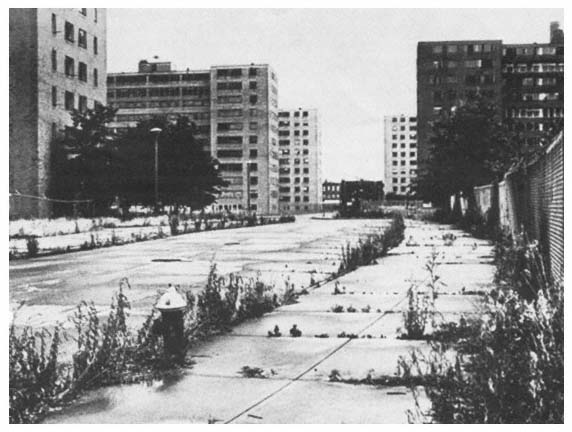
Public Housing: Pruitt-Igoe, St. Louis, 1974.
Hailed as exemplary high taste brought to the poor for efficient public
housing, designed by an impressive team that included the famous architect,
Minoro Yamasaki, the high-rise Pruitt-Igoe towers soon became the
symbol for modern urban ills. Less than twenty-five years after construction,
most of this housing project for the urban poor was abandoned, destroyed,
and labeled an architectural and planning disaster, with the design
of the buildings, in particular their high rise modernism, being most implicated.
Critics blamed modern design aesthetics for the social and physical
problems such buildings sometimes contained. Yet the original caption
to the portion of this photo that appeared in the newspaper observed succinctly,
"Because there was no maintenance fund, Pruitt-Igoe's broken
windows let in wintry air, freezing and bursting the pipes, leading to the
project's downfall."
Source: St. Louis Post Dispatch (August 25, 1974), 27.
formed from homes for kings to prisons to art museums, all the while looking much the same. Mumford ignored this point when he showed Fifth Avenue apartment buildings in New York and compared them implicitly to the dark, small, and nasty back-to-back houses of Leeds and Bradford.[8]