
PART TWO
Chapter Eight
Contenders for Action: The U.S. Case
Quarreling sparrows do not fear man.
Japanese proverb
I pointed out in part 1 that in a number of areas the loose-coupling model applies to the decision-making processes associated with adoption of small-group activities. Perhaps the most dramatic example thus far is the faddish quality of adoptions among suppliers where solutions are typically chasing problems and where power, rather than strategies emphasizing economizing of transaction costs, seems to explain adoption. One of the issues before us in the remaining six chapters is whether commitment to small-group activities represents a short-term management interest or support of small-group activities is in the process of evolving into a significant social movement within industry. Sociologists commonly define social movements as collectivities acting with some continuity to promote or resist a change in the society or group to which they belong (Turner and Killian 1972).Typically the social movements studied by sociologists are driven by a sense of injustice. As we saw earlier, this was not a primary driving force for the evolving small-group-activities movement in the United States, but the Swedish movement had rather more of a populist cast to it. Even in the United States and Japan, however, there was a sense that something was wrong with the way firms were organized—that we were not using our human resources very well—and that this ought to be changed.
In Japan, as we shall see, managers did create a social movement, although it was based less on a sense of social injustice than on a sense of corporate citizenship and improvement.
One way that sociologists distinguish between fads and social movements is by asking whether and in what way the informal interest shown by disparate individuals comes to be coordinated through the development of formal organizational activities, which can be powerful factors in attracting resources, protecting innovators from hostile forces in the environment, and supplying assistance (that is, resources) to innovative individuals and organizations. These activities also make clear the specific interests of the major parties to the labor market.
The preceding analysis indicates that for the period under consideration, roughly 1960 to 1985, all parties to the labor market in Sweden became committed to the small-group-activities movement; in Japan, management became committed; and in the United States no major party to the labor market developed such a commitment. One would expect that these different degrees of commitment would be reflected in the nature of the emergent national infrastructures for diffusing small-group activities. Specifically, I predict that, all things being equal, where at least one of the major parties to the labor market becomes strongly committed to small-group activities as a solution, especially management, a well-organized national infrastructure will be created. The next six chapters allow us to examine the data supporting this prediction.
At the same time, this will give us a chance to examine the ways in which such a national infrastructure smoothes decision-making processes for firms as regards small-group activity, thereby reducing the "garbage can" quality of these processes and economizing on transaction costs. It will also enable us to examine the different nature of the emergent collaborative activities among firms in the three countries and to attempt to account for them. Significant differences in the national infrastructures that evolved tell us a great deal about the character of small-group activities in different settings and their potential for institutionalization at the level of firms. These differences are indeed dramatic.
It is my strong belief, based on the data, that this approach gives a decidedly new perspective on the issue of how and why new social forms like small-group activities become institutionalized. This
is in sharp distinction to the usual social science strategy of examining the potential for institutionalization by trying to evaluate the success of specific programs directly.
Contenders for Leadership
The task in this chapter is to examine the range of contenders for national leadership in the small-group-activities movement in the United States in the 1970s. I ask what path was taken by already existing organizations and interest groups that had the potential to play a leadership role in this area. This chapter is devoted to those who chose not to play and is premised on the view that we can learn a great deal from what did not happen.
The approaches taken in this and subsequent chapters are in keeping with emergent research initiatives in organizational studies stressing the entrepreneurial, environmental, and behavioral aspects of the creation of new organizations. Such approaches provide a healthy corrective to the cross-sectional research methodologies that have dominated the research of American scholars on "mature" organizations (see Kimberly, Miles and Associates 1980).
I turn now to the array of organizations and the interest groups they represented to consider the possible contenders for a leadership role in the diffusion of small-group activities in the United States.[1] Since progress in moving toward shop floor participation of workers has been relatively slow in the United States, it is not surprising that the development of a comparable infrastructure has been modest.
In thinking about the range of probable actors in the creation of national infrastructures, I assess the involvement of participants from the following sets of institutional arenas: university, government, foundations, firms, business association, and unions. If we examine the mid 1970s first, two key players stand out with emergent investments in what in the United States are typically called
[1] This section draws on a variety of written sources such as Dickson 1975 and Davis 1977, interviews with numerous organizational leaders and their staff, and examination of institutional records. It also benefits from my own personal experiences and access to data that resulted from being a member of the board of directors of the American Productivity Center and a member of the academic advisory committee of the Work in America Institute.
participative work practices or the quality of working life: (1) the government acting through the National Commission on Productivity (established in 1970), the Department of Commerce, and other organizational instruments that evolved over time; and (2) the Ford Foundation, with an involvement dating from 1970 through support for the American Center for Quality of Working Life and the Quality of Work Program established in 1974 at the University of Michigan, the Center for the Quality of Working Life at the University of California (also dating from 1974), and the Work in America Institute (1975). I describe their activities not for the sake of description but rather to understand the reasons for the kind of role they did or did not come to play in the small-group-activities movement.
The Federal Government
The involvement of the National Commission on Productivity is particularly interesting, since government sponsorship is well known to be an important factor accounting for patterns of organizational creation and growth; state support and protection and access to public funds can obviously constitute an overwhelming advantage vis-à-vis competitors and with regard to achieving organizational goals (Aldrich 1979).
President Nixon established the National Commission on Productivity by Executive Order on 17 June 1970. The commission was set up as an approach to containing inflation through productivity improvement and was based on the Swedish tripartite model of a forum for top-level people from government, industry, and labor, plus public representatives. George Shultz and Assistant Secretary of Labor Jerome Rosow were the early advocates in the administration. President Nixon was attracted to the idea because of the potential political benefits. Addressing the "pocketbook" issues of inflation and unemployment could win blue-collar votes.
The commission was given token funding, never exceeding $3 million a year, and did not receive a legislative mandate until President Ford signed Public Law 94-136 establishing a National Center for Productivity and Quality of Working Life in 1975. The revitalized commission had a broader—some staffers were to say seemingly endless—list of missions, which included improving the qual-
ity of the workplace in both the private and public sectors, making better use of the nation's human and technological resources, and increasing national productivity.
As part of its activities, the commission planned ten to twenty demonstration projects at work sites in manufacturing, service, and government. These were to involve employers, trade unions, and workers. The commission envisioned that it would "seed" these projects by getting the parties together and securing and funding consultants to advise them how to proceed. Finally, the commission anticipated that it would then disseminate the results of these experiments through conferences, articles, books, and films. All this was to take place by 1980, by which time, it was hoped, wide-scale adoption of these new ideas would have taken place.
Participative work structures were a significant element in the demonstration projects, and small-group activities were part of this conception. Indeed, Eric Trist of the Tavistock Institute was involved with the Rushton mine experiment (and later with experiments with community revitalization at Jamestown, New York). European thinking about small-group activities was thus known to the organizers, as were quality circles. In 1975 the assistant executive director of the commission met with officials from Lockheed's Air Missile Division, the most prominent early adopter of quality circles in the United States. He offered to work with Lockheed to measure and evaluate its program; Lockheed declined the invitation.
The commission's goals were not to be achieved. Congressional funding was erratic, and in 1978 President Carter disbanded the commission on grounds that "it hadn't been sufficiently productive." Basil Whiting, then deputy assistant secretary of labor, and a former Ford Foundation official dealing with these activities, recalls being told by the OMB official in charge: "Forget it. Just you and a few other romantics are interested in this. There simply is no political support. In fact, there is even opposition from the AFL-CIO."
Indeed, labor's attitude toward the commission had been ambivalent from the beginning, and strong business groups had also been ambivalent. The Business Roundtable, a major business lobby group that was created to stand up to big labor, supported the legislation to create the commission, but consistent with its opposition to government intervention, it pushed for a cap on funds, so that the commission was never in a position to carry out its mandate.
With these kinds of "friends," it is no wonder that the commission accomplished little. Underlying this lack of support was the fact that both labor and management lacked full trust in the government as a partner. One sharp observer of the scene at the time (who prefers to remain anonymous) summarizes commission activities as follows: "Conversations on the Commission often degenerated into finger pointing about the same old issues, with labor complaining that they were not accepted and management complaining that labor was not cooperating with efforts to hold down costs." In the final analysis, the commission failed because it lacked a politically powerful constituency. The results, such as they were, tended to be invisible, and this gave rise to continual congressional criticism. From the congressional point of view, the commission was not tackling the political agenda between management and labor.
Although the commission had established an active publications program and helped inaugurate some innovative projects, such as the Bolivar and Rushton mining projects (see Goodman 1979), it cannot be said that it went far along the road to achieving its ambitious goals. Most notable is the failure to establish the commission as a permanent resource for organizations contemplating innovation and as an effective diffusion agent. Some of the functions of the commission were relocated back to other government agencies, such as the Department of Labor, while its records were transferred to the Work in America Institute. This scattering of accumulated assets hardly seemed propitious for the future.
It would be an incomplete picture of the early days of government activities in this area if one were to leave out the key role of the Economic Development Administration (EDA) of the Department of Commerce. Lou Phillips of EDA was a key participant in funding innovative projects such as the early experiments at Rush-ton and Bolivar; the labor-management committee program at Jamestown, New York; and the University of Michigan Quality of Work Program, as well as in directly and indirectly funding some of the organizations to be discussed later in this chapter. Between 1973 and 1976, EDA spent almost $2 million in support of these activities. EDA often collaborated with the Ford Foundation and the National Commission in sponsoring such projects. But as we shall see, government funding for such activities gradually dried up.
Since this early period of support, government involvement has limped along in fits and starts, typically supported on shoestring budgets. In the early 1980s, in an attempt, in part, to preserve existing staff, a Department of Labor task force developed a new program, the Division of Cooperative Labor-Management Programs, "to assist employers and unions to undertake joint efforts to improve productivity and enhance the quality of working life." The idea, approved in 1982, was to create a central clearinghouse of resources on QWL, with particular focus on the successful operation of labor-management committees. While funding has been unpredictable, the unit has shown modest growth; in 1985 it employed some twenty professionals and was budgeted at around $500,000 a year. In a reorganization it has since been elevated to bureau status (as the Bureau of Labor Management Relations and Cooperative Programs), but limited by mandate to the unionized sector and focused on labor-management cooperation, it is not in a position to play a national leadership role in the small-group-activities movement.
Still another federal initiative developed in the late 1970s. Spurred by the success of the communitywide revitalization efforts at Jamestown, New York, Senator Jacob Javits and Representative Stanley N. Lundine spearheaded the passage of legislation in 1978 to involve the Federal Mediation and Conciliation Service (FMCS) in labor-management cooperation efforts (Public Law 95-524). The service, a reluctant partner in this new venture, currently represents the only legislatively mandated federal involvement in the quality of work life area in the United States. Although originally authorized at $10 million a year, it has never received more than $1 million.
The Reagan administration eliminated the program from its budget requests from 1980 to 1985, only to have congressional compromises arrive at budgets varying between $500,000 and $1 million a year. Ironically, a number of other federal agencies that had financially supported QWL, such as the Department of Commerce and the Office of Personnel Management, saw fit to discontinue their activities with the advent of FMCS involvement. Thus the net increment of investment to the field was even less than the modest budget of the FMCS would suggest.
As prescribed in the legislation, the bulk of FMCS funds have gone to support labor-management committees on a competitive-application basis. The FMCS's only involvement with small-group activities is indirect, in the sense that many of the proposals submitted to it for support include plans for small-group activities under the auspices of labor-management committees.
The Ford Foundation and Its Offspring
The Ford Foundation began its support for participative activities in 1970 and by 1978 had spent on the order of $3 million in organizational and individual grants. This included some overseas support for the International Council on QWL.
The initial issue for the foundation was where and how to invest these new resources. A debate took place within the foundation among those pushing for the foundation to lead a national movement for QWL directly and those critical of the whole idea of QWL, which they argued was an approach in which workers and managers were not interested. The former strategy was based on the models developed in the civil rights movement and poverty programs. Initially, it would have involved direct support for selected on-the-ground projects and support to intervening "activators." These latter organizations were to serve as third-party advisor/trainer organizations that would actively diffuse the QWL concept and be involved in stimulating networking among activists and providing technical support to innovators.
This was the time, however, when the foundation was reining in many of its activities in response to outside criticism of its alleged "excessive activism" in the 1960s. The message went out from high-level officials that "we are not going to run a movement here on this subject." This reflected the outside criticism, but also the clear ambivalence on the part of many foundation officials who were not convinced there was a constituency for such intervention. Officials were also responding to the foundation's major budget crunch of the mid seventies. To be sure, the foundation typically had a "seeding" policy, which meant that if there was a social need, the movement once started would pick up other support and/or become self-sustaining. But such participative activities could hardly
be said to have established a firm foundation by the mid to late 1970s. Indeed, an internal memo to the foundation trustees in October 1976 called for expanded funding, arguing:
This field [workplace reform focused on improved quality of worklife] is still very underdeveloped in the United States and larger resources could not be applied effectively, yet. First a base must be laid: existing grantees need further support; some additional centers of competence seem called for in a nation this large; the cadre of professionals competent to aid labor and management is limited and needs buttressing; case studies and materials on successful and unsuccessful efforts are lacking; training programs for managers, union leaders, and workers are needed, reform of traditional university criteria in business and industrial design seems possible; and alternative forms of ownership could be probed and carefully developed.
With the decision to move out of funding in this area, the major opportunity for the foundation to assist in the creation of a national infrastructure of support for participative work practices was lost. Such a commitment could reasonably have been expected to encompass small-group activities were it to have been made.
Given the original ambivalence within the foundation about supporting QWL activities and the growing resistance to the idea over time, advocates within the foundation were forced to change their strategy and turned to a "scientific rationale" to get the money into the field. It was thus political expediency above all that led to the flowering of social science research in participation and QWL in the mid 1970s—certainly not the first time that scholars have been the unwitting beneficiaries, if not agents, of their organizational sponsors. Again we see a situation in which problems and solutions are rather loosely coupled. It is an accident of foundation politics and timing that large-scale support for academic research became identified as a solution to the problem of how to diffuse participatory work structures in the early 1970s.
Ford Foundation activists hoped that these research efforts would legitimate QWL and gradually evolve into more active support for the movement. Such was not to be the case. The major manifestation of this approach was a large multi-year grant in 1974 to the Quality of Work Program of the University of Michigan to evaluate the eight major demonstration projects being facilitated by the
American Center for Quality of Working Life. All of the projects were at unionized sites. As Basil Whiting, program officer for the Ford Foundation, explained in his 1974 Senate testimony:
Despite the fact that only a minority of the American labor force is unionized, this program should concentrate primarily on unionized workplaces. There is a serious danger that job enrichment and other changes in workplaces will be seen as union-busting, anti-labor devices or management gimmicks. . .. The best way to prevent these concerns from emerging is to ensure that unions are involved from the beginning in the experimental efforts.
(Whiting 1975)
The detailed measurement strategies involved in the eight evaluations focused on five dimensions: productivity and other economic results of redesigned jobs; changes in workers' attitudes; social organization and other aspects of QWL; labor-management relations; and changes in technology and other physical aspects of work.
A great deal of effort and resources were spent on the development and validation of observation and measurement methods. Of the almost $1 million available to the Quality of Work Program at Michigan in this period from various grants (including $130,000 passed on to the American Center for Quality of Working Life), about one-fifth was devoted to this measurement effort. When these evaluation activities ended at Michigan, the quality-of-work program gradually contracted. It cannot be said that the results were fed back and came to have a significant impact on private- and public-sector management; rather they primarily became the basis for academic books and articles that influenced scholarly discussion and, no doubt, the careers of those active in the field.[2] Publication in academic journals and in the language of social science tended to minimize the impact of these findings on practitioners.
An understanding of the Michigan QWL project was that the researchers not provide direct feedback to those involved in the change process, a policy exemplifying the emphasis on producing valid scientific results in these "natural experiments." This con-
[2] A preliminary bibliography of publications emanating from the project as of 1985 included forty-seven articles (not including those by contracted change agents and various project reports) and six books. Five other books were in varying stages of completion.
trasts with a strategy that would have provided rapid feedback to those involved. Finally, the long delay between conduct of the research and actual publication made the demonstration projects less than ideal as a stimulus for diffusion. Indeed, although the researchers submitted a technical summary report to the sponsor, the planned public report summarizing and comparing the eight demonstration cases was never completed. Perhaps the greatest impact of this work in the diffusion process was that it trained a significant set of young scholars who were to become increasingly active as organizational consultants with the renewed interest in participatory work practices in the 1980s.
The American Center for Quality of Working Life
The American Center for Quality of Working Life was set up by Edwin ("Ted") Mills, formerly of the National Commission on Productivity and the Price Commission, and prior to that a television producer and advertising executive. The center was established as a nonprofit institute under grants from the Department of Commerce's Economic Development Administration (EDA) and the Ford Foundation (through the Institute of Social Research at the University of Michigan). Funding has been erratic and the center had a near demise in 1978.
Initially, the center acted as a broker bringing parties together, providing outside facilitators to work with internal labor-management committees. In its early years two major conditions of center activity were that the site be unionized and that the parties agree to have developments monitored by an external evaluation group from the Quality of Work Program at the University of Michigan. The evaluation process was carried out independently and involved detailed measurements. The center sponsored eight such arrangements, picking up the Bolivar and Rushton projects referred to earlier (Davis 1977). Mills saw the center as moving through periods of experimentation, detailed scientific measurement, and dissemination (Dickson 1975:352-53). Mills was later to lose his enthusiasm for these evaluation activities and their ability to contribute to dissemination. He moved the center toward operating
more as a permanent technical assistance bureau serving a broad range of clients.
Mills retired in 1982, and Kevin Sweeney became chairman. Sweeney's previous experience was as personnel director for the National Association of Home Builders. Under his leadership, the center refocused its efforts. It placed primary stress on changing organizational culture to improve the quality of working life. As in the past, the center worked exclusively with unionized firms as its long-term clients and stressed building labor-management committees. It also came to conduct its own evaluation studies under contract with various government agencies and private-sector firms. By 1985 the center was operating with about twenty-four staff members, including twenty professionals, and had an annual budget of $650,000 to $750,000. It worked at any one time with perhaps twenty-five clients, from both public and private sectors, and continued to maintain its nonprofit status.
Promotion of small-group activities constitutes a modest, though increasing, proportion of the center's efforts. It tended to define its market niche as both broader and narrower. It was broader than small-group activities in the sense that for the center QWL involved a change in the culture of organizations and therefore required heavy investments in securing the commitment and understanding of top and middle management. This suggested a specific focus on management training. The market niche was narrower than small-group activities in the sense that the organization stressed improving labor-management relations in unionized firms through the use of steering committees. To be sure, these steering committees often establish small-group activities, and the center often works with companies in this phase as well. By concentrating primarily on union firms for its long-term clients, however, it in effect writes off 80 percent of the market. Center personnel were acutely aware of these limitations when I interviewed them in 1984 and indicated that this might change in the future.
More generally, once foundation support declined in the late 1970s, the organization increasingly faced the choice of whether to be a national center or a consulting organization. The need to find a source of regular revenue pushed it in the direction of individual organizational consulting at the expense of a diffusion role as a national clearing house. It tried to minimize this tension through
agreeing to work on projects with substantial learning opportunities whose results could be widely disseminated. But it has been a continuing dilemma. In any case, at no time in its history have small-group activities been a focus of the center's operations.
The Center for the Quality of Working Life
In 1974 a second set of Ford Foundation grants established the Center for the Quality of Working Life at the Institute for Industrial Relations at the University of California (Los Angeles). The program was headed by Louis Davis, a specialist in the application of systems analysis to the design of new plants. The center concentrated on developing new techniques for restructuring work; conducting training conferences for labor, management, and professionals; and providing advice to unions and employers on demonstration projects. The intermediate goal was to establish action research programs in which new concepts were tested. The center hoped to attract sufficient grants, contracts, and fees to sustain its efforts. This did not occur, however, and it is no longer a significant factor on the national scene.
The Work in America Institute
A third grant, along with contributions from other organizations, established the Work in America Institute in 1975. The institute is headed by Jerome Rosow, a former Exxon executive and assistant secretary of labor who was active in the creation of the National Commission on Productivity. Funded by federal, corporate, and foundation sources, the private nonprofit institute was designed to serve as a clearing house for experimentation, research, dissemination of ideas, and discussion of issues concerning the quality of working life. Along with the Center for the Quality of Working Life at the University of California, the institute was intended by Ford to be the major instrument in building a national infrastructure for diffusing the QWL concept. The Ford Foundation provided the institute with some $1 million in seed money over five years, a sum less than originally intended for reasons discussed above. In the mid 1980S the annual budget was running at $2 million a year.
The institute places considerable emphasis on providing in-
formation through conferences, site visits, and publications as a means of building awareness and stimulating action among corporate and union leaders. These activities are typically based on the case method, drawing on the experiences of leading organizations in a particular content area. The institute has an active publications program, but one lesson it learned, says Rosow, is that information dissemination is costly. Much of this activity has to be subsidized.
The publications program, workshops, and conferences have periodically included small-group activities as one of the areas to be promoted. But the emphasis on small-group activities tends to be ancillary to the primary focus on building labor-management cooperation in the unionized sector. The institute has a tripartite board of directors, consisting of management, labor, and government members, and stresses this principle in its activities. In 1986 almost half of the members of the board were active or former union officials. As a matter of principle, the organization conducts little activity in the nonunionized sector. Furthermore, Rosow "didn't see a constituency for a populist movement around small-group activities [such] as existed in Sweden."
Originally, the institute sought to provide direct field support in the form of training and technical assistance. Over time, the costliness of such efforts shifted the institute to more policy-related activity. It actively conducts policy studies funded by corporate and private foundations.
To have concentrated on direct technical assistance would, moreover, have turned the institute into a consulting organization. As Rosow saw it, consultants would have had to be hired and he would have ended up trying to figure out how to raise funds to meet the payroll. Means would thus have turned into ends, and the institute would have lost sight of its original clearinghouse objectives. Moreover, he says, one problem with learning from consulting activities is that you cannot go public with much of the information. With these considerations in mind, the institute pushed for endowment, initiating policy studies and a "Productivity Forum," established in 1979. The forum is composed of forty corporate, government, and union members, who together employ or represent some twenty-two million people; representatives meet regularly to exchange information at site visits and workshops.
Productivity Improvement and Employee Involvement
A later entry into this arena was the American Productivity Center (APC), established in 1977 and renamed the American Productivity and Quality Center in 1988. It was founded by C. Jackson Grayson, Jr., a former chairman of the Price Commission who had worked initially with Ted Mills to set up a unit within the commission to explore the potential of QWL in offsetting inflation through raising productivity.
The APC represented the first in a second wave of national and regional organizations dedicated to improving productivity. QWL and related participatory work practices were not the centerpiece of its program as in the earlier organizations; rather they were one facet—smaller or larger depending on the organization—in its overall strategy to improve productivity. Labor-management cooperation and employee involvement are listed among the principal areas in which the APC works. Small-group activity was one aspect of the QWL or participatory theme, but it assumed only modest proportions.
The APC was initiated with corporate grants from some seventy-five major corporations totaling $8.5 million spread over five years. In addition, a group of Texas businessmen erected a building for the organization in Houston. The board of directors has typically included high-level business executives, but after a while some union leaders and, more recently, a scattering of academics were added. The APC was modeled in part on the German and Japanese national productivity centers. Initially the center concentrated on raising consciousness about the productivity problem and productivity measurement. With the termination of its five-year start-up grants and the failure of contributions and fees for services to keep up with expenditures, there was a dramatic scaling down of operations. Annual expenditures fell from roughly $6 million a year in 1980 and 1981 to $3 million in the mid 1980s, and the professional staff was cut from ninety to fifty.
In commenting on the scaling down, Grayson hints at the dilemma I have referred to earlier in discussing the Work in America Institute and the American Center for Quality of Work Life—that
of reconciling the provision of national leadership with the need to generate sufficient revenues to sustain the organization. "We tried to be too many things. To be self-sufficient, we would have had to become just another consulting firm. That might have endangered our non-profit status," Grayson said in announcing the scaling down of activities.[3] To have relied only on consulting would have required that the APC forfeit any claim to a national leadership role. By their nature, many public-interest activities cannot be self-supporting.
Notwithstanding such concerns, we can see a transformation reflected in the APC's changing sources of revenue. Whereas in 1979 consulting accounted for 5 percent of its revenue, this rose to 43 percent in 1983. The change reflects the absolute rise in consulting income combined with a falling off in contributions. A major crisis occurred in the mid 1980s, when those contributing the consulting income split off to begin their own, at least partially competitive, organization. This, as we shall see, is a common pattern and a major dilemma for nonprofit organizations of this nature. From the consultants' point of view, instead of using the profits of their activities to subsidize the rest of the organization, they can do better by going off on their own and enjoying those profits themselves.
One interesting feature of the APC's new strategy that bears on subsequent discussion is that it has been the most successful of the organizations in this area in developing a mass membership. It has built up a core of 350 annual corporate contributors who serve as members in one capacity or another. With contributions accounting for only some 40 percent of revenues, the center turned more to conducting activities on a fee-for-service basis, such as its study in the mid 1980s of strategies for raising white-collar productivity. Throughout its existence it has also been heavily involved in productivity measurement.
Unlike the Work in America Institute and the American Center for Quality of Working Life, the APC did not limit itself to helping unionized firms. This, combined with its support from conservative oil industry leaders, Grayson's participation in the Nixon administration, its focus on productivity improvement and measure-
[3] Scott Clark, "Productivity Center Cuts Back Education, Emphasizes Practical," Houston Chronicle , 23 October 1983, pp. 2, 5.
ment, and the prominence of nonunion firms such as IBM among its early sponsors, led to charges that it was anti-union. The lack of union leaders among the early board members added to this image. The fact that the APC did not limit itself to unionized firms was also the basis for some animosity on the part of the national organizations focusing on the unionized sectors as they competed for corporate and foundation funds.
However effective the center has been, it clearly was not prepared to assume the national mantle of leadership in the small-group-activities movement. It was juggling a great many balls in the air. Employee involvement/labor-management cooperation formed only one of its five principal areas of concentration. The others were productivity management, white-collar productivity, productivity measurement, and national policy. The organization has not been prepared to allocate major resources to the labor-management cooperation and employee involvement area, and specifically to small-group activities, at the expense of the four other areas.
Board members and corporate sponsors, especially in the APC's early years, saw the path to productivity improvement in terms of traditional approaches like increasing availability of capital at favorable terms, technology investment, and taxation policy. These individuals were more at home negotiating and lobbying for solutions in Washington than in the factories and offices of America. Union leaders on the board were just as comfortable focusing on the "big issues" associated with traditional labor-management concerns. Yet, support for small-group activities in terms of their productivity and quality payoffs requires the acceptance of a view that many small changes, in the aggregate, yield big changes. Receptivity to such views was in short supply among board members.
Other New Wave Organizations
In the late 1970s and early 1980s, a large number of statewide productivity improvement and/or quality-of-work centers were begun. The initiatives for these organizations have typically come from universities. A November 1984 Department of Commerce report (U.S. Department of Commerce 1984) lists thirty-seven state or regionally based organizations, of which thirty-three are housed
in universities. In an overlapping list of comparable organizations compiled by the American Productivity Center, of the twenty-two organizations listed, the largest number started in any one year was six in 1977 and the second highest year for start ups was 1978, with four (American Productivity Center 1985a). Those two years alone thus account for almost 50 percent of the new wave organizations.
These new wave organizations were a response to the heightened competition of the late 1970s and early 1980s. As such, compared to their earlier counterparts, they tended to stress productivity improvement to a greater extent than quality of working life. If we simply examine the names of the thirty-seven state or regional centers referred to above, sixteen contain the word productivity , whereas only four mention quality of working life and three include both terms.
Notwithstanding the productivity emphasis, many of these centers set up labor-management committees. While typically limited to the unionized sector, such committees hold some promise for diffusing ideas and practices relating to new work structures. Tying demonstration projects into a local network of labor and management seems a fruitful means of carrying out the diffusion effort. Yet such state committees as do exist are still struggling to survive and appear far from achieving a self-sustaining momentum. Some, like Michigan, have had to scale down their activities drastically when initial foundation funding ended. In the Michigan case, consulting supplied much of the financial support for diffusion and promotion until the major consultant decided to go off on his own. Some of the state committees have died; the attrition rate is high, and some survive in name only. The National Productivity Network links most of the productivity centers in the United States, and by 1988 it had shrunk somewhat to a membership of twenty-nine regional centers and nonprofit groups. In general, it can be said that networks through which users and potential users could learn from one another have yet to be created on the local level.
Business Organizations
During this whole period under investigation, there existed a variety of organizations representing business interests. Key among them are the National Association of Manufacturers, the Chamber of Commerce, the Business Roundtable, and the Conference Board.
While each of these organizations shows some peripheral interest in participative management and even in small-group activities, they show no inclination to leave their traditional role of lobbying for business interests (or research in the case of the Conference Board) in favor of leading the movement for small-group activities in the United States. The Business Roundtable, perhaps the most visible representative of corporate America in Washington, is primarily concerned with the "big picture," with its efforts focused on lobbying in Washington for measures in its members' interests. Leading the small-group-activities movement would be the furthest thing from the minds of its leaders.
The National Association of Manufacturers (NAM), which has a Human Resources Management Policy Group as one of its five major policy groups, also found leading a movement for small-group activities far from its primary mission, which involves lobbying for members' interests in Washington. Even when NAM journals and publications began giving more play to employee involvement in the 1980s, this grew out of its Council on Union Free Environment, initiated in 1977 and renamed somewhat more benignly the Organization for Positive Employee Relations in 1983. Presenting small-group activities in the context of union avoidance or union busting gave it a very special cast and fed the hostility of organized labor. It is all too easy for labor in this situation to stigmatize all employee-involvement activities as anti-union.
Conclusions
Among these possible contenders for a national leadership role, some organizations have indeed actively conceived of the diffusion of small-group activities throughout the nation as a potentially significant part of their agendas. Others simply have different agendas, ones that typically focus on the "big issues." In the case of the former, lack of management support is clearly the prime explanation for their failure to proceed.
There is in any case little evidence either of informal interests being coordinated formally on the national level or of any proactive pooling of corporate resources to get small-group activities moving. Rather, there has been an unsuccessful cajoling of managers to show an interest in small-group activities and other related work issues by organizations like the Ford Foundation. Clearly one can-
not expect companies to pool resources to advance their common interest in small-group activities when managers are still at the stage requiring consciousness raising. Nor did I see much evidence of an effective local information network, despite some preliminary steps in that direction by the new wave organizations. Indeed, there is little evidence in this chapter for the emergence of a social movement focused on small-group activities; rather the data for the period under investigation indicate only modest management interest, suggesting a fad rather than an enduring social movement.
One dilemma reported by a number of the organizations was the perceived conflict between nationwide diffusion activities (seen as requiring heavy subsidies), and consultant activities. The organizations tended to see these as mutually exclusive. There was pressure to do consulting to bring in badly needed revenue once initial start-up grants ran out, but this was seen as requiring a large staff of full-time or part-time consultants, and soon "the tail was wagging the dog." As one interviewee expressed the matter: "To become self-sufficient, we would have to become simply a consulting organization and this would defeat the goal of assuming nationwide leadership for diffusion activities." That such a dilemma existed again reflects the unwillingness of private-sector firms to pool their resources to meet common interests in the small-group-activities area. In subsequent chapters, we shall examine some organizations that approached the matter very differently.
Organizations that had small-group activity as part of their agendas were often active exclusively in the unionized sector of the economy. As such, they found that doing something about the strong adversarial relationships between management and labor took priority over small-group activity per se. Consequently, they never "got to" making small-group activities a high priority.
The organizations pursuing small-group activities in the nonunion sector, such as the APC, left themselves open, especially early on, to the charge of encouraging employers to use small-group activities in order to avoid or decertify unions. With some notable exceptions, the unions typically took a passive to hostile view of small-group activity. Either it was seen as irrelevant to their situation, a threat to their prerogatives, or part of a union-busting strategy. There were sufficient cases of the latter to fuel these sentiments.
Viewed in this light, the failure of American employers generally to grant legitimacy to the union movement has been a major barrier to efforts to create small-group activities in the United States. Efforts to create a unified national infrastructure championing such activities were bound to founder on the shoals of labor-management distrust. In both Sweden and Japan during the period under investigation, the unions were not confronted with a major movement among employers to challenge their very existence. In the United States, however, the challenge was continuous. It was especially encouraged during the Reagan years by the breaking of the air controllers' union and the strong pro-management stance of the NLRB.
This mistrust operated both at the level of building a national infrastructure and at the level of individual firms. In reflecting on the difficulty of getting union support for shop level employee-involvement activities in the United States, one Swedish observer said to me: "It is much easier for strong unions to support employee involvement. Weak unions and union leaders fearing management efforts to unseat them and weaken the union are much more fearful of cooperative activities."
Lack of management support, other organizational agendas, inability to resolve organizational conflict between diffusion and consulting, inability to build local information networks, and labor-management conflict all combined to make the organizations examined in this chapter "non-starters" when it came to playing a major leadership role in collaborating to spread small-group activities.
Chapter Nine
The American Society for Quality Control: The Liability of Age
Learning can also put forth leaves without bearing fruit.
German saying
Chapter 8 considered entrepreneurs, such as Rosow and Grayson, who created new organizations to deal with the changing nature of work, but who did not see small-group activities as the focus of their operations. In this chapter I look at an organization within which there were strong advocates of assuming a national leadership role in small-group activities, but it was an established organization that proved incapable of taking action to achieve this. Precisely for this reason, we need to pursue this case more closely than those of the organizations discussed previously to better understand the dynamics involved.[1]
On the face of it, the American Society for Quality Control (ASQC) had a variety of resources that could be brought to bear on its assuming a leadership position in small-group activity. Quality-circle activity in Japan had been sponsored by the national quality-
[1] he initial treatment of the ASQC relies on a variety of official historical accounts as well as selected interviews with key informants. The official accounts include Brumbaugh 1946:6-34; ASQC 1986:56-67; Wareham, McClure, Medlock, and Hurd 1986:47-51.
control organization as part of its quality-improvement efforts. This organization, the Japanese Union of Scientists and Engineers (JUSE), saw the ASQC as its natural partner and was prepared to cooperate with it to pursue QC circle activity in America. The ASQC thus had a special pipeline to Japanese expertise.
Generally speaking, using QC circle activities to solve quality problems is far less threatening to workers than small-group activities directly devoted to improving productivity would be, with their implications of job displacement. Quality is an issue the average worker believes in. This focus thus gave the ASQC a natural opportunity to tie in its expertise in bringing about quality improvement with the small-group-activities movement.
Indeed, many long-term ASQC members were among those most knowledgeable about QC circle activities as a result of their early exposure to visiting Japanese quality-circle teams. The result of these relationships was that some key ASQC members and leaders were acquainted with circle activity well before general industry leaders. Joe Juran, a recognized leader in quality control, had written about quality circles in the society's journal as early as 1967. These members and leaders were introduced to circles in the context of an overall quality-improvement effort and could therefore reasonably believe that such activities fell within ASQC's mission.[2]
Many of these individuals, as well as later converts, strongly favored a national leadership role for the ASQC in supporting the circle movement. The ASQC had a regional network of 167 local chapters in North America in 1979, which were available to any diffusion effort. As a long-standing organization, it had a variety of resources available to support such a commitment, including an established publication program and an annual congress.
Given the conditions favoring the ASQC's assumption of a national leadership role in support of quality circles, how is it that it failed to assume this role? This section is devoted to answering that question. In the process we shall learn much about the way in which organizational age and inertia powerfully constrain innovation.
[2] Joe Juran was one of the first to bring circles to Western attention, but at the same time he focused on the obstacles to U.S. applications and predicted adoption on "some slow evolutionary basis" at best (Juran 1980:18-22).
The Historical Experience
To understand the reaction of its leaders to the swelling interest in quality circles, we must first understand what kind of organization the ASQC has been and was in the late 1970s and early 1980s. My purpose is not to provide a detailed history of the organization, but to focus on some key aspects of its evolving mission, as well as on the structure and process that were to influence the organization's response to quality circles.
The American Society for Quality Control was founded in 1946 and grew out of the modest success of the wartime experience with applying statistical methods to production. This in turn rested on the pioneering work of Walter Shewhart in the 1920s and 1930s. Shewhart, recognized as the father of modern quality control, laid the foundation for statistical quality control with his creation of the first control chart at Western Electric.
The society was founded with 1,000 members, and the first president was George Edwards, director of quality assurance at Bell Telephone Laboratories. The ASQC was the first national quality society in the world. Membership grew slowly but steadily, reaching 9,000 in 1955. Along with the membership growth, the original 16 regional sections (chapters) expanded to 86 by 1955. With the establishment of sections, national meetings, a regular publication, industry and functional divisions, education and training activities, and certification programs, the organization increasingly took on the trappings of a typical professional association.[3] Membership continued to rise on an annual basis, with the notable exception of a period of membership loss in the early 1970s. Membership stood at 24,000 in 1970, at 32,000 in 1979, and had risen to some 57,000 by 1988. A large spurt in membership since 1982 came in response to the growing recognition by American management that continuous quality improvement is critical to competitive success. The total number of sections has also risen, totaling 196 in 1987.
Above all, the ASQC saw itself in its formative years as a professional engineering society. George Edwards, the first president,
[3] Society is the term the ASQC uses itself. For my purposes the generic term is association .
formed the first quality-engineering department at a major American firm. The founders typically held university or advanced engineering degrees. The typical president for the first ten years had a bachelor of science degree. Many of the activities of the society during its early years were devoted to securing recognition from the "allied" engineering societies. This focus has left a strong mark even today on organizational goals, structure, and process. In 1971 the ASQC officially styled itself "The Society of professionals engaged in the management, engineering, and scientific aspects of quality and reliability."
In the early years of the society, continuing efforts were made to secure entrance to the Engineers' Joint Council (EJC) and the Engineers' Council for Professional Development (ECPD). Associate status in the EJC was achieved in 1963 and full status in 1970. However, the ASQC never achieved membership in the ECPD; ECPD was important because it determined accreditation of engineering curricula in universities. As such, the founding engineering societies jealously guarded its membership to limit the demands of the proliferating new societies for accredited curricula.
The EJC had an entrance rule that required applicant associations seeking full member status to have over 50 percent of their individual members be graduates in engineering, the natural sciences, or mathematics of colleges and universities of recognized standing (implied ECPD approval), or be professionally licensed as engineers. There was, as one account recalled, "constant pressure" in the ASQC "to elevate the professional status of our membership by adopting more restrictive qualifications." To be sure, there were counter pressures, but the drive for professionalism was strong.
The issue of whether to be an engineering or technical society or one more open to a general constituency has been a continuing problem for the ASQC. A 1967 official reference to the society asks: "In regarding itself as an Engineering Society, what sort of company does ASQC keep? Among the some 90 engineering societies, ASQC, although now a youthful 21, is the 13th largest" (Shearman 1967:551). In recent years the largest increase in membership has been in the categories of lower-level inspector and statistical process control supervisor, and this has been a source of embarrassment to some ASQC leaders. The minutes of one ASQC committee meeting in the early 1980s record the vice president for education
and development as saying: "ASQC is not a 'professional' society, but rather a 'technical' society. Many quality practitioners and ASQC members are para-professionals. No professional 'certification' is required for ASQC membership as it is for professional societies." Notwithstanding this recent frankness, such statements have not been typical of the public rhetoric of the society, where the push toward professionalism has been strong.
The drive to professionalize was reflected in a variety of other ways as well. One was the great emphasis the ASQC put on certification programs for those already members. The professional certification programs for quality engineers were begun in 1966 and later expanded to cover five specialties. As one ASQC publication put it, "professional development has been at the heart of ASQC activities since its founding." ASQC surveys report the salary differences associated with the different levels of certification, the clear inference being that certification has its rewards. The society has also had some modest success pursuing state licensing. Finally, there is a ranking of members according to technical expertise and contributions to the organization. Of the 37,051 members in 1982, for example, 11 percent were associate members, 78 percent were full members, 10 percent were senior members, and only 1 percent were fellows.
A few observations on the concept of professionalism are in order. First, although the society's official objective is to spread modern methods of quality control, its major activities have always revolved around achieving professional recognition and self-improvement of members. A professional association typically stresses individual career development.
With regard to the role of the individual, one of the admission rules of the Engineers' Joint Council was that an association applying for membership must have no less than two-thirds of its members be individuals who could vote in their own right rather than being subject to corporate regulation. We see here a concept of professionalism that stresses individual autonomy and development, not corporate improvement per se. Indeed, this is one of the major distinctions between a trade association and a professional association (Shearman 1967:551). In this same connection, we note that it is individuals who join professional associations, not compa-
nies.[4] To be sure, in the private sector, companies typically subsidize individual membership fees and activities in the association, and that subsidy is critical to maintaining the level of associational activity, but it is the individual who volunteers to join and be active.
These characteristics are important in understanding ASQC reactions to quality circles and to my later comparisons with the evolving infrastructure in Japan and Sweden. The point to be emphasized here is that the ASQC, as a professional association, did not represent a conscious pooling of resources by companies to optimize approaches to common interests. Rather, it was an association of individuals engaged in quality control seeking self-improvement through group action.
One other related aspect needs to be mentioned. Throughout the ASQC's history, the quality discipline has had relatively low status relative to management specialties such as finance, manufacturing, and sales. Its members have been primarily at the middle-management level, and only in recent years have a few members begun to scale the corporate ladder to the top. Consequently the attempt to use the ASQC to achieve group mobility for those in the society—a common feature of professionalizing associations—is not surprising. Professionalism and the rhetoric of self-improvement must ultimately be understood as a form of occupational control (see Johnson 1972).
By the end of the 1970s, there were changes in the membership and leadership that made the ASQC more responsive to problems of quality in the consumer-goods industries and the need to match Japanese achievements. There was a willingness to at least flirt with small-group activity as one approach to quality improvement. Still, it was not exactly a vibrant organization that met these new opportunities. In 1979 the ratio of staff to members stood at 38 to 35,000, or 1.09 per 1,000. The director of technical services at the time reported that this was about half the ratio for comparable organizations. Similarly, the annual budget of the ASQC at this time was about $2 million, less than half that of a number of comparable professional organizations. This small size suggests that it was not
[4] Many associations do have companies as sustaining members; the ASQC adopted such a system itself. These sustaining members, however, are nonvoting.
very innovative in serving members' interests. Furthermore, a financial crisis in 1982-83 crippled many new initiatives just at the time when national interest in quality was blossoming. However little the ASQC may have done for members, it has had even less impact on the outside world. As one official commented at a committee meeting in September 1980: "ASQC produces material for itself—for members to talk to each other at meetings—but it doesn't reach out. It hasn't been an influential mover in improving product and service quality." While perhaps too severe an indictment, this nevertheless captures some of the stagnation prior to the burst of interest in quality and in the ASQC in the first half of the 1980s.
What Happened?
By 1975 there had been four articles in the journal of the American Society for Quality Control and a variety of intermittent contacts by ASQC sections and individual members with visiting Japanese quality-circle teams (JUSE began sponsoring such visits annually beginning in 1968). Society attention was, however, finally focused on QC circles by the 1976 ASQC Technical Conference, at which a whole day's "track" was devoted to the subject.[5] The meeting was well attended, with the response being so encouraging that the proceedings were published (Amsden and Amsden 1976).
The ASQC's quality motivation technical committee (QMTC), established in 1965, represented a stream of thinking on the subject of quality assurance that had existed since the founding of the society, Control charts, which allowed workers to plot the extent to which production was staying within process-control limits, were originally introduced in the late 1940s in part to give workers an objective means of getting away from domination by foremen. The quality-motivation theme was, however, submerged for most of the history of the ASQC, with the central focus being on achieving professional status for members.
[5] This section draws heavily on my own experiences as a member of the ASQC (since April 1979) and my past membership of the quality motivation technical committee, participation as an official observer on the quality circles steering committee, and membership of the research committee of the Human Resources Division. I am indebted to those with whom I associated in this capacity for their frank explanations and sharing of information. They are not responsible for the conclusion I have drawn from the data they supplied.
In 1976 the QMTC announced in its description of its specific objectives that it had assumed leadership of the ASQC's efforts in respect to QC circles. Its three-year program beginning that year set as its objective a variety of educational activities to raise national awareness about QC circles, as well as providing specific tools for conducting them. These activities included conferences, case study research, production of educational materials, training packages on QC circles, and a certification program—seemingly a reasonable agenda for an organization seeking to achieve national leadership in a new industry movement. Yet it did not accomplish much of anything.
In attempting to explain this failure, let us first consider some of the manifest problems seen in the discussions that took place during 1979-81. The QMTC had a membership of twenty-four in 1980 and a vague mandate for improving quality motivation. There were a variety of opinions among members as to how to proceed. These views were strongly expressed, often in quite combative fashions. Many strongly believed that it was not the QMTC's job to endorse any particular vehicle for improving quality motivation. This view had strong support among those who had been in the organization for some time and recalled the ASQC's experience with the zero-defect movement. The zero-defect motivational program was developed at Martin Marietta by Philip Crosby and his associates in the early 1960s. Through constant awareness, workers focusing on the zero-defect concept were to promote a constant conscious desire to do their jobs right the first time (Halpin 1966:5-6). Critics pointed out that it was a movement without any operational mechanism. It was also hostile in its original conception to small-group activity and worker participation.[6]
Despite strong support from some members at the time, the ASQC had resisted endorsing the zero-defect movement and opposed the movement to set up a separate society to promote ZD. When ZD initiatives collapsed in the early 1970s, many felt that they had just missed being "burned." More important, there had been tremendous conflict in the organization, with the threat of a split. The November 1966 issue of the society's journal reported all
[6] For an elaboration of this theme, see Cole 1989. Ironically, the Japanese later adapted the idea of zero defects and combined it with quality-circle techniques to create ZD groups.
the reasons why the board of directors opposed the formation of any new society or group focused on quality motivation.
The QMTC had been heavily involved in these issues, insofar as it was the major unit within the society addressing quality-motivation issues. The lesson that many in the ASQC and on the committee in particular drew from this experience is that there are a lot of fads out there, commitment to any one of which can lead to painful internal conflict, and we ought not to be too quick to leap on any bandwagon. In short, the experience with ZD stigmatized specific quality-motivational techniques as fads. The burning question for ASQC leaders in the late 1970s and early 1980s was whether quality circles were just another motivational fad. Popular discussion focused on this same issue, thereby adding fuel to their concerns (see Lawler and Mohrman 1985:65-71).
A second source of division lay in the strong argument by some committee members that quality-circle endorsement be closely tied to the then-developing quality-of-work-life (QWL) movement and made part of a total systems approach to participation.[7] A number of QMTC committee members had little background and/or knowledge in this area, however, and were not comfortable on such new terrain.
A major source of difference lay in the differing positions that tended to get taken by the quality-circle consultants on the committee and practitioners (company employees). There were five consultants on the committee, and two of the company employees were soon to become consultants. A common view expressed by the consultants was that the society should not compete with its own members (the consultants). In practice this meant that the consultants tended to oppose the society developing training packages that would compete with their own. The view was also expressed that the ASQC should not perform in-plant training, but should rather limit itself to public training to upgrade members' qualifications. Consultants questioned the legitimacy of a membership organization training nonmembers for profit. The consultants' position was consistent with the existing informal policy of the ASQC not to engage in in-plant training (a policy generally adhered
[7] For the concept statement developed by Sidney Rubinstein in this connection, see Rubinstein 1980: 28-31.
to by professional associations, testifying to the strength of consultant members in many such organizations).
ASQC committees like the QMTC also became skirmishing grounds for consultants with different interests in the matter. Some consultants opposed ASQC's involvement with circles because they were associated with the new International Association of Quality Circles (IAQC) and saw business advantages to its success. Other consultants supported ASQC involvement, perhaps in part as a way of neutralizing the IAQC and their consultant competitors.
Still another issue that surfaced in QMTC discussions concerned the role of the committee in ensuring the sharing of information. For company people, professional associations were an ideal way to share information without violating antitrust regulations. This subject came up often. As one company person expressed the matter:
In the old days of the committee there was a general atmosphere of sharing experiences. We developed training manuals and strategies for motivation. Now there are a lot of consultants and they don't share as much, especially their "failures." They are more interested in making speeches and getting exposure for their products. They don't come to meetings unless it serves company business.
Despite an obvious romanticizing of the past, these statements do represent some common sentiments among company members.
The various differences discussed in the preceding paragraphs could easily have been enough to produce a paralysis of the committee and an inability to implement its quality-circle agenda. In fact, this divisiveness paled next to the problems inherent in the committee structure itself. The major problems arise from the voluntary nature of committee activities. Members are by and large self-selected or "tapped" by colleagues who think they have some interest and talent. But participation is strongly influenced by the presence or absence of company financial support.
Company support for membership dues and travel often appears and evaporates with little notice and makes continuity of program activities very difficult. Ups and downs of the business cycle often have the effect of dramatically reducing the numbers of individuals from a given industry who are able to participate in society activities. Beyond the annual meeting of the committee at the annual society convention (which typically was the minimum required by
ASQC rules), it is often extremely difficult to get company support for time for and travel to committee meetings.
Company support would be less of a problem if ASQC members had higher management status, but, as noted earlier, they are typically of low and middle-management levels. Additional meetings are thus either difficult to hold or poorly attended. In this situation, it is extremely difficult to conduct coherent, continuous initiatives. The incentive for unpaid volunteers to contribute their time and labor under these conditions is limited, It takes extraordinary situations such as the start up of new organizations to provide sufficient motivation to overcome such inertia. In a heavily bureaucratized organization such as the ASQC had become in the 1970s, however, such motivation simply was not there. Moreover, corporate members turned over rapidly, requiring much duplication of effort to reeducate new members; new chairpersons every two or three years also try to leave their mark, thereby often leaving earlier agendas unfinished. All this makes progress difficult.
An exception to what has just been said here is consultant participation. Consultants typically see society membership as a business investment and have control over their time. Consequently, they have strong incentives to participate, and they tend to have a high profile and stronger influence on decisions than their numbers alone would suggest. As we have seen, moreover, some of that thrust is to limit society activities that might interfere with their business opportunities. This is not to suggest that consultants' involvement is always instrumental in serving their business, but clearly there is a nonrandom direction to many of their contributions. In talking with "practitioner" members of the ASQC, it is clear that there often is a distrust of consultants' motives and resentment of their using the society to advance their interests. When two newly elected ASQC presidents became consultants, there was a great deal of criticism among members. As one member expressed it to me, "It became hard to distinguish normal society PR from that which was self-serving to the consulting firm."
This description of consultants in the society raises a more general analytic point. In chapter 3 1 described the alternatives facing companies of going to the market to obtain consultant expertise or pooling their corporate resources in associations. The real world is a bit messier. There are association and associations; and not all rep-
resent a pooling of corporate resources. The behavior of consultants is intertwined with associational activity. This will become even clearer when we look at the IAQC in the next two chapters.
The Evolution of the Quality Circles Technical Committee
Industry interest in QC circles was growing rapidly in the late 1970s, but the ASQC was not doing very much to take advantage of it. In response to this situation in early 1980 Charles Mills, the vice president for divisions and technical committees, arranged for Robert Amsden, a faculty member at Wright State University and long-term ASQC member, to head up a steering committee to prepare a report on circles. In his letter of request, Mills, an employee of Westinghouse Canada, indicated that he strongly believed that the ASQC "should be deeply involved" in circle activity, providing both technical and training support. There was thus high-level support for ASQC leadership in this activity at the outset.
There was, however, resentment on the part of some QMTC members at the creation of the QC circles steering committee. The outgoing chair made it clear to me that he opposed having his committee bypassed and putting so many consultants on the new steering committee (two out of the initial four members), and that he would work to keep a role for the QMTC.
The instructions of the General Technical Council (the key initiating and decision-making body within the ASQC that made recommendations to the board of directors) to the new steering committee were contained in a six-page document that covered charges, objectives, functions, organization, membership, finances, meetings, rules of procedure and records, areas of exclusion, areas of cooperative effort, and areas of responsibility.[8] Little was left to the imagination. It was the kind of document one would expect from a tightly organized association. The new steering committee was responsible for determining the need for participation by the ASQC in QC circles and, if there were such a need, for deciding what
[8] The General Technical Council, made up of volunteers heading up the various divisions, reported to the vice president of divisions and technical committees, who in turn reported to the president.
kinds of participation and societal structures would be appropriate for meeting it. QWL and other quality-motivation techniques were excluded from consideration by the committee. This was to ensure separation from the QMTC's tuff.
In addition to the initial suggestion from Vice President Mills that the chair put two consultants and two company people on the committee, the General Technical Council also recommended adding two additional company members, bringing membership to seven including the chairman. One of the company members, however, was soon to turn into a full-time consultant working for one of the other consultant members on the committee. The major attribute of this new committee as opposed to the QMTC is that it was focused exclusively on QC circles. Moreover, all the members of the committee were committed to circles and to expanding the ASQC's responsibilities in this area. There was little doubt from the start that they would put forward a positive recommendation. It is also clear that this was the intent of the General Technical Council when it established the committee—it wanted to get the ASQC moving on QC circles.
At the first meeting of the steering committee in May 1979, there was unanimous agreement that the ASQC should become involved in QC circles. Among the reasons given was the rapid growth of the International Association of Quality Circles (IAQC), many of whose members were quality professionals. The ASQC, and the steering committee in particular, felt a sense of urgency in preventing the void from being filled by a competitor organization. The IAQC was a threat to ASQC membership and it reminded many of the ZD movement, where splinter groups had threatened to break off to form separate organizations. Indeed, the Society for Non-Destructive Testing and the Reliability Engineering Society had done just that.
One ASQC member expressed his concerns on this matter in a letter to the editor of the society's journal in December 1979. He was worried that there would be increasing acceptance of quality circles without the active involvement of the society or its members. This would "weaken the efforts of our profession to increase its collective position/prestige/effectiveness within the managerial hierarchy." In other words, circles were a rising movement that the ASQC ought to be leading as a means of raising the members' collective status.
A major substantive reason for ASQC involvement concerned the technical contributions that quality-control techniques could bring to workshop problem-solving activities. In Japan, this had been well documented. The committee believed that the ASQC was in a unique position to focus on these technical aspects and diffuse their applications.
The initial recommendations developed at the steering committee's first meeting included:
appointing a full-time staff person at the ASQC's Milwaukee headquarters as director of QC circle activities in the United States;
developing an ongoing sub task force to survey QC circle activities in the United States;
developing liaison with professional and academic societies;
defining QC circles in contrast to other programs and defining the objectives/goals of QC circles;
developing certification of facilitators jointly with the IAQC;
evaluating and certifying training materials;
interfacing with the IAQC in sponsoring conferences, training, and publishing;
exploring development of QC circles in white-collar situations;
publishing case studies;
developing group problem-solving techniques;
determining where QC circles fit into the overall quality-control picture.
This was not an unreasonable agenda for a group trying to steer the society into a national leadership role in introducing QC circles.
In keeping with the dependence on volunteers, the second meeting of the steering committee on QC circles was held a year later at the next national conference in May 1980. No formal communication seems to have taken place between these two intervals other than circulating the minutes of the first meeting. No budget was provided to the committee to make possible any additional meetings; nor does one seem to have been requested.
The second meeting opened with a review of past events. The chair reassured committee members, based on his conversations with members of the General Technical Council, that members of
the council were committed to taking firm action to embrace QC circles within the ASQC.
The major action taken at this meeting was the steering committee's approval of the motion that the ASQC form "a QC Circle Technical Committee." The following day, members of the General Technical Council assisted the committee by supplying the elaborate and detailed guidelines, content, and format required to request establishing a technical committee. It was like navigating a maze. Tasks were assigned to committee members and drafts mailed in. The committee chair mailed the 26-page report of the QC circle steering committee recommending technical committee status for circles within the ASQC. No time was allowed for a full-scale committee review of the report. One committee member registered his objections to the report, noting that the financial arrangements with regard to budget "appear to be an impediment to serving our membership and industry." He also noted that although the exclusion of areas such as QWL from consideration might serve some of the society's political objectives, it inhibited the real job to be done. Notwithstanding such objections, the General Technical Council formally approved the formation of the quality circles technical committee (note the Americanization of the original name, QC circles) in November 1980.
As indicated by the objections of one of the committee members just mentioned, the new arrangements left a lot to be desired. The key issue for the committee, although it was not appreciated at the time by most members, turned on the implications of technical committee status within the ASQC's highly bureaucratized structure. Briefly put, to meet the great industry interest in quality circles at the time, one needed a flexible organizational structure capable of responding quickly and taking many different kinds of initiatives. ASQC technical committees simply did not have the autonomy to act in this fashion. Above all, they did not have the ability to engage in income-generating activities without securing either divisional (if they were attached to a division) or headquarters approval. Typically, this involved long lead times to keep them in sync with the ASQC's annual budget process. Any proposed expenditures not included in the society's annual budget had to negotiate an even more complicated approval process. Technical committees did not have their own treasurers. Thus even a relatively simple
operation like running a conference involved extensive negotiations with other units. Most important, the use of any surplus generated had to be negotiated with either a division or with headquarters. An analogous situation prevailed with regard to the ability of the technical committee to issue publications and training materials. In both cases elaborate bureaucratic approval was required.
Flexibility was further limited with the prohibition of working in areas such as QWL. While designed to avoid a confrontation with the QMTC, many felt that this was an artificial distinction that did not reflect needs in the real world. Finally, members of a technical committee and its chair are appointed by the division chairman if the committee is part of a division or by headquarters if it is a free-standing technical committee. This selection mechanism fundamentally limits the autonomy and incentives of any technical committee. In summary, these arrangements are not designed to enhance entrepreneurial activities; rather they speak of bureaucratic caution, maintenance of standards, and risk avoidance.
ASQC staff and General Technical Council members did not make these implications very clear to the QC circle steering committee, probably out of a desire to get things moving in the direction they wanted. What was made clear to the steering committee was that although divisional status would remove many of the limitations on it, "One can't get to be a division until you have served two years as a technical committee." There is a catch-22 quality to this. To get the job done, you need divisional status, but you can't get that until you have served two years as a technical committee, at which point the opportunity for successful initiatives may have passed. Faced with this choice, anxious to do something, and unaware for the most part of the limitations of technical committee status, the steering committee had nonetheless recommended technical committee status.
At the very first meeting of the new technical committee, held in Dayton, Ohio, in February 1981, seventeen people attended, with many new faces and—reflecting the realities of travel costs—heavy local representation. The most important information at the meeting came from the technical director, who reported that owing to budget problems, there was a hold on the hiring of any new staff personnel. He indicated that this would restrict his ability to pro-
vide services for the new committee. This in fact initiated a two-year period of austerity and crisis within the ASQC. Staff services were cut (nine professional staff employees were let go) and the committee was left primarily to its own devices. This meant that success was to be dependent on volunteer committee members, a poor recipe for success in a project of this magnitude.
The committee responded favorably to a report of one of its subcommittees that QC circle registration be initiated at the ASQC with a registration fee and a newsletter edited and published by the ASQC staff, two copies of which were to be sent to each circle. This was a model developed by the ASQC's Japanese "counterpart," JUSE. It was an activity that had also been under study by the International Association of Quality Circles, but no action had been taken. Thus it was seen as a chance for the ASQC to get a jump on the competition and make a name for itself in QC circles.[9]
In February 1982, in cooperation with the QMTC, now renamed the human resources technical committee, the quality circles technical committee submitted to the General Technical Council a detailed plan for QC circle registration, with the rationale outlined, including its income-generating potential, and a step-by-step procedure for implementation.
Despite the board of directors having indicated support for the idea in principle at an earlier date, this plan was never funded. It was the height of the ASQC's budget crisis and the figures did not add up in the eyes of the executive committee of the board of directors. In a letter to the chair of the quality circles technical committee dated 25 February 1982, the new vice president for divisions and technical committees, Mills's successor Dana Cound, currently of Gencorp Corporation, suggested that the plan was too ambitious, too risky financially, and unlikely to be accepted by the board. Cound proposed that the committee instead focus on joining with the human resources technical committee to attain divi-
[9] One of the interesting issues that surfaced, apropos of my earlier discussion of professionalism, was broadening ASQC constituencies. Some saw circle registration as an ideal way to broaden ASQC membership. Others saw it as a way of avoiding giving membership to nonprofessional groups, while still having them associated through registration with the ASQC. As one member of the committee put it, "Registration of circles avoids problems with our professional engineering groups who object to our having members who are nonprofessional [i.e., nondegreed],"
sional status for the latter body.[10] He held out the hope that the resulting division would be able to do a lot of the things being asked for. The assumption was that the quality circles technical committee would report to it. This eliminated the old QMTC opposition to the supporters of quality circles receiving technical committee status. Yet if quality circles flopped, it would be only a committee that had failed, and the broader human-resource activity could go on. It was an organizationally "tidy" solution.
More important, this letter was a clear sign—even though the chair of the committee was not yet willing to recognize it—that the dream of making the ASQC the focus of QC circle activities in the United States was at an end. It was not just registration that was over, but all the activities that symbolized national leadership in a diffusion effort—education for all levels of employees, diffusion of best practices, conferences, publication of case studies, arranging for intercompany sharing of experiences, and a variety of publication vehicles. In retrospect, the end had been foretold long before when the "technical committee" structure was made the society's vehicle for QC circle activities.
Cound clearly had another agenda in mind. In particular, his priority was focusing top management's attention on quality. The ASQC had long suffered from a lack of top management support, and quality had long suffered from the lack of top management recognition of its importance. Cound's initiative had strong support among many long-term ASQC activists. While there can be no doubt as to the importance of top management's commitment to quality, it is interesting that the quality-circle initiative was seen as incompatible with it. The ASQC had also absorbed from the Japanese the idea that only 15 percent of quality improvement came from QC circles, the rest deriving from management and professional initiatives. The decision to focus on top management's involvement thus seemed a reasonable one. As president-elect of the ASQC in 1985-86 and president in 1986-87, Cound was in a strong position to push forward his agenda within the society.
As recommended by Cound, the quality-circle technical corn-
[10] There developed a consensus at this time that "quality motivation technical committee" did not reflect the issues of the time. Activists wanted to reach out to a broader constituency and the vehicle for this was to the new human resources technical committee.
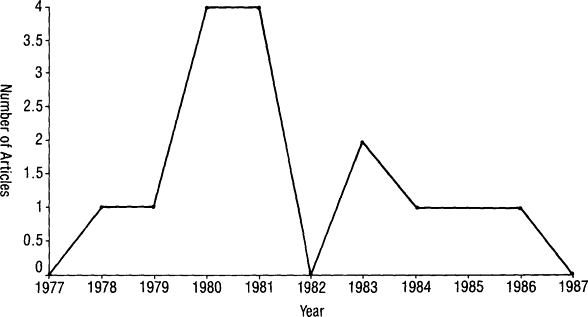
Fig. 5.
Number of Quality-Circle Articles in the ASQC Journal Quality Progress, by Year.
mittee came increasingly to focus on the achievement of divisional status for the human resource technical committee. It was the kind of bureaucratic paper-shuffling activity and jumping through a series of organizational hoops that drained the enthusiasm of everyone but the most committed or unthinking. Participation in committee meetings in 1982 began a downhill slide over the course of the year. Interest declined as committed members looked elsewhere for ways to achieve their goals for quality circles. As one staff person, reflecting on past events, said to me in 1987, "I think those who were really committed to circles went over to IAQC." These kinds of people had not come to the ASQC to play musical chairs or climb the rungs of the ASQC organizational ladder. In a volunteer organization, member involvement dries up very quickly without motivation.
Divisional status was achieved for the human resources technical committee in November 1982. The quality circles technical committee was duly folded into the new division, eventually to lose its status as a separate technical committee and become just a standing committee. As such, it had even less significance than as a technical committee. For all practical purposes, it disappeared from sight.
The "neat" organizational solution at which the ASQC arrived was an empty victory for those who envisioned the society as the leader of a national quality-circle movement. Its structure did not allow for a national leadership role and, most important, the wave of national interest had subsided. The momentum was no longer there. There were no longer highly motivated volunteers available, and the response of industry was not as warm as it had been just a few years earlier. As we have seen from the discussion of the garbage can model, timing, if not everything, is a great deal. We can assess the wave of industry and ASQC interest by the number of quality-circle articles in the society's journal, Quality Progress . As shown in figure 5, the peak of interest as reflected in journal articles was in 1980-81. When the registration proposal finally reached the board of directors, a severe financial crisis was pushing it to reject all new budget initiatives. This, combined with its general conservatism and an alternative agenda, doomed the proposal.
Could a strong QC circle steering committee chairman have made a difference? Even if the chair had been a highly respected
corporate quality engineer, well connected in industry circles and capable of exercising decisive leadership, it is still unlikely—we can never know for sure—that the outcome would have been fundamentally different. Inherent constraints made the technical committee structure inadequate to the task. Moreover, the political (the human resources technical committee had a stronger claim) and bureaucratic (you had to be a technical committee for two years before you could even apply) reasons that made divisional status unobtainable created an impossible situation. It simply wasn't in the cards for the ASQC to become the national agency for the diffusion of quality circles in America, Quality-circle supporters in the ASQC did not know it at the time, but they never had a chance. Only if the society had had the ability and vision to spin off some sort of subsidiary could it perhaps have played the role that so many of its enthusiastic circle supporters sought for it. But even that was not in ASQC's repertoire.
A Broader Perspective on Obstacles to Change
The thrust of my argument thus far is that the organizational vehicle the ASQC chose for its quality circle policies was inherently incapable of arriving at the destination sought by those who wanted to make the ASQC the premier institution for developing and diffusing quality circles in America. While I believe the evidence in this regard to be overwhelming, it is nevertheless useful to step back and take a broader perspective on the matter. Why was this choice of an inappropriate vehicle made? Was it lack of leadership, political intrigue, or simply poor planning?
The population ecologists' study of organizational change and survival provides a useful framework. Howard Aldrich and Ellen Auster (1986:168), from whom I draw the subsequent analytic framework, identify the following four internal conditions, associated primarily with the aging of organizations, that inhibit adaptation to change:
retention of control in the hands of the original founders;
pressures toward internal consistency as a basis of coordination and control;
the hardening of vested interests; and
homogeneity of members' perceptions.
When we talk about these conditions being associated with aging, we are really saying that the organization has a history. What the authors have done is select out of this history some characteristic processes occurring over time that they and others have identified in their research as inhibitors of change. The case study being discussed here provides a further opportunity to examine the fit between the empirical reality and the analytic perspective offered by Aldrich and Auster. By and large, the fit is pretty good, though some modest adjustments need to be made.
The first factor said to inhibit change is retention of control by the original founders. Strictly speaking, this was not that much of a problem for the ASQC. At worst, problems arose from the retention of many of the ideas of the original founders, especially as the organization moved into new areas. This broader view is consistent with the earlier observations of Arthur Stinchcombe (1965), who noted the tendency for a significant correlation to exist between the time in history when a particular type of organization was invented and the social structure of organizations of that type that exist at the present time. Such persistence can inhibit adaptation to change and even threaten organizational survival if environmental changes are significantly large and/or rapid.
The ideas at the ASQC that most fit this discussion are those concerning the drive toward professionalism. Professionalism as a goal developed in the early days of the society as it sought to win recognition from other professional associations. Having been formed at a time when there was a proliferation of new professional societies, the ASQC naturally tended to model itself on the five existing founder societies (the basic engineering societies, founded in the late 1800s).
I would speculate that had a quality-control society first been organized in 1980, it would have had quite different characteristics. By 1980 the idea of quality as a total management system had begun to take root. This way of thinking suggests the need for a more open kind of association. In addition, consultants are a far more pervasive influence on the organization of American society today than they were in 1946. Based on discussions earlier in the chapter,
we can hypothesize that had the first quality association been organized in 1980, the consultants would have fought harder to limit professionalism. Moreover, there is some reason to think that consultants are more influential in the early stages of establishing organizations, when norms and practices are quite fluid. I provide related evidence for this proposition in the following chapters.
Professionalism has been built into the ASQC's structure and policies. Today, it is most associated with the orientation toward self-improvement of members and career enhancement of quality professionals. The very same ideas that contributed to the gradual upgrading of member credentials and status have, however, worked to limit the willingness of society leaders to open the organization to nonprofessionals. It made them less able to draw upon the tremendous power of applied statistics for involving production workers in the quality-improvement process.
The ASQC is changing and the hold of professionalism as a dominant organizational ideology is weakening.[11] The push toward involving top management in society activities in the mid 1980s may be viewed as evidence of this change. However, the pace has been slow. As one member put it to me, the ASQC may have to be dragged kicking and screaming into the twenty-first century. That is to say, its posture has been defensive and reactive rather than seeing the involvement of nonprofessionals as an opportunity to expand its focus. In this environment, it is hardly surprising that the ASQC greeted quality circles and all they stand for with a measure of caution and skepticism. My point here is not that professionalism per se blocked a positive reception to quality circles, but that in conjunction with other factors it served as an inhibiting force.
In this connection, there is another characteristic of the ASQC's organizational history that served to block a positive reaction to circles. It is sufficiently generalizable as to merit creating a fifth internal condition that serves to inhibit adaptation to change, though it is related to the hardening of vested interests and the growing homogeneity of members' perceptions. I would label this fifth factor stigmatization of innovative behavior because of some past experience that resembles the new initiative . I believe this is a rather
[11] The number of members taking the certified quality-engineering exam is nonetheless increasing.
common situation that leads organizations to selectively perceive experience in such a way that new opportunities come to be seen as threats.
Here, the ASQC's experience with the zero-defect movement is instructive. The zero-defect movement served as a negative role model that made ASQC leaders extremely suspicious of quality circles. Some of those associated with the ASQC had been hurt professionally in their organizations by the demise of the zero-defect approach, and the society had flirted with endorsing it, engendering a good deal of internal conflict.
In common with the ZD movement, QC circles involved the commitment and motivation of production workers in the quality-improvement effort, and both innovations arrived with a great deal of fanfare. There was also an element of self-promotion as consultants and those in companies who had had a pioneering role used ZD to advance their personal careers. Sensing these similarities, many ASQC leaders feared that the QC circle movement would soon decline, just as the ZD movement had died. Creating the technical committee structure for QC circles was a "nice" way for the organization to try them out without overly committing itself.
Yet there were fundamental differences between QC circles and the ZD movement. First, the national mood was far more favorable to employee involvement and making better use of our human resources than had been the case almost two decades earlier. Competitive survival seemed to demand it. Second, the zero-defect movement as it developed in the United States lacked an engine to drive it. However, the Japanese had evolved a clearly defined problem-solving methodology to advance QC circles. They had proved the validity of this methodology over some twenty years, so that it hardly qualified as an organizational fad. QC circles as they developed in Japan were task-oriented. As many circle supporters within the ASQC argued, it was natural for the society to play a major role given the quality profession's[12] use of similar problem-solving methodologies and its identical goal of improving quality.
Aldrich and Auster list pressures toward internal consistency as a basis of coordination and control as a second factor inhibiting organizational change. As organizations age, patterns of behavior stabilize,
[12] Quality professionals is a term in common use in industry to refer to specialists in quality assurance.
individuals settle into standardized roles, and standard operating procedures emerge and become institutionalized. The emphasis is increasingly on producing reliable and accountable outputs. Even when managers recognize problems and act to monitor them, they tend to create ritualized solutions, adding to the inertia they are publicly acting to combat (Aldrich and Auster 1986:169).
The ASQC's leaders' search for an existing organizational mechanism that would "handle" QC circles fits this description almost perfectly. Ideas like appointing a full-time staff member at headquarters to direct quality-circle activity for the society were anathema to the leaders because they did not fit anywhere on the organizational chart. They suggested disorder, not the neat organizational boxes to which ASQC officials were accustomed. How would they be funded? What kind of precedent would they set? Even though technical committee status was clearly inadequate for the national leadership role in circles that some ASQC officials talked about, there was no willingness or ability to think about creative organizational strategies that could make it happen. In routine fashion, the QC circle steering committee was created to come up with an organizational response to quality circles, but the ritualized treatment of its recommendations only resulted in further inaction.
The next inhibition of change associated with organizational age is that vested interests harden as organizations age and grow larger. People develop investments in given practices and solutions. Proposals for change are seen as mechanisms for gaining power, and alterations in organization are resisted because it is believed they will disturb the existing distribution of resources and privileges. Under these circumstances, organizations may add tasks or divisions to accommodate new groups rather than alter existing arrangements. This can be a costly strategy (Aldrich and Auster 1986: 170).
In the case of quality-circle supporters and the ASQC, there was first the fear among QMTC members that a separate focus for quality circles in the organization threatened their interests; they felt that they had already staked out that territory. Only when it was made clear that they would achieve divisional status under the rubric of the human resources technical committee, and that the quality circle technical committee would report to them, were they prepared to drop their opposition and support the "package deal."
Here we see a variant on Aldrich and Auster's position. The sepa-
rate existence of a quality-circle organization was seen as a greater threat than the alternative of having the new unit report directly to the new Human Resources Division. This is, of course, hardly surprising. The best way to control potentially dissident units is to have them report to you. This is not the best way, however, to bring about change in an organization! To be sure, there was a logic about this decision that made sense to society leaders. In the private-sector organizations they dealt with, quality-circle coordinators were typically slotted into human-resource departments, so it made "sense" to replicate that model in the society.
More generally, there was also the issue raised by the possible entry into the organization of large numbers of nonprofessionals. Some ASQC constituencies feared that the registration of circles or a merger with the IAQC might lead to a large influx of members without degrees. Implicit here is a possible shift in the ASQC's power base and potentially lower status for the organization as a whole.
Finally, the homogeneity of members' perceptions makes organizational transformation difficult. Indeed, such homogeneity may threaten organizational survival by reason of the obstacles it poses to adjusting to environmental change. Such homogeneity can have various causes. Recruitment efforts focus consciously or unconsciously on particular categories of individuals. One tends to recruit those who are most similar to those already members and to be most successful with the recruitment of these very same categories. Socialization, training, and common experience all contribute to the homogenization of members' outlooks (Aldrich and Auster 1986:170). This homogenization inhibits change by sapping organizational confidence in the ability of the leadership to deal with new constituencies and situations.
Expressed more generally, homogeneity of members' outlooks and perceptions inhibits change by reducing variety. This is probably the central principle of the population ecology approach to organizations. Limiting variety reduces an organization's ability to map its external environment and respond to new challenges effectively. Lack of internal diversity thus makes an organization vulnerable to external challenges. Professional associations which by definition draw their membership from those possessing specialized characteristics, seem particularly vulnerable to this threat.
If I were to identify which of the five factors I judged most criti-
cal to the failure of the ASQC to move more positively toward QC circles, it would be the homogeneity of members' perceptions. It is difficult to quantify these relationships, but we can make a plausible case. The narrowness of the ASQC's constituency—all quality-control practitioners—limited the variety of skills and knowledge in the organization and made it difficult to respond forcefully and intelligently to the challenges posed by quality circles. As traditionally conceived of in the United States, quality control was seen as the responsibility of quality-control departments at the plant level. There was thus no full-scale involvement of all departments and their skills in quality improvement in interaction with quality-control personnel. This meant that ASQC members were likely to lack human-resource-development skills and familiarity with the associated behavioral theory.
The term quality control is misleading. The association had over the years expanded its mission in response to specialization that had taken place at the firm level. Many companies began to have specialized functions for quality assurance separate from quality control. Quality-assurance activities came to focus on broader defect-prevention activities to be achieved through quality control's primary contribution to the firm's business planning and business implementation. Quality assurance also focuses on quality control's total system responsibilities. By contrast, quality-control responsibilities focus on the discipline's traditional functions of detection associated with inspection and testing activities (see Feigenbaum 1983:160, 190). We can see from this description that, independent of other considerations, quality assurance involves quality personnel in higher-status activities with more power, while quality-control activities typically involve working with low-status personnel. Understandably, then, the ASQC was eager to expand the quality mission in the direction of quality-assurance activities. By contrast, taking a leadership role in circle activities would have involved working with an entirely new low-status constituency in ways that challenged conventional norms and practices. This was a much bigger leap than the ASQC was capable of making.
This history made it extremely difficult for the ASQC to evaluate QC circles. There was a feeling among the leadership of the ASQC that none of the people pushing circles understood the behavioral science aspects. As one former president of the society told me,
"There was a feeling that we should stay away [from circles] because we don't have people of sufficient stature leading the way." Charles Mills, the chairman of the General Technical Council at the time of the initial push for QC circles, was a strong advocate of doing something. But he was viewed by many as an amateur in this area. There was also a concern among leaders about infighting among the consultants and that the society could end up being used. There was, in short, a lack of confidence in the organization that this was something that it could manage and bring off in a credible way.
As we have seen, the society has been moving away from its earlier narrow view of professionalism toward a broader systems view of quality, with a recognition that continuous quality improvement requires involvement by all levels and parts of a firm. This, however, has been a slow evolutionary process, and QC circles represented a big jump over a large gap in knowledge. Under these circumstances, it is hardly surprising that conservatism came to rule the society's response. Moreover, if it was going to reach out, it was going to be after top managers who would bring status and recognition to the organization, not lower-level quality-circle coordinators and blue-collar circle members.
The disjunction that saw quality-circle activities assigned to human-resource departments in many companies rather than to quality-control departments also made ASQC leaders uneasy. While they knew they had something to contribute, it was still a big step to try to assume national leadership of a movement that contained dimensions they did not have a total grasp of. In particular, for many of the technical people, there was a sense that the body of knowledge associated with QC circles was too soft and not certifiable. This was an organization comfortable with hard numbers and certification!
In summary, all five factors, but especially the homogeneity of members' perceptions, operated to limit the ASQC's ability to take positive and innovative action with regard to quality circles. Organizational history had a profoundly conservative impact on the society's response to opportunities for change.
Chapter Ten
The International Association of Quality Circles: The Liability of Newness, Part 1
With an annual original budget of less than $100, 000, the IAQC has grown to an organization of 1.5 million dollars in just 9 years. This accomplishment is surpassed only by the amount of mismanagement, theft, and political mismatch that has plagued the financial resources of IAQC.
The passage quoted above appears at the beginning of "The IAQC Chronology: A Financial Perspective," an internal document developed by the IAQC staff (Tarter et al. 1987).[1] It captures well the themes developed in this and the subsequent chapter, both the significant accomplishments of this organization and its miscues and failure to capitalize on a variety of opportunities.
[1] While I was involved with the ASQC as a member of the QMTC and as an official observer on the quality circle steering committee, my experience with the IAQC was far more extensive. I was a member of the board of directors from 1980 to 1983 and again in 1985 and chair of the strategic planning committee in 1984-85. As such, I shared in the successes and failures of the organization.
Typically participant observation research is done in anonymous organizations, often with lower-status individuals. In this research, there can be no concealing of the organization's name. The norm among social scientists is that the researcher plays a passive role so as not to influence any outcomes. In keeping with the Heisenberg principle, the premise is that mere observation affects social processes. I chose an explicitly activist role, however, which included participation on the board of directors and the chairmanship of the strategic planning committee. I believe the trade-offs in information and insight more than compensated for any possible impact I may have had on the organization. I was both a researcher and someone who cared about the success of this organization in achieving its lofty goals. It will be for the reader to judge whether the latter role compromised the former. Finally, in terms of the ethical issues involved, the board of directors was informed periodically (necessary because of turnover on the board) that my major objective was to conduct research. So people knew when they were talking to me that writing about the IAQC was part of my agenda.
I do not want my analysis to be construed as an attack on any individual in the organization or the organization itself. As I expect this chapter to make clear, the resultant outcomes do not reflect the actions or personality of any one individual, but rather the institutional forces in our society.
Research shows the central issue facing small new organizations, once founded, is survival (Aldrich and Auster 1986:186). By this measure the IAQC, founded in 1978, would appear to be quite successful. Its tenth anniversary was celebrated in 1988 under a new name: the Association for Quality and Participation (AQP). Yet its existence has been problematic throughout its life. It has lurched from one crisis to another.
At first glance the organization would seem to have a lot going for it. It came into being as the promoter of a new set of organizational practices. As a consequence, it had no existing domestic competitors. Moreover, as we have seen, none of the most closely associated organizations chose to make a major entry into this market. All this occurred in a period in which Japanese management practices were all the rage. In the late 1970s and early 1980s, talk of quality circles was on the lips of many American managers as they sought ways to solve competitive problems of quality and productivity. Circles were a much-discussed solution in the business press and at management conferences.
Thus, the association had little difficulty getting attention for its product and the solutions it offered. Marketing costs were modest. With a seemingly simple package of organizational technology, the association's entry into the market was rather easily carried out with only modest capital costs. All these advantages are typically problems for small new organizations (Aldrich and Auster 1986: 177-83). Clearly, the IAQC had a lot in its favor. As a new organization, moreover, it was not burdened by a history of precedents, bureaucratic inertia, pressures for internal consistency, and stigmatization of failed past initiatives; in short, it was not burdened by
many of the factors that limited the ASQC's action. Yet the IAQC has hardly been an unqualified success, and one might seriously question whether it has been even a qualified success.
While the IAQC is the major national group promoting quality circles, its acceptance by private and public-sector management has been limited, and its development and spread of best practices have been decidedly weak. Diffusing best practice involves monitoring what is going on in firms at the "cutting edge," digesting and feeding it back to the field in generalizable form. The process involves getting firms to share experiences and synthesizing these experiences in the form of effective training materials. It involves stimulating local organizations to work together.
Based on this criterion, IAQC contributions have been modest at best. Central to the story is the role consultants played in the organization. In chapter 3 I discussed the alternatives available to firms seeking the information they need to adopt and practice small-group activities: (1) obtaining information from the market via consultants or (2) building associations to pool corporate resources to collectively pursue common interests. In the discussion of the ASQC, we learned that in the real world associational activity and consultant activity are intertwined in a variety of ways. In this and the subsequent chapters, this relationship gets carried to the logical extension where the associational governance structure gets taken over in effect (not formally) by consultant interests. The choices posited in chapter 3 are thus reduced to a single possibility. It was not, however, a matter of the venality of opportunistic consultants producing this outcome. Rather, it was the absence of a commitment from corporate America to small-group activities that created a vacuum. Consultants simply pursued their economic interests in a reasonably rational fashion. My account of events turns on the process by which this was played out in the IAQC and its consequences.
Overview of the IAQC
The most useful overview of the organization would be to provide some comparisons over time. This task is made difficult by the exceedingly poor record keeping that has plagued the IAQC throughout most of its history, itself a telling point. Some of the data will
TABLE 1. IAQC Membership Growth | ||||
Fiscal Year | Total Members | Individual | Organizational | Circle |
1978 | 110 | N/A | N/A | N/A |
1979 | 400 | N/A | N/A | N/A |
1980 | 607 | 303 | 304 | N/A |
1981 | 1,433 | 715 | 718 | N/A |
1982 | 3, 875 | 1,932 | 1,943 | N/A |
1983 | 4,215 | 2,101 | 2,114 | N/A |
1984 | 5,751 | 3, 417 | 2,242 | N/A |
1985 | 5,422 | 3,010 | 2,207 | 205 |
1986 | 5,350 | 3,119 | 1,929 | 302 |
1987 | 5,534 | 3,399 | 1,911 | 260 |
1988 (March) | 5,605 | 3,384 | 1,989 | 232 |
SOURCE . Tarter et al. 1987. Supplemented by the author's research materials. | ||||
therefore start from 1982 rather than 1978 when the organization began. Table 1 provides a breakdown of membership as best the organization has been able to reconstruct it and based on my own research notes. We see that by 1988 the organization recorded a total of 5,605 members, breaking down to 3,384 individual members, 1,989 organizational members, and 232 circle members. Organizational membership entitles the participating company to five persons receiving membership status (one voting and four nonvoting) so the organizational membership total (1,989) can be divided by five to give the actual number of company registrations (398). Conversely, circle membership (begun in 1983) can be multiplied by ten (assuming that to be the average circle size) to reflect the total number of persons involved (2,320).
From the data reported in table 1, we can see that membership in the individual and organizational categories peaked in 1984. In 1985 the organization was reporting a nonrenewal rate of 37 percent. A more recent membership survey revealed that of the total of 5,605 members in early 1988, new members joining in 1987 and early 1988 accounted for 53.5 percent of the total. These rates are notably high when compared to professional associations like the
ASQC (20 percent nonrenewal rate); the norm for professional associations seen as doing quite well runs about 15 percent. One partial explanation for the high nonrenewal rate of the IAQC is that many companies treat quality-circle facilitator and coordinator jobs as "pass through positions." Thus they rotate staff through them, with each new staff member in the job replacing the existing IAQC member.
Data from table 2 report the growth in regional chapters. Again we see rapid growth followed by a marked slowing of growth after 1984. There has also been a growth in inactive chapters, so that by 1988, of the 107 chapters, only 76 were officially regarded as active. Informal staff estimates put the number even lower, somewhere around 65.
Table 3 provides a breakdown of revenue sources for fiscal years 1982 and 1987. We can see that conferences accounted for 58 percent of revenues by 1987, as against 25 percent in 1982, with a drastic fall off in the percentage of income accounted for by education (training courses) and material sales. This occurred at a time when total revenues rose from approximately $1 million in 1982 to $1.6 million in 1987. Notwithstanding that increase, in absolute
TABLE 2. Growth in IAQC Chapters | |
Date | Number of Chapters |
November 1979 | 0 |
May 1980 | 2 |
November 1981 | 30 |
November 1982 | 50 |
November 1983 | 75 |
November 1984 | 90 |
November 1985 | 94 |
April 1986 | 97 |
April 1987 | 104 |
April 1988 | 107 |
SOURCE . Tarter et al. 1987. Supplemented by the author's research materials. | |
TABLE 3. IAQC Revenue Sources for Fiscal Years 1982 and 1987 (U.S. $) | ||||
1982 | % | 1987 | % | |
Membership | 135,578 | 13 | 267,159 | 17 |
Education | 362,213 | 34 | 235,722 | 15 |
Spring conference | 262,227 | 25 | 727,580 | 46 |
Fall conference | 195,634 | 12 | ||
Publications | 23,880 | 1 | ||
Material | 285,077 | 27 | 114,104 | 7 |
Interest and other | 11,222 | I | 33,283 | 2 |
Total | 1,056,317 | 100 | 1,597,362 | 100 |
SOURCE . Association for Quality and Participation, Six Year Trend Analysis, 30 January 1988. | ||||
terms revenues derived from education and material sales fell 35 percent and 60 percent respectively during this period. We see, in short, that over this five-year period, the IAQC increasingly became a conference-driven organization.
Table 4 shows the industry composition by the Standard Industrial Classification Category (SIC). Manufacturing represents 52 percent of IAQC membership despite its accounting for only 20 percent of the nonagricultural labor force nationally. What is remarkable notwithstanding is the large size of the nonmanufacturing component. It should be remembered that in Japan in the late 1970s quality circles occurred almost exclusively in the manufacturing sector (that is less true today) and initial adoption in the United States was also heavily weighted toward the manufacturing sector. A 1981 survey of "early adopters" of quality circles found that only 9 percent were nonmanufacturing firms (Cole and Tachiki 1983: 10).
We can also examine the distribution of members by job title. A 1986 IAQC-commissioned survey of 2,047 IAQC members (response rate 28 percent) revealed that quality-circle facilitators and quality-circle coordinators accounted for 55 percent of those surveyed; these positions are rather low-ranking ones created to manage quality-circle activities. An additional 18 percent listed them-
TABLE 4. Distribution of IAOC Members by Industry Classification (SIC Code) | |
Industrial Sector | % |
Manufacturing | 52 |
Transportation and public utilities | 10 |
Wholesale trade | 1 |
Finance, insurance, and real estate | 5 |
Service industries | 17 |
Public administration | 11 |
Military | 3 |
Total | 99 |
SOURCE . Tarter et al. 1987. | |
NOTE . Total does not add to 100 because of rounding error. Data are derived from responses of 60% of the membership. | |
selves as managers, but my experience suggests that they hold relatively low-ranking managerial positions. One way to further examine this is to look at the departments to which IAQC members belong. The top-ranked departments were human resources and personnel (46 percent of IAQC members), production (14 percent), and quality assurance (14 percent) according to the same survey (University of Cincinnati 1987). Again, I note that these are not the high-status departments where organizational control is typically lodged. Finally, one way to evaluate the members' level in the management hierarchy is to look at salaries. The 1986 survey revealed that those earning more than $51,000 a year totaled only 13.9 percent of the membership.
In summary, the corporate political clout of the IAQC membership is quite low. In this connection, it is also the case that women, typically in low-ranking management positions, make up 35 percent of the membership (43 percent of the quality-circle coordinators).
Another membership characteristic relevant to my subsequent discussion is the number of consultants. Four percent of IAQC members designate themselves as consultants. On the face of it, this does not seem to pose a threat to organizational independence, but motivated individuals in key positions can have a decisive impact. Some additional facts to round out this overview are that the
average (median) size of employing organizations of IAQC members is somewhat below 1,000 employees. Forty-seven percent of IAQC members report having a union at their location (18 percent of the nonagricultural labor force is organized). In 1986 only l0 percent of IAQC respondents reported having less than one year's experience in an employee-involvement program, with 38.5 percent reporting from one to three years' experience and 51.5 percent more than three years' experience. That distribution suggests a decline in the growth rate as the movement ages (University of Cincinnati 1987).
"In the Beginning..."
The history of the IAQC begins with the development of quality circles at the Missiles System Division of the Lockheed Missiles & Space Company in 1974. Wayne Rieker was the MSD manufacturing manager responsible for introducing the program; Donald Dewar was the QC circle coordinator, and Jeff Beardsley was the QC circle training coordinator. Based on a study trip to Japan and contacts with JUSE, Lockheed translated and adopted JUSE's training materials with only modest changes.
While not the first quality-circle program in the United States, it was the most highly publicized of the early attempts. By 1977 savings were reported to be $3 million, the ratio of cost savings to the cost of operating was reported to be six to one, and thirty circles were operating. Visitors flocked to the plant for further investigation. The early quality-circle successes at Lockheed and other firms were widely written up in various business journals, including the Wall Street Journal, Time , and Across the Board , in 1979 and 1980 (see Cole 1979). The NBC television program "If Japan Can, Why Can't We?" further heightened interest. (Ironically, the program also was shown on Japanese TV and contributed to increasing interest in circles in Japan as well.)
Rieker, Dewar, and Beardsley discussed the possibility of leaving Lockheed and forming a consulting firm. Unable to agree, they departed one by one to start their own businesses.[2] Rieker left first,
[2] The year 1977 was the high point for circle activity at Lockheed. By 1979 only eight circles were operational there, and not long afterwards circles disappeared. In typical fashion, the publicity given to the demise of circles at Lockheed was tiny compared to the earlier massive publicity. When pressed, management said it had built on circles to create additional team activities. It was generally understood, however, that with Rieker's departure, the program had lost its champion, and it died soon afterwards.
purchasing the rights to the training materials developed at Lockheed. He carried out his first assignment as a consultant in the fall of 1977. Beardsley followed, setting up Beardsley & Associates and building on the Lockheed program and his own experience to create his own training materials. Dewar joined Beardsley in mid 1978, but their association lasted only a short time owing to differences, and in late 1978 Dewar started his own consulting firm.
Having acquired some expertise by virtue of their employment, these managers saw an opportunity to market these skills and set up their own consulting firms. This turned out to be a pervasive pattern that was repeated again and again in the early years of the quality-circle movement. It seems so natural to Americans that it would hardly be worth commenting on if it were not for the fact that the pattern is almost nonexistent in Japan and is relatively muted even in Sweden. We shall have occasion to discuss the significance of these differences in later chapters.
Once on their own, Beardsley and Dewar saw that no one seemed prepared to build a national organization that would focus on quality circles. So in spring 1978 they set about establishing a national organization—the International Association of Quality Circles. Dewar became president; Beardsley, vice president.
The first visible manifestation of the new association was the appearance of the Quality Circle Quarterly . In the first issue (second quarter 1978), the founders promulgated their objectives. I reproduce this statement in appendix D. The first issue contained mostly background information about quality circles, including a couple of company testimonials, as well as an advertisement for the association's first product: an audiovisual package for introducing circles. The issue also announced the first annual IAQC international conference, to be held in San Francisco in February 1979. The journal was a modest effort, and it continued in that fashion, with lots of "boilerplate" content, until 1981. Notwithstanding the modesty of this initial effort, we can see that the first two elements of the association's activity had been set in motion. A journal had
been launched and planning had begun for an annual conference, two of the three core services of the association to date.
The second issue of the journal, which appeared in the third quarter of 1978, placed greater emphasis on company experiences as that data started to become more available. Other features included the first discussion of what was required of a quality-circle facilitator, a function and term developed at Lockheed that adapted the Japanese approach, with the facilitator taking responsibility for promoting the program on the shop floor, training leaders, identifying and removing roadblocks, and providing overall guidance to the program.
By the first quarter of 1979, the association announced a certification program for quality-circle facilitators. The first one-week course was held in spring 1979 and enrolled seven individuals. The association solved the problem of training materials for this course by buying copyrighted materials from Beardsley at cost. Completion of the course and the passing of a certification exam entitled the enrollee to be certified as a quality-circle facilitator. The course fee was $1,800. Its content was modeled closely on the program developed at Lockheed. Apart from the annual conference, this course was to be the IAQC's bread and butter in its early years.
The IAQC plunged headlong into facilitator training and certification, a decision that gave rise to considerable controversy over the next few years as the IAQC came to compete with consultant-offered facilitator training. Consider the following letter to the editor of the IAQC journal in February 1982 from Ed Yager, a well-known organizational consultant. Yager opposed IAQC facilitator certification on grounds of the unstructured character of quality-circle facilitation and its un-American regulatory character. He closed with the following argument:
Who is the IAQC, and what gives this organization, which is heavily chaired, influenced and managed by purveyors of materials and consulting services (and which soon may be marketing its own materials) the right to make such judgments? This is not to condemn the IAQC, indeed it has the potential to provide a major service to the organization development and quality circle community. However, it is certainly in no position to become a certifying agency in any context other than offering its own most professional training and advice. Membership in the IAQC may at some point become a sign of prestige and professional association. It
seems to me that the goal, like that of ASTD, the OD network, ASQC, etc. will be to reach such a point of professionalism that one would want to be a member in order to point out their own professionalism.
Clearly, this was a contentious issue, pitting the association against consultants and consultants providing materials to the IAQC against those on the outside.
In February 1979 the IAQC held its first "international" conference in San Francisco. It was a modest affair, with sixteen presentations, including a report on a problem-solving effort by the members of one quality circle at Hughes Aircraft. There was tremendous energy and excitement at the meeting. Some two hundred individuals attended this first conference (co-sponsored by a local ASQC chapter).
A few months later, the IAQC took its next major step toward becoming a national organization. It announced the policy of chartering local chapters. The first chapter was formed in April 1980 in Louisville, Kentucky. This was the third core activity that was to characterize IAQC services.
At the second annual conference in February 1980, paid attendance doubled, and there was a growing sense among the participants that something special was happening. A special meeting was called to "open up IAQC," with some forty conference participants attending. The agenda proposed by the two consultant co-founders, still president and vice president, was that a new steering committee be set up, composed primarily of users, to review bylaws, elect additional directors, complete incorporation, plan the following year's conference and decide what kinds of education the IAQC should be doing. A long discussion followed, in which great enthusiasm for the reorganization was apparent. It was agreed that a meeting be held in May by those interested in forming the new steering committee. Forty people voluntered to work on the steering committee and/or other committee assignments.
The unstated driving force of the meeting was the need to "professionalize" IAQC activities and to take the association out of the hands of consultants and put it into the hands of users. The co-founders seem comfortable with—and, indeed, proposed—this direction. The evidence suggests that they were finding association activities increasingly burdensome in the light of accelerating requests for information and the various obligations connected with
the annual conference, conference transactions, chapter registrations, and quarterly publications. At the same time, their own consulting businesses were starting to take off. Thus, it is not surprising that they were willing to share responsibilities.
On May 16, 1980, twenty-three of the forty volunteers arrived in Saint Louis for a two-day "reorganization meeting." The two consultant co-founders, nineteen company employees, and two academics were involved from early morning to late evening with plenary sessions, special committee meetings, and socializing. By and large, the company employees were people in middle- to low-level management positions who were in charge of implementing and running quality circle activities in their own firms. They were attending this meeting on their own initiative, having gotten their companies to sponsor the trip. Of them seven became full-time consultants within the next two years—such was the growth of circle activities nationally and the demand for outside expertise. Given the importance of this first meeting to the future direction of IAQC, a detailed account is in order.
The meeting began with a financial report showing that the organization had a net worth of $58,838 (including an inventory valued at $26,000). The participants discussed again whether there should be an IAQC. Robert Amsden, the academic who chaired the ASQC Quality-Circle Steering Committee, reported that ASQC had not yet taken a stand on quality circles. A suggestion was made that the IAQC merge with ASQC. In response, the following objections were raised: the ASQC was too limited—oriented toward statistical methods, not people development; the IAQC had to develop itself first, or it would get lost in the merger; and it would take forever to accomplish anything. Whether there should be an IAQC was never really in question. This was a fired-up group that wanted to do something. In short order, it was moved and passed that there should be a formal IAQC organization. Clearly the participants were excited about creating something new.
The objectives of the organization were identified and turned out to be identical to those promulgated in the first issue of the Quality Circle Quarterly (see appendix D). The functions of the IAQC were designated as:
issuing the Quality Circle Quarterly ;
publishing educational materials on the subject of quality circles;
encouraging the development of local chapters;
sponsoring seminars;
sponsoring conferences;
conducting the IAQC certification program.
Facilitator training and conferences were seen as the major sources of income to pay the association's staff. Jeff Beardsley, one of the co-founders, argued against the association continuing with certification, even though he had initiated it at the IAQC. He now argued that it was hard to set standards. At one point in the discussion he said that "training by IAQC takes bread out of the consultant's mouth." On the other hand, Dewar argued for the IAQC tightening up the standards for certification, but continuing it. Still others argued that the IAQC should continue to provide training but abandon certification.
Next, discussion shifted to what educational materials the IAQC was to use to provide its facilitator training. Only two consultant packages, those by Beardsley and Rieker, were available at this time in addition to company-developed materials. Beardsley stated that he was no longer willing to make his materials available to the IAQC. His materials were still available through the IAQC, however, since the original arrangement involved the IAQC mass-producing the training materials and selling them back to Beardsley and Dewar at cost plus 10 percent. With large-scale production, this reduced the costs of publishing and thus was one way in which the IAQC subsidized the business activities of the two co-founders.
A continuing issue for the organization has been whether it should engage in training or leave it to the consultants. The argument for training is that it is a basic service to members and a focal point for professional activity. The alternative view is that it competes with consultant members. Practically speaking, training was a major income generator for the organization at a time when its organizational survival was in question. This, perhaps more than anything else, carried the day, and it was agreed that the facilitator training courses be continued with the next session, to be coordinated by Dewar, who still had access to the Beardsley materials through the IAQC.
One member proposed using chapters as a focal point for membership growth and income, based on the national organization pro-
viding service to the chapters. There was, however, little response or follow up. There was considerable discussion of what definition of quality circle the organization ought to use. Various committees were set up, with individuals volunteering for those in which they were interested. It was agreed to elect a board of directors pro tern to serve until the next annual meeting.
After a long discussion, twenty-one of the twenty-three who attended the meeting volunteered to be on the pro tern board (including the two co-founders); five additional individuals not at the meeting were also invited to join. The newly constituted board acknowledged Don Dewar's and Jeff Beardsley's contributions to quality circles and for organizing the IAQC, and in recognition of this achievement made them both lifetime members. A second decision authorized Dewar to select an executive secretary to staff the IAQC office.
In the 1980 second quarter issue of the Quality Circle Quarterly , Dewar reported to the membership on the recent developments. He noted the accomplishments of the IAQC to date: two "international" quality-circles conferences and publication of the proceedings, one facilitator conference, completion of four facilitator training courses, establishment of a facilitator certification program, creation of an 80-slide audiovisual program to introduce the uninitiated to QC circles, and publication of a quarterly magazine. These were, as Dewar noted, not trivial achievements. He also pointed out that all this had occurred without benefit of a single full-time paid staff employee. This same issue also reported that the newly "elected" members of the expanded IAQC board of directors numbered twenty-four and would serve until the 1981 annual conference and business meeting.
Evaluation
What observations can we make about this organizational meeting? First, one cannot help but be impressed by the energy and enthusiasm of those involved. For two days they met from early morning to late at night. Moreover, they not merely committed themselves to three annual board meetings over the next eight months; many of them, such as the publications committee members, also took on further meetings (typically by phone or mail) and a great
deal of additional work. For some, this was to continue for the next three years.
Clearly, in the right environment, volunteers are prepared to give a great deal. The contrast with the ASQC treatment of circles is overwhelming. The ASQC potentially had this same energy at its disposal, but strangled it by forcing the volunteers to work on creating the "right" organizational structure. The IAQC, however, possessed a major motivator not available to the ASQC. The "pioneers" at the first IAQC reorganization meeting felt they were building a new organization. This gave them a sense of ownership not possible within the ASQC. At the outset of the May 1980 meeting, the participants had referred to the "IAQC" as an object to be acted on, but before long they were using we . Finally, the IAQC allowed the volunteers to work on building a national organization with relatively little concern for precedent and conformance to regulations.
It was an exhilarating experience for these mid- and low-level managers; most had never been on a board of directors before. That also meant that they were amateurs in respect to a variety of critical matters facing the organization and were thus bound to make some serious mistakes.
The immediate dilemma that underlay the first meeting, and one that was to foreshadow subsequent problems, was that the organization needed access to the training materials and expertise of the consultants—in particular, Dewar and Beardsley, and Rieker. At the same time it needed to divorce itself from the consultants in order to achieve legitimacy in the eyes of the outside business world. This was enormously complicated because of the strong competitive and personal rivalry between Rieker and the two co-founders, but also because the two co-founders had had a falling out as well. Then there were the other consultants, who were in varying degrees dependent on, and in competition with, the "Big Three." These rivalries had a strong impact on the consultants' view of the association and the ways in which they tried to move it.
To complicate matters still further, each of the consultants had a number of former clients, company employees, on the pro tern board. These former business ties formed the basis of cliques. Indeed, some of the pro tern members were eventually to go to work for their former consultants. As one astute board member put the matter to me:
Not only are Jeff and Don dependent on IAQC but many pro tem members are former clients and students of Jeff and Don so they still have a personal tie of dependency on them. That tie needs to be broken if the organization is to professionalize and not make decisions constrained by the impact of consultants. Not only do consultants have to be weaned from the organization but also board members have to be weaned from them. That will take time.
Board members with such insight were in short supply. Many felt that consultants brought skills and energy that such a weak young organization could ill afford to lose. This was the heart of the dilemma facing the IAQC. The reference to "political mismatch" in the quotation opening this chapter refers precisely to the ongoing struggle between consultant and business user interests and its negative impact on the use of IAQC resources.
All this brings us back to a point noted in the previous chapter. Aldrich and Auster (1986: 168) suggest that one of the internal conditions associated with aging that inhibits adaptation to change is the retention of control in the hands of the original founders or members of their families. For "members of their families," we might substitute the term clique to reflect the consultant-client ties referred to above. It is noteworthy that whereas Aldrich and Auster discuss this factor in the context of the problems faced by aging organizations, we see it emerging here very early in the life of a new organization (the IAQC was only two years old when it became a major area of contention).
One of the founders of IAQC, Don Dewar, seemed quite relieved at the prospect of letting go, as his subsequent failure to attend many board meetings demonstrated. The second co-founder, Jeff Beardsley, was more ambivalent. "This is your association; it ain't mine," he had announced at the special meeting during the February 1980 conference. But his actions belied these statements. At the May meeting he was an active presence trying to shape the association. He volunteered to be on the committee to define quality circles, the certification committee, the finance committee, the education committee, and the pro tem board. Moreover, in a later interview Beardsley made it clear that he would someday like to be president of the organization, and indeed he allowed his name to be put into nomination on more than one occasion. So we have a clear case here of a founder saying he was turning the organization over to the users, but not really being willing to let go. Yet for
many of those in industry and elsewhere who cared about the development of quality circles, Beardsley symbolized the inability of the organization to leave its consultant origins and move toward professional status. This was to prove to be a continuing problem for the IAQC.
The IAQC Moves On
A major problem for the association, as Dewar quickly moved to reduce his role, was to find a staff. At a meeting in August 1980 attended by twenty-one of the twenty-four board members, one of the pro tern members, R. D. Diener, volunteered to take the job of executive director temporarily on a half-time basis. He was known as someone who had helped coordinate the 1980 conference and who had guided the growth of quality circles at Tinker Air Force Base.
While the board discussed various alternatives to Diener, no one had any specific names to suggest. Time was seen as critical, and meeting only once every three months was not sufficient to allow members to identify alternatives, compare them with Diener, and make a decision. Thus it was with a great sense of relief that the board accepted Diener's offer. It kept the IAQC alive and gave the members a sense that they were turning a corner. In a volunteer organization where willingness to commit time is often at a premium, it is extremely hard to turn down volunteers even if officials or fellow board members know that the volunteer is not the best person for the job. Time and budgetary pressures often pre-elude more thorough searches. It was not the last time that the IAQC was to have this problem. To be sure, unlike the ASQC, the IAQC could innovate freely without being tied up in rules and precedent, but it was also free to make mistakes without firm standards to guide it.
New by-laws were adopted that included provision for a 21-member board of directors. The board also set up a nominating committee for the first election of a board by the membership. The education committee reported on its plans to staff facilitator courses. The committee discussed ways to deal with the problem of relying on the training material of Beardsley or other consultants for its training activities. IAQC members in companies with their own
QC circle materials were encouraged to have their companies share them with the association. With Beardsley unwilling to continue to provide his materials to the IAQC and no other immediately available alternative open to it besides disbanding its training activity, the IAQC turned to the training materials developed by Don Dewar.
The year 1980 ended with the association seemingly moving forward. Income for the calendar year was reported to be roughly $200,000, with some $135,000 in expenses, leaving a modest balance of $62,000. Membership had grown by 50 percent over the preceding year. More important, industry interest in QC circles was exploding, and the association seemed poised to grow with it. A variety of fundamental problems still remained to be solved, however, and still new dangers were to appear.
At the January 1981 board meeting, the issue of hiring a full-time executive director dominated early discussion. After a long debate, in which it was agreed that the board should employ a full-time executive director, the acting director volunteered for the job. There was tremendous pressure for immediate action, as demands on the office staff were increasing exponentially. No one had any other definite candidate to suggest. Nor was the board inclined to begin a national search.
The board therefore empowered the executive officers to negotiate a contract with the acting director, setting only the salary limits and the length of the contract (two years). Thus, the acting director became the full-time executive director (ED 1). Some accommodation was made for his wish to conduct outside seminars, with agreement reached that fees for such engagements be split with the IAQC. No limit on the amount of such income was set. Some members opposed this on the grounds that if he did too much consulting, "We would be right back in the box of being a consultant front."
The nominations committee developed criteria for candidates and voting procedures. A persistent theme in its discussions was how to limit overrepresentation of consultants on the board. Given the consultants' high name recognition nationally and their ability to mobilize past clients, the committee was fearful that candidates who were company employees would be swamped. Various measures were taken to limit this possibility, including a rule that no more than one consultant per consulting firm would be selected as
a candidate and that a mail ballot of the whole association would be conducted. It was feared that voting at the annual business meeting would allow consultants to stack the meeting with their own supporters. Special voting procedures were instituted to minimize any loading in favor of consultants; they included specifying a minimum number of candidates on the ballot for whom votes had to be cast.
The board approved the overall design proposed by the committee. Subsequent to the board decision, Vice President Beardsley lashed out at the board in the February 1981 issue of the association's journal for placing "limits upon which members may be eligible for national offices." He compared his relationship to the IAQC to that of a parent enjoying his child's freedom but reluctant to let the child make mistakes.
The education committee continued to run facilitator training courses, but put certification on hold as the IAQC wrestled with the implications. For all practical purposes, IAQC certification was a dead issue. There was continued pressure to find alternatives to buying training materials from consultants. The switch from the Beardsley materials to the newly developed Dewar materials did not solve the problem. No matter whose material the IAQC used, it seemed to aggravate the other consultants. And the board members sensed that their claim to professional status was on thin ice when they had to rely on consultant material. Ideas that were discussed again and again were to develop the IAQC's own materials (which seemed beyond the budget capability of the organization), to obtain access to "state-of-the-art" company-developed materials, or to come up with some combination of the two.
The consultants, who so often disagreed among themselves, generally tended to be united in their opposition to the IAQC doing any training, although at this time a consultant who favored the association developing its own "professional materials" headed the education committee. Eventually, however, he came to support the idea that professionalism could include the education committee screening and choosing the best consultant-developed materials (education committee chair, memo to the president, 2 November 1981). During this period, the education committee operated on the explicit assumption that all it would take to develop the IAQC's own facilitator training materials was time and money.
At the January meeting there were indications of growing tensions resulting from pressure by the executive director and other
executive officers to centralize activities in headquarters and opposing pressure to locate decision making and resources in the committees and at local chapters. The latter position had a strong constituency among many board members and among chapter leaders. In particular, committee chairpersons complained they were being bypassed in the decision-making process by the executive director.
These are typical tensions faced by any national volunteer association as it seeks to develop the right balance for organizational development. Central administrators are concerned about quality control and the enormous discretionary power available to volunteers in the field. Chapter and committee members are suspicious of central administrators for not making decisions based on proper information, criteria, and membership views. This tension began to produce considerable conflict and suspicions among board members. Over the next few years, efforts to support chapters with rebates from national dues were repeatedly made, but administrative incompetence and the roller coaster quality of IAQC financing made this impossible to implement. As later became apparent, however, these tensions over the centralizing tendencies of the organization were made more severe in the IAQC by the self-serving activities of the new executive director.
There were also periodic discussions of how to better serve circle members. Some board members developed plans for circle registration, but they were repeatedly postponed. It was not until August 1982 that a small publication for circle members was made available, and not until 1984 that a circle membership program was developed. The whole effort, however, proved very costly to administer and was not very successful. Generally speaking, the national organization made only modest efforts to reach circle members, in sharp contrast, as we shall see, to the Japanese approach.
The March 1981 annual conference, held at Louisville, was an outstanding success. Paid attendance was 1, 100, up from the previous year's figure of 400. Facilities were inadequate, panels insufficient, and conference administration poor. Some questions were raised about irregularities in the handling of cash and checks for the on-site registrations. The inadequate facilities relative to the demand again created an excitement and electricity; participants felt the explosive growth in circle activity taking place around the country. There was a "true believer" quality to many discussions and a sense of being on the cutting edge of a major social move-
ment. One of the circle coordinators from the South described in her talk how she had convinced top management that individual employees could be "transformed" by participation in circles. The presentation had a fundamentalist born-again quality that was to be seen on a number of occasions.
The editor of the Quality Circles Journal[3] captured this enthusiasm and both the promise and dangers it posed in the following editorial remarks in its May 1981 issue:
An event occurred in Louisville Kentucky that should lay to rest any doubts about the interest of American business in the quality circle movement.
The event was the Third Annual Conference of the International Association of Quality Circles, and I cannot recall another time when I witnessed such enthusiasm and excitement by a group of people. This enthusiasm was evidenced by the extraordinary conference attendance. The "Standing-Room-Only" workshops and the burgeoning chapter and national membership roles were also indications that the quality circle idea had come of age. The overwhelming interest by the conferees in all facets of the quality circle process is a clear sign that this concept is sweeping through the American business consciousness. It is at this point in our association's evolution that a clear and sober evaluation of the long-term impact of quality circles management and its effect upon the structure of organizations must be made.
It becomes incumbent upon our association to clarify and impress on the prospective practitioners exactly what the adoption of the quality circle process implies. That is simply, that all individuals within an organization who participate in a quality circle have the right to contribute and participate in the management of the organization. There should be no doubt on the part of management that once the circle process is started, then any aspect of the day-to-day operations is subject matter for circle evaluation. To implement quality circles based on a superficial, short-term return on investment, which in most cases will appeal to management, would be an erroneous application of the concept. Management should, therefore, study the long-term implications. Upon this examination, management may not be ready to embrace the distinctly participative style that the quality circle process creates. It is for this reason that our collective enthusiasm to "spread the word" should be tempered by cautious, managed growth.
Let us proceed as an association, and as disciples of the quality circle concept slowly, albeit deliberatively, towards a solid foundation of mutual understanding with American management.
[3] The name was changed from Quality Circle Quarterly early in 1981.
This sober assessment points up the growing professionalism re-fleeted in the journal under the new volunteer editorial staff. The journal proved a bright spot of professional endeavor during these years, some would say the only one.
Suddenly the IAQC was transformed. Instead of scraping along from one facilitator training course to another to pay outstanding bills, instead of being in the position of hiring an executive director without the funds to pay a full year's salary, the organization now seemed to have the problem of how it was going to spend its new revenues. It cost some $20,000 to put on the Louisville conference, and it generated over $100,000. This was the situation that confronted the newly elected board of directors.
What were the characteristics of the new board? First, there was a very high overlap between the new board membership and the pro tern board it replaced. Second, there is the question of the level of management skills represented on the board. The full-time jobs held by the new board members were as follows:
academic
president, consulting firm
academic
company circle administrator
president, consulting firm
divisional manager, quality-of-work-life program
president, consulting firm
industrial relations department member
training instructor
manager, employee and community relationships
head, personnel training and development
manager, reliability engineering
quality-control manager
quality-control manager and product manager
president, consulting firm
product assurance manager and quality-circle coordinator
division quality-circle program coordinator
industrial engineer and program coordinator for quality circles
quality-compliance manager
program development coordinator for quality circles
There are three observations that can be made about this list: (1) there was a significant representation of quality-control personnel on the new board; (2) those in charge of circle programs were typically talented young staff people, not very high in the management hierarchy, who management had decided had the energy and brains to lead circle introduction; and (3) while there were four consultants among the twenty-one elected members, two other members were to become consultants before long, making the consultant presence more significant than the nominations committee had expected.
It is clear that we are not dealing with a high-level management group. This has two implications. First, one might predict that the new board would have trouble managing a national organization of rapidly growing complexity because of a shortage of management skills. Second, the relatively low status of the board members would make obtaining outside resources and acquiring legitimacy in the eyes of the outside world difficult. The IAQC was not created by companies delegating staff members to pool corporate resources; it was rather an organization of middle- and lower-level management volunteers in a weak position to obtain access to company resources. This difference will be critical to our comparison with emergent national organizations in Sweden and Japan.
The first issue facing the new board at the March 1981 meeting was the election of officers. All but two members of the new board were present. Fred Riley, a middle-rank manager with Hewlett-Packard, was elected president. Jeff Beardsley was elected one of the two vice presidents, based on an informal understanding that he would withdraw his candidacy for president. Throughout the discussions, there was talk about the role of consultants. Two members took the position that there was no problem with having a consultant as head of the organization, but majority sentiment was clearly opposed. Rather, the view predominated that the IAQC was moving toward becoming a user organization and should not give the impression to the outside world that it was still a consultant-run body.
Although this was the third time this group had met, the conducting of business was still quite clumsy. There was heavy re-
liance on Robert's Rules of Order , to the point where the group often tied itself in knots. For a group who did not yet know one another very well, this was not surprising. Reflecting the modest level of management skills, however, this pattern continued for some time. The focus on quality circles often created confusion as to the role of circle problem-solving techniques and procedures in the conduct of the board meeting itself. At regular intervals, someone complained that the board was not proceeding or making decisions in a way consistent with quality-circle decision-making processes (for example, cutting off debate or not using a cause-and-effect diagram to diagnose a problem). Just as often some member would then argue that this was a board of directors', not quality-circle, meeting, Gradually such discussions disappeared from the board meetings as the latter sentiment came to prevail. After each new election, however, there would be some new board member who would return to the theme and have to be "educated."
The June board meeting, attended by all but three of the board members, confronted what had started to be the "usual" list of issues to be discussed: conference preparation, chapter relations, problems of getting rebates to the chapters, and the financial status of the association. With an anticipated $235,000 in revenue and $187,000 in costs, the budget looked tighter than had been expected. This served to limit new initiatives. Jeff Beardsley volunteered to chair the conference committee, and since no one objected or offered to do it, he got the job. At a subsequent meeting of the conference committee (at which Beardsley was not present) in October, it was agreed to limit Beardsley's role in the conference because of concern that he would use his participation to advance his business interests.
The conference chair was a nice position for a consultant to have. At a minimum, the conference chair had the opportunity to address the opening and closing of the conference and thus received considerable exposure and status. For an organization looking to shed its consultant background, selecting a consultant was hardly the ideal decision, but once again it was hard to turn down a volunteer, especially for a demanding job. Consultants simply have more discretionary time than company employees. A mid-level company manager would immediately have to consider whether his or her boss would tolerate one or two more trips a year and/or whatever other time was involved in addition to the four board meetings a
year. Self-employed consultants could, however, make the decision on the spot. If they believed that a commitment to association activity would serve their business interests, they were only too willing to volunteer.
The question of whether the association should be conducting facilitator training once again became a major topic of discussion. The association's economic incentives for doing so continued to outweigh thoughtful evaluation of whether facilitators themselves were necessary for the quality-circle process, much less the question of whether the association should be competing with consultants in offering it.
The board developed a plan to make company training materials available to an academic research team that was to conduct a survey of those who have gone through IAQC facilitator training. Based on the results of this survey, the research team would then construct the new IAQC training materials. Subsequent to the meeting, however, it was found that legal constraints made it impossible for most board members to deliver on their initial commitments to provide company training materials.
Had there been a strong corporate commitment to IAQC activities by a large number of firms, one suspects, companies would have found a way to cooperate with the IAQC request. In November, lacking this option, the board began to consider purchasing training materials on the market, including both company and consultant materials. This was the beginning of the end of the idea that the association should develop its own materials.
Chapter Eleven
The International Association of Quality Circles: The Liability of Newness, Part 2
Got a fox in the henhouse.
Charley Chavis, IAQC president
The October 1981 meeting of the IAQC board was to be a momentous one for the association. Amid a swirl of rumors that the executive director had been engaging in improper behavior, President Fred Riley announced to the board that the executive director had resigned. The immediate event triggering the resignation was the discovery by the executive committee that the organization hired to run the annual conference had been misrepresented by the executive director. He had concealed the fact that one of the principals in that firm was his wife. Moreover, evidence accumulated that significant embezzlement was involved as well. Criminal charges were filed against the executive director, which eventually led to a felony conviction. He pleaded nolo contendere and received a three-year suspended sentence. In addition, the association filed civil charges and eventually a judgment was rendered in its favor. In March 1984 the following item appeared in the association's journal:
During the fiscal year ending August 31, 1983, a judgment was rendered in favor of the Association against R. D. Diener, a former executive director, and related parties to Mr. Diener. The Association was awarded approximately $80,000 plus legal and court fees of approximately $64,000. As of August 31, 1983, a garnishment bond of $18,000 has been received
by the Association and has been recognized as additional income in the financial statements. However, no provision has been made concerning the remainder of the judgment because of the uncertainty of the collectibility of the remaining amount due.
Fortunately, the association was bonded, though it took until mid 1984 to receive the reimbursement of $75,000. The fraud associated with the conference arrangements was, however, the tip of the iceberg. Association officers believed that the extent of embezzlement may have been as much as $200,000. However, the paper trail was inadequate to document this amount.
An Organization in Crisis
How did this happen, and what were the organizational consequences? How it happened is in fact neither difficult to explain nor unique. I have already discussed the pressures that led the association to accept Diener's offer to become executive director. Volunteer associations are vulnerable to opportunistic behavior, a tendency greatly heightened in young, rapidly growing organizations. Such organizations typically have very weak financial control systems, and fraud is not uncommon. In the case of the IAQC, the voluntary board met only four times a year; the executive officers met more often, but ultimately they were also volunteers holding down full-time jobs. In this situation, the executive director, in a geographically isolated location, had a great deal of freedom to devise ways of circumventing the weak controls that did exist. The relative lack of financial and managerial experience on the board (though the treasurer was a bank official) certainly facilitated the outcome.
It would be hard to overestimate the organizational consequences of these events for the IAQC. Over the roughly sixteen months that Diener had served as part-time and then full-time executive director, the level of mistrust on the board had risen dramatically. The executive director's policy of centralization had been very divisive, and those who had supported it for honorable reasons were nevertheless subject to implicit criticism. The sense of camaraderie that had been part of organizing the association had gradually been undone, and in its place suspicion and anger had grown. There was a "post-Watergate" mentality in board discussions, with lots of re-
criminations. The board was caught between trying to inspire trust in one another to bind the wounds and move on for the good of the movement and a sense that past accusations and rumors had been found to have a basis in fact. Anything and anyone was now suspect of having colluded with the former executive director. This attitude was encouraged inadvertently by the association's lawyer, who asked all board members to be detectives and unearth leads and clues—the paper trail—for the law firm to build its case for a civil suit. Everyone felt stained by the scandal, but the board nonetheless had an association to run.
The initial dream of collectively creating something new as part of a national social movement had been shattered. Suddenly the board was in a swamp, struggling to extract itself. Directors worried about their own liability and were mistrustful of many of their colleagues. Moreover, if timing is everything, as the loose-coupling model of organizations suggests, then the IAQC was missing the wave. With the QC circle movement taking off around the country, the organization was knee-deep in embezzlement and unable to take the initiatives that might have made it a major force. The embezzled money could have funded the IAQC's creation of its own training materials. Instead, that goal had to be abandoned. It was not just the loss of the embezzled funds that limited the IAQC financially; it also had to pay lawyers' fees in advance of any settlement.
This is not to suggest that all IAQC activities ground to a halt. There were monthly facilitator training courses to be staffed and administered, a conference to be planned for March 1982, a board of directors election to be run (to fill seven vacancies left by those elected to the initial one-year term) and committee work to be done. Moreover, membership was doubling every twelve months, and chapter formation was proceeding at a rapid clip. Most of this activity at the local level took place without much involvement of the national organization. The staff were too busy meeting board directives to have time for members' needs. This lack of involvement was a major irritation for chapter leaders, who believed they were not getting enough from the national organization. Not only were they not getting their promised dues rebates, they did not feel they were getting much else besides an annual conference and a journal. It was not until 1982 that the rebates started to be paid, and even then only partial rebates were made because of continu-
ing financial problems. Throughout the first half of the 1980s, the board was constantly refiguring the basis and arrangements for the rebates, and that uncertainty did not sit well with those in the chapters.
One additional point with regard to the chapters is important for the discussion that follows. The chapters were typically organized by enthusiastic low- and middle-level management volunteers, who typically joined with volunteers from other companies and met once a month, with invited speakers, typically from among their own membership, to share experiences, problems, and solutions to QC circle development. With the exception of a few large chapters with good corporate support, most local chapters suffered from many of the same problems as the national board. Local chapter members had little association experience and were unable to operate chapters in a way that would promote QC circles over the long term, much less sustain their chapters. Because the chapters typically depended on individual enthusiasm, and especially the leadership of two or three individuals, when that enthusiasm evaporated, so did chapter activity. This created a volatility in chapter activities; there was no stabilizing corporate commitment or shared professional ethos to provide additional incentives for leaders to keep the chapters moving forward. In the place of such incentives, the IAQC did impose a requirement in September 1983 that chapters meet at least six times a year to be considered active, but enforcement was difficult at best. Such bureaucratic requirements were a poor substitute for real incentives. In late 1981, however, all this was not yet much of a problem, as there was still a powerful momentum pushing the movement forward, with high levels of enthusiasm prevailing.
In responding to the crisis, many board members did rally round and make additional time available to the association. Yet the crisis clearly drained the energy of the executive committee. The president noted in a November 1981 memo to the board that some committees needed to become more active. More important, all new initiatives had to be put on hold as the organization struggled just to do the minimum, to hold things together in the face of unprecedented demands by a rapidly growing membership.
One of the immediate tasks of the organization was to begin the
search for a new executive director. On this there was quick action. Yet the board was determined to avoid the past mistake of hiring the first live volunteer who came through the door. A committee of the senior members of the association was established to conduct the search. A detailed job description was drawn up and circulated. Telephone interviews were conducted with prospective candidates, local board members were asked to meet with and evaluate candidates from their regions, and finally seven candidates, including two internal candidates (two board members and the treasurer), were brought to the January 1982 board meeting.
An offer was made to one of the outside candidates, pending reference checks, and he accepted. He was long on QC circle experience but short on management skills relating to this kind of national organization. For the first time, some of the candidates had strong management skills in related human-resource areas, but had little or no quality circle background. It was clear that majority sentiment on the board still favored hiring someone with strong circle experience. Yet most of all at this time the association needed a strong and effective manager; instead, it limited the field of candidates by making circle experience a primary factor in selection. Put differently, the association was not yet able to make professional decisions. A high-level management board with strong corporate backing would have been much more likely to understand the importance of choosing the best manager for the job regardless of circle background.
Many of the board members had arrived on the board and in their current company positions as circle administrators after only a year or so of experience with circles, and many had had "on the job training." There was no reason why an executive director could not do the same. The failure of the board to look for the best manager reflected its commitment to the social aspect of circle development and failure to understand the managerial complexity of operating a national volunteer organization. The new executive director (ED 2) did in fact lack leadership abilities and lasted only thirteen months on the job.
The remainder of the January meeting and much of the special meeting held in March were devoted to various aspects of the Diener matter. These were grueling meetings, each of them lasting
two and one-half days. What is remarkable is the attendance at these and prior meetings. One board member was absent from the January meeting and one from the March meeting. The willingness of these volunteers to contribute time and effort to the association was extraordinary.
Attendance at board meetings was surprisingly high up to this point, testifying to the commitment and excitement that QC circles and the IAQC had generated. If we examine the total number of meeting days available for board attendance from its inception in 1980 through 3 December 1982 (a total of twenty-one days times the number of members on the board for each year) and divide that by the number of meetings attended during the time each of them was on the board, we find an attendance rate of 80 percent. These were not people who simply walked away from the association at the first sign of serious trouble. One clear indication of this occurred with the Spring 1982 board election, when six of the seven incumbents up for reelection choose to run again (they all won). Yet one began to wonder how long these efforts could be sustained. The continued stressful events clearly were taking their toll.
One of the first efforts of the new executive director (ED 2) was in the field of association training and training materials. In a series of memos to the board, he outlined some ideas for moving ahead. While not all of them materialized, they nicely point up some of the ways members were thinking about the key issues relating to professionalism and the role of consultants. I have summarized some of his key points in these memos over a few weeks' time as follows:
2/4/82
What follows are some preliminary thoughts about revisions of our training course offerings. It is also an attempt to take a first small step toward moving the IAQC away from its current status of being a quasi-consulting organization "in many ways in a somewhat conflict-of-interest status with many of its own members."[1] For the short run, this proposal will generate
[1] In what may be seen as a confirmation of that status, the association was notified by the Internal Revenue Service on 18 June 1982 that it was not eligible for non-tax status. The basic reason given was the IRS felt that "IAQC is the same as a for-profit business, and, to give it a non-profit status would confer an unfair competitive advantage on IAQC." The IAQC appealed and in September 1982 received 50l(C) (3) status, which exempted it from paying federal income taxes.
additional income. For the long term, it will set the stage for the IAQC to move away from a consultant role into being more of a professional society.
The executive director then went on to suggest that given the high cost of generating the necessary training materials and keeping them up to date, the IAQC should serve as a coordinating agency for interested parties to oversee the development of a new generation of training materials. He also proposed the development of an advanced facilitator course going beyond the introductory offerings that had hitherto characterized association training and the offering of an executive briefing for top management.
2/20/82
It is becoming clear to me that we must rapidly step up the pace of change to alternative sources of revenue for the IAQC. The quality circle training business is literally exploding, and I feel it will soon pass us by. Not only is our course and its materials no longer the best in the business [the association was still using the training materials of one of its consultant co-founders at this time] but there are so many alternatives available that those who stay in business must be among the very best to survive. There are already scores of sources for low-priced training. With the entry of major groups, such as big corporations who already have training programs, the whole nature of the training business is changing. We could compete, but I feel it would take a great investment, and I believe that would be a mistake.
Our future is to become a truly professional society sustained by its individual and organization members in return for the valuable service they receive. I'd like to move rapidly and get out of controversial and competitive areas.
Our enrollments in the facilitator training course, which has been our bread and butter, are already starting to decline. We need to move rapidly.
2/26/82
One more matter, in phone conversations with several of you over the past two weeks, I received strong encouragement to bid on the Defense Logistics Agency quote for teaching twenty-five facilitator classes. It would of course be a lifesaver financially. But thanks to sound counsel from the president, I am comfortable with the decision not to go ahead since it would be a significant step toward "in-company" consulting, which is the direction opposite to the way we want to go.
The executive director's ideas for joint development of materials never did get off the drawing board, though his plans for introducing an advanced facilitator course and executive briefings were adopted. The latter were never very successful, despite repeated efforts. Small morning breakfast meetings were organized in different cities, with the IAQC organizing a short program introducing circles to which local CEOs were invited. Despite the absence of a fee, they typically did not come or sent some staff person.
We see from the executive director's remarks how the issue of training materials inextricably tied together the issues of professionalism and competing with consultant members. His idea on joint development of materials with those companies and/or consultants who were interested was in fact a rather clever effort to reconcile his ideas on professionalism and service with the presence of consultants. His ideas on joint development of materials were shaped by the belief that managers of company circle programs and consulting organizations faced a heavy cost in developing and updating circle training materials (as did the IAQC), with the risk that they might not recover their costs. In other words, when these organizations could not "make a market," the IAQC's role was to help them achieve that end; that was the executive director's idea of providing service to its constituency.
In the executive director's version, this meant that the consultants' organizations in particular become the "drivers" for what constituted professionalism; professionalism became a residual category of services where consultants could not make a market. Note the contrast with the initial model presented in chapter 3. There the idea was that companies would pool resources when the high transaction costs made it difficult for them to make a satisfactory market. A strong corporate commitment by firms to the IAQC's success would have resulted in corporate representatives on the board who would have pushed this position. Instead, with relatively ineffective middle-level managers on the board acting on their own initiative, it was difficult to resist the emphasis being put on solving consultants' problems. As a consequence, it was the consultants' difficulties in making a satisfactory market that drove developments.
What was in this residual category? The executive director said that he had received some thoughtful suggestions from one of the
consultant board members as to where the IAQC would have an "almost exclusive territory": fostering and supporting local chapters; sponsoring conferences, widespread publication of circle successes and innovations, sponsoring of demonstrations of circle success, and providing executives with authoritative information on quality circles at the corporate level.
This is by no means a trivial list. It was, however, a much narrower role for a professional organization than had traditionally been the case. Professional organizations have routinely been involved not only in identifying best practices but in codifying these practices in training materials, school curricula, and certification procedures. In the March 1984 Quality Circles Journal a letter writer defending association involvement in training wrote: "Most societies consider themselves as a source of (professionally prepared) materials for their members. The review (and presumably sponsorship) by people with the stature and experience of a board of directors or appointed professional committee is a time-honored practice in our voluntary standards organizations." By contrast, the overall tenor of the executive director's remarks makes it clear that his ideas on professionalism were fundamentally shaped by the need to avoid competing with consultants.
The executive director correctly identified the rapidly growing number of competitors in the training business and rightly predicted the association's growing loss of competitiveness in the market. We see in table 3 that the combined percentage of IAQC revenues derived from training and material sales dropped from 61 percent in 1982 to 22 percent by 1987. The average class size for the basic facilitator training course was seven in 1979, thirteen in 1980, and forty-three in 1981. After this dramatic growth, however, there was a precipitous decline to thirteen in 1982, twelve in 1983, eight in 1984, ten in 1985, and eight in 1986.
The Emergent Consulting Industry for Quality Circles
To fully appreciate the growth of competitive forces in the market, we need to describe what happened from 1978 to 1983. I have talked a lot about consultants in the previous two chapters, but to more fully understand the IAQC'S successes and failures, we need
to know more about the nature of the market for consultants in quality-circle services.
When the association was founded in 1978, there were only two, then three, firms with independent training materials exclusively oriented toward quality circles (the "Big Three" that sprang from Lockheed). There were some additional team-building materials from various sources, but by and large the IAQC's entry into the training business was relatively uncontested. Indeed, it was initiated by the consultant co-founders of the association. By 1983 it was quite another matter. First, the initial "Big Three" had grown substantially. In December 1981 two of the Big Three were quoted as reporting that each of their businesses had tripled in the past year to sales of about $1.5 million annually. One of the firms, Rieker's, had nine full-time consultants on the payroll and was operating with a three-month backlog of customers.[2] The extraordinary demand brought a large number of competitors into the field.
An important point here that bears on entry costs concerns copyright protection. Such "organizational software" is often copyrighted, but the protection is slight. Consequently, potential new entrants found it quite easy to rewrite materials; with only a modestly different slant, they had their own materials. A typical rewrite in the early days was to shift from the original Japanese emphasis on statistical problem-solving techniques contained in the Lockheed materials to various behavioral science emphases on team building, communication, and small-group dynamics. I looked at many versions of quality-circle training materials in the early 1980s and was struck by just how similar most of them were to each other. On a number of occasions I met consultants and, especially, company managers who freely admitted they had simply given one of the training manuals on the market a quick rewrite, just enough to avoid the charge of plagiarism. Furthermore, copying machines allowed companies to reproduce training materials in violation of
[2] "Two California Firms Find That Attention to Quality Pays Off," New York Times , 8 December 1981, p. D 4. By 1984, a peak year, Rieker had twenty-five employees (clerical staff and consultants) on the payroll. By then, however, he was expanding more strongly into the quality field and away from exclusive reliance on circles. By 1987 he reported that only one-third of his business was in circles, with most of the rest in the quality field, including statistical process control. A number of other consultants reported similar, if not equally dramatic, trends.
the author's copyright protection. In summary, the need for training materials, one of the potentially high entry costs associated with servicing quality-circle clientele, was in fact not a very significant deterrent to entry. This was to have major implications for the IAQC.[3]
It was not just the weakness of copyright protection that facilitated market entry, however, since some consultants entered by either becoming licensees of one of the Big Three or simply buying IAQC materials (which were produced by the third member of the Big Three) and attending one of the IAQC's public seminars on facilitator/leader training. With a little intelligence and talent, they could then soon be in business for themselves. To be sure, word of mouth is the most important advertising in this business, so those who were "winging it" had some credibility problems. Many of those entering the consulting market, however, had either prior company experience with QC circles or prior management consulting experience. Either of these served to mask some of their deficiencies or at least buy them enough time to learn on the job.
In my own survey of the consulting field in December 1983 I recorded roughly seventy firms that were offering services in quality circles. These ranged from the production of a single video to a full package of services, including in-house training packages, implementation, and follow-up. Since much depends on one's definition of circles, it is in fact difficult to make an accurate estimate of the total number of firms offering quality-circle consulting services. The only publicized marketing survey of quality-circle consulting, conducted in 1980-81, estimated there to be 150 such firms (Morris 1981).[4] There were probably a large number of local firms serving local markets that did not enter into my data base. My listings were based mostly on tallying those with representatives attending the annual conventions and those advertising in various national journals.
In addition to the typical consultant firms, a number of large firms that had adopted quality circles set up departments to market
[3] Recall that a professionally developed set of original materials could easily cost $250,000 at that time.
[4] The information from that survey reported below typically was based on the responses of between twenty-five and thirty-one respondents.
that expertise. This can be seen as an attempt to cover the large start-up and operating costs. The services typically included the conducting of public and in-house facilitator/leader training. Prominent among such entries in the early 1980s were General Motors, Westinghouse, and Sperry. Moreover, a few firms, such as Georgia Power Co., launched QC circles at dozens of companies without charge as a public service.
In her 1981 survey of the quality-circle consulting industry, Rosemary Morris characterizes it as oligopolistic (the Big Three had a dominant role, with many others imitating their offerings) with very narrow boundaries, many part-time sellers (only a small part of whose total business was circles), significant product differentiation, surprisingly low barriers to entry, little buyer concentration, relatively low fixed costs, and very high demand. She also reports that 75 percent of respondent firms had entered the field less than two years earlier, with the number entering having doubled annually for the previous few years. Sixty percent of the respondents said that less than 50 percent of their total business was derived from circles. Finally, 26 percent reported licensing other firms.
It is clear from these data that in a rapidly growing industry, the IAQC was increasingly hard put to maintain its earlier dominant position. Price competition became stronger, and the quality of services being demanded increased. It is difficult to know precisely how many firms were actually offering public facilitator/leader training in competition in the early 1980s. Based on various sources, I think the number could easily have totaled twenty. I do know, based on response to an IAQC request for bids on training materials, that a minimum of seventeen firms had basic facilitator training materials for sale in early 1983.
The rest of 1982 saw a continuing decline in the IAQC's facilitator course enrollments and fiat or declining materials sales. There was increasing recognition that the days of the free lunch were over and that the association would have to start seriously marketing its products.
Education committee members and the executive director agreed that it would be a good idea to create bidding procedures and communicate to all firms with quality-circle training materials that the IAQC was interested in securing a training package. The
bidding procedure, which involved a formal selection committee, was designed to avoid charges of favoritism by consultants whose materials were not selected. The wheels ground slowly, and it was not until the December 1982 board meeting that it was resolved that an advertisement be placed in the association's journal requesting bids for the supply of facilitator training materials. The notice itself did not appear until March 1983.
A Leadership Crisis
The May 1982 board meeting was another critical turning point in the development of the association. The continuing pressures and strains associated with participation on the board were starting to show. Notwithstanding that this was the meeting at which the following year's association officers were to be selected, attendance fell off for the first time, with only fifteen of the twenty-one members present. In a secret ballot, nine individuals were nominated for the presidency (eight board members and one outsider). Seven of the internal candidates declined, leaving the outside write-in candidate and Jeff Beardsley, co-founder of the organization. The outside candidate was Charley Chavis, vice president of the Dover Corporation. Reached by telephone, he agreed to fly in to meet with the board the following day.
Chavis had a strong appeal for many board members simply because he was a vice president of manufacturing and as such had the kind of status that had hitherto been totally lacking on the board. Moreover, one of his subordinates who was a board member testified to Chavis's commitment to quality circles. Finally, he brought with him the support of his company, a company known for its strong quality-circle program. Chavis was an unknown quantity as a person, but he looked good to many of the "users," at least one of whom threatened to leave if the organization was turned back into the hands of one of the consultant co-founders.
That night a caucus of five board members met and identified a slate of candidates for all the executive offices, including Chavis as president, which they all agreed to support. They also mapped out the likely votes of the remaining board members and concluded that the election would be close, with the outcome likely to hinge on three swing votes. They assigned individuals in the caucus to
persuade each of the three of the merits of the slate. The caucus held together and swept the election, with its slate taking all the executive positions. We see here the consequences of the absence of an effective institutional mechanism for choosing the board's officers. In desperation it took a flyer on an unknown individual.
Fred Riley, the outgoing president, summarized the accomplishments of the IAQC over the past two years. Membership had grown from 300 in September 1980 to 5,000 in September 1983.[5] Chapters had grown from none in September 1980 to 50 in September 1982. The number of paid attendees at the annual conference had grown from 300 in February 1980 to 1,900 in March 1982. Riley also listed other accomplishments, such as the production of a very professional quarterly journal, agreement upon and evolution of association bylaws, survival, and chapter-run quality-circle conferences. He closed by noting that the glamor was starting to wear off circles nationally and that the real challenges lay ahead.
Attendance at the October board meeting was off again, with only twelve members present, just making a quorum. One board member resigned, citing frustration and new job duties (he was only the second to resign since the first board had been elected). The board for the first time adopted an attendance provision, specifying that any board member missing more than one regularly scheduled meeting in twelve months would be subject to expulsion at the following meeting. It was passed unanimously.
This board meeting was well managed and efficient. For the first time the association had a president who chaired the meeting with authority. However, the revenue situation was reported to be getting difficult. The major sources of the problem were seen as a loss of membership growth, fiat material sales, and a falling off in attendees at facilitator training courses. The new president identified the following problem areas: the national organization needed to give back something to the chapters so that they would continue their affiliation; IAQC growth was inhibited by lack of top management support; board members needed to attend chapter meetings in their areas; and the IAQC must continue educating the public about QC circles to assure continued growth.
[5] Note discrepancy with the reconstructed figures in table 1.
By the December board meeting, deficits of some $22,000 a month for the previous six months were reported, eating into the organization's modest reserves. The association ran a deficit of $58,000 for fiscal year 1983 (after having had a net income of $147,000 in 1982). Success at the 1983 annual conference was critical to keeping the organization financially sound. Meanwhile, various alternatives were explored to reduce costs and generate additional income. It was in this context that the association made the previously discussed decision to give up its long-held plans to develop its own training materials and opt for seeking bids to supply them, thereby avoiding any up-front costs.
The new president began to flex his muscles in a variety of ways; one of his assistants, a "volunteer" from the company, put pressure on the nominations committee to recruit two or three high-level managers to replace some of the incumbents on the ballot for the next board election and to limit the total number on the ballot to ensure their election chances. While this was exactly the outcome the association needed to improve its management skills and external legitimacy, the nominations committee did not appreciate the strong-arm approach and did not act on the suggestion. This was the first, but not last, case in which the strong-willed new president antagonized some board members. Paradoxically, the participatory style inherent in QC circles often seemed to attract many "Theory X" (Douglas McGregor's term for authoritarian) managers. Chavis saw himself as a doer. He believed he needed the authority to act quickly, without being restrained by the board or the membership, if the organization were to survive.
At the April 1983 board meeting, Chavis pushed through a bylaw change that allowed the board to amend the bylaws subject to alteration or repeal by the members. Prior to this time, the board had only been able to propose changes in the bylaws to the membership. Chavis also developed the habit of appointing and replacing committee members and abolishing and adding committees in a freewheeling manner. Unfortunately, coming on the heels of the Diener affair, this management style tended to recreate feelings of mistrust and suspicion on the board. Notwithstanding, most board members saw no positive alternative, and Chavis was reelected as the following year's president by acclamation.
Other important events took place at the April 1983 board meeting. A new executive director (ED 3) was appointed as a result of dissatisfaction with the performance of the incumbent. For the first time, the IAQC had a director who was an experienced association executive and not simply a QC circle enthusiast. He had other problems, however, and like his predecessor lasted only about a year. By fall 1983 there were nine staff people at the new headquarters office (now located in Cincinnati), including a new assistant executive director. There was a lengthy discussion of chapter relationships and the failure of the national organization to honor its rebate commitments.
Chapter relationships came to loom larger in association business, there being some sixty-five chapters in existence by March 1983. A plan was also proposed for establishing nine geographic regions and electing nine regional vice presidents, who would also be members of the board, replacing nine of the current directors-at-large. The rationale was not entirely dear, but seemed focused on bringing the board closer to the membership and creating a new tier of people capable of holding higher office in the organization. The board endorsed the plan, and the membership approved the regional concept in a mail ballot in October 1983. Once the transition was complete, the board would total twenty-one members. Eleven would be national directors; nine, regional directors.
For the first time, the annual conference in 1983 did not report a growth in paid attendees. Prior to that year, the conference had doubled in paid attendees each year, but in 1983 there was a small decline in attendance. This heightened the financial difficulties facing the organization. One other aspect of the convention bears mentioning. Of the 133 sessions of the three-day meeting that could be classified as either company- or consultant-led, 33 (25 percent of the total) were consultant-led. Clearly, the IAQC had become a major forum for consultants to display their wares, not only in the sales booths reserved for them for this purpose, but at the sessions as well. If the sales pitch was too blatant in the sessions, the staff typically received complaints from attendees. There were a number of such complaints at the 1983 meetings, and those criticized were told that if they persisted, they would not be invited back.
The education committee was reconstituted in early 1983; it now had fifteen members, of whom seven were consultants. Despite the prior agreement to invite bids to supply IAQC training materials, the new committee members introduced some different ideas. One consultant argued forcefully that the IAQC should urge all producers of quality-circle materials to submit their products to it for review and evaluation, with those found acceptable to be included in an IAQC catalogue of approved materials. Vendors would then be charged for space in the catalogue, and the IAQC would receive a commission on sales. Consultants would also submit a portfolio of qualifications to be listed in the catalogue. According to this plan, the IAQC would continue to offer public facilitator training programs, with the trainer free to choose the materials used to teach each workshop from the catalogue of approved materials. The stated objectives of this plan were for the IAQC to generate revenues from material sales and to continue to offer, and receive revenue from, facilitator training workshops. At the same time it was argued that this would establish some standards to assure IAQC members that they would be receiving high-quality materials and services. Finally, an objective would be to "provide a fair and equitable distribution forum for those individuals, consultants, or companies who develop and produce quality-circle materials and literature."
The April committee discussion of this proposal was spirited. The proposal's originator argued that all the IAQC could do, as represented in this proposal, was to set minimum standards and certify all materials that met those standards. (Note the distinction between minimum standards and diffusion of best practices.) He further argued that to become a marketer of any one vendor's materials was inconsistent with the IAQC's role as an information clearinghouse. The argument was that the IAQC should expose everyone to all available materials; it should give consumers a choice and give all consultants an opportunity to get their business. The focus on "freedom of choice" brought into play powerful ideologies to which many were committed. Speakers arguing in favor of the proposal prefaced their statements with words like "in a democratic society." It was also argued that the committee would never be able to choose the one best package, if there was such a thing. It
would simply be too controversial. The implicit argument was that since the IAQC could not define best practice, it had to settle for meeting minimum standards.
One opponent of the proposal, a consultant, asked the rhetorical question, "Why do people come to IAQC?" He answered that it was because "they don't trust consultants and want independent assessments of materials." They perceived IAQC screening to be a bargain. From his point of view, the consultants with high-quality training materials benefited from an effective association screening. Another committee member argued that to accept the new proposal would be to abdicate professional responsibility. The IAQC needed to filter the mass of available information to provide service to the membership. Setting minimum standards for certification would provide only the roughest filter for the organization. The membership needed to have its organization setting the highest standards. Notwithstanding these arguments, the proponents of this new proposal were in a clear majority. A number of committee members, especially the consultants, pushed their position even further, arguing that the IAQC should get out of training altogether, but the chair reminded them that it was the board's decision and that the board was dependent on training for revenue.
What were the views of IAQC members on this whole controversy? At these discussions, few people asked; the focus was rather on what was fair to the consultants. On the general matter of whether the IAQC should be in the training business, there was a clear indication from a 1985 survey of IAQC members that the membership preferred that the IAQC "continue to provide training and training materials" (ReVelle 1985:27). Moreover, this sentiment was directly correlated with length of the individual respondent's experience with QC circles; the more experience one had with circles, the stronger the preference for IAQC involvement in training.
Growing Pains
At the September 1983 meeting of the board (thirteen members attending), the issue of association governance came to the fore. The ample agenda and numerous attached memos and reports prolif-
erating from headquarters were testimony to an active staff. Committee chairpersons complained that decisions were being made that sidestepped or ignored the committee structure. From the staff viewpoint, the committees did not function very well; they met too infrequently (typically four times a year at the board meeting) and attendance was erratic. Moreover, the executive committee had been making decisions in the interim between board meetings without what some board members saw as sufficient consultation with the full board.
The issue that triggered a full-scale debate on these issues was the matter of selecting training materials. Although the education committee voted to let instructors pick their own training materials, the executive committee opposed that decision. Instead, it voted to adopt a training package developed at General Electric as the official IAQC training package.
The GE materials were developed out of a large research project within GE and eventually ended up costing GE some $300,000. They shifted the focus of the IAQC training materials to group process activities as opposed to pure problem-solving methods. The GE package was presented to the board as the "leading edge" materials in the field.
The executive committee believed that the tight financial situation of the association required that action be taken quickly when opportunities presented themselves. It had an opportunity to work with GE to gain access to a set of what it believed to be high-quality materials and thereby solve a problem vexing the organization from the start. At one swoop (most excutive committee members thought), it would break the dependence on consultants and provide the association with training materials of which it could be proud. Committee members also noted that the others entering bids (recall that seventeen sets of materials had been submitted) all wanted up-front payment and were not prepared to grant exclusive use of their materials to the IAQC. Moreover, only two had responded with a complete package. One of the consultant board members asserted that he would have been prepared to meet GE's bid, however, and he criticized the whole decision-making process.
The board voted by a large majority to amend the tentative arrangements with GE and directed the executive committee to re-
negotiate the contract with better terms for the association. It also gave the executive committee, on a much closer vote, the authority to conclude a contract with GE. The executive committee did conclude a renegotiated contract with GE, which was approved by an overwhelming majority at the December meeting. Yet this had been a highly emotional matter for the board, with the opponents hinting at some impropriety on the part of the executive committee. As with the ASQC, we begin to see the organization's past history (in this case, the Diener affair) providing a stigmatizing model.
These were the horns of the dilemma facing the IAQC: to motivate volunteers to operate the committee structure and be active on the board, they had to have a sense that their decisions counted. However, the erratic functioning of the committees, the lack of regular meetings, especially by the board, and the need for quick action to deal with rapidly changing situations led to a shift in the balance of decision making to the executive committee and the headquarters staff.
Much of this tension was simply unavoidable as the organization struggled to find the right balance that would make a majority of people comfortable. One outcome of the board's discussion was that the executive committee agreed for the first time to make the minutes of its meetings available to the rest of the board on a timely basis. The president summarized the discussion by saying: "There has been and is no intent to make decisions outside of required channels. But we do need better communication." Notwithstanding, damage had been done and collective trust had fallen another notch.
Two other matters came up at the September 1983 board meeting that deserve mention. In wrestling with the problem of poor attendance and a bylaw that required the board to remove members who missed more than one meeting, the awkward fact was that the two co-founders were among the worst offenders. Somehow in trying to deal with this problem, the board voted to expel the two co-founders and at the same time to make them directors emeritus with permission to attend board meetings as nonvoting members whenever they chose, One of them, Jeff Beardsley, did become more active on this basis over the next few years, continuing to push the board to pursue his vision of what the IAQC should be. By virtue of his chairing the development committee, he was eli-
gible for and appointed to the executive committee. In 1986 he was elected a regular member of the board. In late 1988 he resigned from the board, citing the difficulty of making board meetings but insisting that he continued to want to participate in shaping the future of the association. Shedding its founder origins continued to be a struggle for the IAQC.
The second matter that came up was a statement by the president that he had become aware that two unions had filed claims with the National Labor Relations Board arguing that employer-established employee-participation programs in the two companies in question violated the National Labor Relations Act by using employee committees to "deal with" employees. Implicit here was the potential claim that quality circles were labor organizations insofar as they influenced the conditions of work. The president informed the board that the IAQC could file a friend of the court brief in which it could argue that quality circles were not labor organizations. The board was also told that the law firm employed by the president's employer would be willing to work on the matter for the IAQC. At its December meeting the board authorized the president to work with appropriate legal counsel to write a brief that communicated a description of quality circles and distinguished them from other forms of employee involvement. This brief would then be presented to the NLRB. The president was instructed to do all this in a way that communicated that the IAQC was not anti-union.
Such briefs were subsequently filed, but it was discovered upon further investigation that one of the briefs had the unfortunate effect of making it appear that the IAQC was taking the side of one of the notorious anti-union firms in the specific case in question. Such had not been the intent of the board. Furthermore, it was discovered that the law firm handling the matter had a reputation for being anti-union. When this was brought to the attention of the board at its November 1985 meeting, it instructed the new president to explore an amendment to the IAQC brief making clear that it was not the intent of the association to take a position on the facts of the specific case. Rather it was its intent to demonstrate that quality circles are not in violation of the NLRA. During this discussion, Chavis (no longer president) stated in an impassioned presentation that he had decided a long time ago that unions were either
"hostile to or at best neutral to circles because it undercuts their role on the workplace floor."
All this is significant for what it tells us about the IAQC and its relation to organized labor. By the early 1980s many union leaders were drawing a distinction between quality circles and QWL. QWL was presented as involving unions and workers in a broad pattern of worker participation that included, but went beyond, small-group activity. Union leaders often saw quality circles as stand-alone initiatives used either in nonunion shops to help keep out unions or in union shops to weaken unions. Such fears were not unfounded, as employee-participation activities were advertised by "union avoidance consultants" as part of a strategy to stay nonunion (Hughes and Demaria 1979:96). Thus, the initial IAQC action described above could only reinforce such interpretations and indeed some radical union dissidents publicized the IAQC's initial brief in the September 1984 issue of the journal Labor Notes (Parker and Boal 1984:7). They urged unions with quality circles to encourage their companies not to use consultants affiliated with the IAQC given its stand on "weakening labor's legal rights."
As reported in chapter 10, 47 percent of IAQC members were in union shops and offices. The danger of being labelled anti-union or having QC circles seen as anti-union was thus a serious matter for the IAQC. It was important for the future of quality circles and the IAQC that they be seen as legitimate among union leaders. Yet the above action showed relatively little sensitivity to the matter. Although some board members had tried to get a union leader to run for the board, they were not successful until 1985, when a union officer ran for board membership and was defeated. However, he was appointed treasurer of the organization in late 1986. Still another union leader running for the board in 1988 was defeated.
By and large, during the early 1980s, the association showed little sensitivity to the issue and undertook relatively few initiatives to recruit and commit union employees to the association. The basic GE training materials sold and taught by the association studiously avoided mention of unions on the theory that it might offend some potential purchasers. It was not until 1986-87 that the IAQC brought in an outside consultant to teach a separate course on "Strengthening Employee Participation in the Unionized Work Organization."
Perhaps most symbolic of this insensitivity were decisions made at the 1985 and 1986 annual conferences, where Coors Beer was officially associated with the conference through various giveaways during the meeting (a Coors employee had become a member of the board). For union activists throughout the country, this was a red flag. From 1977 to 1987 local union publications had prominently featured Coors as a symbol of anti-union activities, and union members were continually being urged to boycott Coors products.
The point of this discussion is not that the IAQC was anti-union; most of the board members were simply naive on the subject, and the matter seldom came to the attention of the board. Nor do I believe that quality circles are intrinsically anti-union, though some companies have certainly used them to that end. Rather, the point is that a new national organization must build legitimacy among its existing and potential constituencies if it is to survive. Unions were one of the IAQC's constituencies, and yet it was incapable of acting to remove simple offensive symbols, much less to take positive initiatives. None of this proved fatal; after all, the IAQC had many members at union shops. Yet the organization was extremely slow in developing and advancing that constituency in a way that would increase their commitment to the IAQC or QC circles.
The May-June 1984 meeting of the board was notable for two events. A new president was elected. He was from the same firm as the previous president, and had been persuaded by Chavis to take the job. Again, the association was forced to bring in an outsider for lack of a credible internal candidate. Chavis stayed on the board (IAQC rules call for past presidents to stay on the executive committee for a year) and the new president, a rather mild fellow, clearly had difficulty getting out of the shadow of his more forceful colleague.
Notable as well at this meeting was the appointment of a new executive director (ED 4). The board, choosing not to engage in a national search, appointed the former assistant executive director. The new director, the first woman to hold the job, also had a background in association activities.
The 1984 conference was a big success, achieving the largest number of paid attendees to date (2,290). That very success led to higher expectations for the 1985 conference and, as we shall see, to new crises. Yet this success did relieve the immediate financial
problems of the association. It was increasingly clear, however, that the success or failure of the annual conference (together with the new fall conference after 1984) was becoming the difference between financial success and failure.
Although board members were not aware of it at the time, association membership reached its peak in 1984, at least for the next few years. Membership (see table 1) hit a high of 5,751 in 1984, declined by some 329 members the next year and held relatively steady through 1988, Similarly, any new chapter growth after 1984 was more than canceled out by the growth of inactive chapters. While the organization could not necessarily be expected to predict the future, the fact is that it did not know its current membership figures because of poor record keeping.
The board was told that the corrected figures showed a total membership of 9,482 for September 1984, and by the end of the year it was publicly claiming l0,000 in the associations journal. The reconstructed figures in table 1, however, show the total at the end of 1984 to have been 5,751. One can allow for some inflation of circle membership to account for an additional 1,000 members. Yet even taking this into consideration, the fact that it was off by a magnitude of 29 percent reflects the chaos from which the organization still suffered. Turning over your executive director every twelve months on average was not a way to build a coherent administrative system. Nor could an organization with such misconceptions about itself be expected to do very effective planning.
The association did for the first time set up a strategic planning committee in the summer of 1984. Until then, the board had been so busy either adjusting to growth and demand for services or digging itself out of crises that it had not initiated a significant planning effort.
The September 1984 board meeting was a new turning point for the organization. With the new regional director system now being phased in, and with none of the existing directors allowed to run for these new positions, there were fewer at-large places on the board to accommodate the incumbents. Of the twenty-seven members of the temporarily enlarged board (a transitional phase before the new regional concept was fully implemented), members of the original elected board totaled only nine (not counting the directors emeritus). "Founder board members" were thus now in a clear mi-
nority, and some of the issues that motivated them were not as salient to the new members. Among the twenty-seven, the number of full-time consultants stabilized at five members (19 percent of the elected board). Moreover, with some of the bloom off the rose, the quality-circle boom was slowing down, and the economic incentives for board members to quit their companies and become quality-circle consultants thus subsided.
The management qualifications of the new board members were not significantly different from those of the original board members. They tended to be somewhat younger and primarily managers and administrators of their company's quality-circle programs. Indeed, the regional directors' job description called for them to service chapters in their regions and answer questions from chapter presidents on how to fill out financial forms and how to get the membership out to meetings. Such a job description guaranteed that no high-level executive would seek the post of regional director. There was a certain grass-roots appeal that some of the newly elected regional directors exploited (most of the regional elections were contested). Nor was the populist approach limited to the campaigns for regional directorships. In one case, the elected at-large candidate wrote up his credentials to appear on the ballot as follows:
Quality circle involvement position statement:
This man isn't a famous QC consultant and no, he hasn't written a book about circles. He's just like you and me—someone with a finger on the pulse of the baseline worker. His involvement with circles since their conception with the VA has yielded an intimate understanding of the QC concept. This knowledge will translate into action for you.
While successfully appealing to populist feelings, such credentials hardly provided the skills needed for running a complex national association. Yet the associations membership regularly turned down many of the high-level management officials nominated to the board in the mid and late 1980s. There was a tendency to want people "just like us" who were "knee deep" in circles.
Until this election, most of the original board members who had dropped out had done so owing to new job assignments and lack of company support (I estimate four had dropped out for these reasons). With the new regional director system being phased in, however, many chose not to run or were forced into runoffs for the
declining number of at-large positions. After the 1986 board election conducted in the summer of 1985, there were only three of the originally elected board members still on the board, plus the two co-founders serving as directors emeritus.
The new regional board members experienced considerable difficulty at their first few meetings (attendance was once again at high levels). They felt they were expected to vote on matters for which back-up data were lacking (for example, budget proposals). This often made them mistrustful and gave them a sense of being manipulated. There also tended to be some faction building, with the at-large directorships being filled by the incumbent board members, who tended to take positions that were opposed by the new regional directors. Rather than dissipating, this sentiment seemed to grow over time. Many of the regional directors believed that the at-large directors were not required to work as hard or did not have the responsibilities that they had.
The regional directors brought to the board a concern for local chapters and members. While true to their mandate, they did not offer any dramatically different ways of organizing the chapters, and many of their concerns were out of step with the fiscal realities of the organization (for example, they tended to oppose dues increases). Once formed, the regional concept created a populist sentiment that was difficult to harness. There was stepped up rhetoric as to how QC circle members and chapters were the "lifeblood" of the organization. Yet, the reality was that the lifeblood of the organization, as it was actually constituted, was the revenue earned by its national conferences. Most board members and officers were reluctant to challenge the populist rhetoric because to do so smacked of heresy.
Organizational Survival in Question Again
The IAQC entered 1985 in moderately difficult economic circumstances. Nevertheless, based perhaps on optimistic projections, spending for the annual spring conference was extraordinarily high. The flamboyant new executive director (ED 4) liked going first class, but the association was once again taken on a long ride. Paid attendance ended up at 1,948 (down 350 from the previous year), and the association was suddenly in deep trouble.
The executive committee was informed that the net income figures for 1985 showed a deficit of $576,678. Reflecting on the size of the net loss, the auditor's report concluded that "these factors, among others . . . indicate that the association may be unable to continue its existence." It was the grimmest moment in the short, tortured financial history of the association. While there was no suggestion of any illegal behavior on the part of the executive director, the crisis illustrated once again the difficulty a volunteer board and executive officers have in retaining control in a rapidly changing situation where sources of revenue are highly variable. Again, these are problems hardly unique to the IAQC (see Naples 1985:77-80).
The executive director (ED 4) resigned in early May. She had lasted just short of twelve months. The four executive directors in the IAQC's short life had served on average less than a year each. If this had been the mid-life of one of those routine muddling-along academic associations that operate in a stable environment, this turnover might have been barely noticed. In a quickly changing environment, a rapidly growing organization like the IAQC was, however, convulsed by these frequent traumatic changes. The office staff was also turning over, and when it wasn't turning over, it was adjusting to a new director. This time, the crisis did not even allow the organization to think about recruiting a new director. It had all too many debts to consider incurring additional ones. The board simply made a senior employee in the office the staff liaison.
The staff, working with the executive committee and the board, developed a crash program for generating revenue and cutting costs. Executive committee and staff members visited eleven companies, to whom over $300,000 was owed, and assured them that the association had every intention of paying in full and was actively dealing with its problems. With few real alternatives, the creditors cooperated, thereby providing breathing space.
Chapters with surplus funds were solicited for donations and loans. Eleven thousand dollars was eventually contributed, not an altogether impressive sum. The relative lack of support reflected the continuing sense of chapters that they were not getting very much from the national organization. Chapter rebates were in fact discontinued once again, and it was not until April 1986 that the board voted to restore them.
A new treasurer with some accounting skills was appointed in September 1985. Not accidentally, he was from the same firm employing the current and past presidents. Both in tangible and intangible ways, support from the president's firm was critical in helping the association through this crisis. One can only wonder what the association would be like if broad-based corporate support was the norm at all times for all affiliating with the association.
An austerity budget was put in place for 1985-86. Survival was literally month to month, with the hope that the fall conference (which had only been run once before and had lost money) would be successful and provide some more breathing space. Board members contributed their time to participate in emergency "fund-raising" seminars and training sessions. The 1985 fall conference was a major success, with some 600 registrations. With a significant reduction in IAQC liabilities, the association now had the possibility of making it to the spring conference, which if successful would put it on an even keel again. The 1986 conference was indeed a major success. Although paid attendees totaled only 1,979, the same roughly as at the preceding spring conference, the conference was held in Spartan style, resulting in a drastic reduction in the cost of conducting it. By March 1987 the association was able to publish its fiscal year report (September 1985-August 1986) showing that its debts had been reduced from $405,785 to $10,421.
This was quite a remarkable achievement for a volunteer organization in such a short time and reflected contributions from a variety of constituencies. In the process of recovering from the excesses of the past, however, the association had become more than ever a conference-driven organization. Whatever one might argue to be its impact on the other members, this surely served the interests of the consultants. The IAQC was less and less a factor in the training market, and its conferences provided ample opportunities to showcase consultants' wares.
Out of the Frying Pan . . .
As the association was digging itself out of its deepest financial hole, other issues were brewing that threatened the organizations stability and the IAQC's ability to adjust to a rapidly changing environment. There were board elections to be conducted in 1986
and a new president to be chosen. Although three of the originally elected members remained in 1987, there continued to be significant turnover in board membership; thirteen of the twenty-seven 1985 members were gone by 1987 (with a slimmed-down board of twenty-one in the final phase of regionalization). As one examines the makeup of each new board, there is no indication of any trend toward higher levels of directorship skills, experience, or position. In addition to this continuing handicap, rapid turnover of the board added to the management dilemma. With each annual election, a major learning experience had to occur before board members could begin to provide useful input.
The April 1986 board meeting was well attended, with twenty-five members plus one of the directors emeritus, Jeff Beardsley, attending. The board congratulated itself on the rapidly improving financial situation. The position of staff liaison was redesignated managing director. The incumbent, who had performed admirably under the financial crisis, took on this new role, the second woman to hold the job. No doubt the organization was gun-shy about designating someone executive director. In any case, for all practical purposes, the association had its fifth executive director in six years. One year later, at the April 1987 board meeting, she was promoted to executive vice president. The association finally had a director who could perform without a major disaster, an unprecedented state of affairs. She proceeded to build an increasingly professional staff, but around a limited set of functions.
In June 1986 Beardsley wrote a letter to all board members indicating that he was seeking election to the presidency of the IAQC. He gave his view on several key issues facing the association. On the matter of expanding the scope of the IAQC and changing its name, as was being recommended in draft reports of the strategic planning committee, he suggested caution. He had on numerous other occasions expressed his view that there was nothing wrong with QC circles and that the idea of going beyond circles was misguided. Although he talked about the need for change, his letter, as well as his public and private statements, all suggested a very conservative tone. He also reaffirmed his continuing opposition to the IAQC being involved in training activities. His preferred role for the IAQC was that of conference sponsor.
In a September article in the associations journal, Beardsley
wrote a little more bluntly on this subject. He discussed the organization's purpose and its dreams "when we started it." He went on to note:
It is time for the membership to demand that the IAQC live up to its charter rather than change the charter to match the current wisdom of the "experts." Although the charter declares that the IAQC be a clearinghouse of ideas concerning the quality circle process, it does not require nor allow the IAQC to become radicalized by those ideas. In short, the charter does not allow the IAQC to go "Beyond Quality Circles."
Such views are often expressed by founders who see "their" organization turning in new directions not anticipated at the time of the founding. To the extent that they are able to limit organizational change, founders often threaten adaptation to new environmental conditions (Aldrich and Auster 1986). Beardsley continued to fight a rearguard action.
Those who had conceived of the organization as a user organization had one last gasp left. As immediate past president, Chavis still wielded considerable power, and in one of his last acts in the organization he recruited Robert Tallon, president and CEO of the Florida Power and Light Company, for the presidency. This was a company that was building a considerable reputation for itself in its quality-improvement efforts, of which quality circles were one aspect. It suited it to be associated with helping the IAQC. Faced with the opportunity to have the president and CEO of a company with such a national reputation as its head, the board eagerly accepted.
The new president was the first member of the board ever to hold CEO status. Once again, however, the association had been forced to go outside to fill its highest office, testimony to its inability to develop internal succession mechanisms. There had been understandings that the first vice president was next in line for the presidency, but these had broken down periodically for one reason or another.
Tallon displayed the kind of policy thinking that had not heretofore existed on the board. Committees were treated as profit centers, with the challenge of competing for surplus resources. In fall 1986, in conjunction with the board, the president developed a set of presidential charges for each committee. The plan was for committees to put forward proposals for implementing these charges at a subsequent meeting, with each committee implicitly required to
show how its plan would be more cost-effective and successful than the others. The full board would decide which initiatives to fund. In this way, it was thought, the board would be able to invest its scarce resources in the most productive fashion. By having the board focus on service delivery to chapters and members in this context, Tallon made it easier for the board to discuss the actual amount of fiscal support provided to this constituency.
The new president also sought to reach out to corporate constituencies through the establishment of a sustaining membership category whereby firms would receive some modest extra benefits (for example, publicity in the associations journal and special workshops at the annual convention) in return for a $1,000 membership fee. By mid 1988, however, there were only two such members. In 1988 Tallon also helped launch "The Academy of the Association," the purpose of which was to recognize outstanding organizations and individuals in the field of quality and participation. It was a way of raising the status of the association by giving recognition to select academy members.
What is important about these two initiatives relative to the Swedish and Japanese experiences described in the next two chapters is that they were made by a volunteer association of individual members in search of a high-status corporate constituency. They are not examples of corporations seeking to pool resources to achieve common goals through associational activities.
There was also a plan presented at the Spring 1987 meeting for making the IAQC an umbrella organization (holding company) with a new name and having it focus on circles as one of several subsidiaries. Other subsidiaries with different, but related, missions would be created by merger. It remains to be seen whether anything will come of this plan.
One additional event at the Spring 1987 meeting points up the recurrence of old issues and the appearance of new solutions. The education committee, following the recommendations of the materials subcommittee, recommended to the board that the IAQC "outsource" its training material requirements. The proposal was to purchase material and training delivery from consultants. "We should become distributors. By going out to consultants, we become more flexible, and have fewer sunk costs than if we had developed programs." This discussion resurfaced because the GE training materials were increasingly seen as obsolete and the orga-
nization faced anew the question of whether to develop its own training materials or to acquire them.
There was a difference, however, from the past discussions. First, the IAQC was no longer a major player in the market. There were individual consultant firms that were doing more training in quality circles than the IAQC. Training and material sales no longer provided the IAQC with 61 percent of its budget as they had in 1982; the total was down to 22 percent. Moreover, there were no longer many on the board who were associated with the weaning of the organization away from the consultants. I did not sense from their discussion that board members believed there was much at stake. Thus, unlike in the past, there was little opposition registered to these new proposals. What this meant was that the IAQC would be left with little in the way of core competencies other than running conferences.
As with the umbrella organization concept, what we see here bears a peculiar resemblance to the broader U.S. business environment. With increased outsourcing and a focus on distribution, the manufacturing competence of American companies becomes increasingly weakened. In its place, a merger and acquisition strategy is put forward, since the organization now finds itself incapable of internal growth and development. This strategy, which so many have criticized as containing the seeds of America's economic decline, shows striking parallels to the IAQC strategy.
As a consequence of its decision to become a distributor, consultants would be free to use the association to promote their materials and training, and the association by giving its seal of approval would help remove the taint of commercialism from consultants' products. The notion of promoting best practices was dead; in its place certification of minimum standards came to the fore. One should not be too melodramatic about this. The association was never able to develop its own materials and training. As one long-term observer of the board put it, what we saw at this meeting was not the overturning of an established principle, but rather the dashing of wishful thinking on the part of some of the early board members. He argued persuasively that this outcome was the inevitable culmination of the developments discussed above.
Nevertheless, the idea of association training materials was not entirely dead. In early 1989, the material and education commit-
tees proposed a controversial plan to develop new association training materials in cooperation with two large companies. Apparently, there was still some sentiment that resisted the distributor role and all that it entailed.
To further bring matters full circle, at the June 1987 board meeting a new president of the organization was elected. Although he was formally an academic, 75 percent of his time was spent on his consulting business. The association had long resisted one of the consultant co-founders' efforts to become president only to choose as its president a man whose primary reputation was as a consultant. Unlike the older generation of self-made quality-circle consultants, who were not particularly schooled in theories of employee participation and the like, the new president represented a new breed of professional consultants, complete, as one quipster put it, with "Ph. D.'s, books, an established consultant network, good grammar, and tweeds." Whatever the differences between the old and new types of consultants, efforts to establish organizational legitimacy by removing the idea that the organization primarily served consultant interests were dealt still another blow.
The new first vice president, slated for the presidency, was also a consultant. In early 1988 he declined to run, however, and another board member, a mid-level manager from a Westinghouse subsidiary, was selected (the first female president). The IAQC had solved its succession problem through internal choices, but they were a consultant and another middle-management person. The association continued to be unable to draw on corporate resources in support of its efforts on a regular basis.
The "Beyond Quality Circles" Fad
The second major issue facing the IAQC as it came out of the financial crisis was the rapidly changing environment. Quality circles had been the buzz word of the late 1970s and early 1980s. By 1984 references to circles began to diminish significantly in the business press. In their place one began to hear more about creating self-managing teams and designing effective work teams. Consider the following introduction to a 1987 American Productivity Center Seminar entitled "Designing Effective Work Teams":
As a result of the evolution of employee involvement efforts in American business, organizations now clearly recognize the need to move beyond initial technique-driven programmatic employee participation efforts.
While small problem-solving groups-quality circles, employee participation groups, etc. are a good first step and can produce dramatic improvements, it is clear that by using employee involvement strategies as a way to manage your business even greater productivity and quality and quality of work life can be achieved.
DESIGNING EFFECTIVE WORK TEAMS offers yon a next step for your employee involvement effort.
It was this sense of a rapidly changing environment and a lack of clarity in IAQC purposes and its future role that led the board to engage in its first systematic planning effort. In fall 1983, well before its most recent financial crisis, the executive director and executive committee formed a strategic committee to plan the association's future. The committee was formally set up in spring 1984, In writing its report, the committee used a variety of information-gathering and feedback techniques. Since, as the first vice president put it in a letter in February 1987, the report became the IAQC's "operating bible," a very brief summary highlighting some key points follows. Commentary is provided to put matters in broader perspective.
The IAQC's current sense of crisis, said the report, did not simply arise from the typical financial ups and downs of a fledgling organization. Rather it grew out of fundamental changes taking place in the marketplace as the QC circle process moved beyond the initial experimental phase in many companies. Membership services were concentrated in those areas appropriate to companies just getting started with circle programs (for example, basic facilitator training). The IAQC had relatively little to offer companies in which large-scale growth had taken place and companies dealing with problems of stagnation and revitalization or working to institutionalize their efforts. Underlying these weaknesses was the difficulty the IAQC had in recruiting a capable staff committed to the organization and in exercising effective management control over its operations.
Dealing with the problem of a narrow market niche, which increasingly accounted for a smaller share of the total market, was
more difficult than it appeared. The IAQC had limited resources, much having been squandered by poor management. It was also operating in a rapidly changing environment, one that posed threats to the survival of both the IAQC and the quality-circle movement itself. Above all, the "beyond quality circles" fad was taking increasing hold of American management. For the IAQC to survive it had to position itself properly to respond to these new developments. The overriding challenge for the IAQC was how to cope with rapidly evolving management interest in the human-resource area .
The seriousness of this challenge was illustrated by a well-publicized article in the Harvard Business Review by Edward Lawler III and Susan Mohrman with the suggestive title "Quality Circles after the Fad" (1985). The authors argued that circles would shortly either die out in the course of an inherently brief evolutionary cycle or develop into more comprehensive participatory forms, represented by self-managing teams. They ignored the fact that the Japanese had sustained circles for over two decades, a long time for a fad, while also exploring other forms of team building. Although there can be no doubt that American management has a tendency to look for the next new cure-all, the way of thinking reflected in articles like Lawler and Mohrman's nonetheless hurt circle activities in many firms.
The report noted that the IAQC's market penetration was precisely in those areas experiencing the most saturation (easy market entry by consultant firms; companies trying to spin off their own expertise), where competition was fiercest, and where the products and services being offered had the most commoditylike character. One of the major consequences for the IAQC was financial instability, deriving from limited and falling demand for its products and a reduced ability to use pricing to raise its revenues. The IAQC's lack of reliable and timely revenue sources flowed from its focus on markets in the most unstable areas. In summary, changing management interests and the IAQC's narrow market penetration interacted to pose the most immediate threat to the IAQC.
The committee proposed that the IAQC respond by broadening its mission to include employee involvement more generally, on the assumption that circles were but one manifestation of employee participation. As one board member was to express the
matter at a later date, we see three broad strategies emerging. The first is the incorporation of employee problem-solving groups within a broader framework of an organizationwide improvement process. The second is the expansion of employee involvement in problem-solving throughout other structures such as task forces or value-engineering teams. The third is the evolution to broader forms of employee involvement, such as self-managing work teams. The challenge facing the IAQC is to broaden its mission while not losing its one comparative advantage, a core competency in circles.
The reaction to these proposals by leaders in the IAQC was mostly positive, but a number of those most deeply immersed in circles reacted in a strongly hostile fashion. The two co-founders both wrote letters complaining about the directions being taken. Consultants whose business had already sharply diversified in response to market trends tended to be supportive, while those most heavily reliant on circles for their business tended to respond negatively.
An IAQC membership survey conducted by Jack ReVelle, then the head of Statistical Service at the Hughes Aircraft Company, found that a majority of the membership responded positively to having the association "focus on all forms of EI including quality circles" instead of focusing only on circles. Moreover, ReVelle found a strong positive correlation with the respondents' personal experiences with circles. The longer one's personal experience with circles, the greater the preference for focusing on all forms of EI including quality circles. The results of this survey were published in the association's journal in December 1985, before the board was to make its final decision (ReVelle 1985:26-29). These kinds of data gave the board some additional confidence in the new directions.
The formal report of the strategic planning committee was approved by a unanimous vote of the board in April 1986. In July 1986 the board formally approved as a separate item the mission statement contained in the final report of the strategic planning committee. This statement was subsequently streamlined in February 1987 to read:
The IAQC is an educational organization that serves its members and the nation through addressing all forms of participation. The IAQC will contribute to the growth of state-of-the-art ideas and practices that involve managers and workers so as to:
—Develop individual and group abilities;
—Improve the quality and productivity of organizations;
—Improve work morale, teamwork and communication and;
—Increase participation in workplace ownership and decision making.
The strategic planning committee proposed a variety of specific actions for each area of the organization to implement the mission statement. The most controversial of those proved to be, as one might expect, a name change for the organization. Survey data from the membership showed a slight majority in favor of a name change, but with stronger support for a name change among those with the longest personal experience with circles. Yet even among supporters there was little agreement on what the new name should be, and opponents of overall change were particularly adamant about not changing the name. It was not until June 1987 that the board formally voted to change the organizations name to the Association for Quality and Participation. Many of the planning committee's recommendations became the presidential charges issued to each committee in 1986-87, discussed above. Some recommendations, such as the one that the organization develop a mechanism for generating its own state-of-the-art training materials, were, as we have seen, simply ignored.
In anticipation of the directions suggested by the strategic planning committee and, more important, in response to market pressures, the IAQC had begun as early as 1985 to significantly expand the content of its conferences and journal to reflect the broad employee-involvement theme. It also co-produced a video on self-managing teams. Yet critics of this expanded mission were quite right in questioning whether the IAQC had the expertise to make a significant contribution in this area, especially given the existence of other associations such as the American Society for Training and Development and the OD Network. The strategic planning committee argued that the association did indeed have a contribution to make, but that remains to be seen.
An Evaluation of the IAQC
How are we to evaluate the eleven-year history of the IAQC? The greatest challenge facing small new organizations after their founding is survival, with growth a distant second. By these measures, and they are important measures, the IAQC achieved an outstand-
ing success. With a band of volunteers and an office staff that suffered from high turnover, particularly in the executive director's position, it nevertheless not only survived but grew to a total of 5,605 members (individual + organizational + circles) by 1988. The volunteer contribution, especially during crises, brought forth impressive efforts on the part, not only of many board members, but also of the staff (who worked long hours for which they were not always paid) and chapter-level personnel. As trite as it may sound, it is amazing what individuals motivated by an idea can accomplish. Nor is this simply a matter of board members contributing extra time during a crisis. In late 1983 the IAQC estimated that over eight hundred members were involved in some type of volunteer role beyond simple membership. This included service as board members, committee members, chapter officers, conference workers or speakers, and special-interest-group leaders. The creation of an organization providing the motivation for such an outpouring of voluntary activities is not to be taken for granted. All these services and activities are significant organizational achievements.
The Institute for Policy Research of the University of Cincinnati conducted an extensive member survey for the IAQC in 1986-87 (University of Cincinnati 1987). It found that IAQC members were generally satisfied with the benefits they were receiving and the services provided to them. Members joined to stay informed and believed the IAQC was reasonably effective in meeting that objective. They described the most important benefits provided by the IAQC as the national conference, the Quality Circles Journal , and chapter activities, and they reported being generally satisfied with these services.
Yet the limitations of the IAQC's achievements are, in the end, far greater. It has in effect carved out a relatively narrow niche in the market for employee involvement. Its membership is small relative to the number of those that are and could be engaging in organizational changes of this nature. Most organizations actively engaged in employee involvement see little need for the services of the IAQC, and there are many more that are not yet engaged in an active organizational change involving small-group activities. The high annual nonrenewal rate of the organization suggests a rather weak set of links between the organization and its members.
What comes through strongly in the preceding historical account
is the way in which the IAQC again and again squandered substantial resources, and in so doing lost opportunities to possibly make a major mark on the way American business is organized. The amateurish nature of the decision-making process—and, in one major case, fraud—defeated the IAQC again and again. The middle- and lower-level management personnel on the board simply lacked the skills and access to resources necessary for running such a complex national organization. For all the strength of voluntary labor, it is typically inconsistent and unreliable. Members' efforts all too often depended on the whims of company superiors who chose to support or not support individual employee involvement with the IAQC. Job changes often led to a withdrawal of services.
After endless discussions and meetings, the drive toward creating an organization that collected, analyzed, and integrated data and fed back best practices to the membership was defeated. In its place was a conference-driven organization moving increasingly toward distribution and lacking a core competency to design and generate its own materials and training. A simplistic interpretation of my argument would cast the consultants as the bad guys. It was they, after all, who gradually wore down the company people and whittled away at what core competencies the IAQC may have had. As appealing as this explanation might appear, however, the matter is far more complex than that for a variety of reasons.
First, it is important to clarify what we mean by the term consultant . In large companies, there are internal consultants who are also members of the IAQC, who perform at least some roles quite similar to those of external consultants. Moreover, it is not a matter of being or not being a consultant. A number of board members actively gave lectures, and some provided in-house consulting, while serving as regular employees of their firms. In my operational definition a consultant was an individual who derived 50 percent or more of his or her income from external consulting on a contractual basis for specific firms. Yet many board members whom I have not classified as consultants profited in monetary and career terms from their membership on the board through the visibility and legitimacy it gave them. Many board members thus had economic incentives associated with their IAQC activities. Conversely, a number of consultants devoted considerable efforts to IAQC activities that did not have visible economic benefits. They provided
an energy and expertise that was not always available from the volunteer company employees. It is reasonable to suggest, however, that the greater the economic returns, present and expected, from consulting, the greater the expectation that it would lead to specific and associated patterns of action.
With these considerations in mind, we may clarify matters by asking what the ideal role of an association would be in terms of a consultant's economic interests. While many IAQC members may have economic interests in pursuing IAQC involvement, in what systematic directions would consultants like to have the association move?
First, they would like the association to have a high degree of legitimacy in the eyes of its members. Second, the association should ideally minimize transaction costs for consultants by enabling them to contact potential customers and providing a means for them to establish their credentials and secure the customer's business. Association conferences are thus an important element, insofar as they can be structured to highlight the wares of consultant members and bring potential buyers and sellers together at one time and place. Third, association activities should be limited to areas where consultants cannot make a market.
From this description, it is apparent that the consultants associated with the IAQC were not acting in an unusual or unexpected fashion; they were just pursuing their economic interests. It would be surprising if they had acted otherwise. The discussion also shows that the consultants were quite successful by the mid 1980s in turning the IAQC into an "ideal" association from their point of view. They were not entirely successful, however, because of a latent contradiction between the first criterion (maximizing the association's legitimacy in eyes of members) and the second and third criteria (minimizing transaction costs and IAQC competition). To the extent that they pushed the second and third criteria, they made many company-based practitioners suspect the purposes of the organization and therefore its products.
The consultants were also not entirely successful because there was continued modest resistance on the board to fully capitulating to their views. I have already mentioned the proposal to jointly develop new training materials with two large companies, In addition, in early 1989 one of the co-founders criticized the association for bidding on an "in-house" company contract that was in compe-
tition with him. At this time the board was also still trying to resolve the dilemma of how to distribute an association membership list without sending copies to consultant members who were also competitors. This was an issue that had been controversial throughout the life of the association. Yet, by the late 1980s, these areas of contention were essentially peripheral skirmishes rather than core stuggles. The consultants had clearly won the most important contested turf.
We have here a case in which the consultants in effect took over the associational alternative and turned it to the service of their own interests. In this sense, corporations needing small-group-activities expertise were denied this alternative, not because the consultants acted improperly—they were pursuing their legitimate economic interests—but rather because corporations chose not to pool their resources to best achieve their common interests.
We need now to ask a more important question. Why were the consultants successful? Why were those pushing for a user-oriented organization ultimately unsuccessful? The answer is that those arguing for a user-based organization were acting on their own individual initiative. They did not have the full corporate weight of their firms behind such efforts. Their firms as corporate units had nothing or very little to do with the IAQC.
In this connection the strategic planning committee received a long letter criticizing one of the early drafts of its report from the Memphis chapter, one of the very few in which there was a strong corporate presence. One item in the letter stated:
We find that the Board of Directors is far too heavily comprised of professional management consultants. Our recommendation is to replace them with professional quality circle or employee involvement practitioners.
They were right about the problem, but not necessarily about the solution.
To succeed in its mission, the IAQC desperately needed high-level corporate representatives on the board of directors who would be capable of delivering the support of their firms and would have acted to maximize achievement of their corporate interests. This would naturally have pushed the consultants more to the fringes. Indeed, in a few sporadic cases, such corporate support did occur during Chavis's and his successor's terms of office as presidents of the organization. In both those cases, that support made a strong
contribution to restoring the association to health. Unfortunately, these interventions were not part of a systematic pattern involving a large number of companies, but rather a set of isolated circumstances involving one company at a time. The significance of systematic high-level corporate involvement for diffusing small-group activity will become apparent in my subsequent discussion of the Swedish and Japanese cases.
An alternative model for limiting the role of consultants would have been for the evolving body of knowledge associated with QC circles to have crystallized into a system of professional norms. The associations rhetoric showed that the aspirations of IAQC leaders were for it to become a professional association. Yet the probability of that happening was quite low in view of the vagueness of the body of knowledge associated with quality-circle activities and the ability of consultants to take control of much of that knowledge. This was symbolized by the debate over certification and the inability of the association to proceed with it. It was easier for the consultants to capture this emerging knowledge than it was to create a professional solidarity among the various quality-circle specialties. This has been a common problem in related associations. For example, in 1981 the American Society for Training and Development announced that it was studying the possibility of certifying human-resource specialists. It further stated that the decision awaited the "identification of the core competencies and body of knowledge which underlie the training and development field" (American Society for Training and Development 1981). Had the incipient drive toward professionalization at the IAQC taken place forty years earlier, when the model of professional societies was more clear-cut and the consulting business form was less well developed, perhaps the IAQC would have had a better chance of becoming a successful professional society.
The Liability of Newness
A different slant on these phenomena can be obtained by examining the typical liabilities associated with new organizations, and especially with small new ones. This analysis will parallel the exploration of the liabilities imposed by organizational aging on the ability of the ASQC to adapt to new circumstances. Aldrich and Auster
(1986) list the following factors as the major ones causing failure among small new organizations: barriers to entry, problems of establishing legitimacy, difficulty of creating and clarifying roles and structures consistent with external constraints, and difficulty of attracting qualified employees. We shall consider each of these. The issue with the IAQC was not a failure to survive but rather a failure to achieve its lofty goals as the primary diffusion agent for a rapidly growing national quality-circle movement.
We have seen that barriers to entry were far less significant problems for the IAQC than is often the case for new bodies. Because of the national wave of interest in quality circles, the lack of established competitors, and the relatively low entry costs associated with the generation of materials and training, the IAQC was able to become a force to be reckoned with in the early years of the quality-circle movement. The market was growing so rapidly that almost any credible entry could do well despite a lot of mistakes. And the IAQC did make a lot of mistakes.
Legitimacy, on the other hand, was a much more complex problem for the IAQC. Initially, the two consultant co-founders had in their favor their Lockheed quality-circle experience, which gave them some credibility as one of the early quality-circle success stories. At the same time, their consulting background made their motives suspect to many company employees who were potential members of the IAQC and purchasers of its services. There is some indication that they were aware of the problem and tried to blunt it. From the very first issue of the Quality Circle Quarterly in the second quarter of 1978, they described the IAQC as a nonprofit organization (see appendix D). Yet, as I noted, state registration as a not-for-profit organization was to elude the IAQC until February 1981, and it did not receive IRS status as a 501(C) (3) organization until September 1982.
This discrepancy symbolized what was a major dilemma for the IAQC in its early years and, as we have seen, continues to be an issue facing the association. Whatever else the new organization did, it kept the names of Dewar and Beardsley visible and therefore made its links to their consulting businesses visible as well. While this was an asset to the two co-founders, it stood in the way of the new organization acquiring legitimacy. If it was seen by outsiders as just a front for the consulting businesses of the two found-
ers, it would have difficulty achieving its announced objectives. Use of terms like "nonprofit" tended to blur such distinctions. With the shift to an elected board, the association began to distance itself from the co-founders. The repeated rejection of one of the co-founders in his attempts to win the presidency is an indication of the efforts of the board to outgrow the associations origins. A number of influential company employees sought to restrict consultants' influence. Yet with the great economic incentives to join the board and/or to become a consultant, there was a steady stream of consultants either elected to the board or coopted as mid-term "conversions." Despite some slackening of movement in this direction as the quality-circle "boom" faded in the mid 1980s, this culminated in 1987 with the election of a consultant to the presidency, the first since the elected board had chosen a president in 1981. Efforts to shake the image of the organization as serving the interests of consultants and develop a professional image thus met with limited success. If legitimacy was to be found in an image of the IAQC as a professional organization, it has yet to be achieved.
Yet what was most lacking in the efforts of the IAQC to acquire legitimacy was top management participation on the board (not just as an occasional president of the association) and the announced support by major business organizations of the IAQC and its objectives. The IAQC had no friendly parental unit seeing to it that doors were opened and the resources it needed made available. We shall see in the next two chapters that the national organizations in Japan and Sweden did have such support. Recent research on volunteer social service organizations has shown that external legitimacy as measured by supportive relationships with other significant organizations is critical to the survival of new organizations (Singh et al. 1986:171-93), In particular, endorsement by powerful institutional actors can have a strong impact on the success of new organizations. There was a failure to use board membership effectively to co-opt important external constituencies and thereby gain access to more resources. All this would have contributed to establishing organizational legitimacy (see Singh et al. 1986:177). As still another alternative, mergers with existing established organizations also have some potential for producing a similar outcome, but such mergers never became a high priority for either the IAQC or its potential partners.
A broad top management presence on the board or support from
friendly influential business associations could have bestowed legitimacy on the organization. It would have reflected shared corporate interests in the IAQC's outputs and encouraged its development of valued assets. Instead, the prominent role of consultants and the squandering of resources and opportunities resulting from mismanagement (and from outright embezzlement), which tarnished the image of the association, showed in the end top management's lack of commitment to the quality-circle movement. Middle and lower-level managers on the board acting on their own initiative simply did not have the contacts and the expertise to operate effectively and thereby realize the organization's dream of leading American industry to a full commitment to quality circles.
A good example of the problem was the associations experience with executive seminars. The failure of these seminars to gain participation by top management reflected both the latter's agenda and the inability of the middle-management board to attract its interest. When the board did briefly attract a top manager to its presidency in 1986, he proposed that one of the leading CEOs with experience in quality circles in each city the seminar was held in be put on the program. As he put it: "If there is one thing CEOs like to do, it is to listen to other CEOs." Whether or not this would have worked, or will work in the future, it shows the benefit of having someone on the board who understands top management's thinking. Without such a presence, the IAQC was hard put to acquire legitimacy among top managers.
Though not a major factor, an additional aspect of the IAQC's quest for legitimacy lay in its insensitivity to union concerns that they be legitimate partners in quality circles in their plants and that circles not be a part of union-busting activities. This was just one additional hurdle that the IAQC failed to jump.
Among the internal liabilities facing new organizations, Aldrich and Auster (1986:179) also list the difficulty of creating and clarifying roles and structures consistent with external constraints. This clearly proved a major problem for the IAQC and on several occasions almost led to its demise. In its brief existence, the IAQC has witnessed rapid changes in its external environment in terms of competitors for training and materials and the extent of managerial interest in circles. These changes had major implications for its roles, structures, and revenue-generating ability. The organization had enormous difficulty in adjusting to these rapid changes. There
is every reason to think that had the board been composed of higher-level, more experienced managers, with access to outside corporate resources and representing corporate concerns, these adjustment problems would have been mitigated.
Another problem faced by new organizations, according to Aldrich and Auster, is the difficulty of attracting qualified employees and training them. They cannot offer much in the way of internal promotion and security of tenure, and training resources are modest. While one can document such problems in the IAQC as well, a prior, more elementary problem was the difficulty it had in simply screening new employees. The lack of resources, and often time, to adequately recruit and select new employees was part of the problem. The other part was the difficulty the IAQC had in applying the proper criteria. The insistence in the early days that executive directors come from a quality-circle background, and giving that priority over management skills, limited the pool from which the association could draw and the expertise it could draw upon. These problems are quite common in new organizations. Moreover, in voluntary associations, we may add to this the unique problem that derives from the difficulty such organizations have in turning down volunteers for jobs. Some of these volunteers may not be qualified to do the job or have personal economic motives for volunteering that distort organizational objectives.
The squandering of resources, the failure of managerial decision making, and the ascendancy of consultants' interests at the IAQC all showed the absence of corporate interest in the fate of the association and, ultimately, in the fate of quality circles. It is for this reason that I said earlier that those who read this historical account of the IAQC as an indictment of consultants will have misunderstood a complex equation. The historical experience of the IAQC as the embodiment of the emergent national infrastructure for diffusing small-group activities in America teaches us a great deal. It failed in its attempt to lead a national diffusion effort above all because it lacked the support of the national business community and the corporate resources that it could have brought to bear on the tasks at hand. Top management in America still was not persuaded that it needed to move in this direction. Those that were persuaded did not deem it in their interests to act collectively with other firms to pool resources to build a national infrastructure that would serve their mutual interests. This ended up weakening everyone's efforts.
Chapter Twelve
The Building of a National Infrastructure in Sweden
Look for a large tree when seeking shelter.
Japanese proverb
Small-group activities in Sweden, as noted in chapter 3, developed as a result of a national consensus: government, unions, and managers, all for somewhat different reasons, committed themselves to the worker-participation movement. They all became actors in the political bargaining process, culminating in key choice opportunities along the way. It was a movement that operated at many levels in many forms. Direct workshop participation through small-group activity was only one of many solutions. It was a solution, however, that had the support of all major actors in the late 1960s. This support was later diluted as the unions explored other directions and the Social Democrats lost their position as the ruling party in 1976-82. It was not until the mid 1980s that a reconstitution of common interests among the various parties began once again to take shape.
The broad level of consensus, especially in the early years, conditioned the emergent national infrastructure in Sweden. This consensus slowly began to emerge in the 1960s through observation of the Norwegian experience with autonomous work groups and experimentation in Swedish companies. Particularly important for the development of the Swedish national infrastructure for diffusing small-group activities were the experiments in the mid 1960s at the Fagersta Steel Company, where the engineering department,
headed by Börje Strender, developed changes in work organization and the wage system to replace the traditional individual piece-rate system.
Employer Initiatives
The Swedish Employers' Confederation (SAF) is the largest organization representing Swedish enterprises. In the early 1970s some 30,000 Swedish companies, with some 1.3 million employees, were affiliated to SAF through forty different industry branch employer federations. Through this structure, and as befitting a "peak association," SAF represented its constituent members' interests on a variety of matters. SAF's membership accounted for some 40 percent of all employees in Sweden. Through its leadership role in the highly centralized Swedish collective bargaining system, SAF commanded great respect. When it took a position on a matter of national policy or identified an approach as best practice, it was guaranteed to be taken seriously by its members and other parties to the labor market. There was no counterpart organization in the United States.
In 1966 SAF established a technical department.[1] The initial motivation for setting up the new department was an effort to develop a workable strategy to cope with the problem of wage drift and, more generally, to build up SAF's own competence by adding personnel with production experience. Börje Strender of Fagersta Steel was hired to head up the new department, which came to symbolize SAF's new commitment to work reorganization and small-group activities.
The initial key staff were all former employees of Fagersta Steel. They were also all industrial engineers who had learned enough behavioral science to absorb the new principles of sociotechnical systems. This was significant, because as production engineers with long industrial experience they had strong credibility in industry. SAF's commitment to the new ideas was signaled by the technical department's sponsorship of the 1969 Stockholm "hallelu-
[1] Thomas Sandberg (1982), provides an excellent description of the emergent national infrastructure. His observations, along with my own interviews of leading figures and additional literature on the subject, serve as the basis for this section.
jah" conference introducing the new ideas on sociotechnical systems, which triggered numerous initiatives in small-group activities throughout Swedish industry.
Consultants from SAF's Technical Department took part in over ten of these locally organized efforts and reported on them in a series of preliminary and final reports published in the first half of the 1970s, They sought to spread new approaches to work organization, including small-group activities, by publicizing each successful effort. Because of the national debate on work organization, there was great pressure on companies to innovate and to make their achievements public. Under these conditions it was hard to treat the new work practices as proprietary information, as many American companies (for example, Proctor & Gamble) have done (Thompson 1987:38-39).
From a scholarly perspective, these reports were often lacking in hard evidence as to the effectiveness of the new work initiatives. SAF's technical department made it clear, however, that it was engaged, not in scholarly research, but in purposeful selection of case studies ("demonstration projects") to advance the diffusion of new work structures. In response to criticisms from scholars in this regard, a SAF official replied curtly that the technical department was not in the business of testing hypotheses and theories, which was why the projects described in its reports succeeded.[2] All this stands in sharp contrast to the Ford Foundation strategy of using scholarly research to diffuse small-group activities.
Companies continued to come to SAF with requests that the technical department follow the changes they were instituting. That led directly to a sharing of company experiences. As the technical department accumulated experience and competence in this area, it began to grow, increasing from five members in 1966 to more than ten in 1970 and fifteen in 1975. SAF worked steadily to incorporate the new thinking into its various training courses (especially those for supervisors and production and industrial engineers). It acted to identify best practices in industry in the area of small-group activities (and other areas as well), generalize from these experiences, and feed back this information to industry rep-
[2] H. G. Myrdal, "SAF's rapporter ingen forskning" (SAF's reports are not research), Dagens Nyheter , 22 November 1977.
resentatives. It sought to ensure that firm-level solutions would be "guided by imitation of one's neighbor," as mediated by SAF. This was the proven formula for pooling corporate resources in Sweden.
In 1975 the technical department published a report based on the experiences of what it said were more than five hundred participative work structure experiments carried out in several hundred companies (Swedish Employers' Confederation 1975). In 1979, it published its new factories report, based on more than a year's work with the participation of some eighty people, totaling some six hundred pages (Agurén and Edgren 1979). The new factories report had a significant impact on managerial thinking on how generally to approach small-group activities and factory organization.
In an interview with the manager of Volvo's Tuve truck plant in the late 1970s, I commented that many of the truck plant's approaches to implementing self-managing work teams were quite similar to those developed by SAF in its new factories report. The manager insisted, however, that they had not directly learned them from SAF. It was as if these ideas were "in the air." That they were "in the air" is testimony to SAF's strong ability to read the evolving management consensus and feed it back to practitioners. In practice, there was an iterative learning process between SAF and the individual companies.
In 1981 most of the staff of the technical department was spun off from SAF and combined with two other SAF-sponsored organizations to form the Swedish Management Group. SAF, however, at the same time kept a competency in the general area previously covered by the technical department by creating a small new section on "codetermination and cooperation." The Swedish Management Group described itself as a consultant group available for advice and assistance on any project in the field of management. An examination of the board of directors of this new group at the time of its initiation indicates that this was no American-style consultancy. The chairman was Olof Ljunggren of the Swedish Employers' Confederation, and the president was Rolf Lindholm, who had emerged as a leading member of the technical department. Börje Strender of SAF was also a member of the board. The Swedish Management Group was, in fact, a fully owned subsidiary of SAF. It was thus dedicated to serving the interests of Swedish employers as collectively conceived by the employers themselves, quite
unlike the free-wheeling consulting firms that characterized the American approach to the diffusion process.
Joint Union-Employer Activities
Also contending for a national leadership role in the promotion of small-group activities were the Development Council for Cooperation Questions and its research subgroup, URAF. The council was formed in 1966 by SAF and the two major union federations, LO (Landsorganisation) and TCO (Central Organization of Salaried Employees, the major salaried workers' federation), to explore methods of promoting cooperation between management and employees that would go beyond the existing work councils. Börje Strender of the technical department was one of the SAF representatives. The council's research subgroup was put on a permanent footing in 1969 and named the Development Council Working Group for Research (Utvecklingsrådets arbetsgrupp för forskning) or URAF.
Managerial motivations for pursuing workplace changes have already been discussed. It was logical for management to seek cooperation from the unions in the context of the high organization rate in Sweden (95 percent of the labor force) and the traditionally pragmatic approaches taken by the parties to the labor market. It was also a strategy for avoiding government intervention. The unions' willingness to cooperate demands some additional explanation.
The highly centralized Swedish union movement has historically been uninterested in direct workshop participation by workers. Centralization developed in the post-World War II period as a combined union and Social Democratic Party strategy in which the union was responsible for increasing workers' share of the national income and following a solidarisk wage policy of reducing differences in income among workers (and therefore industries and firms). These objectives were seen as requiring centralized bargaining structures. At the same time, the unions left actual production decisions to the managers of private firms. As a consequence, the unions had become accustomed to centralized solutions to problems, and the role of local union leaders was considerably circumscribed.
The union leaderships' lack of interest in workshop participation
also stemmed from the continual struggle of the Social Democrats with the Communists in the local and national unions over many decades. The Communists were strong in many local and national unions, and centralization was a means of minimizing their impact. Employee participation in decision making at the workplace, insofar as it was handled structurally, was channeled mainly through works councils. Yet surveys showed that the rank-and-file workers perceived little benefit from the works councils. URAF was originally established in 1968 as a way of combining shop floor participation with the works councils.
Clearly, the strongest galvanizing force that gave new impetus to union support of direct worker participation in the workplace was the two-month wildcat strike at the LKAB iron mine in December 1969. The well-paid miners were concerned about poor working conditions and their loss of wage advantage compared to other occupational groups (Hammarström 1975). It would be hard to convey in a few sentences the impact of this strike on the Swedish public, government, management, and unions. It attracted enormous media coverage, with surveys showing some 70 percent of the public in sympathy with the strikers. But this was hardly simply a strike against management, for the LKAB mine was state-owned. Moreover, the local union officials were portrayed as both powerless and totally unresponsive to rank-and-file demands. The strike and the public support that ensued were thus as much attacks on insensitive government and union bureaucracies as they were against traditional management. The LKAB strike was followed by a wave of wildcat strikes throughout the country in 1970 and 1971.
These strikes set in motion a national debate on the meaning of work, the proper role of trade unions, what employees had a right to expect from work, and the possibility of restructuring work and authority relationships. Media coverage was intense. Journalists like Göran Palm (1972, 1974, 1977) ventured into the factories and wrote about their experiences. An endless number of TV and radio documentaries and dramas took up the theme of the meaning of work and its impact on individual employees. Newspapers ran series after series on the subject, and it was often the subject of editorials. Left-wing Social Democrats and unionists seized upon the discontent manifest in the strikes to advocate a larger role for workers (Karlsson 1969). This was the period in which radical protest was at its height.
It was in this context that choice opportunities developed.[3] Direct workplace participation by workers seemed to be a means to meet the needs of a disaffected rank and file and to redress authority relationships in favor of the workers. These were powerful factors leading to early union cooperation with management to introduce direct worker participation in workplace decisions. As befitting a national movement, this cooperative activity, reflected in the creation and expansion of URAF, was extended to white-collar employees as well as blue-collar workers and to both the public and the private sectors.
URAF's mission was to make clear what stimulated democratization of the workplace and what hindered it. Its specific objective was to initiate and supervise projects and carry on research. These efforts were anchored in "development groups" at the company level jointly representing management and labor. They had at their disposal the research results of social scientists and technicians associated with URAF. Using these resources, the development groups implemented participatory work structures. Most of their recommendations dealt with autonomous work groups.
Some ten key pilot projects were sponsored by URAF in the period 1969-70, which were reported widely and in a strongly positive manner by management groups and in a cautiously favorable fashion by labor groups (see, for example, Landsorganisation 1976). Yet by the mid 1970s the level of cooperative activity within URAF fell off markedly. Each party accused the other of sabotaging the joint effort and blamed the other for the failure to operate more effectively. It is clear that the employers' federation felt shackled by the cooperative activity and preferred that experimental efforts proceed with strong local control. It also felt that the research focus of URAF slowed down diffusion efforts and that there were strong radical influences from the union side. It was also the case, however, that the employers often had an advantage of superior competence over the local unions that they did not necessarily have on the central level (Hammarström 1978:7). Deriving from a mix of all
[3] Andrew Martin provides a good summary of the background factors involved here. He makes a convincing case that union leaders were aware of a number of accumulating signals indicating strong worker dissatisfaction prior to the LKAB strike. For example, LO and TCO had set up internal groups on industrial democracy in 1969 just prior to the wave of wildcat strikes (Martin 1976: 6-8).
these factors, the employers' federation increasingly shifted away from cooperative activity with URAF and turned toward local activities, using the technical department to set the direction.
Nor were the unions innocent in regard to the gradual crippling of URAF. As the momentum for change developed, political events required outcomes that were beyond the capacity of the early experiments in shop floor participation. LO was dissatisfied that shop floor democracy had not served as a stepping-stone to its goal of democratizing entire firms. Yet apart from this "official line," it is also clear that many national union leaders experienced acute discomfort with local activities outside their control. At LO headquarters, some initial supporters of the grass-roots decentralization idea were "reassigned."
At its 1971 convention, LO endorsed a historic reversal of its policies when it fully committed itself to the worker-participation movement, demanding that power for workers at all company levels be guaranteed. Although the program adopted at the 1971 convention called for satisfaction of LO demands through collective bargaining, it concluded that such action would be insufficient: "Accordingly, new legislation seems to be inevitable" (Landsorganisation 1972:58).
The new policy symbolized an end to cooperation between SAF and LO in this area. It rewrote the agenda of solutions and changed the locus of decision making. Initially the 1971 LO resolution was used as a bargaining ploy with employers to get them to move faster on expanding shop floor participation. The LO resolution, which TCO also endorsed, did, however, lead eventually to the passage of the co-determination law (Medbestämmandelagen) that came into effect in 1976. The new law provided Swedish workers and their unions with legal authority to bargain collectively over the full range of management decisions. It meant that a company could no longer refuse to bargain on grounds that the matter at issue was one on which it had the exclusive right to decide. It required management to initiate negotiations concerning important changes in operations such as expansion, contraction, and reorganization, as well as individual tasks and working conditions. The legislation itself only provided a framework. The detailed procedures by which this was to happen were left to negotiations between unions and management at the national and local levels.
It was not until 1982 that SAF, LO, and the salaried workers' union association for the private sector (PTK) reached an agreement (the Agreement on Efficiency and Participation) on a framework for implementing the new law.[4] For the first time in a national agreement, the link between corporate efficiency and participation was made. The agreement stressed that the organization of work should be developed to increase companies' strength and competence while simultaneously contributing to job security for employees. Jobs and work organization were to be designed on the basis of employees' needs and their contribution to a sound work environment. The agreement called for workers to be given the right to take part in the planning and design of their own work and to be given needed information about their work, as well as about the financial situation of the company, and for the unions to be involved in planning technical change.
Although the program adopted at its 1971 convention clearly shifted the focus of LO's energies to the legislative route, it by no means abandoned small-group activities. In the same 1971 program, it was noted that the democratic organization of work was a high priority for LO, and that it must be based on principles that met worker needs. It was in this context that semi-autonomous work groups were discussed and described in positive, if cautious, terms (Landsorganisation 1972:66-81). LO recognized that although national legislation was called for, problems relating to the organization of work would undoubtedly call for guidance (collective bargaining) from the unions and employer groups.
How was this recognized in the 1982 agreement between the unions and employers in the private sector? With regard to small-group activities, the agreement stated that "developing the work organization can, for instance, include measures to improve productivity, the introduction of group work, group organization, job rotation or job enrichment." Note that the term autonomous work group no longer appears. There is almost no discussion of how these processes should be generated; that is left for the local parties.
One interesting section of the 1982 agreement calls for companies to finance the union selection and training of internal and external "employee consultants" to advance union participation in
[4] A comparable agreement was reached in 1978 for the public sector.
evaluating the company's financial and economic situation. We see here a union interest in retaining consultants so that workers get access to resources to match management expertise. Again, however, the use of consultants was carefully controlled to meet the needs of the major parties to the labor market.
That it took so long to reach the 1982 agreement after the legislation was enacted in 1976 reflects a variety of considerations, including the more constrained economic environment of the late 1970s and the loss of power by the Social Democrats from 1976 to 1982. With the conservatives in power, employers felt emboldened and were less willing to give in to labor demands; they did not have to fear that labor would bypass the negotiation route and enforce a legislative solution. The 1982 agreement only provided a framework for local bargaining on how to implement the 1976 co-determination law. While most sectors of industry have now concluded agreements, the working out of local agreements has taken longer, and by 1988 was still not complete. The language of legislation and central agreements has proved difficult to apply in local practice.
One of the hallmarks of Swedish trade unionism until the 1971 watershed decision had been that labor and management had been able to agree on and identify particular areas in which their respective interests could be advanced through cooperative action and remove them from the traditional bargaining relationship. Participation by workers in decision making ran the opposite course. It was traditionally a low priority for the unions, which adopted a cooperative approach, reflected in their setting up the works councils and later their cooperation in URAF. Subsequently, participation in decision making became a bargaining issue with the passage of the co-determination law.
With the waning of the cooperative approach in the early 1970s, legislation came to be seen as the key to making worker participation function by expanding the arena for union negotiations. There was a subtle shift from legislation being a means of achieving shop floor democracy and group work, as well as other objectives, to it becoming an end in itself. There was a sharp fall in small-group experimentation in companies throughout Sweden from about 1975 on. As economic conditions worsened, managers worried less about the labor shortage, and the original incentives for experimentation declined. The upward trajectory in small-group experimentation was not resumed until the early and mid 1980s. A variety of factors
were involved in this renewed activity, including the return to predictability associated with the restoration of the Social Democratic Party to power in 1982, loss of fear by employers of the democracy-at-work law, exposure to the Japanese model, and demise of the wage-earner fund as a polarizing issue between management and labor. Still another energizing factor was the successful turnaround of Scandinavian Airlines Systems through a people-oriented approach that stressed decentralization of decision making, less bureaucracy, and a strong customer orientation.
One senses a continuing ambivalence by national union leaders in the 1980s toward direct participation by workers in workplace decision making. Many union leaders still see the decentralization inherent in the movement as a threat to the centralized union bargaining structures that have been built up over the years. Consequently, they see it as an employer strategy to divide and conquer. Although LO and TCO national officers still endorse worker participation at the workplace, they emphasize the intervening role that the unions should play. Yet, on the local level the unions tend to be fairly passive. Consequently, much of the initiative is left to management.
In one fundamental sense, direct workplace participation in decision making has been a casualty of LO and TCO policy shifts, for these shifts meant that direct workplace decision making became only one of several modes of worker participation LO endorsed. This broadened agenda of solutions brought it into competition with the movement for board membership for workers and a variety of other representative forms of participation, such as expanded works councils. Employee representatives on the boards of directors of limited liability companies and economic associations with more than a hundred employees were mandated by law in 1973 (one of the demands of the 1971 LO congress). In principle, as the activist scholar Bertil Gardell has argued, participation in various forms and on various levels of the company is complementary. In practice, there has often been strong union infighting over the priorities they should assign to the different forms of participation. The worker-participation movement in Sweden has been multi-level and taken a variety of forms. This can be directly attributed to union involvement.
URAF became a casualty of these developments in the mid 1970s. Two consequences of its demise were first that the unions lost a
base upon which to build further core competencies in small-group activities. Secondly, SAF's technical department emerged in the mid 1970s as the key actor in the national movement to redesign the workplace.
A third instrument for diffusing ideas and practices concerning participatory work structures was the Swedish Council for Personnel Administration (Personaladministrativa Rådet), set up by SAF in 1952. In the early 1960s, it was primarily concerned with personnel questions. It was largely a consulting organization providing services to individual firms through its professional staff and associated consultants (chiefly academics). With the shift in public and employer interest toward participatory work structures in the mid and late 1960s, the council moved heavily into this area.
The council guided several important projects and played an important liaison role between academic research and managerial concerns (see Björk et al. 1973). In particular, one of its researchers, Reine Hansson (formerly of Stockholm University), played a key role by virtue of his acceptability by all parties to the labor market.[5] In the late 1970s, the council had some 350 affiliated consultants, who operated as external change agents responding to company requests for help on a variety of matters, including work reorganization.
Increasingly, however, managers and SAF officials found the council's recommendations (for example, sensitivity training) too abstract and divorced from managerial concerns and orientations. The council had few technical people and thus lacked credibility among plant managers; its ties were rather to personnel departments, which lacked decision-making authority. All this again had the effect of shifting the major thrust of employer initiatives back to SAF's technical department. The main part of the council was eventually merged with the technical department to form the new Swedish Management Group in 1981.
Developments in the Public Sector
One of the distinguishing characteristics of the workplace-participation movement in Sweden is its extension into the public sector, particularly in the approximately forty state-owned joint stock com-
[5] Reine Hansson was one of my informants.
panies. Those politically committed to worker participation felt it was absolutely necessary to move the participation movement into the public sector and show that it could work there. The LKAB strike was an enormous embarrassment for the ruling Social Democratic party. The chosen instrument for removing this embarrassment was the Delegation for Company Democracy (Företagsdemo-kratidelegationen), appointed originally in November 1968 (before the LKAB strike) under the Department of Industry.[6] Its staff was composed of young Social Democratic radicals and academics who were committed to using the public sector to set the norms of participation in the entire private sector.
The delegation developed five projects in which it sought to apply the sociotechnical principles to ensure direct worker participation in shop floor decision making. One of the experiments (Arvika) was generally considered to have been a success and was widely publicized by the unions (Landsorganisation 1976). Three of the projects were considered failures by members of the delegation themselves.[7]
From the beginning, the delegations activities were extremely controversial. Conceived in a political atmosphere, and with a staff motivated as much by politics as by organizational reform, they required quick and public results. This was incompatible with the slow, painful process involved in introducing and institutionalizing fundamental organizational change.
After LO's 1971 convention, union interest in the bottom-up model of direct participation diminished. At the same time, opposition from the managers of state enterprises hardened; they resented the public attention and the implication that they were doing things wrong. Opposition political parties criticized the poor financial performance of state enterprises, which came under constant scrutiny. Experiments were difficult to conduct under these conditions. Between 1972 and 1974 state enterprises effectively boycotted the delegation and union and political support dried up. It was no surprise that the delegation terminated its activities in 1975.
Although the Swedes have had some success in spreading the
[6] A special committee (DEFF) was also set up for employees of the national government. They, however, opted primarily for a formal representational system of participation and will therefore not be considered further here.
[7] Personal interview with Olle Hammarström, a former staff member of the delegation, in Uppsala on 17 August 1978.
movement for workplace participation to the public sector, many of the delegation's efforts can be seen to have been counterproductive to diffusion. It relied on external political support to carry through its program, and when the political support evaporated, so did any chance of success. Yet expectations for participation of public employees in workplace decision making achieved and sustained a high level in Sweden. Precisely because there developed a national consensus based on a public debate of enormous proportions, it has been possible to sustain some of the momentum.
In summary, although three major organizational instruments developed more or less outside of SAF, the nature of the developments has been such that they have increasingly played a diminished role in the diffusion of participatory work structures, after having been important in the early 1970s. When they were active, however, they did facilitate a pooling of corporate and union resources.
With the disbanding or playing out of the old organizations, the stage was set in connection with the 1977 co-determination law to create a new organization to deal with workplace issues. In 1976 the Swedish Parliament passed a resolution establishing the Working Life Research Centre (Arbetslivscentrum). Consistent with the Social Democratic Party's majority at the time, a major focus of the new center's activity was research and development in support of progress in the democratization of working life. Although established as a permanent research and development center financed by the central government, the center was under the common direction of the different parties to the labor market, with four union and four employer representatives on the board. In addition to conducting research on the workplace, one of its missions was to diffuse the results of its research. The center has played less of a role than many expected and SAF has been rather cool to its activities, seeing it initially as an instrument set up as a counterweight to its technical department.
An important strategic resource created after the passage of the co-determination law was the Work Environment Fund. This fund, which is financed through payroll taxes on employers, distributes some $80 million a year. Although it focuses on a broad range of work environment issues, a major thrust in recent years has been its program on technology and work reform. This program took as
its mission the values on how to handle new technology set out in the 1982 Agreement on Efficiency and Participation between SAF and LO.
Thus, within the overall theme of technology and work reform, small-group activities are once again receiving attention. Representatives of SAF, LO, and TCO, along with the head of the Work Environment Fund, served as the program's steering committee. A strong effort was made in 1987-88 to present the various case studies (some forty companies and public agencies participated in the program) and diffuse their experiences in a series of national, regional, and professional association conferences. Moreover, a new "development council" composed of SAF, LO, and PTK is once again operative under the fund. All this means that progress is being made once again in building up the infrastructure for the centralized diffusion of new work organization ideas. One senses that it is a far more pragmatic effort than that which characterized the heady days of the late 1960s. In that regard, it may in the end lead to a more effective sharing of corporate and union resources to achieve common ends.
Conclusions
The contrast of the Swedish approach to the building of a national infrastructure for diffusing small-group activities with the American approach is striking. First, the small-group-activities movement in Sweden was embedded in a broad approach to restructuring work, one that involves all the major parties to the labor market. The approach stressed direct democratization of work relationships (sharing of power) in its initial stages. Secondly, the Swedish Employers' Confederation chose to support the new movement directly, and worked to gradually shift its emphasis away from democratization per se. SAF's support was manifested in its creation of the technical department, its participation in URAF with the unions (at least during the early 1970s), and its direction of the Personnel Administration Council. More recently, it has cooperated with the Work Environment Fund to rebuild a national approach to work reform.
Throughout the 1970s SAF's technical department was crucial to SAF efforts and was staffed by industrial engineers who had credi-
bility with the industrial firms. Those responsible for new work organization at the plant level were often technical personnel as well. This pairing of competencies meant that small-group activities acquired almost instant legitimacy through promotion by a direct organ of SAF and its knowledgeable staff, who could relate to personnel at the plant level. This even allowed supporters of small-group activities to propose relatively radical ideas and still be assured of an audience.
One cannot help but note the contrast with the United States, where industrial engineers have been most notable by their absence in the small-group-activities movement, and where they certainly have not assumed a leadership role in national organizations or at the plant level. One reason for this difference was the success Swedish employers have had since the early 1970s in introducing new ideas about work organization in the technical universities. The notion of engineering as a social phenomenon with responsibility for introducing social change has deep roots in Swedish society.
Once the sociotechnical system was identified as a promising approach to work organization, SAF and LO pressured for changes in the engineering content of the university system. In 1973, responding to these pressures, Chalmers University of Technology in Gothenberg (the heart of the Swedish west coast manufacturing complex) became the first of the seven technical universities to establish a course on workshop organization as part of the master of science curriculum for civil engineers (including mechanical engineers). It became a required part of the curriculum in 1978. Gradually, all the technical universities came to offer this kind of course. Chalmers added still other related courses over the next decade. These initiatives by SAF represented joint corporate efforts to achieve goals related to small-group activity. SAF not only worked to change engineering education, but along with top management in individual companies also gave strong direction to engineers to pursue work redesign in the early 1970s.
Roger Svensson, an engineer who was among the key people spearheading the movement at the Saab Car Division of Saab-Scania, has described how negotiation of a new rationalization agreement between SAF and LO in the early 1970s pushed him in new directions. The thrust of the agreement was that engineers could no longer think only about productivity increases when they
made changes in the workshop. Now they also had to think about meeting workers' needs, such as effects on the work environment and maintaining job security. These were new parameters, and he, along with some other engineers, was prepared to accept the new mission as long as the parameters were carefully specified. Svensson was later to receive national recognition for his contributions in this area in the shape of an award from TCO, the white-collar union federation.
In the case of Volvo Corporation, an informal network focused on changing the work organization and industrial engineering was formalized to a certain extent in the early 1980s in a special "forum for industrial engineering and work organization" (OECD 1984b:14). The overall conceptual package that tied engineers into these developments, and for which they came to accept some responsibility in many of the large companies, was the sociotechnical systems theory developed at Tavistock. In many large companies, it was a loose alliance of innovative technical personnel, especially manufacturing engineers (produktionstekniker ), that pushed the movement forward. Sometimes as in the case of Volvo's innovative Uddevalla assembly plant, which began trial operations in 1988, this group allied itself with union leaders to convince management of the need to break new ground.
None of this is to suggest that Swedish industrial engineers have overcome scientific management's explicit separation of execution from planning, with workers expected to execute the orders of a professional management. That heritage is still visible on a daily basis in every major Swedish company. Nevertheless, some headway was made among "forward looking" engineers who responded to managements' direction. That headway represents a critical difference from the development of the small-group movement in the United States, which for all practical purposes proceeded without the involvement of the engineering profession.
Why did the Swedes take such a centralized approach to the building of a national infrastructure? Why didn't they rely on individual firms, consultants, a sense of managerial professionalism, or some combination of these three, as in the United States, to diffuse small-group activities? At the most general level, I would stress that the market has not been elevated as the preferred solution to social problems as it has been in the United States. Simply leaving
small-group activities and all the objectives they were supposed to achieve to individual firms or consultants was thus not seen as an attractive solution.
Instead, Sweden has had a history of decision making by centralized unions and employers' associations, as manifested most concretely in the tradition of centralized collective bargaining. Where they have not made centralized decisions, the unions and employers' associations have often sought to influence local decisions through activities on the national level.[8] The historical experience has been one in which corporations and unions alike have appreciated the benefits of pooling their efforts in ways that minimize transaction costs. It is also true, of course, that individual firms did experiment and act to diffuse innovation in their factories and offices, and that there was learning across corporations at the local level, but such local learning across firms was typically a haphazard process depending on personal relationships and chance. This serendipitous character gave it a "garbage can" quality.
To discover more specific historical reasons why Sweden took such a centralized approach to the building of a national infrastructure, however, we need to ask what organizational models were available to Swedish employers. What did they have in their repertoire that helped them appreciate the benefits of corporate cooperation and gave them a willingness to extend such cooperation beyond the obvious area of wage negotiation?
An early predecessor of SAF's technical department was the Industrial Bureau (Industribyrån AB) established in 1912 by the Federation of Swedish Industries (Svenska Industriförbundet). The bureau, in turn, created a special department for factory organization, whose purpose was to help spread the emergent "rationalization movement" whose godfather was America's own Frederick Taylor. The bureau specialized in studies dealing with all aspects of the management of individual firms with time and motion studies and cost analysis receiving special emphasis (De Geer 1978:105). It was initially a subsidiary of the Federation of Swedish Industries, which in exchange for a share of its ownership guaranteed it against
[8] To be sure, such centralized activities have also met continual challenges. By the late 1980s the union confederations, for example, were having increasing difficulty in holding their member unions to national wage packages.
losses in its early days. This association was gradually loosened, but its significance for our purposes is to be found in the parallels it has to the structuring of SAF's technical department in the 1960s. It was among the "natural models" available to SAF. Indeed, in the spinning off of the technical department as part of the Swedish Management Group in 1981, there are further similarities.
What the central parties to the labor market endorsed typically commanded a great deal of respect among the participant organizations. This was certainly the case with small-group activities. This is not to deny that there were suspicious managers and union officials at the local level who resisted such initiatives. Notwithstanding, the new movement for small-group activities established its legitimacy from an early point in its existence; its corporate sponsors saw to that. To be sure, small-group activities had to prove their worth, but SAF's technical department and predecessors like the Industrial Bureau had a major advantage over an organization like the IAQC. They did not have to be continually concerned about how to generate revenue in order to survive and how to gain access to high-level corporate officers. They could concentrate instead on their mission of identifying and diffusing best practices.
SAF's technical department was not dependent on a large number of volunteers to accomplish its purposes. To be sure, it needed the cooperation of companies who would volunteer to participate in experiments and to allow the technical department to follow what they were doing. The technical department's central offices were staffed by professionals whose job it was to gather and spread the "word." The reports they drafted, by which they built up their core competencies, were not the product of volunteers who somehow had to find the time for them in addition to holding full-time jobs. Firm-level cooperators with SAF were cooperating as part of their jobs. In contrast, those company employees serving as members and officers of the IAQC who were able to write evaluations of quality circles were quick to turn to the commercial market to benefit personally from their knowledge. Three members of the IAQC board published books on quality circles in the early 1980s, all with commercial publishers.[9]
[9] This does not include the consultant members of the board, most of whom also produced pamphlets and/or monographs sold by their firms.
I have noted that consultants were involved in the Swedish diffusion process both as agents of SAF and through participation in the Personnel Administration Council. What was the scope of their activities? A 1972 unpublished survey of SAF members conducted by the Development Council reveals that of the 628 firms judged to be conducting interesting efforts toward work restructuring and worker participation in management, only 45 percent reported using external assistance. Of the 280 firms so reporting, 70 reported working through the Council for Personnel Administration. As a general statement, it may be said that in Sweden there has been a tendency to minimize reliance on outside consultants to initiate participatory work structures (see Kondo 1976). Swedish managers have been extremely conscious of the well-publicized Norwegian experience. This literature stressed that outside consultants too closely supervised the experiments, and that this led to the participatory work structures never being fully integrated into company operations.
The most important observation to be made about the role of consultants in Sweden is that when they were used, their activities were typically controlled and coordinated by the major parties to the labor market. At the national level this control was exercised by SAF's technical department and the Personnel Administration Council. The 1982 Agreement on Efficiency and Participation between the unions and SAF also served to regulate the hiring and use of "employee consultants." The Personnel Administration Council, as seen in the data reported above, was the single major conduit for consulting services in the late 1960s and the 1970s. That many consulting activities have been channeled through the council constitutes a form of quality control by which the council, a creature of SAF, operated as a standard-setting body. Thus, we do not have the situation that we had in the United States of freewheeling consulting firms pursuing their market interests in promoting quality-circle training and implementation. Instead, there is an organized movement, in which the consultants act more as agents of the major parties to the labor market working through central coordinating agencies. These are fundamental differences!
In Sweden, unlike in the United States, we are dealing with corporate instruments (and in some cases corporate and union instruments) and all that this entails. These were neither volun-
teer organizations nor professional associations concerned with setting standards and individual self-improvement of practitioners. Instead, collective corporate resources were brought to bear on the problem of identifying, evaluating, codifying, and disseminating best practices. All this suggests that the Swedish model was a more efficient one for diffusing innovation, and there is indeed evidence to this effect. It stands in contrast to the more haphazard American model, in which firms, when they acted, tended to do so alone in pursuit of their narrow interests. Nevertheless, we need to be somewhat cautious.
The centralized Swedish model had a top-down quality and the various organizational instruments that were created were not mass organizations that ensured the involvement of large numbers of employees at all levels. There is an elitist quality to the Swedish movement for small-group activities despite all the rhetoric of democratization. To be sure, Sweden is a small nation, with most of its roughly eight million people clustered in the southern part of the country. This served to reduce communication problems. Even so, there is reason to think that a mass organization would have greatly added to the effectiveness of the diffusion process. In this latter regard, the American model, with its chapter organization and grassroots activity, despite all its other weaknesses, should not be treated lightly. SAF had eight regional offices, as well as its member industry federations, but these were not instruments of mass participation. This raises the possibility of combining some of the strengths of the two models, which brings us appropriately to the Japanese case.
Chapter Thirteen
The Building of a National Infrastructure in Japan
Two strings to one bow.
Greek saying
In Japan, unlike in the United States, but comparable to Swedish developments, strong organizations emerged to lead the small-group-activities movement nationally. However, unlike in Sweden, no national consensus emerged in Japan on the desirability of introducing small-group activities. Rather, one principal actor, management, spearheaded the movement. There was no national debate on the subject. A debate did surface among management and technical experts about the proper strategy to pursue, but this was by definition a debate of narrow scope and not always subject to public scrutiny.
Nevertheless, a management consensus gradually developed on the need to adopt decentralized work structures, primarily for blue-collar workers. Nikkeiren (the Federation of Employers' Association) played a major role in legitimating the new ideas on decentralization (see Nakayama 1972). Yet Nikkeiren and other peak management organizations did not play a role comparable to that of the Swedish Employers' Confederation in leading the small-group-activities movement; rather that role was assumed by more specialized organizations.
The Japanese Union of Scientists and Engineers (JUSE) emerged as the major organization leading the diffusion of quality-control
circles. There were no serious contenders for this national leadership mantle, in part because JUSE had the advantage of playing the major role in evolving the concept and its functions. It created the very name QC circle . There are industry associations that have taken an active role in promoting QC circles, the most prominent of which is the Steel Industry Association, which promotes a version of QC circles called self-management (jishu kanri ). The active role of the steel association reflects its history as a "national industry" that has traditionally cooperated on a variety of matters. That degree of cooperation has not appeared in the postwar competitive consumer industries like the automobile and electronics industries. In recent years some industry associations in the service sector have started their own promotional activities to develop examples based on their own experiences (for example, hotels and the retail trade). Such associations typically hold their own QC circle convention once a year (cf. Lillrank 1988:202). Such industry association activities have not, however, provided serious challenges to JUSE's hegemony, and it regularly cooperates with these industry associations. Alert to its weakness in this area, however, JUSE did begin in 1985 to hold special QC circle conventions for the service sector.
In 1988 JUSE reported on its survey of 590 companies conducting small-group activities in all sectors of the economy. It found that on average 62.4 percent reported conducting QC circles, 12.9 percent self-management teams, 10.3 percent some form of zero-defect activity, and 13.3 percent some other form of small-group activity (1.1 percent did not respond). These figures, however, understate QC circle dominance of the field. Self-management teams are, as noted above, QC circles that originated in the steel industry and have spread to other sectors, such as the construction industry.
Still another seeming alternative, the zero-defect movement, has been promoted for many years by the Japan Management Association. It had a different focus, but gradually those promoting zero defects in their firms learned to combine the concept with QC circle problem-solving methodology. In this context, something of a competitive relationship existed between the two organizations. However, JUSE was established quite early in most managers' minds as the premier organization for promoting QC circles and was thus not seriously threatened. In the early 1980s, because of
the growing popularity of QC circles, some other organizations sought to enter the market, but they were never serious contenders. The Japan Productivity Center promoted "small-group activities." In private, officials say that these activities are similar to those of QC circles, but they are careful not to use the term QC circle publicly to avoid conflict with JUSE.
JUSE is a national nonprofit organization dedicated to providing services to participating Japanese companies in the areas of quality and reliability. It should be kept firmly in mind that QC circles constitute only a small part of its activity. For example, QC circle-related activities (primarily attendance fees for seminars) account for only 18 percent of its total revenues. JUSE has no direct ties to the government. It is composed of university professors in engineering and science and engineers from leading firms.
Unless one reads the preceding paragraph carefully, it might seem that JUSE is roughly the equivalent to the ASQC. The fundamental difference, and it is a difference that goes to the heart of my argument, is that JUSE provides its services to companies, not to individual members. Indeed, JUSE does not have individual members; it has company members, who pay an annual fee to affiliate. Since 1973 that fee has stood at 50,000 yen a year (roughly $140 at the 1973 exchange rate). Only a small part of JUSE's budget has been accounted for by this fee (roughly 2 percent). Most of its revenues come instead from its training and education services (57 percent), publication sales (11 percent), and consulting activities (7 percent). By 1987 JUSE had some 1,800 Japanese company members.
How did this model of company membership come about? Do Japanese companies intuitively have a greater appreciation of the benefits flowing from such arrangements? If they do, it is in part, as with the Swedes, a result of their having pre-World War II corporate models in their repertoire. Prewar Japanese engineering and technology associations had both corporate and individual memberships. The same was true of the wartime Greater Japan Technology Association (Dai Nihon Gijutsu Kai). JUSE elected to have only corporate membership partially out of concern that few people could afford individual membership fees in the face of the drastically lowered standard of living in the early postwar period.
Of the eighty-member full-time JUSE staff in 1988, seven were
engineers. Most of its work is accomplished not by this relatively small full-time staff but through a committee structure that involves a large number of university professors and company executives. JUSE has some 250 technical committees, and by the mid 1980s some 1,600 volunteer collaborators served on these committees. Of these collaborators, 35 percent are university researchers and educators, 55 percent are engineers working for private companies, and 10 percent are engineers employed by government agencies. Many of these collaborators also serve as teachers, trainers, and writers for JUSE in its public training and consulting activities.
The QC Circle Center is a unit within JUSE set up in May 1962 to promote circle activity. JUSE provides the center with personnel and office facilities, and the president of JUSE serves concurrently as president of the center, but its activities are entrusted to a board consisting of three chief directors. In 1979 the center received some $40,000 in subsidies from JUSE (at the dollar-yen exchange rate of that time), with 30 percent going for travel expenses, allowances, and honoraria for lecturers and advisors, 28 percent going to its publishing activities, 17 percent for director's and regional chairman's meetings, 11 percent for symposia, and 5 percent for subsidies to chapters. These ratios are similar to those of the mid 1980s.
In addition, JUSE provides a variety of indirect subsidies to the center, including the publication of the QC circle journal, FQC , and the provision of education and training for QC circle leaders and members. All these activities contribute to deepening the understanding of circles.
We can see from this description that JUSE and the center are more akin to corporate associations than they are to volunteer professional associations. JUSE does perform some similar functions in terms of providing opportunities for skill enhancement for those taking its courses. Yet there is little in the way of certification activity and no attempt to develop quality specialties as an end in itself. Indeed, Noguchi Junji, JUSE's executive director, argues quite persuasively that one reason for Japan's success in quality control is that it has never cultivated certified quality or reliability engineers; instead, quality control became general knowledge for all engineers.
JUSE does, as we have seen, rely on volunteer collaborators for its committees. However, these volunteers from the private sector and government enterprises participate with the knowledge that their employers are typically members of JUSE and/or the QC Circle Center and therefore strong supporters of their activities. Thus, as "individual volunteers" they are performing a corporate mission. Such participation differs fundamentally from that of IAQC and ASQC volunteers, who act primarily on their own initiatives.
Legitimacy, Engineers, Training Materials, and Training
JUSE is closely tied to business circles. Since 1948, shortly after its founding, the chairman of JUSE has been either the chairman of Keidanren (the Japanese Federation of Economic Organizations), the most powerful business association in Japan, or a former chairman. Furthermore, a significant portion of the intellectual leadership of the QC Circle Center has been provided by Ishikawa Kaoru, its chief executive director, whose father, Ishikawa Ichiro<, was the first chairman of Keidanren to sit simultaneously as chairman of JUSE. These linkages have provided powerful legitimation for JUSE initiatives. It is an arrangement consistent with the pattern reported for Japanese trade associations, which are interconnected in a network of peak organizations rather than having the more isolated character typical of American trade associations (Lynn and McKeown 1988).
While JUSE did not receive financial support from Keidanren, Ishikawa Ichiro did help it gain entrée to companies by providing introductions to company presidents where it could plead its case. Ishikawa Ichiro also got company presidents to attend the pivotal lectures by W. Edwards Deming. In these and other ways, he worked actively to introduce quality control to top management and in so doing helped legitimate JUSE. Those who attribute the involvement of Japanese top management in quality control to Americans like Dr. Deming are ignorant of the close relationships that were established between JUSE and top management from almost the beginnings of JUSE (see Cole 1987). By the early 1960s JUSE had acquired a considerable reputation as the place to get information on quality improvements.
The significance of these relationships and JUSE's early success with quality control was that when it began to develop its QC circle activities, JUSE had already acquired legitimacy among Japanese top management. It did not have to fight the battles that the ASQC and the IAQC did. As JUSE was working with Japanese companies to spread quality responsibility to wider and wider circles of employees, it was a logical extension to push for the creation of study groups at the workplace composed of workers and led by foremen.
Private-sector and academic engineers serving as JUSE collaborators played a major leadership role in diffusing QC circles. As in Sweden, and unlike in the United States, high-status engineers were among the strongest proponents of the new ideas; this gave them added credibility. That collaborators in JUSE were able to foster these new approaches to small-group activities testifies to the closeness of engineers and operators in Japanese industry (Okuda 1988). Japanese manufacturing firms tend to place great stress on their newly hired engineers acquiring front-line workshop experience in their early years of employment. They are seldom assigned directly to technical and planning or quality-control sections at corporate headquarters or to the technical staff sections of factories, as is often the case in Sweden and the United States.
These kinds of experiences reduce the social distance between operators and engineers in Japan and make it easier for engineers to engage in the kind of social engineering that we see in the case of QC circles (see Okuda 1983). It is quite astonishing to see what such engineers have accomplished in the absence of a formal behavioral science framework. To be sure, Western behavioral science ideas, as discussed in chapter 7, have been gradually introduced to "make sense" of what the Japanese have been doing. Indigenous developments have clearly taken priority over Western influences, however, especially in the early days of the movement.
In April 1962 JUSE formally initiated QC circles with a new quarterly publication, Genba to QC (The Workplace and Quality Control), later renamed FQC . This journal, which became a monthly in 1965, served to provide a common language for all those involved in QC circle activity. It was designed to be read by QC circle members and foremen. By the mid 1980s, the number of subscribers stood at 180,000. Ishikawa Kaoru proudly spoke in our 1978 interview about how it initially was priced at 50 yen a month, about the
same price as a pack of cigarettes, so that ordinary workers could afford it. "Buy it yourself for the price of one pack of cigarettes a month," was the slogan. The journal is filled with concrete case studies following QC circles through the cycle of identifying a problem, analyzing its possible causes, collecting data, solving the problem, and coming up with a solution. It also includes educational material on particular problem-solving approaches and testimonials. FQC serves as the widest medium for information exchange on QC circles.
JUSE and its leaders have played a particularly important role in the "democratization of statistical methods." That is to say, they have pioneered in developing applied statistics that workers educated to high school level can use in their own QC circle activities. Development and application of simple techniques like the fish-bone diagram (which allows workers to array possible causes of a problem) and the use of the Pareto diagram (a vertical bar graph ordered according to importance of measurement value) allowed workers to participate in quality-improvement efforts. Value engineering and other techniques used by high-level engineering and management personnel in the West came to be routinely done by blue-collar high school graduates in Japan in the course of their circle activity. JUSE has played a major role in introducing and diffusing simplified versions of these techniques, which must be counted as one of its more important contributions.
JUSE has developed an impressive array of training activities and associated publications. These are important not simply for the expertise they impart but for creating a common language and problem-solving methodology that transcend individual firms and thereby provide a basis for intercompany learning. This gives employees at all levels of many different firms the motivation of a sense of participation in a common social movement.
To be sure, as QC circles grew, companies developed their own training materials and activities. While these company adaptations provide an important opportunity for local invention, and therefore local ownership, the basic JUSE formulas have been retained, so that cross-company communication and learning is not jeopardized. This retention is not simply a random outcome, but rather part of a concerted effort by JUSE. In the late 1960s, with the rapid growth of QC circle activity, the leaders of the movement became
concerned about "unhealthy" divergences from mainline principles. Consequently, they set about creating a standard text. The product of their efforts, a 75-page text entitled QC sakuru koryo (General principles of the QC circle), came to be the "bible" of the movement (JUSE 1970). It functions much the way any "bible" does; it is the definitive statement of circle goals and methods and, as such, it evokes the stock phrase, "When in doubt, go back and study the basic principles enunciated in the Koryo." One of the major themes is that QC circles function as a nucleus for company-wide quality control (CWQC) at the workshop level. This is in contrast to the United States, where circles have often operated as independent entities. By being linked to an issue accorded high priority in Japan, the Japanese QC-circle movement enhanced the probability of its success. One of the characteristics of CWQC is that, in addition to QC being performed by each company, it is "performed organizationally from the point of view of the nation as a whole" (Kogure 1988:35). The reference here is to various events external to the firm, such as the Deming prize competition and the designation of November as quality month. Circles as a firm element in the overall CWQC movement share in this sense of being part of a larger movement.
There is a dark side to QC circle activity being part of a larger social movement that deserves exposure. One hears increasing criticism among leading Japanese managers in the mid 1980s of an "unreasonable" concentration on quality objectives by firms mobilizing employees to compete for outside awards such as the Deming Prize and various zero-defect prizes. They say that these campaigns lead to companies' pushing certain problems under the rug, coercing individuals, stifling discussion, and isolating those not seen as cooperative. One employee recounted to me his disillusionment when, the day after his company won the Deming Prize, all the carefully kept records documenting quality improvement were tossed in the garbage. Such outcomes are seen as increasing liabilities in the new age of Japanese leadership, when Japan is struggling to compete in employee creativity and originality.
QC Circle Conventions and Circle Registrations
JUSE also sought to promote the spread of QC circles through a national registration system that began in 1962 with the establishment of the QC Circle Center. In 1964 it had over 1,000 QC circles registered, and by 1987 registration rose to some 250,000 QC circles. With an average of 8.1 persons per QC circle, the total number of individuals in these registered QC circles totaled over two million.[1]
The significance of this registration activity and of the QC circle conventions was profound; it meant that JUSE welcomed production and office floor workers into the organization and developed a variety of training and recognition activities for this constituency. It created a mass organization ! This was quite different from SAF's technical department or URAF in Sweden, with their top-down approach, and from the ASQC, with its professional orientation. The IAQC took some weak steps in this direction, but these hardly constituted a significant initiative.
Since quality came to be defined as a companywide issue in Japan, it seemed only natural to the JUSE leadership and its company members to expand their activities to include ordinary shop and office floor employees. There was no professional orientation among quality experts to limit this initiative. Nor did a tradition of centralization of labor-market relationships, as in Sweden, prevent JUSE from building powerful inclusive local networks of activity.
In addition to welcoming workers into the organization, the system of national registration for QC circle members created a sense among workers in different companies that they were part of a larger movement. JUSE developed its specific educational products, such as its journal, FQC , as a means of expressing the concerns of the registered QC circle members and meeting their needs. One may imagine that the day after the monthly journal came out, workers in different firms all over the country could be seen studying it for tips on how to improve their QC circle activities. Of course, it did not function this way for all workers, but for those who were committed, it did indeed give a sense of united action.
QC circle conventions, to which diverse companies send circle
[1] The actual registration figures overestimate actual membership because they do not reflect deregistrations.
members to present their problem-solving successes, were begun in 1963. Ishikawa Kaoru recounted to me how JUSE originally feared that company officials would not send their employees to such conferences. They were not accustomed to sending blue-collar workers out of their plants. JUSE did encounter some difficulty persuading companies to provide a budget for it, but the problem was soon overcome.
Because of the common framework provided by JUSE's QC Circle Center, workers from different firms were able to communicate and share experiences at these QC circle conventions. By 1987 a QC circle convention was being held once every 2.2 days in Japan. In the early days of the movement, the conventions were an important device for diffusing the movement through the procedure of inviting representatives of companies that had not yet adopted QC circles. This is still true for the service sector. For the manufacturing-related sectors, however, the conventions nowadays serve more to introduce new QC circle members to the broader movement and to reinvigorate existing QC circles by showing off new methods and applications.
The QC Circle Center's conventions are typically paralleled by company, plantwide, and workshop-level QC circle conventions. The functions of the company QC circle conventions are to provide an opportunity for management to display its interest in QC circle activities; to make the QC circle members feel part of a company-wide effort; to pressure QC circles to make greater efforts to achieve results within a given time frame by using QC circle convention deadlines; and to give individual members an opportunity for recognition (cf. Lillrank 1988). They also function as learning centers for rapidly diffusing generic methods and solutions.
The typical hierarchy of presentations would begin with an employees' work section; next would be the factory, then the QC Circle Center's branch or chapter. The most successful of the regional branches advance to JUSE's national competition. Successful company presentations thus provide a stepping-stone to presentations in the outside world at the QC Circle Center conventions. The latter allow workers to get off regular work hours and travel to another city, and therefore often have somewhat of the character of outings. Workers participating in QC Circle Center conventions thus tend to see them as a reward.
By contrast, the idea of allowing hourly workers to leave the
plant during working hours to attend educational events continues to be foreign to most American manufacturing firms. It was not until the early 1980s that, partly under the influence of the Japanese, some innovative firms adopted this practice and began sending workers outside the plant—for example, to visit suppliers to discuss quality problems. But even here, these tended to be one-shot affairs devoted to solving a particular problem rather than regularized educational activities.
Grass-Roots Activities
Local network activities are at the heart of JUSE's distinctive success with QC circles. As Shiba Shoji expressed the matter to me in a 1985 interview, the local chapter of the QC Circle Center is at the root of the "creation of a new management culture." What he had in mind is that it is now hard to imagine running a large Japanese firm without such small-group activity.
The QC Circle Center began by building regional branches (shibu ), the first being established in 1964 and the last, the ninth, in Okinawa, in 1984. The regional branches have representatives from ten companies on their management boards. These representatives offer free service to their regional branch in making plans, organizing, and administering various events.
The presence of such "volunteer" corporate representatives testifies to the overall support that Japanese top management provides for making this infrastructure work. Establishment of the branches was followed by the establishment of thirty-four local chapters (chiku ). Except for large cities, the chapter boundaries typically coincide with prefectural boundaries. Figure 6 presents a simplified picture of the distribution of activities among the QC Circle Center office, the regional branches, and the chapters.
It is at the chapter level of the QC Circle Center that much of the normal learning about circles and quality control takes place. Each chapter has a senior executive from one of the member companies as its chairman, a board of counselors, and a coordinator, who is often a university professor (Lillrank 1988).
To say that QC Circle Center chapters are roughly equivalent to the chapter or section concepts of the IAQC and ASQC would be grossly misleading; the membership unit for the QC Circle Center is the company, not the individual, so that it is the local factories of
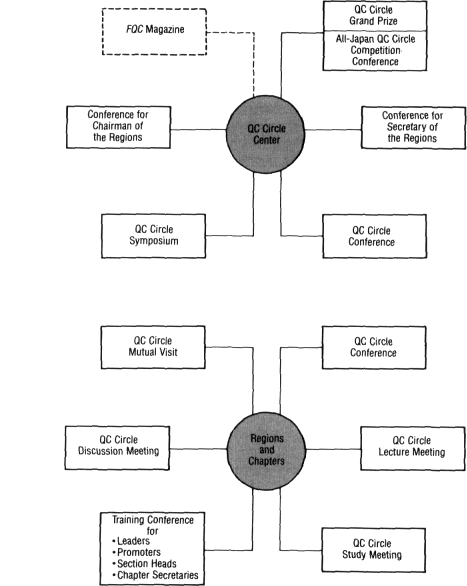
Fig. 6
Activities of the Japanese QC Circle Center, Regions, and Chapters.
national corporations in a given prefecture that typically make up the membership of a chapter. In addition to meetings of higher-level experts, many of the participants in the QC Circle Center's chapters' activities are shop and office floor workers joining in carefully orchestrated events. In contrast, quality-control specialists and leaders of QC circle activity typically comprise and attend the local chapter meetings of the ASQC and IAQC.
Each year, a different registered company member of the chapter is selected by the chapter counselors to take the responsibility for leading chapter activities. For example, in the early 1980s there were 36 companies of the total of 260 company members in the Ibaraki chapter who were designated to run the chapter (all of these are designated kanjigaisha ), specially selected for the quality of their QC circle activities. From among these specially selected member companies, one company is chosen each year to provide overall chapter leadership. Formally speaking, the leadership role is filled on a voluntary basis, but there is a lot of "peer" pressure from representatives of companies that have previously filled this role for others to take their turn.
Chapter activities are numerous and demanding, and it takes considerable corporate resources and donation of services to staff a section. To begin with, these will include one or more managers to run the chapter, clerical help, and office space. Those running a chapter are, we have seen, part-time "volunteers," but come from the ranks of full-time company employees. There are over a thousand such part-time officers working in the QC Center's branches and chapters. Apart from responding to peer pressure, many companies report that their own QC circle activities were restimulated by assuming this responsibility; this has served as an incentive for companies to take on the chapter leadership role. Still, some companies do refuse to accept being designated a kanjigaisha , variously citing the immaturity of their QC circle programs, lack of suitable people to assign to chapter leadership activities, and their firm's difficult economic circumstances as their reasons.
Chapter activities include running QC circle conventions, arranging for factory tour exchanges, and various study meetings. It is through these kinds of activities that local users and potential local users learn from one another. When a company in a given region wants to introduce QC circles or revitalize its QC circle activi-
ties, it would typically turn first to the chapter-level personnel for help (see Lillrank 1988). The secretary of the chapter is also expected to aggressively seek out companies that do not have QC circles and try to get them interested through attending QC circle conventions and the like. In sum, chapter activities provide for a local information network among companies interested in or potentially interested in QC circles.
Large numbers of employees, including shop and office floor employees, are involved in these local-level activities. This is particularly the case in the QC circle conventions held throughout the country; in 1986 some 3,652 case reports were presented, and some 140,000 employees attended. The revenue from the QC circle conventions (workers' registration fees are paid by their companies) provide the bulk of chapter income. Viewed from the other side, the benefit of local chapter activities to the worker, and implicitly to the company, is that they give workers hitherto concerned only with internal company matters and specific work processes an opportunity to take a new look at their work from a much wider perspective. They also foster the feeling among workers that they have many co-workers laboring under the same hardships as they push forward with their QC circle activity, and this gives rise to a feeling of social solidarity and mutual development that goes beyond the company. Furthermore, these kinds of joint experiences provide for exchanges and mutual development among QC circle promoters in each company within the chapter (Sugimoto 1982; Shiba 1983b).
Two Days in the Life of a QC Circle Convention
To promote "feelings of social solidarity that go beyond the firm" means creating within each participant a sense of participating in a social movement. So that the reader has a better feel for how this is accomplished, I would like to describe my observation of a reasonably typical QC circle convention I attended in 1978 in the small provincial city of Nagaoka. The QC Circle Center likes to hold its circle conventions in areas not known for their QC circle activities so as to expose as many new companies to circles as possible. The Nagaoka meeting was the center's 710th QC circle convention since
it began holding them in 1963; it was sponsored by the QC Circle Center in Tokyo with the backing of the Hokuriku regional branch. The attendance fee was ¥8,500 for registered circle members (about $35 at the then exchange rate) and ¥10,000 for non-members ($40). The QC Circle Center arranged for ten managers from different companies to attend as coordinators (sewanin ) for the meeting. These individuals, typically with high-level responsibilities for quality in their company, are selected from among JUSE's 1,600 collaborators and contribute their services on a part-time basis with their companies' support. The QC Circle Center covers their expenses and provides a modest honorarium.
The slogans of the conference were "Let's take world quality leadership through QC circles" and "Let's cope with the new age through QC circles." The schedule for the conference was as follows:
Program for Nagaoka QC Circle Convention | |
4/6/78 | |
9:00 A.M. | Reception |
9:30-12:00 | Case report announcement of problem-solving presentation |
13:00-13:10 | QC circle promoters' address |
13:10-14:40 | Special lecture: "Let's Cope with the New Age through QC Circles" by Mr. Ishihara Katsuyoshi, head, Quality Control Department, Matsushita Electronic Components |
14:40-14:50 | Break |
15:00-17:00 | QC circle public consultation panel |
17:10-18:40 | Social gathering: Nagaoka Cultural Center |
4/7/78 | |
9:30-12:00 | Case report announcement of problem-solving presentation |
13:00-16:30 | Factory visit and workshop forum |
The conference was attended by 350 people, almost all of whom were production workers, with some working foreman serving as group leaders. Only 25 percent of the participants were from companies without an active QC circle program. Most of this inexperi-
enced group were sent by their companies to get some exposure to QC circles in anticipation of their companies possibly initiating QC circle activities. The average age of the audience was thirty. Companies like to send young workers who have not previously had an occasion to present their QC circle experiences outside their company. Almost all the workers were from the manufacturing and utilities sectors; they appeared at all public functions in suits and ties. There were few women. JUSE officials believe that female workers are reluctant to express themselves in front of males, and they have therefore been running QC circle conferences exclusively for women. Employees were present from competitive companies such as Nissan and Toyota, as well as from their respective suppliers.
The heart of the QC circle convention is the case report announcement of problem solving held on both morning sessions of the convention. Here a worker representing his or her QC circle will make a presentation detailing the problem selection and problem-solving cycle experienced by the group. It will also typically include a statement of the savings or improvements achieved. Most of the savings reported were quite modest. One typical group from Nissan Motor reported savings of ¥416,000 ($2,000 at the then current exchange rate). Often, the presentation was done in rather dramatic, if not melodramatic, terms, with the speaker describing how the group had been thwarted by various obstacles but eventually overcame them.
A second worker served as the prop person for each presentation; since 1975 overhead projectors with elaborate transparencies have become the preferred mode of presentation. Each presentation lasted just fifteen minutes, with a warning bell at ten minutes and a final bell. Few workers went over the limit, and most of those who did were less than a minute over. This indicates considerable rehearsal time. Indeed, JUSE publishes a detailed manual describing appropriate modes of presentation. Thus, the presentations are highly ritualized, though each QC circle tries to find some distinctive approach.
A coordinator chaired the session. Following each presentation, there was a five-minute question-and-answer period. Some typical questions included: When is the best time to meet, during or after working hours? How do you coordinate your "mini circles" with
the overall problem-solving effort of the main QC circle? After the question-and-answer session, the coordinator provided a five-minute evaluation, which included complimenting the presentation; providing tips on how it might be improved, or on how the problem-solving effort might have proceeded better if a different path had been taken; or pointing to some important lesson to be learned from this report. The presentation closed with the coordinator giving some token gift to the presenter and with picture taking so that the presenter could show his or her work group, family, and friends visible recognition of the QC circle's achievements. The best presentations stand a chance of being published in JUSE's journal, FQC , and the presenters may be invited to the All Japan QC Circle Convention.
It was impressive to watch workers making these presentations. Some, reflecting their nervousness and lack of experience, struggled to express themselves in front of an audience of strangers. They forgot their lines and spoke hesitatingly. Others carried off the whole presentation with aplomb. Regardless of the quality of presentation, however, they were reaching out to people in other companies sharing common interests and experiences and, in so doing, becoming part of a wider social movement.
There were a total of sixty-two presentations at this conference, with four concurrent presentations at any one time. With two people required for each presentation, this means that 35 percent of the total audience made presentations during the course of the conference. This increased the sense of sharing common experiences; it was an audience quite forgiving of weak and nervous presentations, as most of them could empathize, having made similar presentations, if not now, then at an earlier time.
The special lecture in the early afternoon was inspirational in tone. The speaker stressed the requirements necessary for corporate survival as Japan entered a new era. Without such progress, the speaker said, Japan would find it increasingly difficult to export. Those companies that survived would be ones that cut costs and raised quality. QC circles could provide the vital margin by cutting costs. "Cost down" was announced as the new theme for QC circles.
The special lecture was followed by a break and then the QC circle panel discussion. This involved a number of the coordinators
sitting on the stage responding to questions solicited from the audience in advance. After each question was answered, the questioner was asked if he was satisfied with the answer, and additional questions on the same topic were solicited. The questions were sorted into four categories—education, theme choice, operations, and staffing—and treated in turn.
A sample of questions asked included the following: How do you avoid ritualism (mannerika ) in QC circle activities? What can be done about different levels of interest and ability in the QC circle group? How do you handle younger and older workers in a QC circle? How do you integrate new and irregular workers into a QC circle? How do you find suitable themes to work on? How do you find suitable times to meet? How do you combine men and women in the same QC circle? We have differences in QC circles' performances on different shifts in our plant. How do you level up performance in this situation? The company president told us to set up QC circles within each workshop. How should we proceed? How do you select themes in non-production departments? Should we have a unified theme for all QC circles in all workshops? We have a problem of the leader and subleader doing all the work. We divide the work up and give assignments to everyone, but it doesn't seem to work out. What should we do? How do you evaluate QC circle performance?
The coordinators had heard some variant of these questions many times before, and JUSE has numerous publications responding to most of them. The coordinators' responses were thus reasonably straightforward, but they treated each question with great seriousness and attention. At the same time that workers were getting answers to their questions, they were seeing that, regardless of firm, they had basically quite similar problems. Once again, the implicit message was that we are in a movement larger than any single QC circle or firm, encompassing the entire nation (nowadays, there is great attention to the worldwide character of the movement).
That evening a buffet dinner was held in a large room for all 350 participants, coordinators, and JUSE staff. It was designed as a tension breaker to get people to relax, feel at home, and develop a sense of fellowship with the people in QC circles in other companies. There was lots of alcohol, and people stood in front of the main table helping themselves to food and drink. After a short in-
terval, one of the coordinators serving as the master of ceremonies offered a toast of welcome. A blackboard was hauled out and individuals and companies signed up to sing.
The singing started off with a company song from one of the auto companies, and soon covered romantic old ballads, folk songs, and sentimental wartime songs (just recently back in fashion at that time). As time passed and the alcohol took effect, more and more groups signed up for the singing, usually three or four people from the same workshop. Some voices were obviously terrible, but it didn't matter. One company official serving as a coordinator whipped out his old navy cap, which he conveniently had with him (it drew the expected laughter) and launched into a sentimental war ballad. A local company president after a pretense of resistance, was pushed forward by his subordinates and began his song. Other coordinators were also pushed forward to sing. They did so graciously. After two and a half hours of socializing, the social gathering closed with all joining hands in one big circle and singing the national QC circle song (which was written on the blackboard since most did not know the words). It was treated as a serious moment.
This QC circle song capped the theme of the evening and indeed the entire day; through QC circles, it runs, we are all, regardless of company affiliation, participating in a wider social world beyond the workshop. Barriers among workers and firms were broken down and a sense of fellowship established. It was an evening and a day designed not simply for learning specific tactics but to demonstrate solidarity in a common movement, with workers and managers sharing common goals. It was clear from the skill with which they managed the activities that the JUSE staff and coordinators had orchestrated such "spontaneous events" many times before.
The following morning involved a repeat of the announcements of examples of personal experiences. Attendance was lighter, as some attendees chose to wander around the city and relax. For the afternoon session, the participants were divided into six groups and loaded into buses for a factory visit, for which they signed up in advance. I joined the visit to a ball-bearing plant of Nippon Seiko<. The factory manager started with a fifteen-minute introduction to the company, the history of its QC circle movement, and its mode of operation. We then took a thirty-minute plant tour. This was followed by a panel discussion involving twelve company workers
(eight men and four women). One of the coordinators moderated the session, which lasted for about two hours, with the visitors asking all sorts of detailed questions about both work organization and QC circles in particular.
Once again, we see a situation created in which the participants in the conference were made to confront fellow workers sharing the same kinds of problems. It is hard to imagine a similar exchange of views on work in a Swedish or an American setting. While the IAQC typically has circle presentations at its annual convention, the audience is heavily made up of middle- and low-level management circle experts (especially circle facilitators and coordinators), not fellow workers. An internal staff survey of the IAQC's 1988 spring conference found that only 5.5 percent of the participants designated themselves as "team members." With few circle members in the audience, the circle presentations have somewhat of a "see what the animals in the zoo can do" quality to them. Moreover, the kind of regular factory visit exchanges among Japanese workers just described have few counterparts in the United States and Sweden.
By Japanese management's very willingness to invest in sending its employees to these kinds of events in a regular fashion, workers receive the message that their views and their contributions are important. Moreover, as we have seen again and again, they are told at every turn, in effect, that they are part of a wider social movement. As Ishikawa Kaoru expressed the matter to me, such forums provide opportunities for mutual development: "People doing QC circles are able to jump out of the well and see the broad ocean, thereby getting a bigger view." This is clearly one of JUSE's major contributions, part of a conscious strategy, gradually developed by JUSE. They were driven by a desire to create a mass movement (taishuka<) is the way Noguchi Junji, the executive director of JUSE, expressed it to me.
In proceeding along this route, JUSE has contributed to enhancing the individual worker's sense of self-importance and dignity. Making the worker the focus of the QC circle convention leads workers to return to their workshops with renewed motivation to improve their QC circle activity. To be sure, many workers are not that motivated to engage in QC circle activities, and many never get sent to such conventions. Moreover, we might anticipate vary-
ing degrees of commitment to QC circles even among those who are sent. Overall though, the group that is sent to such conventions is a highly motivated one. To the extent that QC circle success depends upon a cadre of such motivated individuals, JUSE plays a major role in support of corporate objectives.
Chapter Activities
To get a better feel for the scope and character of these chapters, let us examine in detail the activities of the Kanto regional branch (comprising the chapters of Tokyo, Yokohama, Nagano, Gumma, Saitama, Tochigi, Yamanashi, Chiba, Shonan, and Ibaraki).[2] The number of individuals participating in chapter-sponsored events in the whole regional branch rose from 14,000 in 1974 to 36,000 in 1981. If we break this down further to the specific events attended, we find that QC circle conferences accounted for much of the membership participation. Ninety percent of the 36,000 attendees participated in QC circle conferences in 1981. The Kanto branch chapters held a total of forty-five QC circle conferences during the year (averaging five a chapter), and the regional branch held two. Together, these attracted some 32,600 attendees, with the average number of participants per conference being 700.
The remaining 10 percent of those participating in chapter activities attended factory tour exchange meetings, and study meetings for circle leaders, managers, and staff. For all Kanto chapters, this included fourteen leader training conferences, seven quality-circle promoter training conferences, six department and section head training conferences, six factory tour exchange meetings, five member company training conferences, and three other miscellaneous conferences. This breaks down to 4.6 meetings or conferences per chapter per year. In addition, chapter officials are required to attend a larger number of regional branch meetings.
Shiba (1983b) notes that the ratios of those attending QC circle conferences to those attending all other chapter activities was 65 percent to 35 percent in 1974. It moved by 1981 to a ratio of 90 percent to 10 percent. Shiba sees this, along with an overbur-
[2] Most of the material on chapter activities to be reported derives from the research report of Shiba Shoji (1983b).
dening of local chapter officials, as a dangerous trend, resulting in the diluting of serious educational activities.
Shiba further reports chapter officials complaining that they cannot meet the new demand in the service industries for circle support because of their heavy burden of current activities. He notes that 89 percent of chapter secretaryships are held by individuals with jobs closely related to manufacturing; he sees this as a problem in responding to the new market demand in the service sector. He is also concerned that in order to accommodate the large numbers of people wanting to attend meetings, the chapters are forced to dilute educational content; he sees this weakening the link whereby experienced circle participants teach newcomers. JUSE officials deny these are serious problems and contend that the organization would not be growing if they were. What problems do exist in this area, they see as the growing pains of a rapidly expanding enterprise.
The critical point here is that this rich local network of educational and learning activities is conducted primarily at the chapter level. The sheer density of interactions is impressive. There is no counterpart in Sweden or the United States. The tremendous amount of learning that goes on across firms, especially among workers who are high school graduates, provides an enormous stimulation for QC circle activities, reinforcing them at every turn.
We can see from the above discussion that JUSE is very much a corporate association providing specialized knowledge, but it is structured as a mass organization and produces mass involvement. In this organizational framework and environment, independent consultants play an almost nonexistent role in the initiation and operation of QC circles. In 1976 one estimate put the number of external organizational development consultants in Japan at a dozen (Kobayashi and Burke 1976:119). While the number has increased since then, independent full-time consultants still play a quite modest role in Japanese economic life.
JUSE has historically designated a number of individual consultants as its representatives, to be assigned to companies requesting help. Typically, it has concluded an assistance contract with the firm requesting help and then paid the consultant costs plus an honorarium. In 1987 JUSE had 660 consultants, ranked into six categories in order of skill (360 of whom had capabilities in QC
circles). Consulting services include diagnosis, in-company training programs and instruction, and on-the-spot instructions for implementing and sustaining QC circle activities.
Most significantly, JUSE consultants are not primarily in business for themselves; rather they are part-time volunteers who have full-time jobs with companies, government, or universities. Roughly 30 percent are university professors (engineers); 60 percent are industry personnel and 10 percent are government employees. The academics used to be a much higher percentage of a smaller number of consultants. But as the movement has grown, industry expertise has expanded very rapidly. Most important, as in Sweden, consulting activity is carefully controlled to meet corporate interests. Consultants are the agents of corporate actors rather than freewheeling entrepreneurs as in the United States.
Conclusions
What characterizes the Japanese case? JUSE provided strong guidance and coordination for the emergent QC circle movement. This governance structure allowed companies to share and build upon their individual expertise and, in so doing, to reduce the transaction costs associated with planning, adopting, adapting, motivating, and monitoring QC circle activities. No such organization has emerged in the United States.
JUSE's role exceeded even that of SAF's technical department in Sweden for two major reasons. First, JUSE succeeded because its activities were not contested within the management community, or by the unions or government; it had uncontested legitimacy. What above all sets it apart from the Swedish case and accounted for its success, however, was JUSE's ability to turn QC circles into a social movement. In keeping with the framework described in the beginning of chapter 8, JUSE was able to coordinate the informal interests of disparate individuals in diverse firms through the development of formal organizational activities.
JUSE's success in creating a social movement in support of quality circles is directly related to its QC Circle Center's unique chapter structure. These chapters, with strong management support, involved large numbers of blue-collar workers in regular educa-
tional activities. They provided a strong information network that stimulated learning across firms.
JUSE did not by itself create either QC circles or the social movement that drove them forward; QC circles were the results of individual actors at the corporate level forging corporate policy both in support of JUSE and in support of building QC circles in their firms. By correctly reading where these companies wanted to go, involving their personnel in its activities, interacting with them to develop and codify new ideas, training materials, and practices, and ensuring intercompany collaboration, JUSE operated as a powerful catalytic agent. Its accomplishments far surpassed those of its American and Swedish equivalents.
In the early 1960s Japanese companies wanted to find ways to involve workers and foremen in studying how to improve and design new work standards; JUSE and its industry collaborators responded with QC circles. To be sure, QC circles evolved into more than what had been originally intended. The present-day QC circles emerged from a back-and-forth learning process involving feedback between companies and between JUSE and companies. Finally, the development of QC circles must be seen as part of the process in postwar Japan by which the "distribution of intelligence" has been shifted downward to draw on the talents of shop and office floor workers. It is a remarkable achievement that must be recognized as a major factor in Japan's competitive performance vis-ô-vis countries like the United States.
TABLE 5. Comparative Aspects of National Infrastructures for Diffusion of Small-Group Activities | |||
Organizational Characteristics | United States | Sweden | Japan |
Top management support | minimal | high | high |
Type of organization | professionally oriented | corporatist[1] | corporatist[2] |
Mode of participation | individual volunteer members | corporatist membership | corporatist membership |
Structural form | decentralized association; chapter-level organization for experts | centralized association | decentralized association; chapter-level organization with mass participation |
Principal strategy | disseminate information through conferences and journals; expert networking | elite researchers identify best industry practices and feed back to practitioners | create social movement through massive training and inspirational activities; develop applied statistics |
Consulting activities | autonomous at high level | controlled at medium level | controlled at low level |
Engineer involvement | low | moderate | high |
[1] Includes a partial role for national labor organizations. | |||
[2] Excludes national labor organizations. | |||
Chapter Fourteen
Summing Up
In the end, we still depend on creatures of our making.
Goethe
I would like to bring together this discussion by looking at the central characteristics of the respective national infrastructures and reflecting on their significance. These are presented in table 5. Through a comparison of these characteristics, we arrive at a more complete understanding of the evolving national movements for small-group activities in the three countries. This rough comparison of major characteristics does not allow us to provide a precise quantitative parceling out of the causes of success in building a national infrastructure, but it does present us with an overall gestalt. Moreover, it is clear from the preceding analysis that top management support from the major corporations is the key variable that conditions most others.
The United States
In the United States there were a number of potential contenders for leadership of the small-group-activities movement who never did quite leave the starting gate. The direct factors involved in limiting their entry were conflicting organizational agendas, inability to resolve organizational conflict surrounding diffusion versus con-suiting activities, inability to build local information networks, and labor-management conflict. The most important indirect factor lim-
iting their entry was lack of top management support for small-group activities among America's major corporations.
There were, however, two organizations that seriously contemplated a national leadership role. The first, the ASQC, tried to move in this direction, but failed. Created on the model of the engineering professional society and stressing individual and collective self-improvement, the ASQC could not rise above its origins. Organizations created at a particular time tend to retain their characteristic form long after it ceases to be relevant or adaptive. Homogeneity limited the ASQC's ability to reach out to a new constituency, and bureaucratic inertia stifled those who were prepared to take the kinds of initiatives that might have made it a major player in the circle movement. Consistent with the professional model, the ASQC had individual, not corporate, members. The often unreliable voluntary nature of ASQC members' participation on committees and in divisions further limited its ability to move consistently in the direction of creating a nationally effective organization that would identify, reformulate, and disseminate best practices.
The second organization, the IAQC, was an entirely new body, established in 1978. It both survived, grew, and created an impressive annual conference, a reasonably effective journal, and an extensive chapter organization. Yet in terms of its public mission of becoming the national leader for diffusing the quality-circle movement, it must also in the end be regarded as a failure. Although it created a chapter structure for local information exchange, the chapters were composed largely of individual middle- and lower-level management experts who voluntarily met once a month in the evening. These arrangements limited their ability to ensure information transfer across firms among all categories of employees in a regular and systematic fashion.
The IAQC's national leadership, also composed primarily of volunteer middle-ranking managers, was incapable of establishing organizational legitimacy and gaining access to the kinds of resources needed to give it a central role. Its leadership was primarily made up of human-resource, personnel department, and quality-assurance personnel acting on their own initiative; neither the engineering profession nor union leaders were well represented. The IAQC had no friendly parental unit overseeing its activities and providing entrée and support where needed. Nor did it have a corporate constituency of top management officials who were fervently com-
mitted to its goals. In short, the IAQC was not an instrument of collective corporate entities.
This environment provided fertile opportunities for a rapidly expanding community of consultants, whose knowledge, expertise, and discretionary time all allowed them to see association activity as a business investment and to play a prominent role in moving association activities in directions that served their economic interests. The IAQC proved tumble to surmount its consultant origins. By the late 1980s the consultants had all but succeeded in making it into an association to minimize their own transaction costs rather than those of corporations pursuing the adoption of small-group activities. The IAQC had become a conference-driven organization, and was rapidly moving toward becoming a distributor of consultants products.
Ultimately, we can understand this outcome in terms of the failure of American top management to take a leadership role in supporting the IAQC or any other organization that aimed at leading a national movement for small-group activities. For most of the period in question, top management in America was not seriously interested in small-group activities as a solution to its problems. Even when more interest did develop among some top managers in the early 1980s, their firms were by and large uninterested in building a national infrastructure for diffusing these innovations. Without such involvement, the IAQC was left to limp along by it-sell relying on inconsistent voluntary labor, subject to a lack of expertise and clout, and shackled by consultant influence. The result was financial mismanagement, including one large dose of embezzlement, and a relatively ineffectual association.
Sweden
The contrast with Sweden is quite striking. Small-group activities, a subject of national debate, were seen in the light of a movement to democratize the workplace. In the late 1960s, all parties to the labor market came to support small-group activities, albeit for somewhat different reasons. The leading national organization for promoting these activities was the Swedish Employers' Confederation and its offspring, the technical department. SAF was Sweden's peak corporate association, unabashedly pursuing the interests of its corporate members. There was no talk of creating a "professional asso-
ciation" in the sense that animated ASQC or even IAQC activities. Neither SAF in general nor its technical department in particular had individual members.
How Swedish managers handled small-group activities following the wave of interest in quality circles in the early 1980s provides a test of Swedish consistency in approaching structure. In 1987 the Swedish Quality Circle Federation was established. Its operating principles and structure are in keeping with our expectations based on how Swedish leaders treated the earlier movement for autonomous work groups. That is to say, they proceeded in corporatist fashion. Only corporations, not individuals, were allowed to become members (in late 1987 there were 130 member companies), and although consultants' companies are allowed to join the association, they are not allowed to be members of the board of directors.
The task of the staff of SAF's technical department involved identifying, reformulating, and disseminating best practices in small-group activities. This was done through following local experiments, distilling key ingredients of success, and heavily publicizing successes. They relied on a set of elite researchers interacting with practitioners at primarily elite corporations. Dissemination was also done through various training activities and seminars. The technical department was staffed primarily by engineers with "grassroots" private-sector experience who could communicate well with their counterparts in industry. This gave their efforts added legitimacy. More generally, as an organ of SAF, the technical department had almost instant legitimacy among managers. With access to SAF resources, the staff did not constantly have to be concerned about generating revenues and gaining access to high-level corporate officers. Managers in private firms did not automatically agree with them, but they could be assured of getting a hearing.
With the department's activities guided by a paid technical staff, there was little need to rely on volunteer labor. In a small nation such as Sweden, such a centralized group could be reasonably effective in communicating its message to all relevant adopters. However, it did lack a grass-roots educational organizational form like the IAQC's chapter system. As a result, it lacked a direct, systematic method of information sharing across local corporate entities and a means of mobilizing shop floor employees.
The two other relevant national-level organizations in Sweden were URAF and the Personnel Administrative Council. URAF, a
joint union-management research group, did play a significant role in the early days and provided an important avenue for the building of competence in this area by the union movement. It had the potential to be a contender for the national leadership role. The decline in cooperative labor-management relationships in the mid 1970s led, however, to its being dismantled.
The council, primarily a consultant and research organization, was also influential in the early days. It was originally a creature of SAF and can be said to have provided quality control over consultant activities, which it carefully orchestrated to serve the interests of the major parties to the labor market. The council began to play a diminished role in the small-group-activities movement by the mid 1970s.
The decline of URAF and the council shifted the central national role to SAF's technical department, which issued reports and visions of the future (the new factories project in the late 1970s) that were detailed serious examinations of shop floor organization. Regardless of whether one agreed with them, they were documents that had to be taken seriously. Such a role was quite beyond anything the IAQC was capable of.
All this is to say that SAF developed core competencies (assets) in small-group activities that ensured it of national leadership. Despite the dismantling of the technical department, these management competencies were preserved with the establishment of the Swedish Management Group in 1981. The movement to reestablish a national approach to work restructuring proceeded in the mid 1980s under the auspices of the Work Environment Fund. Again, the centralized corporatist model came to the fore, with joint labor-management participation. These experiences contrast sharply with those of the IAQC, which increasingly moved toward "distributor" activities in a way that guaranteed inability to generate original ideas and expertise.
Japan
This leads us to the Japanese case. Unlike in Sweden, there was no national debate on the subject of work democratization, but Japanese management did gradually evolve a consensus on shifting the responsibility for decision making further down in the organization. QC circles were one manifestation of that process.
There were also, however, a number of striking parallels to the Swedish corporatist approach and its ability to establish legitimacy among the business community. While not an organ of one of the peak business associations, JUSE nevertheless had close ties with the business community, especially Keidanren, so that the legitimacy of its new Quality Circle Headquarters (like that of SAF's technical department) was never in question. As the foremost proponent of quality in Japan, JUSE was able to link the QC circle movement to further success in quality improvement. JUSE had no serious contenders for its national leadership mantle in the diffusion of QC circles. This was the case, in part, because it played a major role in evolving the concept and its functions, constantly developing "new products" in a way that no other national organization was able to match. Like SAF, it had only corporate members, and was thus not limited by the inconsistency of volunteer efforts. There were a lot of voluntary efforts at the chapter level and in committee activities at the national level, but these are strongly supported and stimulated by corporate support (especially at the local level).
In neither SAF's technical department nor JUSE was there any attempt to move toward becoming a professional association. Both were task-oriented in terms of spreading small-group activities. The self-improvement of individuals per se had little meaning for them. As in Sweden, corporate- and university-based engineers in JUSE played a decisive role in linking up with corporate engineers in the private sector to develop and refine the QC circle concept.
Distinctive in the Japanese approach was the stimulation of activities at the local level through JUSE branches and chapters, allowing mass participation in the organization. The voluntary company rotation in running the JUSE chapters on an annual basis is notable. Closer examination reveals that these voluntary activities reflect not only perceived self-interest but also peer pressures from other companies. It involves what Bill Ouchi (1984) has called "serial equity" and is premised on the notion that there are corporate memories. Ouchi refers to this as "clanlike" behavior. Regardless of the term, however, what we see here is a level of collective action among corporate actors at the grass-roots level that was absent in the United States and Sweden. It made possible a sharing of corporate experiences and gave those who were active in its events a sense of participating in a national social movement. This had
significant motivational benefits that firms acting on their own in America could not, by definition, replicate. JUSE chapter activities provided a strong, reliable information network that directly and systematically stimulated employee motivation and learning across firms among all categories of employees. The Swedes, even though they proceeded along corporatist lines, did not develop such direct, systematic information sharing across firms.
The IAQC did develop grass-roots activities in its chapter activities, but these were attended primarily by middle- and lower-level management officials responsible for circle efforts in their firms. They were chapters of "experts." JUSE chapter activities, on the other hand, were modes of eliciting mass participation of shop floor employees. JUSE's distinctive organizational contribution to the diffusion of quality-circle activities was its combining of the corporate association form with the provision of specialized knowledge and training to a mass constituency. The organization was structured to ensure mass participation in its activities. It created a succession of special training materials, including creative adaptations of applied statistics for shop and office floor workers. There can be little doubt that JUSE activities building on this foundation were major factors in the successful promotion of quality circles in Japan.
As a leader of this social movement, JUSE stood above the pursuit of private economic interest in a way that was not possible for either consultant firms or individual corporations. Unlike in the American case, consultant activity in both the Swedish and Japanese cases was carefully controlled by the major parties to the labor market. Using part-time consultants from private-sector firms, JUSE managed to harness their experience without jeopardizing its organizational integrity. It also found ways to finance its promotional activities at the national level and its local chapter activities, so that it was not dependent on an ever-increasing role for the consultants. Education and information transfer at the chapter level was financed to a considerable extent through QC circle conventions, with individual attendance fees paid by the employers. These solutions seem quite beyond anything that the Americans could mount.
Final Thoughts
In summary, the professional orientation of the ASQC limited its ability to play a national role in the diffusion of quality circles. The
IAQC, despite some impressive achievements against great odds, failed in its mission to lead a national quality-circle movement. This failure, manifested in the dominant role of consultant interests, reflected above all failure to win support from American top management.
The Swedes had somewhat more success in building an effective national infrastructure relying on a centralized top-down model of corporate associations to accomplish the spread of small-group activities. Volunteer activities and professional development had little currency in this model.
The Japanese, in effect, combined some of the local-level activities of the Americans with the centralized corporate association model of the Swedes. In a stroke of organizational genius, they created a corporate association with a mass constituency. Therein lies one of the central roots of Japanese success and their ability to avoid a faddish succession of management panaceas. Nor was this approach limited to JUSE. The Japan Supervisors' Association (Nihon Kantokushi Kyokai) set up similar local chapter activities for its first-line foreman members to teach them a variety of managerial skills, including, since 1975, how to manage small-group activities. They claim to have developed this organizational form independent of JUSE. Thus, we see an unconscious patterning of organizational responses to the task of mobilizing and training mass constituencies for Japanese industry. The variety of these kinds of organizations means that companies had a "thick" local network of educational and training activities involving their employees at the plant level.
There is one hint of the Japanese approach and what it could accomplish in IAQC experience. The Memphis chapter was generally acknowledged within the IAQC as its most successful chapter. This was the one chapter that had strong and consistent corporate support (Dover Elevator). Thus, when individual Dover employees took leadership roles in the chapter, they knew they were also doing the corporation's work. Such experiences, however, were the exception, not the rule, in the American case.
JUSE provided the guidance and coordination for QC circles that was lacking in the West. It coordinated the informal interests of disparate individuals and firms through the development of formal organizational activities. In so doing, it built a social movement. Joe Juran (1987:61) makes a related point in discussing the
vacuum in Western countries created by the failure of recognized professional quality-control societies to take a leadership role in promoting circles. This vacuum was filled, he says, by company enthusiasts, consultants, journalists, and so on. Such a mixture was unable to provide the broad coordination and guidance needed for the QC circle movement to prosper. Based on my analysis, I would differ only in arguing that the vacuum was created above all by the failure to develop joint corporate action.
I have hypothesized that to the extent that major institutional actors, especially management, become strongly committed to small-group activities as a solution, a well-organized national infrastructure will be created. This hypothesis explains reasonably well the divergence between the American experience on the one hand and the Swedish and Japanese ones on the other. Without the support of any of the major institutional actors, little headway was made in creating an effective national infrastructure in the United States. Conversely, with support from varied institutional actors in Japan and Sweden, significant progress was made toward creation of an effective national infrastructure.
The American failure to successfully create an instrument for corporate collaboration to diffuse small-group activities meant that those individual firms that did have an interest in moving ahead were vulnerable to the garbage can model of decision making. Goals were problematic, the technology was ambiguous, and participation in the decision making to introduce and operate small-group activities often confused. Without a national organization to organize experiences at the firm level on a systematic basis, defining and codifying best practices as one went along, these problems took much longer to resolve. Small-group activities were often abandoned in response to frustrating experiences and unrealistic expectations. Quality circles took on a faddish character. To be sure, some companies persisted and, relying heavily on trial and error, overcame these barriers. The lack of an effective national infrastructure, however, made their task more difficult, increased their transaction costs, and reduced the probability of successful outcomes.
The Japanese and Swedish corporations, however, were more oriented to collective solutions to the start up, operations, and research and development costs associated with small-group activities. They
seem to have had a greater appreciation of the economizing benefits associated with collaborative activities than did their American colleagues. Perhaps the norms, values, and practices in these societies did, in fact, yield greater economizing benefits from collaborative activities than would have been the case in the United States. These benefits contributed to smoothing the decision-making process in individual firms, thereby reducing its garbage can quality much more rapidly. This perspective builds on the reality of imperfect markets in the flow of information between firms and the need to supplement them with external mechanisms that smooth the decision-making process. Firms were guided by imitation of their corporate peers as mediated by national organizations.
In their comparison of U.S. and Japanese trade associations, Leonard Lynn and Timothy McKeown (1988) suggest that Japanese corporations are generally more oriented to collaborative research and development activities. This is not to suggest that American firms never cooperate on an industry or national level. This is certainly not the case. The issue for future research is under what conditions and in what areas firms are likely to engage in joint efforts. I can only say with certainty that the willingness to do so was minimal in the area of small-group activities in the period under investigation.
To the extent that this collaborative tendency is characteristic of both the Swedes and the Japanese, we cannot simply attribute the results to the uniqueness of Japanese culture. Yet if we think of culture as accumulated historical experience, the Swedes and the Japanese share a common cultural orientation with regard to the benefits of pooled corporate activity. In neither country has the market been elevated to such heroic stature as in the United States. Simplistic comparisons that put Sweden and the United States in the same "cultural camp" and Japan off to one side are thus misplaced.
In both Sweden and Japan, there were established traditions of corporate collaboration. Corporate leaders intuitively appreciated the economizing in transaction costs that would result when they jointly pursued small-group activities. It is the American experience that appears unique, at least in this three-way comparison. This way of thinking is strikingly consistent with the more general analysis of Philippe Schmitter and Gerhard Lehmbruch (1979) and their collaborators, who treat Sweden as a case of societal corpo-
ratism, Japan as a case of corporatism acting without labor, and the United States as a case in which the lack of corporatism needs to be explained. This way of thinking is also consistent with the observations of Max Boisot (1986:145), who notes Oliver Williamson's belief that "federations" among employers are inherently unstable; as a consequence, Williamson focused on markets and hierarchies as being the most stable institutional alternatives for parties conducting transactions. Boisot points out, however, that by confining his analysis to the choices facing American firms, Williamson has limited himself to an environment unsympathetic to the "collusive nature of federative transactions," especially at the microeconomic level. In keeping with that analysis, the data I have presented make clear that Sweden and Japan do not share the American distaste for federative economic transactions.
It is apparent that employers vary in both the extent of their coordinated activity (high in Japan and Sweden and low in the United States) and the shape it takes (highly centralized in Sweden and decentralized in Japan). This variation shows the limitations of an approach that emphasizes only the economic factors involved in assessing transaction costs. Such an approach cannot show why employers in the three countries have varied in their willingness to pool resources to reduce their transactions costs for small-group activity. Rather, we must combine economic, social, and political factors to reflect the real impediments to such pooled activities. Thus, the joint associational experience in the repertoires of each country's managers, the extent of knowledge of small-group activities already in the heads of managers, the role of markets, managements' willingness to include labor and pressures for doing so, and the traditions of centralization and decentralization, among other factors, all vary by country. These variables become in effect "costs" and constraints influencing the managerial calculus as to whether to pool resources and, if so, how such activity should be conducted. Upon further examination, it also becomes apparent that country differences on each of these variables capture a great deal of what we commonly call cultural differences.
What does all this mean for competitive abilities? We cannot assume that such pooled corporate activity will be decisive, thereby leading to the dominance of the Japanese over their American competitors. Many factors are involved in determining overall com-
petitive strength; it is not just a matter of how a firm handles transaction costs (Robins 1987:68-86). Moreover, collaborative activity that economizes on transaction costs in one situation may lead to excessive bureaucratic burdens in another. We must be careful not to overgeneralize from the findings. The fact remains, nevertheless, that Japanese firms seem to have been able to move more quickly and efficiently in adopting small-group activities and deploying them for competitive advantage when compared to those of competitor nations. The data presented in the second half of this book strongly suggest that creation of an effective national infrastructure played an important part in these developments.
Notwithstanding these similarities between Japan and Sweden, we do need to highlight the fundamental differences that emerged between these two experiences in this study. In the case of Sweden, disagreements among the major institutional actors about how best to proceed and the emphasis on a corporatist top-down model of diffusion detracted from the effectiveness of the national infrastructure. The uncontested nature of management interests and JUSE's organizational creativity in devising a corporatist structure with a mass constituency seem to explain the greater success of the Japanese in building an effective national infrastructure.
One way to think about these findings is that in the period under investigation the Swedes tried more and accomplished less, the Japanese tried less but accomplished more, and the Americans tried less and accomplished less.