
Momism Revisited: "Be a Real Woman and Like It"
The publication in 1942 (before America had entered the war and thus before large numbers of women had entered the wartime work force) of Philip Wylie's classic attack on American women, Generation of Vipers , signaled the beginning of one of the darkest periods in the history of ideologies of motherhood. Wylie's thesis, that American women had become omnipotent "moms" damaging the psyches of their offspring, the masculinity of their mates, and the vitality of their country, was the initial salvo in a barrage of mom bashing that took hold of the popular imagination, soon followed by the publication in 1943 of David Levy's Maternal Overprotection and in 1947 of Ferdinand Lundberg and Marynia Farnham's popular and vicious Modern Woman: The Lost Sex . Although written in the forties, these texts provided the backdrop to the continued psychologization of the mother/daughter relationship. The language of both overprotection (Levy) and neglect and malevolence (Wylie and Lundberg and Farnham) continued into the fifties, albeit with less rancor and vehemence.
Nina Leibman has argued that fifties films continued the evil mother motif from the forties, presenting a very different version of motherhood than is typically associated with the period. She sees a much less rosy discourse, one, in fact, in which mothers represented a quite malevolent force in their children's lives: "The cinematic family melodramas of the 1950s, then, seem to exhibit an attachment to Wylie's Momism. Mothers are accused of being too
smothering and are then relegated to a marginalized existence within the narrative, where they can witness (with admiration) the blossoming of the crucial familial bond, that between father and son." Leibman argues that this erasure, this marginalization, links fifties television to its filmic counterpart: "Both media depend on a systematic erasure of the mother in order to ensure an emphasis on the father's role in raising his children."[22]
This erasure is certainly apparent in the television sitcoms of the period, as "Father Knows Best" amply illustrates. Sitcom mothers seem absent, anonymous, or inconsequential: "It is possible to discern in domestic comedy programming of the period a concerted effort to deemphasize the mother's importance in the lives of her children; indeed, she is presented primarily as a domestic servant."[23] Interestingly, in an era that both celebrated and derided the mother, it was the father (or often the symbolic father figure in film melodramas such as 1959's Imitation of Life ) who reigned as head of household and pivotal figure in his children's lives. The father/child interaction also proved the most substantive, in terms of both narrative structure and ideological weight.
Fathers seem to have been brought back into the picture as a result of the "realization" (promoted by Wylie, et al.) that mothers were ruining their children. If maternal instinct was now aggressive and predatory, if moms ruled the earth and made their children rue the day, then fathers needed to reenter the family fray and set things straight. "Father Knows Best," for all its innocuousness, implied in its very title that Moms may be cute and addle-brained (or mean and malevolent), but when it really comes down to the important issues of child rearing and family life, father really does know best. As many critics have noted, the father-centered family sitcoms of the late 1950s and early 1960s were perhaps a concerted response to what was seen to be a surfeit of "bumbling dads" in the media:
"Father Knows Best" and "Leave it to Beaver" . . . shifted the source of comedy to the ensemble of the nuclear family as it realigned the roles within the family. "Father Knows Best" was praised by the Saturday Evening Post for its "outright defiance" of "one of the more persistent cliches of television and scriptwriting about the typical American family . . . the mother as the iron-fisted ruler of the nest, the father as a blustering chowderhead and the children as being one crack removed from juvenile delin-
quency." Similarly, Cosmopolitan cited the program for overturning television programming's "message . . . that the American father is a weak-willed, predicament-inclined clown [who is] saved from his doltishness by a beautiful and intelligent wife and his beautiful and intelligent children."[24]
The title of the popular 1950s melodrama, Imitation of Life , implies that the life of a career woman (Lana Turner's character, in this case) is only an "imitation" of the real thing, presumably Mrs. Anderson's life. Directed by Douglas Sirk, one of the great melodrama auteurs , the film exemplifies the double bind mothers in the fifties faced in both the narratives of popular culture and, I would venture, the experience of their everyday lives. Imitation of Life was a 1959 remake of a popular Fannie Hurst novel originally produced in 1934, starring Claudette Colbert. It is the story of two mother/daughter couples: one black and one white. This racial theme is vitally important here, not only for what it reveals about the racial dynamics of American society in the 1950s but for the part it plays in this specific narrative and in the melodrama genre in general. If in the 1930s films such as Stella Dallas played out class conflict through the mother/daughter relationship as metaphor, then in the 1950s, in a film like Imitation of Life , the racial "issue" was refracted through familial interactions. Under the booming, "happy days" exterior of 1950s life, beneath the contemporary surge of rose-colored nostalgia, life was much more fraught, much more complex and disturbing, than popular memory would have it constructed.
The impact of McCarthyism on all areas of popular culture has been well documented.[25] Not only were producers, screenwriters, actors, and directors blacklisted, but the culture industry itself initiated anti-Communist imagery and narratives. These films and TV shows were often overtly anti-Communist, portraying an FBI agent or U.S. spy engaged in a holy war against the Eastern European infidels or a brave scientist battling invaders from another planet. But more often than not the ideology of anticommunism manifested itself in more subtle and oblique ways and was implicitly connected to other ideological agendas, particularly ones concerning the family, with which the red scare found common ground. As Elaine Tyler May notes, the relationship between the cold war and domesticity was close indeed: "With security as the common thread, the cold
war ideology and the domestic revival reinforced each other. The powerful political consensus that supported cold war policies abroad and anticommunism at home fueled conformity to the suburban family ideal. In turn, the domestic ideology encouraged private solutions to social problems and further weakened the potential for challenge to the cold war consensus."[26]
As usual, the melodrama was a central site for the production of domestic ideologies. Imitation of Life is an exceedingly complex and contradictory melodrama, its overpowering, glitzy style often drowning out the more explicit ideological implications. Although the role of Lora Meredith is certainly similar in many ways to the career woman equals maternal deprivation theme of earlier films like Mildred Pierce , the presence of another mother/daughter couplet and the racial theme complicates this otherwise routine story of a mother's climb up the ladder of success and the havoc it wreaks on her home life. Fundamentally, this is another film highly critical of career women, particularly as seen in the context of them as parents. The very title and theme song, Imitation of Life , attest to the "falseness" of a working woman's life ("What is love without the giving? Without love, you're only living . . . an imitation, an imitation of life").[27]
There are two central narrative strands—two parallel stories—in this film that unify around the core issue of "mothering." Lana Turner plays Lora Meredith, a widow recently moved to New York who is trying to make it in the theater and raise her daughter, Susie. The story of Lora's rise is joined early on with that of another mother and daughter, Annie and Sara Jane Johnson (played by Juanita Moore and Susan Kohner), who come to live with/work for "Miss Lora" before she has made it and stay on with her through her success.
Certainly, this success and its repercussions construct a central ideological moment of the film. Lora, like Mildred, wants to give her daughter everything; and it backfires, as Annie lets Lora know after they've moved into a glamorous new house and Susie has been sent to boarding school:
Annie: "Did you see those bills from Susie's new school?"
Lora: "Uh huh. And it doesn't matter."
Annie: "But Miss Lora—"
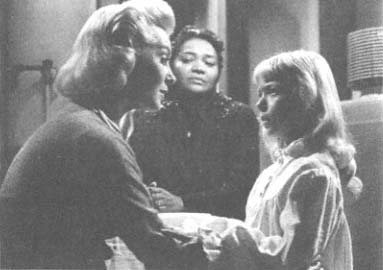
Fig. 11.
Guess who's the good mother in this film? Lana Turner as Lora Meredith
chastises little Susie while good mother Annie Johnson (Juanita Moore)
looks knowingly on in the 1959 Douglas Sirk remake of Imitation
of Life . (Universal Pictures, 1959; photo courtesy of Photofest)
Lora: "No matter what it costs, Susie's going to have everything I missed."
Annie: "From her letters, she misses you more than she'd ever miss Latin. . . ."
As in Mildred Pierce and even Stella Dallas , upward mobility is the province of fathers, not mothers. Later Annie reveals to Lora that Susie is in love with Steve, Lora's own hardworking but unglamorous lover. Lora, in shock, says, "Why didn't I know about this, why didn't she come to me?" Annie replies, "Maybe you weren't around." Lora, of course, gets the message: "You mean I haven't been a good mother." The next scene reiterates the evil career-mother theme, with an angry and love-struck daughter, Susie (played with a sort of wide-eyed adolescent glee by Sandra Dee), further condemning the mom who "gave me everything, but herself." Even Lora's dramatic attempt to make amends with her daughter by sacrificing Steve for the sake of their relationship back-
fires, as Susie pleads with her not to "act" because "I'm not one of your fans." Quite early in the film, when Lora is still living in near poverty and trying to break into the theater, Steve also tells her "not to act" in a fight they were having over her relationship to her work life. The repetition here reinforces the alignment of the daughter with the current patriarchal position on women's labor (its destructiveness and falseness—"acting") and places the mother on the receiving end of their scorn. Lora soon enough sees the light and settles down with the decent, hardworking Steve.
This narrative is contrasted with the story of Annie Johnson and her daughter, Sara Jane, whose desire to be white—and the "passing" that accompanies it—is the other central narrative element in the film. One way to understand this film is that it sets up a good mother/bad mother, good daughter/bad daughter split, with the white daughter and the black mother paired as the virtuous couple. Numerous scenes depict Susie's reliance on Annie as surrogate mother, just as Sara Jane's "passing" is witnessed through her running away to become a dance hall girl, narratively linking her to the white actress mother, whose career is just a sort of "passing" as well. The strange aspect of the film is that, in this case, the daughter who "goes bad" (Sara Jane) is the product of some obviously devoted and healthy mothering. Mildred Pierce blames Mildred for her daughter's badness, but no such blame can possibly be attached to Annie's mothering in Imitation of Life .[28] Rather, Sara Jane's rejection of her mother seems to be the result of a combination of factors: first, the rebellious/alienated teenager theme beloved of fifties filmmakers, second, and more to the point, the effects of a real and present racism. Sara Jane is the way she is not because of Annie's failures as a mother, but because of social failures. Because of the "naturalization" of black maternity (the "mammy" image beloved of Hollywood filmmakers), Annie cannot be condemned as a "bad mother"; that would bring into the narrative the mother/woman dichotomy reserved for white women.
Indeed, both Lora and her daughter are presented as enmeshed within that racist system. Although Lora is depicted as essentially good and loving to both Annie and Sara Jane, there are several significant moments in which the unthinking insensitivity of a white person toward a black person emerges and is critically examined. In one scene, Lora realizes Annie has a life outside her employ and
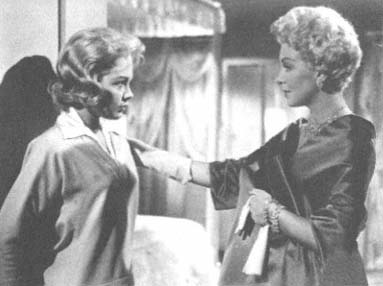
Fig. 12.
A lovestruck Sandra Dee is less than pleased with mom's announcement
of her engagement to old boyfriend Steve Archer in Imitation of Life .
(Universal Pictures, 1959; photo courtesy of Museum of Modern Art Film Stills Archive)
says, "I didn't know you have friends," to which Annie gently replies, "Miss Lora, you never asked." Even Sara Jane's complacent mother recognizes this insensitivity at one point, and the brutal beating Sara Jane receives from a white boyfriend reinforces the social construction of her rebellion rather than the psychological construction via the mother.
This narrative of maternal beneficence and social injustice places the more traditional narrative of maternal neglect and deprivation on shaky ground because it then sets up two separate rule systems for each mother/daughter pair. If Sara Jane is "bad" because of the way a racist society has treated her, it becomes more difficult to validate Susie's anger and resentment toward her career mother. It almost appears as if Sirk didn't really have his heart in it: the confrontation scene between mother and daughter is mild compared to Mildred Pierce , and after speaking harsh words, the daughter immediately falls into the mother's arms and begs her forgiveness.
The prodigal daughter, Sara Jane, returns to the (white) fold after breaking down at the funeral of her heartbroken mother.
The fact that Lora has decided to give up her career and marry Steve before this confrontation scene reverses the traditional cause and effect narrative movement (bad mother realizes her neglect and repents). If Lora "repents" and settles down prior to the confrontation with the daughter (and thus prior to the full realization of her supposed negligence as a mother), then perhaps this resolution can be read as somewhat self-determined, not wholly in response to her guilt feelings. Thus for many reasons, Imitation of Life is not completely believable as a melodrama of maternal neglect.
The difference between the original version and the 1959 remake is instructive. In the original, Claudette Colbert plays a working mother, carrying on her dead husband's syrup business in a valiant attempt to support her daughter. Her rise to success is predicated on the pancake recipe of Delilah, the obsequious black maid who pleads to work for "Miss Bea" and stays with her until her own death, many years later. The work that propels Miss Bea to the top is thus domestic in origin, beginning in a do-it-yourself diner and moving up to a nationally famous pancake recipe (with Delilah's "Aunt Jemima" picture on the box).
This plot in itself places the film on radically different ground because the 1959 version turns the white mother into a glamorous actress whose neglectfulness as a mother is linked to her own ostentation and narcissism as a (sexualized) "star." Claudette Colbert, as Bea Pullman, is a paragon of virtue; never do we doubt her motherliness or compassion. Even when her daughter unwittingly falls for mother's intended (fish researcher Steven Archer), this is seen less as mother's neglect than as benign circumstance; indeed, they are thrown together when Bea has accompanied Delilah on her search for her runaway daughter.
The differences between the two films can be understood as exemplifying precisely that shift away from discourses centered on extrafamilial realities (race, class) to a psychologically centered melodramatic crisis. Although the racial theme is certainly more vividly and candidly expressed (and, one could argue, more socially responsive) in the 1959 version, it is narratively in the service of the
repetitious discourse of bad working mothers. The 1934 version, although more explicitly racist in its blatant and appalling use of stereotyped images of black women, refuses to indict the working (white) mother and rather foregrounds her working classness (as in Stella ) and her motherly devotion. The figure of the male savior, so crucial to the reconstruction of the domestic unit in the 1959 version (particularly in his alliance with the black mother), is almost incidental in 1934, peripheral to the narrative and, really, to the women's lives.
The 1959 version ends with a soundly reconstructed nuclear family after the tragic death of Annie, but the 1934 film continues past that moment and ends with the white mother giving up the lover (at least temporarily) and remaining bonded with the daughter. The wayward daughter, Peola, whose denial of her blackness and "passing" breaks her mother's heart and causes her death, is returned to the fold and reenrolled in a black college. Both mothers have (successfully) sacrificed for their daughters.
The beginnings are significantly different as well. The earlier version opens with a beneficent image of Bea Pullman lovingly washing and dressing her daughter; the 1959 version opens with Lora Meredith searching wildly for the daughter she has "lost" at Coney Island. It is Annie who "finds" little Susie, thus early on establishing her as the "good (sacrificial) mother" to Lora's self-involved actress/mom. As different as these two versions are, certain aspects remain the same. For instance, all the names of the characters change except that of the male figure, Steven Archer. More important, both films completely occlude the possibility of representing the black woman: she is either a stereotyped, sacrificial mother (sacrificing for her own daughter as well as playing surrogate mother and surrogate husband to the white women) or a stereotyped "tragic mulatto" whose desire to "pass" for white is rarely placed in a context that affords it any real meaning. Although white motherhood becomes problematized with the onslaught of popular psychology and the postwar rush to domesticity, black motherhood remains completely "natural" and assumed to be inevitably beneficent. Lora Meredith plays out the mother/woman split in the narrative, but Annie Johnson is denied one side of this admittedly limited dichotomy. Her sexualized daughter can play it out, although
only on the basis of her "whiteness," itself made more complex by the fact that a white actress actually played that part (unlike in the earlier version).
Susan Hayward, another tortured actress similar in both style and substance to Lana Turner, tried her hand at another mother/daughter melodrama about the theatrical life as one of sin and decadence keeping wayward women from their hardworking husbands. I'll Cry Tomorrow is the rage to riches to rags saga of Lillian Roth, poor daughter of immigrants who is pushed by her striving mother (Jo Van Fleet) to acquire fame and fortune as a stage singer. The film begins by firmly establishing the stage mother theme as mother accompanies young Lillian to an audition, then beats her viciously on the street when she fails to butter up the director as mama instructed. Lillian moves to semistardom (not quite as ostentatious as Lana Turner, but then this film was black and white and directed by Daniel Mann, not melodrama magician Douglas Sirk), and mama is always close by her side, pushing her reluctant daughter forward.
When childhood friend David Tredman shows up in Hollywood, Lillian's thoughts turn to romance, and marriage plans are in the wings. Mother, of course, tries to disrupt the happy couple and invites David over for a little chat. As she tries subtly to get him away from her daughter, he calls her bluff and thereby sets himself up as the voice of male-defined integrity against self-interested (s)mothering in a way reminiscent of Dr. Jacquith's homilies of independence. David says, "You and I want Lillian to be happy. And she wants us to be happy. But we're three different people. Each of us has the right to decide where we belong. Or if we belong at all. Without that there's nothing. Now you may want one thing and she may want another and I may want a third."
David knows what he wants: a "wife who will bawl him out for not being ambitious enough." When Lily walks in, she falls right into place after a brief moment of anguished ambivalence: "Whatever David wants . . . is what I want. Whatever makes David happy makes me happy. You see Mama, I want to be David's wife." As mama pleads with her not to throw it all away, Lily rhapsodizes on the joys of wifedom, the plenitude of her future with David, her desire to be a "real wife."
But it is not to be, and poor Lillian doesn't regain love until the end of the film. David dies, sending Lily into a bout of depression and mother-blame: "You always know what's good for me. How to dance, where to sing, what to wear, who to go out with. So what I'm doing now it's not for my own good. And I'm doing it!" Her anger builds, and her mother leaves in a defeated, martyred sort of way ("All I ever wanted was for you to be happy . . . that's what I want now so maybe it's better . . . if I'm not here for a while").
Lily starts on a downward spiral of booze and parties and ends up marrying a man while drunk, then divorcing him after a year of boozy nights. The next man, who looks to be her savior, ends up marrying her for her money and keeping her hostage as he beats and robs her. After escaping from her tyrant husband, Lily hits bottom, then finally finds her way back to mother. Now a frantic alcoholic, Lily plays cards in her mother's house, begging for booze and flying into rages when it is not immediately forthcoming. The requisite confrontation scene between overinvolved/underinvolved mother and victimized daughter is now played out in its full melodramatic potential. Mother, reluctant to go out and buy more liquor, has been stalling an ever more hysterical daughter. As she finally heads for the door, she breaks and gives her version of their relationship:
Mother: "All right, it's my fault huh? I made you become an actress. You didn't want to. All right. I've been a bad mother. You had to support me. All right, all right, all right—everything! (shaking Lily now) But just this and for once in your life you're going to hear it! You know at all why I did it, do you? No you don't. Do you know what kind of a life I had? Do you know what it was like to live with your father, put up with his mistakes and afterwards to be left with nothing. No money, no career, not young anymore, nothing to fall back on. No you don't. You don't know at all what I tried to save you from. The kind of freedom I never had I tried to give to you by making you Lillian Roth."
Lillian: "So you admit it. You invented Lillian Roth. All right. Now look at me! I said look at me! Don't turn your face away. I'm the looking glass you created to see yourself in. All right, all right see yourself now in me. Look at this ugly picture and
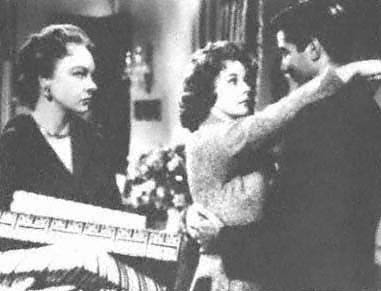
Figs. 13 and 14.
Susan Hayward gets to play yet another drunken ruin in I'll Cry Tomorrow (1955).
This time she plays Lillian Roth, the victimized daughter of a stage mother who plots
to keep her from the man she loves and, predictably, turns her into a needy wreck living
back at home with dear old mom. (MGM, 1955; photos courtesy of Museum of Modern
Art Film Stills Archives)
then get out of here. But keep this ugly picture before your face as long as you live!"
Mother: "It's true. Oh god help me. I owe you this. Every single word of it is true."
Now that the evil done to daughter is out in the open and mother has owned up to it, the prodigal daughter can reclaim the broken mother. She holds her on the couch, saying she didn't mean it, and gets rather apologetic, in a brisk sort of way. Lily leaves the apartment, contemplates suicide in a hotel room, and finds her way to Alcoholics Anonymous and the strong arms of Eddie Arnold, a "survivor" like her. She dries herself out, starts singing again, falls in love with Eddie, and culminates her reclamation with an appearance on "This Is Your Life," telling the world her tortured tale.
Another guilty mom—doomed by her desire to give her all for her little girl—popped up several years earlier in a rather sporty twist on the overinvolved mother paradigm. Ida Lupino's 1951 film, Hard, Fast and Beautiful , is yet one more cinematic rendering of the talented but benighted daughter manipulated by the climbing, striving "stage mother." The film opens with the mother's voice narrating as the tennis whiz daughter steadfastly bangs a ball against a garage door: "From the moment you were born, I knew you were different. . . . I always wanted something better for you and I made up my mind to get it, no matter what I had to do." What she has to do is scheme dishonestly with a rather unscrupulous tennis promoter to propel her innocent daughter to the top, leaving behind the well-intentioned but hapless and weak father and the daughter's honest, working-class boyfriend.
Conniving mom, in a manner reminiscent of later Mommie Dearest scenarios, frames her obviously self-serving martyrdom in terms of giving her daughter all that she never had. In a crucial scene where mom's evil is clearly established, she is in the bedroom she shares with her hopelessly kind husband and informs him, "My
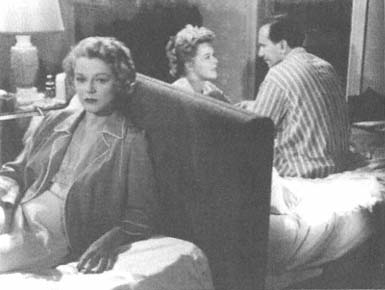
Fig. 15.
Mom may hold the pursestrings of daughter's tennis career, but it's daddy
who holds her heartstrings in Ida Lupino's Hard, Fast and Beautiful . (RKO,
1951; photo courtesy of Museum of Modern Art Film Stills Archive)
daughter's going to have everything, everything I missed. She's going to go places." As she speaks with her husband, they are literally separated by one of the strangest twin bed arrangements to hit the silver screen: the beds are placed head to head so that the supposedly intimate couple does not actually look at each other while they speak. Mother does her nails on one bed, and father first tries to stick up for the daughter and then falls into a pathetic plea: "Every year she was growing up, you were growing away from me. Why, Millie? Can't you love us both?" But in these representations, the love for the daughter must always be at the expense of the love for the father.
After the daughter's predictable rise up the ladder of women's sports, she becomes (predictably) hard and self-serving like her mother. As boyfriend Gordon tells her, "Your mother's done a first class job on you, honey. You're getting to be more like her every day." When Gordon leaves her, she becomes harder and faster (hence the title) and confronts her mother with her duplicity and
unsportsmanlike pursuit of fame and fortune. The daughter briefly tries to emulate the mother's ruthlessness, but she is brought back to life by the efforts of a dying dad and a firm boyfriend who comes to take her away from the high-powered, sleazy world of women's tennis and into the haven of suburban domestic bliss. As she leaves in victory from center court at Forest Hills, she gives the victory cup to mom ("This is yours, you've earned it") and goes off with Gordon. The last shot shows mom alone, at night, watching the garbage blow over the darkened tennis court.
Six years later Lana Turner did a warm-up for her performance in Imitation of Life by playing another working mother neglecting the emotional/sexual life of both herself and her teenage daughter. The notorious melodrama Peyton Place (later to be followed by a television soap opera version) included two mother/daughter pairs—the virtuous Salina (Hope Lange) living in squalor with her mother, who works as a maid for Mrs. MacKenzie (Lana Turner) and her daughter Alison (Diane Varsi). In an early scene (the first between Alison and her mother), the existence of the absent father rears its ugly head. Supposedly, he is dead (a war hero); but because this is a soap opera, he turns out to be a married man with whom Mrs. MacKenzie had an affair. The daughter worships the father she has never seen. When the mother objects to the daughter kissing his picture before she goes off to school, Alison replies, "It's not my fault that he died before I was two." Alison lacks a father—a male presence—and it is this lack that motivates the mother/daughter conflict, as the mother replies angrily, "Stop talking about fathers and husbands and marriage." So an opposition is set up between careerist, unloving, perfectionist, cold mother and daughter's desires for male attention and approval. This is spelled out in a later scene in which mom catches the daughter kissing at a party held in their house:
Mother: "I don't want you to be like everyone else in this town. I want you to rise above Peyton Place."
Daughter: "I don't want to be perfect like you, Mother. I don't want to live in a test tube. I just want to be me. . . . I'd rather be liked than be perfect."
In the ensuing battle, the mother tries to make up by saying that she wants the daughter to fall in love, to meet the right man, and
so forth; but the daughter will have none of it, "You want! Is that all you can say? Well if any man would seriously ask me I'd run away and become his mistress." The daughter's need to be sexually desired is thrown in the face of the mother's fear and denial of her own sexuality. This is reiterated in a later scene where mother accuses daughter of having been swimming nude with a boy:
Alison: "Mother, if you keep this up someday I will do what you keep accusing me of."
Mother: "I wouldn't doubt it. You're just like your father when it comes to sex."
The daughter is again identified with sexuality, freedom, and father, and the mother is clearly the force of repression.
The claustrophobia of the suburban idyll, the endless repetition of actions and reactions, is expressed through the mother/daughter relationship. Alison confides in the maid Nellie after a fight with her mother in much the way Susie confided in the maid Annie when her working mother was "unavailable":
Alison: "Nellie, you've been both a daughter and a mother, which one is worse?"
Nellie: "Being a mother."
Alison: "Why?"
Nellie: "You find yourself doing the same thing you hated your own mother and father doing."
Alison: "That's very interesting. Somewhere along the line doesn't somebody get intelligent and realize that the children have to grow up their own way?"
Here are shades of Dr. Jacquith's theme of "growing free and blossoming." Yet these ideas of letting children grow up "their own way" emerge in the context of a society in which the professionalization of motherhood and the rise of the expert have inserted themselves into every nook and cranny of social life: "Whether or not all Americans read or believed the professionals, there can be little doubt that postwar America was the era of the expert. . . . Science and technology seemed to have invaded virtually every aspect of life, from the most public to the most private. Whether in medicine, child rearing, or even the intimate areas of sex and marriage, ex-
pertise gained legitimacy as familiar, 'old-fashioned' ways were called into question."[29]
As Clifford Clark and others have noted, there existed in the fifties competing discourses of maternal incompetence and natural maternal functioning that make it difficult to decipher the dominant ideology of maternal behavior: "The tension between self-sufficiency and ineptitude which was expressed in Dr. Spock's contradictory emphasis on both personal self-reliance and professional expertise, placed women in an ambivalent position."[30] Indeed, the venerable town doctor in Peyton Place is the voice of professional authority: he advises the victimized Salina, reveals the truth of her rape by her stepfather, and informs Mrs. MacKenzie that it isn't healthy to have only one child.[31]
The mother eventually blurts out her confession (the daughter's illegitimacy), and the daughter leaves Peyton Place and moves to "The City," only to be reunited with her mother when mom proves her "goodness" at Salina's trial for accidentally killing her drunk stepfather. The reunion, though, occurs only after a man (the handsome new schoolteacher) has broken down mom's icy reserve, and she becomes an available object of the gaze. The ending is thus similar to Imitation of Life in that the mother and daughter can be brought back together only when a man enters the picture and "balances it out," thus legitimating the connection, now safely ensconced in a nuclear-family context, and eliminating any suggestion of self-defined mother/daughter intimacy.